Traditionalist Education I: Discovery…of What?

TRADITIONALIST EDUCATION PART I: DISCOVERY…OF WHAT?

Underlying the standard teaching that goes on in most American schools are some fundamental philosophical assumptions about what it means to be a person and the nature of right and wrong.    Beginning in the early twentieth century, progressive educators, led by John Dewey, voiced a vision of humanity that resonated across
American culture.  They recognized that the modern era demanded a new understanding of humanity.  This was a question with ramifications beyond the rarified air of academic philosophy.  Progressive educators took these modern notions of the nature of humans and spelled out their meanings for classroom education.  In brief, modern philosophy recognized that ancient understandings of humanity no longer made sense.  In the traditional view, humans were essentially different from the rest of the animal and vegetable world.  They had a soul, a connection to a transcendent plane of being.  The modern view saw people as one example of life on earth.  One that had evolved into some highly specialized forms, to be sure, but not essentially different from other animals.  There were no transcendent truths out there somewhere; there were no ideal forms casting shadows down upon humanity.
Rather, truths were generated by people, for people.  This did not mean that there were no values, no meaning to notions of right and wrong.  But it did introduce the modern intellectual dilemma: those values could no longer be left unquestioned; they could no longer simply be accepted as givens in a universe dedicated to unrelenting change.

Traditionalists invariably point to a document from 1933 to illustrate this pernicious philosophy.  Signed by John Dewey and an A list of other progressive personalities, the Humanist Manifesto  declared in stirring tones “The time has come for widespread recognition of the radical changes in religious beliefs throughout the modern world.  The time is past for mere revision of traditional attitudes.”

What difference did these notions make to everyday classroom teaching?  At the most fundamental level, they suggested that learning should no longer be seen as the simple transmission of eternal truths from an older generation to a younger.  Young humans must not be seen as empty vessels to be filled with the wisdom of the ages.  Instead, the leading intellects of the progressive education idea argued that young humans, like humans of every age, construct their knowledge based on bits and pieces from their own lives.  In this understanding of humanity, education must not consist of mere lists of knowledge to be acquired, more or less successfully.  Rather, education must be built by each student, based on the experiences that student has already acquired.  In order to facilitate that construction of knowledge, schools and teachers must guide students in their educational process.  The role of the educator is no longer to simply dump knowledge into the young.  Rather, it must be to help those young people build their own knowledge.

For those who advocate traditionalist education, these changes meant a distressing shift in America’s assumptions about the proper role for its public schools.

FURTHER READING: Rousas J. Rushdoony, The Messianic Character of American Education (1995); Mel and Norma Gabler, What Are They Teaching Our Children? (1987); Tim LaHaye, The Battle for the Public School (1983); Sam Blumenfeld, Is Public Education Necessary? (1981)

Progressive Education I: Why Come to School?

Why should students go to school?  At the most basic level, the traditional answer is that students go to school to learn. That learning—in the traditional understanding—consists of the transmission of information from adults (teachers) into children (students).  The more intelligent and hard-working a
student is, the more he or she will retain of that transmitted information.  To complete the process, the adult will measure how much the student has learned by asking him or her to repeat back certain parts.

This testing, in the traditional way of thinking abouteducation and schooling, is like the old game of telephone, except not fun.  There is an assumed degradation of the information transmitted.  The student
is more or less successful—achieves a higher or lower grade—based on how much he or she can repeat back accurately.  On how well she can battle that inevitable degradation.

It may sound a little silly when it’s spelled out like that, but that understanding of the basic principle of schooling still has overwhelming cultural support.  It is one of the most basic foundations of our institutional education system.  For instance, when I pick up my fourth-grade daughter from school, I still ask the same dumb questions:

–“How was school today?”

–“Good.”  Or –“Okay.”

A pause.  Then,
–“What’d you learn about?”

–Shrug and non-committal noise.

It’s not just me.  I overhear every other parent and child having similar conversations at the end of the school day.  Maybe it is just a way for us to look like caring parents in front of the other parents.  Or to look like we are invested in our kids’ education.  Or to demonstrate to the teachers who are also standing around that we support their attempts to transmit information into our kids.  But at the back of that question are some big assumptions about what is supposed to go on in schools: “What did you learn about today?”  Assuming that each school day should include some measure of information transmitted from adult—or video, or book made and selected by adults—to kid.  And that the school should be prompting each student to build up a storehouse of information on a variety of subjects.

It is not only awkward after-school conversations that show this.  As we have all seen for the last ten years, the political power of the cultural idea of testing is hard to match.  The No Child Left Behind Act of 2002 did not create the idea of testing.  It introduced a regime of high-stakes tests that would evaluate all
students’ abilities to read and perform mathematical processes.  Those tests were not just of interest to the individual students and their families.  They did not merely collate into a report card of progress for each
student.  In the new universe of NCLB, the test scores of individual students had practical implications for the funding of entire school districts.  If enough students failed to improve their test scores for three years in a row, school districts risked being forced to close schools and fire staff unless they came up with big ways to improve student scores fast.

The hinge of this regime remained the notion of testing as a way to evaluate the success of education.  The makers of NCLB did not invent this.  They merely tapped into dominant notions about the nature of
education.  Proponents of the NCLB regime did not need to explain that these tests would give good information about the process of learning at each school.  Everyone already agreed that testing could do that.  All NCLB did was build on this notion of testing to enforce a new scheme of funding and bureaucracy.

Americans already agreed that testing is the primary measure of school performance.  And behind the
notion of testing is the assumption that students go to school to receive transmitted information.  A formal testis a way to test how successful that transmission was.  This would only seem so important if that
transmission were assumed to be the main reason for going to school.  Not that NCLB or the regime of high-stakes testing hasn’t been controversial.  It has.  But the controversies have largely focused on the nature of the testing regime, or on the consequences of poor performance on tests.  The notion that students go to school primarily to receive transmitted information is not generally questioned.  That is the general understanding of what a student should be doing within those walls.

It does not take a very sophisticated understanding of sociological theory to see some holes in those assumptions.  Every teacher, every parent, every adult who works in a school sees it right away.  It is inescapable: This shared consensus about the reasons for going to school is only shared among adults.

For their part, students come to school for all sorts of reasons.  Some of them may come to school primarily to receive transmitted information.  But the leading reason why students come to school—from the  students’ perspective—is because they have to.  In different schools, that requirement is more or less coerced.  Many students don’t mind the coercion.  Yes, they have to go.  But the school also represents to them their entire social universe.  And many of them even share the general adult expectations about the reasons for school.  They agree without thinking about it too much that school is the proper place for them.

Perhaps a comparison to other kinds of learning institutions might help.  Think about piano lessons
from when you were ten.  At that age, at that stage, parents make their children go to lessons.  And children go because they have to.  Some of them might enjoy it.  Some of them might complain about it.  But very few kids at that age go to piano lessons because they are seeking to receive transmitted information and skills about music and piano-playing.  Plus, the upcoming “test” is generally not of very much interest to piano students.  In these kinds of private lessons, the “test” will traditionally be a painful recital, in which parents and siblings and grandparents gather to hear the terrible piano playing that their ten-year-olds
can produce.

These assumptions are similar to those of most school experiences.  Students go because they are told to.  They are judged on the level at which they are able to reproduce the musical lessons their teacher has
transmitted to them.  For our purposes,the important point is that the student did not go to the lesson to learn piano.  He went because his mom dropped him off there at four.

Compare that learning experience to a different kind.  Consider a sixteen-year-old kid who is taking guitar lessons.  In my town growing up, there was a guy who taught guitar in a little basement down under where the supermarket used to be, just next to the railroad tracks.  Students went to him because they wanted to
learn to play awesome guitar.  His selling point was that he was awesome.  He played guitar really well, hung out with his friends in the smelly basement “studio,” and smoked a lot of pot.

If a sixteen-year-old boy—and it was almost always boys that seemed drawn to this guy—went to take guitar lessons, it was because the student really wanted to learn what the teacher could teach.  The student saved some money or asked his parents for money to pay this teacher to share his accumulated knowledge of how to play that guitar.  In this case, the student went to school to learn.  The student hoped that the teacher would successfully transmit a certain type of information to the student.

Just having a desire to receive transmitted skills or information is not a magic bullet.  Not every teenage guitar student ends up learning guitar.  But I think this example illuminates what is NOT the norm in regular schools.  Students went to take those guitar lessons because they wanted to learn guitar.  They wanted the teacher to transmit information to them.  That is a different attitude than most students take to their regular school.   In contrast to the most basic assumption of traditional schooling, most students do not go to school to learn.  They go because they have to.    These conditions have been in place for at least the last fifty years.  Sociologist James Coleman noted in 1961 that students do not go to high schools in order to learn.  In fact, he found that the most intelligent students were not the ones that received the best grades.  Rather, Coleman found in 1961 that the best students, gradewise, were those who accepted the game of transmission-and-testing the most unquestioningly, the ones who were “willing to work hard at a relatively unrewarded activity.”  The most intelligent young people, in contrast, took the transmission of information as something to be tolerated.  They went to school for social reasons.  They hoped school would provide them with an exciting and stimulating social environment.  But they did not go to school in order to receive information.  They put up with that as the cost of admission.


PROGRESSIVE EDUCATION I: FURTHER READING:

James Coleman with John WC Johnstone and Kurt Jonassohn, The Adolescent Society: The Social Life of the Teenager and Its Impact on Education (New York: Free Press of Glencoe, 1961).

Meadows and the Missing Link

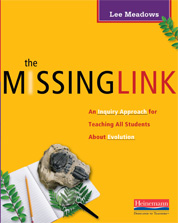
According to author Lee Meadows, (check out his blog here) the main goal of his evolution-education book is to get “resistant students [to] understand evolution, but they don’t necessarily have to accept it.” (xxi) His 2009 The Missing Link: An Inquiry Approach for
Teaching All Students about Evolution
promises to train teachers to seize the middle ground in the evolution culture wars.  It offers practical and specific ways to teach evolution to students who come from anti-evolution backgrounds.

Unlike other models, Meadows’ approach never waters down the science of evolution.  It does not attempt to teach “the controversy;” it does not teach a balance between creation and evolution; it does not teach evolution “lite.”  Instead, it teaches the science of evolution in a way that frankly recognizes student resistance to the notion.  It offers coping mechanisms for science teachers to deal with that resistance in a caring, thoughtful, respectful way.  It does not view that student resistance as a challenge to be crushed, but rather as a legitimate part of student identity.  For example, he speaks in helpful terms of “accommodation for resistant students.”  As Meadows argues, “Public schools must embrace diversity of all kinds, including students from all religious backgrounds.”  (xiii)  This tone shifts the
discussion from combat in classrooms to education.

The essence of Meadows’ strategy is nothing new to teachers.  He hopes to use an inquiry method to allow students to wrestle with difficult questions that might challenge their religious faiths.  By using student inquiry instead of teacher-led direct instruction, Meadows hopes to have science teachers avoid the charge of evolutionary indoctrination.
Students can gain an authentic understanding of central questions of evolution and science without feeling that such notions have been imposed by a hostile ‘secular humanist’ school.

In my view, that kind of inquiry learning is worth pursuing for its own sake, in all
classes.  When teachers, schools, and students can pull it off, it is a powerful and effective way to learn.  Of greater promise to the continuing controversies over evolution education, however, is Meadows’ sustained tone of caring for all students, regardless of their backgrounds.  It does not approach student creationist beliefs as a problem for science teachers to overcome.  Instead, it recognizes those beliefs as part of the young person for whom the teacher is charged to respect, care for, and educate.

This is not a philosophic tome, but a practical teaching guide.  It includes lesson plans and specific teaching strategies.  More important, perhaps, it is full of helpful reminders for eager
science teachers of how NOT to proceed.  It identifies the distinction between an evolutionary and supernatural worldview, for example, then warns:

You can’t resolve these tensions for your students, so please don’t try. It’s not our place as science teachers to impact students’ religious beliefs, even if we’re being “helpful.” That’ssomething that we must leave to their families and their spiritual leaders. (61)

Meadows’ approach will earn him some flak, inevitably, from both sides in the  creation/evolution debate.  Some mainstream scientists will undoubtedly protest that students should not be allowed to decide if they will accept evolution after they learn about it.  To many evolution-believers, that makes no more sense than asking students to decide if they believe in the Pythagorean Theorem.

From creationists, on the other hand, I can imagine Meadows will come under fire for teaching evolution as true, as fact.  And more, creationists might object that Meadows’ suggested methods simply sugarcoat evolution by pretending to care for creationists’ beliefs.  Better, some creationists might say, to honestly attack those creationist beliefs rather than to sneak in evolution education under false pretenses.  I can imagine creationists objecting that Meadows’ distinction between guaranteeing that students KNOW evolution but allowing them not to BELIEVE it is a false one.  It would never be suggested for other subjects.  For example, it is hard to imagine knowing that 2 + 2 = 4 without believing it.  And how could my child learn and know how to identify an indirect object without believing it?

It is a similar dilemma to those parents who object to explicit sex education in public school classrooms.  Since the first days of SIECUS in the 1960s, for instance, sex educators have insisted that they are not advocating sex.  Conservative parents, however, insist that merely by knowing how to use a condom, students have been hurt.  Those parents do not want their
children to know about condoms (or evolution) at all.  They vigorously dispute the notion that their children can learn something in school about such topics without that knowledge
causing fundamental harm.

I believe that these potential objections prove that Meadows is onto something.  When the more extreme elements on both sides attack, it suggests that Meadows is speaking to the great wide middle: Creationist parents who do not want their children attacked in schools;
creationist students who feel as if ‘school science’ is not for them; teachers who feel they can’t simultaneously care for their creationist students and teach those students something the students see as blasphemous; school administrators who need to reach out to parents and students while still encouraging evolution education in their science classes; and mainstream
scientists who want to see more authentic evolution education in American classrooms.

It is a tall order, but Meadows’ work promises something for everyone in this moderate middle.

For a taste of Meadows’ approach, you can read a chapter of his book at his publisher’s webpage.

Traditionalist Education: Introduction

TRADITIONALIST EDUCATION: INTRODUCTION

In 1953, Robert Hutchins, long-time president of the University of Chicago, argued that “an educational system without values is a contradiction in terms.”  Hutchins was a unique voice in Cold War education.  He was something of an intellectual child star, serving as the Dean of Yale’s Law School while still in his twenties and rising to the presidency of the University of Chicago at the age of thirty.  Like many child stars, Hutchins developed some unique ideas and pursued them with single-minded obstinacy throughout his career.  To Hutchins, the best education consisted of a thorough training in the Great Books, those classics that had withstood the test of time.  Hutchins loathed the notion that college should primarily train students for work; rather, Hutchins believed higher education should teach students in the arts of thinking and communicating.  The rest could come later.

Hutchins was an odd duck.
Unlike most traditionalist educators, he was not politically conservative.  But he still became
something of a hero to traditionalists with his insistence that students should spend their time with Aristotle instead of football.  Let me point out once again that in these arguments in favor of traditionalist education I will not necessarily be arguing for my own ideas.  I consider myself a fundamentally progressive educator, in that I think that the best education comes from inquiry and discovery rather than rote repetition and regurgitation.  I believe that schools ought to serve as society’s first line of defense against inequality and injustice.  But as with other topics, here I will be trying to imagine arguments that will make sense to people who don’t agree with them.  I will be trying to show that people can have good reasons for believing these things; they don’t have to be ignorant or wicked to do so.

Even though I don’t consider myself an educational traditionalist, I do agree that education must include moral values.  The real questions are: Which values?  And . . . Who decides?  For a lot of traditionalists, moral values are bundled into classroom practice.  School, in their opinion, should teach basic academic skills, the “three Rs.”  The process of teaching those basic academics should be tied up with proper moral upbringing.  For instance, students should be working hard, memorizing multiplication facts and diagramming sentences.  They should obey the teacher’s guidelines and accept her corrections humbly.  The morals are packed into that vision of classroom life: students ought to show respect for authority; they ought to work hard without asking why; they should learn that there is a right answer and a wrong answer—a transcendent good and a transcendent evil—and they should train themselves to choose the good, even when the evil seems more glamorous and enticing.

Traditionalists often package these recommendations in a vision of the past as a time when more people were brought up this way.  One of the stickiest problems for traditionalists is that such rosy visions of the past open them up to charges that they would also prefer other parts of the American past, such as race slavery and gender discrimination.  Do traditionalists notice, their challengers might say, that in their Mayberry vision of what America’s schools ought to be doing, it is only Opie getting an education?  That is, only the white boy is allowed full citizenship, while girls and black kids are only educated—trained—for a supporting role.  But babies should not be thrown out with the bathwater.  In
these posts, we can try to cull from tradition what we want and update it to remove what we do not.  We do not have to discard the entirety just to demonstrate our liberation from our pasts.

Once again, these might not be the arguments that traditionalist educators themselves prefer.  If you consider yourself traditionalist, weigh in.  What are more compelling reasons to promote traditionalist education?  How do you respond to charges that you want to return to a past of institutionalized white supremacy?  What values do you see in a “three Rs” approach that did not make it into these pages?


INTRODUCTION: FURTHER READING

Robert Hutchins, The Conflict in Education (New York: Harper, 1953).

New Topic: Education

Recent posts have tried to describe reasons why intelligent, informed, well-meaning people might believe either in creation or in evolution.  These arguments haven’t necessarily been the only arguments out there, or the ones that advocates of creation or evolution prefer.  They have merely been my attempts to construct reasons for such differing beliefs.

In upcoming posts, I’ll try to do a similar thing with a new topic: education.  There is not as clear a divide in educational thinking these days; there is not a single bright line dividing educational ideas the way there is between creation and evolution.  Nevertheless, I’ll try to
describe two competing themes that run through educational thinking.  I’ll call them  traditionalism and progressivism.

The labels are tricky, since what I’ll be calling “progressive” thinking about education has a long and influential tradition of its own stretching back to the nineteenth century.  This is the chain of thinking that runs through Pestalozzi, Froebel, Vygotsky, and Dewey all the way through James Banks, Michael Apple, and Paolo Friere.

Traditionalist thinking is also hard to define, since many of its adherents claim to be the true progressives.  Still, there is a clear body of thinking that can be labeled traditionalist; an educational ideological tradition that has fought against progressivist changes since the opening of the twentieth century.

In general, I’ll look at traditionalism as the notion that education is about the transmission of ideas and values.  Traditionalists argue that schools exist to instill a set of information and morals into children.  In addition, traditionalists in this usage insist that a reform of schooling will lead to a general reform of society as well.  By bringing schools back to the “Three Rs,” traditionalists hope to bring American society back to its Godly, patriotic roots.

In contrast, progressives see formal, institutional education—the kind of thing that school is supposed to do—as properly being about discovery and transformation.  Progressives try to view children as persons in their own right, with a rich body of experiences that must be used in order to construct knowledge.  School should facilitate that knowledge construction in each individual, in this view.  School should also work to transform both individuals and society as a whole.  Schools, in the progressive view, have the unique ability to make society less racist, less unequal, and less authoritarian.

It is a muddy field.
American educational thinkers have tended to draw from both sides of these competing visions of education to formulate proposals for improvement in education.  In the upcoming posts, I’ll try to sketch out reasons why advocates of both sides might have reasonable,
intelligent beliefs, even though the two may disagree entirely.

Surely You’re Joking, Mr. Huckabee

All readers and commentators of I Love You but You’re Going to Hell are invited to a public talk about the historical development of creationist thought in the United States.

The talk will be Monday, November 7, 2011, at 5 PM in room AA G-008 on the campus of SUNY Binghamton, in sunny Binghamton, New York, USA.  It is free and open to the public.

The host is David Sloan Wilson’s Evolutionary Studies Program at Binghamton University. David Sloan Wilson Logo

The speaker will be Adam Laats, Assistant Professor at Binghamton.  His talk will focus on issues familiar to readers of ILYBYGTH:  How do creationists cling to their beliefs when surrounded by such overwhelming scientific evidence for creation?  How can evolutionists understand them without simply dismissing them as ignorant or misguided?

For more info, see the EVoS announcement.

Ignorance and Evolutionism

In a recent commentary, First Amendment Center pundit Charles Haynes noted that teacher “neutrality toward religion cuts bothways.”  He examined two recent court cases. In the first, math teacher Bradley Johnson had been forced to remove pro-Bible, pro-Christianity banners from his classroom.  In the second, history teacher James Corbett had been accused of anti-Christian, anti-creationism bias in his lectures.  However, the 9th Circuit Court of Appeals found that Corbett had not done anything to infringe upon the First Amendment rights of his religious students.

Haynes made the salutary point that such court decisions reflected an unfair court bias against religion.  He argued, “In my view, the 9th Circuit was right to bar promotion of religion in the classroom. But fair is fair. If religious people are to accept that their faith cannot be privileged in schools, then they need to be assured that hostility to their faith will not be tolerated, either.”

But the Corbett case deserves a second, and even a third look.  Court documents noted that Corbett had sent home letters to the families of students in his Advanced Placement European History class.  He had explicitly warned students and their families, “Most days we will spend a few minutes (sometimes more) at the beginning of class discussing current events . . . . Discussion will be quite provocative and focus on the ‘lessons’ of history.  My goal is to have you go home with something that will provoke discussion with your parents.” In this letter, which the accusing student and his family received and acknowledged, Corbett
insisted that all students “may offer any perspective without concern that anything they say will impact either my attitude toward them or their grades. I encourage a full range of views.”

In addition, the course description for the Advanced Placement European History class, designed and tested by the College Board, mandated the inclusion of such topics as “[c] hanges in religious thought and institutions,” “[s]ecularization of learning and culture,” “[s]cientific and technological developments and their consequences,” and “[c]hanges in elite and popular culture, such as new attitudes toward religion, the family, work, and ritual.”

Seen from this perspective, it would be irresponsible of Corbett to refrain from challenging the creationist views of students.  Such ideas are inherently challenged by the history of the Reformation and Scientific Revolution.

But Corbett was more than an earnest historian hoping to spread enlightened ideas in his discussions of the Enlightenment.  The court record indicates that he was a dedicated and determined culture warrior.  Almost twenty years previous to this case, he was embroiled in another creation/evolution case at his high school.  A science teacher at the school had been accused of teaching creationism as science.  The school had demanded that the science  teacher, one John Peloza, refrain from teaching creationism.  Peloza sued the school and Corbett as adviser of the school newspaper for five million dollars.  When the school attorney advised Corbett to refrain from making any further derogatory comments about Peloza or
creationism, Corbett refused.  As Corbett recalled, “At that point, I stood up and said, ‘I’ll tell you what. I will sign a statement giving you — you do not have to defend me, but I will not leave John [Peloza] alone to propagandize kids with this religious, superstitious nonsense.’”

The goal to avoid propagandizing students and to bravely defend against attempts to do so is a laudable one.  But Corbett then fell into a very similar trap.  His discussion of science clearly took an excessively hostile, anti-creationist tone.  He used the language of the anti-creationist movement, as when he disparaged the notion of a literal six-day creation as
being as ridiculous as the notion that a spaghetti monster that lived behind the moon had created the universe.  That language, as the lawyers for the aggrieved student pointed out, came from ardent anti-creationists.  Creationist students and their families were familiar with such accusations.  They had heard such things, and they connected it, reasonably enough, to an attack on their religious beliefs.

Some of Corbett’s other classroom statements from the court record also indicate the creation of a resolutely hostile environment for a creationist student.  Consider the following examples:


[T]hink how humbling it’s going to be, you know,

whenall these people who have been talking about

Adam and Eve and creation and all of this stuff for

all that time when eventually something happens,

and they find out that there are people on another

planet, six billion light years away, who don’t look

like us, worshipping huge geckos. (Students laughing.)


How do you get the peasants to oppose something

that is in their best interest? Religion. You have to

have something that is irrational to counter that rational

approach. No problem. . . . [W]hen you put on

your Jesus glasses, you can’t see the truth.


It’s okay for religious people to, you know, or a

magician (inaudible). There may be a distinction, but

there is no difference. What was it that Mark Twain

said? “Religion was invented when the first con man

met the first [fool].”


This kind of language goes beyond treating history or science in an authentic way.  These
quotations, along with Corbett’s history, suggest a sustained bias against creationist belief, or even against any deeply held religious belief.

Let’s be as clear on this point as possible: Teachers must be allowed, and even encouraged, to make provocative statements about religion and science.  They must challenge students to examine their own beliefs and articulate their reasons for those beliefs.  But a teacher should never accomplish those goals by belittling, humiliating, or demeaning students.  Not only is it cruel, it is also ineffective.  As in this case, it merely forces students to retreat to a wholly defensive posture.  It does not draw them out to think deeply about science, history,
religion, and their personal beliefs.

I don’t know James Corbett.  But my hunch is that he would not want to belittle students or
discourage them from learning about science and history.  My hunch is that he is intelligent, brave, and self-sacrificing.  My hunch is that he is so deeply entrenched in his own position on evolution and creation that, like Richard Dawkins, he cannot imagine that an intelligent, informed, well-meaning person could possibly believe it.  From that perspective, there is no more harm to be found in mocking creationism than there would be in mocking flat-earthers or other kooks.

The problem is not only that James Corbett—and those like him, whether teachers, journalists, scientists, or involved citizens of other professions—showed sustained hostility to religion.  The deeper problem, in my opinion, was that he displayed an utter ignorance of the harm he was inflicting.  He hoped to be controversial and thought provoking.  He hoped to be humorous andengaging.  But his jokes and disparaging tone proved deeply offensive to at least one of his students.

The best parallel here is not the Bradley Johnson case, in which a teacher displayed Biblical and religious slogans in his math classroom.  The better parallel would be Michael Scott, the loudmouthed, offensive boss from TV’s “The Office.”  Scott told all sorts of offensive, sexist,
racist jokes.  When challenged, he would just throw up his hands and smile and say, “I didn’t mean to offend anyone.  I thought it was funny.”  Some people on either side of this evolution/creation divide are just that ignorant about those on the other side.  They don’t understand how people could really be offended to have their deepest religious beliefs mocked.  They don’t understand how deeply offensive it can be to compare belief in a creative God to belief in a giant spaghetti monster.

The deep irony is that some crusades against ignorance fail to consider their own deep ignorance about the people they hope to enlighten.

 

Anti-Evolution IV: Minority Rights

ANTI EVOLUTION IV: RESPECT MINORITY RIGHTS


Finally, the bar of proof here should be very low.  Anti-evolutionists these days are not trying to ban the teaching of evolution. Rather, they usually argue that both evolution and creation should be taught as viable explanations of the origins of life.  Even if all the arguments above leave you cold, even if you find the science of creationism ridiculous, you can still
admit that it makes you uncomfortable to have public schools force children to agree to an idea that their parents find religiously intolerable.

Consider the same argument from the 19th century.  Catholics in America’s big East coast cities often objected that the public schools ought not to force their children to read from the King James Bible.  In spite of the arguments of their Protestant enemies, it was not because they did not want their children to hear the truth.  Rather, the version of the Bible that was
being used contained disparaging commentary about Catholicism and the Pope.  In Philadelphia, New York, and
Boston, these disagreements led to riots in the streets.  From a twenty-first century perspective, it seems a matter
of simple bigotry.  The public schools of those cities should not have forced Protestantism and anti-Catholicism on their
students.  Many Protestant school leaders at the time did not see this as religious indoctrination.  They argued that the Bible was simply being read without comment.  The Bible itself, they believed, was not a religion per se but simply God’s book.  There could be no legitimate complaint against it.

There are other examples. Consider the spate of boarding schools for American Indian children that proliferated at the end of the 19th century and first half of the 20th.  Children at these schools were expected to be educated out of their Indian ways.  As
the founder of one of the most famous of these schools put it, they hoped to kill the Indian to save the man.
Students were forced to speak only English, to wear only Euro-style clothes, and to adopt Euro culture enthusiastically.  Some did. Some didn’t.  But the relevant point here is that such cultural indoctrination belongs in a bygone era.  American schools should be as pluralistic as American society.  The children of creationists should not have to abandon their beliefs in order to attend a public school.  They should be allowed to sustain their home culture even while learning about mainstream culture in the public schools.

Those who are not being hurt by the forced inclusion of some idea in public school curricula should not be the ones who decide if it is hurting other people.  Short hair for boys and use of the English language seemed like obvious requirements for Anglo teachers in American Indian boarding schools.  Reading from a Bible that mocked Catholicism and the Pope seemed
unobjectionable to early Protestant school leaders.  They did not see these things as offensive.  To protect against this
danger, we should offer people a low threshold of proof to claim that they believe an idea is hurting them or their children.  Otherwise, schools will continue to force majority culture down the throats of students and families who feel threatened
by it.

Consider one opinion of the US Supreme Court in this regard.  In 1981, the Court heard thecase of Thomas v. Review Board of Indiana Employment Security Division.  The plaintiff, Eddie Thomas, was a Jehovah’s Witness who had been denied
unemployment benefits from the State of Indiana.  Thomas had worked in a sheet metal factory and had been transferred to a division that made tank turrets.  Thomas requested another transfer, or to be laid off.  Those requests were denied, so
he quit.  He did not believe he could ethically build weapons.  The case is not a perfect parallel, since one of the deciding factors for the Supreme Court was that Indiana could pay his unemployment benefits without itself supporting his
religion.  But one line of Chief Justice Burger’s majority decision is telling.  “It is not for us to say,” Burger wrote, “that the line [Thomas] drew was an unreasonable one.”

The same is true with evolution education.  Those who do not find it dangerous or offensive should not be dictating that those who do find it offensive are being unreasonable.  Such ideas are often invisible and utterly inoffensive to those who share them.  But they can be literally damning to others.  The decision should be left to those who feel threatened.


ANTI EVOLUTION IV: FURTHER READING

Carl F. Kaestle, Pillars of the Republic: Common Schools and American Society, 1780-1860 (New York: Hill & Wang, 1999); David Wallace Adams, Education for Extinction: American Indians and the Boarding School Experience, 1875-1928 (Lawrence, Kansas: University Press of Kansas, 1995).

Pro-Evolution V: Conclusion

EVOLUTION V: CONCLUSION

Evolution is not a story people made up to explain the world.  It is a story people discovered about the way the world works.  It doesn’t dethrone any god.  It merely explains how the world came to be.  In other words, evolution has nothing atheistic about it.  Rather, it simply explains the mechanisms by which the world works, however that world came to be.

Those who refuse to accept the truth of evolution don’t do so because the Bible demands it.  They
refuse to accept evolution because of a series of historical accidents.  Certain sects and denominations have been saddled with an anti-evolution orthodoxy that their followers have been forced to accommodate.  They can remain obstinate only so long as they remain within the charmed circle of their own beliefs.  When and if they examine the evidence for themselves, they agree that the best explanation is an evolutionary one.

Most important, if creationism and evolutionism were really two competing scientific models, they would attract mainstream scientists to each side.  Such is the nature of science.  In the case of creationism, it has only attracted—at most—a handful of scientists with any claim to mainstream
scientific credentials.  This astonishing dearth can’t be explained away as mere prejudice on the part of evolutionists.  Consider the case of Kurt P. Wise.  Wise trained at Harvard University, under the tutelage of Stephen Jay Gould.  Though Wise reported some taunting from his evolutionist fellow students, Gould himself always respected Wise’s firm creationist beliefs.  As a convinced
evolutionist, Gould saw no need to ridicule someone like Wise.  Rather, Gould hoped Wise would study the evidence on his own, confident that any such study would demonstrate the truth of evolution.

Creationists can’t claim the same confidence.  They are constrained to assert their belief in the truth of creation, because, unlike Gould’s quiet confidence in the fact of evolution, creationists generally believe in creation by faith.  As a faith, they must cling to their belief whatever the evidence may show.  As Kurt Wise himself put it, “if all the evidence in the universe turned against
creationism, I would be the first to admit it, but I would still be a creationist because that is what the Word of God seems to indicate.”  Even the most scientifically skilled of creationists must acknowledge that their ultimate authority is beyond evidence.  They must go where orthodoxy
leads.  True science, on the other hand, follows only facts.

EVOLUTION V: CONCLUSION: FURTHER READING

John F. Ashton, ed., In Six Days: Why Fifty Scientists Choose to Believe in Creation (Master Books, 2001).

Anti-Evolution III: Science

ANTI EVOLUTION III: SCIENCE

Anti-evolutionists often assert scientific arguments against evolution.  This trend grew especially
strong in the later part of the twentieth century.  At that time, anti-evolutionists associated with the Institute for Creation Research in San Diego realized that their ideas would never be allowed into public school classrooms as religion.  But they could be allowed if they were used as alternative scientific explanations.  The science of creation science was born.

I personally am not convinced by these arguments.  There is plenty of evidence that those who know this stuff best—biologists, geologists, etc.—find these arguments baseless.  Nevertheless, I will attempt to summarize some of their arguments here.  As with the rest of these posts, I will not attempt to convince those already dedicated to an evolutionary worldview.  Rather, I only hope to show that there are reasons why anti-evolutionists hold their beliefs.  They do not have to be ignorant or crazy to do so.  Just as an undergraduate college student in a secular university learns about the geologic ages of the earth and the process by which one form of life evolved from another, so a college student at some religious colleges will learn that the earth was formed in the past 10,000 years and all life forms on it were created by divine fiat.  Those forms, the student will learn, developed according to kind.  Just as the student at the secular school does not have to be ignorant or crazy in order to accept the idea of an ancient earth and a long, directionless process of
evolution, so a student at a religious school does not have to be ignorant or crazy to learn an alternative science.
It is only the exceptional student at either school—usually one with a previous intellectual commitment to a different understanding of the origins of life—that will really question the big story she or he is being taught.

Another reason to cut these anti-evolution scientific arguments plenty of intellectual slack is because they are forced to argue in terms that do not fit their basic underlying ideas.  Imagine that the current mainstream scientific understanding of the origins of life had to justify itself in
Biblical terms.  It would be difficult.  So those who believe in a young earth are forced to make their scientific cases in language that has developed to explain an ancient earth.

One of the oldest scientific arguments against the notion of evolution through natural selection has been that of the development of complex organs.  This case was made long before the notion of evolution became the dominant scientific paradigm and it continued among anti-evolutionists throughout the twentieth century.  And it has been attacked by evolutionary scientists as unsatisfactory.  But for those of us who are not trained in evolutionary science, the argument makes intuitive sense.  I, for one, can’t see what’s wrong with it, and that makes me think that sensible, intelligent, rational people trained in this sort of argument have some grounds for opposing the notion of evolution.

If we understand the mechanism of natural selection to be one in which large-scale evolutionary change happens as an accumulation of tiny random beneficial mutations, then the evolution of complex organs is hard to account for.  Consider Darwin’s tentative explanation of the evolution of the eye, for instance.  He suggested that some part of an early animal’s skin would develop light sensitivity.  Then that sensitive spot would develop the parts of an eye that allowed it to see things.

How could that work?
With any complex organ, there would not be much of a selection advantage until the entire organ developed.  That is, it would not help a blind frog to mutate just a retina, without the rest of the eye.  It would not pass on its genes for retina-having at a greater rate than those blind frogs who had no such genes.  The Darwinian story of a long slow growth of beneficial mutations, even if there was only the tiniest chance of such mutations, falls apart with organs that would need several distinct parts to develop at the same time in order to offer any evolutionary benefit.

So, in order for our blind frog to be able to pass along his genes at a higher rate, there would need to be an impossibly complex mutation.  This would be a comic-book mutation, one beyond what even evolutionists posit as possible.  Our frog would need to mutate an entire, functioning eye that allowed it to see.  All at once.  The chances against even the tiniest advantageous mutation are so small it requires millions of years of accumulating mutations for evolution to make sense.  How can we believe that a complex organ would simply spring into existence?  It strains credulity.

More modern evolution doubters have offered more subtle versions of this complex-organ  argument.  Biochemist Michael Behe has examined the process of blood clotting and suggested that such processes represent what he calls an “irreducible complexity.”  A mutation might be
possible that gave an animal one part of this clotting mechanism.  But having only one part of this package would not offer any evolutionary benefit.  And the notion that all of the many interlocking biological parts necessary to produce such an effect could have simply happened by chance all at
the same time are simply too far beyond the range  of the possible to convince any rational observer.

Consider another example.  Evolutionists will tell you that one of the strongest pieces of evidence
for organic evolution is that once you start looking at evidence, it all confirms the hypothesis.  But if you start with a different hypothesis, you can also find all sorts of confirming evidence.  For example, instead of assuming that evolution created life on earth, assume instead a young earth,
less than 10,000 years old.  If you begin with this idea, it requires a very different understanding of the development of life forms.  There is no time for dinosaurs to have had their millennia, then died out.  If such creatures existed, they would have to have lived at the same time as humans.
We would predict some record of the sightings of such creatures by humans.

That prediction, one could say, has been repeatedly borne out.  By people from different cultures
in different centuries.  The evidence has been right in front of our faces, but because scientists have assumed an ancient earth, they have been blinded to it.  The obvious evidence is all the reports of giant lizards.  In Europe and Asia, the so-called ‘dragons’ have been reported by credible witnesses for centuries.  The fact that such dinosaurs died out, apparently, before the modern era does not mean that they did not coexist with humanity for a long time.

The bar of proof does not need to be very high.  The point is that the idea of a young earth can find confirming evidence from history and nature.  It can support itself with arguments about complex organs and blood-clotting mechanisms.  It does not require, as some evolutionists assert, a willful ignorance or dementia.  Just because those trained in an evolutionary worldview do not understand or agree with the scientific arguments in favor of a creationist worldview doesn’t mean that creationists are ignorant or crazy.   It only means that they are committed to a different understanding of nature and of the nature of humanity.


ANTI-EVOLUTION III: FURTHER READING:

Michael Behe, Darwin’s Black Box: The Biochemical Challenge to Evolution, 2nd ed. (New York: Free Press, 2006); Henry M. Morris, Scientific Creationism (Green Forest, Arkansas: Master Books, 2006); Duane T. Gish, Evolution: The Fossils Still Say No! (El Cajon, California: Institute for Creation Research), 2006); John C. Whitcomb Jr. and Henry M. Morris, The Genesis
Flood: The Biblical Record and Its Scientific Implications
(Philadelphia: Presbyterian and Reformed Publishing Company, 1966); Ken Ham, The Great Dinosaur Mystery Solved! A Biblical View of These Amazing Creatures (Green Forest, Arkansas: Master Books, 2008).