Mormonism and the Paradox of Modern Homosexuality

There is a deep paradox at the heart of American culture when it comes to homosexuality.  On one hand, Americans seem more accepting than ever.  We have openly gay couples at high school proms, gay characters on primetime sitcoms, and plenty of pop songs insisting that homosexuals are “Born This Way.”

Yet on the other hand, many Americans–not just conservatives or Fundamentalists–display a new anxiety about being perceived as gay.  Male behaviors that might not have raised eyebrows in pre-Stonewall days–think Honest Abe sharing a bed with a male pal–now seem obviously “gay.”

If we outsiders hope to understand Fundamentalist America’s hostility to homosexuality, we need to chip away at this seeming paradox.  In a fascinating essay this morning on Religion & Politics, Kristine Haglund explores the way this modern dilemma plays out in LDS (Mormon) communities.  For male LDS members, Haglund argues, an intensely masculine identity is balanced with a soft gentleness.  Male church members have an intense patriarchal privilege.  Yet they are also tied to a sexual chastity that forbids homosexual sexual conquest as a way to establish hetero bona fides.  Men are required to spend their late-teen years in an intimate partnership with another young missionary male.  And in community, men are encouraged to display stereotypically feminine gentleness and emotionality.  These things lead, Haglund writes, to an exaggerated display of masculinity, in traditions such as “church ball.”  Yet LDS members such as Haglund herself are accustomed to seeing men act in gentle, emotional ways in public.  Haglund notes,

“Paradoxically, these behaviors, which might be pejoratively coded ‘gay’ or effeminate in other contexts, are key components of Mormon masculinity. A look at this fraught masculinity may offer a glimpse into what drives the LDS Church, and Mormon politicians like Mitt Romney, to insist on the defense of traditional gender roles in the family. The unique contours of Mormon masculinity can also help answer the question: Why are (many) Mormons so vehemently opposed to gay marriage and any other overt expression of homosexuality?

“The short answer to that question is that the unique mix of ritualized homosociality and patriarchal authority—the bedrocks of Mormon masculinity—means that many Mormon men are nervous about permitting even the idea that there might be more than a platonic ‘bromance’ in the post-Church Ball game sweaty hug.”

What is true for LDS men might be extended to American men as a whole.  As the notion of homosexuality becomes more of an everyday reality in American culture, some males struggle to establish their heterosexuality beyond reproach.  Does this fuel the hostility in Fundamentalist America to the notion of homosexuality as simply another way to be a sexual person?  In other words, as men become more keenly aware of homosexuality as a real phenomenon, does it push them to a sterner insistence on heterosexual supremacy and traditional family norms?

I’m nervous about the dangers of psychologizing such a broad cultural tendency.  It is a tried-and-true culture-war tactic to dismiss any opposition as somehow psychologically maladjusted.  We don’t want to insist that traditionalist opposition to homosexuality can only come from ignorance, fear, and Freudian neuroses.  But Haglund’s observations about the  “performance of Mormon masculinity [as] a difficult balancing act, a tightrope walk between poles established by a brutish, hyper-masculine ‘natural man’ and an effeminate gay man” seem equally applicable outside the LDS temple walls.  For many American men, increasing awareness that homosexuality is everywhere may lead to a desire to project a more firmly anti-homosexual identity.

In the News: What Is a Family? CA Approves Multiple-Parent Bill

We read in yesterday’s First Thoughts that California lawmakers have passed a new law.  Senate Bill 1476 will allow courts to recognize that “a child may have a parent and child relationship with more than 2 parents.”

This bill came about from a complicated family situation.  In In re M.C., a child had been put into the foster system.  Neither the biological mother, nor the mother’s new partner, could or would care for the child.  But the child’s biological father was not legally her parent, so the child could not be given to his care.

The arguments for and against the new law provide an illuminating glimpse into culture-war positions about the meanings of traditional families.  Supporters of the law claim that such laws simply move the courts into balance with the messy realities of our contemporary society.  Bill sponsor Mark Leno (D-San Fran) stated, “We live in a world today where courts are dealing with diverse circumstances  that have reshaped California families.”  Similarly, an LA Times editorial in favor of the law opened with this gambit: “For better or worse, families have changed.”

Opponents of the law have articulated some of the reasons often given in Fundamentalist America for supporting traditional family structures.  Writing in the Huffington Post, John Culhane and Elizabeth Marquardt argued that the new law will open a Pandora’s Box of unintended, but predictable, consequences.  “The ‘rule of two,'” they noted,

“for assigning legal parenthood has rarely been breached, for good reason. Again, consider In Re M.C.. Reunification is always challenging; here, it is unlikely to succeed with anyone except (possibly) the biological father. Is it really wise to deploy already-strained government resources toward three parents? And what if, in another case, reunification with all three parents were achieved?

“The problems would then multiply. It is hard enough for even two parents to agree on how to raise a child. Three parents in conflict would be still worse. Constant judicial involvement in decision-making would be the unintended but entirely predictable consequence. If there were a custody battle, the child might end up being shuttled between all of them. In fact, a Pennsylvania court has ordered custody to be shared among three legal parents.

“And why stop at three? Senator Leno’s bill places no limit on the number of possible parents. If three’s a crowd, four or more is a mob.”

Along the same lines, according to a story in the San Francisco Chronicle, California Assemblyman Tim Donnelly (R-Twin Peaks) complained, “This smacks of the state redefining parenthood.  What’s next? Are we going to parent by committee?”

For conservatives, the primary danger seems to come from state intervention into private family structures.  Those structures, many conservatives believe, have precedence to the state and ought to be immune to state meddling.  For religious conservatives, this is often articulated as a notion that God created the traditional two-heterosexual-parent family.  Human governments ought only to support what God has created.

Tradition and Homosexuality

Why do some people care that other people are gay?  If we hope to understand Fundamentalist America, we need to wrestle with this question.  To begin, we should acknowledge that opposition to homosexuality is a deep tradition in our culture.  Some of the foundational thinkers of our civilization considered homosexuality to be a horrible thing.  For those like me who consider homosexuality simply another way to be a sexual person, this hostility toward homosexuality is difficult to understand.

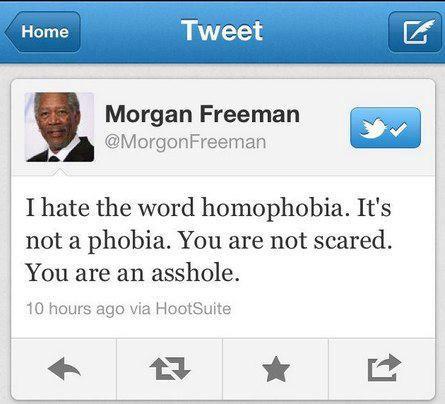
Part of the difficulty must result from the infinitely complicated nature of anti-homosexual feeling in America.  Even those like me sympathetic to what we’re calling Fundamentalist America must acknowledge that some anti-homosexual feeling must result from old-fashioned ignorance and bigotry.  Some, but not necessarily all.  Many of my secular and liberal friends, colleagues, and acquaintances seem to lump all opposition to homosexuality to mere hatred.  They assume, like Morgan Freeman, that any anti-homosexual thinking results from small-minded intolerance of those who are different.

Image source: The Obamacrat.com

To really understand Fundamentalist America, we need to avoid Freeman’s sort of partisan sniping.  It may be briefly satisfying, but it doesn’t help us understand.  Those who simply hate all homosexuals are likely assholes.  But while we can’t forget that component of anti-homosexual culture in today’s America, we need to also acknowledge that many of the best minds of our past have also denounced all homosexuality.

PLATO

Plato denounced homosexuality in the harshest terms.  He repeatedly called it unnatural. (e.g. Laws, VIII, 836Laws, I, 636c.)  Plato’s suggestion for rooting out this unnatural practice was simple and shocking to the modern ear.  Simply convince people that homosexuality belonged in the same class as incest, and the “problem” would disappear. (Laws VIII, 838.)

The goal, according to Plato, must be to ban homosexuality entirely.  (Laws, VIII, 837).

LEVITICUS

Americans may be more familiar with the Biblical tradition on homosexuality.  After all, as we have explored in the pages of ILYBYGTH, American culture has been and remains profoundly influenced by the Bible.  In twenty-first century culture wars, the rules of Leviticus are often raised as evidence for an anti-homosexual attitude.  The book is clear: homosexuality must be viewed as an abomination.  See for example, the following snippets:

Lev. 18.22: “Do not lie with a man as one lies with a woman; that is detestable.”

Lev. 20.13: “If a man lies with a man as one lies with a woman, both of them have done what is detestable.  They must be put to death; their blood will be on their own heads.”

Those who believe the Bible to be a good moral guide must at least wrestle with these commandments.

AUGUSTINE

In his Confessions, Augustine articulates a vision of human sexuality that denounces all non-procreative sex as counter to the will of God.  In Book III, chapter VIII, Augustine called the “sin of Sodom . . . abominable.”  Such acts, the Bishop of Hippo charged, “deserve punishment wherever and whenever they are committed.”  God’s purpose, Augustine argued, was not for humans to “use each other in this way.”

What do these ancient denunciations of homosexuality mean for twenty-first century America?  For one thing, it does not seem fair to interpret these ideas away.  Though some fancy intellectual footwork could likely dispute the meanings of each of these individual quotations, the overall tone of the ancient sources above seems clear: Each condemns homosexuality as unnatural, against God’s plan.  But this leaves us with one obvious question: What does it matter if these ancient sources condemn homosexual practice?  Do the attitudes of the ancients need to influence our thinking?

After all, it does seem as if Plato was an asshole.  In addition to denouncing all homosexuality, he also had complicated ideas about the permissibility of poetry, for instance.  And the lifestyle commandments in Leviticus certainly seem motivated by a small-minded legalism.  For example, we are told in Lev. 19.19 we must not wear clothes made of both linen and wool.   Is it fair to use Leviticus as a reason for opposition to homosexuality, but not use it to fight against textile abuse?  Can Fundamentalist America cite Plato’s opposition to homosexuality, but not insist—as Plato would—that children be taken away from their biological parents and raised by the state?   Such arguments seem like attempts simply to use the Bible or Plato to enforce modern prejudices.  But even if that is the case, we outsiders to Fundamentalist America must acknowledge the deep cultural roots of opposition to homosexuality.

Even more difficult, we need to wrestle with Augustine’s more nuanced understanding of human sexuality.  Homosexuality, for Augustine, was simply a variant of humanity’s depraved understanding of itself.  In an Augustinian framework, the notion of a “sexual orientation” itself reflects a flawed and dangerous understanding of the nature of humanity.  The orientation of humans ought not be sexual, but rather divine.  To live properly, Augustine argued, our minds should be on God, not sex.  This is not bigotry against homosexuals as such, but an argument about the nature of humanity profoundly at odds with our notion that any suppression of sexual feelings is a dangerous affair.

Morgan Freeman probably would not impressed by the deep tradition of anti-homosexual thought in Western culture.  Anyone who starts by dismissing all those with whom he disagrees as simple assholes does not likely desire a more profound understanding of his opponents.

But we do.  Here at ILYBYGTH, we hope to understand conservative opposition to homosexuality.  In addition to strains of bigotry and ignorant intolerance, we must also recognize the foundational element of anti-homosexuality in our shared culture.  This may be a bitter pill for folks like me to swallow, but it is true: Those who dislike homosexuality can claim a long and distinguished intellectual heritage.

Is Gay Okay? Not in Utah…

Image source: Business Insider

I’ll admit it.  I find Glee offensive.  Not because of any teen-steam sexuality or anything, but just because everyone keeps singing and dancing all the time.

Now it appears a new show by one of the creators of Glee will not be aired by a Utah NBC affiliate.  According to an article by Scott Pierce in the Salt Lake Tribune, TV station KSL will not show The New Normal in the usual NBC timeslot.  Why not?  The show depicts the lives and times of a gay couple and their quest for a surrogate-carried baby.

For the culture-war-tuned antennae of ILYBYGTH, the interesting part of this story is the language each side uses to explain its position.  According to Jeff Simpson, CEO of KSL’s parent company, the show was banned because, “The dialogue might be excessively rude and crude. The scenes may be too explicit or the characterizations might seem offensive.”

Voices from Fundamentalist America support this decision.  The activist group One Million Moms has opposed the show.  According to the group’s website,

“NBC is using public airwaves to continue to subject families to the decay of morals and values, and the sanctity of marriage in attempting to redefine marriage. These things are harmful to our society, and this program is damaging to our culture. . . .

“Millions of Americans strongly believe that marriage should be between one man and one woman. NBC’s “The New Normal” is attempting to desensitize America and our children. It is the opposite of how families are designed and created. You cannot recreate the biological wheel.”

In these short paragraphs, One Million Moms sums up (sum up?) the reasons some conservatives give for opposing homosexual marriage and homosexuality in general.  In coming weeks, we at ILYBYGTH will be exploring these arguments in more detail.

In the meantime, the defense of the show demonstrates one of the most popular arguments made in favor of gay marriage.  As Glee and New Normal producer Ryan Murphy argued, “It’s 2012.  I don’t think this is anything so outrageous.”


NEW TOPIC: Family & Sexuality

What makes up a family?  What is the right way to have sex?  Fundamentalist America has strong feelings about these questions.  For many outsiders like me, conservative opinion on these issues is truly perplexing.  If it is “conservative” to want a smaller government, for instance, why is it also “conservative” to regulate all the sexual behavior in all the bedrooms in the country?  If Fundamentalist America wants strong families, why do they deny same-sex partners the rights to marry and raise healthy, happy children?  Even more foundationally, why does Fundamentalist America even care if people are gay, straight, or otherwise curved?  How does it stop a conservative Christian from following her religion if other people have sex in ways she doesn’t like?

For the next several weeks, ILYBYGTH will explore these questions.  Posts will fall into three basic categories:

  • The fights against same-sex marriage;
  • Notions of sexuality; and
  • Contraception.

Just as we’ve done with the topics of creationism, traditionalist education, and the Bible, our goal will be to present the best possible arguments from Fundamentalist America.  Our goal as outsiders will be to understand conservative thinking on these issues, not to attack or defend it.

This will certainly be tricky.  It is much easier to speak calmly and dispassionately about such things as evolution, John Dewey, and Bible apocalypses than the intimate relationships that make up family life.  Attacks on homosexuality, for example, come much closer to home for many people on both sides of the issue than, say, denunciations of evolution.

One more reminder: when we talk about “Fundamentalist America” here at ILYBYGTH, we mean something wider than simply those very conservative evangelical Protestants who might call themselves small-f fundamentalists.  We are talking here about a broad conservative, traditionalist impulse, shared among many different types of conservative people.  Conservative Catholics, Protestants, Jews, and Muslims may all be part of this sweeping interpretation of FA.  Indeed, even mainly secular people who favor traditional society may include themselves as part of this coalition.

The purpose of ILYBYGTH is to understand the ideas of this deeply conservative tradition in America.  You can help.  Share your experiences, comment on posts, ask questions.  Even with this intensely personal and highly emotional topic, we’ll resolve to talk calmly, respectfully, and with a sincere desire to understand, even if we can’t agree.


Art Attack in the Culture Wars

“Holy Rollin Poultry on a Cross” (2012), used with permission of Dreg Studios

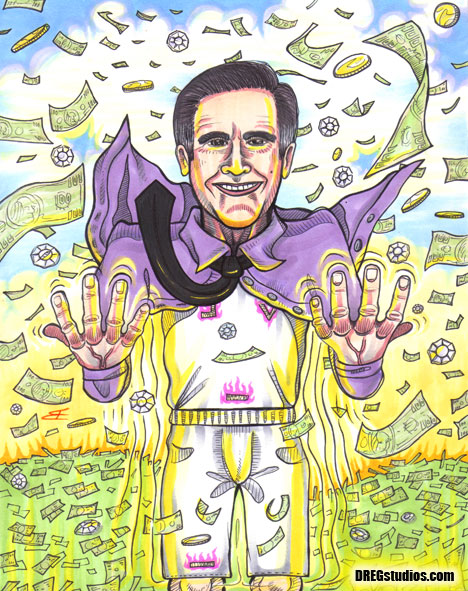
Jon McNaughton’s art is a favorite of the Tea Party set.  Brandt Hardin paints from the other side of the culture war trenches.  He has painted and written about such current topics as Chick-fil-A and traditional marriage, Tennessee’s continuing struggle with evolution/creation, and the power of Mitt’s money in conservative politics.

“Forty-six and 2” (2012), used with permission of Dreg Studios

As we noted about McNaughton, perhaps his popularity with conservatives is bolstered by an implicit appreciation for realistic art, for art that avoids distortion and irony.  If so, Hardin’s pop-surrealistic style provides a stylistic, as well as a cultural, counterpoint.

“Mitt Romney’s Magic Mormon Underwear” (2012), used with permission of Dreg Studios

Quantum Physics and the Need for God

Here’s one we missed until Anna Williams of First Things brought it to our attention: Stephen M. Barr, physicist at the University of Delaware, examines the argument that quantum mechanics suggests a reality beyond the material world.

Barr walks readers through the argument that quantum mechanics makes more sense if we include a notion of transcendent mind.  Here is his conclusion:

“The upshot is this: If the mathematics of quantum mechanics is right (as most fundamental physicists believe), and if materialism is right, one is forced to accept the Many Worlds Interpretation of quantum mechanics. And that is awfully heavy baggage for materialism to carry.

“If, on the other hand, we accept the more traditional understanding of quantum mechanics that goes back to von Neumann, one is led by its logic (as Wigner and Peierls were) to the conclusion that not everything is just matter in motion, and that in particular there is something about the human mind that transcends matter and its laws.  It then becomes possible to take seriously certain questions that materialism had ruled out of court: If the human mind transcends matter to some extent, could there not exist minds that transcend the physical universe altogether? And might there not even exist an ultimate Mind?”

One of the favorite scientific arguments of many intellectuals in Fundamentalist America is that their faith does not contradict the discoveries of true science.  From evolution to abortion, many conservatives will insist from time to time that science will eventually catch up with their religiously motivated beliefs.  Many, like Robert George recently, note that false science, like that of eugenics, has historically captured the fidelity of mainstream scientists for a time.  George insisted that the arrogance of mainstream science often mistakes its own fashions for abiding truths.  In the 1920s and 1930s, George argued,

“Affluent, sophisticated, “right-minded” people were all on board with the eugenics program. It, too, seemed like a juggernaut. Only those retrograde Catholics, joined by some other backward religious folk, resisted; and the thought was that the back of their resistance would soon be broken by the sheer rationality of the eugenics idea. The eugenicists were certain that their adversaries were on “the wrong side of history.” The full acceptance of eugenics was “inevitable.” But, of course, things didn’t quite turn out that way.”

The false science of eugenics and its temporary dominance among mainstream scientists has also long been a favorite theme of creationists.  For example, as David Dewitt argued on the Answers in Genesis blog, eugenics was simply the “dark side of evolution.”

The long-standing hope of many conservatives is that science will eventually come around.  Outsiders often accuse conservatives, especially creationists, of being anti-science.  But a better term might be “anti-professoriate.”  Many conservatives cling–sometimes with increasing desperation–to the hope that mainstram science will someday recover from the long night of materialism.  Arguments such as Professor Barr’s provide fuel for this long siege.

In the News: Update–Chick fil A, Traditional Values, Gay Rights, and Boycotting as Culture War

We’ve been reading with interest the developing story of Dan Cathy and Chick-fil-A.  Defenders such as Mike Huckabee have called for a Chick-fil-A Appreciation Day.  Opponents have rallied for a boycott of all Chick-fil-A branches.  Why?  Cathy’s comments and philanthropic donations have supported what he would call “traditional families.”  His opponents call them anti-gay.

The questions in this story have attracted the attention of everyone interested in today’s culture wars:

  • What does it mean to support traditional families?
  • What role do businesses play in promoting cultural values?
  • Is a consumer boycott a viable tactic for culture war victory?

So far we’ve refrained from posting any more news on this developing story.  But yesterday Darren Grem on Religion in American Life posted an analysis that was so insightful, we thought we’d recommend it.  If you’re following this story, or even wondering about it, Grem’s article is a great place to start.  He offers a cash-flow chart of where every dollar spent at Chick-fil-A likely goes.  We are looking forward to reading more when Grem’s book comes out.


Required Reading: The “Gospel Homosexual”

Just like all people, many Fundamentalist Americans can be a lot of things at the same time.  At Religion Dispatches, Douglas Harrison interviews Anthony Heilbut about people who live with seemingly irreconcilable contradictions: African American, conservative Christian, and homosexual, all at once.  And often without feeling the conflict.  How do they do it?

Heilbut describes his recent book, The Fan Who Knew Too Much: Aretha Franklin, the Rise of the Soap Opera, Children of the Gospel Church, and Other Meditations.  One of his themes is the persistent tradition of “gospel homosexuals.”  Heilbut says in this tradition, homosexuals have long had an influential role.  Often called “the children,” they experienced an intensely ambiguous role as singers, musicians, and fans.

On the one hand, “the children” endured or even participated in an increasingly rabid anti-homosexual theology and culture in the black church.  On the other, they pushed for acceptance–albeit in a very different way than many other post-Stonewall gay-rights activists.

Heilbut wants to crack the anti-gay code, both to prevent more ruined lives and to promote better music.  As he told Harrison,

“What I want to say to all of these people from all denominations—and we know that homophobia is allowed in all the churches—is: where would religious art be without gay men? You wouldn’t have the Sistine Chapel. You wouldn’t have The Last Supper. You wouldn’t have “Ave Maria.” Most likely you wouldn’t have the “Hallelujah Chorus,” because we seem to think Handel was gay.”   

The story, as Heilbut tells it, is not a happy one.  His gospel homosexuals lived tortured, even persecuted lives.  “You must remember,” he concludes,

 “that I’m really very angry. I really want to be literate and literary, but I’m really furious. Probably the most daring thing I say in the book is when I compare [the gospel church to] the Taliban, and then I say, thinking of all the ruined gay lives, this really is the number that no man can number.”

It would be hard to imagine a group of people more exposed to the destructions of America’s culture wars than this.  Forced to negotiate between seemingly irreconcilable cultural identities, some members of this contested group made some of the greatest contributions to gospel music.  More than that, Heilbut implies that other gay African Americans, such as James Baldwin and George Washington Carver, found themselves propelled by these ambiguities to excel in literature or science, too.

Leftist Bias in the Academy?

Conservatives have long complained that American higher education faculty displayed an intellectually crippling ideological bias.  This has been called “anti-intellectualism,” but a more precise term would be something like “anti-professoriate.”  In a recent article in the Chronicle of Higher Education, the non-conservative sociologist Christian Smith of Notre Dame’s Center for Social Research argues that conservatives may be right.

The accusation of academic bias has been so durable in the intellectual world of Fundamentalist America that one is tempted to dismiss it as sour grapes.  For instance, in the 1920s, Presbyterian orthodox leader J. Gresham Machen finally left his beloved Princeton Seminary to start his own school, driven out, he claimed, by his colleagues’ growing intolerance of Machen’s Biblical orthodoxy.  Less intellectually gifted 1920s fundamentalists made similar charges, in more colorful language.  For example, Texas fundamentalist minister J. Frank Norris insisted in 1921 that the problem with America all started when some influential young Americans studied “in Chicago University where they got the forty-second echo of some beer-guzzling German Professor of Rationalism.”

Around the time of the Scopes Trial, a cartoon in the Wall Street Journal captured this anti-professoriate feeling among fundamentalists:
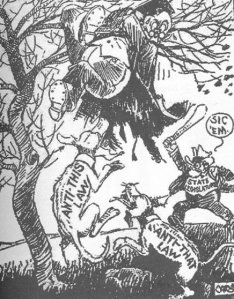
 

Education in the Higher Branches

More recently, in the early 1960s, conservative California State Superintendent of Education Max Rafferty found the main culprit of America’s decline in the progressive, leftist orthodoxy promulgated in America’s institutions of higher education.  Rafferty insisted that colleges had created a new landscape of “temples . . . great universities which marble the land.”  These temples no longer pursued true intellectual endeavor, Rafferty claimed, but only passed along a deadened orthodoxy, “turning out swarms of neophytes each year to preach the gospel of Group Adaptation.  Their secret crypts and inner sanctums are the graduate schools.”

In the twenty-first century, small-f fundamentalist blockbust author Tim LaHaye agreed.  University faculties, LaHaye argued, had placed themselves hopelessly in thrall to the false idols of the cultural Left.  After his huge publishing success with the Left Behind series, LaHaye set out to create a new biblical hero.  In Babylon Rising (2003), LaHaye described the adventures of biblical archeologist Michael Murphy.  In Murphy, LaHaye hoped to create a “true hero for our times,” one who united unwavering biblical faith with scholarly acumen and a dose of two-fisted machismo.  In one telling scene, Murphy is confronted by his smarmy secular dean.  This little episode tells us a lot about continuing fundamentalist attitudes toward the professoriate.

“Hold it, Murphy!”

A bony hand grabbed Murphy by his backpack as he left the hall. “Dean Fallworth.  What a fine example you set for the students by monitoring my lecture.”

“Can it, Professor Murphy.”  Fallworth was as tall as Murphy but cursed with a library-stack pallor that would make some mummies look healthy by comparison.  “You call that a lecture?  I call it a disgrace.  Why, the only thing separating you from a Sunday tent preacher is the fact that you didn’t pass the plate for a collection.” 

“I will gratefully accept any donation you wish to make, Dean.  Did you need a syllabus, by the way?”

“No, Mr. Murphy, I have everything I need to get the university board to begin accreditation hearings for this evangelical clambake you’re calling a class.”

“Temper,” Murphy mumbled to himself.  “Dean, if you feel my work is unprofessional in any way, then please help me to improve my teaching skills, but if you want to bash Christians, I don’t have to stand here for that.”

“Do you know what they’re already calling this silly circus around the campus?  Bible for Bubbleheads, Jesus for Jocks, and the Gut from Galilee.”

Murphy couldn’t help but laugh.  “I like that last one.  I’m intending this to be a quite intellectually stimulating course, Dean, but I confess I did not post an I.Q. requirement for taking it.  The knowledge will be there, I promise you, but I will likely fall short of your apparent requirement that the only acceptable instructional method is to bore your students to an early ossuary.”

“Mark my words, Murphy.  Your hopes of this course surviving and your hopes of tenure at this university are as dead as whatever was in that bone box of yours.”

“Ossuary, Dean.  Ossuary.  We’re at a university, let’s try to use multisyllabic words.  If it doesn’t turn out to be legitimate, maybe I can get it for you cheap and you can keep your buttons in it.  Now, if you’ll excuse me, I have a new artifact to begin work on.”

In this vision of the world of higher education, only fundamentalists have remained true to the original mission.  Fundamentalist intellectuals, this line of reasoning goes, have retained their sense of inquiry and intellectual honesty.  They have not been seduced by the showy appeals of false science, such as evolution.  They have not been lulled by a peaceful-sounding pluralism that in practice degrades human dignity.  And they have not been willing to accept the hidebound leftist, secularist, evolutionist orthodoxy required of the mainstream academic.

Christian Smith’s recent article argues that this leftist orthodoxy is not merely a figment of conservatives’ imaginations.  His article bemoans the attacks on sociologist Mark Regnerus.  Regnerus published an academic article in which he concluded that children raised by same-sex parents have more emotional disorders as adults.  According to Smith, Regnerus followed the guidelines of academic research and publishing.  His conclusions may or may not be correct, but his work followed the traditions of peer review and editing.  Regnerus’ conclusions may be disagreeable to some, but his research methods stand above reproach.

Yet, according to Smith, the attacks on Regnerus demonstrate the problems with today’s left-leaning academy.  As Smith argues,

“The temptation to use academe to advance a political agenda is too often indulged in sociology, especially by activist faculty in certain fields, like marriage, family, sex, and gender. The crucial line between broadening education and indoctrinating propaganda can grow very thin, sometimes nonexistent. Research programs that advance narrow agendas compatible with particular ideologies are privileged. Survey textbooks in some fields routinely frame their arguments in a way that validates any form of intimate relationship as a family, when the larger social discussion of what a family is and should be is still continuing and worth having. Reviewers for peer-reviewed journals identify “problems” with papers whose findings do not comport with their own beliefs. Job candidates and faculty up for tenure whose political and social views are not ‘correct’ are sometimes weeded out through a subtle (or obvious), ideologically governed process of evaluation, which is publicly justified on more-legitimate grounds—’scholarly weaknesses’ or ‘not fitting in well’ with the department.” 

As we have argued elsewhere, this bias is often wrapped in a near-total ignorance about life in Fundamentalist America.  One of the main reasons for this blog has been to introduce the ideas and culture of Fundamentalist America to outsiders who don’t know much about it.  Like Smith, we do not have to actively defend conservative ideas in order to protest against this sort of myopic academic bias.  Rather, we can promote a true diversity of ideas in higher education.  We can push for a true university, one in which the universe of ideas can be discussed calmly, without fear of the vindictive witch-hunts Smith describes.

In order to do so, we need to actively separate the jumble of issues.  The question is not whether children of same-sex parents have a tougher time in life.  The question is whether we will allow that conclusion to be reached in academic journals.  The question is whether researchers will be free to follow their data wherever it may lead, or whether, as Smith concludes, academic life will be governed by a crippling and unnecessary Stalin-lite motto: “Play it politically safe, avoid controversial questions, publish the right conclusions.”