Meadows and the Missing Link

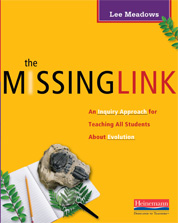
According to author Lee Meadows, (check out his blog here) the main goal of his evolution-education book is to get “resistant students [to] understand evolution, but they don’t necessarily have to accept it.” (xxi) His 2009 The Missing Link: An Inquiry Approach for
Teaching All Students about Evolution
promises to train teachers to seize the middle ground in the evolution culture wars.  It offers practical and specific ways to teach evolution to students who come from anti-evolution backgrounds.
Unlike other models, Meadows’ approach never waters down the science of evolution.  It does not attempt to teach “the controversy;” it does not teach a balance between creation and evolution; it does not teach evolution “lite.”  Instead, it teaches the science of evolution in a way that frankly recognizes student resistance to the notion.  It offers coping mechanisms for science teachers to deal with that resistance in a caring, thoughtful, respectful way.  It does not view that student resistance as a challenge to be crushed, but rather as a legitimate part of student identity.  For example, he speaks in helpful terms of “accommodation for resistant students.”  As Meadows argues, “Public schools must embrace diversity of all kinds, including students from all religious backgrounds.”  (xiii)  This tone shifts the
discussion from combat in classrooms to education.

The essence of Meadows’ strategy is nothing new to teachers.  He hopes to use an inquiry method to allow students to wrestle with difficult questions that might challenge their religious faiths.  By using student inquiry instead of teacher-led direct instruction, Meadows hopes to have science teachers avoid the charge of evolutionary indoctrination.
Students can gain an authentic understanding of central questions of evolution and science without feeling that such notions have been imposed by a hostile ‘secular humanist’ school.

In my view, that kind of inquiry learning is worth pursuing for its own sake, in all
classes.  When teachers, schools, and students can pull it off, it is a powerful and effective way to learn.  Of greater promise to the continuing controversies over evolution education, however, is Meadows’ sustained tone of caring for all students, regardless of their backgrounds.  It does not approach student creationist beliefs as a problem for science teachers to overcome.  Instead, it recognizes those beliefs as part of the young person for whom the teacher is charged to respect, care for, and educate.

This is not a philosophic tome, but a practical teaching guide.  It includes lesson plans and specific teaching strategies.  More important, perhaps, it is full of helpful reminders for eager
science teachers of how NOT to proceed.  It identifies the distinction between an evolutionary and supernatural worldview, for example, then warns:

You can’t resolve these tensions for your students, so please don’t try. It’s not our place as science teachers to impact students’ religious beliefs, even if we’re being “helpful.” That’ssomething that we must leave to their families and their spiritual leaders. (61)

Meadows’ approach will earn him some flak, inevitably, from both sides in the  creation/evolution debate.  Some mainstream scientists will undoubtedly protest that students should not be allowed to decide if they will accept evolution after they learn about it.  To many evolution-believers, that makes no more sense than asking students to decide if they believe in the Pythagorean Theorem.

From creationists, on the other hand, I can imagine Meadows will come under fire for teaching evolution as true, as fact.  And more, creationists might object that Meadows’ suggested methods simply sugarcoat evolution by pretending to care for creationists’ beliefs.  Better, some creationists might say, to honestly attack those creationist beliefs rather than to sneak in evolution education under false pretenses.  I can imagine creationists objecting that Meadows’ distinction between guaranteeing that students KNOW evolution but allowing them not to BELIEVE it is a false one.  It would never be suggested for other subjects.  For example, it is hard to imagine knowing that 2 + 2 = 4 without believing it.  And how could my child learn and know how to identify an indirect object without believing it?

It is a similar dilemma to those parents who object to explicit sex education in public school classrooms.  Since the first days of SIECUS in the 1960s, for instance, sex educators have insisted that they are not advocating sex.  Conservative parents, however, insist that merely by knowing how to use a condom, students have been hurt.  Those parents do not want their
children to know about condoms (or evolution) at all.  They vigorously dispute the notion that their children can learn something in school about such topics without that knowledge
causing fundamental harm.

I believe that these potential objections prove that Meadows is onto something.  When the more extreme elements on both sides attack, it suggests that Meadows is speaking to the great wide middle: Creationist parents who do not want their children attacked in schools;
creationist students who feel as if ‘school science’ is not for them; teachers who feel they can’t simultaneously care for their creationist students and teach those students something the students see as blasphemous; school administrators who need to reach out to parents and students while still encouraging evolution education in their science classes; and mainstream
scientists who want to see more authentic evolution education in American classrooms.

It is a tall order, but Meadows’ work promises something for everyone in this moderate middle.

For a taste of Meadows’ approach, you can read a chapter of his book at his publisher’s webpage.

Traditionalist Education: Introduction

TRADITIONALIST EDUCATION: INTRODUCTION

In 1953, Robert Hutchins, long-time president of the University of Chicago, argued that “an educational system without values is a contradiction in terms.”  Hutchins was a unique voice in Cold War education.  He was something of an intellectual child star, serving as the Dean of Yale’s Law School while still in his twenties and rising to the presidency of the University of Chicago at the age of thirty.  Like many child stars, Hutchins developed some unique ideas and pursued them with single-minded obstinacy throughout his career.  To Hutchins, the best education consisted of a thorough training in the Great Books, those classics that had withstood the test of time.  Hutchins loathed the notion that college should primarily train students for work; rather, Hutchins believed higher education should teach students in the arts of thinking and communicating.  The rest could come later.

Hutchins was an odd duck.
Unlike most traditionalist educators, he was not politically conservative.  But he still became
something of a hero to traditionalists with his insistence that students should spend their time with Aristotle instead of football.  Let me point out once again that in these arguments in favor of traditionalist education I will not necessarily be arguing for my own ideas.  I consider myself a fundamentally progressive educator, in that I think that the best education comes from inquiry and discovery rather than rote repetition and regurgitation.  I believe that schools ought to serve as society’s first line of defense against inequality and injustice.  But as with other topics, here I will be trying to imagine arguments that will make sense to people who don’t agree with them.  I will be trying to show that people can have good reasons for believing these things; they don’t have to be ignorant or wicked to do so.

Even though I don’t consider myself an educational traditionalist, I do agree that education must include moral values.  The real questions are: Which values?  And . . . Who decides?  For a lot of traditionalists, moral values are bundled into classroom practice.  School, in their opinion, should teach basic academic skills, the “three Rs.”  The process of teaching those basic academics should be tied up with proper moral upbringing.  For instance, students should be working hard, memorizing multiplication facts and diagramming sentences.  They should obey the teacher’s guidelines and accept her corrections humbly.  The morals are packed into that vision of classroom life: students ought to show respect for authority; they ought to work hard without asking why; they should learn that there is a right answer and a wrong answer—a transcendent good and a transcendent evil—and they should train themselves to choose the good, even when the evil seems more glamorous and enticing.

Traditionalists often package these recommendations in a vision of the past as a time when more people were brought up this way.  One of the stickiest problems for traditionalists is that such rosy visions of the past open them up to charges that they would also prefer other parts of the American past, such as race slavery and gender discrimination.  Do traditionalists notice, their challengers might say, that in their Mayberry vision of what America’s schools ought to be doing, it is only Opie getting an education?  That is, only the white boy is allowed full citizenship, while girls and black kids are only educated—trained—for a supporting role.  But babies should not be thrown out with the bathwater.  In
these posts, we can try to cull from tradition what we want and update it to remove what we do not.  We do not have to discard the entirety just to demonstrate our liberation from our pasts.

Once again, these might not be the arguments that traditionalist educators themselves prefer.  If you consider yourself traditionalist, weigh in.  What are more compelling reasons to promote traditionalist education?  How do you respond to charges that you want to return to a past of institutionalized white supremacy?  What values do you see in a “three Rs” approach that did not make it into these pages?


INTRODUCTION: FURTHER READING

Robert Hutchins, The Conflict in Education (New York: Harper, 1953).

New Topic: Education

Recent posts have tried to describe reasons why intelligent, informed, well-meaning people might believe either in creation or in evolution.  These arguments haven’t necessarily been the only arguments out there, or the ones that advocates of creation or evolution prefer.  They have merely been my attempts to construct reasons for such differing beliefs.

In upcoming posts, I’ll try to do a similar thing with a new topic: education.  There is not as clear a divide in educational thinking these days; there is not a single bright line dividing educational ideas the way there is between creation and evolution.  Nevertheless, I’ll try to
describe two competing themes that run through educational thinking.  I’ll call them  traditionalism and progressivism.

The labels are tricky, since what I’ll be calling “progressive” thinking about education has a long and influential tradition of its own stretching back to the nineteenth century.  This is the chain of thinking that runs through Pestalozzi, Froebel, Vygotsky, and Dewey all the way through James Banks, Michael Apple, and Paolo Friere.

Traditionalist thinking is also hard to define, since many of its adherents claim to be the true progressives.  Still, there is a clear body of thinking that can be labeled traditionalist; an educational ideological tradition that has fought against progressivist changes since the opening of the twentieth century.

In general, I’ll look at traditionalism as the notion that education is about the transmission of ideas and values.  Traditionalists argue that schools exist to instill a set of information and morals into children.  In addition, traditionalists in this usage insist that a reform of schooling will lead to a general reform of society as well.  By bringing schools back to the “Three Rs,” traditionalists hope to bring American society back to its Godly, patriotic roots.

In contrast, progressives see formal, institutional education—the kind of thing that school is supposed to do—as properly being about discovery and transformation.  Progressives try to view children as persons in their own right, with a rich body of experiences that must be used in order to construct knowledge.  School should facilitate that knowledge construction in each individual, in this view.  School should also work to transform both individuals and society as a whole.  Schools, in the progressive view, have the unique ability to make society less racist, less unequal, and less authoritarian.

It is a muddy field.
American educational thinkers have tended to draw from both sides of these competing visions of education to formulate proposals for improvement in education.  In the upcoming posts, I’ll try to sketch out reasons why advocates of both sides might have reasonable,
intelligent beliefs, even though the two may disagree entirely.