Culture Wars Update: Who’s Winning?

Is the sky falling for progressives like me? In The Atlantic, journalist Molly Ball argues that liberals are losing the culture wars. The same topic just came up in our recent panel of educational historians. Is Ball right?
Four horsemen?

Four horsemen?

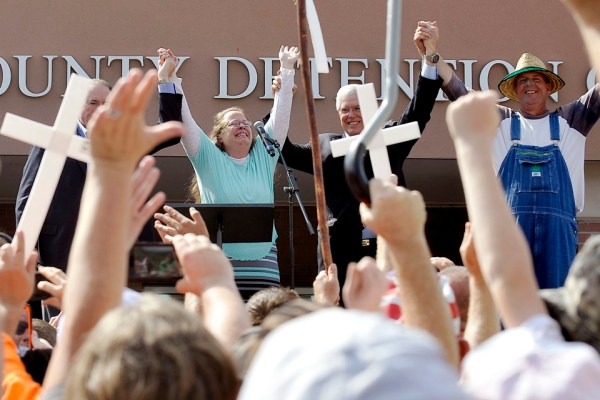
She looked at the results of the recent mid-term elections. In Ohio, voters rejected recreational marijuana. In Houston, they voted against gender-neutral bathrooms. In San Francisco, they booted an immigration-friendly sheriff. In Virginia, gun control struggled. In Kentucky, Kim Davis’s brand of in-your-face culture-war bluster helped win the governor’s office.

Ball’s conclusion?

taken together these results ought to inspire caution among liberals who believe their cultural views are widely shared and a recipe for electoral victory.

Fair enough. But not surprisingly, our all-star panel of historians came to different conclusions. To historians, these electoral losses don’t seem so cataclysmic. After all, consider the historical context: people are voting about making pot legal. Can you really deny Andrew Hartman’s argument that the echoes of the 1960s are dominated by the accents of hippies?

And yes, Houston lost its push for bathrooms that recognize the fluidity of gender. But look again: Who lost? The city in Texas with the openly gay mayor, that’s who.

We can make the same case for the other elections as well. Yes, conservatives here and there will have some successes in blocking the progressive changes that continue to roll through our society. Such blocking maneuvers, however, are a rearguard action.

Voting against gender-neutral bathrooms does not change the fact that we are now considering gender-neutral bathrooms. Thirty years ago—heck, even five years ago—that would not have been up for debate.

I think we need a more nuanced answer to the question of winning and losing when it comes to our culture wars. In my recent book, I looked at the educational activism of conservatives during the twentieth century. A lot of the time, they won. But just as with these recent cases, conservatives tended to succeed only in blocking or delaying certain limited sections of progressive change. Progressives still set the cultural agenda.

Here’s my two cents: first of all, I agree with our dean of educational historians, Jon Zimmerman. Jon argued this week that it is mostly meaningless to talk about winning or losing in this context. As does this Atlantic article, talk about winning or losing is usually a tactic to rally the faithful of each side, not a clear-headed analysis of shifting cultural trends.

Having said that, I think we can discern a century-long trend with these sorts of fights. In every case, conservatives might win or lose the specific battle. They do not win the war. What they do win, time after time, is the right to be listened to, the right to be considered part of the conversation about these issues.

For progressives like me and most of my friends, progressive change seems like an obviously good idea. Of course people should be able to smoke pot if they want. Of course transgender people should be able to use appropriate bathrooms. Of course guns should be controlled, immigrants welcomed, and same-sex marriage rights should be honored.

When we see election results like this one, though, we are reminded that not everyone agrees with us. When we see how strongly people disagree, we should not tear our hair and gnash our teeth. We should not lament the narrow-mindedness of our fellow citizens.

Rather, we should recognize the vast differences between Americans when it comes to these issues. As we do here at ILYBYGTH, we should do our best to understand and even sympathize with those voters who disagree with us.

After all, the only real victory in our bitter culture wars will come when we can respect those with whom we disagree.

The E-Word

You don’t have to love your enemies. You don’t even have to like them. But a founding principle of ILYBYGTH is that we should all try to understand those with whom we disagree. Indeed, as journalist and FOILYBYGTH* Trey Kay notes in a recent episode of his podcast Us & Them, there is a critical difference between disagreeing with someone and calling him or her an “enemy.”

And don't forget about frenemies!

And don’t forget about frenemies!

If you haven’t yet checked out Us & Them, it’s worth a listen. Different episodes explore issues near and dear to SAGLRROILYBYGTH, such as neo-confederate history, gay rights, and conservative textbook watchdogs Mel and Norma Gabler.

In the most recent episode, Kay explores the question of the enemy. As Kay reports, these days it’s not shocking to hear leading politicians describe the opposing party as the “enemy.” What sort of tone does that set for our day-to-day civil discourse? Can I have lunch with someone who is an “enemy?” Could I work on a school board with one?

Trey includes parts of a conversation he had with your humble editor. We talked about the origins of the name of this blog, and about the difficulties of understanding those with whom we disagree. As I told Trey, this blog is, in part, an effort for secular folks like me to understand what conservative religious people might mean if they say “I love you, but you’re going to hell.”

As he included in the segment, I think there are more important goals than simply winning culture-war battles. If we disagree about issues of religion and politics, we need at least to try to include those with whom we disagree in a civil discussion. We can’t do that if we resort to knee-jerk demonization.

That’s easy enough to do with things we don’t really care about. But what about when it hits home? What about when it is a question of what our kids are learning in school, or what rights we have? For example, for creationists it can be very difficult (I imagine) to relax and talk civilly to someone who wants to teach their kids that humans were not created by God. For people like me, it is enormously difficult not to demonize opponents who don’t agree with us about same-sex marriage rights.

So what do we do? To start, we can listen to the Us & Them podcast.

*Friend of I Love You but You’re Going to Hell, natch.

Do I Need to See the Light?

Joel Carpenter is. Mark Noll is. George Marsden is. Ron Numbers is was. John Turner is. John Fea is. I’m not. Does it matter?

Many of the best academic historians of evangelicalism and fundamentalism grew up as part of an evangelical church. Indeed, among academic historians in general, since the 1960s it has been seen as a big plus to have a personal background with the group(s) we study.

It’s not universal. As far as I know, Matthew Sutton didn’t. Molly Worthen didn’t. Tanya Luhrmann didn’t. And if they did, it is not a big part of their public persona. In other words, they write as scholars of evangelical religion, not necessarily as evangelical scholars of evangelical religion.

This is more than just “PC” cliquishness. Historians are sobered and humbled by their own history. Though African American historian WEB DuBois clearly debunked the dominant but false histories of Reconstruction way back in the 1930s, white historians didn’t catch up until the 1960s.

With fundamentalism in particular, non-evangelical historians did a terrible job. Until the 1970s, mainstream historians told us that fundamentalism died after the Scopes Trial of 1925. It had done nothing of the sort, of course. A new generation of evangelical historians such as Ernest Sandeen and George Marsden knew it hadn’t, since they had grown up with it.

Having a background in the world of conservative evangelicalism gives historians an ear for the language and a feel for the connections between groups. When I was stumbling through my graduate work at Wisconsin, for example, my mentor Ron Numbers was able to point me toward super-rare creationist documents from the 1930s. How did he know about them? They were written by his grandfather!

That sort of connection is something we outsiders can never acquire.

As outsiders, though, we non-evangelical historians enjoy some benefits. For us, there are no pre-existing good guys or bad guys. We aren’t embarrassed by the rhetorical excesses of 1920s fundamentalists. They don’t have anything to do with us! We don’t feel a need to demonstrate how different such hellfire preachers are from our own intellectual roots. To us, it’s all archival material.

In short, evangelical historians will always have insights I lack. But they will also have hang-ups and assumptions I’m free from.

Recent discussions on this blog have pointed out the continuing importance of these questions. When I noted the recent visit of Bob Jones University President Steven Pettit to the scenic campus of Wheaton College, I was mostly interested in the turbulent historical relationship between the two schools. At least one commentator, however, accused me of trading in “guesswork and gossip.” I didn’t mean to suggest that BJU was somehow “moving toward neo-evangelicalism.” Many readers within the world of fundamentalism and evangelicalism have very strong feelings about such things. I don’t.

As I plow forward with my new book about conservative evangelical colleges and universities, I need to keep these issues in mind. I need to remind myself that I might be missing out on subtleties of tone or implication that are obvious to those raised within this tradition. I need to watch for connections that are not made explicit to outsiders, but are nevertheless glaringly obvious to those in the know.

Sneaking into the Top Ten

We made it!…just barely.

The Library Journal’s September top ten best-sellers list for education includes my new Other School Reformers, squeaking in at number nine.Library Journal top ten

Nice to hear. I don’t think I’ve made a “top ten” list since my freshman year of high school, when I came in at tenth for our nine-person lacrosse team.

A(nother) New Direction

Time for a new subtitle. From now on, we’ll dedicate ourselves to “Awkward Conversations about School and Society.” What does this change mean? Not much, really, but I think it is necessary.

For SAGLRROILYBYGTH, this might seem familiar. In its four-year lifespan, the blog has changed directions a couple of times. At first, I hoped to explore and explain to my fellow secular progressives why some religious conservatives thought the way they did. I was interested in why smart, educated people could believe the earth was only 6,000 years old. I was curious why dedicated parents would want to keep knowledge about sex and sexuality away from their kids. I was puzzled about why some people could tell you that they loved you, but you were going to hell.

As the years have rolled on, my research interests have changed. I’m still curious about creationism, and conservatism, and old ladies who say they love you but you’re going to hell. But these days, I find myself asking those questions specifically in the context of schools and education. These days, I find myself curious about how all of us think about schools, not just the ways conservative activists think.

In every case, these difficult questions often get swept under the rug, since they are not fit for polite conversation. But they need to be aired in order to keep from festering. So from here on out, we’ll shift our focus a little bit. Instead of focusing exclusively on educational culture wars, or on conservative thinking about culture and education, we’ll ask things such as the following:

  • Why are schools still so racially segregated?
  • Should public schools teach sex ed? How?
  • What history do schools embrace? Why?
  • Why do so many people want creationism taught in public schools?
  • Who has the power in public schools? Who SHOULD have the power?
  • What sacred cows do we need to eliminate in order to get a truer picture of public education?
  • What does it mean to “reform” education? Why does every politician preach it, but so little changes?
  • Etc.!

Today! GOP Candidates Talk Education

What does it mean to be conservative about education? What ed policy will get voters excited? Today at 8:50 (Eastern Time, USA), you can watch live as a handful of Republican presidential candidates talk education.

The discussion will be hosted by The Seventy-Four. It will include Jeb Bush, Chris Christie, Carly Fiorina, Bobby Jindal, John Kasich, and Scott Walker.

Who is the conservative choice?

Who is the conservative choice?

As Carolyn Phenicie points out, these six candidates have very different interpretations of good ed policy. Jeb Bush supports the Common Core standards; Bobby Jindal has sued the federal government over them. There are some common themes that unite them. All of the candidates, for example, support greater privatization of public schooling. All of them would like to water down the power of teachers’ unions.

As I argued in my recent book, it has never been simple to define what it has meant to be “conservative” about education. It has never been easy for conservative politicians to figure out how to mobilize voters about schools. (If you don’t have time for the whole book, you can get a taste of the argument in this Time op-ed.)

In the early twentieth century, for example, most self-styled conservatives had absolutely no problem with an increased federal role in education. Back then, conservatives hoped the federal government could use its influence to make public schools more traditional, more Protestant.

What points will this year’s candidates make? They will likely emphasize their loathing for federal dictation of local school policy. They will likely point to their credentials as education leaders. Yet none of them will be likely to argue that as president they will not implement any education policy. None of them will make the point that federal officials should not have education policies.

As it has been for the last fifty years, conservative politicians these days are in the tricky position of insisting on a leadership position in education, even though they also insist that education should be in the hands of state and local officials.

What I Did on my Summer Vacation

By Adam L.

I hope you choke on your sunscreen. While you are out and about doing summer fun stuff, I’ll be in the office putting together the index for my upcoming book.

Okay, okay, I’m being a little melodramatic. I actually enjoy the process of writing an index. It helps me get into the manuscript in a detailed way. It helps me think over what the main points are. And it helps me imagine what future readers might be looking for.

If you poke your head out the window and crane your neck, you still can't see the beach from here...

If you poke your head out the window and crane your neck, you still can’t see the beach from here…

Not to mention the fact that writing an index has its own share of intellectual challenges. For example, I’m wondering which subheading to use under “Darwinism.” Should I list anti-evolution protests as “Darwinism: equated with atheism, 7, 14—15”? Or should it be more general: “Darwinism: critiqued by anti-evolutionists, 7, 14—15”?

In any case, enjoy your dog days at the beach, or the mountains, or wherever it is that normal people spend their summer time. I’ll be festering in air-conditioned office comfort. When the snow flies in January, this book should be ready to share.

Wal-Mart and the Death of College

Don’t be fooled. Just because the rumors of Sweet Briar College’s death have been greatly exaggerated, don’t think that small colleges have any reason to be optimistic. And for small conservative religious colleges, there is an even more difficult problem. They need to perform an impossible feat—get more religious and less religious at the same time.

Adorable but unaffordable?

Adorable but unaffordable?

As I’m arguing in my current book, fundamentalist and evangelical colleges and universities have always faced all the same challenges of mainline schools, plus many unique ones. The situation today is exactly the same. Conservative religious colleges face the same sorts of Wal-Mart-style challenges of scale, plus the additional constraints of remaining true to religious orthodoxy.

Though its affluent alumni seem to have saved Sweet Briar College, small evangelical and fundamentalist colleges have been winking out like dead fireflies lately. The reasons are clear. Just as the Wal-Martification of retail stores has made Mom-and-Pop stores impossible, so have the twentieth century’s slow academic revolutions made small colleges impossible. Many of them just don’t seem to know it yet.

What happened at Sweet Briar? The numbers just didn’t add up. Writing in the pages of Inside Higher Ed, Scott Jaschik quoted a gloomy financial report:

A report last month by Moody’s Investors Service said, “In Sweet Briar’s case, challenges included small scale, which, combined with weakening demand, declining pricing flexibility and an insufficient endowment, led to an unsustainable business model.” Some of the very qualities that make alumnae so loyal also make it hard to balance the books, Moody’s said. “Sweet Briar’s model of providing highly personalized education with small class sizes is expensive, as indicated by educational expenses per student of approximately $42,000,” said the report. “Although this cost structure is commensurate with the other rated women’s schools, standing at the median, colleges either need greater pricing flexibility, larger endowments or more gift revenue to sustain the model.”

Small colleges are trapped in a terrible pickle. To survive, they have to achieve a certain minimum size. Otherwise, they can’t afford to offer all the programs and services that students these days expect from a college. But they can’t achieve that minimum size if they keep their prices high. Students will go elsewhere if they are charged the full sticker-price. If schools lower prices, however, they will also die.

In Sweet Briar’s case, activist alumni pledged to raise 12.5 million dollars to keep the school running. That’s a lot of moolah. And no school—not even one with wealthy and involved alumni—can expect to survive only on the good wishes of its past students.

For conservative evangelical schools, the outlook is even more gloomy. In order to attract students, they must continue to demonstrate beyond question their religious orthodoxy. In some cases, such as the controversies lately at Bryan College, Mid-America Nazarene, and Northwest Nazarene, this will mean clamping down on faculty who seem to be moving in a liberal direction. At the same time, however, in order to attract students, they need to widen their pool of potential students. That means offering more programs and more courses. It also means opening up to students from different religious backgrounds. After all, if tuition dollars are getting harder to find, it will get harder and harder to turn paying students away.

Some fundamentalist schools are thriving in this difficult environment, at least for now. Most prominently, Liberty University in Virginia is raking in the dough. By making itself into a leader in online education, Liberty has managed to grow at a breakneck pace in the past decade.

Raking in mountains of dough...

Raking in mountains of dough…

As its online offerings increase, however, Liberty has to somehow demonstrate that it has not watered down its strict religious requirements. Those requirements, after all, are the school’s primary raison d’etre. Even as it pumps money into its football team and its all-year faux snowboard hill, Liberty’s leaders need to watch out for the creeping liberalism that tends to accompany higher-ed growth.

I’m happy for those folks who love Sweet Briar College. But their impressive display of life-support should not give comfort to other college leaders. The fundamental financial situation has not changed. Small colleges have to remain small to maintain their traditional style of teaching, but they have to grow in order to be financially solvent.

Small evangelical colleges face those same impossible challenges, plus some unique ones. They have to remain orthodox in order to keep their niche, yet they have to broaden their appeal in order to survive at all.

I’m glad I’m not in charge of one of those schools.

Yearnin’ for the Good Ol’ (Earth) Days

How old is the planet? For some creationists, it may seem like an ancient bit of Christian orthodoxy that God created the whole thing less than ten thousand years ago. But we see more proof today that the idea of a young earth is a relatively novel idea among conservative Christians.

Anyone who has done their homework knows the story. As historian Ronald L. Numbers outlined in his definitive book The Creationists, most conservative Christians believed in an ancient earth until the 1960s. Even in the hottest days of anti-evolution controversy in the 1920s, fundamentalist leaders usually felt no need to believe in a young earth.

As 1920s fundamentalist leader William Bell Riley put it in 1927, there was not

an intelligent fundamentalist who claims that the earth was made six thousand years ago; and the Bible never taught any such thing.

As I make my way through Bradley Gundlach’s excellent book Process & Providence, I came across a similar example from the 1800s. Back then, Princeton Seminary was the redoubt of thinking creationists. In 1856, the school’s journal offered a short review of a new book by David N. Lord, Geognosy, or the Facts and Principles of Geology against Theories.

In his long book, Lord argued that mid-nineteenth-century geologists often missed the boat. Such foolish pseudo-scientists, Lord wrote, mistook the boundaries of their own science and slid into both scientific and theological error when they suggested that the earth must have existed for millions of years.

Antique appreciation...

Antique appreciation…

Today’s conservative creationists might think that any self-respecting creationist would applaud Lord’s work. And the guardians of orthodoxy at Princeton did, to an extent. They described Lord’s goal as “elevated and holy.” His conclusions, however, did not sit well with the Old Princetonians.

In a way that might be surprising to today’s young-earth creationist crowd, the theologians at Princeton assailed Lord’s attempt to defend Scripture by attacking emerging geological science. Why? Not because they doubted the inerrant nature of the Bible. No, the Princetonians instead refused to allow their religion to be bound and hampered by any possible scientific discovery.

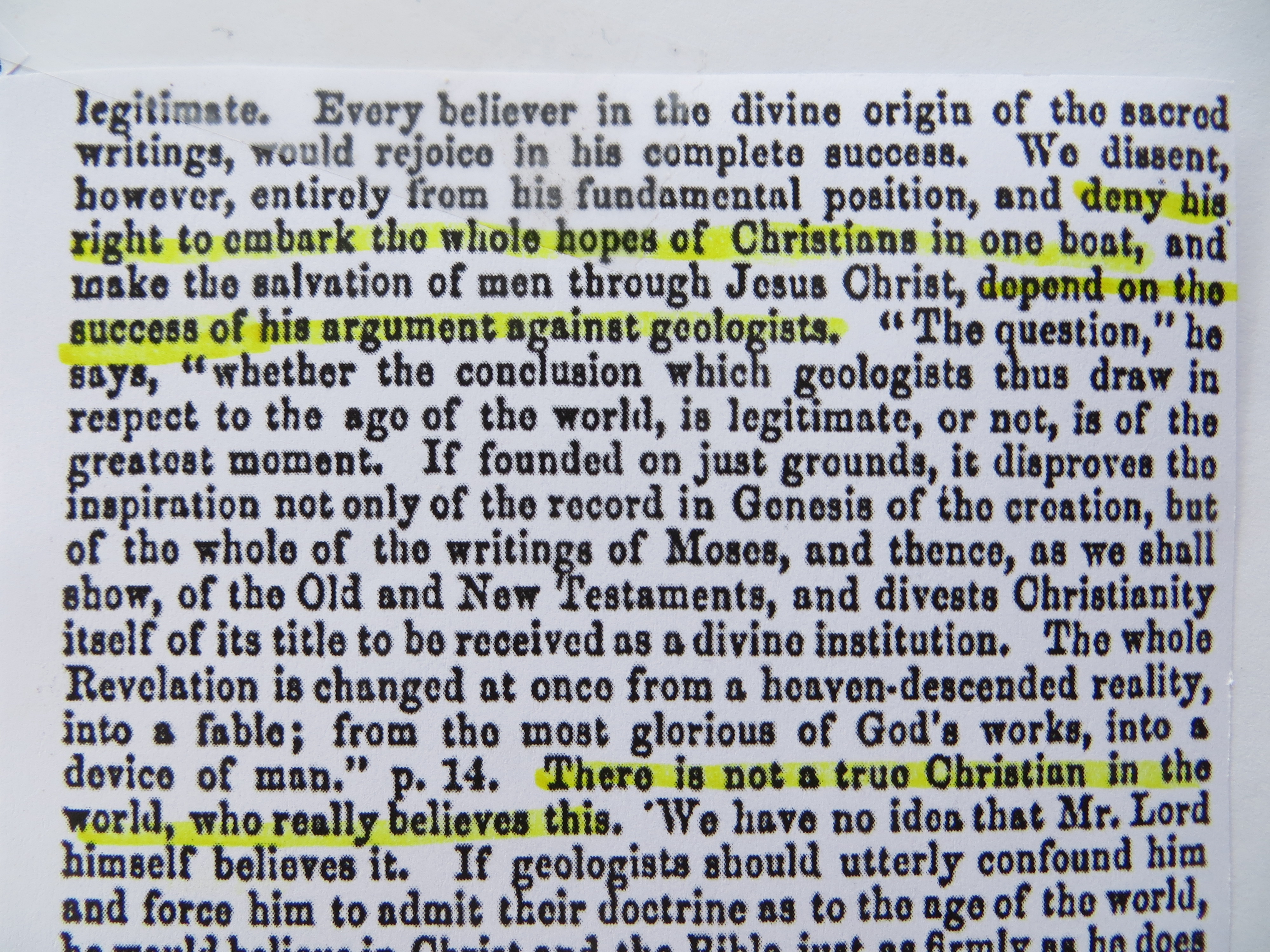
They “dissent,” the reviewers wrote, from Lord’s

Fundamental position, and deny his right to embark the whole hopes of Christians in one boat, and make the salvation of men through Jesus Christ, depend on the success of his argument against geologists.

Lord had argued that the new geology threatened to disprove Genesis. It was imperative, Lord wrote, for thinking Christians to disprove geology instead. Balderdash, huffed the Princetonians: “There is not a true Christian in the world, who really believes this.”Good old days 2 PRIME

Instead, the old-earth creationists at Princeton insisted that creation was an established fact, whichever way the scientific winds might blow. “If science,” they concluded,

Should succeed in demonstrating that the earth is millions of ages old, then we will with the utmost alacrity believe that the days of the creation were periods of indefinite duration.

Hot & Bothered in Binghamton, New York

Clear your calendars! Next Friday Jonathan Zimmerman will be coming to scenic Binghamton to give a talk about his new book.

Zimmerman is a prolific historian and public intellectual. You may have read his blockbuster books such as Whose America? Culture Wars in the Public Schools. Now you can get your hands on his latest, Too Hot to Handle: A Global History of Sex Education. You may also have seen him in the pages of the New York Times or on The Daily Show.

Who's for it?

Who’s for it?

Next Friday, May 1st, at 4:15 in the Admissions Center, Binghamton University will host Professor Zimmerman for our 23rd annual Couper Lecture. In the past, this lecture series has brought to our campus such luminaries as Bill Reese, Michael Apple, Maris Vinovskis, and many more.

As the sophisticated and good-looking regular readers of I Love You but You’re Going to Hell (SAGLRROILYBYGTH) are well aware, sex ed is one of the touchiest topics in America’s continuing culture wars. What should schools tell students about sex? How much is too much?

In his new book, Professor Zimmerman explodes the boundaries of these debates. The culture war over sex ed, Zimmerman argues, is not merely between conservatives and liberals in the USA. Rather, worries about the right relationship between sex and children spread from the US to cover the globe during the twentieth century.

So slip on your smarty-pants and come on over to our scenic campus. All are welcome, but registration is requested.