Philip K. Dick and the Science Fiction of God

Does everyone else know the joke about the cat, the steak, and eating Jesus?

I came late to the Philip K. Dick party.  I suppose I had been vaguely aware of Dick’s work—maybe via Bladerunner—but I was fooled by the ‘science fiction’ label.  I like some scifi, but most of it leaves me pretty cold.

This year, I came across a reference to a posthumous publication of Dick’s unpublished theological rantings, Exegesis.  For someone like me, keenly interested in theological questions but utterly without religion, Dick’s meanderings came as a welcome bar-talk sort of theological seminar.

I picked up some of Dick’s novels.  I started with Valis, the fictionalization of Dick’s Damascus Road experience.   Apparently in real life, Dick experienced a beam of intelligent light.  The beam told him things he could not have known, such as the cause of his son’s vague health complaints.  What was this contact?  God?  LSD?  Psychosis?  Dick’s work seems like a steady stream of fictionalized meditations on all of these possibilities.  As apparently everyone knew but me, the label “science fiction” seems less apt than “theological fiction.”

The theme of divinity, insanity, and the fragility of humanity run through all the novels of the 1960s and 1970s that I’ve been reading this summer.  Here at ILYBYGTH we’ve been wondering lately about the Catholic mystery of transubstantiation.  Here is how Dick wrestled with the issue in his 1965 novel The Three Stigmata of Palmer Eldritch:

“Anne said, ‘What met Eldritch and entered him, what we’re confronting, is a being superior to ourselves and as you say we can’t judge it or make sense out of what it does or wants; it’s mysterious and beyond us.  But I know you’re wrong, Barney.  Something which stands with empty, open hands is not God.  It’s a creature fashioned by something higher than itself, as we were; God wasn’t fashioned and He isn’t puzzled.’

            “ ‘I felt,’ Barney said, ‘about him a presence of the deity.  It was there.’  Especially in that one moment, he thought, when Eldritch shoved me, tried to make me try. 

            “ ‘Of course,’ Anne agreed.  ‘I thought you understood about that; He’s here inside each of us and in a higher life form such as we’re talking about He would certainly be even more manifest.  But—let me tell you my cat joke.  It’s very short and simple.  A hostess is giving a dinner party and she’s got a lovely five-pound T-bond steak sitting on the sideboard in the kitchen waiting to be cooked while she chats with the guests in the living room—has a few drinks and whatnot.  But then she excuses herself to go into the kitchen to cook the steak—and it’s gone.  And there’s the family cat, in the corner, sedately washing its face.’

            “ ‘The cat got the steak,’ Barney said.

            “ ‘Did it?  The guests are called in; they argue about it.  The steak is gone, all five pounds of it; there sits the cat, looking well-fed and cheerful.  “Weigh the cat,” someone says.  They’ve had a few drinks; it looks like a good idea.  So they go into the bathroom and weigh the cat on the scales.  It reads exactly five pounds.  They all perceive the reading and one guest says, “Okay, that’s it.  There’s the steak.” They’re satisfied that they know what happened, now; they’ve got empirical proof.  Then a qualm comes to one of them and he says, puzzled, “But where’s the cat?”

            “ ‘I heard that joke before,’ Barney said.  ‘And anyhow I don’t see its application.’

            “Anne said, ‘That joke poses the finest distillation of the problem of ontology every invented.  If you ponder it long enough—’

            “ ‘Hell,’ he said angrily, ‘it’s five pounds of cat; it’s nonsense—there’s no steak if the scale shows five pounds.’

            “ ‘Remember the wine and the wafer,’ Anne said quietly.

            “He stared at her.  The idea, for a moment, seemed to come through.”

Get it?  I’m not sure I do.  But, then, I’m not sure I really know what the entire business of transubstantiation is all about.  Maybe it only makes sense if we are settlers on Mars.
 

New Look…

We’re trying a new look here at ILYBYGTH.  We hope you like it…

Artsy-Fartsy Tea Partsy?

What does Fundamentalist America hang on its walls?  If America’s Left has its Guernicas and its Imagines, what art can those on the Right embrace?

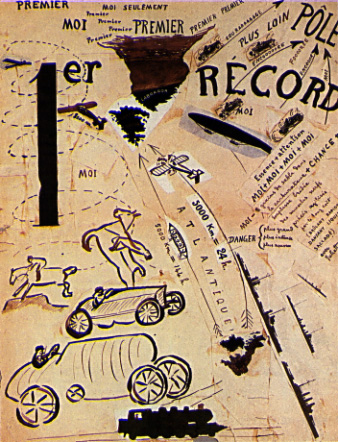
Perhaps the nerdy could dust off a Marinetti or simply adopt almost anything that smacks of Christian heritage.  Middlebrow folks could always seek out an appropriate Thomas Kincade.

Marinetti, from “Words in Freedom”

These days, those looking for a more in-your-face political print to hang above their couches can snap up a Jon McNaughton print.  As reviewed today for Religion & Politics by Duke’s David Morgan, McNaughton’s work offers today’s conservative activists an unabashedly explicit political and cultural message.

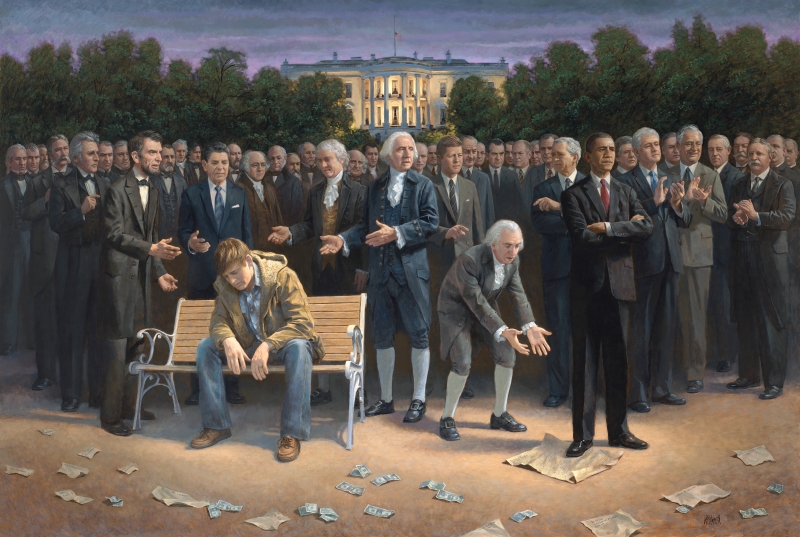
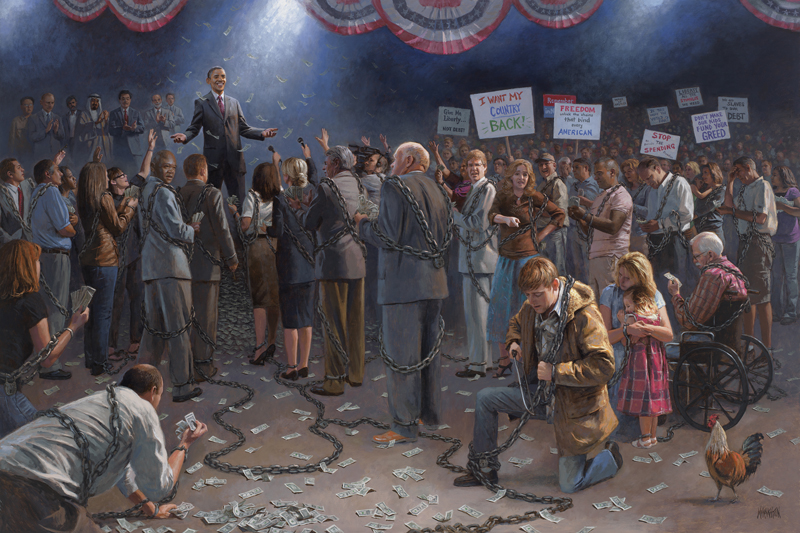
In 2010’s “The Forgotten Man,” McNaugton offers what looks like an attack ad.  In 2011’s “Wake Up America!” that forgotten man works his way to freedom by leading a Tea-Party-like protest against a sinister President Obama.

McNaughton’s The Forgotten Man

McNaughton’s Wake Up America!

According to the Religion & Politics piece, this ardent partisanship led McNaughton’s alma mater Brigham Young University to cease selling one of McNaughton’s paintings.  Yet McNaughton has remained a huge seller.  And Morgan finds McNaughton’s work to be more than just a shill.  Morgan compares McNaughton’s frank preachiness to the contemporary interests of artists such as Michaelango and Giotto.  And, Morgan concludes,

It is easy for art critics to scowl at McNaughton’s pictures as preachy, partisan, and cheesy. Their solemnity and their illustrational literalism tempt many observers to dismiss them as propaganda or kitsch. And Wake Up America! certainly seems more political cheerleading than artistic vision. But simply scorning the work misses the opportunity to understand something powerful moving through many religious sub-cultures in the United States today. These groups do not distinguish between religion and politics the way that many commentators and cultural analysts would prefer. For McNaughton and his admirers, as well as many more, there is nothing at all absurd about Jesus holding the Constitution as a sacred artifact, as evidence of his authorial intent.”

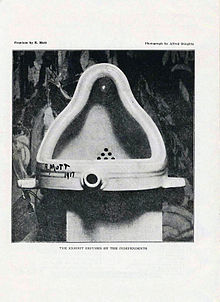
Marcel Duchamp, “The Fountain,” 1917

Morgan doesn’t make this connection, and perhaps it doesn’t hold water, but McNaughton’s popularity in Fundamentalist America may result from an even deeper cultural divide.  Since at least Marcel Duchamp’s 1917 “The Fountain,” high art in the Western Tradition has prided itself on NOT saying what it seems to be saying.  Some of McNaughton’s popularity may come from simple resentment against a self-appointed cultural elite who look down their noses at any Art that does not somehow befuddle the uninitiated.  American art museums have long embraced the pop art of Warhol’s Soup Cans and the ironic self-referentialism of Lichtenstein’s comic-bookism.  Sworls of color and abstruse “performance pieces” have made art museums cold, forbidding, meaningless fortresses to all those who stand outside their elusive mysteries.

It makes a certain amount of sense that Fundamentalist America would celebrate Art that says what it means.  After all, in Fundamentalist America, that is what the Bible and the Constitution have always done.

RIP Paul Boyer

The sad news that Paul Boyer passed away reached ILYBYGTH offices yesterday.  Professor Boyer was a prolific and engaging cultural and intellectual historian whose work and personality had a huge impact on me as I started my graduate work in American History.  I was just arriving in Madison as Professor Boyer was planning his retirement, but I was lucky enough to meet him several times and he was always gracious enough to help me with my first dips into research and writing about American fundamentalism.

Professor Boyer was the author of several influential works, including Salem Possessed and By the Bomb’s Early Light.  The book that packed the most punch with me, however, was his When Time Shall Be No More (1992).  The book helped ground me in some of the basic cultural and intellectual presumptions of prophecy belief in American history.  More than that, Professor Boyer’s sympathetic outsider’s perspective on such Bible believers inspired me to follow in his footsteps.

My sincerest condolences to Professor Boyer’s family and many friends.