Homeschool: Latest Frontier for the Fabulous

Why do parents homeschool?  At least one mother has told us recently that homeschooling has become yet another perk for the fabulously fabulous.

As anyone who follows historian Milton Gaither’s blog knows, the world of homeschooling in the United States is fabulously complex.  There is no simple answer to the question of why some parents choose to homeschool.

For some readers and contributors to this blog (see, for instance, the experiences of Anna), homeschooling has resembled nothing so much as a horrific theocratic prison, similar to the recent expose in the pages of American Prospect.  For these families, homeschooling has functioned as a way to bind up their children’s minds in the over-tight wrappings of fundamentalist theology.

Yet for many other conservative religious folks, homeschooling has included equal parts theology, culture, and pedagogy.  Some non-conservative readers out there might be as surprised as I was to discover the number of conservative evangelical Protestants who homeschool for very progressive-sounding reasons.  Or even the number of conservative creationist homeschoolers who want to teach their children about evolution responsibly and accurately.

But homeschooling is not only for conservative religious folks.  At least since the early 1970s, progressive educators and hippies have been attracted to the allure of “unschooling.”  And homeschooling has long been a traditional option for students who cannot attend school due to health problems or even due to pregnancy.

A recent piece in the New York Times offers another rationale for homeschooling: it’s the only lifestyle that can be fabulous enough for those who have already maxed out on their fabulous-ness.  Jennifer Kulynych’s self-outing as a fabulous homeschool mom took as a pretext her difficulty in admitting to her homeschool practice.  At work, Kulynych explains, she has trouble telling colleagues that she homeschools her daughter.  Too many people, she writes, make too many assumptions about homeschooling.

At its core, though, Kulynych’s self-outing seems like nothing so much as a brag about homeschooling as the last frontier for the fabulous.  Kulynych explains that she began homeschooling her daughter when their public school failed to challenge her daughter intellectually.  Since Kulynych’s daughter was too smart for school, and their family couldn’t afford ritzy private schools, Kulynych chose to homeschool.  Plus, Kulynych explains, she was not willing to see her daughter raised by nannies and tutors.  Instead, Kulynych chose to keep her job as a lawyer, while still arranging a perfect intellectual environment for her perfect intellectual offspring.  The fabulous experiment has not been without cost, Kulynych explains.  She goes without spare time in order to keep up the fabulous pace of her fabulous homeschooling lifestyle.  She enjoys spending time learning with her daughter, as she explains, as “co-conspirators in a counterculture adventure, eating our academic dessert first whenever we like.”

Don’t get me wrong: I’m not knocking Kulynych for homeschooling.  I’m all for parents who sacrifice for the good of their children.  But I do wonder if Kulynych’s self-aggrandizement will mark a new normal in the kaleidoscopic world of American homeschooling.  Homeschooling has always been counter-cultural.  The traditional countercultures, though, have been those of the left or right.  For Kulynych, at least, the “counter” in counterculture seems to rely mainly on being simply too cool for school.


What Technology Do We Need in Schools?

More is more.  That is the mantra of many public-school technophiles these days.  It rests on an often-implicit notion that any problems with schools can be cured with just the right dose of technological innovation.

It is a mantra that Andrew J. Ellison takes to task this morning in the pages of the Front Porch Republic.  Real education, Ellison argues, must be based on mastering language, the most fundamental technology of all.  Bypassing such authentic learning with a series of flashy touch-screens and web apps will only impede learning, he insists.

Of course, one does not have to be culturally conservative to have qualms about the overheated rush to technologize America’s schools.  The recent massive flop of LA’s expensive IPad gamble can turn any taxpayer’s stomach.  And as Stanford’s Larry Cuban has argued compellingly, every American generation has had naïve dreams about the promises of new technology.

Ellison worries specifically about a new program sponsored by President Obama.  Obama asks America’s schoolchildren to submit videos in which they prove that technology improves education.

Ellison notes that the language of this question skews any discussion of the merits of classroom technology.  As he puts it,

the assumption is clear: if you are critical of the faddish and unreflective technologization of our schools, your view is not part of the mainstream.  If you are skeptical of the outlandish educational promises being made by the peddlers of the current classroom iPad fad (maybe because you remember the non-fulfillment of the outlandish promises made in the 1970s about videocassette-based education, or the outlandish promises made about Apple II-based education in the 1980s), your views are unwelcome.  If you are even just a teeny weeny bit inclined to think that the perennial human problem of cultivating intellectual and moral excellence cannot be solved by ANY electronic technology, and that the pursuit of technological solutions to these problems is as inappropriate as the pursuit of a moral and spiritual solution to landing a man on the moon, then you might be discouraged from entering the contest.

In addition to the blithe assumptions of technology’s spotless promise, Ellison lambastes the needlessly and gratingly childish language that the White House uses to promote its program.  Like many clueless adults, the White House tries to wrap its outreach in language that young people will presumably embrace.  Instead of speaking intelligently to young people about real issues involving technology, the White House takes a depressing Hannah-Montana tone:

Yeah, having your schoolwork posted on the fridge at home is cool. But having a video you made posted on the White House website and screened at 1600 Pennsylvania Avenue? We think that’s pretty cool, too. That’s why we’re super-excited to announce the first-ever White House Student Film Festival.

As Ellison points out, this language assumes that young people are somehow unable to handle real language or real questions about technology and culture.  “The condescension of consciously  informal English,” Ellison argues,

is exactly the opposite of real teachers worthy of the name speak to the children entrusted to their classrooms, the opposite of the way we ought to talk to young people if we want to uplift, ennoble, inspire, exhort, challenge—in a word, educate—them.  If we want to make young people better, we have to pull them up towards something better—and while that certainly doesn’t mean that we should talk at uncomprehending 3rd graders in the most difficult and complex literary English we can muster, it does mean that when we speak to children, when we write for them, and when we assign things to them to read, we should be aiming ahead of them, as if we were training a wide receiver to run faster and strain harder to catch the football.

Only if educators focus their efforts at teaching young people to master the real beauty and promise of language will education really happen, Ellison concludes.  Indeed, this sort of training will provide young people with a real mastery of the only educational technology that really matters.  After all, Ellison insists, language is

the first and most human of all technologies, the one upon which all social life depends, the one absolutely indispensable technology, without command of which we become completely unfit for life as free citizens, productive workers, and human beings in the 21st century, at the mercy of others and subject to forces beyond our control and even recognition.


School Is Life

For one homeless girl in New York City, school is life.  In any case, that’s the story told recently in a New York Times feature article.  “For Dasani,” the story opens,

School is everything—the provider of meals, on-the-spot nursing care, security and substitute parenting.

In the progressive tradition, as Bill Reese demonstrated so powerfully almost thirty years ago in Power and the Promise of School Reform, this vision of school as social-redistribution center fulfills a long-held and deeply cherished ideal.

But how do conservatives view this use of public schools?

To be sure, in various instances, as I noted in an article several years ago in Church History, conservatives have also taken advantage of the wide reach of public schools.  Conservative evangelicals, for example, have used schools as a convenient distribution network for Bibles and religious tracts.  But in general, conservatives in America have not yearned for redistribution the same ways progressives have.  Schools, many conservatives might agree, must be understood as educational institutions, not welfare agencies.  When public schools try to do too much, some conservatives might argue, they end up doing nothing at all.

When school reform has worked for conservatives, Ross Douthat argued recently, it has been when market-based reforms have made schooling more equitable for low-income and minority students as well as affluent whites.  That sort of concrete reform, Douthat wrote, has been the primary success conservatives have scored in overcoming their legacy as the party of white racism.

But that is not the sort of success trumpeted in the NYT feature.  Those market reforms, the article argues, merely move schooling and public services farther out of the reach of girls like Dasani.

No, the article concludes, for homeless youth like Dasani,

school and life are indistinguishable.  When school goes well, she is whole.  When it goes poorly, she can’t compartmentalize like some students, who simply ‘focus’ on their studies.

According to the New York Times feature, Dasani’s life as a homeless eleven-year-old in glitzy New York City is rough.  She shares a room in a shelter with her entire large family.  They endure infestations of mice, roaches, and sexual predators.  In contrast, Dasani’s classroom is a “cozy haven of book-lined shelves and inspirational words scrawled in chalk.”  At school, Dasani gets attention from a brilliant and caring classroom teacher, as well as a social worker and medical professionals.

For us at ILYBYGTH, this seems like a perfect example of a perennial question at the heart of educational culture wars.  What are schools for?  Ought they provide all the services needed by every child, no matter how extensive those needs might be?  Or should schools limit themselves to a narrower definition of “education,” focusing on academic work and leaving families to provide the rest?

In America’s twentieth century, one’s position on this question often served as a quick-and-easy definition of “progressives” vs. “conservatives.”  Progressives wanted schools to think of education as a whole-life question, meeting children where they were and providing every social service possible to ensure a high-quality education for everyone.  Conservatives, in contrast, have pushed for the elimination of “fads and frills” from public schools.  The government—in school or anywhere else—ought not take primary responsibility for children or anyone else.

In this story, we see one example of the way this long-running disagreement has been won, largely, by the progressive vision.  Dasani’s life is far from easy.  But her ability to secure a range of services through her public school demonstrates the long-run triumph of one central progressive idea.

Is the Common Core Un-American? Professor Deneen Says Yes

What should conservatives do with the new Common Core Learning Standards?

Trash them, demands Notre Dame political theorist Patrick Deneen.  In doing so, Deneen makes some fishy assertions about the educational imaginations of our Founding Fathers.

As ILYBYGTH readers are well aware, there is no unified “conservative” position on the Common Core.  Some smart conservatives hate them.  Other smart conservatives hold their noses and endorse them.

Professor Deneen signed on to the recent letter against the standards to the US Catholic Bishops.  Deneen and other prominent Catholic intellectuals voiced their dismay at the intellectual, political, and spiritual implications of the new standards.

In his recent essay in The American Conservative, Deneen spells out in more detail his objections.

The standards, Deneen warns, represent a monstrous over-emphasis on only two of the five main purposes of education.  The standards push schools to focus only on basic facts and logic. They ignore the formation of good citizens with character and a sense of wonder.

In this case, according to Professor Deneen, two-fifths of a loaf is worse than none at all. These standards, he argues, are not simply a good attempt at a difficult task.  Rather, they are fundamentally flawed, since they are based on a “dessicated and debased conception of what a human being is.”

So far, so good.  But Professor Deneen argues that this sort of common educational standard violates the best American traditions, and this doesn’t seem to fit the historical record.

The good professor is a mighty smart guy, well versed in the political thought of our founders.  So I have a hard time sussing out what he means by the following:

Because humans in their social and political communities are various, it was understood by our Founders that the way that these educational purposes to be achieved would be various, and so the commitment to local control of education was not born of a resignation in the absence of a strong central government, but a positive embrace of variety and multiplicity.

I’m no expert in early America, but that just ain’t so.  Prominent founders such as Thomas Jefferson, Benjamin Franklin, and Benjamin Rush all pushed for greater systematization and centralization of schooling.  Each of them hoped to organize a chaotic network of educational opportunities into a more coherent centralized system of schooling.

Perhaps none of these founders would have wanted a single system for all of the states, as the Common Core standards hope for.  But each of these founders, at least, would have applauded the attempt to make education less happenstance and more predictable.

I understand Professor Deneen’s disgust at the lopsided nature of the Common Core State Standards, even if I don’t agree with it.  But I don’t see the basis for his claims that this sort of effort violates the spirits of the Founders.  On the contrary, this sort of rationalization and systematization is just the kind of thing those big-idea men would have drooled over.


Classical Education and Conservatism

What is “classical” education?  Is it a “conservative” thing?

The Heritage Foundation recently published a video lecture by Leigh Bortins, founder and leader of Classical Conversations.

Readers of ILYBYGTH may remember a recent guest post from Patrick Halbrook about the thought of classical education inspiration Dorothy Sayers.

Bortins’ talk at Heritage did not focus too much on Sayers’ work, but rather on teaching homeschooling parents  a classical approach.  Those familiar with the themes of classical Christian education will notice that Bortins mostly assumes the age-graded breakdown of the Trivium, though she does talk us through it.

Her organization, Classical Conversations, claims over 62,000 students enrolled.  Bortins says her program has trained over 8,000 parents, as well as over 16,000 parents who have attended three-day practicums.

Bortins herself now hosts groups of college-age people (currently 19) in her home.  She teaches them in the classical model at her home.

Young people, Bortins insists, must be challenged in age-appropriate ways.  Monotony and repetition, she says, are the right way to teach young people.  Older students must move into questioning and using knowledge to improve themselves and their communities.

Too many contemporary education systems, Bortins argues, focus on basics such as literacy and numeracy.  Instead, education must keep its focus on big questions of virtue and personal formation.  Education, she says, has been turned too often into an industrial processing of young people.

The talk runs for about an hour and is worth your time if you’re interested in understanding the spectrum of conservative ideas about education.  Bortins takes her audience through some exercises relating to teaching with a classical model.  How do we define a common thing?  Bortins uses the example of the Washington Redskins.  What makes the Redskins different from other similar things?  What defines the team?

Parents can learn to engage their student-children in a set of guiding questions like this.  There is no mystery to it, Bortins believes.  Classical education, she says, will allow everyone to enter into all the great conversations from across human history.

Critics might complain that this educational model is literally medieval.  Students in this approach spend time defining, comparing, and disputing, just as young Europeans learned for centuries.

But knee-jerk characterizations of “conservative education” might be thrown off by Bortins’ emphasis on the educational value of the humanization and individualization of education.  Caricatures of conservative education often don’t have room to include Bortins’ emphasis on young people freed to sit under the stars and ponder their existence, young people learning to knit as a way to connect themselves to past generations of civilization.  Bortins’ take on good education revolts against an industrial model that treats young people like widgets.

Yet Bortins also insists on the value of free-market values in education.  She implies a Christian grounding to all true and proper education.  In the American context these days, that puts her in the conservative camp.

Of course, Bortins’ vision of classical education can’t be taken as the last word.  Other classical educators might differ in their definitions and approaches.  But Bortins’ talk gives us at least one prominent classical educator’s explanation of the promise of classical education.


Faith & Physics, Part II

ILYBYGTH is happy to continue our series of guest posts from Anna.  In her first post, Anna described her shift from creation science to mainstream science.  Today she tells us a little bit about the way she learned her creationist science as a kid.  Anna blogs about her experiences leaving the fundamentalist subculture at Signs You Are a Sheltered Evangelical.  She holds an M.Sc. degree in Astroparticle Physics and currently lives in Virginia with her fiance Chelsey and a cat named Cat.

Creationist Curriculum

I am a conservative, anti-government-educator’s dream.  Because I was homeschooled, my family had the unique opportunity to control every aspect of my education completely.  Part of this included being taught with a Christian science curriculum that supported Biblical 6-day creation, denied Evolution, described scientific evidence for a global flood, and opposed modern environmental policies.  When I tell my secular peers this, the reactions of shock, horror, and amazement are often rather comical.  Very often, I am told that I must be remarkably resilient or intelligent to be able to make a successful science career for myself after being handicapped by my early education.  As much as I’d love to accept the accolades, I simply don’t see it that way.  My seemingly-bizarre education did not hamper me much at all, and in some ways, I must credit it for inspiring me to become a scientist in the first place.  Although I cannot defend the inaccuracies in the curriculum, I still have fond memories of it, and I can highlight both the shortcomings and successes of the book series.

My formal science education, I believe, started around age 10 or 11 (since I was homeschooled, I did not progress through formal grades, so it is sometimes very difficult for me to track the passage of time without these milestones to help.)  I was started on an A-beka book, which I remember little of besides loathing.  It was spiral bound with wire and the pages were made of cheap paper, meaning that they were constantly tearing out, scattering across the floor, and getting lost.  Besides that, the text itself was dry, the pages were cluttered with illustrations that illustrated nothing, and the quizzes (aptly named “brain drains”) never seemed to pertain to the actual text and would often quiz you in facts only found in the illustration captions.

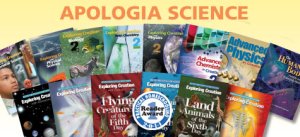
For the rest of my pre-college education, I used Apologia‘s Christian-centered curriculum by Dr. Wile, and I loved it.  Over the years, I worked through Exploring Creation with General Science, Exploring Creation with Physical ScienceExploring Creation with Biology, Exploring Creation with Chemistry, Exploring Creation with Physics, and Advanced Physics in Creation.  I wish that I had a copy of some of these books still with me… especially the 1st edition of General Science and Physical Science (if anyone feels like getting me an early Christmas present… I won’t say no) because I recall those two books having the most absurdities in them.  Obviously, I cannot cover all of the curriculum in detail, but I can shed some light on the divergences from science that I recall.

Image Source: Apologia

Image Source: Apologia

I have to laugh now recalling that one of the books (General Science, I think) had an entire chapter devoted to attempting to validate the Bible as an accurate scientific and historical record.  This would seem grossly out of place in any standard science text.  For a creationist, however, it is perfectly reasonable and, indeed, necessary to discuss this in depth.  I recall in my early years of college, seeing my peers and professors laugh at the absurdity of creationism.  “Scientists start with evidence and draw a conclusion from it.  Creationists start with a conclusion and draw evidence for it,” was posted on my professor’s office door.  I felt a little defensive.  “We all tend to accept conclusions that come from reputable, repeatedly-tested sources,” I thought.  “If the Bible were not reputable and repeatedly-tested, then obviously accepting claims from it would be absurd, but that is not the case.”  Much of my conviction on the validity of the Bible originated from the early Apologia texts.  It’s important to remember that Creationists do not see themselves as anti-science… they want to find compelling evidence for their claims.  As a result, I waded through a chapter discussing the accuracy of Bible translations, similarities between different Biblical manuscripts, refutations of Biblical contradictions, etc.  The purpose of this was to prove that the Bible could be reliably used as a basis for scientific theory.  To exclude this chapter would be grossly negligent if claims in the Bible are indeed the basis of your theory.  Even so, the whole conversation bored me; I wanted to learn science.

The Physical Science textbook spent an inordinate amount of time condemning modern environmental policies as fraudulent.  I recall the book passionately opposing the ban on CFC’s, claiming that the ozone hole was a scare tactic used by politicians to promote a hysterical agenda, and predicting that people would suffer from increased rates of infection now that medical tools could no longer be sterilized by the chemical.  These political discussions now irritate me more than any of the other inaccuracies in the books.  I had been raised when I was young in a very rural area and had developed a great love of nature.  I was fiercely protective of the environment, and all of the flora and fauna in it.  I wrote an article to my local newspaper about reducing litter when I was 11 years old or so which I was very proud to see published.  As such, it angers me in retrospect that I was taught so many lies about proper stewardship of the environment and that I believed them for so long.  I have never fully understood why Christian Fundamentalism is so opposed to environmental protection, and yet it seems to be a common theme.  Apologia science chose to start kids on that path early.

The Biology text book focused on disproving Evolution.  Of course.  In all honesty, as silly as 6-day-creation seems to me now, my Bible-based text book really did not deprive me of a decent education on evolutionary biology.  Because of the sheer amount of information I was provided with to refute Evolution I came away with a pretty darned good understanding of it.  I disbelieved it, of course, but once I came around to accepting true science, I was no further behind in understanding than any of my secular peers.  This is why the shock-and-horror response to my anti-evolution education makes me chuckle a little.  If one truly wants to argue effectively against an opponent, one must know his position at least as well as he does.  Thus, I truly believe that my anti-evolution text served me surprisingly well.

Now that I’ve discussed all of these lies, distortions, and absurdities, you might wonder how I can have a favorable memory of Apologia at all.  Well, for one, the books were very well written.  Their style was conversational, without sacrificing content.  The illustrations were meaningful and placed sparingly to complement the text, rather than cluttering the book.  Learning felt like learning… like you were truly on a road to discovery, rather than simply memorizing information for a test.  And, perhaps most awesome of all, if you emailed the author, he would email you back within 24 hours.  If I ever found myself confused by a concept or curious about some theory, I would write to him and eagerly await his response.  He was always friendly and informative with his replies.  Perhaps my enthusiasm over this simple email contact seems exaggerated but, remember, I was homeschooled.  I was almost entirely in charge of my own education by the time I reached higher sciences.  My mother did not have the education to help me in science or math, and none of the other homeschooling moms in my group were any better.  Whenever I was uncertain about something, I would have to figure it out myself.  Thus, having an authority figure to direct my questions to was amazing.  I felt like I was talking to a celebrity.  My childish enthusiasm aside, I think that it also highlights Dr. Wile’s admirable dedication to education.  It meant a lot to me at the time, and I still think back on it fondly.

Dr. Wile was one of my inspirations to become a scientist.  I loved his enthusiasm for the subject, I loved his dedication to the students using his books, and I wanted to emulate that.  Honestly, I still do.  As an instructor, I strive to let my enthusiasm show, to infect others with it, and to always make myself available to my students for questions and assistance.  But what about the science-denial?  It is still a bit difficult for me to look back on authority figures and members of my community that I looked up to and respected and wonder: are they just ignorant, or are they purposely deceptive?  How can a scientist be completely honest with him- or herself and still make the claim that ALL evidence points to a 6-day creation, without question or doubt?  I give myself a lot of grace for my early ignorance because I was young and had little access to any information outside of the pre-approved worldview that I was being fed.  But creationists like Ken Ham, Dr. Wile, and others have no such excuse.  So, without being able to see inside their minds, can I offer them the grace of assuming that they are truly honest in their seeking and have just been misled?  I think the answer is both yes and no, and it is greatly complicated by a wide array of cultural factors involved in the creation/evolution debate.  In order to begin to tackle this, I need to first discuss the factors and pressures that surround a creationist belief in the first place.  For that, however, you will have to wait for the next installment.


Should Adults Lie to Children?

I’ll say it: Lying to children is a vital part of a good education.

Adults lie to children all the time.  Santa Claus. Easter Bunny. Tooth Fairy. Daddy will eventually come home again…

But can such lies be considered “education?”  Our attitude toward this question might tell us a thing or two about the continuing culture wars over American education.

The question came up again in Professor Jerry Coyne’s review of Jonny Scaramanga’s Salon article.  For those of you who just joined the party, Professor Coyne is an irascible atheist and scientist.  He is an inveterate campaigner against creationism and delusional religionism.  Scaramanga is a recovering fundamentalist, blogger, and sometime contributor to these pages.  Scaramanga’s Salon article decried the repackaged fundamentalist curricula that are being taught in some publicly funded charter schools in Texas.

In response, Coyne thundered,

Adults have the right to be as stupid as they want, but I don’t think they have the right to tell lies to children. Those lies include not only religious dogma, but the antiscience attitudes that come with it. How sad that a group of bright and curious children can become ignorant, superstitious ideologues simply because they were born into the wrong families.

Professor Coyne is not the first science pundit to take this position.  In his 1964 anti-creationism book This View of Life, paleontologist George Gaylord Simpson blasted the lies that had thwarted evolution education.  “Even now,” Simpson argued,

a hundred years after The Origin of Species, most people have not really entered the world into which Darwin led—alas!—only a minority of us.  Life may be considerably happier for some people in the older worlds of superstition.  It is possible that some children are made happy by a belief in Santa Claus, but adults should prefer to live in a world of reality and reason.

But as anyone involved with education knows, adults lie to children all the time.  Doing so is a vital part of every good education.  Let’s look at a couple of examples.

1.) “This is what we believe.” 

Every education, in every culture, whether it means formal schooling, apprenticeships, or informal instruction, includes the passing along of central ideas.  Professor Coyne meant that adults should not tell young people things that are untrue.  But what if the adults believe it fervently?  Is that a lie?  Or, to complicate the matter, what if the adult isn’t sure if she believes it fervently, but is convinced that it will be good for the young person to believe?  For example, in the world of religious faith, an adult may have had serious doubts about her faith, but decide that a young person is not yet mature enough to consider those gray areas.  She might then tell young people that certain religious mysteries are simply truths, knowing that later the child will and should wrestle with the more complicated questions about it.

2.) “You can do this.”

This can be a flat-out lie.  Teachers and parents often work to inspire confidence in their children and students, even when the adults are very unsure of the truth of their statements.  Adults may have serious doubts that young people can, indeed, accomplish certain goals.  Yet the adults might tell the children that such goals are definitely, absolutely, 100% achievable.  It’s a lie.  But it is something good parents and teachers do.

3.) “I hate phonies.”

In our culture, many of the biggest truths are best understood through lies.  I’m no Salinger fan, but I still remember reading Catcher in the Rye in high school.  I remember Holden’s struggle with phonies.  It taught me important truths about the ways people interact with one another.  None of it was “true,” of course.  It was all fiction, all lies.  But my teacher taught me those lies.  And I’m very glad she did.

Our attitude about lying to young people can tell us a lot about our positions on key educational culture-war issues.  Professors Coyne and Simpson think it is not okay for young people to learn creationism or other religious falsehoods.  But that position doesn’t include room for the complexities of real education.  Adults lie to children all the time, for the children’s benefit.  Sometimes they do so deliberately.

But more often, adults tell children things that the adults think are true.  Creationists don’t set out to deceive their children; they hope instead to protect their children from the deceptions of mainstream science.

But what if we don’t agree that creationism is true?  Are those creationists guilty of lying to children?  Professor Simpson said yes.  Professor Coyne says yes.  Jonny Scaramanga, I’m guessing, would say yes.

I disagree.  Teaching children our core beliefs is not lying.  Even if I think those beliefs are untrue (and I do think young-earth creationist beliefs are untrue), parents who teach such things to their children are guilty of nothing more than educating their offspring.

There is no parental right more fundamental than that.


What You Need to Know about . . . Dorothy L. Sayers

By Patrick Halbrook

I Love You but You’re Going to Hell is pleased to announce a new series of guest posts.  Inspired loosely by the One Thousand Words series at Front Porch Republic, this series asks experts to describe briefly the most important contributions of the most important conservative educational theorists and activists.   

How did a British detective novelist inspire an evangelical pastor from a small town in Idaho to found one of the fastest growing Christian schooling movements in America decades after her death?

Dorothy L. Sayers (1893-1957) is most widely remembered today not for her writings on education (which were rather brief), but for her literary output.  Her Peter Wimsey detective novels continue to be re-printed, and were adapted for television by the BBC in the 1970s.  Her twelve-part radio play about the life of Jesus, “The Man Who Would Be King” (1941-42), was considered by her friend C.S. Lewis to have been one of her finest works, and he enjoyed re-reading the manuscript every year during the week before Easter.  Sayers continues to be praised for her translation of Dante’s Divine Comedy, on which she spent the final decade of her life after teaching herself Italian.  Her prolific career as a writer and social critic have led her to be called “the most significant female British Christian intellectual of the twentieth century,” and an author who “made a substantial impact on nearly as many fields as G.K. Chesterton or C.S. Lewis.”

But if you were to visit a conference on Christian education and pull aside a parent or teacher to inquire about the distinguished Ms. Sayers, more often than not she would simply be lauded as the author of a brief 1947 essay on education entitled “The Lost Tools of Learning.”

Throughout the past few decades, this essay has spread throughout the evangelical Christian community through a peculiar turn of events.  In the mid twentieth century it came to the attention of William F. Buckley, who reprinted it at various times in National Review.  In the pages of Buckley’s magazine, it was read by a pastor of a small church in Moscow, Idaho named Douglas Wilson (Wilson is now known, among other things, for debating Christopher Hitchens and writing an award-winning novel).  In the early 1980s, Wilson began a private Christian school in Moscow in which he implemented Sayers’ ideas; he later popularized them in his 1991 book, Recovering the Lost Tools of Learning.  Over the following years, hundreds of schools across the country began to form using Wilson’s school as a model.  Sayers’ ideas also appear in the pages of The Well-Trained Mind: A Guide to Classical Education at Home, an enormously popular book on homeschooling which is now in its third edition.

“The Lost Tools of Learning” presents a rather simple educational paradigm based on the medieval Trivium and the notion that the goal of education is to teach students to think and learn for themselves.  For Sayers, this paradigm was the solution to what she considered to be the rather sorry state of early twentieth-century education.  “Has it ever struck you as odd, or unfortunate,” she asked, “that today, when the proportion of literacy throughout Western Europe is higher than it has ever been, people should have become susceptible to the influence of advertisement and mass propaganda to an extent hitherto unheard of and unimagined?”  She continued,

For we let our young men and women go out unarmed, in a day when armor was never so necessary.  By teaching them all to read, we have left them at the mercy of the printed word.  By the invention of the film and the radio, we have made certain that no aversion to reading shall secure them from the incessant battery of words, words, words.  They do not know what the words mean; they do not know how to ward them off or blunt their edge or fling them back; they are a prey to words in their emotions instead of being the masters of them in their intellects.

Students were graduating from school unprepared for life, Sayers argued, because “we fail lamentably on the whole in teaching them how to think: they learn everything, except the art of learning.”  What was needed in such times was a system of education capable of producing “a society of educated people, fitted to preserve their intellectual freedom amid the complex pressures of our modern society.”

Sayers found in medieval education two insights which, if applied in the twentieth century, would offer modern man a way out of the mess in which he had found himself.  First, by way of the Trivium (grammar, logic, and rhetoric), medieval education offered a paradigm for stages of learning to think and express oneself.  Second, its emphasis on theology gave all knowledge a coherence and unity without which education could only disintegrate into a collection of irrational, disjointed parts.

Confessing that her views of child development were “neither orthodox nor enlightened,” Sayers maintained that children go through three basic stages of development.  Each of these she associated with a part of the Trivium.  In the elementary years, or “Poll-Parrot” stage, children excel at memorizing new facts.  This corresponds with the “grammar” stage of the Trivium, which consists of learning the basic facts for each subject.  The grammar of language is self-evident, but other subjects have grammar stages as well.  In history, for instance, it consists of memorizing names and dates and events.  The goal of this stage is therefore to get as many facts into children’s heads, whether they understand their significance or not, while memorization is still relatively easy and even fun.

In the “Pert” stage, which corresponds to middle school, children naturally begin mastering the art of talking back and contradicting their elders.  This makes them ideally suited for the “logic” or “dialectic” stage, which would include the study of formal logic, as well as the “logic” of various subjects.  At this point students take what they have learned in the grammar stage and learn to apply critical thinking skills to those facts.  In literature, they debate whether or not a character’s actions were justified; in history, they study the causes and effects of the events they have already learned about.

Finally, students of high school age enter the “Poetic” stage, in which they yearn to express themselves and to achieve real independence of life and thought.  Because during the grammar stage they have been given something to think about, and during the logic stage they have learned how to think clearly, they are finally ready during their high school years to begin the study of “rhetoric.”  The purpose of this stage is to teach students to express their thoughts with clarity and eloquence through writing and speaking.  Students by this point in time have also become competent to take up new subjects to study on their own, needing less and less guidance needed from their teachers.

(It is worth noting that Sayers has come under fire for allegedly misrepresenting the Trivium, whose parts were, during the medieval period, all studied together and never corresponded to stages of child development.  Yet Sayers admitted as much, recognizing that what she was suggesting was a modern application of a traditional paradigm using her own views on psychology.  On another note, it has also been pointed out that Sayers’ paradigm of learning stages parallels Bloom’s taxonomy, which was published about a decade after “The Lost Tools of Learning.”)

In addition to her explanation of the Trivium, Sayers also turned to medieval education for its emphasis on Christian theology.  She wrote,

I shall add it to the curriculum because theology is the mistress-science without which the whole educational structure will necessarily lack its final synthesis.  Those who disagree about this will remain content to leave their pupil’s education still full of loose ends.

Theology would provide a coherent worldview which would allow students to understand how each subject fit together.  For Sayers, Christianity was never merely a set of ethical principles and religious rituals, but was at its core a way of making sense of the world.  “To me, Christian dogma seems to offer the only explanation of the universe that is intellectually satisfactory,” she wrote on one occasion.[1]  It was therefore an indispensable part of her educational vision, its neglect being a significant cause of modern education’s impotence.

What would it look for these “tools of learning” to be rediscovered and once again put to use?  Ironically, Sayers never dreamed it would actually happen.  She considered it “in the highest degree improbable that the reforms I propose will ever be carried into effect.”  She would therefore be quite surprised to know that today, over 40,000 students in private Christian schools (not to mention countless homeschooled students) are being taught grammar, logic, and rhetoric in the way that she envisioned.

They may not know much about her detective novels, but multitudes of conservative Christian educators have been profoundly influenced by Dorothy L. Sayers.


For more on Sayers…

About the author: Patrick Halbrook teaches at a classical Christian school near Raleigh, North Carolina.  His research interests include the history of Christian education and the intersection of science and religion, and for his master’s thesis he explored the role of the Scopes trial in American memory.  You can reach Patrick at phalbrook@carychristianschool.org.


[1] Letters, 2:401

Public Schools Can’t Serve the Public

To be useful to the public, Christians must reject “public” education.

That’s the argument made recently by Stephen Richard Turley in the pages of The Imaginative Conservative.

As I’ve noted elsewhere, one of the fundamental questions of Christian-school advocates is whether or not to stay in public education.  Dr. Turley makes the case that real Christians must abandon so-called public education.  In doing so, Turley writes, Christians do not turn away from the public sphere, but rather embrace it.

Today’s public education, Turley argues, is by definition anti-public.  Today’s so-called public schools hope to squeeze religious life into the private margins.  By doing so, so-called public schools warp the public sphere, allowing only secular notions to flourish, Turley writes.

The only answer for Christians, Turley believes, is to remain dedicated to true public witness by embracing private schools.

Confused?  Read Turley’s entire essay.

As he concludes,

If Christians are to remain faithful to the biblical gospel, we must once again affirm the public witness of the church, particularly in the field of education. For such an affirmation not only awakens the soul to the True, the Good, and the Beautiful, but in embodying the Truth, it exposes the state-financed educational system which denies Truth as what it is: a lie. We cannot teach our students that Truth is relative and expect our politicians to be honest; we can’t claim that the Good has been replaced by situational ethics and expect Wall Street executives to ground their business decisions in anything other than profit, greed, and expediency; and we cannot relegate Beauty to personal preference and then feign shock when we encounter a urinal as part of an art exhibit.

Christians will never expose this lie as long as they support and fund it. Classical Christian education offers nothing less than a parallel public, a revelation of Truth that in its social splendor awakens wonder and awe in teacher and student alike, as together they fellowship in Him who is the divine renewal of all things.


Private Schools Are Only for Bad People

Send your kids to your local public school.  Even if the school sucks.  Even if it won’t teach your child anything but how to get drunk.  Even if you have better options.

That is the provocative manifesto offered recently by Slate editor Allison Benedikt.

If you follow the latest, you’ve probably seen it by now.  Since I can’t keep up, I didn’t hear about it until this morning, and then only from the heated reaction it sparked among conservative commentators such as Ross Douthat, Erick Erickson, and Rod Dreher.

Benedikt’s diatribe was meant to poke the conservative bear.  She opens with the bear-poking line, “You are a bad person if you send your children to private school.”

Her argument, in a nutshell, is this: only if all parents send their kids to their local public schools will those schools improve.  If you send your kid to a private school, you are hurting everyone for the sake of your own perceived benefit.  Ipso facto, you are a bad person.

She proudly proclaims that she went to crappy schools and turned out okay.  She didn’t learn anything about history, literature, science, or math, but she did get drunk behind the bleachers with kids from different social backgrounds.

In fact, she promises that your children will do fine in bad public schools, if you are the sort of person who cares enough to pull your kids out of public schools.

Predictably, conservatives couldn’t resist such low-hanging ideological fruit.

Rod Dreher proclaimed, “This is one of those things that only a left-wing ideologue can possibly believe.”

Ross Douthat tweeted, “Everything for the state, nothing outside the state, nothing against the state.”

Erick Erickson twisted the knife, declaring that Benedikt only holds this outlandish position because her husband told her to.

But Benedikt’s position, minus the blogosphere-riling rhetoric, is nothing new or strange.  Indeed, for anyone who has studied the history of American education, even at a public school, Benedikt’s call for full enrollment in public education sounds traditional, even boring.

It was Horace Mann, after all, in the years before the Civil War, who midwived our system of public education.  In those years, our notions of “public” and “private” had not yet taken hold.  Parents or sponsors paid out of pocket for most formal education.  Those schools that required no tuition were commonly known as “charity” schools, fit only for the lowest class.

Mann realized that tax-funded education could only work if it received the endorsement, and the children, of the emerging affluent business classes.  This is why he made a powerful two-pronged appeal.  First, Mann argued that tax funds must be used to pay for tuition-free education, an education available to all.  Second, he argued that everyone should send their children to these schools.  These would not be “charity” schools, Mann argued.  They would not be “church” schools, or “dame” schools.  In today’s lingo, he would have insisted that these would not be “government” schools.  Rather, the name Mann promoted was the name Benedikt and other commentators would use for generations, even centuries: Public Schools.

Benedikt’s essay is intentionally provocative.  But its central idea is as old as American public education itself.  Our public schools can only function if they have the full-throated support of the public.  That support, as Mann argued and as Benedikt repeats, will come most easily if everyone sends their children.