Creationism and Climate Change

What do creationism and climate-change skepticism have in common?

A lot, according to the leading young-earth creationist organization Answers In Genesis.

This morning we see an argument from AiG’s Elizabeth Mitchell about the dangers of climate-change science.  Dr. Mitchell is responding to the recent report from the Intergovernmental Panel on Climate Change (IPCC).

Why do Christian creationists care about climate change?

Dr. Mitchell’s essay offers a few ideas.

First, Mitchell warns that climate-change science is based on “dubious sources.”  She asks if mainstream climate-change scientists might build their case on mistaken assumptions.  Skepticism about evolutionary science, it seems, bleeds over into suspicion of all mainstream science.  If mainstream science has been proven, from creationists’ perspective, to be a naked emperor, then its conclusions on every topic must be treated warily.

Second, young-earth creationists are committed to the idea of a young earth and, for many, a catastrophic global flood.  Arguments about the changing climate from outside the circle of young-earth creationists assume a much older earth.  Climate-change science must rest on such assumptions.  Young-earth creationists, then, have a keen interest in making climate arguments that insist on a short lifespan and a global cataclysmic flood.

Finally, we see an important difference in the issues of evolution and climate-change.  Dr. Mitchell, at least, takes a much more irenic position toward Christians who DO agree with the mainstream science of climate change.

Christians, Mitchell argues, must weigh the evidence and make up their minds about the science of climate change.  It does not do violence to scripture, she implies, to believe the mainstream science on this issue.  The most important issue, Mitchell concludes, is that

Whatever position a Christian citizen chooses to take, he or she needs to understand the present in the true light of biblically documented, scientifically affirmed history rather than uniformitarian assumptions about the earth’s past—and future.


Is This Child Abuse?

Arch-creationist Ken Ham wants to train up a spiritual army of young Christian creationists.  Does that count as child abuse?

I’m no creationist, but I just don’t think so.

Ham trumpeted the training of a new generation of young “soldiers” at an Answers In Genesis conference at Atlantic Shores Baptist Church in Virginia Beach, Virginia.  By teaching young people the truths of young-earth creationism, Ham claimed he was “preparing them for the spiritual war going on around us.”

Image Source: Answers in Genesis

Image Source: Answers in Genesis

This language of child soldiers makes me nervous.  Plus, I don’t like the notion that young people are being turned away from real evolutionary science by this sort of religion posing as science.  To me, this seems like another painful example of the ways faith has been tangled unnecessarily with real evolutionary science, resulting in bad science and tortured theology.

But it is child abuse?

Leading skeptics have called it that, folks such as physicist Lawrence Krauss and biologist Richard Dawkins.  They assert that cramming this false science down young people’s throats counts as abuse.

Let’s look at both sides of this argument.

Why might someone call this child abuse?

1.)    These young people are being told things are true, when they really aren’t.  They are being taught, to cite just one example, that dinosaurs and humans coexisted a few thousand years ago.  Worst of all, relationships of close trust between parents, teachers, and children are being exploited to promote the veracity of this false science.  Loving mothers, loving fathers, caring teachers tell innocent young people that this is scientific truth.  Ingenuous young people take their word for it.  Such deception is abusive.

2.)    In this essay, Ken Ham explicitly calls them soldiers—spiritual soldiers, but soldiers nonetheless.  This seems a terrible violation.  Young people should not be exploited as culture-war cannon fodder.

Why might defenders disagree?

1.)    There is no threat or coercion here.  Though it may come as a surprise to outsiders like me, Answers In Genesis makes it very clear that believing in a young earth and recent special creation are not required for Christian salvation.  In other words, Ken Ham and his colleagues do not threaten young people with terrifying visions of hellfire if the children don’t embrace creationism.

2.)    The parents and teachers seen here are apparently sincere in their belief that creationism is true.  They are trying to pass that truth to their children and pupils.  There’s nothing abusive in passing along the best knowledge to the next generation.

3.)    Though science pundits such as Bill Nye have argued against it, believing the young-earth creationism of Answers In Genesis will not hurt the life chances of these young people.  According to Gallup polls, nearly half of American adults share a belief that humanity has only been around for a few thousand years.  And as I’ve argued elsewhere, careers in science-related fields do not seem thwarted by a belief in young-earth creationism.  Consider the case of US Representative Paul C. Broun Jr. of Georgia.  Broun is a fervent creationist, a medical doctor, and a member of Congress.  Not a bad career!

Image Source: Answers In Genesis

Image Source: Answers In Genesis

Is it child abuse?  No.  And calling it that is irresponsible.  After all, there is real child abuse out there.  It is horrific and terrifyingly common.  Calling this sort of science/religion education ‘child abuse’ is only an ill-considered scare tactic.

Perhaps this argument could use some illustration from another religious tradition.  Consider the recent career of child abuse in the Catholic Church.  As we all know only too well, the despicable actions of some priests and prelates in that church have caused untold suffering.

But the abuse perpetrated by members of the Catholic Church does not extend to its anti-scientific teachings.  After all, the Catholic Church teaches young people that certain wafers and wine can magically transform into flesh and blood.  And then young people are taught to eat that flesh and drink that blood.  For outsiders like me, teaching children to engage in this sort of ritual cannibalism is creepy and anti-scientific.  It is also demonstrably false: the wafers and wine are always really just wafers and wine.  Nevertheless, it is not child abuse for Catholics to teach their children this mystery of transubstantiation.  Calling such teaching ‘child abuse’ would disrespect the real suffering that real child abuse has caused within the Catholic Church.

A similar logic may apply in this case.  The young-earth creationism peddled by Answers In Genesis is not true.  But it is sincerely believed by its adherents.  Teaching those ideas to young people is not child abuse.

Unfortunately, we can picture what real abuse might look like in similar cases.  As Billy Graham’s grandson has pointed out recently, evangelical Protestant organizations have also engaged in real child abuse.  They have conspired, just as did the Catholic hierarchy, to cover up that terrible real abuse.  We could imagine a scenario in which a Protestant organization such as Answers In Genesis called together thousands of children and abused some of them.

But that is not the case here.  This was an educational gathering.  To call it ‘child abuse’ makes a mockery of the all-too-real threat of abuse.


Creationists: We Don’t Want Creationism in Public Schools

We don’t push creationism on America’s public schools.  That’s the word from two very different ends of America’s creationist spectrum.

An intelligent observer might be forgiven for feeling a little confused.  If creationists don’t want creationism in America’s schools, what do they want?

Seen from this outsider’s perspective, this creationist plea demonstrates the important fact that America has not hit a wall with evolution/creation controversies; we are not trapped in a timeless deadlock; evolution and creation are not grappling in an endless, changeless battle.

Evolution is winning.

Don’t believe me?  Consider the recent statements of two leading creationists, two creationists with very different anti-evolution ideas.

Our first creationist voice for keeping creationism out of public schools comes from the leading proponent of intelligent design, Seattle’s Discovery Institute.

According to the conservative Christian World Magazine, the Discovery Institute’s Stephen Meyer has called recently for intelligent design advocates to stop pushing ID on public schools.  In a New York talk about his new book, Darwin’s Doubt, Meyer insisted it would be “imprudent for our side to be pushing intelligent design into textbooks.”

There was no need for such forceful public advocacy, Meyer argued.  Instead, growing doubt among mainstream scientists should be allowed to bubble over into public-school science curriculum.  According to Meyer, “There are too many scientists doing science from this perspective to keep it out of schools.  I’d prefer for it to happen organically.”

At the other end of the creationism spectrum, Ken Ham has called for a similar hands-off policy concerning public schools.  Ham, the founder of the leading young-earth creationist ministry Answers In Genesis, has insisted recently that his group does not push young-earth creationism into public schools.  Why not?  Because mandated creationism, Ham argued, would “likely be taught poorly (and possibly mockingly) by a teacher who does not understand what the Bible teaches. . .”

On the other hand, Ham does hope that public schools will teach a greater variety of ideas about evolution, including young-earth creationism.

For those of us non-creationists hoping to understand American creationism, what lessons can we take out of these statements?

At first glance, such arguments seem merely strategic.  My hunch is that both Meyer and Ham would prefer to see more intelligent design or young-earth creationism in America’s public schools, respectively.  Insisting that they do not push such notions seems nothing more than an attempt to play the role of innocent bystander in creation/evolution fights.

But we can take other lessons from these creationist statements as well.  First of all, both statements demonstrate a recognition that ID or YEC are not currently dominant in America’s public schools.  Dr. Meyer says he does not want to push ID, since that will leave the decisions in the hand of a judge, as happened in the Dover trial.  Mr. Ham worries that mandatory creationism would lead to withering critiques of the creation curriculum by the vast numbers of anti-creationist teachers.

As I’ve argued in my 1920s book, such creationist attitudes represent a wholesale revolution in anti-evolution politics.  In the 1920s, anti-evolution campaigns wanted more than to have creationism included in public schools.  Back then, anti-evolution politicians hoped to ban evolution wholesale.  Not only that, in the 1920s politicians and activists insisted on banning all sorts of ideas that might have challenged traditional Protestant culture.  Consider the “anti-evolution” law that passed the US Congress in 1924.  That law specified that no teachers could engage in “disrespect of the Holy Bible.”  But the law also insisted that DC teachers could not teach that the USA had an inferior form of government.

The sort of “us-too” strategy engaged in by Ham and Meyer demonstrates a very different goal.  Even if they are being duplicitous in their insistence that they do not want to push creationism on public schools, the very fact that they choose to disavow such insistence speaks volumes.

In the 1920s, anti-evolutionists wanted evolution out.  All the way out.  With all its attendant theories of atheism, socialism, sloppiness, and bad manners.  Anti-evolutionists went out of their way to show their vehement condemnation of all things evolutionary.

In the 21st century, in contrast, anti-evolutionists claim only to want a place at the public-school table.

This revolution in anti-evolution strategy demonstrates that there is no long-term deadlock in the evolution/creation struggle.

I’ll say it again: Evolution is winning.

It only appears to be a deadlock if we restrict ourselves to a short historical perspective.  Yet, for understandable reasons, many of the smartest voices in the evolution/creation debates have implied that we are in fact stuck.

Randy Moore, for example, has long been the smartest guy in the room when it comes to the struggle over creationism and biology education.  Yet even he allows himself to imply that evolution/creation has bogged down.  In a recent essay in the BioLogos Forum, for example, Moore opens with the following assertion: “the evolution-creationism controversy has been one of the most abiding controversies in America during the past several decades, public attitudes about evolution and creationism have changed relatively little during that time.”

True enough, but he restricts himself to a relatively short timeline.  Opinions since the 1980s may have congealed, but that does not imply a longterm freeze.

Michael Berkman and Eric Plutzer, too, open their wonderful study of evolution and creationism battles with the assumption that these battles have changed little.  They do not ask IF creation/evolution fights have deadlocked.  They only ask WHY such fights have been so durable.

Today’s statements from Stephen Meyer and Ken Ham demonstrate the dangers of these assumptions.  From an historian’s perspective, attitudes that have stayed the same since the 1980s are not proof of deadlock.  Rather, they appear only to be recent trends.

The fact that leading creationists insist that they do not want to push their theories into public schools tells us a lot.

It doesn’t tell us, of course, exactly how sincere such protestations might be.

But it does tell us that the evolution/creation controversy has changed dramatically over the past century.  Whereas the first rounds of this battle saw anti-evolutionists pound evolution education into the ropes, more recent decades have seen that trend reversed.

It is now creationists who insist they don’t want to push their ideas into public schools.

“Why can’t creationism be included?” is a vastly different question than “Why should schools include evolution?”


Creationism on the Ropes

Is creationism taking over American education?  Nope.

Not at the Blue Ridge Christian School, anyway.

Readers may remember Blue Ridge for its fifteen minutes of fame last May, when a dinosaur quiz from the school attracted attention.


Image Source: Answers in Genesis

Image Source: Answers in Genesis


According to the Christian Post, the school is closing down.  After all the attention, school founders hoped to raise enough funds to stay afloat.  However, in spite of international attention, the school only raised $15,000 of the $200,000 it needed.

So is creationism taking over?  In this case, at least, it’s not even staying alive.


They’re Coming for your Children

Beware!  The State is coming for your children.

That is the reminder recently from some conservative Christian commentators.

As we’ve noted here at ILYBYGTH, the struggle for control over children between parents and the state has a long and bitter history.

The cover of Sam Blumenfeld's 1981 Is Public Education Necessary depicted a teen being forcibly abducted from his home by agents of the State.  His crime?  Learning outside of government schools.

The cover of Sam Blumenfeld’s 1981 Is Public Education Necessary depicted a teen being forcibly abducted from his home by agents of the State. His crime? Learning outside of government schools.

Recent warnings have come from Elizabeth Mitchell of Answers in Genesis and Roger Kiska of the evangelical Alliance Defending Freedom.

The lesson from Germany is stark, both insist.  In that country, homeschooling parents have had their children taken away by the government.

Mitchell tells the story of the Wunderlich family.  By German law, the four children of this homeschooling family were arrested for violating a school-truancy law.  Mitchell warns that such threats are not limited to Germany.  “Those of us,” she insists,

who maintain that the Word of the Creator of the universe can be trusted from the very first verse work to provide answers to equip children and adults to understand science as well as the suffering in the world in the light of God’s Word. At the same time, we as Bible-believing Christians must not take for granted our freedom to speak the truth. . . .  we need to remain vigilant to guard against encroachments that chisel away at the freedoms we have in our own country.

Writing for the Alliance Defending Freedom, Kiska similarly warns, “today, the suppression of parental rights to teach and influence their own children isn’t restricted to overtly fascist regimes.”  In Sweden and Germany, “a land once shrouded under the Nazi flag,” homeschooling families have been attacked by government forces.  Such threats are not limited to Europe, Kiska insists.  He asks,

So, could Europe’s degree of intolerance and crackdown on homeschooling reach American shores anytime soon? It all depends on how vigilant we are in opposing decisions like the one in New Hampshire—and it’s precisely why ADF is fighting to protect parental rights in that case and abroad so that a very nasty cancer is not allowed to grow.

For outsiders like me, this anti-state rhetoric can seem strangely hyperbolic, even a “paranoid style.”  But dismissing these fears as mere social neurosis misses the point.  For many Americans of a conservative bent, the dangers of government aggression are of primary concern.  So, for instance, when pundits such as Allison Benedikt make an aggressive case for public education, many conservative writers express alarm.

This is more than just a paranoid style.  This is a thorough-going distrust of government power.  This distrust lies at the heart of conservative thinking in the United States.  Many conservatives still relish the pithy expression of this central idea by Ronald Reagan.  As Reagan put it, the most terrifying words in the English language are these: “I’m from the government and I’m here to help.”

For some conservatives, that government “help” might include the forcible abduction of children.  Folks like me might scoff at the extreme paranoia of such ideas, but we will be wise to understand that such warnings resonate with large numbers of Americans.


Easy but Painful: Converting to Atheism

What would it mean for religious people to abandon their faith?

Yesterday we saw an example of this process from Jerry Coyne’s blog Why Evolution Is True.

As “Matthew” describes, leaving his conservative Christian faith was not very difficult.  But it was painful.  And it can teach us some important lessons about conservatism and education.

First, Matthew’s story confirms the fears of many young-earth creationist activists.  Folks at organizations such as Answers In Genesis and the Insitute for Creation Research have long argued that learning about evolution can (or will) lead to atheism.  According to Matthew, that was exactly his experience.  For Matthew, evolution was a “gateway” idea for rejecting Chrisitianity in toto.  For young-earth creationists, this must come as proof of long-held fears.  For evolution educators, this must demonstrate that young-earth creationists have a point when they lament the atheistic implications of evolutionary theory.

Also, Matthew’s story shows how difficult it will be to improve evolution education in the United States.  For many resistant students, as sensitive science-ed types such as Lee Meadows and David Long have pointed out, evolution is not just one idea among many.  Evolution is word that provokes profound cultural, psychological, theological, and even existential anxiety among some students.  As Matthew’s story demonstrates, only when a student from this background actively seeks an alternative way of understanding the world can such evolutionary theory take hold.

Finally, though, Matthew’s story shows how important evolution outreach efforts are.  Matthew started his odyssey away from conservative religion by browsing internet sites and podcasts.  The educational work of organizations such as the National Center for Science Education has been a leading source for such evolution content online.  Matthew’s story shows how important that work can be, even if it must seem frustrating at times.


A Strange Sort of “Lion’s Den:” AiG at NEA

If I ever get thrown into a lion’s den, I want it to be the sort leading creationists complained about recently.

America’s leading young-earth creationist calls the National Education Association the “Lion’s Den,” “one of the most humanistic, pro-abortion, pro-“gay” marriage, anti-creation organizations in the USA.”

If so, why are creationists associated with Answers In Genesis spending time, effort, and money to make an appearance at the NEA convention?

Image Source: Creation Science Educators' Caucus

Image Source: Creation Science Educators’ Caucus

In leader Ken Ham’s words, the teachers and administrators affiliated with the NEA are “in dire need of the creation-gospel message (though we praise God for the Christian teachers who are something like “missionaries” in the public school systems).”

In order to reach those wayward teachers, Answers In Genesis supported a booth at this year’s convention.  As ever, as intrepid creationist Jobe Martin reported, the main goal is to spread their version of evangelical Christianity.  The topic of creation, Martin said, “is a great platform from which to spring off into the gospel.”

How did the creation ministry fare at NEA?

Results were mixed.  As young-earth creationists might have predicted, the booth provoked a lot of animosity.  In Dr. Martin’s words,

This year a man walked all the way around the booth, saying in a loud voice with a determined look on his face: “Lies! Lies! Lies!” A woman (who called herself a Christian) came by yelling that she was going to have us “kicked out” of the NEA convention. Many teachers passed by us with a comment that they seemed to think is original with them, but we hear this smug remark every year:  “No thank you, I teach science.”

As regular ILYBYGTH readers know, I’m no creationist.  But I try hard to be open-minded and sympathetic to creationists’ claims.  In other essays, I’ve defended Ken Ham’s right to his ministry, and encouraged my fellow non-creationists to reach across the culture-war trenches.

In this case, however, Ken Ham and his colleagues sound like the boys who cried lion’s den.

Full disclosure: I am a proud NEA member myself.  But I don’t think I’m offering here a knee-jerk defense of my union.  Based solely on the reporting from the young-earth creationists themselves, they seem to have been welcomed to the NEA convention.  According to Dr. Martin, the NEA has even offered official status to a caucus of creation scientists.  What’s more, though the creation booth attracted hostile attention, according to Dr. Martin, it also welcomed several creationist teachers who thanked them for their presence and took home bagloads of free curricular materials.

Is that life in a lion’s den?  It sounds to me more like life in a vibrant pluralistic organization, one that welcomes all kinds of people into its ranks, even when the leaders of the organization disagree vehemently with some of those people.


Evolution Down Under

Every once in a while, we hear an intelligent but deluded science pundit tell us that the United States is the only industrialized country with a significant creationist population.

It’s just not true.

A survey released recently by the Australian Academy of Science gives us some clues about the prevalence of anti-evolution thought Down Under.

Thanks to the National Center for Science Education’s blog, we hear about this survey of just over 1500 Australians.

The survey is not quite what we would hope for.  We would like to hear more specific questions about Australians’ beliefs about evolution.  This survey asked respondents if they thought evolution was occurring today.  Nine percent answered that they did not believe in evolution.  Another ten percent answered that evolution is not occurring today.  Twelve percent said they were not sure, and seventy percent thought evolution was occurring today.

These answers don’t tell us all we would like to know.  For instance, it is entirely possible—likely, even—that an informed young-earth creationist would answer that evolution was occurring today, in many ways.  Creationists often distinguish between “macro-“ and “micro-“ evolution (a distinction that drives mainstream scientists bonkers).  Such folks can happily agree that evolution is occurring today without agreeing that the earth is older than 10,000 years.  They can agree that evolution is going on now without agreeing that God did not create humanity in a literal week roughly 6,000 years ago.

In addition, other sorts of creationists could also agree that evolution went on today.  There’s no reason why intelligent-design mavens, believers in old-earth creationism, or “evolutionary creationists” would disagree that evolution was occurring right now.  But such agreement doesn’t tell us enough about the contours of anti-evolution thought, in Australia or anywhere else.

Another intriguing question from this survey asked respondents if humans lived at the same time as dinosaurs.  Just over a quarter (27%) of respondents thought that early humans lived at the same time as dinosaurs.  Of course, this question, too, leads to more questions.  Do such respondents believe in the Answers-in-Genesis sort of human/dinosaur cohabitation?  Or are they simply misinformed about the way life began?

One thing seems clear from this survey.  Significant percentages of Aussies, for whatever reason, do not agree with fundamental tenets of mainstream science.  Sorry, Bill Nye, but creationism is not “unique” to the United States.


Would You Sign It?

Should creationism be banned from schools?  Intelligent design?

That’s the question posed by a new petition on the White House’s website.

As of this morning, the petition has garnered 7,662 signatures.  It only needs 92,338 more by July 15 to earn an official response.

The language seems mild to an evolution believer like me:

Since Darwin’s groundbreaking theory of Evolution by Natural Selection, scientists all around the world have found monumental amounts of evidence in favor of the theory, now treated as scientific fact by 99.9% of all scientists.

However, even after 150 years after the establishment of evolution, some schools across the US are “teaching the controversy,” including Creationism and Intelligent Design. Both of these so-called “theories” have no basis in scientific fact, and have absolutely zero evidence pointing towards these conjectures. These types of loopholes in our education are partially to blame for our dangerously low student performances in math and science.

Therefore, we petition the Obama Administration to ban the teachings of these conjectures that contradict Evolution.

I agree with these sentiments.  Though there are legitimate scientific questions about evolution, such questions do not merit teaching evolution as merely a “controversy.”  Evolution is a fundamental idea about science and deserves to be taught as such in public schools.

However, I think this talk of a “ban” misses the point.  The religious notions of creationism and intelligent design are already banned in public schools.  This kind of anti-creationist activism only antagonizes the substantial number of Americans who sympathize with religious explanations of the origins of life.  Antagonizes without purpose.

In the pages of the Christian Post, for example, young-earth creationist Ken Ham correctly pointed out that the petition could never have any real impact on the teaching of creationism.  The petition only proved, Ham insisted, “the intolerance of evolutionist activists who do not want to see any challenge to their deeply held secularist worldview.”  Since the petition did not specify public schools, Ham argued, this petition can be seen as an aggressive attempt to dictate the teaching even of religious private schools.

Similarly, John West of the Discovery Institute, an intelligent-design think-tank, called the petition “ill-informed, confused, and beside the point.”

I don’t want to see creationism of any sort taught in public schools.  But I agree here with West and Ham.  This petition looks like another well-meaning but ill-considered scheme by overzealous anti-creationists.

Would you sign it?

Dinosaur Quizzes and Beleaguered Minorities

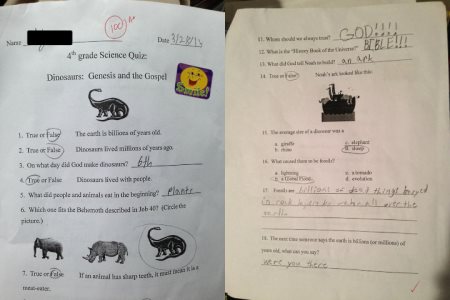
Have you seen it?  The dinosaur quiz below has been making the rounds lately.

dino quiz

Source: Answers in Genesis

This seems like a good chance for an ILYBYGTH gut check: What does this quiz tell us about creationism and American education?  For fans of evolution, this quiz confirms that creationism is a looming threat.  For young-earth creationists, though, this quiz and its public career tell us that Biblical creationists have become a righteous minority, besieged on all sides.

Here’s the story so far:  This quiz apparently came from a fourth-grade classroom at a private Christian school in South Carolina.  A parent posted it online when he found out to his dismay that his daughter had been learning this account of the origins of life.

What does this tell us about the state of American education?  Depending on your perspective, it can teach very different lessons.

For some commenters at r/atheism, this quiz serves as proof of the creeping power of Christian fundamentalism.  One poster noted, “They’re teaching these kids how to respond to people who spread the ‘evils of the world,’ in order to defend their faith.  It’s just very, very sad.”

Another agreed.  “This is just disgusting, my goodness,” he or she noted, concerning the fact that so many accredited schools in the United States teach this kind of science.  “I would really love to see a full on description of what is required to be taught to remain accredited, and then see if I could develop a program based around worship of FSM [i.e., the Flying Spaghetti Monster] that would meet those requirements.”

For young-earth creationist leader Ken Ham, however, the brouhaha over this quiz tells a very different lesson.  Ham complained that the backlash to this quiz proves that atheists have taken over America.  As he put it recently,

It seems that since the last presidential election, atheists have grown more confident about having something of a license to go after Christians. These secularists want to impose their anti-God religion on the culture. They are simply not content using legislatures and courts to protect the dogmatic teaching of their atheistic religion of evolution and millions of years in public schools. There is something else on their agenda: they are increasingly going after Christians and Christian institutions that teach God’s Word beginning in Genesis.

The danger, Ham and his colleague Mark Looy warned, should be readily apparent: “the atheists want your children. They are aggressively trying to demonize and marginalize Christians in their attempts to recruit your children for atheism or secularism.”

So who is the victim here?  Is it besieged Christians, defending their schools against dominant atheism?  Or is it science and reason, holding out in a last-ditch effort to save American education from Taliban-ism?

I’ll go out on a limb and try to define America’s educational consensus on this one.  The overwhelming majority of Americans agree, I’ll argue, that private schools can teach whatever they wish.  But there is one enormous exception: schools cannot teach doctrines that will cause harm to students or the wider society.

Obviously, this kicks the discussion back to the definition of “harm.”  We will all agree that teaching students how to rob liquor stores will ultimately be bad for both students and society.

But does teaching creationism constitute harm?  To anyone?  Here’s where tempers get heated.  I do not endorse young-earth creationism, but I believe the harm it does to students and society is far less than the harm that would be done if steps were taken to coerce schools to teach evolution.  Let schools teach young-earth creationism.  Try to persuade–not force–people to teach their children evolution instead.

Smart people disagree.  Some folks consider teaching young-earth creationism to be no harm at all.  Others, such as physicist Lawrence Krauss, consider teaching creationism to be a form of “child abuse.”   

Whichever side of this fence you fall on, this dinosaur quiz and the response it has generated can serve as a creationism quiz, a quick check of your attitudes toward this alternative science.  Does this sort of teaching harm students?  Does this sort of education harm society?