
You’ve heard the howls from creationists over Neil deGrasse Tyson’s recent Cosmos series. But did you know non-creationist conservatives also get cheeved at Tyson’s science punditry?
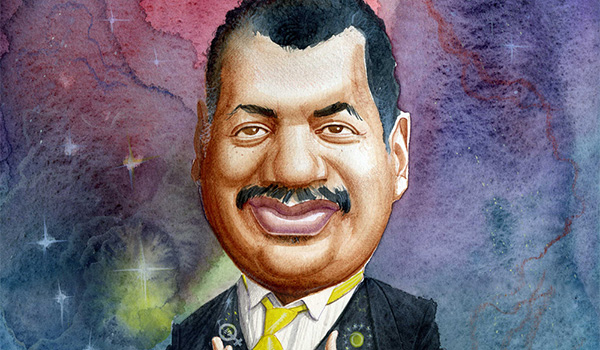
Science Snob?
The creationist complaints make sense. The hugely popular new science series pointedly called out young-earthers for their belief in a newish universe. The series also insisted on the creation of species through evolution.
But the complaints of non-creationist conservatives might not seem so obvious. In the pages of National Review, Charles C.W. Cooke took Tyson to task for his leftism, not just for his love of evolution. Cooke accuses Tyson and others of his ilk of a puffed-up condescension, of glibly associating liberal politics with superior intellect.
Too many of these self-righteous faux-nerds, Cooke writes, wrap their insouciance in the mantle of science. For these Tyson fans and wanna-bes, being smart does not mean doing actual intellectual work, but rather simply adopting a pre-packaged list of things to dislike. As Cooke puts it, that list includes anything
southern, politically conservative, culturally traditional, religious in some sense, patriotic, driven by principle rather than the pivot tables of Microsoft Excel, and in any way attached to the past.
This sort of prejudice against anything recognizably conservative likes to call itself the side of “science,” Cooke argues. Yet among progressives, real science often takes a beating. “Progressives . . . ,” Cooke says,
believe all sorts of unscientific things — that Medicaid, the VA, and Head Start work; that school choice does not; that abortion carries with it few important medical questions; that GM crops make the world worse; that one can attribute every hurricane, wildfire, and heat wave to “climate change”; that it’s feasible that renewable energy will take over from fossil fuels anytime soon . . .
Yet in spite of this demonstrably unscientific attitude, Cooke laments, the Left insists on calling itself the “reality-based” party.
Cooke is not the first to complain about such things. In the first generation of creation/evolution controversies, anti-evolution activists worked hard—and failed—to claim “science” for their side. As I noted in my 1920s book, leading anti-evolutionist William Jennings Bryan maintained his membership in the staunchly pro-evolution American Association for the Advancement of Science. He refused to allow that leading science group to be wholly taken over by fans of evolution.
Similarly, prominent 1920s fundamentalist activist William Bell Riley fought hard to keep his generation of Neil deGrasse Tysons from pushing conservatives out of the world of science. As Riley put it in a 1927 speech, the creation/evolution debate was not a debate between
Experts on the one hand, and, as someone has said, ‘organized ignorance,’ on the other. This is not a debate between the educated and the uneducated.
Like Bryan in the 1920s and Cooke in 2014, the conservative Riley was loath to cede the scientific and intellectual high ground to evolution-lovers.
One of the results of that first decade of evolution controversies was the formation of durable cultural associations, the associations about which Cooke complains. Since the 1920s, “science” has become indelibly associated in the public mind with progress, with social experiment, with iconoclasm. Politically, if not logically, all of those things are part of the broad package of cultural leftism. And, like it or not, conservatism has been associated time and again with obstructionism and heedless obscurantism.
For conservative pundits like Cooke, trying to fight that tradition will be an uphill battle.





 I Love You but You're Going to Hell