Climate-Change Party Crashers

I love the analogy, but I don’t know if the story sounds realistic.

Over at the National Center for Science Education blog, Executive Director Ann Reid tells a story about converting skeptics into climate-change believers. Dr. Reid tells a two-part tale of her encounter at a dinner party with someone who does not accept the scientific consensus on climate change. She explains how she made her case.

Full disclosure: I’m a big fan of the NCSE. Unlike some of my fellow evolution mavens, I appreciate the NCSE’s accommodating attitude toward life in a pluralistic society. I’ve personally seen the ways leaders at the NCSE speak respectfully and productively with creationists. Instead of labeling conservatives “the enemy,” the thoughtful activists at the NCSE try to understand creationist thinking, try to see things from a creationist perspective.

Will she be invited back?

Will she be invited back?

But Director Reid’s story still sounds a little outlandish to me, on two counts.

Before I describe my objections, let’s hear the story. Dr. Reid tells a two-part tale (one and two) in which she chats amiably at a dinner party with a scientist who believes that today’s climate changes are just part of naturally occurring cycles. What to do?

Dr. Reid listens to the skeptic’s reasons, then lays out her best case. One doesn’t need to know everything about everything, Dr. Reid says, to see the overwhelming evidence. Consider just a couple of studies that show the drastic warming of the North American landmass. Species are moving north. And planting zones are shifting, too.

What did her interlocutor say?

Well, I’d never heard that before. That’s very interesting.

The savvy Dr. Reid knows that she won’t convince every skeptic this way. She’s not even sure she convinced this one guy.   But, she concludes,

I certainly made him think a little bit. I didn’t get into a debate, and I gave the rest of the table some conversational fuel for the next time they are seated next to a skeptic. Not bad for one dinner party. Give it a try! And let us know how it turns out.

Can it work? Like Dr. Reid’s dinner-party companion, I’m skeptical. Here’s why:

First, I agree that a Thanksgiving dinner is an excellent analogy for our continuing culture wars over climate change and other educational issues. But the analogy really points in a different direction.

As I argue in my new book, conservative activists have usually been able to exercise a veto over new ideas in America’s public schools. And they do so in a dinner-party way. That is, in America’s public schools—like at America’s dinner-party tables—controversial issues are anathema. It is not acceptable at dinner parties (except, of course, at really good dinner parties) to lambaste one’s fellows with offensive phrases or ideas.

Across the twentieth century, conservative activists have used this sort of dinner-party mentality to restrict significantly the advance of progressive ideas in America’s schools. Should we teach evolution? Not if it’s controversial! Should we teach kids how to have safer sex? Not if it’s controversial! Should we teach kids that boys can like pink toys? …that good books sometimes include bad words? …that every idea should be questioned, even religious ideas? …that every country has its flaws, even the USA? …and so on?

When an idea can be labeled “controversial,” public schools will flee from it in terror, as timid as a dinner-party host who has invited the boss over.

In generation after generation, conservatives have been able to maintain fairly traditional classrooms—though the vision of “tradition” has changed over time—by exercising this sort of dinner-party veto. Conservatives do not need to prove their case against progressive textbooks, or science, or literature. All they need to do is prove that those things are considered offensive by some, and the dinner-party rule kicks in.

Of course, that’s not the only reason to be skeptical about Dr. Reid’s optimistic story. In real life, most encounters like hers will go very differently, for a fundamental culture-war reason.

The way she tells the tale, her two mind-blowing pieces of evidence got everyone thinking. They exposed the skeptic to a new way of thinking about climate change. And her story ended there.

In real life, educated and informed culture-war partisans are not simply ignorant of the other side. Creationists know a lot about evolution. Wallbuilders know a lot about academic history. Abstinence-only educators know a lot about sexually transmitted diseases.

Dr. Reid’s dinner-party companion would likely know a lot about climate change. At the very least, he would have some of his own party-pleasing evidence ready to share. Instead of receiving Dr. Reid’s examples in humble silence, he would likely have countered with his own show-stopping studies. The rest of the dinner table would be left in the same position as it was when the party started: Confronted with two competing and seemingly convincing arguments, from two authoritative-seeming sources.

How should they pick?

Like most of our educational culture-war issues, this climate-change dinner party would likely come to a more obvious conclusion. Instead of fighting vehemently for one side or the other, instead of splitting the dinner table into hostile camps, most dinner parties come to a different conclusion. Like public schools, dinner parties choose to avoid any controversial subject, rather than get into a down-and-dirty debate.

Of course, I don’t get invited to many dinner parties, so I don’t really know what I’m talking about. Does my dinner-party analogy seem too cynical? Too negative?
Conservatives LOVE Science

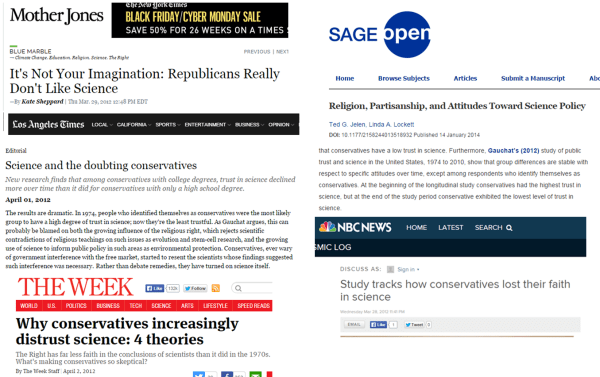
Or at least they like it very much.  Or maybe they love it, but they’re not in love with it.  That’s the argument coming out of Dan Kahan’s Cultural Cognition project these days.

Professor Kahan takes issue with the slanted punditry that has latched on to recent analyses of social attitudes toward science. Too often, commentators inflate their claims about the extent to which self-identified “conservatives” have lost faith in scientists and scientific institutions.

Kahan's Kollage of Kwestionable Klaims

Kahan’s Kollage of Kwestionable Klaims

As Professor Kahan points out, a closer look at those findings gives a much different picture. In a nutshell, since 1974 there has been a noticeable decline in the number of conservatives who say they feel “a great deal” of confidence in the leaders of scientific institutions. Some wonks seized on this finding to claim that conservatives were anti-science.

Nertz, says Professor Kahan. The number of conservatives who say they feel “a great deal” of confidence in scientists may have declined, but the total number of conservatives who say they feel either “a great deal” of confidence or “only some” confidence in science has remained fairly steady.

Even more compelling, Kahan notes that these same conservatives rank “science” near the tops of their lists of social institutions they trust. Since 1974, only medicine or the military has outranked science as the number one most trustworthy social institution among conservatives. Other institutions, , such as organized labor, the President, the Supreme Court, education, TV, and, yes, even religious institutions and big corporations, have ranked lower on conservative rankings of trustworthiness.

You heard that right.  Overall, conservatives have consistently voiced greater trust in the institution of science than in the institution of religion.  Conservatives since 1974 have evinced more trust in science than in big business.

Check out Kahan’s argument for yourself. He has charts and graphs ‘n’ stuff, so you know it’s true.

Year-End Quiz: Do You Speak Conservative?

It’s the end-of-the-year rush for every sort of retrospective.  Can you take the ILYBYGTH challenge?

Thanks to the folks at the Texas Freedom Network Insider, we have several lists of the most contumacious quotes from America’s conservative punditry.  One list describes the year in creationist/no-climate-change quotations, one from the anti-Islam contingent, and one from the continuing “War on Christmas” campaign.

Here’s the idea: The Insider compiled these quotes as a demonstration of the intellectual outrageousness of contemporary conservatism.  Here at ILYBYGTH, we have a different goal: Can we understand what these conservatives meant?  Can we see the point each speaker hoped to make?  Of course, we know that some quotations are just plain dumb.  This is not only true for conservatives, of course.  Every sort of political blabbermouth can say stupid stuff.  But in some cases, it seems that the quips that seem the most outrageous to liberal secular folks like me actually represent a coherent, compelling conservative worldview.

If you call yourself a conservative, can you explain these quotations in terms that might seem less outrageous to non-conservatives?

Or, if you think of yourself as non-conservative, can you try to put yourself deep enough into the conservative mindset to understand what each speaker was getting at?

So put down the pumpkin pie, stop donning your gay apparel, and try the quiz!

Quote #1: Pat Robertson on the definition of Islam:

I hardly think to call it a religion, it’s more of — well, it’s an economic and political system with a religious veneer.

Quote #2: Rafael Cruz, father of obstreperous Tea-Party favorite Ted Cruz, on the connection between evolution and communism:

You know most Americans have their head in the sand about evolution. I’ve met so many Christians that tell me ‘well, evolution is a scientific fact.’ Baloney! I am a scientist, there is nothing scientific about evolution. But you know something, Karl Marx said it, ‘I can use the teachings of Darwin to promote communism.’ Why? Because communism, or call it socialism if you think communism is too hard a word, necessitates for government to be your god and for government to be your god they need to destroy the concept of God. That’s why communism and evolution go hand in hand. Evolution is one of the strongest tools of Marxism because if they can convince you that you came from a monkey, it’s much easier to convince you that God does not exist.

Quote #3: Fox News’ Megyn Kelly, complaining about efforts to imply that Santa was not white:

Just because it makes you feel uncomfortable doesn’t mean it has to change. Jesus was a white man, too. It’s like we have, he’s a historical figure that’s a verifiable fact, as is Santa, I just want kids to know that. How do you revise it in the middle of the legacy in the story and change Santa from white to black?

How bout it?  Can you beat this year-end quiz?  What did these conservatives mean?  For folks like me, can you do the mental gymnastics to put yourself into a world in which these statements make sense?  Be sure to check out the fuller lists at the Texas Freedom Network Insider.

Happy 2013 and best wishes as we slide into 2014!


No More Talk: Popular Science Closes Its Comments

Why can’t we ever have a civilized conversation?

That’s the lament we hear all too often when it comes to issues such as evolution or climate change.

As science pundit Greg Laden noted recently, a new editorial policy at Popular Science shuts down conversation entirely.  The online version of the magazine will no longer be open to comments from readers.

Why?  Such comments, online editor Suzanne LaBarre explained, could have a negative impact on the way readers understand science.  She cited academic studies in which readers of hateful comments had changed their opinions about the scientific content of essays and articles.  “Trolls and spambots” had a negative impact on readers’ understanding of key scientific issues.

LaBarre concluded,

A politically motivated, decades-long war on expertise has eroded the popular consensus on a wide variety of scientifically validated topics. Everything, from evolution to the origins of climate change, is mistakenly up for grabs again. Scientific certainty is just another thing for two people to “debate” on television. And because comments sections tend to be a grotesque reflection of the media culture surrounding them, the cynical work of undermining bedrock scientific doctrine is now being done beneath our own stories, within a website devoted to championing science.

As a result, Popular Science.com comment forums will be closed.  Are such policies draconian?  Totalitarian?  Orwellian?  Is it a symptom of defeat among mainstream science popularizers that they can no longer accommodate disagreement?

Or, more chilling for those of us who want to see more and better science education in all sorts of institutions, could this new policy be a sign that mainstream academic science has been defeated at the popular level?  That is, is this new policy a sign that small-p popular science has become utterly unmoored from its connections to mainstream academic science?

When commenters, “cynical” or not, can close down the public conversation at such a storied institution as Popular Science, it demonstrates an epochal popular victory for non-mainstream science, whether that be creationism, climate-change denial, homeopathic medicine, or anything else.


Creationism and Climate Change

What do creationism and climate-change skepticism have in common?

A lot, according to the leading young-earth creationist organization Answers In Genesis.

This morning we see an argument from AiG’s Elizabeth Mitchell about the dangers of climate-change science.  Dr. Mitchell is responding to the recent report from the Intergovernmental Panel on Climate Change (IPCC).

Why do Christian creationists care about climate change?

Dr. Mitchell’s essay offers a few ideas.

First, Mitchell warns that climate-change science is based on “dubious sources.”  She asks if mainstream climate-change scientists might build their case on mistaken assumptions.  Skepticism about evolutionary science, it seems, bleeds over into suspicion of all mainstream science.  If mainstream science has been proven, from creationists’ perspective, to be a naked emperor, then its conclusions on every topic must be treated warily.

Second, young-earth creationists are committed to the idea of a young earth and, for many, a catastrophic global flood.  Arguments about the changing climate from outside the circle of young-earth creationists assume a much older earth.  Climate-change science must rest on such assumptions.  Young-earth creationists, then, have a keen interest in making climate arguments that insist on a short lifespan and a global cataclysmic flood.

Finally, we see an important difference in the issues of evolution and climate-change.  Dr. Mitchell, at least, takes a much more irenic position toward Christians who DO agree with the mainstream science of climate change.

Christians, Mitchell argues, must weigh the evidence and make up their minds about the science of climate change.  It does not do violence to scripture, she implies, to believe the mainstream science on this issue.  The most important issue, Mitchell concludes, is that

Whatever position a Christian citizen chooses to take, he or she needs to understand the present in the true light of biblically documented, scientifically affirmed history rather than uniformitarian assumptions about the earth’s past—and future.


Climate Change in Schools? Not If Fox News Can Stop It

How do conservatives feel about climate-change curriculum for public schools?  The only good climate-change curriculum, they might say, is a dead climate-change curriculum.

We saw a telling example recently of this sentiment.  Fox News host Stuart Varney warned viewers recently that the Environmental Protection Agency was filling kids’ minds with all kinds of climate-change malarkey.  The watchdog Media Matters included Varney’s warning in a compilation of Fox climate-change riffs.  (It’s the first video clip on the MM page.)

Varney was reacting to a new set of climate-change lesson plans made available by the EPA.  Bad enough, Varney exclaimed, that such pernicious ideas had penetrated public education.  But even worse was the fact that such notions had been peddled by a bloated tentacle of the federal octopus.

The problem with this sort of federal overreach, guest Monica Crowley insisted, was that “We are paying for the indoctrination of these kids.”

The federal government ought not use taxpayer money to fund such controversial anti-science, Crowley warned.  The science itself was ridiculous, she insisted.  But worst of all was the fact that the federal government used taxpayer dollars to undermine proper public education.  As she concluded, “We wonder what kind of propaganda they’ll be teaching our kids, on our time.”

Host Stuart Varney agreed.  “And it is propaganda,” he insisted.  “On our time and our money.”

What can this sort of school jeremiad tell us about conservatism and American schooling?  I have two comments and I invite others.

First, we can see from this brief clip how climate change stands poised to become the new contentious science issue in America’s schools.  Conservative traditions of opposition to evolution education seem to be retooling for an eerily similar fight over the science of climate change.  Science-education activists such as those in the National Center for Science Education have warned about this for a while now.  Indeed, the NCSE’s Glenn Branch recently called climate change the “second front” in the culture wars over science education.

Second, Varney and Crowley offer us a near-perfect demonstration of a long tradition in conservative educational activism.  We might call this the “Not In My Kids’ School” (NIMKS) tradition.  Just as protesters have often fought against bad influences in their own back yards, so have conservatives often presented cultural issues as a threat to young people.  This rhetoric hopes to energize conservatives to fight against educational programs on the threat that such programs will soon be spreading their dangerous tentacles into schools everywhere.  Bad ideas are bad enough, the thinking goes.  But such notions are far worse, far more menacing, far more likely to mobilize activists, if such ideas can be portrayed as meddling with the minds of innocent young people.

Common Core + Climate Change Science = Progressive Beer Bong

Solve the equation for X.

Many conservative educational activists are up in arms about the new Common Core State Standards.  Today we read a new articulation of this conservative hostility from Iowa State Representative Ralph Watts.

Watts called the Next Generation Science Standards—the science branch of the Common Core—a “beer bong for American education.”  For those whose college education did not include the arts and sciences of beer bongs, the Honorable Representative Watts meant to imply that these standards will deliver ideas quickly enough to overwhelm students’ ability to digest them.  In his words, the new standards constitute “a vehicle for progressive activists to spread their philosophies and propaganda to our children through a conduit designed very effectively to serve their needs.”

Next Generation Science Standards, Watts warns, insist that human-caused climate change is a fact.  This is another episode of federal overreach, Watts insists.  “Centralization. . . .” Watts concludes, will be a “colossal mistake and a classic failure.”

In the field of science education, Watts has a point.  Local control often protects the teaching of creationism and intelligent design, for example.  The same could be true for climate-change skepticism.  Putting mainstream scientists in charge of more rigorous science standards can’t hurt.  But I worry that it also won’t help too much.

In spite of Representative Watts’ poignant words, there are no true beer bongs in American education.  There is no way for any central body to deliver ideology so overwhelmingly to students nationwide as to overwhelm their home culture’s beliefs.