Core Wars

What do conservative activists hate about the Common Core State Standards?

A recent essay by conservative commentator Stanley Kurtz in National Review points out some conservative objections.

As we’ve noted recently, conservatives share with progressives a fervent opposition to the CCSS, though usually for different reasons.  Everyone from Phyllis Schlafly to the Heritage Foundation has warned of looming implications for culture, politics, religion, and education.  For those of us trying to understand conservative attitudes toward American education, these diatribes against the CCSS are a good place to start.

Kurtz was responding to an article in the Washington Post about Tea Party objections to the new shared standards.  Obama officials, Kurtz complained, responded with deceptive statements and obfuscation.  In the end, Kurtz argued,

. . . the Tea Party is right when it accuses the Obama administration of nationalizing education standards through the back door. The Founders opposed that for a reason. Once de facto nationalization is achieved, parents will lose their ability to influence their children’s education. Leverage that can be easily exercised at local school-board meetings or through representatives in state legislators will be lost to unaccountable federal bureaucrats (like Lois Lerner), and worse, to the even less accountable private education consortia that are developing the Common Core. So if educators try to impose politicized curricula or “fuzzy” math, parents will have no recourse.

Kurtz’s “local control” argument echoes a long tradition among conservative education thinkers.  Most powerfully, California State Superintendent of Schools Max Rafferty pushed hard during the 1960s to combat increasing federal control.  Rafferty’s colorful prose often made the case more lyrically than I’ve seen it since.

In one speech from the archives,[1] Rafferty articulated a conservative position for local control that I suspect might still be appealing to today’s Tea Partiers.  As he told the California Small School Districts Association Convention on March 8, 1965,

You live and work in an out-of-the-way corner of this county.  A small town where the sky is still blue, where the roar and tension of freeway traffic has not yet penetrated; where a little boy can still run and play in open fields.  You’re there because you want to be.  You moved there deliberately a few years before because you liked that feeling of grassroots independence.  That unique sense of having an equal share in the controlling of one’s own destiny which has been the legacy of every American ever since the first little villages began to dot the New England countryside more than three centuries ago.  You’ve been happy there.  Your children are growing up clear-eyed and self-reliant with that indescribable look of quiet confidence which comes from life spent in a region where hills and trees are very real, very close at hand.  Where a neighbor is a lot more than someone who just happens to live close to you.  Suddenly, something goes wrong at your local school house, as things sometimes do.  Maybe it’s a new course of study which just doesn’t quite fill the bill.  Maybe it’s a neurotic old school administrator, we do run across one now and then!

No matter, you tell yourself, nothing can possibly happen in your community which can’t be solved by you and your neighbors, working and acting together in the traditional American spirit of mutual tolerance and good will.  But this time you’re wrong.  Shockingly, unbelievably wrong!  You and your friends try to arrange an appointment with your district superintendent to tell him of your problems and make your suggestions.  But you don’t have a district  superintendent anymore, in fact you don’t even have a district!  You try to contact your local school board, but it’s gone too!  A hundred miles away, a group of county or state officials meet once a month to decide the destiny of your children.  You don’t know any of them personally, in fact you never even heard most of their names!

But in our nightmare today, they tell you what your children will be studying.  They hire the teachers who will be molding the thinking and the behavior of your children throughout the years that lie ahead.  They decide whether or not the school bus is going to stop near your home or indeed if there is going to be a school bus at all.  Whatever they decide, you’re stuck with.

Rafferty worried about the Elementary and Secondary Education Act, the direct progenitor of No Child Left Behind.  As several of the commentators on Stanley Kurtz’s essay pointed out, the centralization of public schooling can be traced back through several generations of federal leaders, including President George W. Bush.
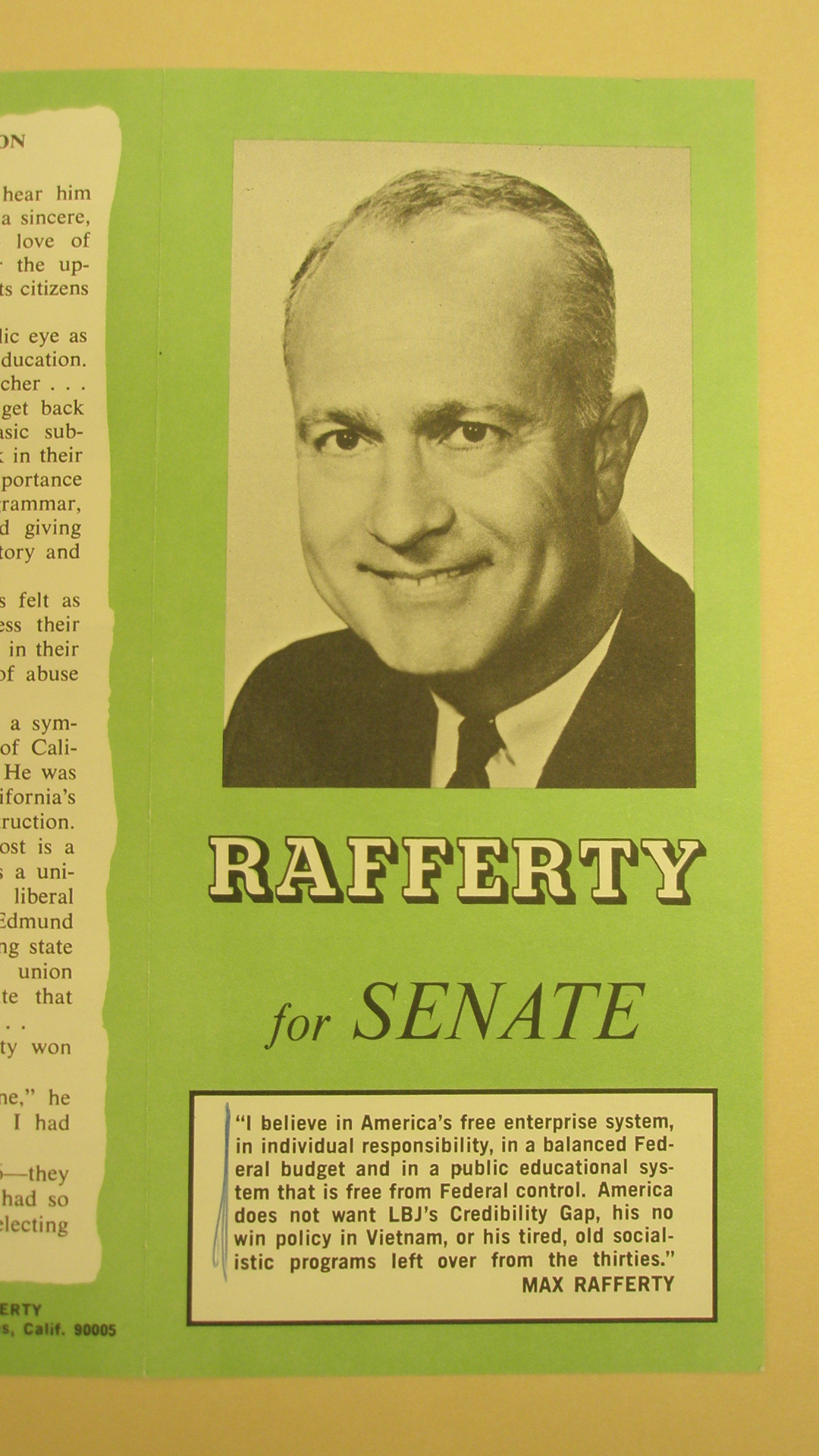
From the Hargis Collection.

From the Hargis Collection.

But that doesn’t mean that today’s version, the Common Core State Standards, will be greeted with anything but alarm among some sectors of conservative thought.


[1] This speech survives as a typescript in the Billy James Hargis Papers, University of Arkansas Mullins Library Special Collections, MC 1412, Box 48, Folder 2, Public Schools, 1950-1978 (1 of 2).  This collection of papers represents, IMHO, the best single-stop shop for any scholar hoping to understand the career of twentieth-century educational conservatism.  The Reverend Hargis was a leader in the Christian conservative movement in the second half of the twentieth century, and he was an avid collector of newsletters, correspondence collections, and other ephemera that shed a unique light on conservative thinking about education during the period.

 

Phyllis Schlafly Blasts the Common Core

Don’t do it, Phyllis Schlafly warned states recently. Don’t fall for the hoopla about the new Common Core State Standards.

Schlafly is often best remembered for her successful campaign to block the Equal Rights Amendment in the 1970s. But as historian Don Critchlow has argued, Schlafly’s career was about much more than just the ERA.  An examination of Schlafly’s activism can tell us much more about the changing face of “conservatism” in the twentieth century.

Image Source: Christian Post

Image Source: Christian Post

Now Schlafly has joined the chorus of conservative anti-CCSS voices.  As we’ve noted earlier here at ILYBYGTH, conservatives join many progressives in lambasting the new unified state standards, but usually for different reasons.

Writing in the pages of the Christian Post, Schlafly offers conservative parents and voters solidly conservative reasons to get up off the couch and take an interest in their local schools’ new curricular guidelines.  “Common Core,” Schlafly warns, “means federal control of school curriculum, i.e., control by Obama administration left-wing bureaucrats.”

The standards will not improve students’ academic performance, Schlafly argues. Nor will they achieve their trumpeted goal of making all students “college ready.”  Rather, these new standards represent only the latest left-wing drive to transform the United States into a “totalitarian government.” In Schlafly’s words,

Common Core means government agencies will gather and store all sorts of private information on every schoolchild into a longitudinal database from birth through all levels of schooling, plus giving government the right to share and exchange this nosy information with other government and private agencies, thus negating the federal law that now prohibits that.

Everything about the standards is “encrusted with lies,” Schlafly insists. The suggested content itself predictably indoctrinates students toward leftist ideas and policies. As conservatives have warned for decades, the suggested readings even veer into the “pornographic.”

So what is a conservative to do? According to Phyllis Schlafly, the new Common Core State Standards represent only the latest effort by leftist federal bureaucrats to seize control of children’s minds. Any red-blooded American must shudder at the implications.

Common Core + Climate Change Science = Progressive Beer Bong

Solve the equation for X.

Many conservative educational activists are up in arms about the new Common Core State Standards.  Today we read a new articulation of this conservative hostility from Iowa State Representative Ralph Watts.

Watts called the Next Generation Science Standards—the science branch of the Common Core—a “beer bong for American education.”  For those whose college education did not include the arts and sciences of beer bongs, the Honorable Representative Watts meant to imply that these standards will deliver ideas quickly enough to overwhelm students’ ability to digest them.  In his words, the new standards constitute “a vehicle for progressive activists to spread their philosophies and propaganda to our children through a conduit designed very effectively to serve their needs.”

Next Generation Science Standards, Watts warns, insist that human-caused climate change is a fact.  This is another episode of federal overreach, Watts insists.  “Centralization. . . .” Watts concludes, will be a “colossal mistake and a classic failure.”

In the field of science education, Watts has a point.  Local control often protects the teaching of creationism and intelligent design, for example.  The same could be true for climate-change skepticism.  Putting mainstream scientists in charge of more rigorous science standards can’t hurt.  But I worry that it also won’t help too much.

In spite of Representative Watts’ poignant words, there are no true beer bongs in American education.  There is no way for any central body to deliver ideology so overwhelmingly to students nationwide as to overwhelm their home culture’s beliefs.

Conservatives and the Common Core

What do conservatives think about the emerging Common Core State Standards?

As with any question, ask a hundred conservatives and you’ll likely get a hundred different answers.
However, some distinct themes have emerged in recent months.

First, many conservative politicians and activists object to the Common Core’s implications for the creeping expansion of government.  Some insist that the standards add another layer of inaccessible, distant, controlling, expensive central control.

Second, conservatives object that the new national standards chip away at parental control of children’s education.  With greater central control, parents and responsive local governments will lose that much more ability to control directly what goes in their local public schools.

Both of these are storied conservative protests against the trends in public education.

Before we examine these themes and their histories, let’s look at the CCSS themselves.  So far, forty-five states, plus the District of Columbia and Department of Defense schools have adopted these standards.  Supporters of the CCSS insist these are not imposed by the federal government, but rather created jointly by state education officials.  The reasons for such standards are many, according to supporters.  In the words of the CCSS Initiative,

“High standards that are consistent across states provide teachers, parents, and students with a set of clear expectations that are aligned to the expectations in college and careers. The standards promote equity by ensuring all students, no matter where they live, are well prepared with the skills and knowledge necessary to collaborate and compete with their peers in the United States and abroad. Unlike previous state standards, which were unique to every state in the country, the Common Core State Standards enable collaboration between states on a range of tools and policies.”    

Conservatives are not the only ones to dispute these claims.  Progressive critics (see one example here) often lament the new standards’ failure to consider adequately individual student situations.  Some progressives call the standards a greedy corporate power grab.  Others lament the goal of squeezing all young minds into a procrustean bed of regurgitative multiple-choice testing instead of pursuing the more difficult goal of authentic learning for real students.  Alfie Kohn, for instance, insisted that national standards would “squeeze the life out of classrooms” by mandating one-size-fits-all education, dictated by self-seeking corporate interests.

When conservative activists and pundits critique the CCSS, it is usually on different grounds.  Writing for the Heritage Foundation, for example, Lindsey Burke warned, “The push for centralized control over what every child should learn has never had more momentum.”  CCSS, which Burke called “national standards,” represented a “challenge to educational freedom in America.”  Implementation of the standards would be expensive, Burke pointed out.  Even worse, these standards reversed the proper structure of education.  Instead of more and more central control, Burke argued, “Education reform should give control over education to those closest to students.”

The Heritage Foundation’s Rachel Sheffield praised state lawmakers who pushed to exit the CCSS.  In Indiana, for instance, conservative state lawmakers have proposed a bill to put the CCSS on hold.  One of the requirements of Indiana’s Senate Bill 193, for instance, will be to include parent members on the standards committee.  Another will be to allow any parent to challenge their children’s standard-based high-stakes test results.

These themes—federal overreach and parental control—have long been central to conservative educational activism.

As we’ve noted, agitation against federal intrusion into the local politics of education has been an important element of conservative educational activism since at least the 1940s.  Though it might come as a surprise to some, before the 1940s many conservatives endorsed increased centralization of education policy, as Douglas Slawson has noted in his excellent book The Department of Education Battle, 1918-1932.

The second conservative worry about CCSS also has a long history.  Conservative pundits have argued for decades that parents need more control over their children’s education.  Back in the 1960s, conservative educational leader Max Rafferty insisted, “Children do not belong to the state. They do not belong to us educators, either. They belong to their parents and to nobody else.  And don’t you forget it.”  (Source: Rafferty, On Education, pg. 9)

Note one protester's button: "Parent Power"

Note one protester’s button: “Parent Power”

These conservative concerns spanned the country and the decades.  As historian Ron Formisano noted in his landmark 1991 history of Boston disputes over forced busing, parents insisted on their fundamental rights to determine their own children’s educational careers.  As anti-busing leader Louise Hicks fumed, “If under a court order a child can be forcibly taken from his parents into unfamiliar, often hostile neighborhoods, then we shall have opened a pandora’s box of new, unlimited government powers” (pg. 192).

Similarly, President Reagan insisted in 1983, “I believe that parents, not Government, have the primary responsibility for the education of their children.  Parental authority is not a right conveyed by the state; rather, parents delegate to their elected school board representatives and State legislators the responsibility for their children’s schooling.”  (Source: Catherine Lugg, For God and Country, pg. 136).

Across the spectrum of conservative belief and activism, we hear similar echoes.  In 1989, for instance, creationist leader Ken Ham warned that “Most parents have left the training of their children to the church, school or college.”  No wonder, Ham argued, that children embraced anti-God theologies.

So when conservatives in 2013 warn that CCSS will undermine parental control, they draw on a rich tradition of conservative thought and activism.  Schools must remain on a tight leash, many conservatives have insisted over the years.  If allowed too much power, centralizing educational authorities will take over.


Homeschooling and the Common Core

Education folk these days are a-flutter with talk about the Common Core State Standards.

Recently, William Estrada of the Home School Legal Defense Association has warned about the implications for homeschoolers of such national curricula.

Without an historical perspective, it would be easy for readers of recent headlines to assume that conservatives have always opposed greater educational centralism.  After all, Ronald Reagan came to office on a promise to eliminate the then-new Department of Education.  Recently, Republican Presidential hopefuls such as Rick Perry, Michele Bachmann, and Ron Paul promised to fulfill Reagan’s plan.

Back in the 1920s, however, leading conservatives often made the strongest case for a federal department of education.  As I explored in a recent article in the History of Education Quarterly, the 1920s Ku Klux Klan hoped greater educational centralization would help Americanize immigrants and standardize Americanism education.  The main institutional opponent of such centralization in the 1920s, as Douglas Slawson’s wonderful book The Department of Education Battle, 1918-1932 points out, was the Catholic Church.  In that turbulent decade, social traditionalists, conservative Protestants, and many leading progressives all agreed that the nation needed greater centralization and increased educational funding.

By the 1940s, however, educational centralization had become a leading bugbear of anti-communist conservatives.  From the fringes of conservative anti-communism, influential pamphleteer Allen Zoll denounced federal aid to local schools as the central strategic goal of subversive communism.

Allen Zoll, They Want Your Child! (New York: 1949)

Allen Zoll, They Want Your Child! (New York: 1949)

In “They Want Your Child!” (New York: National Council for American Education, 1949), Zoll warned, “We had better stop smiling.  There IS a conspiracy.  The conspiracy against the American way of life, against everything that we hold dear, is probably the most completely organized, ruthless design against other people ever set in motion in all human history. . . . THE INFILTRATION AND CONTROL OF AMERICAN EDUCATION BECAME COMMUNISM’S NUMBER ONE OBJECTIVE IN AMERICA.  THEY WANT THE CHILDREN OF AMERICA.  THEY WANT YOUR CHILD.”  To Zoll and many of his readers, centralization of education meant that subversives could collect all the threads of education policy in their grasping claws.

Once the US Supreme Court began ruling in favor of school desegregation in the 1950s and against school prayer in the 1960s, the notion of greater educational centralization became anathema to wider and wider circles of American conservatives.  Centralization became associated purely with the long-standing enemies of traditionalist and conservative education: evolution science, progressive pedagogy, left-wing anti-racism, anti-patriotic politics, and secularism.

In his December 2012 brief, Will Estrada of the HSLDA made some of the traditional conservative arguments against greater educational centralism.  First, Estrada pointed out, states were pushed into accepting these common standards out of financial desperation, not out of any educational benefit.  President Obama’s Race to the Top funding, as Estrada noted, was often tied to adoption of common core standards.  Second, centralized education would decrease quantifiable student achievement, Estrada argued.  Scores on English and math tests would likely decrease after these standards were in place, at the cost of billions of dollars.  Perhaps most in line with the complaints of many American conservatives, Estrada warned that common standards weakened parental control.  “Top-down, centralized education policy,” Estrada wrote, “does not encourage parents to be engaged.”

Specific to homeschoolers’ interests, Estrada worried that centralized curricula would encourage greater pressure on homeschoolers to follow along.  If every college and every college entrance exam measured student achievement by success on common-core-linked tests, homeschool students would feel pressured to master that common curriculum.

Supporters of today’s Common Core State Standards argue that the standards will bring greater efficiency and equality to education in the United States.  However, the idea of centralization has had a checkered career among American conservatives.  Will Estrada of the HSLDA raised one voice in opposition to today’s centralization effort.