I Don’t Know What to Believe…

I don’t even know what to know, or what knowing means, or what believing might mean.  The good news is that I’m not alone.  No one seems sure of these things, especially not when it comes to touchy subjects like evolution. But I’m still confident of our argument that the best approach to teaching evolution is to encourage a separation in science classrooms of the need for students to KNOW evolution from the need for students to BELIEVE evolution.

It’s a tricky distinction, and I’m sympathetic to criticism that it may not make a real difference.

Some recent survey results make me wonder if this distinction might not even be a workable one in public schools. In the blog of the National Center for Science Education, the prolific Josh Rosenau notes the results of some survey work from the University of Alabama. In short, the researchers found that the more college students accepted evolution, the more they knew about it. Now, this confounds claims by cultural-cognition guru Dan Kahan that “knowing” evolution says more about who you are than about what you know. It is more a measure of belief than of knowledge.

For a mild-mannered historian like me, these conflicting survey results leave me scratching my head. Not only are we not sure if people need to “believe” evolution to “know” it, but we’re not even sure if we “know” that “believing” and “knowing” go together!

But I can’t just throw up my hands and go back to the archives. This question of knowledge and belief is central to all of us who care about evolution education. In my upcoming creation/evolution book with talented and stylish philosopher Harvey Siegel, we argue that public schools must teach evolution, but they must teach it in a way that separates claims of knowledge and belief.

Because there is one thing I do know, as a historian: Creationism is a religiously driven belief system. It is not exactly science, but this whole foofaroll about evolution education stems from the fact that creationism is a religiously driven belief system with claims to scientific legitimacy.

When it comes to educational policy, we have to make a delicate distinction that is usually lost in all the hot air. Creationists’ claims to scientific legitimacy do not carry any weight outside of their own religious circles. But that does not mean creationists do not have a right in the public square to believe in their own scientific legitimacy.  It means creationists have a right to public schools that do not force them to perform religious acts. Since affirming the truth of mainstream evolutionary thinking would be a religious act for many creationist students, public schools need to be more careful about insisting on such things.

In practice, in public schools, this means we face a situation that makes everyone unhappy. Creationism has no legitimate claim to a place in public-school science curricula, since it is derived from religious beliefs. But public-school science classes (and history classes, and math classes, and literature classes and gym classes) have no right to push creationist students to engage in religious acts, either.

Rather, to be more precise, public schools may teach ideas that tend to denigrate religious ideas. Schools shouldn’t do so casually or glibly, but if there is an important reason, they may do so. However, public schools may not force (or even encourage) students to engage in the (possibly) religious act of denigrating creationism themselves. In short, public schools CAN expose students to ideas students find religiously offensive. But public schools CAN’T ask students to do religious acts. If affirming the truth of evolution is a religious act, then public schools cannot insist upon it, or even imply that such an affirmation is desirable.

Creationists may hate this conclusion. Since the 1920s, anti-evolutionists and creationists have insisted that their beliefs are better science, true science. In court case after court case, however, experts have demonstrated the intellectual paucity of this belief. Creationists may not admit it, but they might recognize that their claims to scientific legitimacy don’t convince people outside of their own religious circles.

And for public education, that’s enough. My religious beliefs do not carry weight—as religious beliefs—in public schools. Even if my religious beliefs insist that they are better science. Or history. Or literature. Or physical education.

But traditional science-ed types will also hate this conclusion. As a set of religious beliefs, creationism is entitled to special consideration in public schools. Though the case law is somewhat mixed on this point, the moral case is compelling: Children of any religious or cultural background must be made welcome in every public school. Their beliefs may be challenged by the curriculum, but students cannot be asked to perform religious acts in those public schools. And acts that might not seem religious to me might be religious to religious people, or even to an imaginary “objective observer.”

Conservative Christians have had mixed results trying to make this case in court. Perhaps most famously, in 1987’s Mozert v. Hawkins, an appellate court ruled that conservative parents could not ban curricular materials they found offensive. The conservative parents had argued that textbooks with references to occult practices, evolution, and impolite children infringed on their rights to religious liberty. The books, the parents believed, hurt their children’s ability to freely practice their religion.

The constitutional complexity in this case was demonstrated by its tortuous path through the court system. One district court judge agreed with the parents on one point: textbooks that say there are multiple ways to worship God really are teaching religious content. In the end, the appellate court disagreed.

Other federal courts have made this difficult point. In another case from Tennessee, Wiley v. Franklin (1979), the court decided that

if that which is taught seeks either to disparage or to encourage a commitment to a set of religious beliefs, it is constitutionally impermissible in a public school setting.

The rub in these cases, it seems to me, is that courts have trouble defining the boundaries of religion. The final ruling in Mozert relied on the fact that the conservative children didn’t have to do or say or affirm anything about religion. They were only exposed to ideas that their parents considered offensive.

And that seems telling for our case here. Though I may find it a simple statement of fact, the notion that there are many paths to religious salvation has profound religious implications for many people. And though I may find it a simple statement of fact, the notion that the earth is bajillions of years old has profound religious implications for many people. Public schools should expose students to these ideas. But public schools cannot force creationist students to engage in the religious act of agreeing with these ideas.

The fact that affirming evolution is not a religious act for me does not mean it is not a religious act for anyone. For many creationist students, saying that evolution is true is a religious act. Schools can’t insist upon it. But understanding the basic concepts of evolution is not. Public schools must insist upon that.

Though this post is already too long, let me add one caveat. This argument does not agree with creationists’ insistence that evolution is a religion. Rather, it simply says that evolution is an idea that some religious people consider religious. This is a hugely important distinction.

Public schools cannot force students to do religious things. For many students, affirming that evolution is true would be a religious act.

At the same time, public schools must teach the best available knowledge. In science classes, the modern evolutionary synthesis is an example of that sort of knowledge.

So here is our goal: Separate out our demands on students. It is not as complicated as it may seem. Adding two or three little words can do it. Instead of asking students to say, “The earth is millions of years old,” we ask students to say, “Scientists say the earth is millions of years old.”  Instead of asking students to say, “Humans evolved from other forms of life,” we ask students to say, “According to scientists, humans evolved from other forms of life.”

Do I know that this will work? No, but I believe it will help.
“The Talk:” Evolution Edition

What do young people need to know about evolution?  A recent commentary from University of Washington professor David Barash has sparked a new round of debate.  For us at ILYBYGTH, it sparks a different question: When and how should ‘resistant’ students learn about evolution?

We all know that some religious students get uncomfortable when the subject of evolution comes up.  “Until recently,” Barash wrote, “I had pretty much ignored such discomfort, assuming that it was their problem, not mine.”  They should be uncomfortable, Barash concluded.  There were foundational ideas in many religious traditions that science simply made untenable.

For example, students who really understood evolutionary science would have a hard time maintaining a belief in a fundamentally good and all-powerful deity.  As Barash put it,

The more we know of evolution, the more unavoidable is the conclusion that living things, including human beings, are produced by a natural, totally amoral process, with no indication of a benevolent, controlling creator.

Also, students who hope to maintain a belief in the special nature of humanity will be in for a rude awakening.  Humans, evolutionary scientists have demonstrated conclusively, are “perfectly good animals,” but not anything specially created.

Finally, the old watchmaker argument just doesn’t hold water.  Though life might seem irreducibly complex, modern evolutionary science has demonstrated that, as Barash put it,

an entirely natural and undirected process, namely random variation plus natural selection, contains all that is needed to generate extraordinary levels of non-randomness.

Not surprisingly, creationists have reacted with outrage.  Stephen Meyer of the intelligent-design bastion Discovery Institute blasted Barash as “willfully ignorant” of recent scientific developments.  Other creationists have called Barash “intellectually dishonest.”  Even Catholic writers berated Barash.  As one Franciscan blogger put it, “His laboratory pontification exceeds his areas of competence.”

Such reactions, it seems to this writer, accomplish Barash’s goals perfectly.  With his insouciant attitude toward religious perspectives and his history of anti-religious polemics, it’s hard not to conclude that Barash and the editors at the New York Times hoped for exactly this sort of outraged response.

Here at ILYBYGTH, we want to ask different questions.  For instance, we want to know if students from anti-evolution homes can be taught about evolution without simply rejecting it.  We want to know if our deep culture-war trenches over evolution education can be bridged by a different approach.

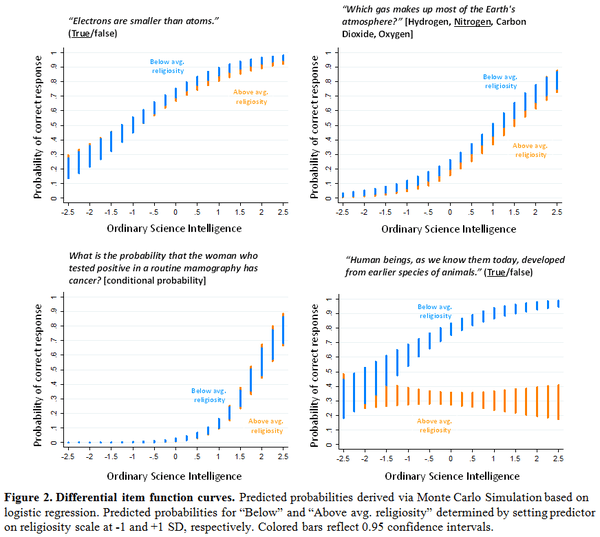
As we’ve learned from scholars such as Dan Kahan, what people say they know about evolution tells us about their identity, not their knowledge base.  As Kahan puts it, it tells us about who they are, not what they know.  There is not a significant difference between evolution-supporters and evolution-deniers when it comes to knowledge about evolution.  That is, people who say they believe in evolution or agree with evolutionary theory don’t actually know more about it than people who say they don’t.

And, as ethnologist and science-education guru David Long has demonstrated, “evolution” is tied to a bundle of non-scientific meanings for many resistant students.  Knowledge of evolutionary theory was not a problem for the creationist students Long studied.  Instead, acceptance of the idea of evolution presented identity challenges to these students.

Perhaps more shocking to culture warriors like Barash, creationists WANT their children to know about evolutionary theory.  But they want their children to be protected from attitudes like his; creationists want their children to learn about evolution from people who understand and respect their religious qualms.

How do we know this?  Because many conservative religious schools INSIST that all students take a course on evolutionary science.  Liberty University, for example, has made an evolution/creation course a requirement for graduation.  And here at ILYBYGTH, I have been educated by creationist parents who earnestly hope to teach their children about evolution.

Learning about evolution, Liberty style

Learning about evolution, Liberty style

In an upcoming book, philosopher Harvey Siegel and I argue that the way forward in evolution education is to promote an “understanding-not-belief” approach.  Public schools must teach students the best available science.  And right now, that includes the modern evolutionary synthesis.  But public schools must also refrain from imposing religious (or anti-religious) ideas on students.

It’s a tall order, and many smart commentators have pointed out the difficulties with our prescription.  As David Long has suggested, our book might just be a “red herring” in these discussions.

But imagine how very different our version of “the talk” would be from David Barash’s.  Like Barash, we want teachers to tell all students that evolution is the best current science.  It is.  But that doesn’t mean that people can’t and don’t have good reasons for speaking out against it.  Students should be allowed, no, encouraged, to separate their personal identities from their knowledge about evolution.  Knowing evolution makes them educated, not evil.

Perhaps most important, a teacher’s attitude can make all the difference.  If a teacher hopes to make students “shift uncomfortably in their seats,” then Barash’s approach will work.  But a good teacher recognizes the world of difference between a healthy, growthful intellectual discomfort and an antagonistic, coercive one.  Barash hopes to jolt creationist students out of their intellectual blinkers.  But his approach will only weld those blinkers on more securely.

A better “talk” will be one that helps students understand that evolution is an idea, not an identity.

Knowin’ Ain’t Believin’

What do we mean when we say we do or don’t believe in evolution?  As we’ve discussed here in the pages of ILYBYGTH, it’s not the simple question it appears.  At his Cultural Cognition blog, Dan Kahan recently rehashed his argument about the utter disjunction between knowledge and belief when it comes to evolution.  The argument has ramifications for both the way we think about the culture wars in general and the specific ways we think about evolution education.

For those interested in issues of evolution and creationism, if you’re not regularly reading Dan Kahan’s Cultural Cognition blog, you should be.  Professor Kahan argues that culture precedes facts.  Whether the issue is immunizations, climate change, evolution, or other questions of science and public understanding, Professor Kahan insists that “knowledge” is not a simple matter of exposure to facts.  The way people respond to facts is conditioned by their cultural background.

In the case of evolution and creationism, conservative religious folks may know a great deal about education, yet that knowledge tends not to show up on standard surveys.  As Professor Kahan relates, religious people often know a great deal about mainstream science, yet when they are asked about evolution, they seem not to know it.  But the standard survey questions misrepresent how many of those conservative religious types actually know about evolution.

The traditional question asked by the science literacy survey of the National Science Foundation, for instance, asks respondents the following question: “human beings, as we know them today, developed from earlier species of animals, true or false?”  Not surprisingly, among highly religious Americans, the number of people who get this question “correct” takes a huge dive.  This is true even among those respondents who answer many other science questions correctly.

You know it must be true, because it has charts 'n' stuff...

You know it must be true, because it has charts ‘n’ stuff…

But this discrepancy can be fixed by wording the question differently.  When the survey added a simple phrase such as “According to scientists,” then religious people answered the evolution question correctly.  In other words, asking some conservative religious people if evolution is “true or false” is not asking them if they “know” evolution.  But!  Asking conservative respondents if SCIENTISTS SAY human beings developed from earlier species of animals comes closer to testing real knowledge about evolution.  And the simple addition of this phrase—“scientists say”—offers a promise of healing some of the viciousness of our evolution/creationism controversies.

After all, what do we want out of people?  Must we insist that Americans believe evolution to be true, rather than false?  Or rather, do we want to insist that to be educated, one must understand what mainstream science says about evolution?

As I am arguing with co-author Harvey Siegel in a new book about the history and philosophy of evolution education, only the latter makes any real sense.  It makes sense for creationists.  And it makes sense for mainstream scientists and science educators.

Those of us who want public schools to teach evolution—and only evolution—as science  need to be clear among ourselves what it is we are really after.  We do not want to impose religious beliefs on public-school students.  If a student and his or her family finds evolution objectionable for religious reasons, it is not the job of the public school to disabuse that student of those religious beliefs.  It is similarly not the job of a public school to convince creationist students that evolution does not in fact threaten those religious beliefs.  In short, the religious beliefs of public-school students are beyond the purview of public-school teachers and curricula.

But it is entirely proper and necessary for public schools to insist that all students of all backgrounds know the best current science.  And that science is the modern evolutionary synthesis.  Whatever some creationist pundits may say, creation science, intelligent design, and other varieties of creationism are not scientific improvements.  They are, rather, religious objections to mainstream science.

Professor Kahan’s careful distinction between knowledge and belief provides a helpful guide for this vision of proper evolution education in public schools.  Public school science classes must teach evolution and only evolution as the best current scientific knowledge.  Students must be able to identify and define key ideas such as natural selection, random mutation, and genetic variance.

But too many science educators implicitly tie knowledge of those ideas to belief in them.  That connection is as unnecessary as it is harmful.

As Professor Kahan points out, this connection between knowledge and belief can be fixed with a simple patch.  In surveys, instead of asking respondents if human evolution is true or false, we can ask respondents if human evolution is true or false, according to mainstream scientists.

The same approach can work in public school science classes.  Instead of implying that evolution is true, teachers can add—either implicitly or explicitly—a notion that evolution is the way mainstream science explains the origins of life.  Students can and must be expected to explain and analyze evolution.  But they can do so with a conditional always in the background.  That is, they can maintain a notion that the mechanisms of evolution are the ideas of mainstream scientists, not some grand explanation of the truth about human life.

Can it work?  According to Professor Kahan, it already does.  Changing the wording of survey questions has an enormous impact on the answers.  And historically, as I’ve argued in both my 1920s book and my upcoming book about conservative activism in education, creationists have not objected to their children learning about evolution.  They have only disputed the way evolution was taught as the simple truth about humanity’s origins.  The same is true today, I’m guessing.  Creationists, I’m confident, will agree that their kids should know about evolution.  They simply resent the attitude of many evolution educators.

This attitude can be seen in the way we talk about evolution education.  Is evolution “true?”  That sort of question is the absolute wrong approach.  It forces evolution skeptics to reject evolution.  It forces dissenters to present themselves as anti-evolution.  And students must therefore get questions about evolution wrong.  Students must try not to “know” evolution.  But if we allow students to add a simple phrase, we might sidestep a world of unnecessary and corrosive disputation.

Consider the world of difference, for instance, between the following two student responses:

  • Scientists say that some speciation arose through the mechanism of genetic drift.”
  • “Some speciation arose through the mechanism of genetic drift.”

There are only three additional words in the first response, yet the cultural meaning of the first response is worlds different from the second.  Many creationists, I’m convinced, would be willing and eager for their children to learn about evolution, if those children had the freedom to discuss evolution with the implicit addition of the phrase “scientists say.”

Am I missing something?  For those like me who want to see more evolution education in public schools—and more effective evolution education in those schools—would this approach help?  And for creationist parents, teachers, and preachers, would the separation of knowledge from belief lead you to support this sort of evolution education for your kids?


Take the Creation Museum Challenge

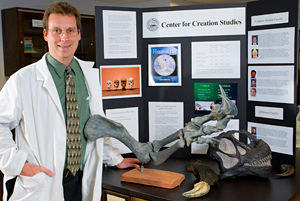
We can gnash our teeth.  We can pull our hair.  But no matter what we do, the Creation Museum of Answers In Genesis has pulled it off.  With its new $1.5 million dinosaur exhibit, the flagship museum of young-earth creationism has successfully mimicked the outward appearance of mainstream scientific museums.

Big Valley Creation Science Museum

Big Valley Creation Science Museum

It used to be easy.  Creationist museums used to be only sad little affairs.  They used to look like this one from Alberta, Canada.  The Big Valley Creation Science Museum, pictured here, may do a great job in spreading the creationism gospel.  But no idle tourist would be likely to confuse it with mainstream museums such as the Smithsonian’s Museum of Natural History or Boston’s Museum of Science.

It used to be easy for outsiders like me to mock the lame pretensions of the many creation museums that dotted our great land.  And Canada.  As one angry visitor noted, even the bigger creation museums used to have strange, sad displays like this one from San Diego’s Creation and Earth History Museum.

Not a Lot of Big Bang for your Buck

Not a Lot of Big Bang for your Buck

But here’s the new challenge: Can you tell which of the three pictures below comes from Kentucky’s Creation Museum display and which come from the Smithsonian and Boston’s Museum of Science?  As arch-creationist Ken Ham explained gleefully recently, this new display of a million-dollar Allosaurus fossil puts Ham’s Creation Museum in the same league as those mainstream museums.  As Ham put it,

For decades I’ve walked through many leading secular museums, like the Smithsonian in Washington, D.C., and have seen their impressive dinosaur skeletons. But they were used for evolution. Now we have one of that class, and it will help us defend the book of Genesis and expose the scientific problems with evolution.

So take the Creation-Museum challenge.  Just by looking, can you tell which of these images comes from a young-earth creationist museum and which come from mainstream ones?  (Don’t cheat.  But once you’ve given it a try, you can click on each image to see its provenance.)

Is this "real" science?"

Is This “Real” Science?”

Or Is It This One?

Or Is It This One?

Millions of Years?  Or Millions of Dollars?

Millions of Years? Or Millions of Dollars?

This successful mimicry is important.  In creationism’s twentieth-century struggle to establish alternative educational institutions to rival those of mainstream science, young-earth creationists often wrestled with significant disadvantages.  Not least of these were questions of funding, as historian Ron Numbers described in his must-read book The Creationists and I detailed in my 1920s book.  In the case of this priceless fossil, rich creationists Michael and Stephen Peroutka donated it to help the Creation Museum with its work.

It would be nice to think that America’s public would make its decisions about the age of the earth and the origins of humanity by weighing evidence and considering counter-claims.  To people like me, the Creation Museum’s claim that this well-preserved fossil serves as proof of a worldwide flood 4,300 years ago seems absurd.

But I don’t think we need to be very cynical to guess that appearance matters.  As Dan Kahan argues, what people believe about creation and evolution usually has more to do with their cultural identity than it does with scientific evidence.  If Answers In Genesis can make their museum LOOK like the Smithsonian, many visitors will assume it is just as good.  And if Answers In Genesis can crank out peer-reviewed science publications that attest to the scientific veracity of their claims, many readers will assume their science is just as good.

So take the Creation Museum challenge.  If you can’t tell the difference, how can you expect anyone else to?


Bill Nye Misses the Boat on Creationism

What does it mean to be a creationist?  Especially a young-earth creationist of the Ken Ham sort?  “Science Guy” Bill Nye argued the other day that creationism represents “striking science illiteracy.”

I like Bill Nye.  I like science.  But Nye’s statement represents a lamentable cultural illiteracy.  In the long run, it doesn’t help the cause of evolution education.  It does not help to bridge the culture-war trenches.

http://www.youtube.com/watch?v=5I95sTHR2mc

Around minute five of the video above, Nye begins to discuss his recent debate with young-earth creationist leader Ken Ham.  Nye humbly acknowledges that it might not have been a good idea to debate Ham.  But he went ahead with the debate.  Why?  Because Nye worries about the “striking science illiteracy” represented by young-earth creationism in the United States (around 6:23 in the video clip above).  Without science, Nye goes on, there would be no internet.  There would not be enough food for everyone.  Science and especially science education represent basic building blocks of a just and prosperous society.  Nye hopes that high-profile debates might help voters and taxpayers de-fund and delegitimize creationism in America’s public schools.

For the record, I agree that the “Ham-on-Nye” debate was a good thing for those of us who want more and better evolution education in America’s schools.  I applaud Nye’s bravery and his presentation skills.  But I wish he would not rely on this false notion that young-earth creationism represents a simple lack of knowledge about evolution.  It is not true, and it suggests bad policy approaches to improving evolution education.

Consider, for example, our best recent polls about science literacy and creationism.  As political scientists Eric Plutzer and Michael Berkman recount in their book Evolution, Creationism and the Battle to Control America’s Classrooms, creationists are not less scientifically literate than non-creationists.

For instance, one Pew poll from 2005 found that Americans who know about the scientific consensus in favor of evolution still support the teaching of creationism in public schools.  You read that right: Among the 54% of Americans who agree that scientists agree about evolution, large majorities (74%) supported teaching creationism, intelligent design, or some mix of evolution, ID, and creationism in public-school science classes.

Another poll that Berkman and Plutzer summarize found that general scientific literacy was not correlated with belief in evolution.  That is, whether or not one was aware of general scientific information had no relation to whether or not one evinced a belief in evolution.

As Dan Kahan noted recently, even the National Science Foundation has considered removing a question about evolution from its science-literacy poll.  Why?  Because there is no correlation between general scientific knowledge and beliefs about evolution.  What people know or don’t know about evolution does not give us any information about whether they believe it or don’t.

Knowledge is distinct from belief.

Bill Nye’s assumption that young-earth creationism represents a lack of scientific knowledge is more than just an embarrassing ignorance on Nye’s part.  The educational and political tasks in cases of naïve non-knowledge are worlds apart from the educational and political tasks in cases of intentional or constructed non-knowledge.  In the case of evolution education, if creationists were simply unaware of evolutionary science, then outreach programs would have a good chance of success.  The task would be simply to spread information.  But in reality, evolution education must recognize that many students and families are not simply ignorant, but resistant to this form of knowledge.  Educational efforts must strive first to understand the reasons for this resistance.  Only then can evolution educators hope to develop effective strategies to teach evolution.

Consider an example from outside the world of evolution education.  Imagine your task is to deliver polio vaccine in a rural area.  If the people in the area did not know about the vaccine, you could simply publicize the benefits and the location of the vaccination clinic.  Then people would bring their children to receive the vaccine.

But if the people in the area thought that the vaccine was dangerous, you couldn’t simply put up posters and distribute flyers.  You would have to engage in a very different task.  You would have to understand why people thought the vaccine was dangerous.  You would have to get to know the reasoning involved in order to offer counter-arguments that would be convincing.  Only if you could convince people that the vaccine was helpful and not dangerous could you ever hope to vaccinate large percentages of the population.

Bill Nye is talented.  Bill Nye is brave.  Bill Nye is smart.

But he continues to display a puzzling ignorance about the contours of creationism in America.  Instead of using his considerable influence to suggest pragmatic policies to spread evolution education, he continues to misdirect evolution education policy.  He needs to learn about creationism if he wants to debate it intelligently.


Jesus Is the Answer

We Americans don’t have any confidence in evolution.  But we might if Jesus told us about it.  That’s the implication I get from Dan Kahan at the Cultural Cognition Project.

This fits with anecdotal evidence we hear from our evangelical friends and colleagues.  Many folks who grew up in strict young-earth creationist homes reported a life-changing experience at a Christian college.  When they heard about evolutionary theory from a science professor who was ALSO a devoted evangelical Christian, it changed the equation.  Instead of being forced to choose between their religious identity and evolutionary theory, they could accept both without facing a crisis.

Professor Kahan argued yesterday that Americans, in general, do not distrust science or scientists.  Skeptics who complain that Americans do not listen to scientific truth, Kahan says, simply don’t know what they’re talking about.  The evidence just doesn’t show it.  In case after case, Kahan shows, Americans love science.  We want more science and more funding for science.

With issues of climate change and vaccinations, people don’t argue against science.  Rather, Kahan says, people argue about who is a legitimate scientific expert.  People tend to trust more in the credentials of “experts” with whom they agree, or, more precisely, in the credentials of experts with whom they can identify.  As Kahan puts it,

If subjects observed the position that they were culturally predisposed to accept being advanced by the “expert” they were likely to perceive as having values akin to theirs, and the position they were predisposed to reject being advanced by the “expert” they were likely to perceive as having values alien to their own, then polarization was amplified all the more. . . . polarization disappeared when experts whom culturally diverse subjects trusted told them the position they were predisposed to accept was wrong.

When it comes to evolution, creationism, and evolution education, we can’t help but conclude that Jesus should do it.  That is, evangelical Christians and other resistant populations will be more amenable to learning about evolution if they can learn from someone who seems to share their religion.  It makes sense, then, to support the evangelical-friendly approach of organizations such as BioLogos.

On the other hand, Kahan’s argument implies that the angry-atheist approach will actually INCREASE creationist belief.  When evolutionary theory is associated with an anti-religious personality, religious people will tend to reject evolution entirely.