From the Archives: Conservatives, Historical Knowledge, and the Political Process

Guest Post by Kevin B. Johnson

How could American History bother conservatives?

Most people probably believe that sex education and evolutionary biology are the most contentious subjects taught in school.

But conservative activists have also targeted American history.  Why?  Because as historians such as Jon Zimmerman and David Blight have argued, America teeters on a culture-war divide in its understanding of its own history; a culture-war divide no less contentious than questions about sex and God.

Nowhere has this battle over the nation’s history been more bitter or grueling than in Mississippi.

A look at the record of conservative activism in the Magnolia State may shed some light on the continuing battle over the nature of history.  It also demonstrates the ways conservatives have scored their greatest successes.  In Mississippi, at least, conservatives managed to win by promoting one central idea: historical knowledge, properly understood, is static and unchanging.

As the Cold War split nations into the Free, Unfree, and Third Worlds, Americans began scrutinizing their communities in search of suspected communists and subversives. In Mississippi, these searches involved the content in state-approved social studies textbooks. Civic-patriotic organizations such as the American Legion, the Sons of the American Revolution (SAR), the Daughters of the American Revolution (DAR), and the Mississippi Farm Bureau Federation led the charge in exposing objectionable historical knowledge presented in social studies texts.

The civic organizations were not alone in controlling textbook content. In the 1940s Mississippi began providing students with schoolbooks; lawmakers also set up the State Textbook Purchasing Board charged with governing the screening and selection of all texts. In the Cold War context, however, many civic organization leaders believed the state’s education professionals were ill-suited for this job and challenged their role in screening school materials.

A few key figures spearheaded the effort to guard historical knowledge. Mississippi State College education professor Cyril E. Cain, for example, found reading and “doing” history to be a mystical-spiritual experience. In 1949, Cain learned about the California SAR calling for removal from that state’s schools the Building America textbook series. America and its democratic system was not part of a process, the SAR argued. Rather, American democracy had been built and perfected in comparison to rival governments.

Through the Mississippi Patriotic Education Committee, Cain called upon other conservatives guard against the historical knowledge contained in schoolbooks. He wrote to the state regent of the Mississippi DAR—Edna Whitfield Alexander, asking for collaboration between their two organizations “for the common cause of defending America” from textbook authors who espoused “alien ideologies.”

For the next twenty years, Alexander became the South’s preeminent textbook activist. She developed her organizational skills through the Mississippi DAR, which held significant power in the 1950s and 1960s. Many DAR members’ husbands served in state government or were the state’s business leaders; the DAR owned numerous radio stations throughout Mississippi. A segregationist society like other civic clubs, its members naturally opposed perceived egalitarian messages in textbook treatments of history, civics, and economics. History was the DAR’s domain and it held what they believed was magnificent power to order present-day society.

Gaining the attention of Mississippi’s leaders, especially Mississippi House Speaker Walter Sillers, Jr, by 1958, Alexander and DAR activists officially recorded their objection to the content in dozens of state-approved books.

The following are just a few examples:

“Laconic treatment of the South…did not mention Fielding Wright as Vice-Presidential nominee of the States Right party…praises Federal aid to education…Booker T. Washington picture is much later than Thomas Jefferson [sic]” –review of United States History, American Book Company, 1955 reprint.

“This slanted-against-the-South book makes no mention of the fact that Russia offered to help the North [during the American Civil War]” –review of The Making of Modern America, Houghton-Mifflin, 1953.

“…records a good bit of history—some of which we are not too proud, and conspicuously omits some of which we are very proud like religious freedom!” –review of Your Country and the World, Ginn & Company, 1955.

“…advocates creation of a state of social equality…” –review of Economic Problems of Today, Lyons and Carnahan, 1955.

“Formerly history was largely concerned with kings, monarchies, laws, diplomacy, and wars…Today history deals with the entire life of a people. So now were are told that history must change along with this changing world and George Washington, Valley Forge, and the U.S. Constitution are no longer worthy of recognition to be ignored so far as our children’s history books are concerned.” – wrote a DAR reviewer of The Record of Mankind, published by D. C. Heath, 1952.

The DAR, in addition, opposed books citing renowned scholars such as Henry Steele Commager, Charles Beard, Allen Nevins, Gunnar Myrdal, Arthur Schlesinger, John Hersey, in addition to Mississippi writers like Hodding Carter, Ida B. Wells, and William Faulkner.

These comments sent to Sillers demonstrate the DAR’s view of History.  In the DAR vision, History should be dominated by pro-South, segregationist, and patriotic biases. The reason for teaching history in the Cold War context, the DAR and others agreed, was to instill in school children loyalty to state and country.

The DAR, under Alexander’s leadership, began a concerted lobbying effort. In 1959, Alexander informed the Mississippi Superintendent of Education and head of the State Textbook Purchasing Board, Jackson McWhirter “Jack” Tubb, that “youth must be taught Americanism in its purest form if this Republic is to survive.”

The American Legion and the Mississippi Farm Bureau Federation became important DAR allies. These civic clubs conducted official studies of Mississippi’s approved books and found that many “cater to alien ideologies contrary to the Mississippi way of life.” Boswell Stevens, a Legionnaire and president of the state’s Farm Bureau, believed social studies curricula should cultivate among students adoration of quintessential American values like Jeffersonian individualism, capitalism, and patriotism.

During state elections in 1959, the lobbyist coalition collaborated by staging exhibits of objectionable texts in the lobby of the Robert E. Lee hotel in Jackson. After Sillers intervened the DAR moved the exhibit to the lobby of the state capitol in time for the 1960 legislative session.

Lawmaker-members of American Legion and the Farm Bureau dominated the Legislature, passing amendments to state laws pertaining to textbook screening and adoption. The amendment gave the governor, recently elected Ross Barnett, appointment power over the state’s education professionals on these important textbook screening committees.

These conservative victories were not unopposed, however.  Newspapers editorials considered the DAR efforts as a “witch-hunt” and the state’s teachers association believed that textbook reviews were best left to education professionals.

But politics—in this case, staunchly conservative politics—trumped the claims of journalists and teachers.  Conservative activists also managed to stymie complaints from academic historians. In 1975, for example, James W. Loewen and several co-authors of the history text Mississippi: Conflict and Change had to file a federal lawsuit against Mississippi for adoption of their revolutionary new textbook. Loewen even commented at the time that most of the state-approved books were merely “didactic chronologies.”

Loewen’s lawsuit demonstrated the deeply entrenched nature of conservative visions of History in Mississippi.  For decades, conservative activists had succeeded in establishing state sanction for their vision of History: a static, unchanging field of facts, uniquely useful for promoting patriotism and instilling a love for traditional Americanism.


Kevin Boland Johnson is a doctoral candidate in American history at Mississippi State University and a dissertation fellow with the Spencer Foundation. His dissertation, “The Guardians of Historical Knowledge: Textbook Politics, Conservative Activism, and School Reform in Mississippi, 1928-1988,” explores numerous education reform efforts designed either to constrain or improve public school social studies curricula. You can reach Kevin at kbj41@msstate.edu.


I PROMISE Not to Pervert or Subvert

Good news: I just got a promotion!

But to do so, I had to promise not to subvert the constitution of the United States.

Why?

The answer can tell us something about the history of conservative educational activism in the US of A.

As part of my move to the rank of Associate Professor at the august Binghamton University, State University of New York, I had to reaffirm my pledge to support the constitution of the USA and of the State of New York.  I also had to promise to “faithfully discharge the duties” of my new position.

As I discuss in my current book, The Other School Reformers, conservative school activists throughout the twentieth century insisted on this sort of loyalty oath as an iron-clad requirement for all teachers in public schools.  It seems quaint these days to think of asking enemy agents to solemnly promise not to undermine the American way of life, but from the 1930s through the 1950s and beyond, many leading conservatives considered such oaths a primary means of combating alien influence in American society.

In 1950, for example, conservatives in Pasadena, California, fretted that their award-winning school superintendent had aligned himself too closely with communist-friendly “progressives.”  One of the fixes the conservatives insisted on was to put the Daughters of the American Revolution in charge of administering new teacher loyalty oaths.

The move made sense at the time.  Throughout the 1930s, the DAR had led the fight to pass mandatory loyalty-oath laws in several states.  By the 1950s, the DAR had established itself as the leading proponent of teacher loyalty oaths.  Therefore, it makes sense to think that if we want to understand the reasoning behind such oaths, we should start with the DAR.

At the tail end of the 1920s, for example, Grace Brosseau, national leader of the DAR, told the annual meeting that teachers’ loyalty oaths made up a key component of the DAR’s strategy to improve American education.  Such oaths, Brosseau insisted, could help America’s mothers be confident that “instructors in your communities are of the right calibre and are teaching sound Americanism instead of instilling pernicious doctrines into the minds of their pupils.”[1]

At that same national meeting, the assembled DAR representatives passed a resolution in favor of such teacher loyalty oaths.  Why?  Because, in their words, “anti-American elements are incessantly working to overthrow our constitutional form of government.”  Teacher loyalty oaths could help, they thought, along with “greater care in the selection of instructors for our schools, more widespread interest in curriculum and textbooks and a deeper understanding of methods of instruction.”[2]

In the mid-1930s, a successor to Grace Brosseau agreed that teacher loyalty oaths constituted a key element of right-thinking conservative school reform.  As President General Florence Becker argued in 1935,

A Teachers’ Oath of Allegiance law is but a tardy recognition of the fact that of all public servants holding positions of trust and receiving pay from public funds, the teacher holds the key position of importance.  The education system should be kept free from government control, and the American people should not commit suicide by failure to provide teachers who have faith in America.[3]

One DAR activist in Michigan thought that a teacher oath would at least give parents some legal recourse if they found a subversive teacher in their local school, “spreading his un-American doctrines among our children.”[4]

In sum, it seems that teacher loyalty oaths resulted from anti-communist political pressure in the 1930s and 1950s.  Even at the time, other anti-communists wondered if such oaths mattered.  Would a foreign agent dedicated to subversion be deterred by such an oath?

These days, the United States does not face the threat of a large body of communist agents.  Does it make any sense to continue these loyalty oaths?


[1] Grace L.H. Brosseau, “Annual Message of the President General,” Proceedings of the Thirty-Eighth Continental Congress, National Society of the DAR (1929), page 11.


[2] “Resolution No. 16, Teachers’ Oath,” Proceedings of the Thirty-Eighth Continental Congress, NSDAR (1929), 681-682.


[3] Mrs. William A. Becker, Tapestry Weavers: an Address of Mrs. William A. Becker, President General, National Society, Daughters of the American Revolution at Fall State Conferences, 1935 (no publisher, no date, [likely DAR published, likely 1935.  Copy in the NSDAR archives, Washington, DC]), pages 6-7.


[4] Vivian Lyon Moore, “Michigan’s ‘Oath of Allegiance’ Bill,” DAR Magazine Volume 65 (July 1931), page 404.


From the Archives: Bobby Squirrel, Billy James Hargis, and the Counter-Subversive Imagination

Quick: What’s the most anti-communist animal?  The ass-kicking bald eagle?  The industrious ant?

Fifty years ago, prominent Mississippi conservative leader Edna Whitfield Alexander lamented the subversive communist takeover of another likely forest-dwelling Cold Warrior: the nut-hoarding squirrel.

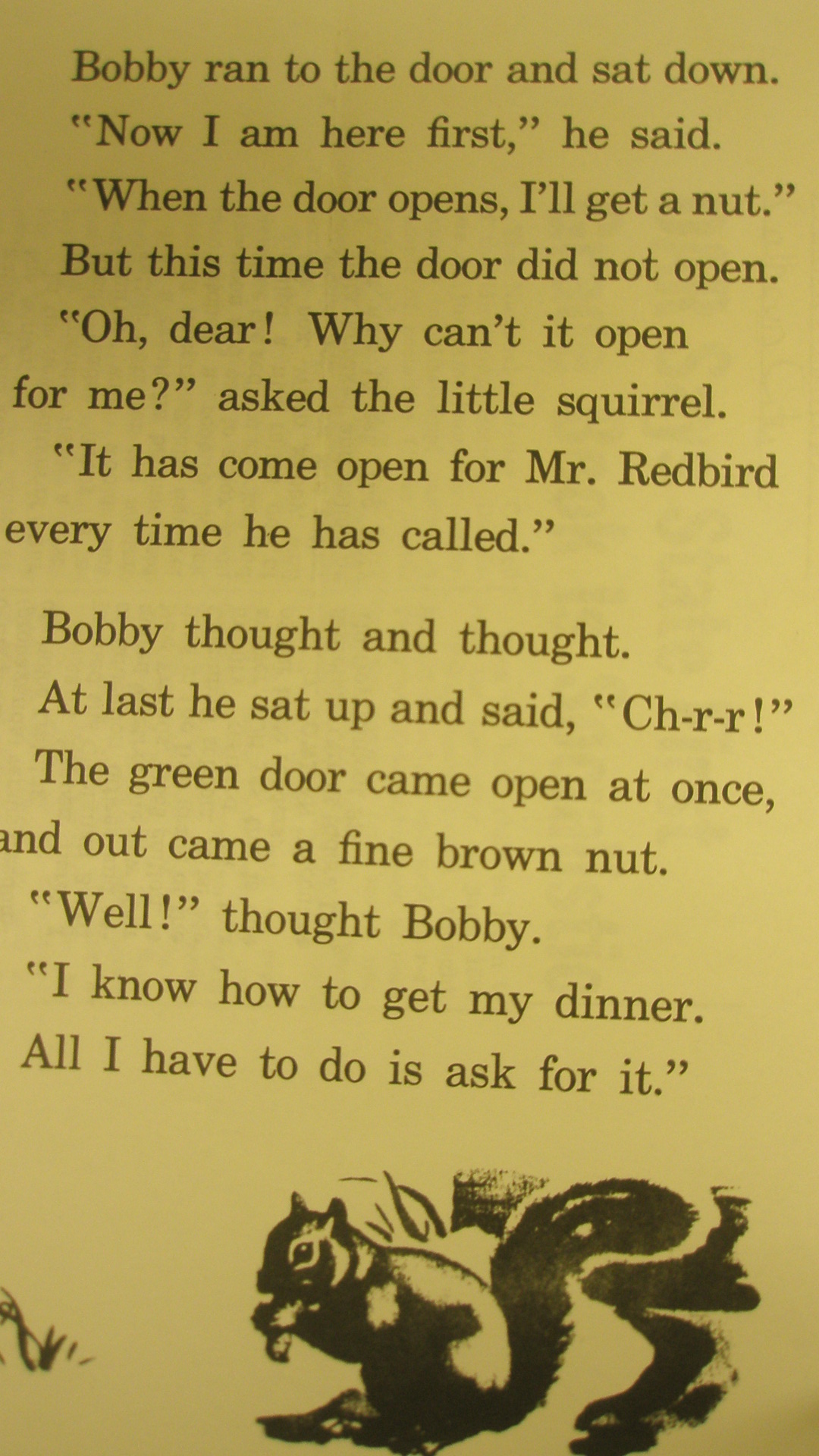
At the time, Alexander chaired the Mississippi Daughters of the American Revolution’s Committee on National Defense.  She complained that a story in one of Mississippi’s first-grade textbooks subverted the naturally capitalistic image of the squirrel.  In “Ask for It,” Alexander charged, “socialistic” authors used a tale of Bobby Squirrel insidiously to undermine the idea of hard work and thrift among Mississippi’s impressionable young school children.

In a pitch-perfect example of what historian Ellen Schrecker has called the “counter-subversive imagination,” Alexander blasted the textbook The New Our New Friends.  Among the seemingly innocuous just-so stories, Alexander sniffed out the “socialistic” message this book included about Bobby Squirrel.

OLYMPUS DIGITAL CAMERA

From “Ask for It,” The New Our New Friends, by William S. Gray, Marion Monroe, A. Sterl Artley, and May Hill Arbuthnot, (Chicago: Scott, Foresman and Co., 1956). Adopted as a school textbook by the State of Mississippi, 1963.

As Alexander asked in the pages of the Monitor Herald (Calhoun City, MS), January 3, 1963, “Have you ever heard or read about a more subtle way of undermining the American system of work and profit and replacing it with a collective welfare system?”

From a twenty-first-century perspective, it is difficult to remember the prominent role anti-communism played in American conservatism throughout much of the twentieth century.  As historian George Nash has argued, anti-communism often served as the intellectual glue that held together a disparate conservative movement, linking free-market activists with libertarians, Catholic intellectuals, and Protestant social traditionalists.

I came across this story in the Billy James Hargis Papers at the University of Arkansas in Fayetteville.  All historians interested in the history of conservatism in twentieth-century American education, religion, and culture should make this one of their first destinations.  Not only did the Reverend Hargis keep his own voluminous collection of small magazines, newsletters, and ephemera from various conservative evangelical and fundamentalist Protestant and anti-communist sources, but he also apparently bought up other collections, such as Allen Zoll’s.  As a result, the Hargis Papers in Fayetteville provide a one-stop reading shop for a vast collection of rare archival gems.

Unfortunately, Hargis did not keep much personal material.  It is not easy to get a sense of Hargis’ own thinking.  But the many boxes of newsletters and clippings include a wide array of pieces like Mrs. Alexander’s attempt to purge Mississippi schoolbooks of creeping, hopping Squirrel socialism.

FROM THE ARCHIVES: Fundamentalism vs. Communism, c. 1949

In the twenty-first century, it can be difficult to remember the menace once posed to Fundamentalist America by communism.  Of course, it was not only Fundamentalist Americans, but most Americans, who shared a strong anti-communism, at least since the 1930s.  As historian Ellen Schrecker has argued, anti-communism WAS Americanism.

It is too easy to limit our understanding of anti-communism to a narrow campaign against one political group.  In Fundamentalist America, the fight against communism took on a broad array of meanings.  “Communism” itself came to include a vast spectrum of purportedly anti-American ideas, including anti-theism, progressive education, declining manners, anti-capitalism, disrespect for tradition, and so on.  Not surprisingly, the fight against communism came to include such notions as support for more public religion.  It often included support for traditional families and social relationships.  It also included a fight for more traditional teaching, both in content and in method.

To cite just one example, as President General Anne Minor of the staunchly anti-communist Daughters of the American Revolution insisted in 1923, Americans “want no teachers who say there are two sides to every question.”  Teachers must teach a strict patriotic traditionalism.  They must tell their students the correct answer, with the correct social values, every time.  Those “progressive” teachers who waffle and squirm, who infect their students with a crippling moral relativism, would eventually create a generation of insipid, unpatriotic Americans unable to defend against the menace of communism.

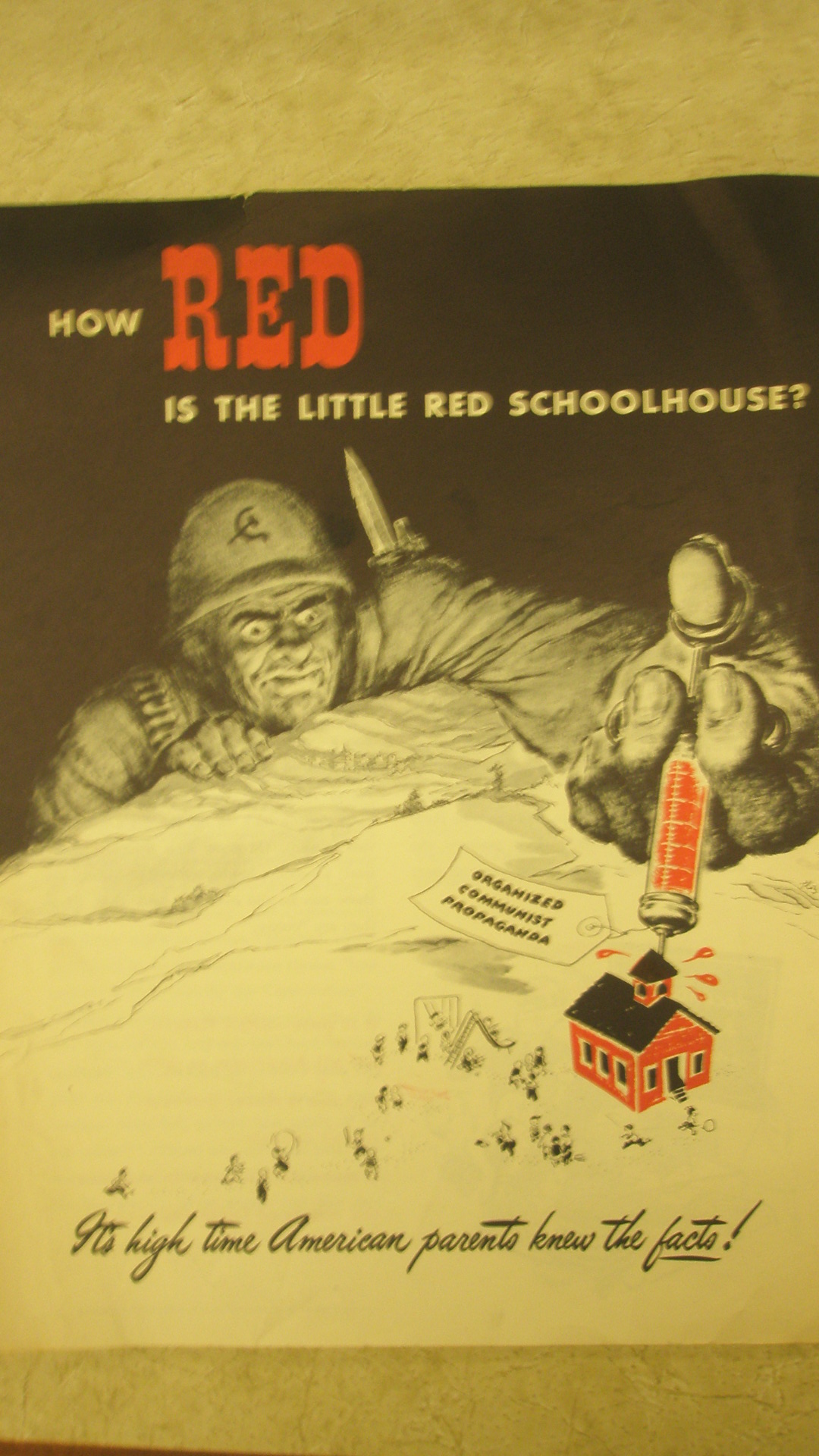
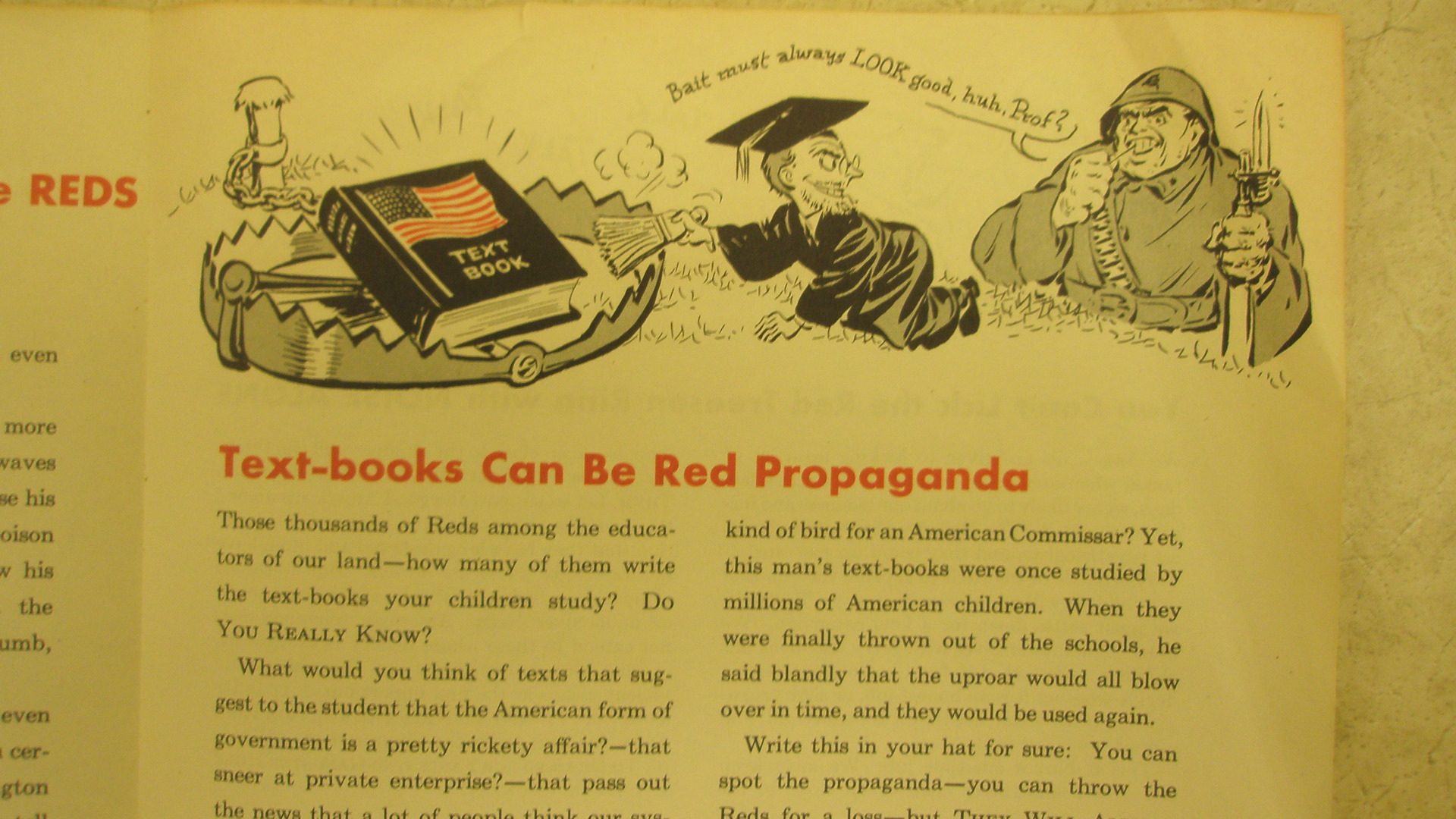
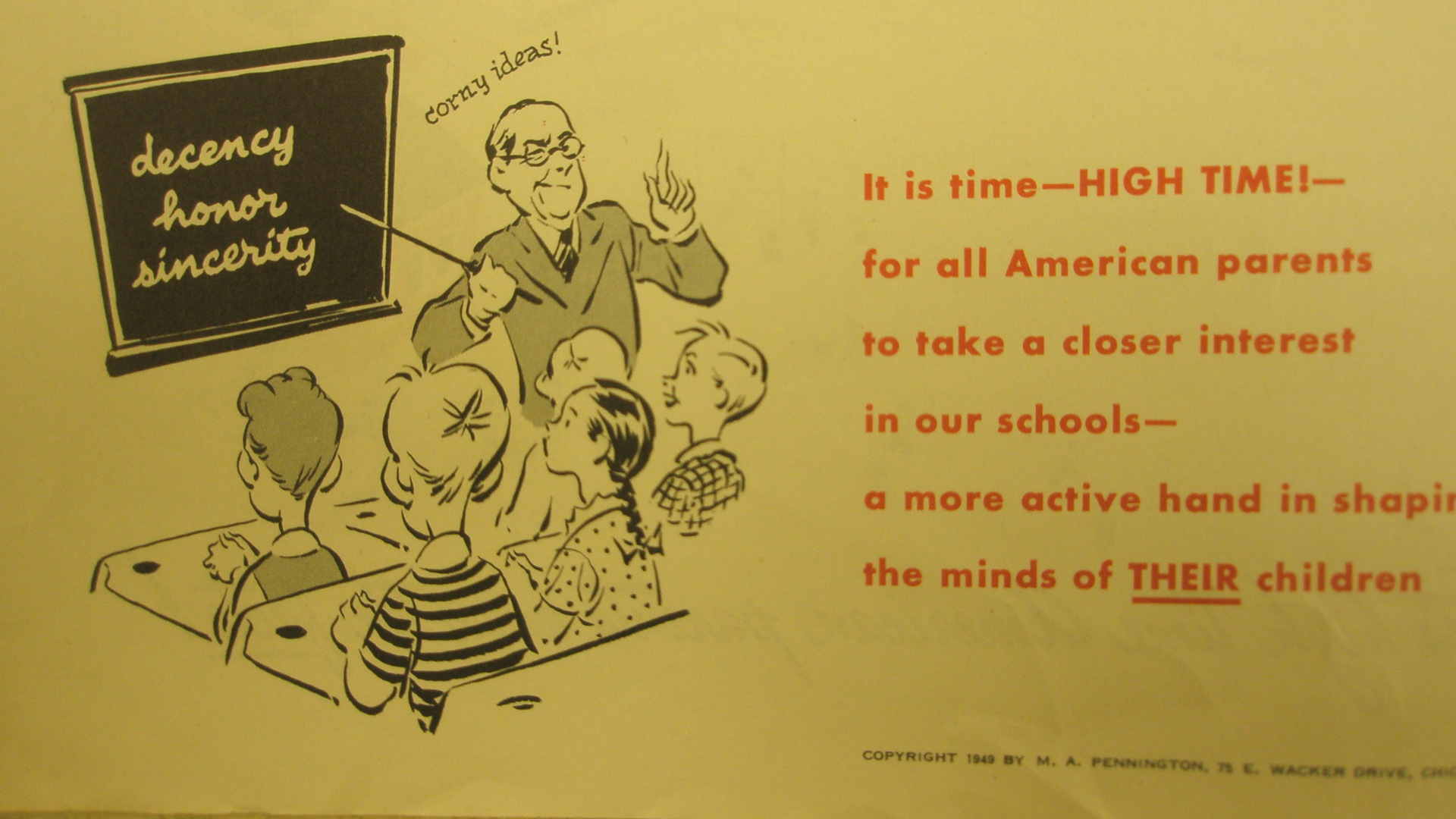
As always, a picture is worth a thousand words.  In this case, I’ll share some cartoons from an anti-communist pamphlet from 1949.  These cartoons demonstrate one common ideological thread in Cold War Fundamentalist America.  At the time, activists like the one who published this brochure felt that Communism threatened a two-pronged attack.  The danger included a military menace from Soviet Russia.  But it also meant internal subversion by dupes who did the work of the Red Army.  Intentionally or not, such subversive activity helped to weaken the resolve of America, making a communist takeover that much easier.

Further Reading: Ellen Schrecker, Many Are the Crimes: McCarthyism in America (Princeton: Princeton University Press, 1998); Jonathan Zimmerman, Small Wonder: The Little Red Schoolhouse in History and Memory (New Haven: Yale University Press, 2009).

This one shows the vast sweep of cultural ideology folded into the fight against communism. Not only must patriots fight communism, they must also fight to uphold traditional values.

Parents squeezing the “Red” out of textbooks.

As historian Jonathan Zimmerman has argued, the image of the “Little Red Schoolhouse” has long been a potent political symbol. In this cover image, the cartoonist makes a connection common in Cold-War anti-communism. “Reds” worked hard to subvert the Red Schoolhouse.

The scheming, bearded academic has long been an object of suspicion in Fundamentalist America. Here, he does the work of the Red Army.

Traditionalist Teaching for Progressive Teachers? Lisa Delpit and Fundamentalism in Black and White

Fundamentalists don’t like progressive education.  They may not realize that they have some potential allies deep in the heart of the academic education establishment.

What do fundamentalists mean when they fight against “progressive education?”  For one thing, fundamentalists tend to pooh-pooh reading instruction that allows children to ‘discover’ reading on their own.  And they dismiss the notion that classroom teachers should put authority in the hands of students.  Also, fundamentalists often look askance at education professors who advocate soft-heading, child-centered classroom teaching that fails to deliver basic information and academic skills.

Generally, fundamentalists make these complaints from outside of the academy.  Some historians and other prominent academics—folks such as Arthur BestorRobert Hutchins,  or Arthur Schlesinger, Jr.—have critiqued the claims of progressive education, but most of the effective critics have worked outside of higher education.  But in the past generation, at least one prominent academic educator has critiqued “advocates of any progressive movement” who fail to consider the opinions of those “who may not share their enthusiasm about so-called new, liberal, or progressive ideas.”  The work of this world-famous educational activist is read at every school of education, especially ones in which teachers are trained to use progressive teaching methods.

Then why does she talk this way?  Because she framed the issue not as traditional and progressive, but as black and white.  Her name is Lisa Delpit, and her traditionalist critique of progressive education did not lead to her exclusion from the education academy.  On the contrary, she has received some of the academy’s most prestigious awards for her work, including a MacArthur “Genius” award in 1990 and Harvard Graduate School of Education’s Outstanding Contribution to Education award in 1993.

To be clear, Delpit demonstrated considerable differences from many other traditionalist education activists.  For example, she backs a multicultural approach to education, most conservative traditionalists do not.  (See the ILYBYGTH discussion of traditionalist critiques of multicultural education here, here and here.)  She supports reading in depth and excoriates rote instruction.

But she also pushes a traditionalist ideology of teaching.  She offers withering criticisms of progressive teachers’ justifications.  In one career-making speech and article from the late 1980s, Delpit castigated progressive educators for their misplaced softness toward students.  She cited with approval one African American classroom teacher who described her anger at white progressive teachers as “a cancer, a sore.”  This teacher had stopped arguing against progressive methods.  Instead, she “shut them [white progressive teachers and administrators] out.  I go back to my own little cubby, my classroom, and I try to teach the way I know will work, no matter what those folk say.”  Delpit suggested that a direct-instruction model matched more closely the cultural background of most African American students.  In one model Delpit described favorably, the teacher is the authority.  The goal is to teach reading via “direct instruction of phonics generalizations and blending.”  The teacher keeps students’ attention by asking a series of questions, by eye contact, and by eliciting scripted group responses from the students.  Such traditionalist pedagogy, Delpit noted, elicited howls of protest from “liberal educators.”

In a sentence that could come straight from such conservative traditionalist leaders as Bill Bennett or Max Rafferty, Delpit supported the notion of many African American educators that “many of the ‘progressive’ educational strategies imposed by liberals upon Black and poor children could only be based on a desire to ensure that the liberals’ children get sole access to the dwindling pool of American jobs.”

In another critique, Delpit argued that white, middle-class teachers hid their classroom authority in ways that were confusing to poor and African American students.  Teachers of all backgrounds, Delpit suggested, need to be more explicit about their power and authority in the classroom.  A good teacher, Delpit noted, was seen as both “fun” and “mean” by one African American student.  Such a teacher, Delpit’s interviewee argued, “made us learn. . . . she was in charge of that class and she didn’t let anyone run her.”

More important for fundamentalist activists, Delpit’s voice is not alone.  A call for traditional pedagogy and schooling seems to be gaining adherents among African American parents and educators.  We could look at the deep traditionalism of such prominent schools as the New York Success Academy Charter Schools.  Or we could probe the attitudes of those who run KIPP (Knowledge Is Power Program) Schools, which tend to serve significant numbers of African American students.  In a recent article about school “paddling” in USA Today, one African American school administrator confirmed that she believed in spanking “because I’m from the old school.”

The numbers indicate African American students tend to receive corporal punishment more often than students of other racial backgrounds, but don’t indicate the level of support for such punishment among African American teachers as opposed to teachers of other races.  There are some indications that African American parents tend to use corporal punishment more often than other groups.  This would support Delpit’s assertion that many African American students have different cultural expectations from other students when they get to school.  But the same study asserts that a huge majority of parents of other groups also use corporal punishment at home.  And, indeed, there is a lot of support for corporal punishment at school among white conservative activists.  But such support generally comes as part of a broader traditionalist, anti-progressive ideology of schooling.

Delpit’s argument is different.  She argues for traditional authoritarian teachers within a progressive, multicultural educational system.

What does this mean?  I’ve got a couple of reflections, and I’d welcome more.

For one thing, it tells us something about the current state of education scholarship.  Seen optimistically, we might conclude that the popularity of Delpit’s work proves that education scholars are willing to embrace a true diversity of opinion.  That is, education scholars might not be the petty intellectual tyrants some traditionalists accuse them of being.  To cite just one example, arch-traditionalist Max Rafferty in 1968 accused the “education bureaucrats” of only speaking to regular people “with that air of insufferable condescension.”  Such “educationists,” Rafferty charged, only listened to one another; they only hoped to turn America’s schools into something approaching a “well-run ant hill, beehive or Hitlerian dictatorship.”  Delpit’s example of progressive traditionalism might suggest that education scholars are more open to dissent than Rafferty and others have consistently charged.

In a less rosy light, though, we might conclude that this is yet another example of the ways the mainstream academy is hamstrung over racial ideology.  We might wonder if Delpit’s ideas would be welcomed as fervently if education scholars weren’t so terrified of being considered racially insensitive.  It helps, of course, that Delpit is a wonderful writer and powerful polemicist.  But it is hard to ignore the question: How warmly would a scholar be welcomed who trashed the idea of progressive pedagogy in general?  Not just for one group of students, but for students and schools in general?

One other point jumps out at us: we apparently need to be more careful when we talk about traditionalist education.  I’ll plead guilty.  I am most interested in those traditionalists who act out of what we can fairly call a conservative impulse to transform American schools and society.  Folks like Rousas Rushdoony, Max Rafferty, Sam Blumenfeld, Mel and Norma Gabler.  Groups like the Daughters of the American Revolution and the American Legion.  Activists from these groups have long believed that teaching must be made more traditional so that American society itself can reclaim some of its lost glory.  But there are traditionalists like Delpit who hope that schools will transform school and society in a vastly different way.

Perhaps we need to treat “educational traditionalism” the way we treat “evangelicalism.”  A lot of folks, scholars and normal people alike, tend to treat “evangelicalism” as if it were the sole domain of white, conservative folks such as Billy Graham and Jerry Falwell.  But religious historians are also interested in other forms of evangelicalism.  There have always been leftist evangelicals, for instance, as Raymond Haberski has recently noted.  And, of course, there has always been a strong evangelical tradition among African Americans.

Perhaps the most important notion to think about here is that we have more than one kind of educational traditionalism.  Bashing progressive education has long been the national pastime of educational conservatives.  For the last twenty-five years or so, such conservatives have been joined by an influential cadre of mainstream education scholars.

Further reading: Lisa Delpit, “The Silenced Dialogue: Power and Pedagogy in Educating Other People’s Children,” Harvard Educational Review 58 (Fall 1988): 280-199; Delpit, (1986). Skills and other dilemmas of a progressive black educator. Harvard Educational Review, 56(4), 379-386; Delpit, Lisa. (1995). Other People’s Children: Cultural conflict in the classroom. New York, NY: The New Press; Delpit, L & Perry, T. (1998). The Real Ebonics Debate: Power, Language, and the Education of African-American Children (Eds.). Boston, MA: Beacon Press; Delpit, L. & Dowdy, J. K. (2002). The Skin That we Speak: Thoughts on language and culture in the classroom (Eds.). New York, NY: The New Press; Delpit, L. D. (2012). Multiplication is for White People: Raising expectations for other people’s children. New York:The New Press.

FROM THE ARCHIVES: Fundamentalists and Federal Aid to Schools

If only Rick Perry could have remembered what he planned to abolish, he might have won the 2012 Republican Presidential primary.  If he had won, he might really have carried out his threat to get rid of the federal Department of Education, along with Energy and Commerce.  Or maybe not.  After all, Ronald Reagan had also promised to eliminate the Department of Education.  In the end, Reagan merely treated the department shabbily.  These days, it seems every self-respecting conservative insists that the Federal Department of Education is an outrage.  Devvy Kidd of WorldNetDaily, for example, insists the department “must be abolished” due to its “chilling” trend toward “communism.”

This hostility toward federal money for local schools has not always been a bedrock belief of American conservatives.  In the 1920s, as Douglas Slawson’s terrific 2005 book The Department of Education Battle describes, the fiercest opponent of a cabinet-level federal department of education was the Catholic Church.  It follows, then, that one of the fiercest PROponents of such a department was the 1920s Ku Klux Klan.  The 1920s Klan, after all, focused much more intensely than did later Klans on fighting the power of the Catholic Church.  It also focused much of its public activism on defending its vision of the “Little Red Schoolhouse.”  For God and Country, the 1920s Klan argued, the USA needed a cabinet-level Department of Education.

By the late 1940s, however, opposing federal aid to local schools had become an article of faith among American conservatives.                        

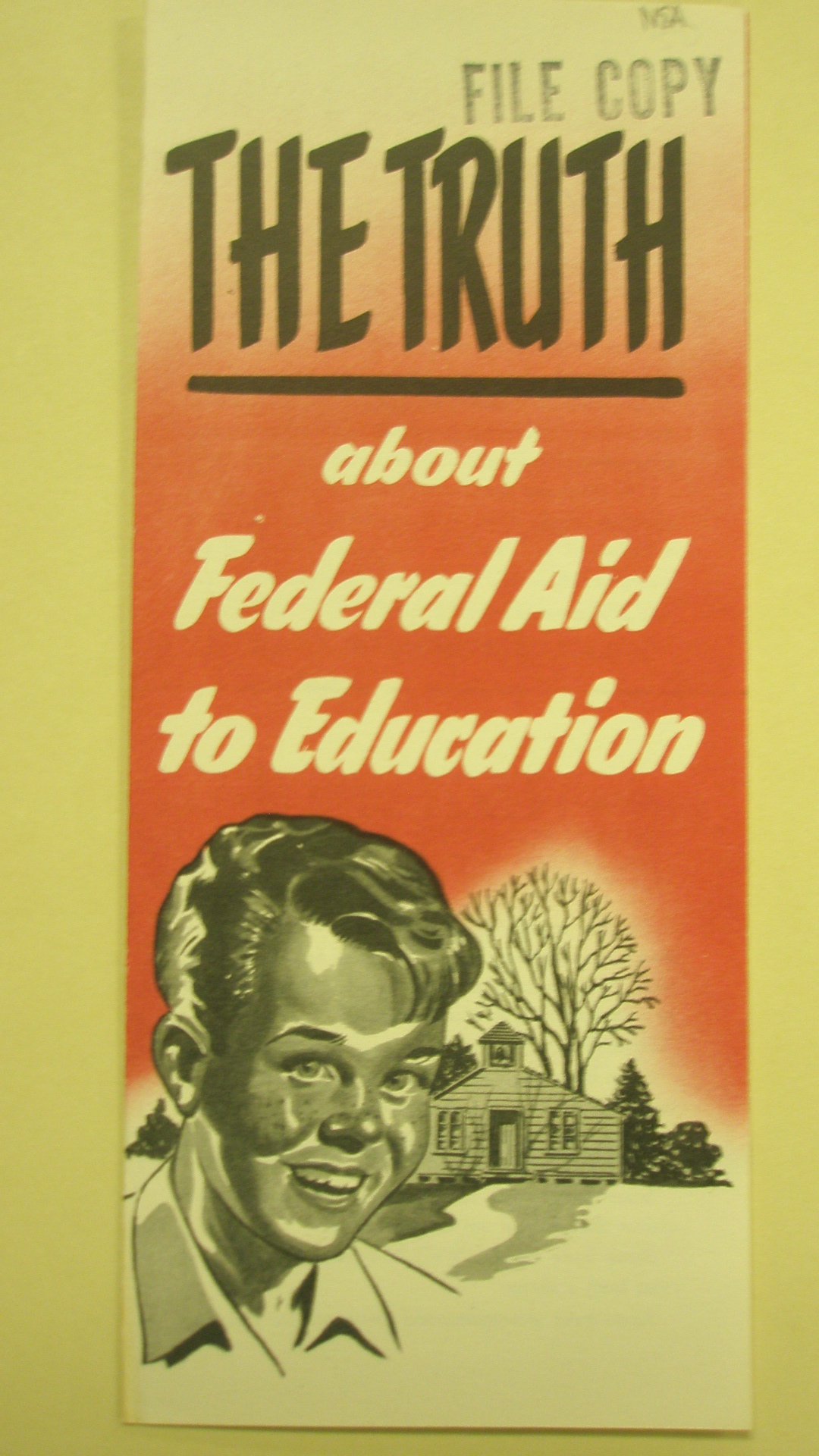
Perhaps because the National Education Association fought so fervently for more federal funding for local schools, as we can see with this 1948 NEA brochure, conservatives insisted that such aid would be merely the camel’s nose under the tent.  Such aid would inevitably include more federal control over local schools.

As one earnest Daughter of the American Revolution warned her conservative sisters in 1943,

“The citizens of the United States do not want the Federal Government to supervise education from the cradle to the grave, from nursery school to adult education. . . .  It is not difficult to see another huge arm of the Federal Government in the making, and more chains being forged to shackle the unthinking. . . . socialist-minded educators would use the funds to build ‘a new social order’ and . . . training in fundamentals [will be] neglected.”

Other conservatives in the 1940s and 1950s agreed.  Allen Zoll, a professional right-wing activist and founder of the National Council for American Education, published a couple of hugely influential pamphlets in the 1940s. 

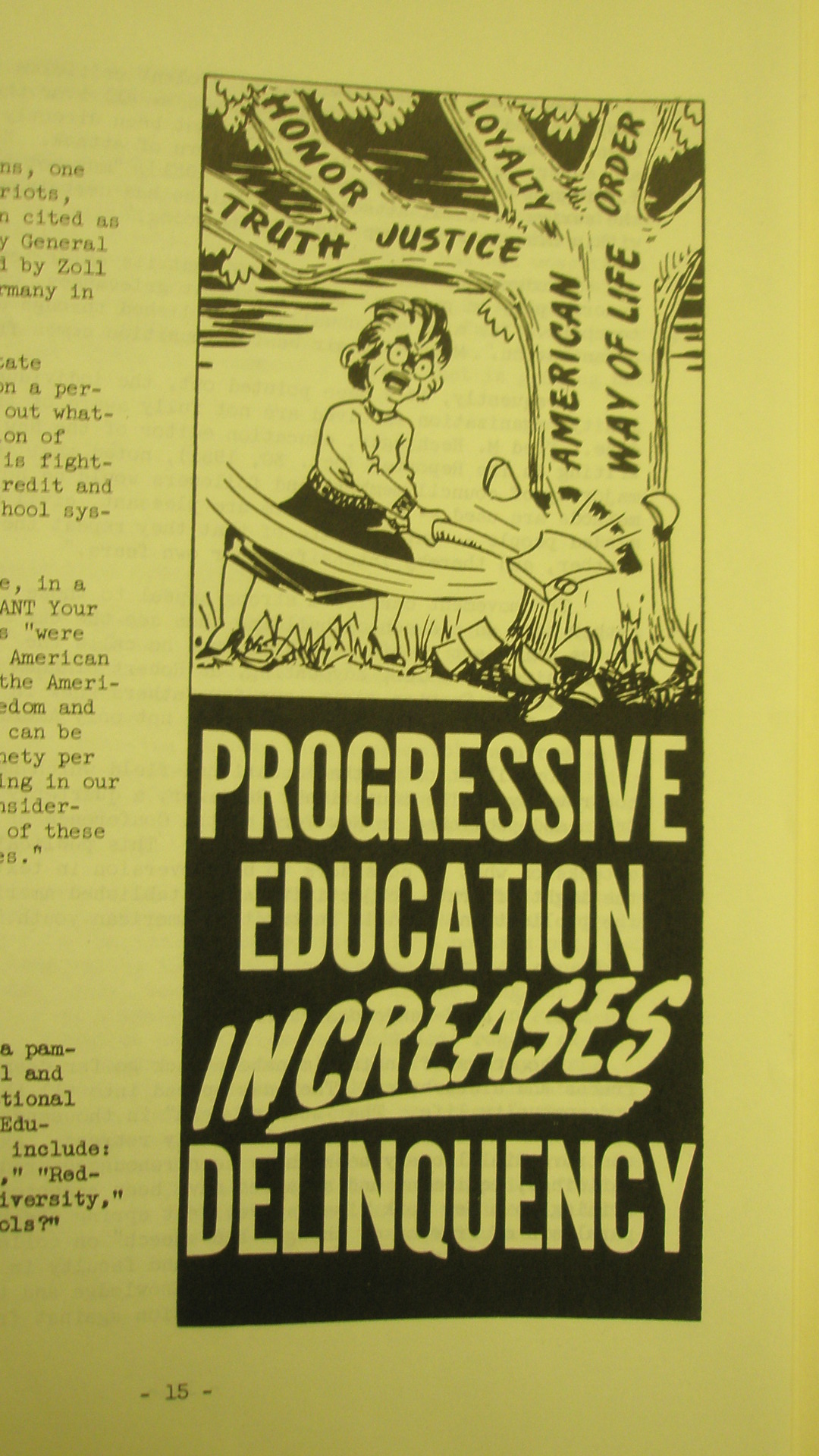
In one of them, “Progressive Education Increases Delinquency,” Zoll warned readers that contemporary education no longer taught students the traditional, fundamental values of American society.  He insisted,

The tragic and terrifying thing about all this is that it represents not merely rebellion against a moral code, but denial that there can be any binding moral code.  It is a fundamental revolution in human thinking of the first order: it is mental and ethical nihilism.  If it goes on unchecked, it will mean not merely tragedy for millions of individuals, it will mean the disintegration and final extinction of the American society.”

In another pamphlet from the late 1940s, “They Want YOUR Child,” Zoll warned that the NEA’s drive to secure federal funding for local schools was a conspiracy of the darkest order, a “conspiracy against the American way of life, against everything that we hold dear, . . . probably the most completely organized, ruthless design against other people ever set in motion in all human history.”

Inevitably, Zoll insisted, federal aid to local schools would lead to federal control over local schools.  Once schools fell for that trap, they would be controlled by an aggressive mind-controlling educationist bureaucracy.  The scheming of “progressive” educators such as Theodore Brameld, William Heard Kilpatrick, and George Counts would soon lead to a softening of the youth of America, a start of the slide to socialism, secularism, and destruction.

Some conservatives in the 1950s took this fight against federal funding one step further.  Although they never represented a majority conservative viewpoint, some insisted that all public monies for schools represented government tyranny.  One eccentric proponent of this maximalist position in the 1950s was R.C. Hoiles.  Hoiles had earned a pile of money—one journalist in 1952 estimated $20,000,000—with his Western media empire.  In his editorials for his newspapers, Hoiles argued that all public schools implied government tyranny.  In one from The Marysville-Yuba City (CA) Appeal Democrat, February 28, 1951, for example, Hoiles argued,

“Very few people realize to what degree the government has grabbed the authority to indoctrinate the youth of the land.  We cannot reverse our trend toward socialism as long as the youth of the land comes in contact and is trained by teachers who believe that they have a right to do collectively what they know would be immoral if done by an individual.  In short, the youth of the land is coming in contact with men who are communistic in their thinking, if we properly define communism.  Here is a good definition of communism written by David Baxter.  ‘Communism is the conclusion that more than one person, or a majority of persons, have a right to do things collectively that it would be wrong and immoral for one person to do.’  Can anyone improve upon this definition of communism?

            “According to this definition, is not every believer in tax-supported schools a believer in communism, whether he knows it or not?”

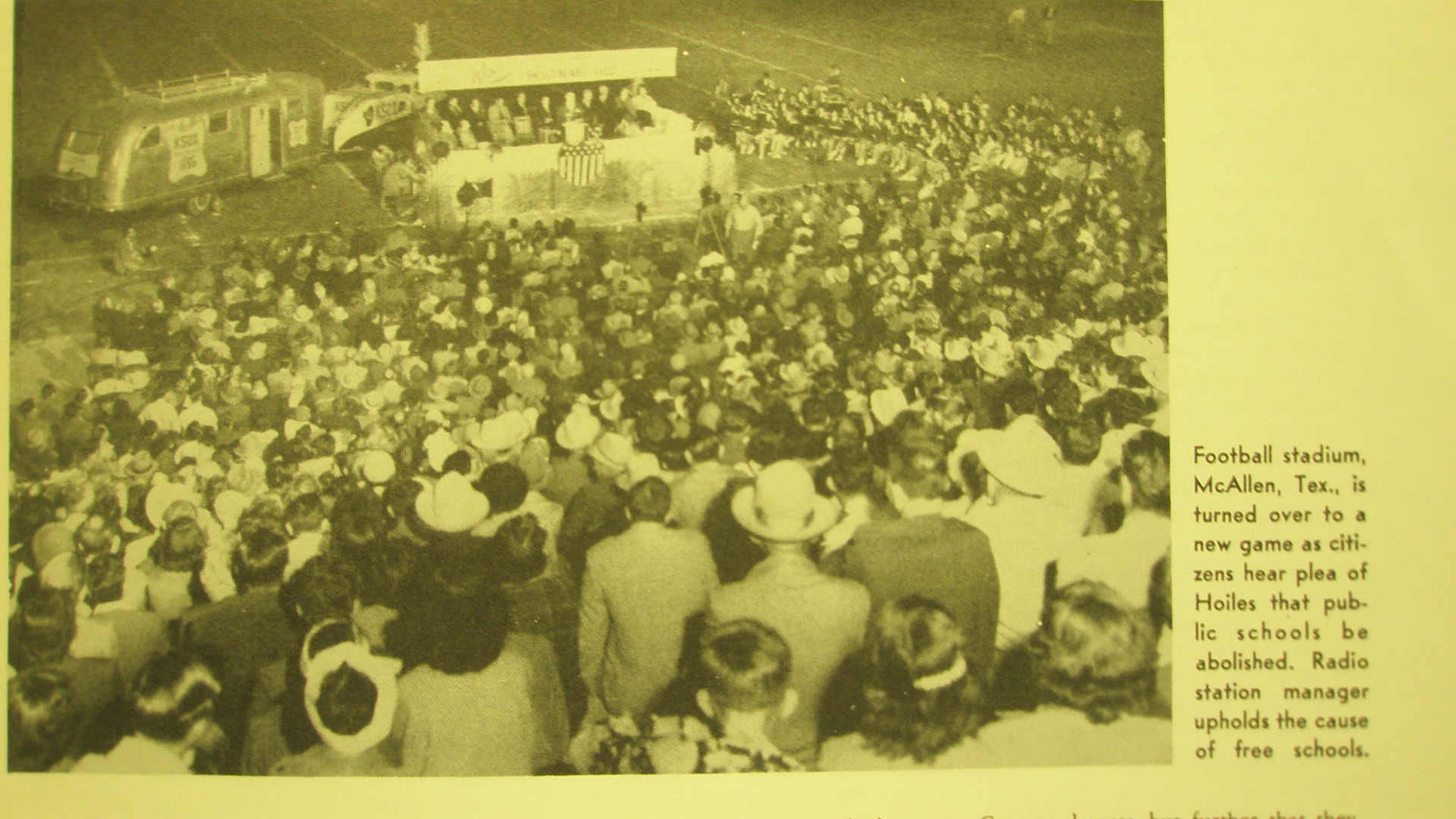
Hoiles also issued a standing challenge to debate this issue.  On February 2, 1952, a radio personality took him up on his offer.  Thousands of people crammed into the football stadium to hear the debate between Hoiles and Roy Hofheinz.  Among the rhetorical gems Hoiles unloaded at that debate included the following:

“Every board of education is government; therefore, it is force.  It is not reason or eloquence—IT IS FORCE!  It is a fearful master—it certainly does not seem rational that understanding and education can be promoted by the force of a policeman . . . “

“There are many ideas as to what is a good government.  But only one idea can be taught in government schools.  And that idea cannot be anything unfavorable to existing government institutions.  It would be impossible to find any teaching in government schools unfavorable to government schools.  It would be impossible to find anything taught in government schools unfavorable to existing state administration.  We cannot now find anything taught in government schools really unfavorable to New Dealism.

            “We believe it would be next to impossible to find anything taught that preaches old-fashioned American individualism as against our modern New Deal fraternalism in government.  Thus we believe that government schools’ teaching in regard to government must favor administration policies, whatever they may be.  Hitler and Hirohito used government schools to promote their regimes. 

            “Stalin is using Russian government schools to promote his regime.  Karl Marx made free public schools one of the points in his famous ‘Communist Manifesto.’  Any government delights in having schools to propagandize its doctrine.” ….

“It has often occurred to me that if an overwhelming majority of Americans really favor the present system of education, it should not be necessary to compel anyone to support it.  A system as sound and popular as tax-supported public schools are supposed to be should be well supported on a voluntary basis.” 

Funding of schools will likely always be a contentious issue.  Taxpayers, especially those who have no children or send their children to private schools, have a dollars-and-cents reason to oppose public schooling.  Perhaps the powerful tradition in Fundamentalist America of opposition to federal funding—or even to any public funding—of local schools can be reduced mainly to a desire to keep more money from the hands of the tax man.  But there also seems to be a deeper ideological connection.  Since the 1940s, at least, fighting against federal funding for local schools has become an article of conservative faith among some citizens of Fundamentalist America.

FURTHER READING: Douglas J. Slawson,  The Department of Education Battle, 1918-1932; Public Schools, Catholic Schools, and the Social Order (University of Notre Dame Press, 2005; Madeleine P. Scharf, “The Education Finance Act of 1943,” Daughters of the American Revolution Magazine 77 (October 1943): 635-637.