Meadows and the Missing Link

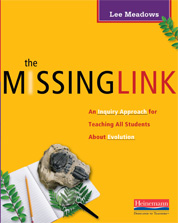
According to author Lee Meadows, (check out his blog here) the main goal of his evolution-education book is to get “resistant students [to] understand evolution, but they don’t necessarily have to accept it.” (xxi) His 2009 The Missing Link: An Inquiry Approach for
Teaching All Students about Evolution
promises to train teachers to seize the middle ground in the evolution culture wars.  It offers practical and specific ways to teach evolution to students who come from anti-evolution backgrounds.

Unlike other models, Meadows’ approach never waters down the science of evolution.  It does not attempt to teach “the controversy;” it does not teach a balance between creation and evolution; it does not teach evolution “lite.”  Instead, it teaches the science of evolution in a way that frankly recognizes student resistance to the notion.  It offers coping mechanisms for science teachers to deal with that resistance in a caring, thoughtful, respectful way.  It does not view that student resistance as a challenge to be crushed, but rather as a legitimate part of student identity.  For example, he speaks in helpful terms of “accommodation for resistant students.”  As Meadows argues, “Public schools must embrace diversity of all kinds, including students from all religious backgrounds.”  (xiii)  This tone shifts the
discussion from combat in classrooms to education.

The essence of Meadows’ strategy is nothing new to teachers.  He hopes to use an inquiry method to allow students to wrestle with difficult questions that might challenge their religious faiths.  By using student inquiry instead of teacher-led direct instruction, Meadows hopes to have science teachers avoid the charge of evolutionary indoctrination.
Students can gain an authentic understanding of central questions of evolution and science without feeling that such notions have been imposed by a hostile ‘secular humanist’ school.

In my view, that kind of inquiry learning is worth pursuing for its own sake, in all
classes.  When teachers, schools, and students can pull it off, it is a powerful and effective way to learn.  Of greater promise to the continuing controversies over evolution education, however, is Meadows’ sustained tone of caring for all students, regardless of their backgrounds.  It does not approach student creationist beliefs as a problem for science teachers to overcome.  Instead, it recognizes those beliefs as part of the young person for whom the teacher is charged to respect, care for, and educate.

This is not a philosophic tome, but a practical teaching guide.  It includes lesson plans and specific teaching strategies.  More important, perhaps, it is full of helpful reminders for eager
science teachers of how NOT to proceed.  It identifies the distinction between an evolutionary and supernatural worldview, for example, then warns:

You can’t resolve these tensions for your students, so please don’t try. It’s not our place as science teachers to impact students’ religious beliefs, even if we’re being “helpful.” That’ssomething that we must leave to their families and their spiritual leaders. (61)

Meadows’ approach will earn him some flak, inevitably, from both sides in the  creation/evolution debate.  Some mainstream scientists will undoubtedly protest that students should not be allowed to decide if they will accept evolution after they learn about it.  To many evolution-believers, that makes no more sense than asking students to decide if they believe in the Pythagorean Theorem.

From creationists, on the other hand, I can imagine Meadows will come under fire for teaching evolution as true, as fact.  And more, creationists might object that Meadows’ suggested methods simply sugarcoat evolution by pretending to care for creationists’ beliefs.  Better, some creationists might say, to honestly attack those creationist beliefs rather than to sneak in evolution education under false pretenses.  I can imagine creationists objecting that Meadows’ distinction between guaranteeing that students KNOW evolution but allowing them not to BELIEVE it is a false one.  It would never be suggested for other subjects.  For example, it is hard to imagine knowing that 2 + 2 = 4 without believing it.  And how could my child learn and know how to identify an indirect object without believing it?

It is a similar dilemma to those parents who object to explicit sex education in public school classrooms.  Since the first days of SIECUS in the 1960s, for instance, sex educators have insisted that they are not advocating sex.  Conservative parents, however, insist that merely by knowing how to use a condom, students have been hurt.  Those parents do not want their
children to know about condoms (or evolution) at all.  They vigorously dispute the notion that their children can learn something in school about such topics without that knowledge
causing fundamental harm.

I believe that these potential objections prove that Meadows is onto something.  When the more extreme elements on both sides attack, it suggests that Meadows is speaking to the great wide middle: Creationist parents who do not want their children attacked in schools;
creationist students who feel as if ‘school science’ is not for them; teachers who feel they can’t simultaneously care for their creationist students and teach those students something the students see as blasphemous; school administrators who need to reach out to parents and students while still encouraging evolution education in their science classes; and mainstream
scientists who want to see more authentic evolution education in American classrooms.

It is a tall order, but Meadows’ work promises something for everyone in this moderate middle.

For a taste of Meadows’ approach, you can read a chapter of his book at his publisher’s webpage.

Surely You’re Joking, Mr. Huckabee

All readers and commentators of I Love You but You’re Going to Hell are invited to a public talk about the historical development of creationist thought in the United States.

The talk will be Monday, November 7, 2011, at 5 PM in room AA G-008 on the campus of SUNY Binghamton, in sunny Binghamton, New York, USA.  It is free and open to the public.

The host is David Sloan Wilson’s Evolutionary Studies Program at Binghamton University. David Sloan Wilson Logo

The speaker will be Adam Laats, Assistant Professor at Binghamton.  His talk will focus on issues familiar to readers of ILYBYGTH:  How do creationists cling to their beliefs when surrounded by such overwhelming scientific evidence for creation?  How can evolutionists understand them without simply dismissing them as ignorant or misguided?

For more info, see the EVoS announcement.

Anti-Evolution IV: Minority Rights

ANTI EVOLUTION IV: RESPECT MINORITY RIGHTS


Finally, the bar of proof here should be very low.  Anti-evolutionists these days are not trying to ban the teaching of evolution. Rather, they usually argue that both evolution and creation should be taught as viable explanations of the origins of life.  Even if all the arguments above leave you cold, even if you find the science of creationism ridiculous, you can still
admit that it makes you uncomfortable to have public schools force children to agree to an idea that their parents find religiously intolerable.

Consider the same argument from the 19th century.  Catholics in America’s big East coast cities often objected that the public schools ought not to force their children to read from the King James Bible.  In spite of the arguments of their Protestant enemies, it was not because they did not want their children to hear the truth.  Rather, the version of the Bible that was
being used contained disparaging commentary about Catholicism and the Pope.  In Philadelphia, New York, and
Boston, these disagreements led to riots in the streets.  From a twenty-first century perspective, it seems a matter
of simple bigotry.  The public schools of those cities should not have forced Protestantism and anti-Catholicism on their
students.  Many Protestant school leaders at the time did not see this as religious indoctrination.  They argued that the Bible was simply being read without comment.  The Bible itself, they believed, was not a religion per se but simply God’s book.  There could be no legitimate complaint against it.

There are other examples. Consider the spate of boarding schools for American Indian children that proliferated at the end of the 19th century and first half of the 20th.  Children at these schools were expected to be educated out of their Indian ways.  As
the founder of one of the most famous of these schools put it, they hoped to kill the Indian to save the man.
Students were forced to speak only English, to wear only Euro-style clothes, and to adopt Euro culture enthusiastically.  Some did. Some didn’t.  But the relevant point here is that such cultural indoctrination belongs in a bygone era.  American schools should be as pluralistic as American society.  The children of creationists should not have to abandon their beliefs in order to attend a public school.  They should be allowed to sustain their home culture even while learning about mainstream culture in the public schools.

Those who are not being hurt by the forced inclusion of some idea in public school curricula should not be the ones who decide if it is hurting other people.  Short hair for boys and use of the English language seemed like obvious requirements for Anglo teachers in American Indian boarding schools.  Reading from a Bible that mocked Catholicism and the Pope seemed
unobjectionable to early Protestant school leaders.  They did not see these things as offensive.  To protect against this
danger, we should offer people a low threshold of proof to claim that they believe an idea is hurting them or their children.  Otherwise, schools will continue to force majority culture down the throats of students and families who feel threatened
by it.

Consider one opinion of the US Supreme Court in this regard.  In 1981, the Court heard thecase of Thomas v. Review Board of Indiana Employment Security Division.  The plaintiff, Eddie Thomas, was a Jehovah’s Witness who had been denied
unemployment benefits from the State of Indiana.  Thomas had worked in a sheet metal factory and had been transferred to a division that made tank turrets.  Thomas requested another transfer, or to be laid off.  Those requests were denied, so
he quit.  He did not believe he could ethically build weapons.  The case is not a perfect parallel, since one of the deciding factors for the Supreme Court was that Indiana could pay his unemployment benefits without itself supporting his
religion.  But one line of Chief Justice Burger’s majority decision is telling.  “It is not for us to say,” Burger wrote, “that the line [Thomas] drew was an unreasonable one.”

The same is true with evolution education.  Those who do not find it dangerous or offensive should not be dictating that those who do find it offensive are being unreasonable.  Such ideas are often invisible and utterly inoffensive to those who share them.  But they can be literally damning to others.  The decision should be left to those who feel threatened.


ANTI EVOLUTION IV: FURTHER READING

Carl F. Kaestle, Pillars of the Republic: Common Schools and American Society, 1780-1860 (New York: Hill & Wang, 1999); David Wallace Adams, Education for Extinction: American Indians and the Boarding School Experience, 1875-1928 (Lawrence, Kansas: University Press of Kansas, 1995).

Pro-Evolution V: Conclusion

EVOLUTION V: CONCLUSION

Evolution is not a story people made up to explain the world.  It is a story people discovered about the way the world works.  It doesn’t dethrone any god.  It merely explains how the world came to be.  In other words, evolution has nothing atheistic about it.  Rather, it simply explains the mechanisms by which the world works, however that world came to be.

Those who refuse to accept the truth of evolution don’t do so because the Bible demands it.  They
refuse to accept evolution because of a series of historical accidents.  Certain sects and denominations have been saddled with an anti-evolution orthodoxy that their followers have been forced to accommodate.  They can remain obstinate only so long as they remain within the charmed circle of their own beliefs.  When and if they examine the evidence for themselves, they agree that the best explanation is an evolutionary one.

Most important, if creationism and evolutionism were really two competing scientific models, they would attract mainstream scientists to each side.  Such is the nature of science.  In the case of creationism, it has only attracted—at most—a handful of scientists with any claim to mainstream
scientific credentials.  This astonishing dearth can’t be explained away as mere prejudice on the part of evolutionists.  Consider the case of Kurt P. Wise.  Wise trained at Harvard University, under the tutelage of Stephen Jay Gould.  Though Wise reported some taunting from his evolutionist fellow students, Gould himself always respected Wise’s firm creationist beliefs.  As a convinced
evolutionist, Gould saw no need to ridicule someone like Wise.  Rather, Gould hoped Wise would study the evidence on his own, confident that any such study would demonstrate the truth of evolution.

Creationists can’t claim the same confidence.  They are constrained to assert their belief in the truth of creation, because, unlike Gould’s quiet confidence in the fact of evolution, creationists generally believe in creation by faith.  As a faith, they must cling to their belief whatever the evidence may show.  As Kurt Wise himself put it, “if all the evidence in the universe turned against
creationism, I would be the first to admit it, but I would still be a creationist because that is what the Word of God seems to indicate.”  Even the most scientifically skilled of creationists must acknowledge that their ultimate authority is beyond evidence.  They must go where orthodoxy
leads.  True science, on the other hand, follows only facts.

EVOLUTION V: CONCLUSION: FURTHER READING

John F. Ashton, ed., In Six Days: Why Fifty Scientists Choose to Believe in Creation (Master Books, 2001).

Anti-Evolution III: Science

ANTI EVOLUTION III: SCIENCE

Anti-evolutionists often assert scientific arguments against evolution.  This trend grew especially
strong in the later part of the twentieth century.  At that time, anti-evolutionists associated with the Institute for Creation Research in San Diego realized that their ideas would never be allowed into public school classrooms as religion.  But they could be allowed if they were used as alternative scientific explanations.  The science of creation science was born.

I personally am not convinced by these arguments.  There is plenty of evidence that those who know this stuff best—biologists, geologists, etc.—find these arguments baseless.  Nevertheless, I will attempt to summarize some of their arguments here.  As with the rest of these posts, I will not attempt to convince those already dedicated to an evolutionary worldview.  Rather, I only hope to show that there are reasons why anti-evolutionists hold their beliefs.  They do not have to be ignorant or crazy to do so.  Just as an undergraduate college student in a secular university learns about the geologic ages of the earth and the process by which one form of life evolved from another, so a college student at some religious colleges will learn that the earth was formed in the past 10,000 years and all life forms on it were created by divine fiat.  Those forms, the student will learn, developed according to kind.  Just as the student at the secular school does not have to be ignorant or crazy in order to accept the idea of an ancient earth and a long, directionless process of
evolution, so a student at a religious school does not have to be ignorant or crazy to learn an alternative science.
It is only the exceptional student at either school—usually one with a previous intellectual commitment to a different understanding of the origins of life—that will really question the big story she or he is being taught.

Another reason to cut these anti-evolution scientific arguments plenty of intellectual slack is because they are forced to argue in terms that do not fit their basic underlying ideas.  Imagine that the current mainstream scientific understanding of the origins of life had to justify itself in
Biblical terms.  It would be difficult.  So those who believe in a young earth are forced to make their scientific cases in language that has developed to explain an ancient earth.

One of the oldest scientific arguments against the notion of evolution through natural selection has been that of the development of complex organs.  This case was made long before the notion of evolution became the dominant scientific paradigm and it continued among anti-evolutionists throughout the twentieth century.  And it has been attacked by evolutionary scientists as unsatisfactory.  But for those of us who are not trained in evolutionary science, the argument makes intuitive sense.  I, for one, can’t see what’s wrong with it, and that makes me think that sensible, intelligent, rational people trained in this sort of argument have some grounds for opposing the notion of evolution.

If we understand the mechanism of natural selection to be one in which large-scale evolutionary change happens as an accumulation of tiny random beneficial mutations, then the evolution of complex organs is hard to account for.  Consider Darwin’s tentative explanation of the evolution of the eye, for instance.  He suggested that some part of an early animal’s skin would develop light sensitivity.  Then that sensitive spot would develop the parts of an eye that allowed it to see things.

How could that work?
With any complex organ, there would not be much of a selection advantage until the entire organ developed.  That is, it would not help a blind frog to mutate just a retina, without the rest of the eye.  It would not pass on its genes for retina-having at a greater rate than those blind frogs who had no such genes.  The Darwinian story of a long slow growth of beneficial mutations, even if there was only the tiniest chance of such mutations, falls apart with organs that would need several distinct parts to develop at the same time in order to offer any evolutionary benefit.

So, in order for our blind frog to be able to pass along his genes at a higher rate, there would need to be an impossibly complex mutation.  This would be a comic-book mutation, one beyond what even evolutionists posit as possible.  Our frog would need to mutate an entire, functioning eye that allowed it to see.  All at once.  The chances against even the tiniest advantageous mutation are so small it requires millions of years of accumulating mutations for evolution to make sense.  How can we believe that a complex organ would simply spring into existence?  It strains credulity.

More modern evolution doubters have offered more subtle versions of this complex-organ  argument.  Biochemist Michael Behe has examined the process of blood clotting and suggested that such processes represent what he calls an “irreducible complexity.”  A mutation might be
possible that gave an animal one part of this clotting mechanism.  But having only one part of this package would not offer any evolutionary benefit.  And the notion that all of the many interlocking biological parts necessary to produce such an effect could have simply happened by chance all at
the same time are simply too far beyond the range  of the possible to convince any rational observer.

Consider another example.  Evolutionists will tell you that one of the strongest pieces of evidence
for organic evolution is that once you start looking at evidence, it all confirms the hypothesis.  But if you start with a different hypothesis, you can also find all sorts of confirming evidence.  For example, instead of assuming that evolution created life on earth, assume instead a young earth,
less than 10,000 years old.  If you begin with this idea, it requires a very different understanding of the development of life forms.  There is no time for dinosaurs to have had their millennia, then died out.  If such creatures existed, they would have to have lived at the same time as humans.
We would predict some record of the sightings of such creatures by humans.

That prediction, one could say, has been repeatedly borne out.  By people from different cultures
in different centuries.  The evidence has been right in front of our faces, but because scientists have assumed an ancient earth, they have been blinded to it.  The obvious evidence is all the reports of giant lizards.  In Europe and Asia, the so-called ‘dragons’ have been reported by credible witnesses for centuries.  The fact that such dinosaurs died out, apparently, before the modern era does not mean that they did not coexist with humanity for a long time.

The bar of proof does not need to be very high.  The point is that the idea of a young earth can find confirming evidence from history and nature.  It can support itself with arguments about complex organs and blood-clotting mechanisms.  It does not require, as some evolutionists assert, a willful ignorance or dementia.  Just because those trained in an evolutionary worldview do not understand or agree with the scientific arguments in favor of a creationist worldview doesn’t mean that creationists are ignorant or crazy.   It only means that they are committed to a different understanding of nature and of the nature of humanity.


ANTI-EVOLUTION III: FURTHER READING:

Michael Behe, Darwin’s Black Box: The Biochemical Challenge to Evolution, 2nd ed. (New York: Free Press, 2006); Henry M. Morris, Scientific Creationism (Green Forest, Arkansas: Master Books, 2006); Duane T. Gish, Evolution: The Fossils Still Say No! (El Cajon, California: Institute for Creation Research), 2006); John C. Whitcomb Jr. and Henry M. Morris, The Genesis
Flood: The Biblical Record and Its Scientific Implications
(Philadelphia: Presbyterian and Reformed Publishing Company, 1966); Ken Ham, The Great Dinosaur Mystery Solved! A Biblical View of These Amazing Creatures (Green Forest, Arkansas: Master Books, 2008).

IS there a creation/evolution culture war?

IS there a creation/evolution culture war?


Is there really a culture war between evolutionists and creationists?  Have you experienced it in your lives?

Some folks have argued that culture war talk is more the figment of politicians’ and journalists’ ambition than actual fact.  Morris Fiorina and his colleagues, for instance, cite survey data that attests to large majorities of Americans identifying themselves as centrists and moderates on religious and cultural issues.  As they argued in their 2004 book Culture War, “The simple truth is that there is no culture war in the United States—no battle for the soul of America rages, at least none that most Americans are aware of.”

Their point is valid.  Lots of Americans feel themselves to be in the middle on divisive issues.  Nevertheless, I think Fiorina
and other culture-war-deniers miss the boat on the big picture.  I think we do suffer from a culture war on the creation/evolution issue, for two main reasons.  First, I see a stark divide between believers of the two camps.  Creationists have a hard time believing that evolutionists truly believe their scheme.  Evolutionists return the favor.  Also, the feelings on both sides of this divide seem ferocious and bitter.  These are the ingredients for a durable and damaging culture war.

I’ve seen these effects in my own work.  As I’ve mentioned in these posts, I am personally an evolutionist.  I believe human life came to its present form through a process of natural selection over millions of years.  As a historian of American conservatism and conservative religion, I’ve given talks to largely evolutionist audiences in which I’ve described the ideology and theology of generations of American anti-evolutionists.  The responses I’ve received from those audiences have convinced me that many evolutionists suffer from a real blind spot in their understanding of creationism and creationists.

For example, after one brief talk about 1920s anti-evolution activism, one evolutionist audience member asked me in all sincerity, “What’s wrong with these people?”  She was earnest and sincere; she could not believe that “these people”—creationists—could really oppose the findings of mainstream science for so long.  (See a related discussion over at the US Intellectual History blog.)  There is no way this woman—a distinguished American academic and specialist in multicultural education—would ever allow herself to refer to any other subcultural group as “these people.”  But in the case of creationists, she did not mind lumping them all together in this condescending and demeaning way.  In her opinion, creationists deserved to be demeaned.

Similarly, evolutionists have often asked me if I think creationists REALLY believe in creation, and if so, how they can be so
dense.  The evidence of evolution, to evolutionists, is so self-evident that any disagreement seems either ignorant or mysterious.

Evolutionists often find themselves stumped by the vast difference between their own understandings of life and those of
creationists.  As a result, many evolutionists assume creationists must be scheming and dishonest.  Even in the pages of this blog, I have been accused of being a “lying creationist” for framing arguments in favor of divine creation.  There is a great deal of bitterness with which some people on each side of this cultural divide regard the others.  So much so that any attempt
to understand the other side is seen as stark treason, a punishable offense.

Perhaps my sense of uncertainty developed from my long exposure to other intelligent people who were serious about their religious beliefs.  For a long time I worked in Catholic schools, with a faculty that included lay Catholic and Jesuit
teachers.  Many of the serious Catholics seriously believed in transubstantiation.  They believed that a wafer and a jug of wine could really transform into the body and blood of Christ.  They believed that such things happened commonly, every time there was a Mass, all over the world.

I cannot get my head around that kind of miraculous belief.  I firmly believe that a scientific diagnosis of the wine after it had been supposedly transformed would still show the same chemical makeup that it showed before.  Yet such conclusive proof would not convince my former colleagues.  They might even agree with me that chemical tests had proven that wafers were still chemically wafers and wine was still chemically wine.  And yet they would also believe that they were not.  The wafer and wine had actually become flesh and blood, no matter what the chemical tests may show.  How could my Catholic colleagues believe that?  They were well read and intelligent.  They were good people.  Many had dedicated their careers and lives to
helping others instead of getting themselves ahead.  Yet they believed in this unlikely miracle of transubstantiation.

How?  I don’t know.
But I do respect them as intelligent people and I guess that my inability to believe might be a weakness on my part rather than on theirs.  I can’t help but see their belief as an authentic understanding of the world that differs starkly from my own.  Perhaps the same could be true for those who believe in other ideas that seem outlandish to me?

Have my experiences been unusual?  Have other people interested in the creation/evolution debate had similar experiences?  Those of you who are creationists, have you experienced a wide divide from evolutionists?  Have you seen or felt bitterness and anger toward the other side?  How about evolutionists?  Have you had a difficult experience with a creationist?  One in which he or she would simply not listen to reason?  Or, even worse, one in which he or she lied or acted dishonestly in order to promote creationism?


FURTHER READING: Morris P. Fiorina, with Samuel J. Abrams and Jeremy C. Pope, Culture War?  The Myth of a Polarized America (New York: Pearson Longman, 2004).

Pro-Evolution IV: The Nature of Science

EVOLUTION IV: THE NATURE OF SCIENCE

Science is not a simple discovery of truth.  It is a human process, a cultural process.  There have been scientific “truths” that generations of scientists have ardently believed.  Ideas such as phlogiston (although this can cut both ways; see the anti-evolution spin on phlogiston in this post) have convinced scientists and elbowed other ideas out of the realm of science.  This notion that science is somehow a social construction as much as a deduction of objective truth has led some evolution opponents to hope that evolution might be only a fashion among scientists rather than a basic truth about life on earth.  But even this understanding of the nature of science points out the fundamental truth of evolution.

Real science means continual skepticism.  The most ardent searchers for holes in the theory of evolution are not creationists; they are evolutionary scientists.  Any scientist who could come up with a big new theory that displaced evolution would be made an instant celebrity.  His or her career would be made forever.  It leads again to the question of the most likely: Which is more likely, a conspiracy of thousands of scientists over generations to keep a false theory as established science in order to undermine Christian faith (one of the implicit arguments of many creationists) or thousands of ambitious, aggressive scientists who have hammered evolution theory with every test imaginable, looking for a hole that would make their careers?

Take just one example to illustrate.  Stephen Jay Gould was one of the leading evolutionary scientists of the late twentieth century.  His writings attracted large appreciative audiences among both scientists and lay readers.  Yet he was also one of the fiercest critics of mainstream thinking about the nature of evolution.  Along with fellow evolutionist Niles Eldredge, when Gould found a weakness in standard scientific thinking about evolution, he pounced.  In 1972, Eldredge and Gould published a paper critical of the notion that species gradually evolved.  Rather, the fossil record seemed to argue for long periods of equilibrium punctuated by periods of rapid species change.  Rapid, of course, must be understood relatively.  Gould and
Eldredge did not argue—in spite of claims by later anti-evolutionists—that such change happened in sudden catastrophes.
They did not argue that there were no transitional fossil forms.  Rather, they argued that the pace of evolution must be understood to vary substantially over time.  The periods of change, Gould suggested, likely came in windows of between 50,000 and 100,000 years.  Nevertheless, their notion of punctuated equilibriums was a major criticism of contemporary thinking about the nature of evolution.  And it was suggested not by anti-evolutionists, but by evolutionary scientists themselves.  Far from conducting a campaign to enforce an evolutionary orthodoxy, scientists such as Gould and Eldredge continually probe the weaknesses of evolution.

The nature of science also tells us something about the origins of modern evolutionary thinking.  The idea of evolution is bigger than Charles Darwin.  Darwin gets the credit for introducing the modern notion of evolution with his 1859 book Origin of Species.  And he deserves a lot of credit.  His book spelled out a notion of changing species that could actually work.  But Darwin was not by any means the first to suggest that species had evolved from one another.  That idea was as ancient as Western culture itself.  Nor could Darwin claim all the credit for the notion of natural selection as the mechanism by which species changed.  Darwin finally published his book in 1859 after decades of working on it.
He was pushed to finally get it out into the public sphere by similar work by a man named Alfred Russel Wallace.  The fact that the two scientists came up with the notion of natural selection independently shows that the idea did not come from the unique genius of just one man.  Rather, it was an idea whose time had come.  Darwin’s patience in waiting for twenty years to publish his book and his elegant prose went a long way toward making his ideas credible.
But even without Darwin’s clout among the scientific community and his impressive style, the truth of natural selection would have made an impression on both scientists and regular readers.

Science is a competitive process.  It does not fit well with ideas of conspiracies.  It does not even fit well with ideas of ideology.  Scientists hope to establish themselves by proving something new.  If they smell a problem with the theory of
evolution, they will rush in to poke holes in it.

EVOLUTION IV: FURTHER READING

The TalkOrigins Archive: Exploring the Creation/Evolution Controversy; http://www.talkorigins.org/; Charles Darwin, The Origin of Species, Anniversary Edition (New York: Signet, 2003); Stephen Jay Gould & Niles Eldredge, “Punctuated Equilibria: The Tempo and Mode of Evolution Reconsidered,” Paleobiology 3:2 (1977): 115-151; Niles Eldredge, Time Frames: The Evolution of Punctuated Equilibria (Princeton: Princeton University Press, 1985);  Stephen Jay Gould, The Structure of Evolutionary Theory (Cambridge, Massachusetts: The Belknap Press of Harvard University Press, 2002).

Anti-Evolution IIa: Closedmindedness (continued…)

ANTI-EVOLUTION II (a): CLOSEDMINDEDNESS (cont.)

Plus, even the commonly held notion that “all” scientists believe in evolution doesn’t hold up. Look closely the next time you hear that argument.  Notice that much of the evidence given is not about the science itself, but about the credentials of the scientist.  A scientist is supposedly closer to the truth the more accolades he or she has received.  Thus, you may see a letter supporting more evolution education in schools, signed by seventy-five Nobel Prize winners.  Signed by leading professors at Stanford, MIT, Harvard, Michigan.  But notice the circularity of that measure.  Those accolades come from within the dominant scientific paradigm.  By definition, such prizes and honors represent not some objective truth, but rather the opinion of other scientists that someone has done something praiseworthy.

The next time you hear that all scientists believe evolution, try sampling from the list below:

  • Fred Hoyle: Hoyle has suggested that current thinking about materialistic evolution is a crock.  Most memorably, he has suggested that the
    chances of life on earth developing on its own was about as likely as the chances that a hurricane blowing through a junkyard would assemble a Boeing jetliner.  In other words, life on earth is entirely too complex to have simply happened.  It needs some source, some cause.  In Hoyle’s case, this is not an argument based on a previous intellectual commitment to the Bible.  In fact, Hoyle’s preferred explanation for the origins of life are not from divine intervention but rather through the seeding of this planet by interstellar viruses containing the basic forms of life.  And even by the standards of mainstream science, Hoyle’s credentials are hard to ignore.  He is often credited, for instance, with coining the term “Big Bang,” although he did not accept the notion himself.  He did not win a Nobel Prize
    himself, although many people think he was unfairly denied one in 1983 despite his contributions to the project that won.
  • Chandra Wickramasinghe: Wickramasinghe was a student of Hoyle, and collaborated with him.  Like Hoyle, Wickramasinghe’s  mainstream scientific credentials are hard to ignore.  He has published dozens of articles, for instance, in the journal Nature.  He holds a professorship at Cardiff University and was the youngest person ever to receive such a professorship.  Like Hoyle, Wickramasinghe is not a biblical Christian.  He does not try to disprove the notion of materialistic evolution out of a commitment to religious ideas.  He is
    simply an innovative scientist able to rest on his credentials enough to publicly doubt the orthodoxy of evolution.  His unorthodox ideas have occasionally cost him funding.  Nevertheless, he has continued to study the idea that life on earth developed from cosmic dust, rather than simply springing into existence on its own.
  • Michael Behe: Behe is a biochemist.  He has argued that some organic functions, such as the mechanism for blood clotting, demonstrate what Behe calls an “irreducible complexity.”  Such complexity cannot have been evolved by a random process, since the entire mechanism needs to have developed all at the same time in order to offer any evolutionary benefit.  In other words, the evolutionary idea that some mutations offer a selective advantage to some individuals of a species, and that those advantages can lead to new species, does not account for some of the complex organic mechanisms.  It would do a simple species no good, in other words, to mutate one part of the blood-clotting mechanism.  It would have to mutate all the parts of it at once in order to derive any evolutionary benefit.

Evolutionists will point to the shortness of this list as evidence that such ideas are the realm of the kook, the crank.  But a balloon only needs a tiny pinhole to explode.  If even a few scientists doubt the evolutionary orthodoxy, that is enough to explode the myth that all scientists agree on the idea.  It is enough to demonstrate that scientific experts, even one expert, can evaluate the scientific evidence and find compelling alternative explanations.  The fact that the great majority of working scientists agree with the idea that life evolved on its own does not prove that it is true.  Before Einstein, the vast majority of working scientists did not understand the theory of relativity.  That does not mean that relativity was not true.  It simply means that most scientists were not able to come up with that idea on their own.  They were trained in other ideas and they  conducted all their research based on the ideas in which they were trained.  The vast majority of scientists at one time worked with the  assumption that phlogiston explained combustibility.  The vast majority also assumed at one time that human races were linked in a hierarchical chain with sub-Saharan Africans at the bottom and Nordic Europeans at the top.  Such orthodoxies are not convincing simply because they can conjure up large majorities of scientists.  Such majorities are, rather, just result of such ideological dominance.  They demonstrate nothing about the fundamental truth of evolution or any other scientific idea.

Even Darwin, in a famous closing passage to his 1859 Origin of Species, invoked the notion of a Creator as the ultimate source of life.  “There is grandeur in this view of life . . . having been originally breathed by the Creator into a few forms or into one.”  But wait, you might say, Darwin said that to soften the blow of his controversial book.  As he delved further into the idea, he largely discarded the notion that any Creator had been involved in any way, even to initially breathe life into the evolutionary process.  Such notions only got in the way of his understanding of life.  But look at it from a different angle.  When Darwin started, he was open to the idea of a creator.  As he explored the idea of organic evolution, it only made sense if he eliminated the creator part.  That is, once he decided there was no creator, he realized he didn’t need a creator.  Circular logic.  Not due to evidence, but due to preliminary assumptions about the evidence.  You can do the same thing in reverse.  Assume a young earth.  It will lead you to conclude that such a thing is not possible without a supernatural creator.  Also circular?  Yes.  But it is better, more scientific, to leave all the options on the table.  To examine evidence without first presuming that there are or are not supernatural causes.  Science should mean open minded inquiry, not materialistic inquiry.  If you include that possibility, nine times out of ten the best explanation for life on earth is not due to chance but to design.

When Galileo agreed to recant his support for a heliocentric earth, according to legend, he did so only with an ideological wink.  “E pur si muove,” he allegedly said, “It still moves.”  In other words, in the origins of the modern scientific project, Galileo asserted that whatever humans might say about the physical universe, that universe went on heedlessly.  It didn’t matter, to Galileo, whether or not he recanted his statement, the earth still rotated around the sun.  It seems that Galileo’s position is the one of ultimate faith: It doesn’t matter what I say or do, the truth of my position
is larger than my own being.

The fact that Galileo’s would-be successors in the modern scientific establishment can no longer muster his sense of calm confidence is revealing.  If scientists today really were as confident in their evolutionary ideology as they purport to be, they would not be as insistent that all scientists agree with their position.  In other words, if the notion that life evolved in all its forms without a guiding intelligence really had the same
intellectual weight as the notion of a heliocentric solar system, scientists should be able to muster Galileo’s calm notion that “It still moves.”  They ought to be able to allow other ideas to be considered, knowing that theirs was the truth.

But they can’t.
Mainstream scientists today enforce a rigid evolutionary ideology.  The ideological—as opposed to truly scientific—roots of this kind of closedmindedness become evident in those few cases when scholars have attempted to present alternative ideas in academic settings.  Creationist Jerry Bergman collected cases of such discrimination in his 1984 book The Criterion.  Bergman, who claimed to have been denied tenure at Bowling Green University in the early 1980s due to his creationist beliefs, describes the stories of academics such as Clifford Burdick.  Burdick was allegedly refused his PhD at the University of Arizona in 1960 for including a consideration of divine creation as an explanation for  discrepancies in the fossil record.  Bergman argued that such attitudes had no place in a university setting.  Firing a creationist for speaking to students about his or her beliefs, Bergman argued, would be like “if a black were fired on the suspicion that he had ‘talked to students about being black,’ or a woman being fired for having ‘talked to students about women’s issues.’” In a similar case, Dean Kenyon was reprimanded by his
institution for his work with the notion of intelligent design.  Kenyon had co-authored one of the most influential textbook supplements in the intelligent-design field, Of Pandas and People.  In 1992, his school, San Francisco State University, ordered him to cease teaching scientific creationism as part of his biology classes.  Kenyon had been teaching such ideas as part of his curriculum.  He had been teaching evolutionary ideas as well, but had included other notions about the origins of life.  Such open-mindedness was anathema to the administration of the purportedly open-minded university.  To be fair, the rest of the faculty voted to allow Kenyon to keep teaching such ideas, as part of their right to academic freedom.  But the sentiment in favor of muzzling such ideas was significant.

Similarly, intelligent-design advocate Michael Behe’s university department felt forced to publish a disclaimer of Behe’s work that strayed beyond mainstream orthodoxy.  In embarrassment, apparently, that one of its faculty members could question the reigning scientific ideology, his academic department felt obliged to post the following disclaimer on its website: “The department faculty . . . are unequivocal in their support of evolutionary
theory. . . . Behe’s . . . views . . . are his alone and are in no way endorsed by the department.”  Why is this sort of statement necessary?  Because evolution’s dominance of mainstream science is maintained through social, not scientific, rigidity and control.

However, there is a heavy price to be paid for such control.  Such attitudes not only enforce
the evolutionary orthodoxy, they also demonstrate its fundamental intellectual weakness.  When scientists feel they must resort to such heavy-handed ideological enforcement, it is evidence that their emperor really has no clothes.


ANTI EVOLUTION IIa: FURTHER READING

Michael J. Behe, Darwin’s Black Box: The Biochemical Challenge to Evolution, 2nd edition (New York: Free Press, 2006); Dean Kenyon and Percival Davis, Of Pandas and People: The Central Question of Biological Origins, 2nd edition (Haughton, 1993); Fred Hoyle and Chandra Wickramasinghe, Evolution from Space: A Theory of Cosmic Creationism (New York: Simon & Schuster, 1984).

Pro-Evolution III: Sects and Science

EVOLUTION III: SECTS AND SCIENCE


Perhaps most troubling of all is the shallowness of anti-evolutionists’ reasons for rejecting evolution.  It makes a great deal of sense to reject
evolution if it is a simple choice between religion and evolution.  Faith makes all sorts of demands, and spurning a scientific idea seems relatively easy.  Especially if that rejection is seen as a requirement of faith.  And for a lot of evolution skeptics, that is apparently part of their rationale.

But rejecting evolution as a litmus test of Christian orthodoxy is extremely problematic.  For one thing, many ardent and devout Christians do not agree that they must oppose evolution in order to be faithful Christians.  They believe in an all-powerful God who uses evolution as his method of
creation.  To insist that one cannot be a Christian if one accepts the fact of evolution means rejecting the faith of all those people.

Even more disturbing, the idea that evolution must be rejected by faithful Christians has shallow and erratic roots.  Not until about 100 years after Darwin’s publication of Origin of Species did Bible-believing Christians largely agree on the notion that the idea of an ancient earth with long periods of evolution was anathema.  Before that, many fundamentalist leaders theorized that the “days” described in Genesis could represent long geologic periods in which life forms developed.  Some subscribed to the notion of an enormous temporal gap between the events described in one part of Genesis, when God created light, and other parts, when he created humanity.  During that gap, these early fundamentalists believed, life could have developed in an evolutionary way.  The important point to these Bible-believing, fundamentalist Christians was that God  intervened directly in time to create forms of life, especially human life.  They did not see a conflict with their religious beliefs and the scientific observations that the planet had lived through long geologic ages.

The idea that true Christian faith only had room for a young earth began among small sects, not originally among the majority of Bible-believing Christians.  Most of the first generations of fundamentalists in the 1920s through the 1950s did not agree that the earth had been created in the last 10,000 years or so, in pretty much its present form.  They did not agree that the fact of a worldwide flood—Noah’s flood—constituted a test of
true belief.  The story of how those extreme ideas came to be considered central tenets of Biblical Christianity shows how tenuous and ultimately unnecessary they are.  It was not always the case that fundamentalist Christianity required belief in a young earth and a literal worldwide flood.  Once we can understand that such beliefs represent a triumph of a certain sect, we can see why evolution does not need to be rejected by devout Christians as a whole.

Ellen G. White: Vision of the End, Vision of Beginning

In the 1920s, when these questions of evolution and Christian belief erupted in the first of America’s twentieth-century culture wars, many leading evolution opponents believed that the earth could be ancient.  At least, they did not see a young earth as one of the bedrock notions of their Biblical faith.  William Bell Riley, for instance, allowed that God took ages to create the earth and its life.  Riley insisted that there was not “an intelligent fundamentalist who claims that the earth was made six thousand years ago; and the Bible never taught any such thing.”  We can’t doubt Riley’s opposition to evolution.  In 1919, he organized the World’s Christian Fundamentals Association, the first fundamentalist umbrella
organization, to combat the teaching of theological modernism and evolution.  He led the fight for anti-evolution laws in the 1920s.  Evolution, for Riley, meant the teaching of atheism.  He dedicated his career to stopping it dead.  But that did not mean that Riley believed in a young earth.  He took a backseat to no one in his fundamentalism.  But he did not think that it was a requirement to insist that the earth could only be 6,000 years old or so.

Similarly with William Jennings Bryan.  Bryan may be remembered best for his role in the 1925 Scopes trial.  In that trial, Bryan led the prosecution of John Scopes for teaching evolution and breaking Tennessee’s new anti-evolution law.  The trial was remembered—badly—in the play and film Inherit the Wind.  In the movie, Bryan comes off as a bitter, malevolent, ignorant man.  Bryan was none of those things.  He had run for President three times as the candidate of the Democratic Party.  He had been Secretary of State under Woodrow Wilson.  He was a member of the American Association for the Advancement of Science and a devout Bible-believing Presbyterian.  He lent his talents and prestige to the very
successful 1920s campaign to get evolution out of America’s public schools.  Like Riley, Bryan thought evolution was bad science.  He thought it
was a way to confuse young people and force them to doubt their Biblical faith.  Once students were told that life had evolved in a random process, Bryan believed, they would necessarily doubt the fact that God had created life in its present forms.  But Bryan also believed that God might have done His creating over long geologic ages.  Bryan believed that they “days” referred to in Genesis could refer to millions of years.  Over those millennia, Bryan believed, God could have created life in all its forms.  Any other belief would run up against the scientific evidence for the age of the earth.  Bryan fought for the Bible.  Bryan fought against evolution.  But Bryan did not believe that he had to believe in a young earth.

In the 1920s, only a minority of evolution opponents insisted on the belief in a young earth as an article of faith.  Fundamentalist geologist George McCready Price led the charge.  In the 1920s, Price wrote, lectured, and debated tirelessly against evolution supporters.  He built a reputation as the leading anti-evolution scientist.  And Price insisted that one of the central tenets of his faith was the notion of a literal six-day creation, without long gaps for the earth to develop.  Price demanded belief in a literal worldwide flood and a young earth.  As opposed to his Bible-believing allies, Price insisted that adherence to such ideas formed the foundation of true orthodoxy.

Price studied the earth’s crust to find evidence.  The striated levels in exposed cliffs showed most geologists that the earth had formed in long ages of sedimentation and crust upheavals.  Price saw something different.  Price explained the striation in rocks as proof that they had been formed in a huge flood.  The fossils embedded in those rocks came from plants and animals trapped by the rising waters.  It was the flood, in Price’s geology, that explained the complicated crust.

Price did not just stumble upon his beliefs.  He was a member of the Seventh-day Adventist Church.  For members of that faith, the idea of a young earth and a literal worldwide flood really were requirements.  One could not be an orthodox believer and still doubt such notions.  But the rub for non-Seventh-day Adventists comes from understanding the roots of such orthodoxy.  It did not come from the Bible itself, but rather from the prophetic experience of the denomination’s founder, Ellen G. White.

White began her prophetic career as a follower of William Miller.  Miller had predicted the date of the coming apocalypse around 1843 or 1844.
His predictions proved so popular among his neighbors in Vermont and New York that he published them for wider circulation.  Soon, he took his lecture on the road, presenting his biblical case for 1843 as the end date predicted in the Book of Daniel.

Thousands were convinced.  The Millerite revival grew from a local curiosity to a national movement.  At first, Miller was hesitant to give an exact date for the Second Coming.  But he believed that the world must end by March 21, 1844.  Some believers sold their farms, wrapped up their earthly concerns, and donned white robes to await Jesus Christ.  Famously, some even sat on the roofs of their barns and watched the sun rise on March 22.  On that morning, things appeared much as before.  No Jesus.

Some gave up.  Others listened to a new date—a correction William Miller agreed to—that said the true date must be in April.  Those must have
been anxious weeks.  Not wishing to be caught out like the foolish virgins, but now maybe a little skeptical that these predictions had the true power of prophecy, Millerites still waited.  After April 18, Miller himself gave up.  He apologized for his mistake but did not refute the notion that the world would soon be coming to an end.  He merely admitted that his calculations of its date must have been in error.

Ellen White did not give up.  In 1844 she was a young woman, convinced by the power of prophecy.  She had been converted by William Miller when she was still a young girl of twelve.  His predictions of judgment and apocalypse had terrified her, and she had spent nights crying, sweating, and shaking in fear of her body and soul’s suffering and damnation.  She was convinced.  But when Miller’s date came and went, she wasn’t sure what to believe.  Like many Millerites, her answer was to pray.  Unlike most of the disappointed ones, though, White’s prayers brought her outside of herself.  She was entranced in visions of heaven and earth.  She began seeing divine histories of the future scrolled out for her with the universe as a canvas.  She described the experience as being surrounded by a bright light.  She would be swept out of her body and hear the commanding voice of Jesus as God, telling her the story of the universe’s past and future.  She was surrounded by clouds of angels celebrating her divine experience.  At first, she kept her experiences to herself.  But she knew that could not last.  Jesus himself had directed her to share what she had been told.  She had become a prophet, equal in power and vision to those whose inspiration had created the Bible itself.  It was not intended for her alone, but for all humanity, to make known the truth of life.

White listened, and spoke.  She spread the word of her visions with the help of her new husband.  She described what God had shown her, which included the creation of the earth in six literal days.

Seventh-day Adventists (SDA) will tell you that White’s prophecies aren’t the same as the Bible.  Although she was inspired by the same power that inspired the Biblical authors, and White’s writings are authoritative among SDA believers, they do not make up a new Bible.  But the visions
she described, along with the implications for life and faith, still had the power to dictate behavior and belief among her followers.

Among those followers were the founders of big food companies, like Kellogg’s and Little Debbie’s.  The dietary restrictions that resulted from White’s prophecies meant that SDA members could not eat lard, so a Little Debbie’s snack will not have the same lardy filling as a Hostess Twinkie.  They also led Mr. Kellogg to experiment with healthy new foods, including by accident the original corn flake.

More important here, one of White’s visions included the creation of the universe and life.  White described her vision of God’s direct creation in six literal days.  She placed the date either 6000 or 4000 years before her writing.

Just as SDA members needed lard-free food, they also needed to believe in a literal six-day creation.  Not six “ages,” in which the words of Genesis stood for long geologic ages.  Not one day, then a long geologic gap, then five more days.  For Seventh-day Adventists, White’s vision affirmed a literal six-day creation, not very far in the past.

One of those followers was George McCready Price.  In the 1920s, when other Bible-believing fundamentalists believed in the possibility that the earth had existed for long ages before God created humans, Price campaigned for a much more radical kind of opposition to evolution.  He had to.  Ellen G. White attested to it.  To do otherwise would have been unthinkable for any Seventh-day Adventist, even if it would not have been for other conservative Christians.

As so often happens, Price’s unshakeable commitment to the notion of a recent, literal six-day creation carried the day.  Other fundamentalists were open to the idea of a young earth, but they didn’t insist on it.  Price did.  In addition to debating every prominent evolutionist he could find, Price helped establish the Deluge Geology Society.  As the name implies, this group was committed to the notion of a literal worldwide flood
that was responsible for forming the apparent layering of the earth’s crust.  This flood could explain the fossil record of extinct species.

When new generations of Christians wanted to find out more about evolution, it was the Deluge Geology Society that seemed the most active
and ardent opponent to the idea.  Part of that opposition, the new generations learned, must mean a literal six-day creation.  It must include a real worldwide flood.  And it must mean that the earth was young, no older than ten thousand years.

One of this new generation of anti-evolutionists was Henry Morris.  Morris was not SDA, but as he explored the possibilities of opposition to evolution, he found the most congenial home in Price’s Deluge Geology Society.  As he developed his ideas about the age of the earth and the origins of life, he did so under the influence of Price’s ideas.

In 1961, Morris published his own anti-evolution bombshell.  Along with John Whitcomb, another non-SDA anti-evolutionist, Morris explained his ideas about creationism in The Genesis Flood.  This book became the inspiration for a new generation of evolution opponents.  Unlike the folks that started the fight in the 1920s, this generation agreed on some basic ideas: the earth was no older than 10,000 years; it had been created in six literal days as described in Genesis; and it had been destroyed in a literal worldwide flood.  Most important, The Genesis Flood
made a convincing and influential argument that all of these beliefs were central to Biblical Christian orthodoxy.  As had not been the case for earlier Biblical Christians, the new generation, readers of Morris and Whitcomb’s book, believed that these fairly radical notions had always been central to true faith.

They had not.  They developed in large part from the visions of Ellen White.  They were not part of the ancient orthodoxy of Christian belief, but rather of the influence of one energetic SDA scientist, George McCready Price.

That matters.

Understanding the sectarian roots of this kind of anti-evolutionism will show that such opposition is much newer and peripheral to Christian belief than its advocates will admit.  But here’s another twist.  Even for those anti-evolutionists who dispute this line of argument, the story of Ellen G. White’s prophecies tells us something about religious opposition to the idea of evolution.  That is, many earnest anti-evolutionists could say that this SDA history has nothing at all to do with their anti-evolution beliefs.  They could say that Ellen White’s visions may agree with their belief in a young earth, a six-day creation, and a worldwide flood, but that they were convinced by arguments that came directly from the Bible, not from White’s prophecies.  That wider biblical argument, after all, was the one laid out in Morris and Whitcomb’s Genesis Flood.  Fair enough.
Just because Karl Marx and Friedrich Engels wrote in the Communist Manifesto that governments should impose a graduated income tax does not mean that every such tax is a communist law.

But here’s the kicker.
Non-SDA anti-evolutionists do not care much about Ellen White’s prophecies.  Her vision of God’s work does not compel them to fight against the teaching of evolution.  For those outside of the SDA tradition, White’s prophecies are irrelevant.  They may even be blasphemous, assuming the role of something near the Bible itself.  In any case, those who believe in the Bible are not generally motivated by anything White may have seen.  It makes no part of their anti-evolution activism.

For these non-SDA anti-evolutionists, I suggest the following mental experiment.  Imagine your feelings about the prophecies of Ellen White.  You do not find her visions compelling.  You do not think they should be guiding public policy.  That feeling is the feeling of many Americans, Christian and non-Christian, about all Bible-based opposition to evolution.  Most Americans do not agree that the Bible dictates a belief in a literal special creation.  Lots of people do not care what the Bible says at all, the same way many anti-evolutionists don’t care about Ellen G. White.  Is it fair to base our public education system on ideas that are only meaningful for one segment of the population?  No matter what proportion of the population hold that belief?  The answer is obvious.  No sectarian belief ought to dictate public policy.  It should be left to private individuals to promote their particular beliefs, whether that be the vegetarianism and flood geology of a Seventh-day Adventist or the transubstantiation beliefs of a Catholic.  None of those beliefs should guide the planning of public school education.  Keeping evolution out of schools, or even watering it down by teaching it side by side with the notion of special creation, takes those sectarian beliefs and elevates them to the notion of universal doctrine.  It is not fair to those who do not come from that tradition, whether they are a minority or a majority.


EVOLUTION III: FURTHER READING

John C. Whitcomb Jr. and Henry M. Morris, The Genesis Flood: The Biblical Record and Its Scientific Implications (Philadelphia: Presbyterian and Reformed Publishing Company, 1966); Ronald L. Numbers, The Creationists: From Scientific Creationism to Intelligent Design, expanded edition (Cambridge: Harvard University Press, 2006); William V. Trollinger Jr., God’s Empire: William Bell Riley and Midwestern Fundamentalism (Madison, Wisconsin: University of Wisconsin Press, 1990).

 

Anti-Evolution II: The Argument against Closedmindedness

ANTI EVOLUTION II: CLOSEDMINDEDNESS

One of the most convincing intellectual weapons in the arsenal of evolution supporters is that evolution has won over scientific opinion.  This is the argument that convinces me, for instance.  I admit that I don’t really understand the deeper science behind evolution, but when I see that every mainstream scientist endorses the idea, I am willing to be convinced.  But if we step outside that consensus, it is easy to see that such a consensus can actually be an argument against the simple truth of evolution.  And for the purposes of this blog, remember that I am not trying to convince or convert committed evolutionists to the opposite point of view.  All I hope to do is to show that there are respectable reasons why people might hold that opposite point of view.  I would like each side only to acknowledge that those on the other side might not be wicked, ignorant, or crazy.  In the case of the scientific consensus about evolution, it is easy enough to see how such a consensus can be proof of the
untruth of evolution, as much as it can be proof of its truth.  Here’s what I mean:

For most regular people, science is still understood to be a matter of deducing the objective truth about the nature of life and humanity.  Something is more scientific, in this view, when it comes closer to that objective truth, and less scientific as it edges away.  Thus, if evolution is
science, then those who oppose evolution must oppose science.

But scientists and those interested in the nature of science offer a much more complex view, especially since works like Thomas Kuhn’s
influential 1962 book The Structure of Scientific Revolutions.  Since that time, the nature of scientific truth has been understood to be more of a social construction.  To create scientific truth, scientists engage in a social process that constructs an orthodoxy.  The word Kuhn used has made it into everyday usage: scientists construct a paradigm that guides their explanations.  Those who fall outside that paradigm must be forbidden from calling their work “real” science.  However, due to the nature of this process, the next scientific revolution can only come from those at the
outer boundaries of the current dominant paradigm.  Only by challenging the existing paradigm can scientific revolutions take place.

To clarify this process, consider an example that Kuhn himself used.  In the seventeenth and eighteenth centuries, European scientists agreed that combustibility resulted from an ineffable substance they called phlogiston.  When something burned, it was the phlogiston in that material being released.  This concept guided their research.  They argued about phlogiston’s nature; they disagreed about the implications of experiments in which different elements were burned in the air or under glass lids; they created a scientific consensus about the nature, meaning, and  implications of phlogiston.

By the end of the eighteenth century, a scientific revolution had rejected the idea of phlogiston.  Until that time, however, any notion that contradicted the dominant scientific paradigm would have been rejected.  Why did some materials gain weight, for example, when they rusted and supposedly emitted phlogiston?  During the reign of the scientific consensus about phlogiston, such disconfirming evidence was explained within the paradigm of phlogiston.  Scientists wondered if phlogiston might have negative weight, for example.  But they generally did not consider the idea that phlogiston itself was utterly imaginary.

The implications of this understanding of scientific truth are obvious.  In the case of evolution, the fact that mainstream scientists all agree on evolution does not prove the merit of evolution.  Rather, it only proves that such evolutionary scientists are trapped by the intellectual
constrictions of that dominant paradigm.  They do not need to be wicked, ignorant, or insane to do so.  In fact, most of them would love to come up with a powerful new idea that would revolutionize scientific knowledge.  Most of them would drool at the thought of having their name ranked up there with the other scientific revolutionaries, Lavoisier, Newton, Darwin, Einstein.  It is not that they are trying to enforce an orthodoxy.  Rather, they are fundamentally unable to think beyond the restrictions of their current paradigm.  They cannot think of ideas, in other words,
that build on ideas they do not think.  It will not be until a scientific revolution overhauls current understandings that scientists will be able to see the flaws in their evolutionary thinking.

Perhaps the example of phlogiston is too far removed from current thinking, however.  It might be easy to acknowledge that scientists back in the seventeenth century would fall prey to such unscientific notions, but to take solace in the idea that more recent science would not do so.  An
example from the twentieth century, then, might be more convincing.  For a few decades at the beginning of the twentieth century, one dominant idea was that of scientific racism.  Experts explored the differences between different types of humanity.  Races were graded on a scale from robust, vigorous, intelligent Anglo-Saxons at the top, to indolent, brutish Sub-Saharan Africans at the bottom.  The qualities of each race were
scientifically delineated.  Readers were told that such notions had been agreed upon by a consensus of leading scientists.  To doubt it would be to
express ignorance and reactionary stubbornness.  The policy implications of this kind of science were obvious.  If there were greater and
lesser races of humanity, it made sense to avoid cheapening the better races with the traits of the lesser.  Breeding between different races would lead to a deadly downward spiral of stupidity and weakness.  It made sense to promote racial eugenics, the discouragement of breeding of less advanced races and the utter prohibition of breeding between races.  The people who promoted these ideas were not cranks or outsiders.  They included scholars such as Madison Grant, who testified as an expert before US Congress as they debated passing newer, stricter immigration laws in 1924.

Before such ideas were kicked out of mainstream science by scholars such as Franz Boas, they dominated thinking about the nature of man
and society.  It took people with a previous commitment to an alternative understanding of humanity to challenge that view.  Among those challengers were evangelical Protestants.  James M. Gray, for example, in his career as president of the Moody Bible Institute of Chicago
(1904-1934), challenged the notion of scientific racism, just as he challenged the notion of human evolution.  For Gray, both ideas conflicted with the truth of Biblical teachings.  The Bible, Gray believed, described a common origin for all of humanity in the Garden of Eden.  Thus notions that some races were higher or lower contradicted God’s teaching.  The fact that scientists with impeccable credentials scoffed at Gray’s supposed
intellectual naiveté didn’t deter him.  He was able to think outside the dominant paradigm because he was committed to his understanding of an inerrant Bible.  Indeed, he was forced to think that way.  He could not have accepted the ideas of scientific racism, just as he could not accept the idea of evolution.

It is easy enough for some to reject the logic of Bible-based anti-evolutionists, but such rejectionists should be humbler in their assertions of confidence in the scientific consensus.  Such consensuses have in the past bound mainstream scholars to reprehensible ideas such scientific racism, or incorrect ideas such as phlogiston.  Simply because there is a consensus doesn’t make something true.

Those who support evolution often make another criticism of their opponents.  They point out that creationists’ claims violate the most fundamental principles of modern science by requiring a supernatural cause.  Such arguments, evolution supporters insist, go against the nature of true science, in which supernatural causes are rejected in favor of digging out the true material causes of things.  Science, at its heart, must reject such explanations, or else risk falling into a muddle in which every event can be explained away as the result of divine activity.  Take a simple example.  Thunder can be explained as the noise made when angels are bowling.  Such an idea is comforting to young children frightened by the noise of a storm.  But if adults were to seriously contend that thunder might in fact be caused that way, it would require fundamental violence to the notion of science.  Scientists know that thunder is really caused by the rapid movement of air to fill the void left by electrical discharges of lightning.  What if the Bible declared that thunder were caused by angels bowling?  Then anti-thunderists might declare that scientists arrogantly assumed that every roll of thunder was caused that way, when in fact some of the thunder might be due to angels bowling.  There is no proof, they could say, that angels did not bowl some of the thunderbursts.  No scientist could ever prove the cause of every single thunderburst.

But those who oppose the idea of evolution are not talking about thunder.  Their case is much stronger.  Thunder is observable.  Thunder can be studied as it happens.  In the case of the origins of life, evolutionists will admit that they have no direct proof of what occurred.  They infer from a body of evidence what they think makes sense, but in doing so they privilege an enormous package of pre-existing ideas about the notion of causation.  In other words, when they look at evidence from fossils and embryos, such evidence confirms their evolutionary hypothesis.  But in order for it to do so, evolutionary scientists must assume that there is only a material cause.

So, for example, evolutionists note that the basic structure of human hands is very similar to the bone structure of a bat’s wing, or a whale’s flipper.  From that they conclude that each of these mammals must have evolved from a common ancestor.  Makes sense.  But that conclusion has already assumed a material, evolutionary cause.  Consider, for instance, what can happen when you open your mind to consider a divine cause.  The conclusion of divine creation makes just as much sense.  Take a look underneath the hood at the engines of a Ford, a Toyota, and a Hyundai.  You will see very similar structures.  Each of them uses very similar mechanisms for generating power and translating that power into movement.  Each of them also has some similar additional parts, such as a reservoir for windshield-washer fluid.  Does that mean that they were not designed?  Of course not.  It means that the designers worked with structures that worked well.  If we assume a designer for life on earth, then we might conclude that the designer found that the same basic structure worked well for whales, bats, and humans.  The point is that evolutionists put the cart before the horse.  They assume a material, evolutionary cause for life, then when they look at evidence, they find their assumption confirmed.  At the very least, if we assume a divine, intentional cause for life, we can find our assumptions similarly confirmed.

ANTI EVOLUTION II: FURTHER READING

Thomas S. Kuhn, The Structure of Scientific Revolutions, 3rd edition (Chicago: University of Chicago Press, 1996); Jerry Bergman, The Criterion: Religious Discrimination in America (Richfield, MN: Onesimus Press, 1984); Madison Grant, The Passing of the Great Race (New York: Scribner’s, 1916).
