The folks at Scienceblog recently reviewed the findings of Gordon Gauchat, a postdoctoral fellow at University of North Carolina. In his study, Gauchat found that Americans who self-identify as conservatives trust “science” less in 2010 than conservatives did in 1974. In contrast, self-identified liberals and moderates kept a stable attitude toward “science” during that period.
So what do these findings tell us? On first glance, it might seem as if conservatives simply don’t like science. After all, we’ve seen a rush to denigrate climate-change science and evolution among 2012’s Republican Presidential candidates. This confirms some culture-war stereotypes, which paint Fundamentalist America as the hillbilly redoubt of Nascar, meth labs, married cousins, and a hatred for all forms of higher learning.
But the study needs a second look. The level of respondents’ education had an inverse relationship to their reported trust of “science.” That is, conservatives who had more education tended to trust science less. This is not about anti-intellectualism or anti-science, at least not as such.
Let me suggest an historical analogy. I’m not sure if it’s got legs, but I think it’s worth thinking about if we want to understand the phenomenon of educated conservatives maligning “science.”
In the Glory Days of American liberalism, a deep distrust of the cultural and political establishment took hold among the well-educated Left. With the founding of the Students for a Democratic Society in 1962, some of the best-educated young people in the country announced their disdain for the establishment world of universities, governments, and research centers. These earnest, intelligent young leftists would have responded to a survey that they did not trust mainstream intellectuals. As they agreed in their 1962 Port Huron Statement, SDS disdained academic culture. They attacked their “professors and administrators,” as tools of The Man who
“sacrifice controversy to public relations; their curriculums change more slowly than the living events of the world; their skills and silence are purchased by investors in the arms race; passion is called unscholastic.”
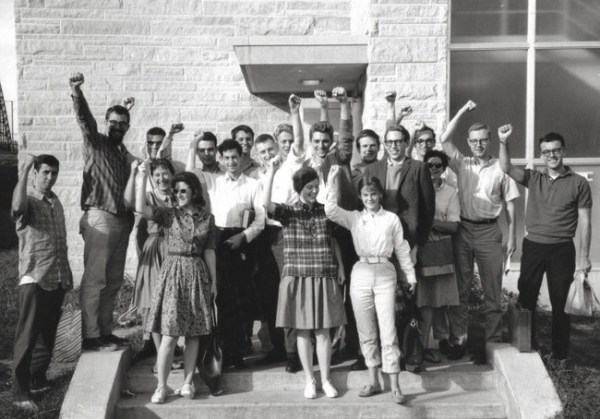 Did this disdain for the culture of higher education mean that the intellectuals of SDS were anti-intellectual? No, what it signaled was an active disdain for the dominant culture of American higher education.
In less than a decade, this anti-establishment impulse among well-educated young leftists had careened down a startling path and mutated into a very different animal. By 1970, the scattered remnants of SDS had resorted to bombing the Pentagon, army bases, and—accidentally—themselves. Leftist disdain for the establishment had morphed from the smiling, fist-shaking intellectualism of the 1963 SDS meeting pictured above into the gleeful nihilism of Abbie Hoffman pictured below.
 So what might this analogy tell us about the feelings of today’s conservatives and fundamentalists about mainstream science? For one thing, it suggests that the proper term here is not “ignorance,” but “disdain.” Well-educated American fundamentalists are not ignorant about mainstream science, but they feel a deep disdain for it. That disdain has increased in the last generation as alternative intellectual institutions have propagated an anti-establishment culture.
Other studies have supported this intuition. As we reviewed here recently, Jonathan Haidt’s Righteous Mind included a survey of 2000 respondents. In this study, self-identified conservatives and moderates were very good at predicting the moral responses of liberals. Self-identified liberals, on the other hand, could not guess what conservatives might say. This suggests that Fundamentalist America is well aware of what liberals think, but liberals have allowed themselves to become ignorant of other intellectual options.
Let’s return to our analogy to see if it helps explain this phenomenon. If fundamentalists in 2010 share the disdain for mainstream intellectual culture that was espoused by well-educated young leftists in the early 1960s, what might be the results?
In the case of the Left, this divorce from academic culture was merely a trial separation. Most of the student radicals of the 1960s and 1970s ended up the boring center-leftists of the 1990s. The academically inclined among them founded or joined friendly academic centers hoping to eliminate racism or poverty or war. The more talented and lucky managed to open new fields of study and press for new visions of education, promoting successful “ethnic studies” programs and multicultural education initiatives. For a small minority of 1960s/70s leftists, those who followed the logic of anti-establishment culture to its bitter 1970s conclusion, this meant increasingly bizarre forms of dress and behavior, meant to signal distance from the establishment. For a tiny fraction, this meant political and cultural violence, such as bombs at the Pentagon and Days of Rage.
What will it mean for fundamentalists? If the historical analogy holds any weight, this distancing between mainstream science and fundamentalists will lead a small fringe on the Right to continue its violent campaign against America. Like the violent Weather Underground, some fundamentalists will likely follow the logic of separation from mainstream culture to a violent conclusion. But for the overwhelming majority of conservatives and fundamentalists, if the historical analogy holds any weight, it will mean the continuation of a trend toward alternative intellectual institutions. Many conservative and fundamentalist intellectual types will find congenial homes in the widening world of the academy and private foundations/think-tanks. Since the 1970s, indeed, we have seen a proliferation of conservative think tanks and foundations, such as the Heritage Foundation. In recent years, these conservative alternative intellectual centers have offered well-educated fundamentalists a happy home in which to continue their intellectual work while continuing to feel a deep disdain for mainstream intellectual culture. In some cases, this has included a disdain for mainstream science. For example, a new intellectual center at Biola University, the Center for Christian Thought has promised to offer
“scholars from a variety of Christian perspectives a unique opportunity to work collaboratively on a selected theme. Together, they develop their ideas, refine their thinking, and examine important cultural issues in a way that is informed by Scripture. Ultimately, the collaborative work will result in scholarly and popular-level materials, providing the broader culture with thoughtful and carefully articulated Christian perspectives on current events, ethical concerns, and social trends.”
Just as the 1970s witnessed a huge increase in Left-friendly academic centers and fields of study, so this widening cultural distance between educated fundamentalists and mainstream science and academic life should lead to an increase in fundamentalist-friendly academic centers like this one. It will lead to a deepening division between types of well-educated people; it will force Americans to confront their notions that there is one “correct” version of science and intellectualism.
***Thanks for the reference to Tim Lacy at USIH ***

 What if Batman shooter James Holmes had been a seminary student instead of a science student?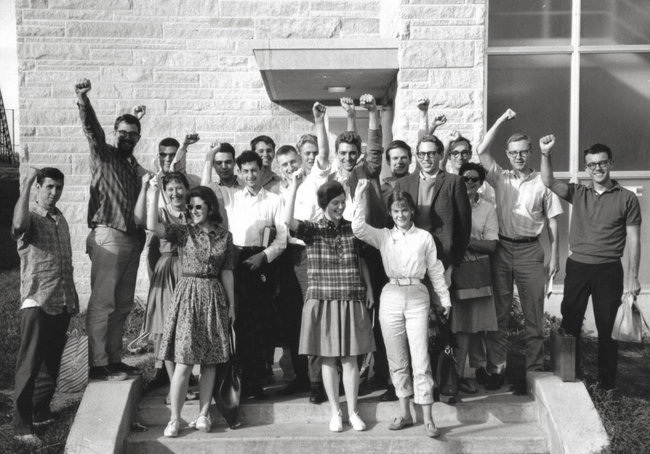




 I Love You but You're Going to Hell