Just the Facts, Ma’am

What should good history teaching look like?  As we’ve noted here at ILYBYGTH, conservative critics have warned that the new Advanced Placement US History framework pushes a “consistently negative view of the nation’s past.”  Now, two big historical associations have defended the guidelines.  But those associations are downplaying a central reason why so many conservative critics object to the APUSH framework.

Anyone with ears to hear can’t miss the conservative concern about the tenor of the new APUSH framework.  From the Republican National Convention to the blogosphere to the stuffed-shirt crowd, conservative pundits have teed off on the new guidelines for the advanced history classes.

Time and again, conservative activists such as Larry Krieger have warned that the new guidelines leave out key documents such as the Mayflower Compact and teach children that America’s history is the story of white exploitation, greed, and genocide.

The National Council for History Education and the American Historical Association have published letters in defense of the APUSH guidelines.  Mainly, these history groups insist that the new framework is not biased.  As the AHA puts it,

The AHA objects to mischaracterizations of the framework as anti-American, purposefully incomplete, radical, and/or partisan.

The 2012 framework reflects the increased focus among history educators in recent years on teaching students to think historically, rather than emphasizing the memorization of facts, names, and dates.  This emphasis on skills, on habits of mind, helps our students acquire the ability to understand and learn from key events, social changes, and documents, including those which provide the foundations of this nation and its subsequent evolution.  The authors of the framework took seriously the obligation of our schools to create actively thinking and engaged citizens, which included understanding the importance of context, evidence, and chronology to an appreciation of the past.

But there is a minor theme in these defenses.  In the snippet above, the AHA signatories mention that good history education goes beyond the “memorization of facts.”  Similarly, the NCHE insists, “The point of education is not simply to acquire a specific body of information.”

But for many conservative activists and their supporters, the definition of education is precisely the acquisition of knowledge.  And that definition has proven enormously politically powerful over the years.  Please don’t get me wrong—I’m an ardent supporter and sometime member of both the NCHE and the AHA.  But these letters downplay the culture-wars significance of what Paolo Freire called the “banking” model of education.

Not that conservative critics aren’t concerned with the partisan tone of the new guidelines.  That is certainly a key motivating factor for many, I’m sure.  But behind and beyond those worries lies a deeper conservative concern with the definition of education itself.  Not all, certainly, but many conservatives want education in general to remain the transmission of a set of knowledge from teacher to student.

This notion of proper education is so deep and so profound that it often goes unarticulated.  Conservatives—and many allies who wouldn’t call themselves conservative—simply assume that education consists of acquiring knowledge, of memorizing facts.  And this assumption lurks behind many of the big education reforms of our century.  The test-heavy aspects of the No Child Left Behind Act and the new Common Core standards rely on a notion of good education as the transmission of information.  If a student has really learned something, the thinking goes, a test can find out.

For over a century, progressive educators have railed against this powerful assumption about the nature of education.  But for just as long, conservative activists have worked hard to keep this idea of education at the center of public schooling.  As I argue in my upcoming book, conservatives have been able to rally support for this “banking” vision of proper education in every generation.

In the 1930s, for instance, one leader of the Daughters of the American Revolution defined education precisely as a body of ideas that “shall be transmitted by us to our children.”

And in his popular 1949 book And Madly Teach, pundit Mortimer Smith insisted that true education consisted precisely of transmitting the children “the whole heritage of man’s progress through history.”

Similarly, in 1950, an angry letter-writer in the Pasadena Independent insisted on the transmission model as the only proper method of education.  As this writer put it,

Children have the right to learn by being taught all and more than their parents and grandparents learned—one step ahead instead of backward, through each generation.

Perhaps the most articulate advocate for this notion of traditional, transmissive education was California State Superintendent of Public Education Max Rafferty.  In his official jobs and his syndicated newspaper column, Rafferty insisted that the only worthwhile definition of education was the transmission of knowledge from adult to child.  Two fundamental principles of “common sense” in education, Rafferty argued in 1964, were the following:

  • Common sense told us that the schools are built and equipped and staffed largely to pass on from generation to generation the cultural heritage of the race.

  • Common sense took for granted that children could memorize certain meaningful and important things in early life and remember them better in later years than they could things that they had not memorized.

We could list a thousand more examples.  This tradition among conservative activists has remained so powerful that it often goes without saying.  And it lurks behind conservative agitation against each new generation of progressive educational reform.

So when groups such as the AHA and the NCHE defend the new APUSH guidelines, they should spend more time explaining and defending their notion that good education relies on more than just the memorization of facts.  For many parents and teachers, the transmission of those facts is precisely the definition of good education.
How to Hit your Child

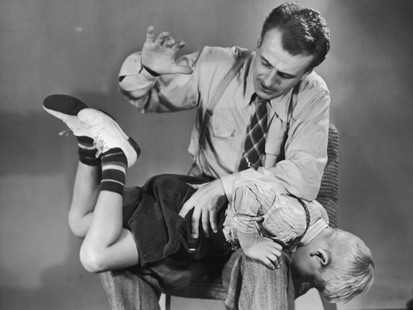
What do you do when your kids misbehave?  Do you hit them?  Or is that a form of abuse?  It seems as if our culture is confused about this question.  Throughout the twentieth century, as I argue in my upcoming book, conservatives argued that parents and teachers MUST beat children in traditional ways.  Anything else threatened civilization itself.  Has that attitude changed?

Is this "abuse?" Or is this "parenting?"

Is this “abuse?” Or is this “parenting?”

In American culture, a certain form of physical correction of children by parents has long been the norm.  Especially “spanking.”  In this kind of punishment, the child is swacked on the butt by the parent, either with a hand, a spoon, a brush, a belt, or some other mild weapon.

As a survey article in National Review Online describes, states now differ in their laws about spanking.  In New York, for instance, a judge recently ruled in favor of parents’ right to spank, as long as it is done mildly, with only an open hand.  In the New York case, the parent insisted he had not used a belt on his child.  That would have crossed the line, he felt.  In other states as well, courts have struggled to draw clear boundaries between acceptable spanking and unacceptable child abuse.

Until 2012, according to the NRO article, all 50 states recognized parents’ right to spank their own children.  In that year, Delaware passed a law forbidding any form of physical punishment.  At the first and second degrees, parents in Delaware can be charged with a felony for causing harm to their children.

As you might expect, a certain sort of conservative finds this sort of law outrageous.  Not only should the rights of parents over their children be sacrosanct, some conservative activists have argued, but spanking is a healthy and humane form of punishment.  The Home School Legal Defense Association, for example, called Delaware’s new law “a violation of the right of parents to direct the upbringing of their children, including the long-recognized right to administer reasonable corporal discipline.”

It’s not a new issue.  As I found during my research for my upcoming book, educational conservatives have long insisted on the right and duty of both parents and teachers to use physical punishment on unruly youth.  For some conservatives, this sort of corporal punishment is the only way to properly shape character.  As the old saying goes, “Spare the rod and spoil the child.”

In 1950 Pasadena, for instance, local activists bubbled over with their outrage at progressive novelties in their local public schools.  One parent insisted that teachers must use “whipping . . . when the situation calls for such punishment.”  The problem, many conservatives in Pasadena thought at the time, was not that teachers might abuse students.  Rather, the danger came from a generation of children left uncorrected and unbowed to authority.  Such unguided youth, one letter-writer complained, were in danger of total “moral disintegration.”  And the obvious reason for that disintegration, according to this anonymous writer, was the “fatal lack of the right kind of instruction in our schools.”

A few years later, conservative stalwart Max Rafferty agreed on the importance of corporal punishment.  In his 1964 book What Are They Doing to Your Children, Rafferty warned of the dangers of progressive methods.  New teachers, Rafferty explained, came

Fresh from college and still pretty Dewey-eyed about things, [they] compromise themselves and their careers in a hopeless attempt to convince some freckled-faced [sic] urchin with devilment coming out visibly all over him that he must discipline himself.

Instead, Rafferty believed, the traditional methods remained the best.  Each teacher should learn when and how to correct a student using physical punishment.  In the old days, Rafferty wrote, such things were beyond argument.  In times past, Rafferty described, some parents might

Storm into the schoolyard and whip the teacher for abusing little Willie, but by far the more typical parental reaction to the tearful complaint ‘Teacher licked me!’ was to reach for the razor strop and give a home version of teacher’s treatment out in the woodshed.

Rafferty and the Pasadena conservatives knew that such physical punishment was controversial in their own times.  Each conservative writer appealed to a past in which teachers and parents had an unfettered right and duty to use appropriate methods to raise children right.  In 1950 and 1964, conservatives saw themselves as stalwarts of traditional methods.  Those methods had already come under attack by dunderheaded progressives.

So there is nothing new to controversy over corporal punishment.  Yet clearly, as the NRO review shows, things are changing.  Could we be on the cusp of a new age for corporal punishment?  Will more states follow Delaware in outlawing all forms of physical punishment?


The Handwriting on the Wall

Conservatives have been proven right!  About handwriting, at least.  A recent article in the New York Times suggests that teaching handwriting might be a good way to help students learn.

In the research for my upcoming book about educational conservatism, I kept coming across conservative complaints that schools were abandoning the traditional subject of handwriting, often called “penmanship.”

In the pages of the Pasadena Independent, for example, editor T.G. Wood complained in 1950 that “progressive” education fads had led to less learning of traditional subjects.  Parents were increasingly starting to wonder, Wood wrote acerbically,

why little Johnny puts two and three together and comes up with nine, why his penmanship shows little or no improvement, and why his reading is poor or backward.

An angry Pasadena reader agreed.  Back in the old days, one letter-writer explained, Pasadena’s schools had benefited from the work of teacher Albert P. Meub, “a penman of national note.”  Meub had tried to keep the subject of penmanship in the schools, the letter-writer complained, but to no avail.  The rush for progressivism in schools had led to the willy-nilly abandonment of traditional subjects such as penmanship.

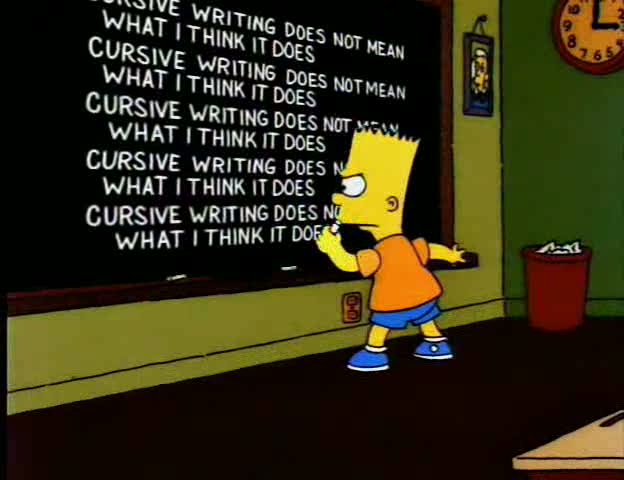
I can’t help but think of the Simpsons episode in which Bart’s new teacher asks him if he knows cursive.  “Well,” Bart replies, “I know hell, damn, and fart.”

Hell, Damn, and Fart

Hell, Damn, and Fart

According to the research review in the New York Times, both Bart and the children of Pasadena would have done better if they had spent more time learning to write by hand.  Some of the research compares writing by hand to writing by computer.  But some psychologists have also studied the difference between learning to write in cursive or by writing block letters.  Some think that students will do better when they learn cursive.

Why?

Karin James of Indiana University suggests that writing by hand helps students learn about the infinite complexity of letter variability.  Every Times-New-Roman “A” may look the same, but not every hand-written one.

Another study suggests that learning cursive may actually stimulate more brain activity and help fight language problems.

The crusty conservative editor T.G. Wood of the Pasadena Independent might have argued from his perch in 1950 that such studies only belabor the obvious.  Educational fads that abandon tradition out of a misguided trust in the superiority of the new and shiny will always lead young people astray.  Traditional education, conservatives have long insisted, has lasted so long for an obvious reason: It works.

Can You Find the Conservative Education in This Picture?

Gracy Olmstead doesn’t mind tweaking the noses of her fellow conservatives.  She has encouraged them to relax about the dangers of the new(ish) Common Core State Standards, for example.  And now she wants conservatives to embrace Finland’s progressive-education model.

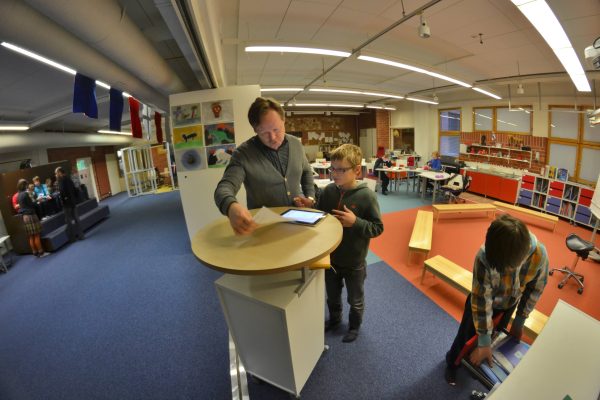
In today’s battles over classroom teaching and school organization, progressives often point to Finland as a guide.  Olmstead wants to claim Finland’s model as one for thinking conservatives.  I’ll admit: I’m stumped.  I can’t find the “conservative” elements Olmstead wants me to see in this picture.

A Conservative Model?

A Conservative Model?

Famously, Finland’s schools shun standardized tests.  Finland’s teachers are an elite cadre of highly trained professionals.  Students in Finland’s schools spend little time cramming or regurgitating information.  Students are encouraged to play, to think, to roam outside the boundaries of classrooms and textbooks.

Most progressives love this model.

Olmstead does too.  She says it embodies the core conservative principle of subsidiarity.  For those of us who haven’t been paying attention to conservative rhetoric for the past couple of years, “subsidiarity” is an old term that has attracted some new conservative devotees lately.  Paul Ryan, for instance, famously invoked the Catholic notion of subsidiarity as the moral justification for his 2012 budget plan.  Though other Catholic intellectuals disputed Ryan’s definition, Ryan used the term as shorthand for Reagan-esque encouragement of localism in government.  The best solutions were those closest to the problems.  Central governments should play only a subsidiary role, tackling issues local folks cannot.

Olmstead finds this principle at the heart of Finland’s school plan.  No centrally imposed curriculum, no dictatorial imposition of one-size-fits-all schooling.  She notes that some conservatives might not like the lack of private options for schooling.  But she does not stress the fact that American conservatives will likely also rebel at the very practices of schooling in Finland.  Olmstead quotes progressive guru Linda Darling-Hammond’s description of Finnish schooling:

In a typical classroom, students are likely to be walking around, rotating through workshops or gathering information, asking questions of their teacher, and working with other students in small groups.

Now, Olmstead’s enlightened conservatism may find this image appealing.  But many American conservatives (not all!) connect traditional classroom practices with effective schooling.  Indeed, one of the constant themes of conservative educational activism throughout the twentieth century, I argue in my upcoming book, has been this connection between traditionalist classroom practice and traditionalist social morality.

I applaud Olmstead’s open-mindedness.  But I wonder how many other conservatives will join her in her embrace of the Finnish model.


Conservative Education for Dummies

How can a conservative person in America be sure her kids are getting a good education?  Relax, says Anthony Esolen in a recent article in the Imaginative Conservative.  It’s easy.  Just follow a few simple steps.

1.) Don’t give up on memorization.

2.) Read good books.

3.) Relax: your kids will get a good education.

Esolen advises conservative parents and school leaders to trust in the natural learning capacities of young people.  Children learn.  If we trust in our instincts, we will help.

One thing that works is to have children memorize things.  Too often, Esolen writes, educators look down their noses at “mere” memorization.  “For fifty years,” Esolen laments, “we have been cowed by the educational ‘experts’ into believing that it is contemptible, simplistic, backward, and ineffectual.”  But memorizing things—whether it’s the multiplication tables or Milton—lies at the heart of education.  Esolen relates the tale of a farmer who memorized Paradise Lost.  This was more than just rote memorization.  This was “getting it by heart,” a process of imbibing a priceless intellectual resource to spark real human-scale education.

What should be the content of this sort of real education?  Esolen wants conservative parents to relax.  There are good books everywhere that can form the base of an effective education.  Too often, Esolen says, educators focus on the crass, the cynical, or even the pornographic in a misguided attempt to expose children to the latest intellectual fads.  Why pervert your children’s minds by assigning Slaughterhouse Five, Esolen asks, when the list of good books is so long and so readily available?  Why not pick from any of the good books all around us:

Heidi, Treasure Island, The Wind in the Willows, The Jungle Book, The Secret Garden, The Yearling, David Copperfield, Silas Marner, Black Beauty, Kim, The Adventures of Robin Hood, Little Women, Oliver Twist, Tom Sawyer, Hans Brinkerthe fairy tales of the Brothers Grimm, and of Hans Christian Andersen.

For older students, pick from

Chaucer, Spenser, Shakespeare, Milton, Keats, Tennyson, Browning, Whittier, Dickinson, Frost, and many more. We have all of the wonderful novels of Jane Austen and Dickens and Eliot and Mark Twain and Walter Scott. There’s the great literature of the western world—Virgil and Dante and Cervantes and Tolstoy.

Relax.  Esolen insists, this process is “not like going to the moon. It is like looking up at the stars.”

If you educate your children this way, Esolen writes, no standardized test will have the power to frighten or dismay them.  They will know more than children educated by the most modern methods.  Indeed, they will know things, and other children will not.

What is a conservative parent to do?  According to Esolen, the answer is clear: Relax.  The tried-and-true methods and content of schooling are still the best.


Sit Down, Shut Up: Old School Teaching for New School Results

What’s the best way to teach children?

Get them to suffer.  Get them to fear.  Get them to obey.

That’s the message, anyway, of a recent essay by Joanne Lipman in the Wall Street Journal.

Lipman, of course, might put in another way.  In her words, she wants us to “revive old-fashioned education. . . . with strict discipline and unyielding demands.”

How should we do this?  Lipman offers eight guidelines.

We should understand that the highest levels of performance are helped, not hurt, by “a little pain.”  We need to get back to memorization.  Kids need to be allowed to fail, to understand that failure is a necessary aspect of improvement.  Plus, “strict” teachers do better than “nice” ones.  Also, creativity can be achieved through hard work.  Not by coddling, but by teaching “grit.”  Teachers need to get out of the habit of fulsome, unearned praise.  Last but not least, children need to experience stress in order to maximize their improvement.

Lipman claims scientific support for her platform, even though some of her cited studies don’t sound rock-solid.  Some have small sample sizes.  Just because something worked for a couple dozen students doesn’t mean it will be generally true.  Others have unconvincing methodologies.  One study, for instance, asked undergraduates about the stresses they had experienced in their lives.  Then the researchers dunked the students’ hands in ice water.  Those who had experienced stress, the study concluded, did not feel as much discomfort.

Such dubious science does not make me clamor to expose my daughter to more yelling at school.  But whether or not we accept the scientific rigor of Lipman’s sources, we cannot deny the political and cultural clout her argument for more traditional teaching has had over the decades.

In the 1920s, one leader of the influential Daughters of the American Revolution denounced innovations in classroom teaching.  Too many ‘modern’ teachers, President General Grace Brosseau lamented in 1929, thought that teaching consisted of presenting students with options.  Balderdash, Brosseau insisted.  Teachers must continue to deliver information to students in an authoritative way.  “One does not place before a delicate child,” Brosseau argued,

a cup of strong black coffee and a glass of milk; or a big cigar and a stick of barley candy; or a narcotic and an orange, and in the name of progress and freedom insist that both must be tested in order that the child be given the right of choice.  Instead, one carefully supplies only what will make for the development of the young body and assure its normal growth.

Schools, Brosseau insisted, must return to authoritative teaching.  Teachers must insist on hard work and dedication.  They must decide, instead of foisting all decisions off on immature children.

This traditionalist theme was taken up in the 1960s by the influential education pundit Max Rafferty.  Rafferty insisted that the only way to improve education was to return to traditional methods and content.  Young people need to memorize, to compete, to work hard, Rafferty claimed.

In his 1964 book What Are They Doing to Your Children, Rafferty offered a vision of “Education-In-Depth” that might delight Lipman and other contemporary traditionalists.  Children, Rafferty argued, must submit to sometimes-unpleasant processes.  “Before a child can learn to write creatively and imaginatively,” Raffferty believed, “he must submit to the discipline of learning the writing trade—the metaphor, the syntax, the verb conjugations, and above all the spelling.”

Schools must stress “subject matter,” not feelings.  They must give lots of homework.  They must teach the basics, such as multiplication tables.  Perhaps most of all, they must reverse the “progressive” poison by teaching children to “not be afraid of hard work.”

As I’ve argued elsewhere, Rafferty’s model still has influential admirers today.  Lipman does not seem to be one of them, at least not consciously.  She does not seem aware of the tradition of traditionalism in education.  My hunch is that she’d like to dissociate her call for “old-fashioned” education with some of the views of Rafferty or Brosseau.  Lipman might prefer to have her vision of traditionalism associated with rigorous social science than with the flag-waving patriotism and anti-communism of earlier traditionalists.

Nevertheless, Lipman and other fans of traditional discipline and memorization might be well advised to study their own history.


FROM THE ARCHIVES: Fundamentalism vs. Communism, c. 1949

In the twenty-first century, it can be difficult to remember the menace once posed to Fundamentalist America by communism.  Of course, it was not only Fundamentalist Americans, but most Americans, who shared a strong anti-communism, at least since the 1930s.  As historian Ellen Schrecker has argued, anti-communism WAS Americanism.

It is too easy to limit our understanding of anti-communism to a narrow campaign against one political group.  In Fundamentalist America, the fight against communism took on a broad array of meanings.  “Communism” itself came to include a vast spectrum of purportedly anti-American ideas, including anti-theism, progressive education, declining manners, anti-capitalism, disrespect for tradition, and so on.  Not surprisingly, the fight against communism came to include such notions as support for more public religion.  It often included support for traditional families and social relationships.  It also included a fight for more traditional teaching, both in content and in method.

To cite just one example, as President General Anne Minor of the staunchly anti-communist Daughters of the American Revolution insisted in 1923, Americans “want no teachers who say there are two sides to every question.”  Teachers must teach a strict patriotic traditionalism.  They must tell their students the correct answer, with the correct social values, every time.  Those “progressive” teachers who waffle and squirm, who infect their students with a crippling moral relativism, would eventually create a generation of insipid, unpatriotic Americans unable to defend against the menace of communism.

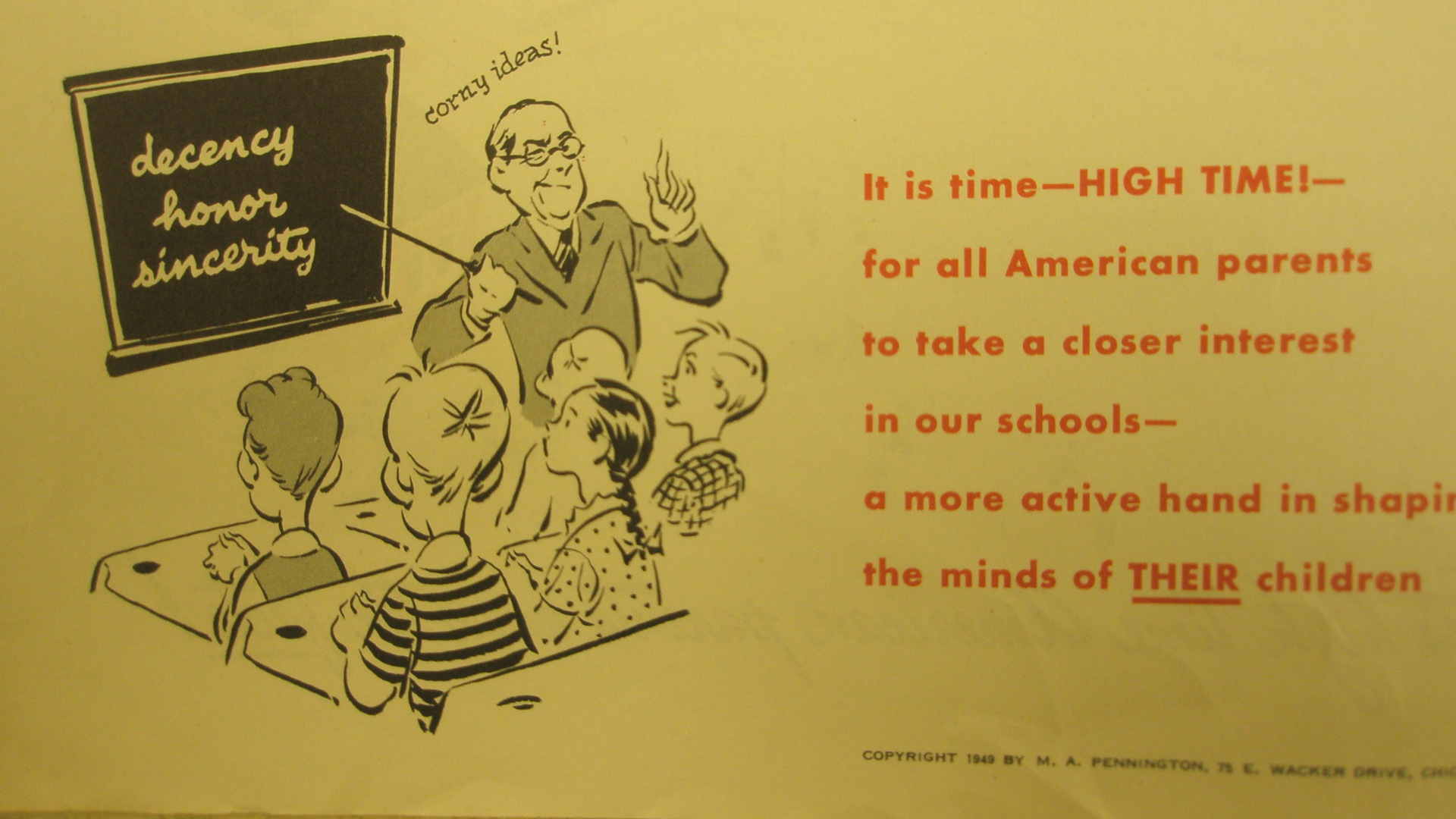
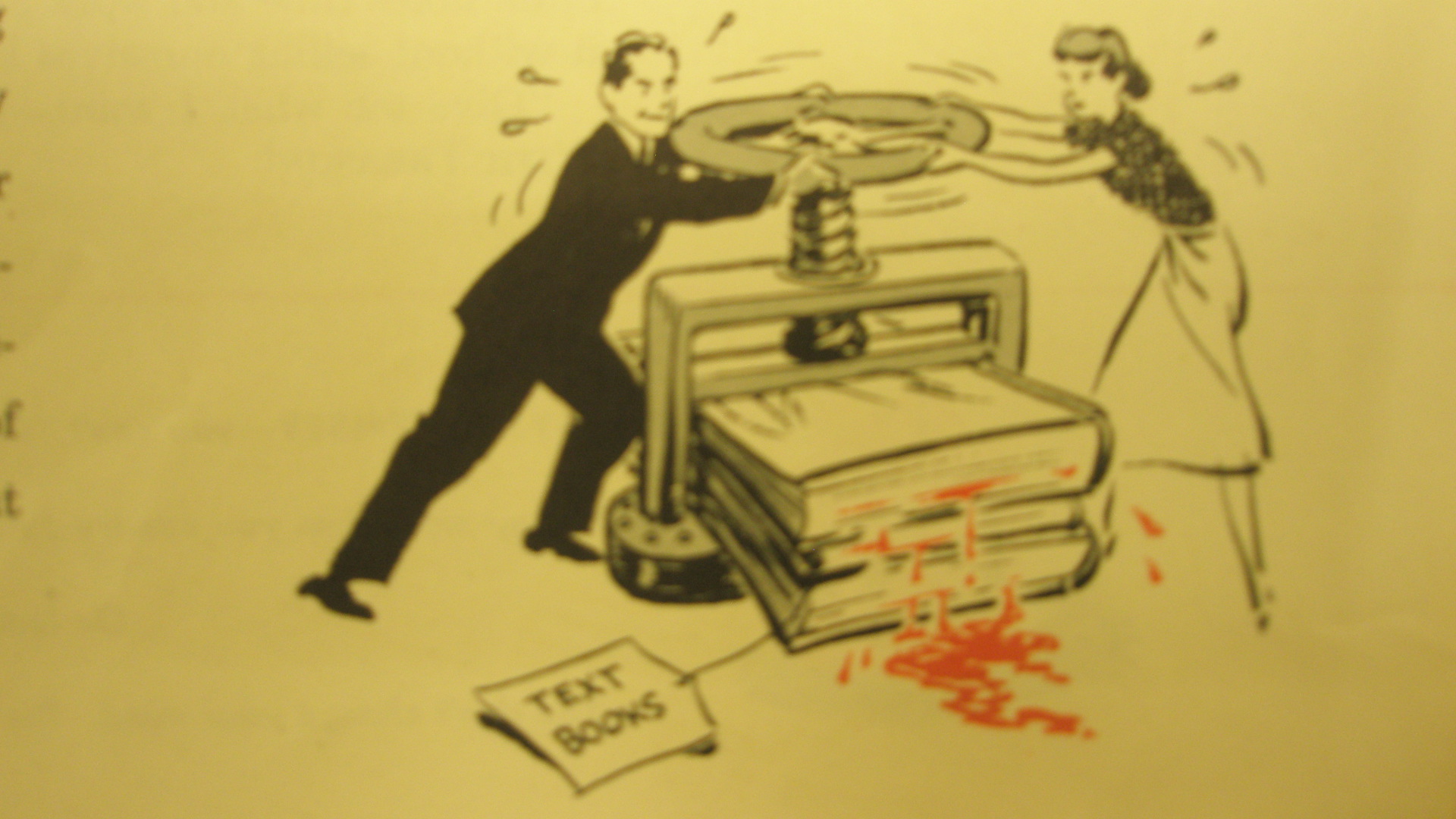
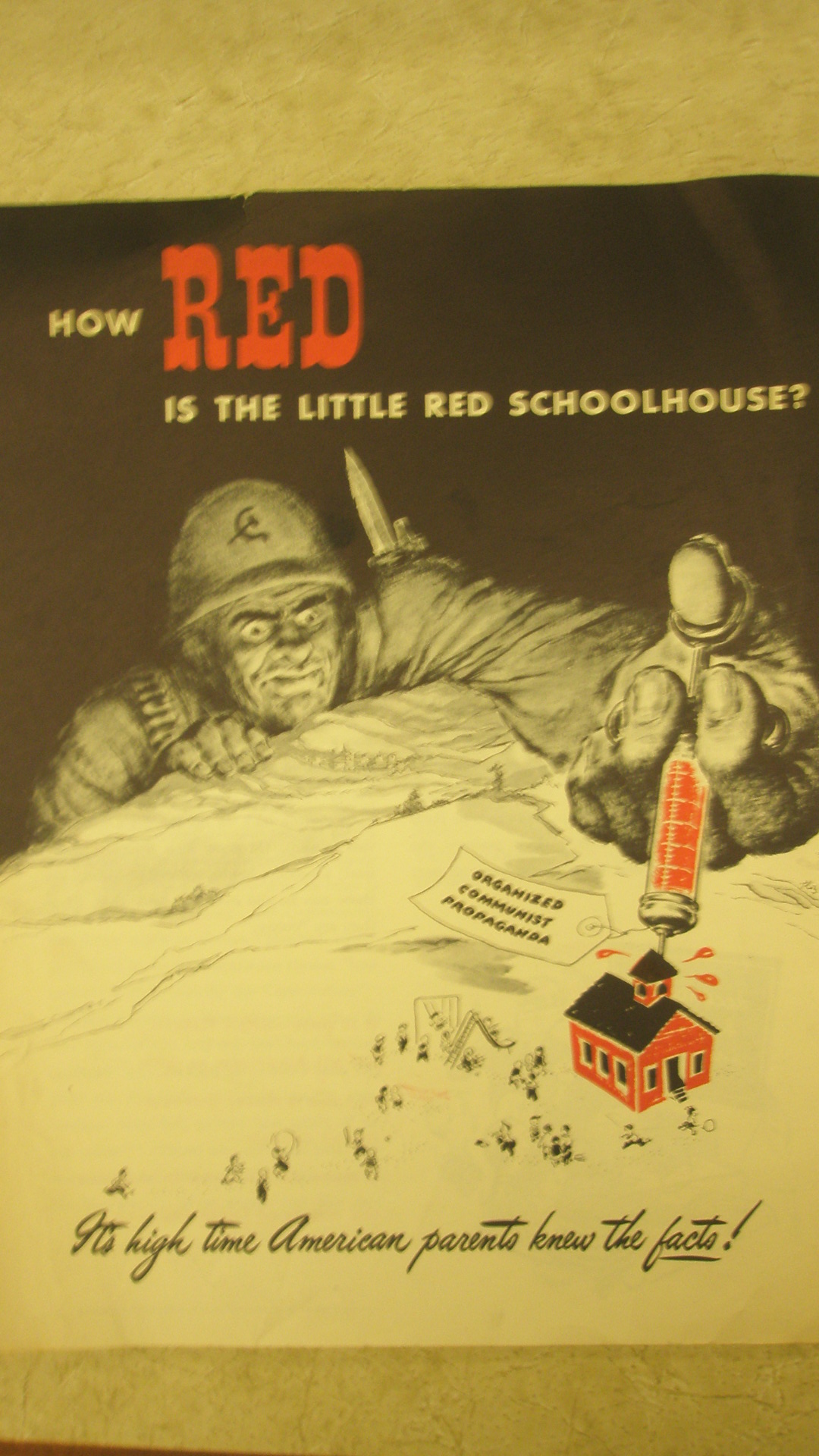
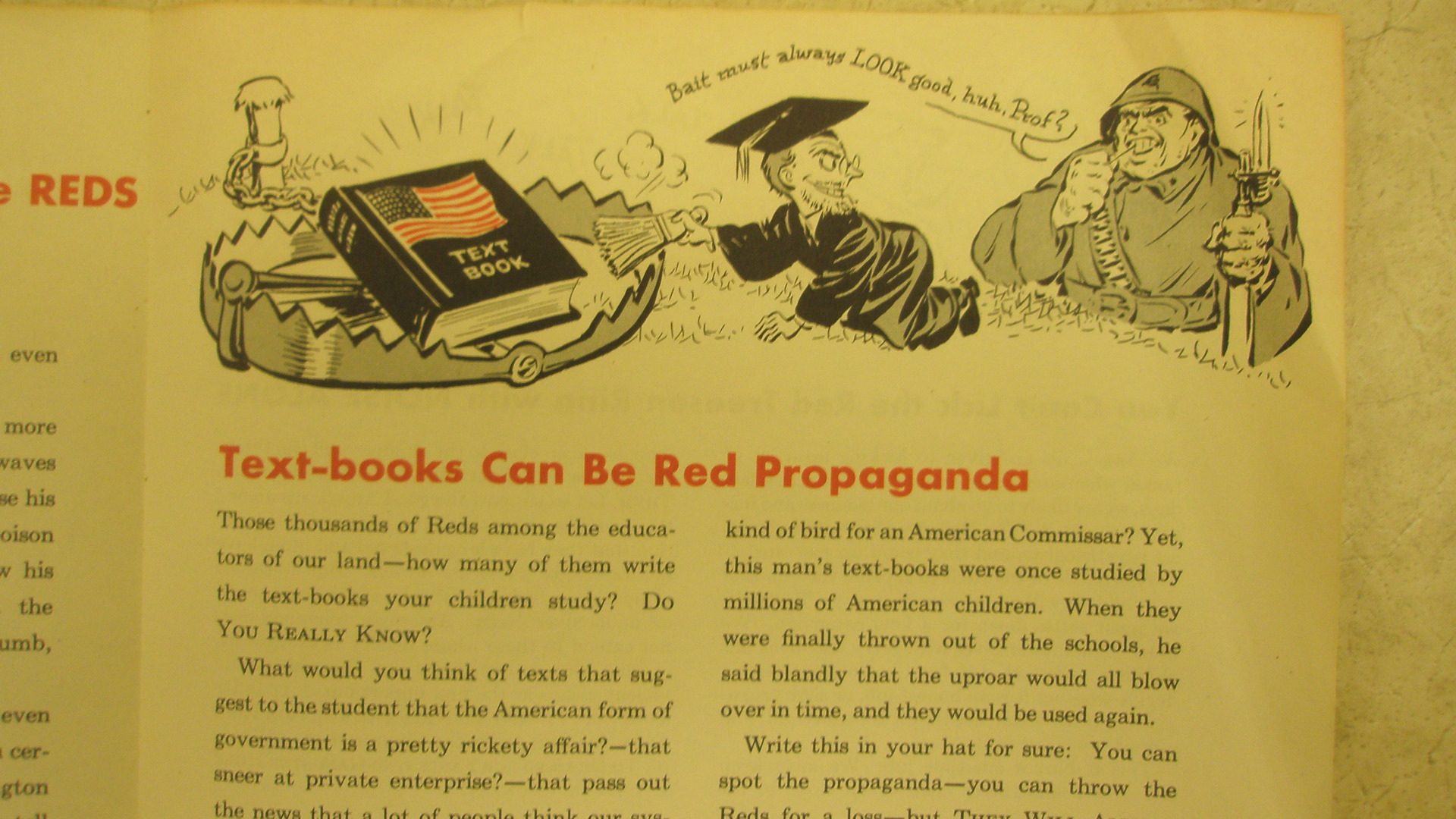
As always, a picture is worth a thousand words.  In this case, I’ll share some cartoons from an anti-communist pamphlet from 1949.  These cartoons demonstrate one common ideological thread in Cold War Fundamentalist America.  At the time, activists like the one who published this brochure felt that Communism threatened a two-pronged attack.  The danger included a military menace from Soviet Russia.  But it also meant internal subversion by dupes who did the work of the Red Army.  Intentionally or not, such subversive activity helped to weaken the resolve of America, making a communist takeover that much easier.

Further Reading: Ellen Schrecker, Many Are the Crimes: McCarthyism in America (Princeton: Princeton University Press, 1998); Jonathan Zimmerman, Small Wonder: The Little Red Schoolhouse in History and Memory (New Haven: Yale University Press, 2009).

This one shows the vast sweep of cultural ideology folded into the fight against communism. Not only must patriots fight communism, they must also fight to uphold traditional values.

Parents squeezing the “Red” out of textbooks.

As historian Jonathan Zimmerman has argued, the image of the “Little Red Schoolhouse” has long been a potent political symbol. In this cover image, the cartoonist makes a connection common in Cold-War anti-communism. “Reds” worked hard to subvert the Red Schoolhouse.

The scheming, bearded academic has long been an object of suspicion in Fundamentalist America. Here, he does the work of the Red Army.

From the Archives: Of Penises and Progressive Schools

Like most other culture-war issues, the enduring battles over the proper form and function of schooling have tended to fight with caricatures rather than realities.  Each side has produced compelling fictions about the dangers of ‘tyrannical’ traditional schools or ‘anarchic’ progressive ones.  Among fans of progressive education, the generations have not produced a more damning portrait of traditional schooling than Dickens’ Mr. Gradgrind.

Gradgrind hammered home his bullheaded vision of the proper goal of schooling:

‘“Now, what I want is Facts.  Teach these boys and girls nothing but Facts.  Facts alone are wanted in life. Plant nothing else, and root out everything else.  You can only form the minds of reasoning animals upon Facts: nothing else will ever be of any service to them.  This is the principle on which I bring up my own children, and this is the principle on which I bring up these children.  Stick to Facts, sir!”

‘The scene was a plain, bare, monotonous vault of a school-room, and the speaker’s square forefinger emphasized his observations by underscoring every sentence with a line on the schoolmaster’s sleeve.’

A little bit later in the story, Gradgrind receives a visit from an official in the government bureau of education.  The two reach perfect agreement on the essence of proper schooling:

‘“Fact, fact, fact!’ said the gentleman.  And “Fact, fact, fact!” repeated Thomas Gradgrind.

‘“You are to be in all things regulated and governed,” said the gentleman, “by fact.  We hope to have, before long, a board of fact, composed of commissioners of fact, who will force the people to be a people of fact, and of nothing but fact.  You must discard the word Fancy altogether.  You have nothing to do with it.  You are not to have, in any object of use or ornament, what would be a contradiction in fact.  You don’t walk upon flowers in fact; you cannot be allowed to walk upon flowers in carpets.”’

This sketch of the cruelties of traditional education from 1854 could just as easily be a conversation from 1954 or 2004.  The caricature of traditionalist education is that it harps senselessly and incessantly on the need for young children to memorize and regurgitate ‘Facts, Facts, Facts!’  Every traditionalist since 1854 has lambasted “progressive” schools for including fads and frills, of ignoring the overwhelming importance of ‘Facts, Facts, Facts!’

For their part, traditionalists can’t hope for a more ridiculous picture of the perils and puerility of progressive education than we find in the 1955 novel Auntie Mame, by Patrick Dennis.  This is a title that resonated powerfully with Americans when it first came out.  It stayed on the New York Times bestseller list for over two years, and sold over two million copies.  Inevitably, it was made into a Broadway play and musical, then into a Hollywood movie.  Apparently, the musical still makes an appearance every now and again.

The novel tells the story of young Patrick Dennis, a ten-year-old orphan sent in 1929 to live with his free-spirit Aunt Mame.  Mame lives the life of the New York intellectual avant-garde to the hilt.  At first, young Patrick is terrified by the outlandish characters his aunt surrounds herself with, but he soon embraces her slapdash bohemian elegance.

When it comes time to send the boy to school, Aunt Mame subverts his dying father’s last request that the boy be sent to a “conservative school.”  Instead, she finds Patrick a place in a “completely revolutionary” school run by her friend Ralph, a man who scolds Mame for allowing the boy to read.

When young Patrick arrives at the “progressive” school, he falls in with a school regime that typified contemporary stereotypes of the foibles of progressive education.  The portrait so perfectly captures the enduring caricature of excessive progressive schooling that I’ll include a good long chunk of it here:

When we got there, the big room was filled with naked children of all ages racing around and screaming.  Ralph came forward, as naked as the day he was born, and shook hands cordially.

‘Isn’t he lovely,’ Auntie Mame gushed.  ‘Just like a Praxiteles.  Oh, darling, I know you’re going to love it here!’

A square little yellow-haired woman, also naked, rushed up and kissed Auntie Mame.  Her name was Natalie.  She and Ralph were running the school together.

‘Now you just tag along with Ralph and enjoy yourself, my little love, and I’ll see you back at the flat in time for tea.’

Auntie Mame departed with a gay wave and I was left alone, the only person in the place who was wearing any clothes.

            ‘Come in here and disrobe, yes?’ Natalie said, ‘then join the others?’

            I always felt a little like a picked chicken at Ralph’s school, but it was pleasant and I never had to do anything.  It was a big, stark, whitewashed room with a heated linoleum floor, quartz glass skylights, and violet ray tubes running around the available ceiling.  There were no desks or chairs, just some mats where we could lie down and sleep whenever we wanted, and, in the center of the room, a big white structure that looked like a cow’s pelvis.  We were supposed to crawl in, around, and over this if we felt like it, and whenever one of the younger children did, Ralph would give Natalie’s broad bottom a resounding smack and chuckle, ‘Back to the womb, eh Nat!’

There was a communal toilet—‘Nip the inhibitions in the bud’—and all sorts of other progressive pastimes.  We could draw or finger-paint or make things in Plasticine.  There were Guided Conversation Circles, in which we discussed our dreams and took turns telling what we were thinking at the moment.  If you felt like being antisocial, you could just be antisocial.  For lunch we ate raw carrots, raw cauliflower—which always gave me gas—raw apples, and raw goat’s milk.  If two children ever quarreled, Ralph would make them sit down with as many others as were interested and discuss the whole thing.  I thought it was awfully silly, but I got quite a thorough suntan.

But I didn’t stay long enough at Ralph’s school to discover whether it did me good or harm.  My career there—and Ralph’s too, for that matter—ended just six weeks after it began.

Ralph and Natalie, under the misapprehension that their young followers did any work at school, organized an afternoon period of Constructive Play so as to send us all home in a jolly frame of mind.  The general idea was that the children, all except the really antisocial ones, were to participate in a large group game that would teach us something of Life and what awaited us beyond the portals of the school.  Sometimes we’d play Farmer and attend to the scrubby avocado plants Natalie grew.  At other times we’d play Laundry and wash all of Ralph’s underwear, but one of the favorite games of the smaller fry was one called Fish Families, which purported to give us a certain casual knowledge of reproduction in the lower orders.

It was a simple game and rather good exercise.  Natalie and all the girls would crouch on the floor and pretend to lay fish eggs and then Ralph, followed by the boys, would skip among them, arms thrust sideways and fingers wiggling—‘in a swimming motion, a swimming motion’—and fertilize the eggs.  It always brought down the house.

On my last day at Ralph’s we’d been playing Fish Families for about half an hour.  Natalie and the girls were on the linoleum and Ralph started to lead the boys through the school of lady fish.  ‘A swimming motion, a swimming motion!  Now! Spread the sperm, spread the sperm!  Don’t forget that little mother fish there, Patrick, spread the sperm, spread the . . .’

                        There was a sudden choking sound.

                        ‘My God!’ a familiar voice gasped.

            We all turned around and there, fully dressed and looking like the angriest shark in the sea, stood [Patrick’s “conservative” trustee] Mr. Babcock. . . . With one deft motion, he yanked me out of the melee.  ‘God damn it!  You get your clothes on and hurry.  I want to talk to that crazy aunt of yours and I want you to be there with me!’  He threw me in the dressing room.  ‘As for you, you filthy pervert,’ he shouted to Ralph, ‘you haven’t heard the last of this!’ . . .

The next day Ralph’s school was raided by the police, and the tabloids, caught in a lull between ax murders, became profoundly pious about all of progressive education.  Over delicately retouched photographs of Ralph and Natalie and the student body were headlines such as SEX SCHOOL SEIZED, with articles by civic leaders and an outraged clergy that all seemed to begin: ‘Mother, What Is Your Child Being Taught?’

Some of the emphasis on Freud as a panacea for curing children of traditional hang-ups seems a bit dated, but the notion of over-eager progressive school leaders establishing bedlams under the cover of freeing young minds does not.  Every generation of progressive school leader has suffered from comparisons—voiced or silent—to this kind of caricature of the dangers of progressive schooling.

Of course, progressive educators will counter that this kind of cartoonish depiction says nothing about the realities of progressive education.  More important, though, to understanding the seemingly permanent culture war over the proper nature of education, this stereotype of the eventual result of progressive schooling has always had enormous cultural power.  Many traditionalists have argued that any opening in the traditional school regime will lead eventually to some sort of chaotic free-for-all.  For most traditionalists, however, Patrick Dennis’ rose-colored nostalgia for the bumbling Freudian ineptitude of Ralph and Natalie mistakes the more common result.  Not only will students “never have to do anything” constructive in such muddle-headed progressive schools, but the students will soon be robbed of any sense of traditional morality.  They will descend, as in Ralph’s game of Fish Families, to little more than scrabbling beasts, learning that they should consume raw vegetables from the field, that they ought to defecate in public, and that they should see the end and goal of their animal existence as nothing more than laying eggs and spewing sperm.

READINGS: Charles Dickens, Hard Times, For These Times (New York: Signet Classics, 1961); Patrick Dennis, Auntie Mame (New York: Vanguard Press, 1955).

In the News: Schooling, Poverty, and the Educational Culture Wars

In a recent piece in the New York Times, (Class Matters: Why Won’t We Admit It?)  policy professor Helen Ladd and journalist/college-guide writer Edward Fiske offered a strong argument for the close link between social class and school performance.

Poorer children tend to do worse in school.  As Ladd and Fiske point out, this is not news.  Nor is this only an American dilemma.  Other countries face similar situations.
The point of Ladd’s and Fiske’s piece is that federal policy has obstinately and deliberately ignored this important aspect of education policy.

For those interested in the continuing culture wars over education, the more interesting question is this: how have the progressives/liberals/Left come to embrace the position that fixing only schools can not fix education, while the traditionalists/conservatives/Right has taken to heart the idea that schools can be fixed by more rigorous testing and standards?

After all, the notion that schools are only one educational institution among many has long conservative roots.  For generations, educational conservatives have argued that the educational rights of family, church, and other non-school institutions must be respected.

Similarly, for a long time the notion that schools must find ways to test every student to determine individual capability and performance has a long and respectable progressive history.

Yet these days, the notion that schools alone can’t be held responsible for students’ total education has become a favorite on the educational left.

My hunch is that there are two main reasons for this development.

First of all, ten years of No Child Left Behind has shifted the ideological weight of “testing” squarely from left to right.  But this did not come out of Right field.  The progressive appeal of testing faded when the cultural biases of IQ tests were clearly established in the middle of the twentieth century.  When progressives called for more testing, they did so in the hope that such tests would allow schools to tailor education more closely to individual strengths and interests.  When traditionalists call for more testing, they do it as an appeal to the long American tradition of educational exhibitionism.  In the American tradition, schools, teachers, and students are all expected to make public displays of their learning. Today’s high-stakes tests are only an updated version of the old tradition of calling the schoolmaster out on the rug, forcing students to “toe the line,” to show off their learning in ways the community finds acceptable.

In addition, the argument that schools alone can’t fix education comes from a progressive notion that any social improvement must be more than just a policy band-aid.  That is, in order to fix schools, we must fix the more basic injustices of our society.  In order to improve students’ performance, we need to address the fundamental economic imbalance of society.  This would shift the discussion in markedly progressive directions.  Instead of labeling poor children and schools in less affluent areas as ‘failing,’ we would need to start talking about reducing the Gini coefficient, about reducing the growing chasm between the few rich and the many poor.  Instead of blaming schools and teachers for cheating on high-stakes tests, we would need to find ways to improve the economic well-being of huge numbers of poor people.

The ideological baggage that comes along with each of these educational positions points out the difficulty of speaking calmly and clearly about education reform.  Each side hopes to seize the moral high ground, even while claiming to argue in practical, non-ideological terms.  But the very terms we use frame the discussion in ways that are difficult to overcome.  Are we talking about a redistribution of income?  Or are we talking about improving individual performance in reading and math?

PROGRESSIVE EDUCATION Ic: WHY COME TO SCHOOL? (cont…)

Let’s continue the argument in favor of a more progressive understanding of schooling.  In the last post, we discussed an analogy to schooling: giving and receiving directions.  The traditionalist understanding of education is like a mere list of directions to students, directions in an area students are unfamiliar with and to somewhere they have no desire to go.  A more progressive schooling would be sure students were familiar with the area first, then allow them to practice getting there.  When we understand schooling in this “progressive” way, the need for repeated testing falls apart like toilet paper in a rain storm.  You can still use it if you want, but it won’t have the effect you’re after, and you’re likely to make a mess in the process.

Let’s stick with the directions analogy for a minute: if our goal is to help students get from point A to point B, a standardized test is the equivalent of making students write out a list of the directions they have heard.  It only provides a way to check if they had memorized the list of directions.  It does not test whether or not they understood why they were going to point B in the first place, or whether or not they could actually get there in real life.

This is a meaningless game.  Students recognize that.  Instead of providing an evaluation of how much students are learning, repeated standardized tests merely test to see how many students in any given school are willing to compete in the game.  This is why test scores are so unshakeably tied to race and class.  When schooling conditions are pleasant and the meaningless school game seems to be a game that must be played, a higher proportion of students will work to master the lists of information provided.  They will try to perform well on the regurgitative tests.  When schooling in unpleasant and there is less family and peer pressure to do well at the school game, a higher proportion of students will not bother.

Standardized tests promise to provide a dipstick measurement of student learning.  What they provide instead is a measure of cultural compliance.

What would truly provide a check of student learning would be a system in which students are allowed to drive from point A to point B.  Can they navigate the difficulties of real life conditions to perform at an important adult skill?  Do they have the imagination, knowledge, and experience to get there?  There are two main reasons why this kind of authentic testing is not attractive to those who shout for increased testing and “accountability.”  First, these kinds of tests would cost a great deal of money.  Second, these tests would force schools to loosen their coercive grip on young people.  In short, these kinds of authentic tests would disrupt two of the important functions of institutional schooling.  They would release students from the economically designed control offered by our current school model.

Let’s see how it would work in practice:  To see if students really had mastered an authentic skill, such as driving cross town from point A to point B, a teacher would need to spend time with each individual student.  The teacher would need to help the student with some maps and written directions.  The teacher would have to gauge when each student was ready to move to the next step in the learning process.  Finally, the student would have to be allowed to authentically test her skills.  She would have to get from point A to point B, first with some teacher guidance, then finally on her own.  Such a test would provide real information about the intelligence, knowledge, imagination, and skills of students.  It would keep teachers accountable for the authentic learning of their students.

But imagine the financial price.  In essence, each student would need her own adult teacher.  Instead of the current model that provides one salaried adult teacher for twenty to thirty kids, this model would multiply that salary cost by at least twenty times.

Second, this kind of testing would shatter the implicit coercive wall of schools.  It would force schools to abdicate their implicit role as containment for the majority of young people during the traditional work day.  If schools were to attempt to give students an authentic education, one that consisted of helping them master the skills and knowledge that they will need as adults in our society, they would have to allow students to try out those ideas outside of the institution.  Young people would no longer be (more or less) reliably contained and separated from adult society.  They could engage in the delinquency that has been such a feared part of youth for centuries.

If the goal is to force schools, teachers, and administrators to be accountable for student learning, standardized tests are only a convenient figleaf.  They do not check to see if students are actually mastering any intellectual or practical skills and knowledge.  They only check to see how willing they are to play the game of memorizing lists of seemingly haphazard information.  Teachers and schools can pack such lists of information into more appealing forms.  They can increase material incentives for students to play the testing game.  They can limit the functions of their school to drill students in the peculiar skills necessary to master this meaningless game.  But they do not have to provide any authentic education.

Such tests and testing regimes remove any accountability from teachers and schools.  They allow teachers and schools to spend their time on the testing game itself instead of on helping students master real adult challenges.

Consider the difference in the questions teachers and schools face when they are faced with a standardized testing regime, as opposed to when they are trying to help students authentically master ideas:

Teacher’s questions   for himself in testing regime: Teacher’s questions   for himself in authentic education:
Will the student remember what I told her about the plot   of Hamlet? How can I help students understand Hamlet’s existential   dilemma?
What tricks can I show students to help them get a good   score on a reading-comprehension question? Can students read a voter-information bulletin?
What do they need to know for the test about the   Pythagorean theorem? Do my students understand the relationship between the   sides of right triangles?
How can I entice them to try their hardest on the test so   that I do not get my salary docked? Can they function as competent, caring, informed adults?


Which column puts more pressure on teachers?  Which column has more difficult questions?  Which column reflects a teacher who puts more effort into true education for students?

The answer is obvious: testing merely elevates the meaningless game of random information repetition into the only measure of education.  It gives students and teachers a free pass to sidestep the difficult work of real education.  It gives students no reason to play along.  And it forces schools and school districts to enforce the vision of education that is least productive.  It pushes those districts to increase the coercive and regurgitative nature of institutional schooling, when those are the factors that had pushed students to evade the meaningless game of standardized testing in the first place.

In other words, an educational regime that emphasizes standardized testing will discourage all the elements of education itself.  It decreases teacher responsibility, removes local control of schooling decisions, and restricts students from developing their skills as the intelligent citizens necessary to a democracy.


FURTHER READING: Theodore Sizer, Horace’s Compromise: The Dilemma of the American High School (Mariner, 2004); John Holt, How Children Learn (1969).