The Trauma of Evolution

Can we educate by banning ideas?  For one group of conservative Christian homeschoolers, proper education means banishing lots of ideas.  How can progressive educators like me understand this impulse to put up intellectual walls around young people’s minds?  I wonder if some creationists view exposure to evolutionary ideas as a form of trauma, an entirely harmful experience.

The Finish Well homeschooling conference, in the words of its organizers, “is designed to equip homeschooling families to confidently homeschool the high school years for the glory of God!”

One of the ways the conference promises to help attendees is by purging the atmosphere of any hint of evolution.  In order to secure a table at the conference, vendors are required to agree to the following statements:

“1) Scripture teaches a literal 6 day creation week, a young earth of approximately 6,000 years, and a literal understanding of Adam and Eve, the Fall, and the world-wide Flood of Noah’s day. 2) The Bible is the verbally inspired Word of God. It is inerrant and our ultimate authority in what we believe and how we live. Any speakers who contradict these two truths during their speaking session will be immediately asked to leave.”

Clearly, the goal of Finish Well is not only to keep out evolution.  Any other explanation about humanity’s origins will be verboten as well, including the evolutionary creationism of folks such as Darrel Falk or the big-tent creationism of the intelligent-design movement.

This notion of proper education is one of the hardest intellectual nuts for progressive educators like me to crack.  How are we to understand this idea that good education means hiding important ideas away from young people?  My first reaction, my gut reaction, is that this is precisely the sort of totalitarian impulse that kills any real education.  This sort of intellectual protectionism smacks of Nazi Germany or Stalinist Russia.  To me, and to lots of people, one of the first rules of true liberal education means opening intellectual doors, not bricking them up.  Real education, in my opinion, means allowing young people to explore a variety of ideas, to make up their own minds.

But in the conservative tradition, an important aspect of improving education has long consisted of the effort to remove “dangerous” ideas from the educational mix.  For generations, various types of conservative activists have insisted that simple exposure to certain ideas represented a danger—something from which young people had to be protected.

This idea played a big part in the first “creationist” controversies in the 1920s, as I explored in my 1920s book.  One of the public leaders of the anti-evolution movement of that decade was populist politician and former US Secretary of State William Jennings Bryan.  Bryan condemned the notion that good education meant a willy-nilly exposure to perfidious ideas.  In a battle with the University of Wisconsin over the teaching of evolution on campus, Bryan offered this sarcastic advertisement for the college:

“Our class rooms furnish an arena in which a brutish doctrine tears to pieces the religious faith of young men and young women; parents of the children are cordially invited to witness the spectacle.”  [SOURCE: William Jennings Bryan, “The Modern Arena,” The Commoner (June, 1921): 3.]

For my current book, I’m exploring the longer history of conservative educational activism.  This notion of proper-education-as-protection echoed throughout the twentieth century.  For instance, Grace Brosseau, President General of the Daughters of the American Revolution, argued that young children ought not be harmed by “the decrepit theory that both sides of the question should be presented to permit the forming of unbiased opinions.”  Such modern theories of education, Brosseau insisted, fundamentally misunderstood the nature of childhood and the responsibilities of education.  As she explained in 1929,

“One does not place before a delicate child a cup of strong black coffee and a glass of milk; or a big cigar and a stick of barley candy; or a narcotic and an orange, and in the name of progress and freedom insist that both must be tested in order that the child be given the right of choice.”

Instead, parents and teachers must give students only what students need to develop the “delicate and impressionable fabric of the mind.” [SOURCE: “The 38th Continental Congress, N.S.D.A.R.,” DAR Magazine 63 (May 1929): 261-271.]

More recently, the late Mel and Norma Gabler echoed this notion that proper education meant protecting young people from dangerous ideas.  In their 1985 book What Are They Teaching Our Children, the Gablers compared modern teaching to letting young children float in dangerous seas in flimsy lifeboats.  Modern teachers, the Gablers argued, too often allowed children to drift near sharp reefs and crashing waves, without offering any sort of guidance.  The teachers knew the rocks were there, the Gablers argued, yet these ‘progressive’ teachers did not see fit to warn the students.  Better for the students to ‘discover’ such dangers for themselves.  The Gablers asked, “Has the instructor gone mad?” (pg. 99).

For the Gablers, as for Bryan, Brosseau, and the organizers of the Finish Well conference, the notion that some ideas must be hidden from children made perfect sense.  For those like me who don’t agree, perhaps one key to understanding might come from the school controversies of the 1920s.  During that decade, many state lawmakers proposed bills that promised to keep certain ideas out of children’s paths.  One 1927 bill in Florida would have banned “any theory that denies the existence of God, that denies the divine creation of man, or that teaches atheism or infidelity, or that contains vulgar, obscene, or indecent matter” [Florida House Bill 87, 1927].

To the authors of this bill, evolution and atheism could be treated the same way as “obscene” material.  To those 1920s legislators, it made sense to keep obscene materials out of the hands of school children.

I agree that young people ought not be exposed to “obscene” materials.  And maybe this is the way for folks like me to understand the conservative impulse to keep some ideas out of schools.  After all, all of us—not just conservatives or fundamentalists—agree that some things must be kept from children.  No one wants young people to view a lot of hard-core porn at school, for instance.  Nor do we think that children should see graphic violence.  Exposure to such things seems traumatic.

Is this the key to understanding the conservative insistence on keeping certain ideas out?  For some young-earth creationists, mere exposure to evolutionary ideas represents a danger to their young children.  It might be that such conservatives view exposure to evolutionary ideas as an intellectual trauma, a theological trauma.  Such ideas might be ‘out there’ in the world, just like genocide, rape, and lynching might be ‘out there,’ but that does not imply that education must include graphic exposure to them.

Is this the way to understand Finish Well’s prohibition of any hint of evolution?  I’d love to hear from those who believe that young people should be protected from such ideas.

Plumbers and Teachers

What is a teacher? A hired hand?  Or an independent scholar?  A functionary enrolled to help parents?  Or a professional charged to form young minds as she or he best sees fit?

Students of conservative educational activism like me often list the same litany of complaints made by conservatives about public schooling in the past century.  Schools, conservatives often complain, must not warp their students’ minds.  Schools should teach patriotism.  Schools should teach respect for religious values and traditional notions of right and wrong.  Some conservatives believe schools must not teach atheism and call it science.

But there remains one hugely important conservative issue that rarely gets the same amount of attention: conservative concern with the overweening authority of teachers and educational experts.

As part of his recent series on education at Front Porch Republic, Anthony Esolen articulates this traditional conservative frustration.

Esolen frames the question in a provocative fashion: What if teachers were plumbers?

Here is one of Esolen’s scenarios:

“Jones pokes his head into the basement. He hasn’t done that in two years. He’s told himself again and again that they must know what they are doing, they are the experts and he isn’t, they are from the government, and he must mind his own business. But the devil gets into him.

“‘What is that?’

“‘What is what?’

“‘That – that tangle of pipes! Why so many? It’s a maze! It takes up half the room. In some places you can’t stand up straight. It’s like what happens to a hundred foot extension cord. The whole contraption is in knots!’

“‘I fail to see what you are so concerned about. Presumably you wanted us to do your plumbing. Well, so we have. We’ve done a great deal more than you expected.’

“‘But it’s leaking all over the place! Why didn’t you just do the simple but necessary thing? Why didn’t you do what I hired you to do?’

“‘Hired, Mr. Jones?’”

In the research for my current book about twentieth-century conservative educational activism, I’ve seen this argument repeated with a variety of emphases.  For generations, conservative activists have argued that schools and teachers have taken too much authority over children.

For instance, during the 1920s school controversies, William Jennings Bryan famously argued, “The hand that writes the paycheck rules the school.”

A generation later, in 1951, Ernest Brower, a conservative leader from Pasadena, California, complained to a state senate investigating committee that “progressive” education had seized too much control.  In their citizen investigation, Brower reported,

 “Well, you might liken public education, in Pasadena at least, and I think probably in other sections of the country as well, to a patient who is very sick, and so, naturally, the proper thing is to start looking for symptoms, and we found several symptoms of the disease. . . . we noticed there was a definite elimination of parental authority, undermining of parental influence.”

For Brower, as for Bryan and Esolen, this undermining of parental influence signaled the underlying “disease,” of which other educational problems were merely symptoms.

In 1968, conservative California school superintendent Max Rafferty agreed.  “Children,” Rafferty warned,

“do not belong to the state.  They do not belong to us educators, either.  They belong to their parents and to nobody else.  And don’t you forget it.

“Because if you do forget it and let the kids become wards of an all-powerful government, you won’t have to look forward with fear and trembling any more to that dread year 1984.  It will be here, considerably ahead of schedule.”

In 1980, free-market economist Milton Friedman lent his considerable influence to this central conservative notion.  “Parents,” Friedman wrote,

“generally have both greater interest in their children’s schooling and more intimate knowledge of their capacities and needs than anyone else.  Social reformers, and educational reformers in particular, often self-righteously take for granted that parents, especially those who are poor and have little education themselves, have little interest in their children’s education and no competence to choose for them.  That is a gratuitous insult.”

We could multiply examples of this sentiment almost endlessly.  From the early years of the Heritage Foundation’s work, Connie Marshner insisted,

“A parent’s right to decide the direction of his child’s life is a sovereign right, as long as the child is subject to his parent.  Educators have no business creating dissatisfaction with and rebellion against parental wishes.”

Similarly, Texas school watchdog Norma Gabler echoed this sentiment in the 1980s,

“Number one, my sons belong to my husband and I.  They do not belong to you and the state—yet.”   

For all these leading conservative intellectuals and activists, one foundation of schooling is that it is a service provided for families by educators.  It has long been a source of intense frustration that progressive educators presume glibly to arrogate total control over children’s lives.

As Professor Esolen reflected in his recent essay series, this arrogance is all the more exasperating when it seems utterly unaware of its own ridiculousness.  We would not accept the fact that a plumber would ignore our wishes and have his way with our pipes.  Why, Esolen asks—echoing generations of conservative intellectuals—why do we accept this brazen arrogance from teachers?

Strange Bedfellows: Creationists and the “Cults”

Here’s a stumper: Why do proudly orthodox Protestant young-earth creationists embrace non-orthodox writers?

If anyone were to be touchy about the theological bona fides of their friends, it would seem to be the YECs, the defiantly literalist readers of Genesis.

But for generations, creationists have enthusiastically promoted the work of anti-evolution writers from outside the world of conservative Protestantism.

These days, the best example is the work of Jonathan Wells.  Wells’ 2000 Icons of Evolution received an enthusiastic reception even among the fiercest and most combative young-earth creationists.

Wells has credentials to back up his frontal assault on the scientific establishment.  In addition to his PhD in theology from Yale, Wells earned a doctorate in molecular and cell biology from Berkeley.  He currently holds a fellowship at the intelligent-design mothership Discovery Institute.

It’s not surprising that the big-tent anti-evolutionists of the Discovery Institute would welcome Wells.  But it may come as a shock to see him embraced by the fiercer separatists at the young-earth Answers in Genesis.  Yet, in its review of Wells’ Icons, AiG only describes Wells as follows:

“Wells is a man with indisputable intellectual gifts who does not bow to intimidation. Having been opposed to serving with the American armed forces in Vietnam, he chose jail rather than compromise his convictions. He then went on to earn a Doctorate in Theology (Yale) and a second Doctorate in Molecular and Cell biology (Berkeley).”

Fair enough.  But conspicuously unmentioned is Wells’ leadership role in Rev. Moon’s Unification Church, the once-booming religion often called “the Moonies” by outsiders.

Wells himself makes no secret of his Unification belief.

At best, most conservative evangelical Protestants would likely agree that the Unification Church lies somewhere outside the borders of true Christianity.  One evangelical theologian defined the Unification Church as “a pseudo-Christian cult.”  Less prominent evangelical bloggers have called the Unification Church “the anti-Christ,” and a dangerous, greedy, opportunistic organization peddling “wacky theology.”

Most intriguing, this orthodox embrace of the non-orthodox is nothing new.

As I argued in my 1920s book, the first generation of Protestant fundamentalists eagerly snapped up the anti-evolution writings of authors from far outside the pale of acceptable theology.  Most prominently, early American fundamentalists read the work of Catholic authors such as Alfred McCann.  McCann’s God or Gorilla earned him an invitation from William Jennings Bryan to come to the 1925 Scopes Trial as an anti-evolution expert.

Though Bryan himself had a tetchy relationship with fundamentalism, Bryan saw no reason not to publicly embrace the Catholic McCann.  McCann, however, did not want to play along.  He told Bryan privately in June, 1925 that a big public trial would not solve the problem.  Likely, McCann did not feel comfortable on the side of the prosecution.  In that era, Protestant fundamentalists regularly denounced the Pope as the anti-Christ, and Catholicism as a deadly soul-crushing abomination.

For those like me outside the intellectual world of conservative religion, it might make perfect sense for anti-evolutionists to ally with anyone who fights evolutionary theory.  After all, the enemy of my enemy is my friend.

But when we get inside theological logic, such pragmatism is often denounced as moral compromise and sinful truckling.  Consider, for instance, Answers in Genesis’ recent denunciation of conservative Protestant leader Pat Robertson.  Over the course of his career, Robertson has proven himself to be a staunchly conservative, thoroughly dedicated evangelical Protestant.  Yet when he repudiated the notion of a young earth, the young-earth creationists pounced on him.  In the words of AiG pundit Tommy Mitchell, “It is compromisers like Robertson who actually lead our children astray.”  If creationists accept an ancient earth due to the mainstream scientific evidence, Mitchell asked,

“Why not adopt the views of the secular world about abortion, about marriage, about homosexual behavior, about premarital sex, about child-rearing, and about morality? After all, if the secular world is wise enough to tell us how to interpret our Bibles, it must be wise enough to guide us in other areas, too.”

To my mind, this is the puzzle: Among some young-earth creationists, a thoroughly heterodox Jonathan Wells can be lauded as an exemplar of correct thought.  But a deeply conservative Protestant leader like Robertson can be denounced as leading children into abortion and homosexuality by insisting that Biblical belief does not mandate belief in a young earth.

How are we outsiders to make sense of this?

The first obvious answer is not satisfying.  We might say that young-earth creationists care only about protecting their “brand,” the notion of a young earth.  Any evidence from any source that confirms this will be lauded; any argument from any source that denies it will be attacked.  To believe this, however, we would have to deny that young-earth creationists have a theological reason for insisting on a young earth.  We’d have to think that YECs don’t really care about the wider theological implications of an ancient earth.  That doesn’t fit the evidence.  Leading YECs often argue that only a young-earth allows for true orthodox belief.  Only a literal reading of Genesis, they insist, solves the problem of death before the introduction of sin into the world.  Only a literal reading of Genesis solves the problem of Jesus’ vouching for the veracity of the Genesis account.  The arguments for a young earth consistently point toward the promotion of orthodox Christian belief.  If we think that YECs don’t care about such broader issues of Biblical orthodoxy, we don’t really understand YEC belief.

The second obvious answer also does not work.  Some outsiders might glibly conclude that YECs don’t know about the non-orthodox nature of Jonathan Wells’ Unification Church.  Maybe some don’t, but leading YEC intellectuals are trained to sniff out heresy.  The notion that someone with a proud public history of leading the Unification Church might sneak past YEC heterodoxy detectors doesn’t make sense.

So what is it?  I don’t believe for a minute that many Protestant YECs accept the theological legitimacy of the Unification Church.  Nor do I find the notion of a conspiratorial political pragmatism among YEC leaders plausible.

So why is it okay to follow the Reverend Sun Myung Moon, but not the Reverend Pat Robertson?


ILYBYGTH in the Chronicle of Higher Education

Hot off the presses!  I’m happy to say that the Chronicle of Higher Education is running a commentary of mine in this morning’s edition.

Readers of ILYBYGTH might not find much new in this piece.  I argue that many evolution educators display a woeful and unproductive misunderstanding of creationism.  For instance, evolution supporters generally assume that creationists such as US Representative Paul Broun must be utterly ignorant of science.  In fact, Broun and many other creationists often have degrees in science.  Broun, for instance, has a BS in chemistry and an MD.

As political scientists Michael Berkman and Eric Plutzer have demonstrated, creationists often know plenty about evolution.  Creationists just don’t believe it.

Another tricky point about Representative Broun’s particular style of creationism rests in the nature of representative democracy.  As I ask in the CHE piece, “Do we really want to demand than an elected official not fight for the ideas in which his constituents believe?”

I also appreciate the comments on the online CHE article.  There are some of the usual displays of huffy antagonism.  For instance, one reader suggested that the best lenses to understand creationism would be “abnormal psychology” and “cult theory.”  But other commenters raised more intriguing points.  One suggested that the real issue is that American education tends not to teach students anything they don’t know already.  Another pointed out that any teaching that seems to come between parents and children will be resisted.

I’ll look forward to reading more comments as they come in.  Especially since many of them make excellent counter-arguments.


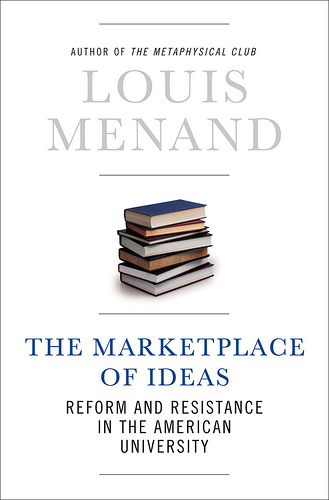
Required Reading: Louis Menand and the Left-Leaning Ivory Tower

Louis Menand,  The Marketplace of Ideas: Reform and Resistance in the
American University.
  New York:  W.W. Norton, 2010.

Fundamentalists have long argued that America’s colleges and universities had been captured by a sinister left wing.  Now they have some evidence to back up their complaints.

Most often, those accusations branded mainstream American univeristies as hopelessly lost to pernicious non-fundamentalist ideas.  For example, Texas fundamentalist minister J. Frank Norris insisted in 1921 that the problem with America all started when some influential young Americans studied “in Chicago University where they got the forty-second echo of some beer-guzzling German Professor of Rationalism.”

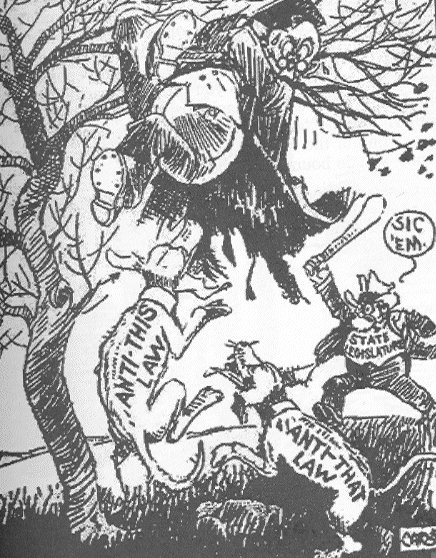
This hostility among fundamentalists toward the professoriate was noted by one cartoonist in the Wall Street Journal around the time of the Scopes Trial in 1925.  In this cartoon, hillbilly fundamentalists sic their legislative dogs on a hapless professor.

In the run-up to that Scopes Trial, the greatest fundamentalist scientist of the 1920s, George McCready Price, informed William Jennings Bryan confidentially that evolutionists had fallen prey to a debilitating group-think.  Because they only listened to one another, Price insisted, such evolutionists had become “out of date,–behind the times,–and don’t know it.”

This outright hostility toward the academic classes continued throughout the twentieth century.  For instance, one pamphlet from the American Legion in 1930 warned that too many college professors saw their jobs as indoctrinating each new generation of young, impressionable minds.  In this author’s opinion, college professors did not try to authentically educate their students, but only saw their jobs as a chance to make new “teachers of communism and atheism out of them.”

In the early 1960s, conservative California State Superintendent of Education Max Rafferty found the main culprit of America’s decline in the progressive, leftist orthodoxy promulgated in America’s institutions of higher education.  Rafferty insisted that colleges had created a new landscape of “temples . . . great universities which marble the land.”  These temples no longer pursued true intellectual endeavor, Rafferty claimed, but only passed along a deadened orthodoxy, “turning out swarms of neophytes each year to preach the gospel of Group Adaptation.  Their secret crypts and inner sanctums are the graduate schools.”

More recently, fundamentalist blockbuster author Tim LaHaye agreed.  In the twenty-first century, LaHaye believed, university faculties had placed themselves hopelessly in thrall to the false idols of the cultural Left.  After his huge publishing success with the Left Behind series, LaHaye set out to create a new biblical hero.  In Babylon Rising (2003), LaHaye described the adventures of biblical archeologist Michael Murphy.  In Murphy, LaHaye hoped to create a “true hero for our times,” one who united unwavering biblical faith with scholarly acumen and a dose of two-fisted machismo.  In one telling scene, Murphy is confronted by his smarmy secular dean.  This little episode tells us a lot about continuing fundamentalist attitudes toward the professoriate.

“Hold it, Murphy!”

A bony hand grabbed Murphy by his backpack as he left the hall. “Dean Fallworth.  What a fine example you set for the students by monitoring my lecture.”

“Can it, Professor Murphy.”  Fallworth was as tall as Murphy but cursed with a library-stack pallor that would make some mummies look healthy by comparison.  “You call that a lecture?  I call it a disgrace.  Why, the only thing separating you from a Sunday tent preacher is the fact that you didn’t pass the plate for a collection.”
“I will gratefully accept any donation you wish to make, Dean.  Did you need a syllabus, by the way?”

“No, Mr. Murphy, I have everything I need to get the university board to begin accreditation hearings for this evangelical clambake you’re calling a class.”

“Temper,” Murphy mumbled to himself.  “Dean, if you feel my work is unprofessional in any way, then please help me to improve my teaching skills, but if you want to bash Christians, I don’t have to stand here for that.”

“Do you know what they’re already calling this silly circus around the campus?  Bible for Bubbleheads, Jesus for Jocks, and the Gut from Galilee.”

Murphy couldn’t help but laugh.  “I like that last one.  I’m intending this to be a quite intellectually stimulating course, Dean, but I confess I did not post an I.Q. requirement for taking it.  The knowledge will be there, I promise you, but I will likely fall short of your apparent requirement that the only acceptable instructional method is to bore your students to an early ossuary.”

“Mark my words, Murphy.  Your hopes of this course surviving and your hopes of tenure at this university are as dead as whatever was in that bone box of yours.”

“Ossuary, Dean.  Ossuary.  We’re at a university, let’s try to use multisyllabic words.  If it doesn’t turn out to be legitimate, maybe I can get it for you cheap and you can keep your buttons in it.  Now, if you’ll excuse me, I have a new artifact to begin work on.”

In this vision of the world of higher education, only fundamentalists have remained true to the original mission.  Fundamentalist intellectuals, this line of reasoning goes, have retained their sense of inquiry and intellectual honesty.  They have not been seduced by the showy appeals of false science, such as evolution.  They have not been lulled by a peaceful-sounding pluralism that in practice degrades human dignity.  And they have not been willing to accept the hidebound leftist, secularist, evolutionist orthodoxy required of the mainstream academic.

This trope has remained so ubiquitous among fundamentalist activists that is tempting to dismiss it as sour grapes.  In this sour-grapes line of thinking, fundamentalists attack the intellectual pretensions of college professors since those professors show universal disdain for the Biblical belief of fundamentalists.  Fundamentalist attacks, this argument goes, actually prove the intelligence and perspicacity of college professors.

Louis Menand’s new book suggests otherwise.  Menand, best known for his Pulitzer-Prize-winning Metaphysical Club, now takes aim at the sclerotic intellectual culture of American higher education.  Menand is no fundamentalist.  Nor does he have an axe to grind against the left-leaning cultural politics of today’s universities.  However, he does agree with fundamentalist critics that the professoriate encourages group thinking and intellectual conformity rather than innovative ideas and iconoclasm.

Unlike fundamentalist critics of higher education, Menand does not blame evolution, socialism, or secularism for this state of affairs.  Rather, Menand’s critique is more prosaic.  In order to become a tenure-track professor in the humanities, Menand points out, aspiring professors must endure years, even decades, of powerless apprenticeship.  Those who survive this ordeal do so not by bucking the intellectual party line but rather by honing their ability to locate and placate the institutionally powerful.

In Menand’s view, this leads to a dangerous state of affairs in which “The academic profession is not reproducing itself so much as cloning itself” (153).  Until and unless research universities find a new way to train the next generations of faculty, Menand frets, the trend toward intellectual conformity will accelerate.  [UPDATE: For a full review of Menand’s book, be sure to check out the H-Education list review commissioned by Jon Anuik:  https://www.h-net.org/reviews/showrev.php?id=33892 Thanks, Jon, for this notice.  –Editor]

Fundamentalists won’t be surprised.  For generations they have dismissed the protestations of the kept intellectuals at America’s universities.  Menand’s book should serve to give them support from outside their own ranks for their deeply held distrust of pointy-headed professors.

Mencken and “Extremism” in the 1920s

In lots of contemporary culture war battles, each side works hard to position the other as the side of “extremism.”  Pundits these days could learn a great deal from the American past master of such polemic positioning, H.L. Mencken.  I was tickled pink to be asked to write a review for H-Net of a collection of Mencken’s writings about the 1925 Scopes Trial in Dayton, Tennessee.  Like him or hate him–and I like him–it’s hard to dispute Mencken’s credentials as one of the most influential culture-war writers of the twentieth century.

Mencken’s dispatches from the Scopes trial, I believe, cemented in the American imagination the new stereotype of fundamentalism as an irruption of backwoods ignorance.  His intemperate critique of the nature of the American masses and their pathetic need for intellectual and theological certainty became the standard criticism of the fundamentalist persuasion for generations.

I invite everyone interested in the nature of American fundamentalism and in the history of the creation/evolution debates to read this new collection of Mencken’s Scopes writings.  For a brief taste, see my review on H-Net.

Pro-Evolution III: Sects and Science

EVOLUTION III: SECTS AND SCIENCE


Perhaps most troubling of all is the shallowness of anti-evolutionists’ reasons for rejecting evolution.  It makes a great deal of sense to reject
evolution if it is a simple choice between religion and evolution.  Faith makes all sorts of demands, and spurning a scientific idea seems relatively easy.  Especially if that rejection is seen as a requirement of faith.  And for a lot of evolution skeptics, that is apparently part of their rationale.

But rejecting evolution as a litmus test of Christian orthodoxy is extremely problematic.  For one thing, many ardent and devout Christians do not agree that they must oppose evolution in order to be faithful Christians.  They believe in an all-powerful God who uses evolution as his method of
creation.  To insist that one cannot be a Christian if one accepts the fact of evolution means rejecting the faith of all those people.

Even more disturbing, the idea that evolution must be rejected by faithful Christians has shallow and erratic roots.  Not until about 100 years after Darwin’s publication of Origin of Species did Bible-believing Christians largely agree on the notion that the idea of an ancient earth with long periods of evolution was anathema.  Before that, many fundamentalist leaders theorized that the “days” described in Genesis could represent long geologic periods in which life forms developed.  Some subscribed to the notion of an enormous temporal gap between the events described in one part of Genesis, when God created light, and other parts, when he created humanity.  During that gap, these early fundamentalists believed, life could have developed in an evolutionary way.  The important point to these Bible-believing, fundamentalist Christians was that God  intervened directly in time to create forms of life, especially human life.  They did not see a conflict with their religious beliefs and the scientific observations that the planet had lived through long geologic ages.

The idea that true Christian faith only had room for a young earth began among small sects, not originally among the majority of Bible-believing Christians.  Most of the first generations of fundamentalists in the 1920s through the 1950s did not agree that the earth had been created in the last 10,000 years or so, in pretty much its present form.  They did not agree that the fact of a worldwide flood—Noah’s flood—constituted a test of
true belief.  The story of how those extreme ideas came to be considered central tenets of Biblical Christianity shows how tenuous and ultimately unnecessary they are.  It was not always the case that fundamentalist Christianity required belief in a young earth and a literal worldwide flood.  Once we can understand that such beliefs represent a triumph of a certain sect, we can see why evolution does not need to be rejected by devout Christians as a whole.

Ellen G. White: Vision of the End, Vision of Beginning

In the 1920s, when these questions of evolution and Christian belief erupted in the first of America’s twentieth-century culture wars, many leading evolution opponents believed that the earth could be ancient.  At least, they did not see a young earth as one of the bedrock notions of their Biblical faith.  William Bell Riley, for instance, allowed that God took ages to create the earth and its life.  Riley insisted that there was not “an intelligent fundamentalist who claims that the earth was made six thousand years ago; and the Bible never taught any such thing.”  We can’t doubt Riley’s opposition to evolution.  In 1919, he organized the World’s Christian Fundamentals Association, the first fundamentalist umbrella
organization, to combat the teaching of theological modernism and evolution.  He led the fight for anti-evolution laws in the 1920s.  Evolution, for Riley, meant the teaching of atheism.  He dedicated his career to stopping it dead.  But that did not mean that Riley believed in a young earth.  He took a backseat to no one in his fundamentalism.  But he did not think that it was a requirement to insist that the earth could only be 6,000 years old or so.

Similarly with William Jennings Bryan.  Bryan may be remembered best for his role in the 1925 Scopes trial.  In that trial, Bryan led the prosecution of John Scopes for teaching evolution and breaking Tennessee’s new anti-evolution law.  The trial was remembered—badly—in the play and film Inherit the Wind.  In the movie, Bryan comes off as a bitter, malevolent, ignorant man.  Bryan was none of those things.  He had run for President three times as the candidate of the Democratic Party.  He had been Secretary of State under Woodrow Wilson.  He was a member of the American Association for the Advancement of Science and a devout Bible-believing Presbyterian.  He lent his talents and prestige to the very
successful 1920s campaign to get evolution out of America’s public schools.  Like Riley, Bryan thought evolution was bad science.  He thought it
was a way to confuse young people and force them to doubt their Biblical faith.  Once students were told that life had evolved in a random process, Bryan believed, they would necessarily doubt the fact that God had created life in its present forms.  But Bryan also believed that God might have done His creating over long geologic ages.  Bryan believed that they “days” referred to in Genesis could refer to millions of years.  Over those millennia, Bryan believed, God could have created life in all its forms.  Any other belief would run up against the scientific evidence for the age of the earth.  Bryan fought for the Bible.  Bryan fought against evolution.  But Bryan did not believe that he had to believe in a young earth.

In the 1920s, only a minority of evolution opponents insisted on the belief in a young earth as an article of faith.  Fundamentalist geologist George McCready Price led the charge.  In the 1920s, Price wrote, lectured, and debated tirelessly against evolution supporters.  He built a reputation as the leading anti-evolution scientist.  And Price insisted that one of the central tenets of his faith was the notion of a literal six-day creation, without long gaps for the earth to develop.  Price demanded belief in a literal worldwide flood and a young earth.  As opposed to his Bible-believing allies, Price insisted that adherence to such ideas formed the foundation of true orthodoxy.

Price studied the earth’s crust to find evidence.  The striated levels in exposed cliffs showed most geologists that the earth had formed in long ages of sedimentation and crust upheavals.  Price saw something different.  Price explained the striation in rocks as proof that they had been formed in a huge flood.  The fossils embedded in those rocks came from plants and animals trapped by the rising waters.  It was the flood, in Price’s geology, that explained the complicated crust.

Price did not just stumble upon his beliefs.  He was a member of the Seventh-day Adventist Church.  For members of that faith, the idea of a young earth and a literal worldwide flood really were requirements.  One could not be an orthodox believer and still doubt such notions.  But the rub for non-Seventh-day Adventists comes from understanding the roots of such orthodoxy.  It did not come from the Bible itself, but rather from the prophetic experience of the denomination’s founder, Ellen G. White.

White began her prophetic career as a follower of William Miller.  Miller had predicted the date of the coming apocalypse around 1843 or 1844.
His predictions proved so popular among his neighbors in Vermont and New York that he published them for wider circulation.  Soon, he took his lecture on the road, presenting his biblical case for 1843 as the end date predicted in the Book of Daniel.

Thousands were convinced.  The Millerite revival grew from a local curiosity to a national movement.  At first, Miller was hesitant to give an exact date for the Second Coming.  But he believed that the world must end by March 21, 1844.  Some believers sold their farms, wrapped up their earthly concerns, and donned white robes to await Jesus Christ.  Famously, some even sat on the roofs of their barns and watched the sun rise on March 22.  On that morning, things appeared much as before.  No Jesus.

Some gave up.  Others listened to a new date—a correction William Miller agreed to—that said the true date must be in April.  Those must have
been anxious weeks.  Not wishing to be caught out like the foolish virgins, but now maybe a little skeptical that these predictions had the true power of prophecy, Millerites still waited.  After April 18, Miller himself gave up.  He apologized for his mistake but did not refute the notion that the world would soon be coming to an end.  He merely admitted that his calculations of its date must have been in error.

Ellen White did not give up.  In 1844 she was a young woman, convinced by the power of prophecy.  She had been converted by William Miller when she was still a young girl of twelve.  His predictions of judgment and apocalypse had terrified her, and she had spent nights crying, sweating, and shaking in fear of her body and soul’s suffering and damnation.  She was convinced.  But when Miller’s date came and went, she wasn’t sure what to believe.  Like many Millerites, her answer was to pray.  Unlike most of the disappointed ones, though, White’s prayers brought her outside of herself.  She was entranced in visions of heaven and earth.  She began seeing divine histories of the future scrolled out for her with the universe as a canvas.  She described the experience as being surrounded by a bright light.  She would be swept out of her body and hear the commanding voice of Jesus as God, telling her the story of the universe’s past and future.  She was surrounded by clouds of angels celebrating her divine experience.  At first, she kept her experiences to herself.  But she knew that could not last.  Jesus himself had directed her to share what she had been told.  She had become a prophet, equal in power and vision to those whose inspiration had created the Bible itself.  It was not intended for her alone, but for all humanity, to make known the truth of life.

White listened, and spoke.  She spread the word of her visions with the help of her new husband.  She described what God had shown her, which included the creation of the earth in six literal days.

Seventh-day Adventists (SDA) will tell you that White’s prophecies aren’t the same as the Bible.  Although she was inspired by the same power that inspired the Biblical authors, and White’s writings are authoritative among SDA believers, they do not make up a new Bible.  But the visions
she described, along with the implications for life and faith, still had the power to dictate behavior and belief among her followers.

Among those followers were the founders of big food companies, like Kellogg’s and Little Debbie’s.  The dietary restrictions that resulted from White’s prophecies meant that SDA members could not eat lard, so a Little Debbie’s snack will not have the same lardy filling as a Hostess Twinkie.  They also led Mr. Kellogg to experiment with healthy new foods, including by accident the original corn flake.

More important here, one of White’s visions included the creation of the universe and life.  White described her vision of God’s direct creation in six literal days.  She placed the date either 6000 or 4000 years before her writing.

Just as SDA members needed lard-free food, they also needed to believe in a literal six-day creation.  Not six “ages,” in which the words of Genesis stood for long geologic ages.  Not one day, then a long geologic gap, then five more days.  For Seventh-day Adventists, White’s vision affirmed a literal six-day creation, not very far in the past.

One of those followers was George McCready Price.  In the 1920s, when other Bible-believing fundamentalists believed in the possibility that the earth had existed for long ages before God created humans, Price campaigned for a much more radical kind of opposition to evolution.  He had to.  Ellen G. White attested to it.  To do otherwise would have been unthinkable for any Seventh-day Adventist, even if it would not have been for other conservative Christians.

As so often happens, Price’s unshakeable commitment to the notion of a recent, literal six-day creation carried the day.  Other fundamentalists were open to the idea of a young earth, but they didn’t insist on it.  Price did.  In addition to debating every prominent evolutionist he could find, Price helped establish the Deluge Geology Society.  As the name implies, this group was committed to the notion of a literal worldwide flood
that was responsible for forming the apparent layering of the earth’s crust.  This flood could explain the fossil record of extinct species.

When new generations of Christians wanted to find out more about evolution, it was the Deluge Geology Society that seemed the most active
and ardent opponent to the idea.  Part of that opposition, the new generations learned, must mean a literal six-day creation.  It must include a real worldwide flood.  And it must mean that the earth was young, no older than ten thousand years.

One of this new generation of anti-evolutionists was Henry Morris.  Morris was not SDA, but as he explored the possibilities of opposition to evolution, he found the most congenial home in Price’s Deluge Geology Society.  As he developed his ideas about the age of the earth and the origins of life, he did so under the influence of Price’s ideas.

In 1961, Morris published his own anti-evolution bombshell.  Along with John Whitcomb, another non-SDA anti-evolutionist, Morris explained his ideas about creationism in The Genesis Flood.  This book became the inspiration for a new generation of evolution opponents.  Unlike the folks that started the fight in the 1920s, this generation agreed on some basic ideas: the earth was no older than 10,000 years; it had been created in six literal days as described in Genesis; and it had been destroyed in a literal worldwide flood.  Most important, The Genesis Flood
made a convincing and influential argument that all of these beliefs were central to Biblical Christian orthodoxy.  As had not been the case for earlier Biblical Christians, the new generation, readers of Morris and Whitcomb’s book, believed that these fairly radical notions had always been central to true faith.

They had not.  They developed in large part from the visions of Ellen White.  They were not part of the ancient orthodoxy of Christian belief, but rather of the influence of one energetic SDA scientist, George McCready Price.

That matters.

Understanding the sectarian roots of this kind of anti-evolutionism will show that such opposition is much newer and peripheral to Christian belief than its advocates will admit.  But here’s another twist.  Even for those anti-evolutionists who dispute this line of argument, the story of Ellen G. White’s prophecies tells us something about religious opposition to the idea of evolution.  That is, many earnest anti-evolutionists could say that this SDA history has nothing at all to do with their anti-evolution beliefs.  They could say that Ellen White’s visions may agree with their belief in a young earth, a six-day creation, and a worldwide flood, but that they were convinced by arguments that came directly from the Bible, not from White’s prophecies.  That wider biblical argument, after all, was the one laid out in Morris and Whitcomb’s Genesis Flood.  Fair enough.
Just because Karl Marx and Friedrich Engels wrote in the Communist Manifesto that governments should impose a graduated income tax does not mean that every such tax is a communist law.

But here’s the kicker.
Non-SDA anti-evolutionists do not care much about Ellen White’s prophecies.  Her vision of God’s work does not compel them to fight against the teaching of evolution.  For those outside of the SDA tradition, White’s prophecies are irrelevant.  They may even be blasphemous, assuming the role of something near the Bible itself.  In any case, those who believe in the Bible are not generally motivated by anything White may have seen.  It makes no part of their anti-evolution activism.

For these non-SDA anti-evolutionists, I suggest the following mental experiment.  Imagine your feelings about the prophecies of Ellen White.  You do not find her visions compelling.  You do not think they should be guiding public policy.  That feeling is the feeling of many Americans, Christian and non-Christian, about all Bible-based opposition to evolution.  Most Americans do not agree that the Bible dictates a belief in a literal special creation.  Lots of people do not care what the Bible says at all, the same way many anti-evolutionists don’t care about Ellen G. White.  Is it fair to base our public education system on ideas that are only meaningful for one segment of the population?  No matter what proportion of the population hold that belief?  The answer is obvious.  No sectarian belief ought to dictate public policy.  It should be left to private individuals to promote their particular beliefs, whether that be the vegetarianism and flood geology of a Seventh-day Adventist or the transubstantiation beliefs of a Catholic.  None of those beliefs should guide the planning of public school education.  Keeping evolution out of schools, or even watering it down by teaching it side by side with the notion of special creation, takes those sectarian beliefs and elevates them to the notion of universal doctrine.  It is not fair to those who do not come from that tradition, whether they are a minority or a majority.


EVOLUTION III: FURTHER READING

John C. Whitcomb Jr. and Henry M. Morris, The Genesis Flood: The Biblical Record and Its Scientific Implications (Philadelphia: Presbyterian and Reformed Publishing Company, 1966); Ronald L. Numbers, The Creationists: From Scientific Creationism to Intelligent Design, expanded edition (Cambridge: Harvard University Press, 2006); William V. Trollinger Jr., God’s Empire: William Bell Riley and Midwestern Fundamentalism (Madison, Wisconsin: University of Wisconsin Press, 1990).