The Creation Debate We Need

Ken Ham, creationist debater extraordinaire, has again thrown down the gauntlet. This time, Ham has challenged conservative evangelist Pat Robertson. More than watching Ham battle Science Guy Bill Nye, America needs to hear this debate between conservative evangelical Protestant creationists.

Apparently, according to Mr. Ham and the folks at Right Wing Watch, Robertson has been taking pot-shots at young-earth creationism lately. On his television show The 700 Club, Robertson recently announced, “You have to be deaf, dumb and blind to think that this Earth that we live in only has 6,000 years of existence.”

As he has done recently with other conservative colleges such as Calvin and Bryan, Ham wondered pointedly if Robertson’s colleagues at Regent University really support Robertson’s old-earth position. Ham asked if the school followed Robertson in “compromis[ing] the Word of God with the pagan ideas of fallible men.”

Ham offered to debate these issues with Robertson. As Ham put it,

I wonder if Pat Robertson would be prepared to discuss these issues with me or one of our AiG scientists on the 700 Club? Or maybe in some sort of debate format at Regent University? We are certainly willing to do that…. I wonder if Pat Robertson, who is allowed to state these things so publicly through CBN will agree to have his statements publicly challenged and tested!

Both conservative religious folks and outsiders like me would benefit from such a debate. We outsiders would learn more about the issues that matter to creationists. None of us were particularly surprised by the arguments Bill Nye put forward. But many of us would be enlightened to hear the reasons for and against belief in a young earth, since both sides would be arguing from a relatively similar religious perspective. We outsiders could learn about the kaleidoscopic world of creationism. For some people, this might be the first time they heard that not every creationist embraces the idea of a young earth.

And evangelicals would benefit enormously. After all, belief in a young-earth as creationist orthodoxy is a very recent phenomenon. As historian Ron Numbers demonstrated so powerfully, until the second half of the twentieth century, belief in a young earth was restricted to a relatively small percentage of conservative evangelicals. At the time of the Scopes trial in 1925, for example, leading fundamentalists differed in their beliefs about the age of the earth. At that time, no one looked askance at anti-evolutionist leaders such as William Jennings Bryan who believed in an ancient earth. Only with the publication of Henry Morris’ and John Whitcomb’s creationist blockbuster The Genesis Flood did young-earth creationism become a dominant theme in conservative American evangelical thought.

Many young evangelicals these days don’t know this history. They often assume they must either accept the doctrine of a young earth or abandon their religion entirely. A debate between two conservative evangelical leaders would demonstrate the possibilities.


How Richard Dawkins Begat Ken Ham

Why is there creationism?  Marc Barnes at Bad Catholic makes the argument that today’s young-earth creationist movement is nothing more nor less than a theistic outgrowth of Richard Dawkins-style materialism.

Today’s sort of Ken-Ham-style creationism, Barnes correctly observes, is an entirely modern phenomenon.  Barnes doesn’t make the point, though he could have, that ignorant partisan anti-creationist hack jobs like that of Mark Stern in Slate miss the boat entirely when they accuse creationism of being “medieval.”  Nonsense.  Today’s creationism is a thoroughly modern affair.  Even the briefest familiarity with the history of the movement makes that point abundantly clear.

Today’s creationism, Barnes argues, is not a wholesale repudiation of the materialist viewpoint, though it falsely claims to be.  Materialism, after all, in this sense, means the assumption that life and everything has purely material origins.  Primordial soup somehow got a transformative spark, perhaps from undersea volcanic vents.  Life came from non-life due to purely material causes.  Similarly, life itself, though it may feel like it has transcendent spiritual meaning, is nothing more than biochemistry.  When the switch goes off, the magic ends.  Back to carbon.

Such a view of life separates God out entirely, Barnes points out.  And Ken-Ham-style creationists make the woeful mistake of simply plugging God back in, from the outside.  In other words, Barnes argues, young-earth creationists stupidly think that by insisting on a God who popped into time, created life and the universe, inspired a Bible, and sent his kid in to fix things, they have refuted materialist assumptions.  Not so, Barnes contends.  That sort of outsider God, a God who creates, judges, and saves, all from somewhere outside of, beyond the creation itself, actually endorses the materialist vision of life.  Instead of electricity as the prime mover, though, Ken Ham’s style of creationism plugs in a Bearded-Guy-in-a-Throne sort of God.

God, in this YEC vision, is a mere competitor with electricity for the role of life’s spark.  God, in this YEC vision, is simply the materialist understanding of life with a quick substitution of God for an unintelligent spark.

Instead of falling for this materialist presumption, instead of simply rebutting one part of materialist assumptions about life, real creationism needs to posit an entirely different relationship between the world and its Creator, Barnes argues.  As he puts it,

God is not simply the Creator of the material order, and the theistic tradition has never made such laughable claims. The concept of God as Creator has always been the source of existence as such. This means that God does not just answer the material question of “Where came this rock, that plant, or the entire conglomerate of material thingmabobs we call the universe?” He answers the ontological question: “Why is there something rather than nothing?”


Creation Debate Update: Squeezing Out the Middle

Forget the Super Bowl.  Next Tuesday, February 4th, at 7 PM New York time, we’ll all be watching the debate between young-earth creationist Ken Ham and science popularizer Bill Nye.  It looks as if Nye and Ham agree on their goals: squeezing out the middle.  Both debaters want to draw attention to young-earth creationism, and their agreement threatens to exacerbate the divide between evolution and creationism.

The debate host, Answers In Genesis’ Creation Museum, will be streaming the action live for all of us to see.

Ken Ham has suggested that the debate might be a perfect learning opportunity for teachers and students in public school science classes.  From Ham’s point of view, this debate might be a chance to reach students who might not otherwise be aware that mainstream evolutionary science is full of holes.

Bill Nye, too, has explained his reasons for engaging in this debate.  In these pages and elsewhere, evolution-education mavens have wondered if this debate only legitimizes the dead science of the young-earth creationists.  As “The Science Guy” explained, “I don’t think I’m going to win Mr. Ham over.”

So why debate?  Nye says, “I want to show people that this belief is still among us. . . . It finds its way onto school boards in the United States. . . . I’m not going in as a scientist as such . . . I’m going in as a reasonable man.”

So it seems both debaters have the same goal.  Both men want to make people aware of the claims of young-earth creationism.  From Ham’s perspective, such awareness will help keep smart young Christians from leaving the faith.  From Nye’s point of view, if people know what creationism is, they will help fight against it politically.

With such agreement, it seems likely both debaters might succeed.  This debate might elevate the profile of young-earth creationism.  One casualty, it seems, will be other visions of creationism.  Ken Ham’s brand of young-earth creationism, after all, is only one extreme form.  Many religious people believe that humans and life were created at some point by God.  But they do not believe that they must discard the findings of modern science.  The folks at BioLogos, for example, insist that fervent Biblical Christianity can go hand-in-hand with mainstream evolutionary science.  And “old-earth” creationists such as Hugh Ross agree that God did it all, but they don’t insist that he did it only 6,000 years ago.

If this debate succeeds—at least according to the goals of both Ken Ham and Bill Nye—those “other” creationist belief systems will likely get squeezed even further out of the conversation.  That’s a shame.  Too many observers already equate “creationism” with young-earth creationism.  It may make for more lively debates, but it makes for less productive and civil conversations.


Can Evolution Match This?

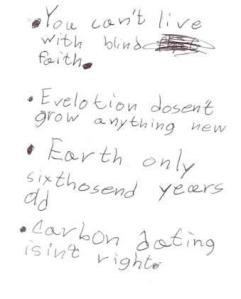
So clear and compelling a seven-year-old can understand it.  That’s the boast of young-earth creationist leader Ken Ham.  As proof, he published the lecture notes of one of his young audience members.

Image Source: Answers In Genesis

Image Source: Answers In Genesis

Image Source: Answers In Genesis

Image Source: Answers In Genesis

Image Source: Answers In Genesis

Image Source: Answers In Genesis

For those of us hoping to improve evolution education in the United States, Ham’s revelation raises a serious question: Can evolution hope to match the gut-level appeal of creationism?

Science pundits have long noticed this yawning gap between the popular acceptability of mainstream science and that of creation science.  The most clear-headed writers have admitted that creationism has better stories.

As Richard Dawkins put it in his 1996 book The Blind Watchmaker,

It is almost as if the human brain were specifically designed to misunderstand Darwinism, and to find it hard to believe.

The creation stories of young-earth creationists, on the other hand, are appealing to all age levels.  There’s a garden, there’s love, there’s disobedience, there’s punishment.  All of these are powerful themes that resonate with young and old alike.

And, lest we evolution-embracers smugly conclude that this stark advantage of creationism will fade as audiences get more intelligent and more sophisticated, let’s remember that creationism’s advantage also pulls in the intellectually sophisticated.

ILYBYGTH readers may remember the postmodern plea of journalist Virginia Heffernan.  A few months back, Heffernan declared her affinity for creationism over evolution.  Why?  In her words,

I was amused and moved, but considerably less amused and moved by the character-free Big Bang story (“something exploded”) than by the twisted and picturesque misadventures of Eve and Adam and Cain and Abel and Abraham.

Obviously, something doesn’t need a compelling narrative in order to be true.  But in the stubborn culture wars over evolution and creationism, popular appeal matters.  Evolution’s biggest selling point is that it does a better job of explaining and predicting than does creationism.  Maybe the winning narratives won’t be the detailed natural-selection classic tales starring finches and moths, but rather the far more stirring story of enlightenment triumphing over dunderheaded fogeys.

That’s a good story.  At least it worked for Kevin Bacon in Footloose.


You Don’t Need a Young Earth to Get to Heaven

Do creationists use intimidation and spiritual threats to coerce young people to believe?  Not as often as some critics assume.

Young-earth creationist leader Ken Ham of the organization Answers In Genesis repeated his call recently that Christians do not need to believe in a young earth.

For outsiders like me, this can appear puzzling.  After all, those of us outside the circle of conservative evangelical belief often assume that all conservative evangelical Protestants spend their time sweating over their eternal fate.  We might make the mistake of assuming that conservative evangelicals thrive by threatening sinners with hellfire, brimstone and damnation.

Take, for example, the Christian beliefs of young-earth creationists.  From the outside, it’s tempting to assume that the more insistent YECs must somehow bully new generations into embracing their beliefs.  After all, those beliefs are so radically different from the ones embraced by mainstream science that it seems impossible for young people to become YECs unless compelled.

This is why some prominent atheists have called this kind of creationism “child abuse.”  As we’ve seen in these pages, smart young people brought up in the faith have wondered why their trusted adult leaders sold them a scientific bill of goods.  As Anna wondered recently in her illuminating ILYBYGTH series about her youth as a YEC, “It is still a bit difficult for me to look back on authority figures and members of my community that I looked up to and respected and wonder: are they just ignorant, or are they purposely deceptive?”

For us outsiders then, it can seem surprising that arch-creationist Ken Ham takes time to point out that young-earth belief is not a salvation issue.  That is, Ham insists that good Christians can disagree about the age of the earth.  As he puts it,

Many great men of God who are now with the Lord have believed in an old earth. Some of these explained away the Bible’s clear teaching about a young earth by adopting the classic gap theory.

Others accepted a day-age theory or positions such as theistic evolution, the framework hypothesis, and progressive creation.

Scripture plainly teaches that salvation is conditioned upon faith in Christ, with no requirement for what one believes about the age of the earth or universe.

Ham hastens to add that discarding a belief in a young earth can have “very severe consequences.”  In sum, since the Bible clearly describes the origins of earth, disregarding that message puts Christians on the very slippery slope to disregarding Biblical authority as a whole.

“All biblical doctrines,” Ham concludes, “including the gospel itself, are ultimately rooted in the first book of the Bible.”

Make no mistake: Ken Ham wants you to believe in a young earth.  But this is not a threat.  This is not a tent-preacher warning that only YEC can save your soul.

Too many outsiders like me ignore these kinds of nuance in the intellectual world of conservative evangelical Protestantism.  We end up calling YECs child abusers or worse, without taking the time to understand the real culture of young-earth creationism.  That might make for good headlines, but it does so at the heavy cost of relying on caricature rather than reality.

Inconsistent Christians Don’t Need a Young Earth

If you don’t really understand it, you can still go to heaven.  But if you are logical, you can’t.

That’s the message about creationism and salvation recently from the young-earth creationist Institute for Creation Research’s Jason Lisle.

Lisle debated “old-earth” creationist Hugh Ross at the National Conference on Christian ApologeticsBoth men spoke with The Christian Post after their debate.

It’s possible to still go to heaven if you don’t embrace a young earth, Lisle said.  But that is only true if you are willing to embrace illogic and ambivalence.  In order for the Bible to make sense, Lisle argued, Christians need to insist on its obvious meaning.

One problem, Lisle noted, was that children tend to reject illogic.  “Some people,” Lisle told the CP,

will say they can live with the inconsistencies. They’ll tell me: ‘Well, it’s just Genesis that I allow the scientists to tell me what it meant.’  But, what we’ve found is that children will see that inconsistency, and they will be more consistent, they will reject all of the Bible. They’ll say, ‘Well, mom and dad don’t really believe in the Bible because they don’t believe in the first few chapters. Why should I believe in the Gospel?’ We’ve seen that happen. The statistics are just alarming. We see the students walking away from church in droves.

Christians CAN be saved if they don’t accept a young earth, Lisle concluded. However, it doesn’t make any logical sense for them to do so.  As he explained,

If you believe in millions of years, if you believe the fossils are millions of years old, you have death before Adam sinned, in which case death cannot be the result of Adam’s sin if it was already there for millions of years. If death is not the penalty for sin then why did Jesus die on the cross?

As astute observers from both sides have noted, this is one idea on which atheists and young-earth creationists agree.  Jason Rosenhouse, for instance, an atheist mathematician and student of American creationism, agrees with young-earth creationists that evolutionary science is a fundamental challenge to traditional Christian faith.

Those who hope to maintain faith—especially a faith built around a belief that the Bible is God’s inerrant Word—while embracing evolutionary science or the idea of a very old universe have a tougher case to make.  As Hugh Ross, the old-earth creationist, explains, “God’s revelations in Scripture and nature do not, will not, and cannot contradict.”

Bridging the worlds of creation and evolution may make intuitive sense to Ross and many more Bible-believing Christians out there.  But the logical case for a rigid choice between either atheism or young-earth creationism remains compelling.  For those who believe in an inerrant Bible, the choice can seem all-or-nothing.


Is This Child Abuse?

Arch-creationist Ken Ham wants to train up a spiritual army of young Christian creationists.  Does that count as child abuse?

I’m no creationist, but I just don’t think so.

Ham trumpeted the training of a new generation of young “soldiers” at an Answers In Genesis conference at Atlantic Shores Baptist Church in Virginia Beach, Virginia.  By teaching young people the truths of young-earth creationism, Ham claimed he was “preparing them for the spiritual war going on around us.”

Image Source: Answers in Genesis

Image Source: Answers in Genesis

This language of child soldiers makes me nervous.  Plus, I don’t like the notion that young people are being turned away from real evolutionary science by this sort of religion posing as science.  To me, this seems like another painful example of the ways faith has been tangled unnecessarily with real evolutionary science, resulting in bad science and tortured theology.

But it is child abuse?

Leading skeptics have called it that, folks such as physicist Lawrence Krauss and biologist Richard Dawkins.  They assert that cramming this false science down young people’s throats counts as abuse.

Let’s look at both sides of this argument.

Why might someone call this child abuse?

1.)    These young people are being told things are true, when they really aren’t.  They are being taught, to cite just one example, that dinosaurs and humans coexisted a few thousand years ago.  Worst of all, relationships of close trust between parents, teachers, and children are being exploited to promote the veracity of this false science.  Loving mothers, loving fathers, caring teachers tell innocent young people that this is scientific truth.  Ingenuous young people take their word for it.  Such deception is abusive.

2.)    In this essay, Ken Ham explicitly calls them soldiers—spiritual soldiers, but soldiers nonetheless.  This seems a terrible violation.  Young people should not be exploited as culture-war cannon fodder.

Why might defenders disagree?

1.)    There is no threat or coercion here.  Though it may come as a surprise to outsiders like me, Answers In Genesis makes it very clear that believing in a young earth and recent special creation are not required for Christian salvation.  In other words, Ken Ham and his colleagues do not threaten young people with terrifying visions of hellfire if the children don’t embrace creationism.

2.)    The parents and teachers seen here are apparently sincere in their belief that creationism is true.  They are trying to pass that truth to their children and pupils.  There’s nothing abusive in passing along the best knowledge to the next generation.

3.)    Though science pundits such as Bill Nye have argued against it, believing the young-earth creationism of Answers In Genesis will not hurt the life chances of these young people.  According to Gallup polls, nearly half of American adults share a belief that humanity has only been around for a few thousand years.  And as I’ve argued elsewhere, careers in science-related fields do not seem thwarted by a belief in young-earth creationism.  Consider the case of US Representative Paul C. Broun Jr. of Georgia.  Broun is a fervent creationist, a medical doctor, and a member of Congress.  Not a bad career!

Image Source: Answers In Genesis

Image Source: Answers In Genesis

Is it child abuse?  No.  And calling it that is irresponsible.  After all, there is real child abuse out there.  It is horrific and terrifyingly common.  Calling this sort of science/religion education ‘child abuse’ is only an ill-considered scare tactic.

Perhaps this argument could use some illustration from another religious tradition.  Consider the recent career of child abuse in the Catholic Church.  As we all know only too well, the despicable actions of some priests and prelates in that church have caused untold suffering.

But the abuse perpetrated by members of the Catholic Church does not extend to its anti-scientific teachings.  After all, the Catholic Church teaches young people that certain wafers and wine can magically transform into flesh and blood.  And then young people are taught to eat that flesh and drink that blood.  For outsiders like me, teaching children to engage in this sort of ritual cannibalism is creepy and anti-scientific.  It is also demonstrably false: the wafers and wine are always really just wafers and wine.  Nevertheless, it is not child abuse for Catholics to teach their children this mystery of transubstantiation.  Calling such teaching ‘child abuse’ would disrespect the real suffering that real child abuse has caused within the Catholic Church.

A similar logic may apply in this case.  The young-earth creationism peddled by Answers In Genesis is not true.  But it is sincerely believed by its adherents.  Teaching those ideas to young people is not child abuse.

Unfortunately, we can picture what real abuse might look like in similar cases.  As Billy Graham’s grandson has pointed out recently, evangelical Protestant organizations have also engaged in real child abuse.  They have conspired, just as did the Catholic hierarchy, to cover up that terrible real abuse.  We could imagine a scenario in which a Protestant organization such as Answers In Genesis called together thousands of children and abused some of them.

But that is not the case here.  This was an educational gathering.  To call it ‘child abuse’ makes a mockery of the all-too-real threat of abuse.


Easy but Painful: Converting to Atheism

What would it mean for religious people to abandon their faith?

Yesterday we saw an example of this process from Jerry Coyne’s blog Why Evolution Is True.

As “Matthew” describes, leaving his conservative Christian faith was not very difficult.  But it was painful.  And it can teach us some important lessons about conservatism and education.

First, Matthew’s story confirms the fears of many young-earth creationist activists.  Folks at organizations such as Answers In Genesis and the Insitute for Creation Research have long argued that learning about evolution can (or will) lead to atheism.  According to Matthew, that was exactly his experience.  For Matthew, evolution was a “gateway” idea for rejecting Chrisitianity in toto.  For young-earth creationists, this must come as proof of long-held fears.  For evolution educators, this must demonstrate that young-earth creationists have a point when they lament the atheistic implications of evolutionary theory.

Also, Matthew’s story shows how difficult it will be to improve evolution education in the United States.  For many resistant students, as sensitive science-ed types such as Lee Meadows and David Long have pointed out, evolution is not just one idea among many.  Evolution is word that provokes profound cultural, psychological, theological, and even existential anxiety among some students.  As Matthew’s story demonstrates, only when a student from this background actively seeks an alternative way of understanding the world can such evolutionary theory take hold.

Finally, though, Matthew’s story shows how important evolution outreach efforts are.  Matthew started his odyssey away from conservative religion by browsing internet sites and podcasts.  The educational work of organizations such as the National Center for Science Education has been a leading source for such evolution content online.  Matthew’s story shows how important that work can be, even if it must seem frustrating at times.


Not Jesus OR Evolution, Jesus AND Evolution

What dead-end questions do we keep asking in our continuing creation/evolution debates?

  • What does real science say?
  • What does real religion require?
  • What does the Bible mean?
  • How does the evidence prove the claims of Darwin?

As we’ve seen recently, smart people can bump heads endlessly on these questions without ever convincing one another.  As I argued in my 1920s book, these go-nowhere debates have been going on for almost a century.

More evidence today that the real question we should be asking is different.  Instead of asking about true religion or true science, it seems the real question is simpler:

  • Who am I?

A piece on the BioLogos Forum recently demonstrates the centrality of this basic question to attitudes about evolution and creation.

Geochemist Steven M. Smith relates his story.  For followers of the creation/evolution controversy, it is a familiar one.  An earnest young Young Earth Creationist sees the scientific evidence for a young earth.  This evidence brings on not only a scientific or religious crisis, but an existential one.  As Smith relates, his young self felt forced to choose between his Christian identity and the unassailable evidence of science.

For Smith, it was Christian support, including the “Christ-like” model of a Christian academic mentor that convinced him that he could be both Christian and scientific.

Smith’s story is not an outlier.  As anthropologist and science educator David Long argued so convincingly in his book Evolution and Religion in American Education, the central question for most students is not one of scientific evidence or religious belief.  The real question is one of identity.  Evidence that contradicts deeply held beliefs can trigger an existential crisis.  Though a few extraordinary individuals might pull off a wholesale revolution in their understandings of their selves, most people reject the evidence and stick with their well-established identities.  In the case of Long’s study of biology students at a large secular public university, most students from creationist backgrounds did not “convert” to belief in evolution.

As Steven Smith’s story suggests, simply pouring more science on people will not make much of a difference.  If we want to promote more and better evolution education, we need to consider the profound implications of evolution for the identities of many creationists.  An acceptance of evolution, for many, is not simply an acquiescence to evidence.  Instead, unless and until they find a way to construct an identity consonant with both their religion and the scientific evidence, it would entail a wholesale revolution in their understandings of themselves.

If we want more people, more creationists, to accept the evidence for an old earth and common ancestry of species, it makes sense to support those religious folks who can help create and promote such identities.


What do Pastors Believe about Origins?

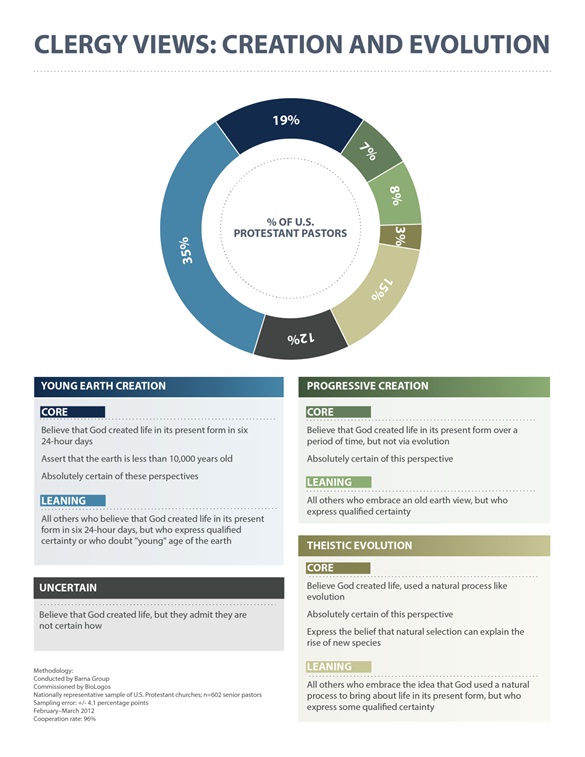
What do America’s professional Protestants think about evolution and creation?  Biologos has published the results of a survey of US Protestant pastors.

Those concerned with creationism and evolution have published many surveys of the ways evolution is taught in public schools.  Those surveys tend to focus on the ideas of high-school biology teachers.  Most recently, the work of Penn State political scientists Michael Berkman and Eric Plutzer offered a thorough nation-wide look at what biology teachers think and teach.

Source: Biologos Forum

Source: Biologos Forum

This survey, in contrast, asked 602 “senior pastors” for their views.  The results invite a few comments.

First of all, we should note that this is not a survey of religious Americans’ views about evolution and creation.  Rather, this is specifically a survey of a spectrum of US Protestant pastors’ views.  There were no leading Catholics involved, much less Muslims, Jews, Hindus, or any other religious group.  That matters.

Second, the numbers themselves make some interesting points.  We are not surprised by the majority (54%) who call themselves young-earth creationists.  We are surprised, though, by the strong showing for “uncertain” (12%) and the relatively weak showing for “theistic evolution” (18%).  Could these two answers be reasonably combined to form a much stronger bloc—nearly a third—of American pastors who take a theistic but uncommitted view of evolution?

Finally—for now, though the Biologos editors have promised to dig in more deeply to these survey results in the future—what about the striking Biologos note in its seventh point?  As the Biologos editors point out, a majority of pastors with young-earth creationist (YEC) beliefs agreed that publicly challenging those views might cost them their jobs.  In other words, for pastors with YEC beliefs, even a whiff of doubt or skepticism must be avoided.  This seems to confirm the accusations of anti-creationists.  If YEC pastors feel obliged to maintain their positions—feel dug in to YEC beliefs regardless of evidence or personal struggles—it seems fair to accuse YECs of closed-mindedness, obdurate clutching of YEC due more to social and economic pressure than to Biblical conviction.

Certainly, Biologos is not a disinterested party.  The organization hopes to promote “evolutionary creationism” or “theistic evolution.”  And my social-science chops, I’m afraid, aren’t sharp enough to offer a good critique of this survey methodology.  But if we take Biologos’ word for it, there might be a large number of YEC pastors out there who stick to their YEC guns for other reasons than Bible-based conviction.