A Hideous Truth: Flannery O’Connor on Fascism and Fundamental Belief

What does it mean to believe in something beyond reason?  How can we know the truth if we cannot trust our emotional responses?

A few days back The American Reader posted a remarkable letter from Flannery O’Connor to Betty Hester.  It seems the novelist in 1955 began a long correspondence with Hester.  Hester, a clerk in an Atlanta office, had written to O’Connor out of the blue.

Flannery O’Connor in 1955. Image source: The American Reader

The letter from September 6, 1955 reveals that Hester was no sycophantic fan.  She had apparently accused O’Connor of fascism.  As O’Connor defends in her letter,

“A higher paradox confounds emotion as well as reason and there are long periods in the lives of all of us, and of the saints, when the truth as revealed by faith is hideous, emotionally disturbing, downright repulsive. Witness the dark night of the soul in individual saints. Right now the whole world seems to be going through a dark night of the soul.”

For those of us outsiders trying to understand Fundamentalist America, these brief sentences can help.  The cultural divide seems deepest when it comes to the origins of truth.  For citizens of what we’re calling Fundamentalist America, truth can come from something beyond and above ourselves.  As O’Connor explained to Hester, “the thought of everyone lolling about in an emotionally satisfying faith is repugnant to me.”  In other words, for many religious conservatives–even those without O’Connor’s gift for expression–truth is not simply a result of our own feelings and cogitations.  Truth exists outside of us.  Our job is to submit to truth, not merely to quest for our own individual explanations.

This vision of truth sits hard with folks like me.  I was always taught to question, to doubt, to inquire skeptically into every notion.  Truth, the way I was raised, came from tearing down the accumulations of irrational tradition to get at the core of what is real.  You’ll know you’ve found the truth, the nostrum went, when you feel it deep down inside.

O’Connor offers a very different vision.  Her prescription for truth and truth-seeking help explain to us outsiders how someone can be intelligent and yet believe in things beyond reason.  How, for instance, can someone who knows the scientific evidence for evolution continue to believe in a young-earth creation?  For folks like me, such things seem outlandish.  And skeptics such as Richard Dawkins can only conclude that creationists must be “ignorant, stupid or insane (or wicked, but I’d rather not consider that).”

O’Connor’s letter gives us a different explanation.  The truth, for O’Connor, does not derive first from our reason.  It does not need to satisfy our feelings or our desires.  Rather, the truth might be “hideous,” but truth nonetheless.

Mormonism and the Paradox of Modern Homosexuality

There is a deep paradox at the heart of American culture when it comes to homosexuality.  On one hand, Americans seem more accepting than ever.  We have openly gay couples at high school proms, gay characters on primetime sitcoms, and plenty of pop songs insisting that homosexuals are “Born This Way.”

Yet on the other hand, many Americans–not just conservatives or Fundamentalists–display a new anxiety about being perceived as gay.  Male behaviors that might not have raised eyebrows in pre-Stonewall days–think Honest Abe sharing a bed with a male pal–now seem obviously “gay.”

If we outsiders hope to understand Fundamentalist America’s hostility to homosexuality, we need to chip away at this seeming paradox.  In a fascinating essay this morning on Religion & Politics, Kristine Haglund explores the way this modern dilemma plays out in LDS (Mormon) communities.  For male LDS members, Haglund argues, an intensely masculine identity is balanced with a soft gentleness.  Male church members have an intense patriarchal privilege.  Yet they are also tied to a sexual chastity that forbids homosexual sexual conquest as a way to establish hetero bona fides.  Men are required to spend their late-teen years in an intimate partnership with another young missionary male.  And in community, men are encouraged to display stereotypically feminine gentleness and emotionality.  These things lead, Haglund writes, to an exaggerated display of masculinity, in traditions such as “church ball.”  Yet LDS members such as Haglund herself are accustomed to seeing men act in gentle, emotional ways in public.  Haglund notes,

“Paradoxically, these behaviors, which might be pejoratively coded ‘gay’ or effeminate in other contexts, are key components of Mormon masculinity. A look at this fraught masculinity may offer a glimpse into what drives the LDS Church, and Mormon politicians like Mitt Romney, to insist on the defense of traditional gender roles in the family. The unique contours of Mormon masculinity can also help answer the question: Why are (many) Mormons so vehemently opposed to gay marriage and any other overt expression of homosexuality?

“The short answer to that question is that the unique mix of ritualized homosociality and patriarchal authority—the bedrocks of Mormon masculinity—means that many Mormon men are nervous about permitting even the idea that there might be more than a platonic ‘bromance’ in the post-Church Ball game sweaty hug.”

What is true for LDS men might be extended to American men as a whole.  As the notion of homosexuality becomes more of an everyday reality in American culture, some males struggle to establish their heterosexuality beyond reproach.  Does this fuel the hostility in Fundamentalist America to the notion of homosexuality as simply another way to be a sexual person?  In other words, as men become more keenly aware of homosexuality as a real phenomenon, does it push them to a sterner insistence on heterosexual supremacy and traditional family norms?

I’m nervous about the dangers of psychologizing such a broad cultural tendency.  It is a tried-and-true culture-war tactic to dismiss any opposition as somehow psychologically maladjusted.  We don’t want to insist that traditionalist opposition to homosexuality can only come from ignorance, fear, and Freudian neuroses.  But Haglund’s observations about the  “performance of Mormon masculinity [as] a difficult balancing act, a tightrope walk between poles established by a brutish, hyper-masculine ‘natural man’ and an effeminate gay man” seem equally applicable outside the LDS temple walls.  For many American men, increasing awareness that homosexuality is everywhere may lead to a desire to project a more firmly anti-homosexual identity.

Required Reading: David Long and an Ethnography of Creationism

Gallup polls are what they are.  The numbers can be misleading from time to time.  As Homer Simpson scornfully concluded, “Facts!. . . pffft.  Facts can be used to prove anything that’s even remotely true.”

Image source: Dead Homer Society

But when polls keep saying the same thing, it makes sense to listen.  According to Gallup, from the mid-1980s through today, nearly half of American adults agree that the earth was created in “pretty much its present form within the last ten thousand years or so.”

Evolutionists like me tend to be shocked by this number.  How is this possible?

As David E. Long argues in his book Evolution and Religion in American Education: An Ethnography (Springer, 2011), the old evolutionists’ answers don’t hold up anymore.  Some evolutionists tend to assume that creationism, especially young-earth creationism, is similar to a public-health problem.  As soon as enough people are exposed to the saving truth of evolution, this argument goes, creationists will quickly realize the errors of their ways.  This assumption doesn’t match the historical facts, but it still has its share of true believers.  As we noted here recently, Bill Nye “The Science Guy” attracted a lot of attention when he endorsed this sort of fallacy.

Another problem, Long argues, is an implicit “deficiency model” among evolution educators.  These educators, Long asserts, would not be likely to blame students from households without a lot of books for being somewhat behind in their reading skills.  Yet they do blame students from creationist households for resisting evolution.

Long hopes to challenge these approaches to understanding creationism in America.  As he puts it, too many educators act as if learning evolution were a simple matter of “being shown discrete points of Truth and adding these bits to our respective Truth-piles” (14, emphasis in original).  If this were the case, Long argues, “there simply would be no societal issue over evolution.”  Obviously the deadlock over such issues as evolution, scientific creationism, and intelligent design proves that much more is going on here.

Long’s study joins others in offering a new approach.  As did Michael Berkman and Eric Plutzer in their study of biology education, Long hopes to get inside the heads of those who are somehow avoiding evolution education.  Berkman and Plutzer found that anti-evolutionists had not necessarily been isolated from the truths of evolution.  Instead, many anti-evolutionists “choose to ignore scientific arguments demonstrating evolution.”[*]  Knowledge of evolution, according to their large study funded by the National Science Foundation, is often relatively high among those who dispute it most fervently.  This does not match the fantasies of science fans such as Bill Nye.  Long’s study, like that of Berkman and Plutzer, promises to unravel this apparent mystery.

Instead of asking, even implicitly, “what’s wrong with these creationist students?”, Long wants to ask, “what in fact do Creationists have that makes the study of evolution troublesome or even dangerous?” (15, emphasis in original.)

Long himself grew up in a conservative Protestant family.  He remembers his mother telling him sadly that he was going to hell (11).  But this book is neither an apology for creationism nor an attack on creationists.  Instead, Long offers an ethnography of creationism in action.  He conducted interviews with thirty-one students at a state university along the Ohio River.  The results make for arresting reading.

One student, a non-traditional student who grew up as a child of missionaries, reported that she had not learned any evolution before she got to college.  Sitting in the large lecture halls, she told Long that a professor made her feel distinctly inferior.  She remembered the lecturer’s attitude:  “If you believe in God creating the earth, then pretty much you’re an idiot.  And he obviously didn’t use those words, but that’s pretty much what he said.  And I remember thinking . . . What is he talking about?. . . like, he should just go around and ask people to raise their hands ‘who believes in this and who doesn’t’!” (36).

This student, “Esther,” told Long that she had no problem with the academic challenge of evolution.  In her words, “I take those really big classes, because it’s really easy to excel in those huge classes.  I mean, I got like a hundred on every test.  You have to be an idiot pretty much not to.  If you just sit, and you listen to what they’re saying, and you know how to take tests, it’s very easy to do well in those classes” (36).  Long wrestles with the important questions this sort of testimony evokes.  For students like Esther, what does it mean to “know” evolution?  What does it mean to feel belittled for one’s background, even if it is done unintentionally?

Another thoughtful creationist interviewee told Long that accepting the truth of evolution would mean “a lot of work for me to change my worldview, a lot of time, a lot of alienation from friends” (41).  Long asked what it would mean if somehow this student—who had been homeschooled into his creationist views—what it would mean if somehow this student found out that humans had really evolved.  The student replied, “It would be a complete crisis.  It would be really tough” (41).  As Long notes, this is more than a scientific situation.  This is an entire life wrapped up in creationism.

Long argues that evolution educators have not sufficiently wrestled with the existential anxiety at stake for some creationist students.  Accepting the truth of evolution, for some, would be more than simply changing one’s mind.  It would be a radical change, and more often, the “positive, commonsensical, and affirmed” path is to simply reject evolution (47).

In most cases, Long concludes that no amount of education really threatens to change students’ worldviews.  Of his batch, only three experienced any sort of profound change, including in their attitudes toward evolution.  These three cases form the basis of Long’s fifth chapter, a chapter that’s worth the price of admission all by itself.  Long describes the case of “Cindy,” a student from a staunchly anti-evolution small town.  Cindy ended up open to the notion of human evolution, but only because she challenged her entire upbringing.  It was not the eye-opening scientific evidence for evolution that convinced her.  Rather, Cindy got pregnant and had an abortion in high school.  The gossipy and cruel reaction of her church drove her away from that worldview.  The entire experience left Cindy open to the idea of human evolution.

Equally fascinating is the case of Renee.  Renee came from a non-religious family, sort of.  She was a biology major with plans on graduate work in pharmacology.  Her non-religious worldview was shattered not by the saving words of Jesus, but rather by pair of bitter divorces.  Renee herself divorced her husband, and her father divorced her mother.  Partly as a result, Renee’s father embraced the creationist-centered conservative Protestantism of his youth.  Though Renee’s mother continued to insist on the family’s atheism, Renee embraced creationist Christianity during a trip with her father to the Creation Museum outside of Cincinnati.

These brief summaries can’t do justice to the fascinating case studies Long explores in this book.  The book itself is a must-read for any outsiders who really want to understand the evolution/creation stalemate in America.  Long’s interviews and analyses offer unmatched insight into the reasons why evolution and creation both create such durable and impermeable worldviews.

Unfortunately, unless and until a paperback edition comes out, Long’s publisher has priced this out of range for most non-institutional buyers.  At $140, it is targeted more at university libraries than interested lay readers.  Hopefully, that will not restrict the number of readers this book attracts.  Joining other nuanced studies like Berkman’s and Plutzer’s, Long’s book promises to make an end run around some of the conceptual difficulties that have stymied so many efforts to understand the durability of creationism in the United States.


[*] Michael Berkman and Eric Plutzer, Evolution, Creationism, and the Battle to Control America’s Classrooms (Cambridge: Cambridge University Press, 2010), 78.  Emphasis in original.

“All I write about is Jesus:” the Case for a Conservative Kerouac

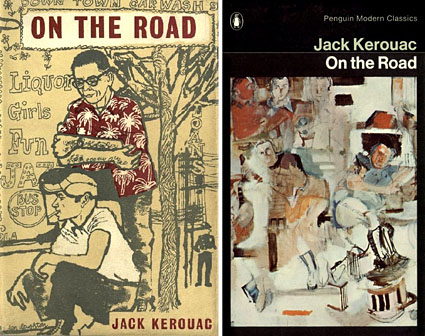
This morning at the American Conservative Robert Dean Lurie makes the case for including Jack Kerouac in the canon of culturally conservative authors.

As Lurie acknowledges, Kerouac’s rambling, drug-, jazz-, sex-, and booze-fueled writing does not usually bring this to mind.  Yet Lurie insists Kerouac is “up for grabs ideologically.”  Kerouac, Lurie writes,

“did indeed go on to lead a wild existence filled with alcohol, drugs, and perpetual shiftlessness; he fled from monogamy as from leprosy. Yet one cannot grasp the soul of Kerouac unless one understands his fundamentally traditional core. He never wished to foment a revolution. He did not desire to change America; he intended to document, celebrate, and, in the end, eulogize it.”

Image Source: Feuilleton, by John Coulthart

I admit I’ve never been a fan.  Years spent teaching English to bright and talented high-schoolers caused me to resent the influence of On the Road.  Too many young people seemed to lean on this book, among others, as proof that writing and thinking did not need to be disciplined or systematic.  More than that, the book always seemed to be too careful and planned in its spontaneity.  A tantrum, not a rebellion.

Lurie argues that we’ll never understand Kerouac if we stop at this surface impression.  The theme of Catholicism permeates Kerouac’s work, yet many readers miss it entirely.  As Lurie notes,

“The influence [of Catholicism] is so obvious and so pervasive, in fact, that Kerouac became justifiably incensed when Ted Berrigan of the Paris Review asked during a 1968 interview, ‘How come you never write about Jesus?’ Kerouac’s reply: ‘I’ve never written about Jesus? … You’re an insane phony … All I write about is Jesus.'”

In the end, Lurie concludes, Kerouac stood out among his Beat colleagues:

“Allen Ginsberg, the poet visionary, pined for utopia and spiritual revolution. William S. Burroughs, the outlaw libertarian, pined for anarchy and gay liberation. Neal Cassady, the exiled cowboy, pined for girls and cars. Jack Kerouac, the mystic, pined for God and home.”

The Real Wall of Separation

At ILYBYGTH, we’ve been following stories in Missouri and New Hampshire about religion, authority, and public schools.

Today in a guest post on Valerie Strauss’ Washington Post Education blog, I argue that these kinds of laws just won’t work.  In this post, I allow myself to get a little more strident than I usually do on these pages.  I argue that rules allowing parents and families to opt out of school rules a la carte just won’t work.  Nor are they new.  In the 1920s, anger at and fear of a steamrolling anti-religious curriculum drove the first anti-evolution campaign.  In the 1970s and 1980s, in places such as Kanawha County, West Virginia, and Hawkins County, Tennessee, battles over school curriculum led to a new generation of conservative school activists.

The maturation of that generation can be seen in laws and amendments such as those in Missouri and Tennessee.  I am deeply sympathetic to parents who don’t want schools to dictate hostile ideas to their children.  But putting up a wall of separation around each individual student just won’t work.

In the News: God and the DNC

If the RNC tried to act like a multi-headed tent revival, the DNC seems to be fighting a bitter struggle against its own Godlessness.  According to reports from the Huffington Post and Fox News, a mini-floor fight erupted over an attempt to reinsert “God” and Jerusalem back into the 2012 Democratic platform.

Villaraigosa, image source: Human Events

When Los Angeles Mayor Antonio Villaraigosa called for a voice vote on two measures, the reinsertion of language supporting “God-given potential” of working people, along with language supporting Jerusalem as the capital of Israel, loud dissent roiled the convention.  After three unclear voice votes, Mayor Villaraigosa declared the measure passed, to a chorus of boos from the floor.

According to Fox News, the new “God language” restores the 2008 platform.  The party now claims,

“‘We need a government that stands up for the hopes, values, and interests of  working people, and gives everyone willing to work hard the chance to make the  most of their God-given potential.’

“The initial 2012 platform language said this: ‘We gather to reclaim the  basic bargain that built the largest middle class and the most prosperous nation  on Earth — the simple principle that in America, hard work should pay off,  responsibility should be rewarded, and each one of us should be able to go as  far as our talent and drive take us.'”

What does this mean?  First of all, it is unclear what conventioneers booed.  Was it the recognition of Jerusalem as an Israeli city?  Or the return of the God language?  Both?  Or just the heavy-handed tactics steamrolling over their opposition?  It is hard to tell.

Second, this mini-episode demonstrates the political power of God.  President Obama had maneuvered to get the God language back in.  Republican party hacks circulated the video immediately as proof that the Democrats hated God and the Jewish state.

In America, not just Fundamentalist America, it is good politics to get an endorsement from God.  And it is bad politics, apparently, to fight over it.

Is the War between Science and Religion Over?

Here’s one we missed: among the year-end top-ten lists was Paul Wallace’s list of “Top Ten Peacemakers in the Science-Religion Wars” at Religion Dispatches.

Looking back at 2011, Wallace offered this cheering prediction:

“This year has marked, I believe, the beginning of the end of the war between science and religion. Creationism cannot last. The New Atheists are now getting old. And between these camps the middle ground continues to expand.”

Wallace’s article lists ten leading voices from the broad middle ground.  Included are evangelical scientist Karl Giberson and irenic atheist Chris Stedman.

We missed Wallace’s list at the time.  Looking back at the progress of 2012 so far, it doesn’t seem as if the culture wars have abated noticeably.  But perhaps we need to look more at trends than headlines.  As one of Wallace’s top-ten peacemakers, Rachel Held Evans, put it,

“My generation of evangelicals is ready to call a truce on the culture wars. It seems like our parents, our pastors, and the media won’t let us do that. We are ready to be done with the whole evolution-creation debate. We are ready to move on.”

The goal at ILYBYGTH has always been to promote a true and lasting peace in these culture wars, not merely an angry and demilitarized standoff.  A more profound and sympathetic understanding of Fundamentalist America among us outsiders could lead to a greater willingness to work together.  Or at least to an ability to understand what the other side is saying.

Was Wallace right?  Has 2012 produced a new crop of peace-makers?  It is not too difficult, after all, to stretch beyond Wallace’s list to point out other hopeful signs of a new generation of writers and activists willing to reach across the cultural trenches to work with the other side.  Just a few that have attracted wide notice lately:

Starting long before Pat Buchanan’s famous 1992 invocation of the “culture-wars,” it has seemed that the boldest headlines have been made by those who attack their opponents relentlessly.  Perhaps we can see here a broadening of interest in the peaceable middle, those who want to speak civilly and productively with those on the opposite sides of these culture-war trenches.  One can always hope.

In the News: A Party with the Soul of a Church

With apologies to GK Chesterton, we notice a remarkable collection of photos from the GOP’s national convention this week at the Washington Post.

Many commentators (check out samples here, here, or here) have opined on the abundance of religious rhetoric emanating from the Florida convention.  If each of these photos is worth 1,000 words, this photoessay tells the story best of all.

The first thing any viewer will notice is the diversity of religious speakers.  From Judaism, Greek Orthodoxy, the Church of Jesus Christ of Latter-day Saints (Mormons), Catholicism, Sikhism, Protestantism…the convention made an effort to promote itself as ferociously religious, but determinedly non-sectarian.

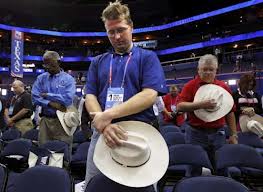
Image source: Twin Cities.com

The second reflection that jumps out at us is the spectacle of the convention floor during each invocation.  A vast room, not too unlike an old-fashioned revival tent, packed with people from all walks of life, bowing their heads in reverent prayer.  The image of a convention floor giving its moment of respect to God sent a political statement.  Whatever God you worship, the GOP seemed to be saying, we’re the Party for you.

In the News: What Is a Family? CA Approves Multiple-Parent Bill

We read in yesterday’s First Thoughts that California lawmakers have passed a new law.  Senate Bill 1476 will allow courts to recognize that “a child may have a parent and child relationship with more than 2 parents.”

This bill came about from a complicated family situation.  In In re M.C., a child had been put into the foster system.  Neither the biological mother, nor the mother’s new partner, could or would care for the child.  But the child’s biological father was not legally her parent, so the child could not be given to his care.

The arguments for and against the new law provide an illuminating glimpse into culture-war positions about the meanings of traditional families.  Supporters of the law claim that such laws simply move the courts into balance with the messy realities of our contemporary society.  Bill sponsor Mark Leno (D-San Fran) stated, “We live in a world today where courts are dealing with diverse circumstances  that have reshaped California families.”  Similarly, an LA Times editorial in favor of the law opened with this gambit: “For better or worse, families have changed.”

Opponents of the law have articulated some of the reasons often given in Fundamentalist America for supporting traditional family structures.  Writing in the Huffington Post, John Culhane and Elizabeth Marquardt argued that the new law will open a Pandora’s Box of unintended, but predictable, consequences.  “The ‘rule of two,'” they noted,

“for assigning legal parenthood has rarely been breached, for good reason. Again, consider In Re M.C.. Reunification is always challenging; here, it is unlikely to succeed with anyone except (possibly) the biological father. Is it really wise to deploy already-strained government resources toward three parents? And what if, in another case, reunification with all three parents were achieved?

“The problems would then multiply. It is hard enough for even two parents to agree on how to raise a child. Three parents in conflict would be still worse. Constant judicial involvement in decision-making would be the unintended but entirely predictable consequence. If there were a custody battle, the child might end up being shuttled between all of them. In fact, a Pennsylvania court has ordered custody to be shared among three legal parents.

“And why stop at three? Senator Leno’s bill places no limit on the number of possible parents. If three’s a crowd, four or more is a mob.”

Along the same lines, according to a story in the San Francisco Chronicle, California Assemblyman Tim Donnelly (R-Twin Peaks) complained, “This smacks of the state redefining parenthood.  What’s next? Are we going to parent by committee?”

For conservatives, the primary danger seems to come from state intervention into private family structures.  Those structures, many conservatives believe, have precedence to the state and ought to be immune to state meddling.  For religious conservatives, this is often articulated as a notion that God created the traditional two-heterosexual-parent family.  Human governments ought only to support what God has created.

Tradition and Homosexuality

Why do some people care that other people are gay?  If we hope to understand Fundamentalist America, we need to wrestle with this question.  To begin, we should acknowledge that opposition to homosexuality is a deep tradition in our culture.  Some of the foundational thinkers of our civilization considered homosexuality to be a horrible thing.  For those like me who consider homosexuality simply another way to be a sexual person, this hostility toward homosexuality is difficult to understand.

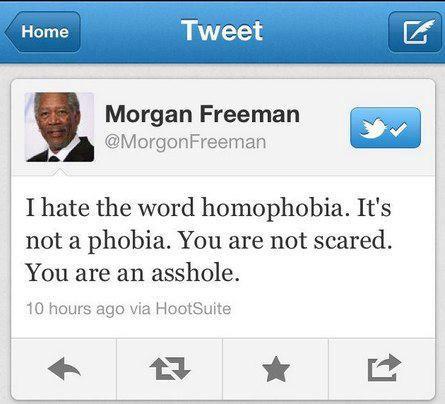
Part of the difficulty must result from the infinitely complicated nature of anti-homosexual feeling in America.  Even those like me sympathetic to what we’re calling Fundamentalist America must acknowledge that some anti-homosexual feeling must result from old-fashioned ignorance and bigotry.  Some, but not necessarily all.  Many of my secular and liberal friends, colleagues, and acquaintances seem to lump all opposition to homosexuality to mere hatred.  They assume, like Morgan Freeman, that any anti-homosexual thinking results from small-minded intolerance of those who are different.

Image source: The Obamacrat.com

To really understand Fundamentalist America, we need to avoid Freeman’s sort of partisan sniping.  It may be briefly satisfying, but it doesn’t help us understand.  Those who simply hate all homosexuals are likely assholes.  But while we can’t forget that component of anti-homosexual culture in today’s America, we need to also acknowledge that many of the best minds of our past have also denounced all homosexuality.

PLATO

Plato denounced homosexuality in the harshest terms.  He repeatedly called it unnatural. (e.g. Laws, VIII, 836Laws, I, 636c.)  Plato’s suggestion for rooting out this unnatural practice was simple and shocking to the modern ear.  Simply convince people that homosexuality belonged in the same class as incest, and the “problem” would disappear. (Laws VIII, 838.)

The goal, according to Plato, must be to ban homosexuality entirely.  (Laws, VIII, 837).

LEVITICUS

Americans may be more familiar with the Biblical tradition on homosexuality.  After all, as we have explored in the pages of ILYBYGTH, American culture has been and remains profoundly influenced by the Bible.  In twenty-first century culture wars, the rules of Leviticus are often raised as evidence for an anti-homosexual attitude.  The book is clear: homosexuality must be viewed as an abomination.  See for example, the following snippets:

Lev. 18.22: “Do not lie with a man as one lies with a woman; that is detestable.”

Lev. 20.13: “If a man lies with a man as one lies with a woman, both of them have done what is detestable.  They must be put to death; their blood will be on their own heads.”

Those who believe the Bible to be a good moral guide must at least wrestle with these commandments.

AUGUSTINE

In his Confessions, Augustine articulates a vision of human sexuality that denounces all non-procreative sex as counter to the will of God.  In Book III, chapter VIII, Augustine called the “sin of Sodom . . . abominable.”  Such acts, the Bishop of Hippo charged, “deserve punishment wherever and whenever they are committed.”  God’s purpose, Augustine argued, was not for humans to “use each other in this way.”

What do these ancient denunciations of homosexuality mean for twenty-first century America?  For one thing, it does not seem fair to interpret these ideas away.  Though some fancy intellectual footwork could likely dispute the meanings of each of these individual quotations, the overall tone of the ancient sources above seems clear: Each condemns homosexuality as unnatural, against God’s plan.  But this leaves us with one obvious question: What does it matter if these ancient sources condemn homosexual practice?  Do the attitudes of the ancients need to influence our thinking?

After all, it does seem as if Plato was an asshole.  In addition to denouncing all homosexuality, he also had complicated ideas about the permissibility of poetry, for instance.  And the lifestyle commandments in Leviticus certainly seem motivated by a small-minded legalism.  For example, we are told in Lev. 19.19 we must not wear clothes made of both linen and wool.   Is it fair to use Leviticus as a reason for opposition to homosexuality, but not use it to fight against textile abuse?  Can Fundamentalist America cite Plato’s opposition to homosexuality, but not insist—as Plato would—that children be taken away from their biological parents and raised by the state?   Such arguments seem like attempts simply to use the Bible or Plato to enforce modern prejudices.  But even if that is the case, we outsiders to Fundamentalist America must acknowledge the deep cultural roots of opposition to homosexuality.

Even more difficult, we need to wrestle with Augustine’s more nuanced understanding of human sexuality.  Homosexuality, for Augustine, was simply a variant of humanity’s depraved understanding of itself.  In an Augustinian framework, the notion of a “sexual orientation” itself reflects a flawed and dangerous understanding of the nature of humanity.  The orientation of humans ought not be sexual, but rather divine.  To live properly, Augustine argued, our minds should be on God, not sex.  This is not bigotry against homosexuals as such, but an argument about the nature of humanity profoundly at odds with our notion that any suppression of sexual feelings is a dangerous affair.

Morgan Freeman probably would not impressed by the deep tradition of anti-homosexual thought in Western culture.  Anyone who starts by dismissing all those with whom he disagrees as simple assholes does not likely desire a more profound understanding of his opponents.

But we do.  Here at ILYBYGTH, we hope to understand conservative opposition to homosexuality.  In addition to strains of bigotry and ignorant intolerance, we must also recognize the foundational element of anti-homosexuality in our shared culture.  This may be a bitter pill for folks like me to swallow, but it is true: Those who dislike homosexuality can claim a long and distinguished intellectual heritage.