ILYBYGTH at RiverRead Books

…and you’re invited!  Everyone in the Binghamton area is welcome at a book talk I’ll be

giving at RiverRead Books in downtown Bingo.  Mark your calendars: September 20 at 6:30 PM.

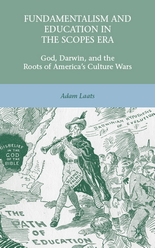
I’ll be talking about the subject of my first book, Fundamentalism and Education in the Scopes Era: God, Darwin, and the Roots of America’s Culture Wars.  I’ll start by making my case for why we need to understand the 1920s if we hope to get a handle on today’s culture wars.  Then we’ll open up a discussion on any and all topics of interest to ILYBYGTH readers: the meanings of fundamentalism, the nature of the creation/evolution stalemate, the proper role for religion in public life, and so on.

So come on down!  Even if you can’t make this event, be sure to stop by RiverRead.  It’s a great place to buy books.


Bill Nye Doesn’t Get Creationism

Thanks to Our Man in Scotland, we recently read some comments on American creationism from “The Science Guy,” Bill Nye.  Though we at ILYBYGTH don’t defend young-earth creationism, we do hope to understand it on its own terms.  In that task, mainstream scientists like The Science Guy often seem uniquely unhelpful.

Bill Nye The Science Guy. Image Source: Educational Communications Board

In a bit from February on Big Think, the well known TV science popularizer had some harsh words for those who believe in a young earth.  Only when we understand the extreme age of the universe, Nye charged, does the story of life on Earth make sense.  Those who try to stick to a young earth make things “fantastically complicated,” Nye insisted.  “The idea of deep time,” Nye explained, “of this billions of years, explains so much of the world around us.  If you try to ignore that, your world view just becomes crazy, just untenable, itself inconsistent.”

Let’s take this accusation apart a little bit.  As I read it, America’s favorite nerd is not quite calling young-earthers crazy, the way Richard Dawkins likes to do.  Instead, Nye is saying that trying to frame a conception of the universe that takes all the evidence into a account is crazy, unless we assume an extremely long timeframe.

Nye makes other statements about creationism that are just plain wrong, though.  First, Nye ends his diatribe with a familiar “progressive” fallacy.  Nye asserts that young earth belief will wither away.  “In another couple centuries,” Nye states, “. . . it just won’t exist.  There’s no evidence for it.”  But that is not how things have worked historically.  Young earth belief was far less prevalent in 1920 than it became in 1980, for instance.  Some evolutionists fall into this trap of assuming that young-earth belief is strictly a matter of ignorance and isolation.  As more and more people are exposed to the evidence for evolution, the assumption goes, young earth belief must surely die out.  But young-earth belief has grown along with America in the twentieth century.  As more and more people get more and more education, a significant minority of them are educated into young-earth belief, not away from it.  As I describe in my 1920s book (Now in paperback!) anti-evolutionists in the 1920s set up a durable and influential network of schools and colleges to educate American toward young-earth belief, not away from it.

Ronald Numbers. Image Source: University of Wisconsin Madison

The second error Nye makes is in his opening statement.  “Denial of evolution,” Nye insists, “is unique to the United States.”  That is simply not true.  Strong creationist movements thrive world wide, especially in Australia and New Zealand.  As my mentor Ronald Numbers has explored in the new edition of his classic book The Creationists, young-earth belief is also strong in countries such as Turkey.

Like a lot of evolutionists, Nye seems to be a particularly bad guide to the world of young-earth creationism.  Perhaps because from his position firmly within the scientific mainstream, the ideas of creationism look particularly outlandish.  Nye and his mainstream scientific colleagues have no ability to understand something that builds its intellectual structure upon a radically different foundation.  To Nye and his ilk, the only explanation is that such thinking is crazy, etc.  We at ILYBYGTH hope to understand it more profoundly.

Is Gay Okay? Not in Utah…

Image source: Business Insider

I’ll admit it.  I find Glee offensive.  Not because of any teen-steam sexuality or anything, but just because everyone keeps singing and dancing all the time.

Now it appears a new show by one of the creators of Glee will not be aired by a Utah NBC affiliate.  According to an article by Scott Pierce in the Salt Lake Tribune, TV station KSL will not show The New Normal in the usual NBC timeslot.  Why not?  The show depicts the lives and times of a gay couple and their quest for a surrogate-carried baby.

For the culture-war-tuned antennae of ILYBYGTH, the interesting part of this story is the language each side uses to explain its position.  According to Jeff Simpson, CEO of KSL’s parent company, the show was banned because, “The dialogue might be excessively rude and crude. The scenes may be too explicit or the characterizations might seem offensive.”

Voices from Fundamentalist America support this decision.  The activist group One Million Moms has opposed the show.  According to the group’s website,

“NBC is using public airwaves to continue to subject families to the decay of morals and values, and the sanctity of marriage in attempting to redefine marriage. These things are harmful to our society, and this program is damaging to our culture. . . .

“Millions of Americans strongly believe that marriage should be between one man and one woman. NBC’s “The New Normal” is attempting to desensitize America and our children. It is the opposite of how families are designed and created. You cannot recreate the biological wheel.”

In these short paragraphs, One Million Moms sums up (sum up?) the reasons some conservatives give for opposing homosexual marriage and homosexuality in general.  In coming weeks, we at ILYBYGTH will be exploring these arguments in more detail.

In the meantime, the defense of the show demonstrates one of the most popular arguments made in favor of gay marriage.  As Glee and New Normal producer Ryan Murphy argued, “It’s 2012.  I don’t think this is anything so outrageous.”


Required Reading: Who’s Afraid of Evolution?

Stop me if you’ve heard this story before.  I started this blog when I discovered many of my secular, liberal friends and family shared my ignorance about the complexities of life in Fundamentalist America.  One academic acquaintance once asked me regarding young-earth creationists, “What’s wrong with these people?”  She didn’t mean to be patronizing, but she dismissed a huge group of Americans with one sarcastic comment.

As we’ve noted here before, American creationists embrace a wide variety of beliefs.  Calling oneself a “creationist” doesn’t necessarily mean one believes in a six-thousand-year-old planet, or a literal six-day creation.  But it might.

Venema. Image source: Trinity Western University

Dennis Venema of Trinity Western University recently shared some of his experiences teaching evolution at an evangelical Protestant university.  Writing on The BioLogos Forum, Venema discusses the thrill he experiences when he shares his evidence for evolution with his evangelical students.  As he describes, some of his students resist accepting the evidence.  Even when they do recognize the power of chromosomal similarities, students still reach individual conclusions about how this science impacts their faiths.

Venema’s reflections demonstrate the complexities of creationism within the borders of Fundamentalist America.  We outsiders must be careful not to lapse too glibly into a simple evolution/creation binary.

As Venema relates,

“For me personally, the most difficult circumstances to watch are students who feel torn between the evidence and their faith. In some cases these are extremely bright students, who easily see the strength of the evidence, but feel the need to remain unengaged and uncommitted because they fear a backlash from their churches, or (especially) their parents.  While an evangelical university can be a wonderful, safe environment for students to explore these issues, that environment doesn’t follow them home. These struggles are painful to watch, and I’ve spent more than a few hours in prayer for students facing them.”

This experience is different at an evangelical university than it would likely be at a mainstream school.  For starters, the assumptions about students’ home lives would not be the same.  No matter how caring and sympathetic a professor might be at a mainstream college, he or she would not likely assume that evolution would cause such struggles for his or her students.

Students who learn about evolution at my institution, for example, would do so under the auspices of David Sloan Wilson’s EVoS program.  This is a wonderful and powerful academic experience for undergraduates.  But the students in the program generally assume that anyone who does not embrace the science of evolution is trapped somehow in a bizarre and archaic subculture.  My chat about the intellectual culture of creationism with a group of bright and talented students in the EVoS demonstrated the intense secular bias of the program.  (You can listen to a podcast of that conversation here.)

As Venema continues, at an evangelical college, the situation is vastly different.  Many students come from churches and families in which the word “evolution” has long been associated with every sort of rank sin.  At Venema’s school, for instance,

“evolution matters. That intensity of student engagement is invigorating, and the students feel it too. Regardless of where students ultimately decide to “land” on the issue, many report that they enjoyed the process – the exchange of ideas, the discussions and debates, and the new understandings gained.”

So who’s afraid of evolution?  Many of my secular friends and family would likely assume that students at evangelical colleges are taught simply to hate and fear the truths of modern science.  As Venema shares, the real experience is a much more complicated thing.

NEW TOPIC: Family & Sexuality

What makes up a family?  What is the right way to have sex?  Fundamentalist America has strong feelings about these questions.  For many outsiders like me, conservative opinion on these issues is truly perplexing.  If it is “conservative” to want a smaller government, for instance, why is it also “conservative” to regulate all the sexual behavior in all the bedrooms in the country?  If Fundamentalist America wants strong families, why do they deny same-sex partners the rights to marry and raise healthy, happy children?  Even more foundationally, why does Fundamentalist America even care if people are gay, straight, or otherwise curved?  How does it stop a conservative Christian from following her religion if other people have sex in ways she doesn’t like?

For the next several weeks, ILYBYGTH will explore these questions.  Posts will fall into three basic categories:

  • The fights against same-sex marriage;
  • Notions of sexuality; and
  • Contraception.

Just as we’ve done with the topics of creationism, traditionalist education, and the Bible, our goal will be to present the best possible arguments from Fundamentalist America.  Our goal as outsiders will be to understand conservative thinking on these issues, not to attack or defend it.

This will certainly be tricky.  It is much easier to speak calmly and dispassionately about such things as evolution, John Dewey, and Bible apocalypses than the intimate relationships that make up family life.  Attacks on homosexuality, for example, come much closer to home for many people on both sides of the issue than, say, denunciations of evolution.

One more reminder: when we talk about “Fundamentalist America” here at ILYBYGTH, we mean something wider than simply those very conservative evangelical Protestants who might call themselves small-f fundamentalists.  We are talking here about a broad conservative, traditionalist impulse, shared among many different types of conservative people.  Conservative Catholics, Protestants, Jews, and Muslims may all be part of this sweeping interpretation of FA.  Indeed, even mainly secular people who favor traditional society may include themselves as part of this coalition.

The purpose of ILYBYGTH is to understand the ideas of this deeply conservative tradition in America.  You can help.  Share your experiences, comment on posts, ask questions.  Even with this intensely personal and highly emotional topic, we’ll resolve to talk calmly, respectfully, and with a sincere desire to understand, even if we can’t agree.


Let’s Be Civil: Scott F. Aikin & Robert B. Talisse

We must be civil.  If we here at ILYBYGTH hope to understand Fundamentalist America from the outside, it is not optional.  The purpose of ILYBYGTH is to imagine the best reasons for conservative ideas on evolution, religion, education, etc.  Without civility, this turns into another useless and bitter witchhunt.

But what does it mean to be civil?  Philosophers Scott F. Aikin and Robert B. Talisse of Vanderbilt offer a compelling short definition of true civility.  In a piece on 3 Quarks Daily, the two philosophers argue for a more precise and healthy definition of civil argument.  “We now are able,” Aikin and Talisse say in part,

“[to] identify civility in argument with tendencies that enable the exchange of reasons among disputants. Chief among these concerns the need for those who disagree to actually engage with each other’s reasons.  This requires arguers to earnestly attempt to correctly understand and accurately represent each other’s views.  For similar reasons, arguers must also give a proper hearing to their opponents’ reasons, especially when the opponent is responding to criticism.  In addition, when making the case for their own view, arguers must seek to present reasons that their opponents could at least in principle see the relevance of.  We can summarize these ideas by saying that civility in argument has three dimensions: Representation, Reception,and Reciprocity.”

And they conclude:

“Thus we see that civility in argument is not a matter of being nice, calm, or even polite.  It instead has to do with being a sincere arguer.  Civility is consistent with sharp tones, raised voices, and other forms of adversariality that would in other contexts be inappropriate.  But our model of civility also holds that name-calling, impoliteness, and hostility are to be avoided when they would obstruct or undermine properly run argument.”

For those of us who try to engage with those with whom we don’t agree or don’t even understand, this definition will help define the parameters of civil discourse.  It is a reminder that we must not abandon our own positions in order to respect the other.  Such wallpapering is not true civility, but rather only a stalling maneuver.  This definition also frees us to be angry, so long as we understand that anger is a feeling, not an argument or strategy.  True civility, in my opinion, is like parents arguing in that quiet time when a baby has just fallen asleep after a long stretch of midnight crying.  Both parents can be angry.  Both can point fingers and accuse the other of sloth.  But both parents also implicitly–automatically–keep their voices down to a hushed whisper.  Though they may have a ferocious argument, they both agree not to wake the baby.

Can people really do this?  There often does not seem to be any agreement to keep argument civil.  Culture warriors break this implicit code all the time, engaging in violence or accusing one another of inciting violence.

But there is hope.  Political scientist Morris Fiorina has argued that the “culture-wars” are not truly as vicious as they are made out to be.  Scholars such as Jonathan Haidt insist that there are moral positions on both sides of many hot-button issues.  And activists such as John Corvino and Maggie Gallagher have committed to talking civilly with one another, sometmes with “sharp tones, raised voices, and other forms of adversariality.”

So let’s be civil.  When we disagree, let’s remember to try to understand the other side.  Let’s listen to one another.  Let’s give reasons that might make sense to the other side.  And let’s agree to be open to changing our ideas.  A tall order, but a necessary one.

Reds Under the Bed? Christians Under the Couch!

Conspiracy sells.  Just ask Dan Brown.  But unwarranted anxiety about conspiracy also poisons our shared public life.

Source: The Guardian

Conspiracy hunting used to be a sport dominated by conservatives.  Think Joe McCarthy waving his sweaty lists of communist infiltrators.  In recent years, though, politicians and commentators have found a new subversive threat: the Religious Right.  A new book by former GOP functionary Mike Lofgren, for instance, warns of the ways his Republican Party was infiltrated and taken over by “stealthily fundamentalist” religious conservatives.

This kind of “paranoid style” has a long history in American public life.  Witches were fiendishly difficult to detect in seventeenth-century New England.  Scheming Catholics worried nineteenth-century WASPs.  Communists emerged as the primary subversive threat in America’s twentieth century.

Leaders of the Religious Right have often worked up convincing conspiracies of their own.  As historian William Trollinger has described, this tradition started with the first generation of American fundamentalists in the 1920s.  One of the most prominent leaders of that Scopes generation, William Bell Riley, finally blamed evolutionary theory on a far-reaching plot of “Jewish Communists.”

In 1926, as I describe in my 1920s book (now in paperback!), one of the new grassroots fundamentalist organizations, the Bible Crusaders, announced the root of the evolution problem.  “Thirty years ago,” the Bible Crusaders revealed,

“five men met in Boston and formed a conspiracy which we believe to be of German origin, to secretly and persistently work to overthrow the fundamentals of the Christian religion in this country.”

A generation later, writing in the magazine of Chicago’s Moody Bible Institute, one evangelical writer shared his experience with the famous progressive educator John Dewey.  This writer told a cautionary tale of secularist conspiracy, with a story of Dewey’s eighty-fifth birthday party in 1944.  Our evangelical witness had been invited to the celebration, the other guests unaware of his theological commitment.  Celebrating the life of the prominent progressive educator, the guests proudly recalled their efforts to transform America’s schools from Christian institutions to secular training centers.  “A generation has passed since that birthday gathering,” reported the evangelical spy to the MBI readership,

“and the plan has been immeasurably advanced by a series of court decisions that have de-theized the public schools.  As a result, American state-supported schools are as officially secular and materialistic as are their counterparts in Communist countries.  Are we awakening?”

Such warnings shouted by Christian conservatives have occasionally attracted enormous audiences outside of religious circles.  In the 1970s, Hal Lindsey’s Late Great Planet Earth became a runaway bestseller.  With his co-author Carole Carlson, Lindsey spun a premillennial dispensationalist reading of the Bible into a riveting tale of international conspiracy.  In the premillennial dispensational interpretation, popular among some conservative evangelical Protestants, the Antichrist will return in the guise of a savior, combining governments into a massive superstate.  What seems like secular salvation is quickly revealed as the ultimate cosmic conspiracy, dedicated to binding all of humanity to a Satanic anti-religion.

Image source: Wikipedia

These themes saw another burst of popularity in the late 1990s, when Tim LaHaye and Jerry Jenkins repeated Lindsey’s feat.  LaHaye’s and Jenkins’ Left Behind series fictionalized Lindsey’s tale, again turning a conspiratorial interpretation of the apocalypse into beach reading for millions of Americans.

These Christian conspiracies have not been without cultural cost.  Though LaHaye and Jenkins carefully included a righteous Roman Catholic Pope among their fictionalized true Christians, other Christian conspiracy theorists, like William Bell Riley, have been too quick to implicate anyone outside of their circle of conservative evangelical Protestantism.

The dangers from conspiracy theorizing are not limited to the conspiracies imagined by conservative Christians.  Overheated accusations about the threat from subversive groups have long posed a profound danger to our public life, as any blacklisted Hollywood writer or interned Japanese-American could attest.  The threat is not limited to false conspiracies.  Satan may not have inspired Salem’s witch troubles, but historian Ellen Schrecker has argued that the communist-hunters of the 1950s often targeted real communist conspirators, if in a clumsy and overly aggressive way.

Similarly, Lofgren’s ominous warnings are not spun of whole cloth.  Lofgren warns vaguely of the “ties” of many leading Republican politicians to extreme positions such as Christian Dominionism.  This theology, associated most closely with the late Rousas John Rushdoony, wants to establish Christian fundamentalist control over American political life.  As Lofgren emphasizes, such thinkers approve the need to act “stealthily.”

Lofgren did not make this up.  Dominionism exists.  Prominent Republican politicians such as Rick Perry and Michele Bachmann really do work with groups who support such notions.  But the way Lofgren and other commentators discuss such threats from the Christian Right distort the public discussion over the role of religion in the public sphere.  As with warnings about President Obama’s connections to the “terrorist professor” Bill Ayers, this kind of conspiratorial rhetoric encourages a no-holds-barred approach to politics.

After all, as Lofgren intones, the “‘lying for Jesus’ strategy that fundamentalists often adopt” gives anti-fundamentalists a reason to punch below the belt in their culture-war battles.  If they did not, the warning goes, they would be helpless before the wiles of the Christian Right.  This is the primary danger of such breathless exposes as Lofgren’s.  They build a shaky and fantastic argument upon a foundation of authentic examples in order to convince the convinced.  Activists swallow the outlandish examples without demur.  Such true believers do not consider the real complexities of their opponents, but rather paint a simplistic and terrifying image to shock and motivate their own side.

As with the real communist movement, the real world of American conservative Christianity is not such a simple place.  Nor is it so headline-grabbingly power hungry.  Consider a recent leadership poll by the National Association of Evangelicals.  This organization, an umbrella group for conservative evangelical Protestants, asked just over one hundred of its leaders if the United States constituted a “Christian Nation.”  Sixty-eight percent said no.  One respondent told the NAE, “I hope others will learn to love Christ as I do, but that will happen more authentically through the Church and individual Christians sharing the Good News and demonstrating the person of Christ through our words and actions.”

This kind of statement from a conservative Christian does not sell books.  What does sell is a cherry-picked catalog of statements by Christian leaders revealing their plans to take over American politics and public life.  It was easy enough in Cold War America to discover evidence of a world-wide subversive communist movement.  But as America learned from Senator McCarthy’s outlandish claims, there is a danger in stripping down the image of subversives to cartoonish bogeymen.

I am not a conservative Christian myself.  I do not hope to apologize for the excesses of some conservative Christians.  Indeed, I believe denunciations of the schemes of conservative Christians have some basis in fact.  But when they serve only to encourage anti-fundamentalists to fight dirty, they do more harm than good.  When such conspiracy-hunters ignore the complexities and ambiguities of their targets, they attack more than their real enemies.  They smear innocent bystanders and poison the political life of the nation.

What Do Missourians REALLY Want?

Everyone interested in what we’re calling Fundamentalist America should be following Missouri’s Amendment 2.  The debate about the nature of religion in public schools and institutions gets right to the heart of many culture-war controversies.  But it appears that the amendment might pack a much heavier culture-war punch than it seems to.

There are plenty of places to go to catch up on the story.  ILYBYGTH has introduced the upcoming vote, discussed the results, and noted Catholic Bishops’ support for Amendment 2.  The St. Louis Post-Dispatch offered a very helpful introduction in late July.  For anyone interested in the viewpoint of amendment supporters, a Baptist congregation in Odessa published an hour-long video of Representative Mike McGhee explaining his vision for the amendment, frankly and openly.

For those who don’t like clicking on stuff, here’s the story in a nutshell:  On August 7, 2012, Missouri voters overwhelmingly (83%) approved an amendment to their state constitution.  The amendment was promoted as a school-prayer amendment.  Supporters such as legislative sponsor Mike McGhee called it a clarification of the rights of religious people to pray in public, so long as their prayers did not disturb others.  McGhee claimed that such rights are often disrespected.   Opponents such as Americans United for Separation of Church and State insisted it was at best unnecessary, since such rights are already protected in the US Constitution.  At worst, opponents insist, this amendment threatens to undermine the barrier between church and state.

Given a closer look, however, this amendment does much more than clarify students’ rights to pray in public schools.  It does that, but the amended Constitution now includes two other rights for students.  These new rights go far, far beyond protecting the rights of public schoolchildren to pray quietly.  The new rights satisfy the long-standing desires of important constituencies in Fundamentalist America.  For all parents who have worried that their children might be taught unwholesome moral, sexual, or religious lessons in public schools, the Missouri Constitution now offers an easy escape route.

The first added phrase, “students may express their beliefs about religion in written and oral assignments free from discrimination based on the religious content of their work,” opens the door for conservative families to include their beliefs in all parts of the school curriculum.  For example, creationist parents and students could now use their beliefs to answer questions about evolution.  This has long been a sticking point for creationists.  Consider the words of Avis Hill, a pastor from Kanawha County, West Virginia.  Hill rose to national prominence in 1974 when assumed a leadership role in a controversy over adopted textbooks.

From Trey Kay, “The Great Textbook War”

Hill told interviewers that his daughter was given a failing grade for her report on evolution.  According to the Reverend Hill, the young Miss Hill, fifth grader, told her teacher, “‘Mrs. So-and-So’—whose name I’ll not use—‘I’ll not give that report, and I’ll not read that book in class.’  She said, ‘I have a book I will read,’ and she opened her Bible—and I did not coach her because it didn’t bother me that much at that time—she opened her Bible, and she began in Genesis 1, ‘In the beginning God—‘ and the teacher failed her.” [Interviewed by James Moffett, included in Moffett’s Storm in the Mountains (Southern Illinois University Press, 1988), pg. 90].

This sentiment echoes throughout Fundamentalist America.  Fear that students will be forced to learn evolution, or about the use of condoms, or about the moral ambiguities of modern life have long dominated conservative rhetoric about public education.  Missouri’s new Constitution fixes that perceived problem.

The second telling phrase in the new Constitution underlines the point.  “No student,” the amendment reads, “shall be compelled to perform or participate in academic assignments or educational presentations that violate his or her religious beliefs.”  The implications are clear.  Sex ed, evolution ed, “situation ethics,” all have loomed large in the imagination of Fundamentalist America for generations.  This amendment guarantees that no student shall be forced to learn about such things.

Missouri’s amendment is not the only place to find this sentiment in political action.  New Hampshire’s state legislature recently passed a very similar law.  As I argue in my 1920s book,  conservatives have struggled to protect conservative religious students from public-school curricula since the 1920s.  In the last generation, the fight in Hawkins County, Tennessee, might have generated the most attention.   In that case, conservative religious parents ultimately lost their lawsuit against the school board.  Parents had claimed that anti-religious messages in school textbooks forced their children to learn messages inimical to their religious beliefs.  In 1987, the US Court of Appeals for the Sixth Circuit disagreed.

Lawmakers in New Hampshire and now voters in Missouri found a way around this legal precedent.  However, it is not clear that Missouri voters knew just what they were voting for.  Consider the wording of the ballot measure:

“Shall the Missouri Constitution be amended to ensure:

“That the right of Missouri citizens to express their religious beliefs shall not be infringed;

“That school children have the right to pray and acknowledge God voluntarily in their schools; and

“That all public schools shall display the Bill of Rights of the United States Constitution.

“It is estimated this proposal will result in little or no costs or savings for state and local governmental entities.

“Fair Ballot Language:

“A “yes” vote will amend the Missouri Constitution to provide that neither the state nor political subdivisions shall establish any official religion. The amendment further provides that a citizen’s right to express their religious beliefs regardless of their religion shall not be infringed and that the right to worship includes prayer in private or public settings, on government premises, on public property, and in all public schools. The amendment also requires public schools to display the Bill of Rights of the United States Constitution.

“A “no” vote will not change the current constitutional provisions protecting freedom of religion.

“If passed, this measure will have no impact on taxes.”

No mention of creationism, sex ed, condoms in schools, or other implications.  Nothing about guaranteeing students the right to opt out of any instruction they deem pernicious.  The ballot measure emphasized the amendment as a clarification of students’ rights to pray.  Yet the amendment itself makes the other meanings crystal clear.

Missouri voters approved the amendment by overwhelming margins.  But it appears that the implications of that ‘yes’ vote might not have been entirely apparent.  So what DO Missouri voters want?

Barton and Evolution

You might be tired of hearing about David Barton.  I know I am.  But how about just one more point?  This morning, History News Network ran an essay of mine asking a new question about Barton.  In the essay, I ask what might happen if Barton was defending the notion of a young earth, rather than the notion that Thomas Jefferson was a devout Christian.

Thanks to the History News Network for running that piece.  Since I submitted to their editor, the Barton story has developed in ways that make me even more intrigued in the comparison between (some) conservative Christians’ views of history and creationists’ views of biology and geology.

In a piece that ran in the August 13 online edition of Glenn Beck’s Blaze newsletter, Barton defended his work.  According to the Blaze article,

“Barton seemed anything but shaken by the controversy when he spoke via telephone with TheBlaze. He freely answered questions about the controversy and explained that he’s prepared to respond to some of the critiques, while dismissing what he believes is an ‘elevated level of hostility that’s not really rational in many ways.’

David Barton Responds to Jefferson Lies Controversy and Warren Throckmorton

“While he stands by his central arguments about Jefferson, Barton isn’t pretending to be immune from error. The historian said that the book has already gone through three or four printings and that there have been word and text changes based on spelling or grammar errors along the way. Also, he addressed a willingness to amend historical items, should they be pointed out and proven wrong by other academics.”

What’s intriguing to me in this defense is the way it echoes the challenges posed by 1920s creationists.  Note the phrase “other academics.”  Barton here defends his position as one academic historian among others.

It has been a very long while since scientific creationists insisted that they were part of of the mainstream scientific establishment.  As Ron Numbers described in his classic The Creationists, after the Scopes trial in 1925 leading creationist scientists still fought for creationism’s acceptance in mainstream science.  But they quickly learned that such debates did not offer a real chance to convince mainstream scientists of creationism’s superiority.  Seventh-day Adventist George McCready Price, for instance, left one debate in London shocked and demoralized by the reaction of the crowd.  “Do not confine your reading wholly to one side,” Price pleaded in response to one scornful outburst from the audience.  “How can you know anything about a certain subject if you read only one side of the case? There is plenty of evidence on the other side, and this evidence is gradually coming out.”  After this debate, Price left the stage feeling humiliated, and he never engaged in another public debate. (Numbers, ed. Creation-Evolution Debates, pg. 186).

This does not mean, of course, that creationists gave up.  No, it demonstrates that creationists moved in the 1920s, in fits and starts, away from fighting for acceptance by mainstream scientists.  Instead, they built their own powerful institutions: schools, publishers, and research organizations.  By 2012 no politician needs to retreat from creationist belief.  Similarly, no creationist feels a need to prove his or her claims to an audience of mainstream scientists.

David Barton, on the other hand, is giving us what might be a new Scopes moment.  Forced to endure the public humiliation of having his book withdrawn, Barton has taken a defiant posture.  He has insisted, like Price in 1925, that readers do more than “read only one side of the case.”  He continues to claim his credentials as one academic historian among others.  I wonder if soon historians like Barton will embrace their outsider status.  If so, as I argue in the History News Network piece, we might be seeing another sort of 1925.

Forget the Zombies, It’s a Bible Apocalypse

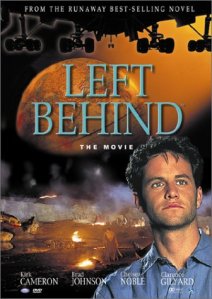
Kirk Cameron as Buck Williams

Ask Kirk Cameron.  One of the most compelling parts of a Biblical worldview is its clear explanation of the future.  And that future isn’t too rosy, at least for those outside of the charmed circle of Biblical Christianity.

How are those of us outside this circle to understand this prophetic tradition?  We might start by trying to understand the ways some conservative Protestants read the Bible.  After all, if one believes in an inerrant Bible, one is encouraged to interpret its words in the most obvious sense.  The dangers, in this tradition of Bible interpretation, come when readers exalt their own understanding higher than the words of Scripture.

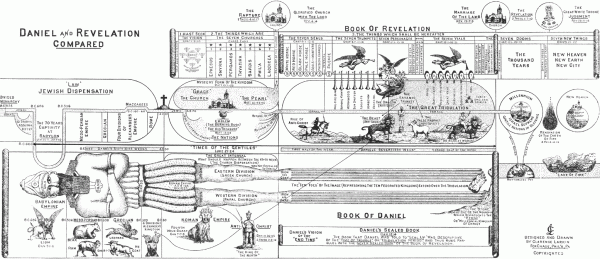
And the most obvious interpretation of some Biblical books, such as Daniel and Revelation,  is that they are prophecies of what is to come.

One of Clarence Larkin’s dispensational charts (1919)

Through a few quirks of history—though, of course, no Bible Christian would likely consider them accidental—one interpretation of these prophecies has come to exert an outsized influence on conservative evangelical Protestant belief in 20th­­- and 21st-century America.  This interpretation, burdened with the cumbersome name “dispensational premillennialism,” has become the dominant form of understanding Bible prophecy among the subset of evangelicals who call themselves small-f fundamentalists.

For those like me–outside of this tradition but trying to understand it–it is well worth our time to read some of the terrific academic histories out there.  The late Paul Boyer, of my alma mater, wrote a wonderful introduction to prophecy belief for outsiders.  Writing from closer to the tradition, Timothy Weber also offered a great guide to the history of this theology.  George Marsden also included a helpful introduction in his now-classic history of fundamentalism and American culture.

However, none of these terrific academic studies has reached the kind of audience that the prophecies themselves have claimed.  Just as the Bible’s continuing popularity must tell us something about the nature of popular religious belief in Fundamentalist America, so the popularity of rapture theology must hold some lessons.

In 1970, Hal Lindsey authored a runaway bestseller explaining this interpretation of the end days.  The Late Great Planet Earth sold millions of copies.  The book explained the themes of dispensational premillennial theology in an engaging and convincing way.  Lindsey and co-author Carole Carlson mapped the predictions of Daniel and Revelation onto world events of the 1970s.  As had generations of prophecy writers before him, Lindsey insisted that the world was entering the last days described to John in his Revelation.

A generation later, Tim LaHaye and Jerry Jenkins repeated this feat with their Left Behind series.  Beginning in the late 1990s, this fictionalized apocalypse told the story of end times, as understood by dispensational premillennialists.  The series sold millions of copies, and soon spun off an empire of related products, including a kids’ version and the movie starring Kirk Cameron.

What does the wild popularity of these books and their apocalyptic messages tell us about Fundamentalist America?  One danger would be to assume that all of the millions of readers embraced the theology of rapture and Biblical apocalypse.  It seems unlikely that all the readers of these books included themselves in the roll of Bible believers.  Just as the popularity of Harry Potter does not imply an increase in the belief in magic, so the popularity of these books does not necessarily mean a huge bump in belief in this apocalyptic tradition.  Nevertheless, conservative evangelical Protestants since the 1920s have argued for the importance of this particular way of understanding the Bible.  These books helped cement that understanding in the popular imagination.

For many readers, whether or not they buy into the entire theology, The Late Great Planet Earth and the Left Behind books tell THE Biblical story of the last days, not just one interpretation.

For those of us hoping to understand the nature of Fundamentalist America, the books are worth reading.  As long as we avoid the trap of thinking that these books are the last word in what conservative religious people really think, this vision of the nature of reality can go a long way to decoding some traditional shibboleths of the Fundamentalist tradition, such as the dangers of the United Nations and the importance of a strong Israel.

In each case, the politics of today and tomorrow have been explained thousands of years in advance.  As Revelation explains, the Antichrist will appear as the savior of humanity.  He will unite nations into one humanitarian global government.  All will appear obviously to the good.  For dispensational premillennialists, this prophecy provides fodder for an unyielding campaign against internationalism.  In the United States, this tradition has fueled an intense animosity toward organizations such as the League of Nations and the United Nations.  Again, we must not assume too much.  Not every conservative anti-internationalist has based his or her opposition on Biblical prophecy.  But among those who do, that opposition takes on more weight than simple policy considerations.  The fight against internationalization becomes, for some Bible believers, a literal cosmic battle of Good vs. Evil.  Understanding those roots will guide us in understanding the sometimes-puzzling international policies of some religious conservatives.

As reporter Buck Williams of the Left Behind series might explain, doubt and skepticism must end with the Rapture.  After that, the only option left for a dedicated Tribulation Force is to fight tooth and nail against the scheming Evil of Carpathia and His Global Community.

Further reading:

  • Timothy Weber, Living in the Shadow of the Second Coming: American Premillennialism, 1875-1925 (New York: Oxford University Press, 1979);
  • Paul Boyer, When Time Shall Be No More: Prophecy Belief in Modern American Culture (Cambridge: Harvard University Press, 1992);
  • George M. Marsden, Fundamentalism and American Culture, 2nd ed. (New York: Oxford University Press, 2006);
  • Tim LaHaye and Jerry Jenkins, The Left Behind Series (Tyndale House, 1995-2007);
  • Hal Lindsey and C.C. Carlson, The Late Great Planet Earth (Grand Rapids, MI: Zondervan, 1970).