Fundamentalist America: A Lock for the GOP?

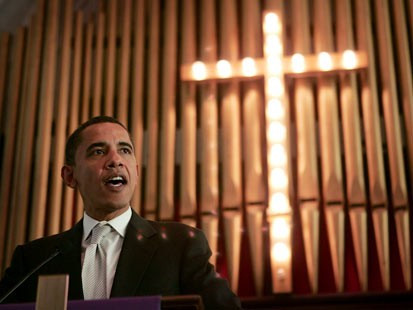
Casual observers might assume that every Fundamentalist vote is a lock for the GOP.  After all, at least since Reagan took the evangelical vote away from the evangelical Jimmy Carter, the Republican Party has cultivated an image as the staunch defender of life, family, and traditional values.

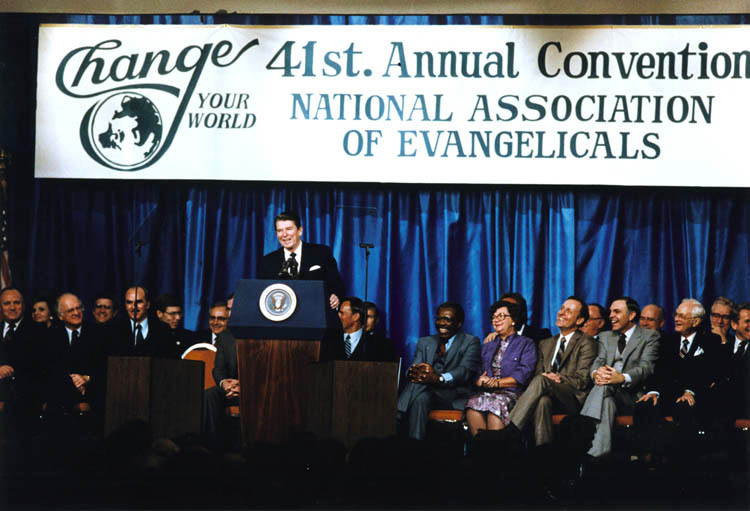
Reagan at the 1983 NAE Convention.


So even though the presumptive GOP nominee is a leader of the LDS Church, it is a general electoral rule of thumb that Bible voters will go for Romney in 2012.

But will they?

An article in this week’s Economist tries to pick apart the “evangelical vote.”  The article offers some interesting numbers.  Here are a few to consider:  in 2008, 65% of (self-identified) white evangelicals called themselves Republicans.  A recent poll put that number at 70%.  Self-identified white evangelicals made up 44% of Republican primary voters in 2008, compared to “over half” in the first 16 GOP primaries in 2012.  That’s a strong vote of support.

But look at the other side of those numbers.  In 2008, almost one-quarter of evangelical voters voted for Barack Obama.  Part of that support comes from a closer look at the meaning of “evangelical.”  President Obama, according to the Economist article (citing a Pew Research Center poll), enjoys a 93-point lead over Governor Romney among African American voters.  And those voters, after all, include a large percentage who are evangelicals.

The numbers get even dicier when we expand our understanding of “Fundamentalist America” beyond the boundaries of evangelical Protestantism.  Many conservative Catholic voters line up these days with conservative Protestants to vote for a vision of traditional Christian values.  And the conservative Catholic vote includes large numbers of Latino voters.  Such voters may vote for the GOP as the pro-life, pro-family, pro-Jesus party.  But many Latinos might be turned off by the Republicans’ growing support for harsh anti-immigration laws, many of which seem to target Latinos specifically.  As the Economist article points out, President Obama leads Governor Romney by 67% to 27% among surveyed Latino voters.

Could these numbers harken a shake-up of the relationship between Fundamentalist America and the two major parties?  For those who know their history, it would not be the first time.  After all, before the 1980 presidential elections, white evangelicals often portrayed themselves as above party politics.  They claimed to vote for candidates who best embodied the values of Bible-believing America.  And before the 1930s, African American voters reliably voted Republican, the Party of Lincoln.

Could we be on the verge of another party shake-up?  Could the Democratic Party attract young and non-white conservative Christians by appealing to social justice issues?  Could the GOP fumble by alienating non-white Fundamentalists and young social-justice evangelicals?  Even more interesting, could we be on the verge of a vast party realignment, of the kind that has revolutionized party politics a few times in the past?  In the mid-1800s, the new Republican Party built a powerful coalition out of the remnants of the Whig Party, the American Party, and abolitionists.  In the 1930s, the Democratic Party built another blockbuster with a Solid (white) South, urban “ethnic” voters, the union vote, and non-whites.

These powerful electoral coalitions don’t need to be logical.  But a new party that combined today’s Democratic Party’s tradition of social justice, plus the GOP’s tradition of traditional Christian values, could capture this broad middle from Fundamentalist America.

Google Trends and Fundamentalist America

Fundamentalist America is aflutter.  One of Fundamentalism’s favorite sons made a big splash last week.

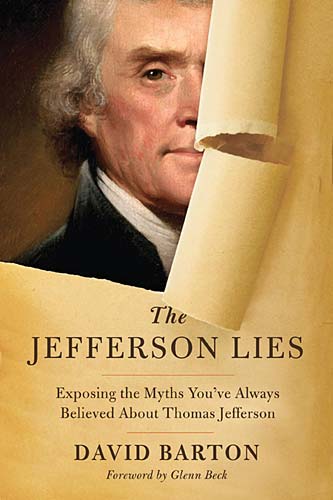
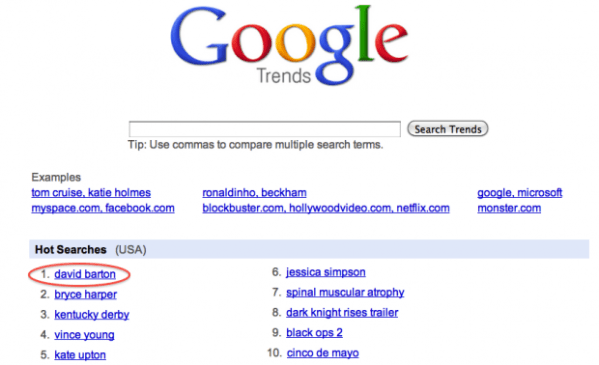
After David Barton’s appearance on Jon Stewart’s Daily Show to promote his new book The Jefferson Lies, the Beckite Blaze reported that the term “David Barton” had surged to number one on the list of trendy Google search terms.

When I followed up, I couldn’t confirm The Blaze‘s claim.  When I checked Google’s “Hot Searches” for May 2, 2012, Barton shows up as number nine.

The experience led to me tinker around a little bit with Google Trends.  Now, I know I need to apologize for my lateness at showing up to this party.  This is yet another example of the way I am far behind the times in finding out about the possibilities of the Google Mothership.

But I want to share a few of the interesting results for those outsiders interested in Fundamentalist America.  First, for those who are as backwards as I am, I’ll explain the premise a little bit.  Google Trends gives users a chance to find out how many people have Googled specific terms over time.  Today (May 5, 2012), many of the hottest search terms concern the recent death of Beastie Boy Adam Yauch.  In general, it seems as if the biggest topics in the daily news tend to attract the most Google searches.

But Google Trends also lets us see what people are googling over time.  If we want to understand what googling Americans are interested in, it gives us a chance to find out.  Now, I won’t make any claims that these results are definitive.  We can’t know very much about the intentions of googlers.  But there are still a few interesting results that I want to share, just to give everyone something to think about.

For example, I checked the trends for terms in tandem and got some interesting results.  For instance, “evolution” has trumped “creationism” by a long sight for the past several years.  On the other hand, comparing the google history of “Bible” and “Origin of Species” shows a huge tilt toward Bible googlers.    And, in the past few years at least, Jesus has almost always been comfortably bigger than the Beatles.  In fact, “Jesus” as a search term has held a comfortable lead over most other topics I could think of, including “David Barton,” “atheism,” and even “cats,” although “cats” seemed to hold its own pretty well.

What does all this tell us about Fundamentalist America?  Not much, really.  But it does demonstrate the enduring popularity of Christian terminology on Google.  Of course, people Google all sorts of different terms for all sorts of reasons.  Are there any other term comparisons that can tell us something about the nature and meaning of life in Fundamentalist America?

The Bible in America: A Graphic

Thanks to Jared Fanning and Mark Misulia of First Things, we have a new graphic to consider.  As we’ve argued before, the Bible sells.  Though we don’t want to jump too quickly to conclusions about what that means, it seems evident that the Bible matters to Americans.  Anyone who hopes to understand Fundamentalist America needs to understand the unique and important role of the Bible in American history and culture.

The Bible as America’s Book: The View from 1898

Fundamentalists insist that America needs the Bible.  As we’ve explored here before, many argue that America was founded as a Biblical nation.   Fundamentalists will tell you that America went to the dogs when Americans foolishly agreed to kick the Bible out of public schools.  If you have three minutes to spare, check out this video for a brief and dramatic version of this line of Fundamentalist thinking.

As with a lot of historical claims in Fundamentalist America, this one needs some scrutiny.  Outside of angry nostalgia and heated rhetoric, what can we know about the uses and meanings of the Bible in the history of America’s public schools?  Educational historians agree it is notoriously difficult to find out what went on in classrooms in the past.  Reading textbooks only tells us what was in those books, not what teachers and students really did.  Reading memoirs of student life can tell us what students choose to remember from their school days, but it can’t get us behind that closed classroom door.  And reading school laws and regulations only tell us what rulemakers wanted schools to do, not what the schools actually did.  But in spite of all these difficulties, we do have scattered chunks of evidence about classroom practice in the past.

In this post, I’ll analyze one such piece of evidence.  At the end of the nineteenth century, the Chicago Woman’s Educational Union conducted a survey to determine the degree to which the Bible played a leading role in American public education.  In 1898, the CWEU published the results as The Nation’s Book in the Nation’s Schools As the name implies, this was never meant to be a disinterested survey.  The editor, Elizabeth Cook, planned to use her evidence to promote a vision of American public schools as the proper home of a thoroughly Biblical culture.  As she wrote in her preface, Cook hoped to “aid in the beautiful work of guarding and extending the proper use of the Bible in our Glorious Educational System.”  The historical vision of the Chicago group would have made today’s fundamentalist historians such as David Barton proud.  Cook explained to readers that the Founding Fathers had imagined a thoroughly Biblical culture and society.  In 1777, she described, the Continental Congress ordered 30,000 English copies of the Bible for public distribution.  This proved, Cook argued, “how deeply the conviction that a knowledge of Biblical truth was essential to National life and health.”  The Chicago women’s group decided to see if the Bible still retained a prominent role in the nation’s public schools.  They surveyed state, county, and city school administrators.  The results of this survey satisfied the women that the Bible did indeed remain central to American public education.

Of course, we must recognize that the responses of these school superintendents tell us more about the political nature of the inquiry than about actual Bible reading in public schools in the late nineteenth century.  It shows us more about how these school politicians wanted to be seen than about what actually went on in classrooms.  These survey responses framed a political statement about the proper role for the Bible in 1898’s public schools, not a neutral batch of evidence.  Nevertheless, for that very reason the responses can tell us a great deal about contemporary attitudes.

The survey responses from my new home state, New York, described what Cook interpreted as a thoroughly Biblical public school culture.  A significant majority (53 of 94 respondents from across the state) reported Bible reading as an opening daily exercise in their schools.  Yet a sizeable minority (17 of 94) answered that the Bible was not read in their local schools.

In a neighboring state we see a similarly complicated response.  The state superintendent of public education in New Jersey, one CJ Baxter, responded that most schools in his Garden State read from the Bible.  Their reasons for doing so, he insisted, were simple.  Baxter told the Chicago Bible women that New Jerseyans “rejoiced under the reign of God, confident that He would ‘beautify the meek with salvation.’”  This answer from a state superintendent of education certainly sounds different from what one would expect from such an official today.  Not only did he agree with the surveyors that the Bible ought to be part of public education, but in 1898 he publicly aligned himself with the evangelical Protestant tradition.  With such attitudes at the top, it would not be surprising to find New Jersey’s teachers reading from the Bible in many public classrooms.  But it would also be unsurprising to find that significant numbers of parents and teachers quietly ignored their state leader’s loud evangelicalism.  It does not take a stretch of historical imagination to envision plenty of New Jersey schools in 1898 working out a far less evangelical attitude toward the practices in any given classroom.  And, in fact, even Superintendent Baxter confessed that “a few” of the school boards in New Jersey did not allow Bible reading in their public schools.

From Pennsylvania, the state superintendent reported that 15,780 out of 18,109 public schools in the Keystone State read from the Bible.  Such statistics delighted Cook and the CWEU.  But in other places, officials reported that Bible reading would not be allowed.  The curt responses from school leaders in Idaho and Utah, for example, demonstrated different regional attitudes.  John Parks, Utah’s state superintendent, offered a Mormon-powered interpretation of the use of Bible in public schools.  “While morality is taught and inculcated in all of the public schools of this State,” Parks told the Chicago Bible women, “the Bible is not read in any of them.  The belief seems to be quite wide-spread here that moral teaching in the public schools should be wholly non-sectarian, and many believe it to be impossible to introduce the Bible into the schools without at the same time removing one of the strongest guards against sectarianism.”

In 1898 Utah, “non-sectarian” meant no Bibles.  But in many eastern and southern states, non-sectarian had a much different meaning.  Most eastern and southern respondents felt that if the Bible could be used in a way that did not discriminate against or among Protestants, Catholics, and Jews, it could be used freely.  In spite of the eager evangelical tone of the New Jersey superintendent, most of those who approved of reading from the Bible in public schools agreed it must be done “without note or comment.”  Most school Bible rules explicitly stated that the Bible’s words must be allowed to stand free of any imposed interpretation.

For example, Baltimore’s Bible rule, according to Cook’s report, specified that schools might use either the evangelical-friendly King James Version or the Catholic-friendly Douay version for their school readings.  The rule in New York City specified,

No school shall be entitled to, or receive any portion of the school moneys, in which the religious doctrines or tenets of any particular Christian, or other religious sect, shall be taught, inculcated, or practiced; or in which any book or books containing compositions favorable or prejudicial to the particular doctrines or tents of any particular Christian or other religious sect, or which shall refuse to permit the visits and examinations provided for in this chapter.  But nothing herein contained shall authorize the Board of Education to exclude the Holy Scriptures, without note or comment, or any selections therefrom from any of the schools provided for by this charter.”

In other words, most school leaders agreed there must be no sectarian books in schools.  In Utah, that meant no Bibles.  But in New York, it didn’t.  In New York, and many other eastern and southern states, the Bible stood out as a uniquely powerful book, beyond all sectarian controversy.  All people, the thinking went, could support the reading of the Bible in public schools, since it transcended all religious differences.

Such differences in New York City and Baltimore focused on Catholic/Protestant/Jewish disagreements about the nature and uses of the Bible.  Those in Utah and Idaho implied LDS/mainstream Protestant disagreements.  Reporting from North Carolina, State Superintendent of Public Instruction John L. Scarborough noted a different division.  The Bible, Scarborough responded to the survey, transcended racial differences, with a “native population, white and black, the majority of whom and their leaders, love the old Book, and its doctrines and morals.  God bless her people every one, and keep her in the old paths.”

Most of the survey respondents who wanted Bibles in their schools argued that the Bible ought to be read in public schools for fundamentally non-religious reasons.  Though some, like New Jersey’s and North Carolina’s superintendents, might have personally agreed with the Protestant evangelical mission of the Chicago Bible women, most framed their arguments in terms of moral indoctrination.  For instance, one school superintendent from Tennessee declared that the Bible was and must remain in Tennessee’s public schools.  He did not say this would lead children to heaven, though.  Instead, he insisted, “The Bible is our rock of public safety.”  Such arguments in favor of Bible reading in public schools seemed to resonate strongly in late-nineteenth-century America.  Cook summed up this patriotic morality by noting, “Even as all political parties of the United States honor our Flag and National Constitution, so should the people of every faith look to our Nation’s Bible for instruction in National righteousness.”

In Cook’s opinion, the Bible stood out as a unique moral guide.  She argued not only that it should be used in America’s public schools, but that it was used in a vast majority of those schools.  Yet her own evidence shows how complicated that use was.  In many parts of the country, the Bible in 1898 was seen in a way very similar to the way it is seen today: as a divisive religious book.  In states such as Utah, Idaho, and Montana, state superintendents responded that the use of the Bible in public schools would mean an un-American imposition of religion in public schools.  In many other regions, however, the Bible seems to have been embraced as an appropriate non-sectarian—or better yet, super-sectarian—book for use in public schools.

Where it was used, however, it generally took its place as a generic moral guide.  Most school leaders did not say they read from the Bible in order to lead children to heaven.  Much more common was the argument that public schools must read the Bible in order to lead children out of the gutter and the prison.

Required Reading: Greg Forster and the Hundred Years’ War

At the Witherspoon Institute’s Public Discourse this morning, Greg Forster introduced a three-part series inquiring into the changing relationship between evangelicals and politics in the United States over the past century.  The series, Evangelicals and Politics: The Hundred Years’ War, promises to examine the tense relationship between conservative evangelicals and political life.

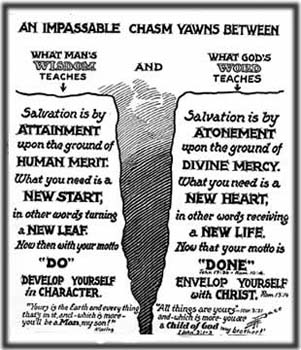
An Impassible Chasm

From EJ Pace, Christian Cartoons, 1922

Forster is deeply sympathetic to the cultural claims of conservative evangelical Protestants.  Though he would likely dispute the label, he writes about what I call Fundamentalist America from deep inside its boundaries.  He works and has worked for a variety of conservative foundations, including the Kern Family Foundation and the Friedman Foundation for Educational Choice.  He has written about the Joy of Calvinism and argued in favor of the marketization of schooling.

In this series, he asserts that evangelical political activism has been a force for good throughout the twentieth century.  “Good citizens,” he notes,
“don’t stand by while their nation is threatened, and evangelical political activity has accomplished much good. Although the rising tide of moral disorder has not been reversed, its progress has been halted in many respects, and forces of renewal are gathering. All of this was made possible largely by evangelical efforts.”

But Forster does not simply present the History of Heroic Fundamentalists.  He takes conservative evangelicals to task for misunderstanding the implications of the Great Schism, the split among Protestants around the turn of the twentieth century between “modernists” and “fundamentalists.”  In Forster’s words:

“Before the schism, America had a longstanding social consensus on how to reconcile religious freedom with public morals: the state would legislate based on the moral consensus of society, but keep its hands off directly confessional issues and try to steer clear of inhibiting diverse religious exercise. Meanwhile, beyond the bounds of state power, America’s leading institutions would be predominantly defined by and loyal to the Protestant view of the world. This strong yet informal Protestant cultural authority would keep the citizenry moral, so the coercive power of the state could be mostly kept out of moral formation in the interests of religious freedom.

“The Protestant schism was the decisive factor that ended the old social order. To be sure, a variety of other factors were already weakening it; for example, the injustices imposed upon Catholics and Jews were becoming steadily harder to ignore. However, the schism destroyed the framework of the social order from within. Protestantism could no longer serve as a moral center of society once no one could say with any confidence what “Protestantism” was.

“But evangelical leaders misunderstood the nature of the threat. They didn’t seem to grasp that the schism had destroyed America’s Protestant cultural consensus. They spoke and acted as though it was still basically sound in the country at large, and was only being challenged by a cabal of liberal secularists who were hijacking America’s culturally leading institutions (especially denominational bodies and universities). In short, they thought of the crisis more in terms of apostasy by a relatively narrow set of leaders than a true schism of the church.

“Because of this misunderstanding, evangelicals turned to politics as a tool for mobilizing social power and cultural influence to wage their battle against the liberal secularists. They expected that politics would give them the power they needed, because elections are based on majority rule and America was still basically a Protestant country.”

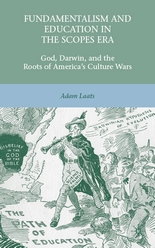
Forster’s analysis fits.  In some key “fundamentalist” political battles, conservatives hoped to mobilize the power of the state to support their cultural power.  As I argue in my book Fundamentalism and Education in the Scopes Era, (coming soon in paperback, pre-order now!) 1920s fundamentalists were successful when they mobilized a broad spectrum of Protestant support.  They were less so when they fought against liberal Protestantism.  So, for instance, when they disputed the teaching of evolution in public schools, liberals successfully castigated them as hillbillies and anti-intellectuals.  But when they pressed for laws mandating Bible reading in public schools, they met far less resistance.

I’m looking forward to the rest of Forster’s series.

In the News: Tennessee Two-Step

Tennessee’s lawmakers recently passed a law that—according to supporters—will allow teachers to work with more academic freedom.  It will encourage students, supporters insist, to explore ideas beyond the surface.  Opponents argue that the new law is only a sneak-attack by creationists and intelligent designers.  The law speaks in the language of academic freedom, opponents say, only to mask its true creationist intent.

The law itself claims to want to “help students develop critical thinking skills.”  Since the teaching of “some scientific subjects, including, but not limited to, biological evolution, the chemical origins of life, global warming, and human cloning, can cause controversy,” the law asserts that Tennessee teachers need clarification and assistance in teaching such issues.  The law mandates that school districts allow and encourage teachers to teach such controversial issues.  The law states that “teachers shall be permitted to help students understand, analyze, critique, and review in an objective manner the scientific strengths and scientific weaknesses of existing scientific theories.”  Finally, the new law notes that this law “shall not be construed to promote any religious or non-religious doctrine.”

In presenting the issue as one of academic freedom, Tennessee lawmakers apparently hope to overcome constitutional objections that have overwhelmed other anti-evolution laws.  The inspiration seems to have come from the Discovery Institute, a think tank dedicated to promoting the teaching of intelligent design.  In 2007, the Discovery Institute offered a similar-sounding model Academic Freedom bill.

Tennessee is not the first state to enact such a law.  In 2008 Louisiana lawmakers passed a similar “academic freedom” law.  Even earlier, in 2001, then-Senator Rick Santorum inserted a non-binding note into the No Child Left Behind Act that recommended teaching a full range of ideas whenever “controversial issues” were taught.

The Tennessee law has attracted more than its share of journalistic attention because of the easy connection to the 1925 Scopes trial.  The editors of the New York Times, for example, began their objection to the Tennessee law by intoning, “Eighty-seven years after Tennessee was nationally embarrassed for criminally prosecuting the teaching of evolution, the state government is at it again.”

Nearly all the news coverage of the new law insists on connecting it to the famous 1925 trial.  Coverage in USA Today and the Huffington Post offer a sample of the way every journalist seems obliged to mention Scopes.

However, as perspicacious observers have noted, this new law represents something very different from the 1925 event.  Today’s laws demonstrate a remarkable shift in the strategy and nature of anti-evolution activism.  As Charles Haynes of the First Amendment Center pointed out, today “the curriculum shoe is on the other foot.”

Haynes is right.  The power in public schools has shifted decisively.  Anti-evolution activists today do not try to ban evolution from public schools.  Rather, anti-evolutionists these days struggle to insert wedges into school curricula.  They hope to create opportunities for teachers and students to question the scientific claims of evolution.  At the time of the Scopes trial in 1925, anti-evolutionists had a much different agenda.

In my book Fundamentalism and Education in the Scopes Era, (coming soon in paperback edition, pre-order today!), I explore the ways so-called “anti-evolution” laws in the 1920s included much more than simply the teaching of evolution or creation.  The laws themselves, including Tennessee’s 1925 Butler Act, usually preserved a special role for Protestant theology in public schools.  Other bills considered “anti-evolution” made much more sweeping claims.  In 1924, Representative John W. Summers of Washington successfully inserted an amendment banning “disrespect of the Holy Bible” among Washington D.C. teachers.  In a similar vein, one so-called anti-evolution bill in North Carolina (1927) actually would have banned any teaching that would “contradict the fundamental truth of the Holy Bible.”  A proposed bill in West Virginia cut an even broader swath.  That bill would have banned the teaching of “any nefarious matter in our public schools.”  In Florida, a 1927 bill hoped to prohibit teaching and textbooks that promoted “any theory that denies the existence of God, that denies the divine creation of man, or that teaches atheism or infidelity, or that contains vulgar, obscene, or indecent matter.”

These bills were about more than just prohibiting evolution. They asserted ideological and theological control over public schools.  Public schools, in the vision of these bill’s supporters, ought to do more than just ban evolution.  They ought to be purged of any notion that might challenge the traditional evangelical morality of students.
Today’s laws are also about more than the teaching of evolution, but in a very different way.  Rick Santorum’s non-binding rider to NCLB was more about making a statement about the nature of science, culture, and education than about transforming education.  It didn’t and couldn’t actually change the way teaching happened.  Some observers have suggested that Tennessee’s law will also not change a thing.

But such laws do change something.  For one thing, laws like the ones in Tennessee and Louisiana demonstrate the political power of anti-evolutionism.  These laws show that significant numbers of voters in those states agree with this kind of cultural statement against the claims of mainstream science.  Laws like these also tell us something about the ways schooling is controlled.  If mainstream scientists cannot simply decide what will be the best sort of science education, then we can see that schooling is not simply a neutral institution in which knowledge is disseminated.  Rather, laws like this show clearly that knowledge is political.  Schools do not simply teach what is true.  Schools teach what culture decides children should know.

Science and “The Question”

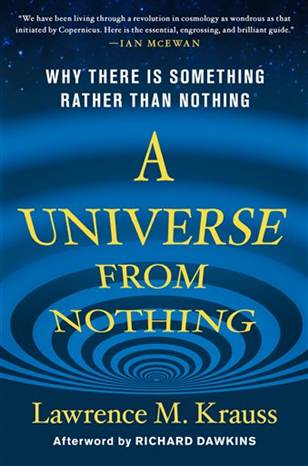
In a recent scathing review of Lawrence Krauss’ A Universe from Nothing, science writer John Horgan argues that science will never answer “The Question.”  That is, Horgan thinks that science–the way we usually understand science–will not be able to explain why there is something rather than nothing.

For those following the creation/evolution debates, “the Question” has long been a central bone of contention between creationists and evolutionists.  Creationists have always rested their arguments on the notion that science could not explain the fundamental creation of life ex nihilo.

As Horgan insists, one does not have to be a fundamentalist anti-evolutionist to doubt the ability of science to answer such fundamental questions.  In fact, Horgan concludes his review by warning scientists that they must not overextend.  If mainstream scientists claim to be able to answer “The Question,” Horgan warns, “they become the mirror images of the religious fundamentalists they despise.”

I imagine many of those fundamentalists will take solace from the fact that prominent scientists dispute Krauss’ ex nihilo argument.  There is a vibrant tradition among anti-evolutionists of following evolution debates among scientists.  Anti-evolution writers and activists have always used such debates to demonstrate to their audiences that scientists do not agree on the science of evolution.  As Ronald L. Numbers demonstrated in Darwin Comes to America and The Creationists, anti-evolutionists have long celebrated disagreements among mainstream scientists.  My hunch is that some pundits from Fundamentalist America will cite anti-Krauss arguments as evidence that science will never be able to answer “The Question.”

Traditionalist Teaching for Progressive Teachers? Lisa Delpit and Fundamentalism in Black and White

Fundamentalists don’t like progressive education.  They may not realize that they have some potential allies deep in the heart of the academic education establishment.

What do fundamentalists mean when they fight against “progressive education?”  For one thing, fundamentalists tend to pooh-pooh reading instruction that allows children to ‘discover’ reading on their own.  And they dismiss the notion that classroom teachers should put authority in the hands of students.  Also, fundamentalists often look askance at education professors who advocate soft-heading, child-centered classroom teaching that fails to deliver basic information and academic skills.

Generally, fundamentalists make these complaints from outside of the academy.  Some historians and other prominent academics—folks such as Arthur BestorRobert Hutchins,  or Arthur Schlesinger, Jr.—have critiqued the claims of progressive education, but most of the effective critics have worked outside of higher education.  But in the past generation, at least one prominent academic educator has critiqued “advocates of any progressive movement” who fail to consider the opinions of those “who may not share their enthusiasm about so-called new, liberal, or progressive ideas.”  The work of this world-famous educational activist is read at every school of education, especially ones in which teachers are trained to use progressive teaching methods.

Then why does she talk this way?  Because she framed the issue not as traditional and progressive, but as black and white.  Her name is Lisa Delpit, and her traditionalist critique of progressive education did not lead to her exclusion from the education academy.  On the contrary, she has received some of the academy’s most prestigious awards for her work, including a MacArthur “Genius” award in 1990 and Harvard Graduate School of Education’s Outstanding Contribution to Education award in 1993.

To be clear, Delpit demonstrated considerable differences from many other traditionalist education activists.  For example, she backs a multicultural approach to education, most conservative traditionalists do not.  (See the ILYBYGTH discussion of traditionalist critiques of multicultural education here, here and here.)  She supports reading in depth and excoriates rote instruction.

But she also pushes a traditionalist ideology of teaching.  She offers withering criticisms of progressive teachers’ justifications.  In one career-making speech and article from the late 1980s, Delpit castigated progressive educators for their misplaced softness toward students.  She cited with approval one African American classroom teacher who described her anger at white progressive teachers as “a cancer, a sore.”  This teacher had stopped arguing against progressive methods.  Instead, she “shut them [white progressive teachers and administrators] out.  I go back to my own little cubby, my classroom, and I try to teach the way I know will work, no matter what those folk say.”  Delpit suggested that a direct-instruction model matched more closely the cultural background of most African American students.  In one model Delpit described favorably, the teacher is the authority.  The goal is to teach reading via “direct instruction of phonics generalizations and blending.”  The teacher keeps students’ attention by asking a series of questions, by eye contact, and by eliciting scripted group responses from the students.  Such traditionalist pedagogy, Delpit noted, elicited howls of protest from “liberal educators.”

In a sentence that could come straight from such conservative traditionalist leaders as Bill Bennett or Max Rafferty, Delpit supported the notion of many African American educators that “many of the ‘progressive’ educational strategies imposed by liberals upon Black and poor children could only be based on a desire to ensure that the liberals’ children get sole access to the dwindling pool of American jobs.”

In another critique, Delpit argued that white, middle-class teachers hid their classroom authority in ways that were confusing to poor and African American students.  Teachers of all backgrounds, Delpit suggested, need to be more explicit about their power and authority in the classroom.  A good teacher, Delpit noted, was seen as both “fun” and “mean” by one African American student.  Such a teacher, Delpit’s interviewee argued, “made us learn. . . . she was in charge of that class and she didn’t let anyone run her.”

More important for fundamentalist activists, Delpit’s voice is not alone.  A call for traditional pedagogy and schooling seems to be gaining adherents among African American parents and educators.  We could look at the deep traditionalism of such prominent schools as the New York Success Academy Charter Schools.  Or we could probe the attitudes of those who run KIPP (Knowledge Is Power Program) Schools, which tend to serve significant numbers of African American students.  In a recent article about school “paddling” in USA Today, one African American school administrator confirmed that she believed in spanking “because I’m from the old school.”

The numbers indicate African American students tend to receive corporal punishment more often than students of other racial backgrounds, but don’t indicate the level of support for such punishment among African American teachers as opposed to teachers of other races.  There are some indications that African American parents tend to use corporal punishment more often than other groups.  This would support Delpit’s assertion that many African American students have different cultural expectations from other students when they get to school.  But the same study asserts that a huge majority of parents of other groups also use corporal punishment at home.  And, indeed, there is a lot of support for corporal punishment at school among white conservative activists.  But such support generally comes as part of a broader traditionalist, anti-progressive ideology of schooling.

Delpit’s argument is different.  She argues for traditional authoritarian teachers within a progressive, multicultural educational system.

What does this mean?  I’ve got a couple of reflections, and I’d welcome more.

For one thing, it tells us something about the current state of education scholarship.  Seen optimistically, we might conclude that the popularity of Delpit’s work proves that education scholars are willing to embrace a true diversity of opinion.  That is, education scholars might not be the petty intellectual tyrants some traditionalists accuse them of being.  To cite just one example, arch-traditionalist Max Rafferty in 1968 accused the “education bureaucrats” of only speaking to regular people “with that air of insufferable condescension.”  Such “educationists,” Rafferty charged, only listened to one another; they only hoped to turn America’s schools into something approaching a “well-run ant hill, beehive or Hitlerian dictatorship.”  Delpit’s example of progressive traditionalism might suggest that education scholars are more open to dissent than Rafferty and others have consistently charged.

In a less rosy light, though, we might conclude that this is yet another example of the ways the mainstream academy is hamstrung over racial ideology.  We might wonder if Delpit’s ideas would be welcomed as fervently if education scholars weren’t so terrified of being considered racially insensitive.  It helps, of course, that Delpit is a wonderful writer and powerful polemicist.  But it is hard to ignore the question: How warmly would a scholar be welcomed who trashed the idea of progressive pedagogy in general?  Not just for one group of students, but for students and schools in general?

One other point jumps out at us: we apparently need to be more careful when we talk about traditionalist education.  I’ll plead guilty.  I am most interested in those traditionalists who act out of what we can fairly call a conservative impulse to transform American schools and society.  Folks like Rousas Rushdoony, Max Rafferty, Sam Blumenfeld, Mel and Norma Gabler.  Groups like the Daughters of the American Revolution and the American Legion.  Activists from these groups have long believed that teaching must be made more traditional so that American society itself can reclaim some of its lost glory.  But there are traditionalists like Delpit who hope that schools will transform school and society in a vastly different way.

Perhaps we need to treat “educational traditionalism” the way we treat “evangelicalism.”  A lot of folks, scholars and normal people alike, tend to treat “evangelicalism” as if it were the sole domain of white, conservative folks such as Billy Graham and Jerry Falwell.  But religious historians are also interested in other forms of evangelicalism.  There have always been leftist evangelicals, for instance, as Raymond Haberski has recently noted.  And, of course, there has always been a strong evangelical tradition among African Americans.

Perhaps the most important notion to think about here is that we have more than one kind of educational traditionalism.  Bashing progressive education has long been the national pastime of educational conservatives.  For the last twenty-five years or so, such conservatives have been joined by an influential cadre of mainstream education scholars.

Further reading: Lisa Delpit, “The Silenced Dialogue: Power and Pedagogy in Educating Other People’s Children,” Harvard Educational Review 58 (Fall 1988): 280-199; Delpit, (1986). Skills and other dilemmas of a progressive black educator. Harvard Educational Review, 56(4), 379-386; Delpit, Lisa. (1995). Other People’s Children: Cultural conflict in the classroom. New York, NY: The New Press; Delpit, L & Perry, T. (1998). The Real Ebonics Debate: Power, Language, and the Education of African-American Children (Eds.). Boston, MA: Beacon Press; Delpit, L. & Dowdy, J. K. (2002). The Skin That we Speak: Thoughts on language and culture in the classroom (Eds.). New York, NY: The New Press; Delpit, L. D. (2012). Multiplication is for White People: Raising expectations for other people’s children. New York:The New Press.

FROM THE ARCHIVES: Bible in America: Bibles to the Backwoods

A few years back I stumbled across a remarkable Bible campaign.  Beginning in 1921 and continuing throughout the twentieth century, Bible evangelists based at Chicago’s Moody Bible Institute delivered Bibles, New Testaments, and tracts to underserved regions.  This campaign, which began as part of the Bible Institute Colportage Association and eventually became part of the Moody Literature Mission, delivered millions of Bibles and religious literature to the Southern Appalachian region, as well as the Ozarks, western logging camps, Louisianan Catholic schools, prisons, hospitals, and other venues in which missionaries thought people were hungry for the Word. 

            At the time, I focused my study on the missionaries’ use of Appalachian public schools as a distribution network for this religious literature.  I published some of my findings in an academic journal [“The Quiet Crusade: The Moody Bible Institute’s Outreach to Public Schools and the Mainstreaming of Appalachia, 1921-1966,” Church History 75:3 (September 2006): 565-593.]

            Looking over my notes as I thought about the meanings of the Bible in Fundamentalist America, I came across my collection from this research.  As usual, there was a lot more material than what I could use in the article. 

            This will be the last of these collected posts from BICA and MBI. See other posts from this series HERE and HERE.  Most of the material is available at the Moody Bible Institute in downtown Chicago.  The people there were very accommodating and friendly on my visits, and the archive is certainly worth a visit if you’re in the area. 

            I won’t argue that these materials somehow capture any single essence of fundamentalist attitudes about the power of the Bible.  That would be far too simplistic.  But I do believe that the attitudes toward the Bible expressed in these materials give a window into a commonly held fundamentalist vision of the nature of Holy Scripture.  As we’ll see, the Bible missionaries from Chicago believed the Word had a unique power.  The Gospels, to them—and, I argue, to many fundamentalists in the 1920s and since—meant more than just a collection of edifying religious messages.  As we’ll see, many of these Bible missionaries held a fundamentalist belief in the saving power of this powerful text. 

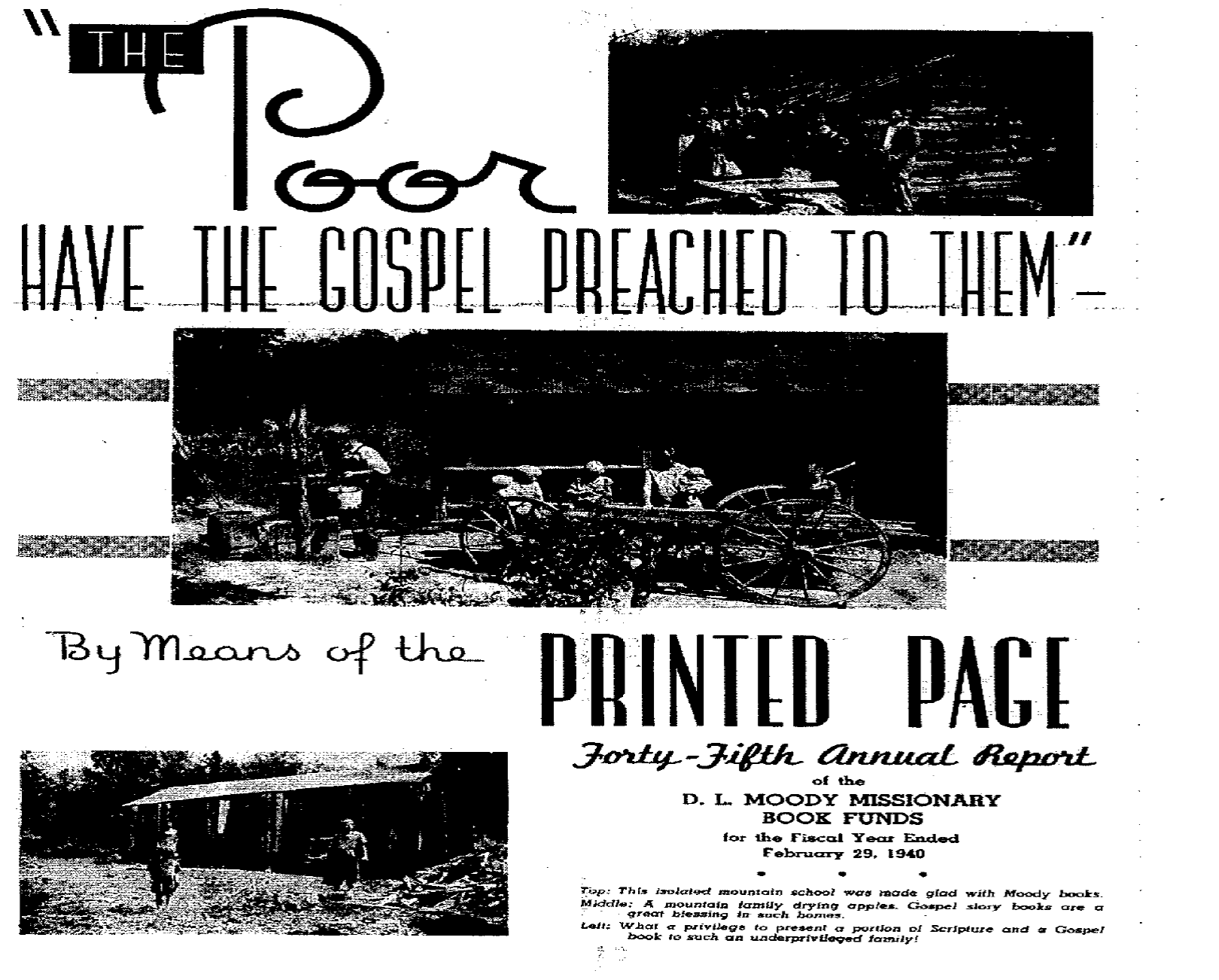
The inspiration for the Moody Bible Institute missionaries to deliver Bibles to the Southern Appalachian region came from the apparent lack of reading material of all kinds in the region.  In the 1920s, ‘30s, and ‘40s, the Chicago missionaries saw the “mountaineers” as particularly ready for literature outreach.  The reasons to send Bibles instead of humans were many.  First of all, Bibles were cheaper and easier to crate and ship.  Second, the Bible had a supernatural power to convert.  As one missionary proclaimed in 1921, the Gospels formed “the most unique, the most startling, the most compelling, and most unearthly message that has ever commanded God’s attention.”  No matter how talented a human missionary, he or she could not hope to compare with the words of the Gospel itself.  But another reason why Bibles made good missionaries was because the people of the region desperately wanted reading material of any kind.  Folks starved for reading material, the argument went, would eagerly read the Bible if only they could get one.  And by reading the Bible, they would be convinced by its supernatural power; they would embrace Fundamentalist Protestantism.  As one fundraising brochure from 1940 called it, this crusade could preach the gospel to the poor by using the “printed page.”

Many children from the region craved book ownership, it seemed, much more than they craved enlightenment.  Many of the Chicago book missionaries capitalized on that notion to satisfy young people’s lust for books with a healthy desire for the Gospel.  This picture of children in front of their log school was meant to show children’s appreciation for the Gospel.  It also shows, though, how much young people liked to have a book of their own.

These images from the Moody Bible Institute’s outreach tell us something about fundamentalist attitudes toward the Bible.  For many people, especially those without access to many books, the Bible served as both a religious text and a status symbol.  Both the Appalachian schoolkids and the Chicago Bible missionaries accepted this premise.  The Chicago missionaries played up this appeal by instituting a traditional Sunday-school Gospel-memorization strategy.  If schoolkids memorized a certain number of Bible passages, the missionaries would reward them with a Bible of their own.  Missionaries saw the lust for Bibles as a healthy desire for spiritual uplift.  Some of the schoolkids eagerly participated in the memorization program merely out of their desire to own books of their own.  They conflated their desire for ownership with their desire for salvation.

Also, this campaign shows us how evangelical Protestant missionaries in the early twentieth century tended to present their targets as different from themselves.  The missionaries may have been well-to-do—or at least middle-class—urban, Northern whites.  The folks they hoped to reach with their Bible outreach were consistently presented as something else.  Here, that other-ness was the “mountain” aspect of Appalachian life.  The little kids with their tiny log school, the farmers with their ancient wagon technology, or even simply the description of targeted populations as “The Poor,” all of these markers separated the missionaries themselves from those they hoped to reach.  As we’ve seen, by the middle of the twentieth century these Fundamentalist Protestant Bible missionaries had shifted their understanding of their targets.  Instead of consistently distancing their targets from themselves, by the mid-1940s these Bible missionaries presented their targets as white middle-class urban and suburban people.  This shift in Bible outreach tells us a great deal about the changing nature of Fundamentalist America in the twentieth century.  These Bible missionaries came to see themselves as reaching out in their own neighborhoods, to people like themselves. They no longer assumed that the only ones in need of soul-saving work were in far-away locations with exotic cultures.  Fundamentalist America came to see itself as working close to home.


The Bible in America: How the Bible Works

A lot of people don’t get it.  Why does it matter so much in Fundamentalist America what the Bible says?  After all, the Bible, for a lot of people, is just one collection of ancient writings.  Richard Dawkins concluded his Blind Watchmaker, for example, by calling “the Genesis story . . . just the one that happened to have been adopted by one particular tribe of Middle Eastern herders.”  Dawkins has not been the first to make such accusations.  In the 1920s, sociologist Harry E. Barnes derided the Bible as merely “the product of the folkways and mores of the primitive Hebrews. . . and the personal views of religious reformers of all grades from Jesus to Paul.”  It doesn’t make sense to non-fundamentalists to base social policy or even personal ethics on this collection of cranky commandments from ancient sheep-herders.  Deuteronomy just doesn’t fit with today’s lifestyle, some think.
Those hoping to make some sense of the ways Fundamentalist America understands the Bible should take some time with a newish book, Brian Malley’s How the Bible Works.   It is not an attack or expose of fundamentalist foibles.  Rather, it is an ethnographic study of one evangelical community, “Creekside Baptist.”  It is a thoughtful and deeply sympathetic attempt to understand what one group of conservative evangelical Protestants mean when they say “Bible.”  Malley himself is the product of a conservative evangelical Protestant upbringing.  ILYBYGTH readers will likely appreciate his perspective.  He is not out to demonize or lionize the folks he studies.  Rather, he conducted a series of interviews and probed the complicated questions lying at the heart of many conservative Protestants about the Bible and their faith.

In the first section of the book, Malley asks his informants to help him understand labels.  Perhaps most interesting for ILYBYGTH readers, he asks then to explain how they felt about “fundamentalist.”  Here is a taste of some responses:

“the word has gotten such a bad rap, but yes [I consider myself fundamentalist.]  Not in the sense that you hear in the news.  Basically I view those words as being interchangeable—evangelical and fundamentalist.”

Several interviewees said they felt fundamentalist, but that the term had a negative connotation.  For example, in the words of one “middle-aged man”:

“That [‘fundamentalist’] has a more negative connotation to me.  I think of it as a person.  ‘Fundamentalist’ to me today means more of a judging person that has a whole series of rules that they follow and I don’t think that’s right.  I’m not on the other end of the spectrum either, a wild liberal person either.  I guess I don’t live primarily by rules but by principles.  The principles come from the Bible.  But I don’t see myself as what I hear people describing fundamentalist as today.”

Another interviewee, “Stan,” said,

“I don’t like the term because of the connotations that it has.”

            Brian: “Which ones specifically?”

            Stan: “Connotations being I think that if you said that in this country, a fundamentalist would be considered kind of a far-right-wing wacko, and is a way extreme almost to the point of being non-Christian, something other than Christian.  Probably in its true identity, the definition of the word is you believe the fundamentals of Christianity, the basics of Christianity, that term would apply.  But that definition doesn’t apply anymore in this country.”

One young man, “Todd,” offered this explanation:

“Again, ‘fundamentalist’ is another term which I fear has been misunderstood and caricatured and stereotyped widely across modern American culture.  I’m not really familiar with what I consider properly called ‘fundamentalist culture.’  I know a bit of fundamentalist theology, but . . . I think properly understood, especially if you look at historical roots of fundamentalism, it gets down to what are fundamentals of the faith, and I think most fundamentalists and I agree what the fundamentals of the faith are, if you boil it down.”

For these conservative evangelical Protestants, “fundamentalism” had attracted a cluster of unfair meanings.  They generally agreed with what they understood to be fundamentalist theology, but they felt that fundamentalism as a whole had come to include all sorts of other meanings.

But Malley’s main interest in in the ways his respondents felt about the Bible.  Evangelicals, Malley argues, create a many-layered meaning around “Bible.”  One important part of this is what Malley calls “artifactual knowledge.”  Evangelicals know the Bible as a physical thing, a certain kind of book.  As he describes, this kind of knowledge is encouraged among evangelicals.  In the very youngest of children’s groups at Creekside Baptist, two-year-olds are taught to hold a Bible while they sing song such as “Pat the Bible” (to the tune of Did You Ever See a Lassie, or Wheels on the Bus, or Here We Go Round the Mulberry Bush, etc.).  In the words of one teacher of this two-year-old class, the youngsters should learn that the Bible is a special kind of book.  It is something to be cherished and valued.  It is not something to be treated like other books.

Another fascinating point Malley makes is that his respondents don’t think of the Bible as a certain translation of the original documents.  He held up two versions in some of his interviews, one in Greek and one in English.  He asked his interviewees which one they thought was “the” Bible.  Not only did the folks he talked with say they were both equally “Bible,” they thought the very question was nonsensical.  In other words, for this community at least, “The Bible” does not refer only to one specific translation.  Rather, it is understood to be a collection of texts that has been and will continue to be understood in a variety of languages, in a variety of translations.  Not only that, but folks at Creekside Baptist all agreed that the Bible did not actually have to be a printed book at all.  It could be put onto a website or CD.  It could be printed on enormous sheets or in a tiny pocket edition.  But it could NOT be made into a movie.  Movies could be made ABOUT the Bible, but they would not be the Bible itself.  The Bible was print, but it could be print in a variety of formats, languages, and translations.  As long as the text stayed true to the original meanings, any sort of text could be used to create an authentic Bible.

Malley also argues that his respondents have an interpretive Bible tradition, but not a hermeneutic one.  That is, evangelicals define their intellectual and theological world in large part as an interpretation of Biblical texts.  Scholarship and intellectualism mean, in large part, engaging in interpretation and citation of Biblical texts.  This results in the Bible-centered talk that non-evangelicals often find so baffling.  For example, evangelicals will explain their political opinions on topics such as gay marriage by offering Bible citations.  To evangelicals, those citations act as strong intellectual arguments.  If one can back up opinions on any topic with proper citations, one can carry the argument.  But evangelicals are not trained—outside of academic theologians—to engage in hermeneutic acts with and about their Bibles.  That is, Malley’s respondents did not feel a need to apply special interpretive skills to reading their Bibles.  Respondents consistently referred to reading their Bibles not as an act that required intellectual training, but as an act that required devotion.  The challenge was not to learn a set of keys to make sense of the Bible, but rather to learn an attitude toward reading.

Another topic Malley tangles with is the complex meanings of “literalism.”  Some folks outside of conservative Protestant circles misunderstand the notion of a literal interpretation of the Bible.  For Malley’s informants, as for most conservative Protestants, “literalism” does not mean that every word of the Bible must be taken as the literal truth.  In some places, the Bible clearly speaks figuratively, as when Jesus tells his audience they are the salt of the earth.  For Malley’s informants, the important aspect of literalism is a reading of the Bible that gives authority to the Bible itself.  Instead of taking freedom to interpret passages in ways that make the most sense to readers, the Bible must be read in ways that make the most sense in the context of the Bible itself.  Literalism, in this understanding, is more about authority than anything else.  If a passage was intended to be literal, it must be taken that way, even if that seems to contradict with the reader’s experience or desire.  Generally, when the Bible does not mean for itself to be taken literally, as in Jesus’ parables, it makes that abundantly clear.  Readers do not have the right to assume it is speaking symbolically when it does not clearly say that itself.

Malley points out that there are several layers of Biblical interpretation active at the same time in the evangelical world, broadly considered.  Among evangelical scholars, questions of authority and interpretation receive intense scrutiny.  But among the folks he talked to, there was much wider latitude for traditional, passed-along understandings of “Bible” and its meanings.  As Malley argues, “The evangelical tradition solves this problem by maintaining fairly rigorous standards of exegesis in its scholarship and quietly ignoring those standards in the churches.”

So, for example, Malley’s informants at Creekside Baptist could confidently assure Malley that the Bible was authoritative, even if they could not clearly explain what they meant by that when Malley pressed them.  As one way of testing this principle, Malley pressed people to explain why they regarded only some parts of the Bible as authoritative.  He asked, for example, what respondents thought about passages such as Romans 16:116, repeated in 1 Corinthians 16:20, 2 Corinthians 13:12, and 1 Thessalonians 5:26, in which Christians are instructed to “greet one another with a holy kiss.”  Malley interviewees acknowledged that the instruction was in the Bible.  They agreed that the Bible was authoritative.  And they acknowledged that they did not follow that particular instruction.  When pressed to explain the contradiction, respondents argued that such passages were “cultural” commands, meant to apply to people at the time, but not to them.  Or respondents shrugged.  The important point is that Biblical Christians did not feel this kind of apparent contradiction challenged the authority of the Bible, or their justification in considering the Bible authoritative in their lives.

For those living outside of the tradition of evangelical Protestantism, such apparent paradoxes can seem like proof that a Biblical worldview is non-sensical.  Malley doesn’t try to make that leap.  Rather, he is more interested in understanding and explaining how his respondents themselves understand this seeming contradiction.  He is more interested in exploring the fact that it does not appear to be much of a contradiction at all to them.

If outsiders hope to understand Fundamentalist America, this kind of intellectual stretching will help.  Malley’s study of one evangelical community can’t be taken to speak for all conservative Protestants, much less for the broad conservative coalition that makes up Fundamentalist America.  But his book is a good place for outsiders to start.  It will help people from outside the tradition make sense of the many meanings of “Bible” in Fundamentalist America.

FURTHER READING: Harry Elmer Barnes, “Sociology and Ethics: A Genetic View of the Theory of Conduct,” The Journal of Social Forces, III (January, 1925): 214; Brian Malley, How the Bible Works: An Anthropological Study of Evangelical Biblicism (Walnut Creek, CA: Altamira Press, 2004).