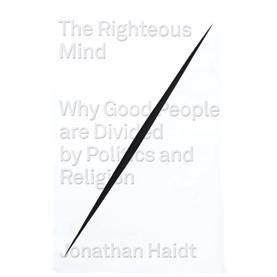
Required Reading: Are we all bigots now? Haidt’s Righteous Mind

Fundamentalists get called bigots a lot.  They don’t like it.  Since the 1920s, they have spent a lot of mental time and energy proving that they are, in fact, the side of openminded scientific inquiry.  For example, in the early 1920s fundamentalist intellectual Alfred Fairhurst complained that the teaching of evolution served mainly to close student minds.  “I am sure,” Fairhurst complained,

“that the teachers who would teach the subject are not fully prepared to present both sides as should be done when taught.  I believe that the teaching of evolution is mostly dogmatic, and that the result of teaching it is a new crop of dogmatists.  I am aware that there are those who hold that the subject of evolution greatly expands the mind.  I think that, as taught, it warps the mind and closes it against much truth.”

Generations later, in 1995, Duane Gish agreed that excluding creation science from public schools was nothing but “bigotry.”

Like the creationist activist Duane Gish, fundamentalists like to call their secular and liberal foes the true bigots.  As we have explored here at ILYBYGTH, fundamentalist activists such Bradley Johnson press the limits of fundamentalist free speech.  They provoke repression of their public religiosity in order to highlight the masked bigotry of hypocritical liberals.  Traditionalists point to foundational lefty intellectuals such as Herbert Marcuse as creeping totalitarians.  Marcuse and his minions, fundamentalists assert, are the ones who will not tolerate any disagreement.

I’m no fundamentalist, but I’ve seen this kind of anti-fundamentalist bigotry in action.  My academic research focuses on the history of fundamentalism.  While giving talks or discussing my research, I’ve often been surprised by both the viciousness and the ingenuousness of anti-fundamentalist bigotry.  I once had a very intelligent, well educated college student ask me how long it would take before religious people realized that religion was only for weak, ignorant people.  A colleague asked me once, regarding fundamentalists, “What’s wrong with these people?”  Another academic acquaintance suggested that the cure to the creation/evolution debate would be to “round up all the crazy white people” and force them to go through a rigorous de-theization education.  I like to think this last person was joking, but her comment elicited raucous cheers in the conference room.  All of these comments, fundamentalists would say with some justification, would never be tolerated about any other cultural group in our society.  Perhaps most egregious, the people making these comments tend to be almost entirely ignorant about fundamentalism.  They form their opinions based on vague stereotypes and in-group thinking, the very definition of bigotry.

So I sympathize with fundamentalist claims.  But I do agree there are limits.  I agree that fundamentalists often make these claims of victimization in order to promote a false moral equivalence between cultural sides.  For example, if we acknowledge the cultural legitimacy of creation science, do we give in to a strategic desire to muddle the issues in mainstream science and evolution?  (For an example of this debate, see the discussion at the US Intellectual History blog about the legitimacy of ILBYGTH’s fundamentalist-friendly forum.)

A new book casts a pox on all houses.  Psychologist Jonathan Haidt argues that most Americans decide first and come up with reasons later.  In The Righteous Mind: Why Good People Are Divided by Politics and Religion, Haidt describes his conclusions from over 130,000 online morality tests he and his colleagues delivered.  Their website, YourMorals.org, asks people an array of moral questions, from the mundane (Should teenagers listen to their parents’ advice?) to the bizarre (Is it morally acceptable to have sex with a dead chicken?).  For most people, Haidt argues, the moral answer is intuitive, not rational.  We do not start with principles and deduce the proper response.  Rather, we answer first and come up with justifications later.

If the nature of bigotry is to cling to irrational ideas demanded by ingroups and cultural cliques, then, according to Haidt, we’re all bigots now.  The moral answers we insist upon derive more from “groupishness” than from reason.

Not that both sides of America’s “culture wars” do everything the same way.  Haidt and his colleagues parsed morality into six fundamental notions: care, fairness, liberty, loyalty, authority, and sanctity.  Most Americans are deeply moved by the first three of these.  Liberals, however, tend to “care” more.  Conservatives tend to be more concerned with “fairness.”  According to Haidt—who self-identifies as a recovering partisan liberal—American conservatives do a better job with loyalty, authority, and sanctity.  Haidt disputes the notion that conservatives somehow trick voters into voting against their economic interests.  Rather, Haidt thinks conservatives simply do better at speaking to all six of the fundamental moral notions people really care about.

The most compelling part of Haidt’s book, for ILYBYGTH readers, is his conclusion about the closedmindedness of liberal America.  Haidt conducted a survey of 2,000 Americans, asking them to predict the moral choices of those with whom they disagree.  Self-identified “liberals” fared the worst at this game.  That is, respondents who called themselves “very liberal” ended up being the worst able to guess what fundamentalists cared about.  For outsiders—non-fundamentalists—who are trying to understand Fundamentalist America, this must serve as a sobering warning.  Simply because the worldview of liberal America treasures such notions as inclusiveness, tolerance, openmindedness, and rationality, doesn’t mean that we naturally apply such notions to fundamentalist ideas.  Rather, liberals—at least in Haidt’s research—tend to be the least able to understand where their cultural rivals are coming from.

Haidt hopes that true humility about the bigotry of our own moral impulses might lead to a softening of America’s culture wars.  He argues that one way to overcome our “groupishness” is to spend time engaged with the moral understandings of those with whom we disagree.  He has established one web forum to do just that.  At civilpolitics.org, he and his colleagues have listed ways to help Americans of different moral backgrounds to work together more calmly and productively.

Such anti-bigotry is the goal of ILYBTGTH as well.  Acknowledging the pre-rational roots of our strong moral feelings does not mean simply throwing up our hands and embracing moral relativity.  But making an honest effort to understand someone else’s moral universe can’t help but move us along the spectrum to a moral society we can all live with.
 

The Bible in Early America

Was early America Fundamentalist?  Fundamentalists like to say that it was.  Fundamentalists argue that America was always meant to be a Christian nation.  To pick just one recent example, Presidential hopeful Rick Santorum took some heat a couple of days ago for his presence at a fiery fundamentalist sermon in Baton Rouge.  According to the Huffington Post, Pastor Dennis Terry hit this theme pretty hard.  He told his audience,

“I don’t care what the liberals say, I don’t care what the naysayers say, this nation was founded as a Christian nation…There is only one God and his name is Jesus. I’m tired of people telling me that I can’t say those words.. Listen to me, If you don’t love America, If you don’t like the way we do things I have one thing to say – GET OUT. We don’t worship Buddha, we don’t worship Mohammad, we don’t worship Allah, we worship God, we worship God’s son Jesus Christ.”

This understanding of the Christian roots of American society is an article of faith among most fundamentalist Americans.  Among fundamentalists, no one has more credibility in this argument than David Barton.  Barton has built a career out of his historic vision.  For example, in a 2008 article Barton listed voluminous examples of religious quotations from leading founders.  Barton’s point here, as in most of his work, is that the roots of American society are profoundly Biblical.  Barton argues tirelessly that twentieth-century US Supreme Court rulings have erroneously erected an unconstitutional “wall of separation” between Christianity and public life.  Barton has attracted a large an influential audience in Fundamentalist America.  Journalists have oohed and aahed at the extent to which Barton’s work has drawn adoring praise among conservatives.  For example, one New York Times article noted that leading Republican presidential candidates such as Mike Huckabee, Newt Gingrich, and Michele Bachmann all extolled Barton’s work.  Huckabee called Barton “maybe the greatest living historian on the spiritual nature of America’s early days.”

Predictably, liberal criticsatheist activists,  and academic historians have vehemently disputed Barton’s work.

But careful historians agree that the influence of the Bible in early American public life was overwhelming, even if they qualify the meaning of “overwhelming” somewhat.  One of the most prominent twentieth-century historians of early America, Perry Miller, claimed in 1939 that “New England was founded as a Puritan commonwealth and was intended to be a holy and unique corner of the world.”  Later in his long career, Miller argued that this intense public religiosity lasted well into the nineteenth century.  In a 1955 article, Miller noted the rationalism of Jefferson and Franklin, but he said those beliefs were swamped in the late 1700s by intense Biblicism “among the masses.”  Even in the first years of the nineteenth century, Miller believed, the overwhelming majority of Americans understood their world through Biblical lenses.  “The Old Testament,” Miller noted, “is truly so omnipresent in the American culture of 1800 or 1820 that historians have as much difficulty taking cognizance of it as of the air people breathed.”

Since the time Miller wrote, new generations of academic historians have explored the religiosity of early New England and found room for a less strictly Biblical culture.  David Hall, for instance, wrote about the common phenomenon of “horse-shed” Christians.  Such folk, in the words of one early minister, were nominally Christian, but they preferred to spend their time on Sundays “between the [religious] Exercises . . . [to] Discourse of their Corn and Hay, and the prices of Commodities, of almost any thing that they discourse of on Working dayes.”  In other words, these horse-shedders were intensely religious in everything except theology.  They went to church, made the socially acceptable mumblings, but they didn’t take their religion very seriously.  I doubt any fundamentalist, whether in 1620 or 2020, would want to claim such folk as a basis for a truly Christian society.

According to Hall, even in these early decades of British settlement in New England—the period and locale in which the best case can be made for a thoroughly Biblical American culture—we need to understand the extent to which early Americans discounted the importance of the Bible in their daily lives.  Simply counting the percentage of people who went to church, then reading the sermons they listened to, can’t tell us if and how they really embraced that faith.  Just as important, Hall argued, was the great number of early New Englanders who focused their lives on commerce, and thought more of horse-sheds than of altars.

Even more compelling, as Hall notes, are the ways that early New Englanders used the Bible as one of the many religious influences in their lives.  For evidence, Hall analyzes the fascinating diary of Samuel Sewall.  Sewall had come to Boston as a child in 1661.  As an adult, he kept a careful record of his daily activities as well as his deeply religious mental world.  By today’s standards, Sewall would certainly qualify as a fundamentalist.  He and his family held daily Bible readings; Sewall sang psalms and prayed in his bedroom closet; and Sewall met with a small group of like-minded Christians for prayer sessions.  He attended church regularly and took careful notes of the sermons he heard.  According to Hall, the adult Sewall knew the Bible almost by heart, and he arranged his life by its precepts.  Nevertheless, Sewall’s religiosity was also formed by a vast array of less Christian portents.  He carefully noted lightning, rainbows, the birth of deformed children, eclipses, conjoined twins, and other omens from the natural world.  For Sewall, these were not rival religious events.  Rather, they formed part of his Puritan sacramental nature.  The Bible played a central role in his faith, but so did wonders and portents with roots in the nature religions of earlier European history.

To return to our question: Was Samuel Sewall part of a deeply Christian America?  Can we take his example as proof that early New Englanders understood their world Biblically?  And, if so, can we insist on more Bible in our current public life?  Among academic historians, the most careful recent exploration of these issues is John Fea’s Was America Founded as a Christian Nation?  In this book, Fea tries to overcome the simple yes-or-no answers that dominate public debate about the issue.  Fea, himself an evangelical Protestant who teaches at Messiah College in Pennsylvania, argues that in some senses, early America truly was a Christian nation.  For example, in its self-understanding compared to the Barbary States, the people of the United States tended to think of themselves as part of a Christian nation.  It was “Christian” as opposed to “Islamic” or “Buddhist.”  However, Fea notes that in some sections of the colonies and early united States, especially Virginia, Christian doctrine did not play a dominant role.  Furthermore, many of the most prominent Founding Fathers, such as Thomas Jefferson, could hardly be called Christian.

In the end, Fea offers a careful answer to his question.  “Many inhabitants of the early American Republic,” he writes, “but not all of them, lived in political communities where Christianity, and in most cases Protestantism, was such an important part of the culture that the framers of government thought it was necessary to sustain that culture by privileging Christianity.”  Like most academic historians, Fea insists that the most important part of any answer might be: It Depends.

So let’s return to our main question.  Are fundamentalists right?  Was America always meant to be an explicitly Christian society?  Did early European settlers and the Founding Fathers all agree on the importance of Biblical precepts in public life?  Finally, do secular folks today who object to public Christianity simply misunderstand American history?

Is it true?

First of all, it is important in these discussions to recognize the vast sweep of time that sometimes gets bundled together as “early America.”  Perry Miller (at least in part) and David Hall were writing about New England settlers in the early 1600s.  Fea generally focuses on the generation of the Founding Fathers, over a hundred years later and much more geographically diverse.  It is tempting to mix up the many “early” regions and time periods into an argument that early Americans were uniformly Biblical, or that early American culture was Biblical.  It is more accurate, however, to note the vast differences in time and place between Boston in 1620 and Philadelphia in 1780.

If we really want to understand the power and influence of the Bible in “early” American culture, we must repeat John Fea’s line: It Depends.  In some senses, early America really was founded on Biblical belief.  The dominant ideology of the generation that settled British New England in the early 1600s really was a Biblical theology.  We cannot hope to understand much about that culture without grounding it in an aggressively Biblical worldview.  Perhaps more important for understanding today’s Fundamentalist America, the cultural influence of that early settler culture in New England has punched above its weight for centuries.  Americans since at least the mid-nineteenth century have given a privileged place in historical memory to the first generations of “Pilgrims.”  Fundamentalists did not force this understanding upon an unwilling secular America.  Rather, this understanding is shared widely among Americans of all cultural backgrounds.  No matter where we live in America, young children are usually taught stories about the First Thanksgiving.  Children are taught that the first settlers came to America to escape religious persecution.  This is true even in areas in which a local history might logically trump the Squanto-and-Turkey story.  For example, young Americans in Florida could be taught that the first European Americans built a fort in what is now Florida.  They didn’t wear buckles on their hats and shoes, but rather those big conquistador-style helmets.  In other words, the true diversity of early European settlement in what is now the United States does not get its due in the stories American children learn.  Pride of place still goes to the kind of New England Mind that Perry Miller focused on.  It seems unfair to single out the historical memory of fundamentalists when it is still so widely shared among Americans of all beliefs.

In the end, from one angle, when Fundamentalist America insists that the US of A was founded as a Biblical society, they can make a reasonable claim.  There really was a thoroughly Biblical culture among the leadership in early New England.  And that particular story of the founding of America, no matter how ardently academic historians may try to point out the many other founding stories, still resonates powerfully among most twenty-first century Americans, Fundamentalist or not.

But we must also temper our enthusiasm for this historic vision by some important caveats.  Even among that first generation of New Englanders, the Bible was used in ways that twenty-first century Fundamentalist America would find disturbing.  Christians like Samuel Sewall freely mixed omens, portents, and wonders from the natural world into their Biblical worldview.  Furthermore, even among that particular group of New England “Puritans,” many of the nominal Christians were Christians of the “horse-shed” type, more interested in farming than salvation.

Also important, Puritans in New England made up only one small faction of British settlement in the New World.  Early settlers in Virginia, for example, didn’t care as much about the Bible or God’s vision for a Covenant Society.  Settlers came to Virginia primarily to make money.  As historian Edmund Morgan has argued, most of the backers of Virginia’s Jamestown colony “looked toward legitimate profits.”  They were not interested in establishing a Biblical commonwealth.  Instead, they asked themselves whether they should first look for gold, a water passage to the Pacific, or valuable plants.  The main concern, Morgan argued, was not a lack of Bibles, but a lack of labor.

For those outsiders who hope to understand Fundamentalist America, then, the most important lesson about the roots of a Biblical society is this: a twenty-first century Fundamentalist can state with absolute confidence that one root of today’s United States was thoroughly Biblical.  It’s true.  Academic historians will tell you that this is only true for some of the leaders of one part of British North America.  They will tell you that even among early New Englanders, commitment to the official theology was often lukewarm at best.  That is also true.  For our purposes, however, the fact that there are other roots to the United States complicates the story, but it doesn’t change the fact that Early America—in the way Fundamentalist America wants to understand it—really was a Biblical society.

FURTHER READING: John Fea, Was America Founded as a Christian Nation? (2011); Edmund Morgan, American Slavery, American Freedom (1975); Perry Miller, The New England Mind: The Seventeenth Century (1939); Miller, “The Garden of Eden and the Deacon’s Meadow,” American Heritage, December 1955, p. 55-61, 102; David Hall, Worlds of Wonder, Days of Judgment (1989)

Another Fundamentalist Mystery: Protestants and Rick Santorum

We asked recently why there seems to be so little anguish among conservative Protestants over the fact that there are no Protestants on today’s US Supreme Court.

The 2012 Republican Presidential primaries have raised a similar question: Why do today’s conservative Protestants seem to love the Catholic candidate Rick Santorum?

Political scientist Matthew Franck pondered this question this week.  Franck identifies as a conservative Catholic who has lived and taught for years in a region dominated by conservative evangelical Protestants.  Franck asks:

So what’s up with the victories of Rick Santorum, a western Pennsylvania Italian Catholic, in two states, Alabama and Mississippi, where upwards of four in five voters described themselves in exit polls as evangelical or “born-again” Christians?  Although the New York Times’ Bill Keller famously misidentified Santorum last year as an evangelical, these voters know better.  They knew going to the polls Tuesday that they could choose the LDS Mitt Romney, the Lutheran-turned-Baptist-turned-Catholic Newt Gingrich, or the lifelong Catholic Rick Santorum.

Franck notes the novelty of this situation:

The first observation to make about the role of religion in these two deep-south states, then, is that three non-evangelical candidates all did respectably well in a heavily evangelical (and conservative) electorate.  Each of the candidates topped 30 percent of the vote.  Just a half century ago, John F. Kennedy had to go to Houston to make a case to Baptist ministers that a Catholic deserved a shot at the presidency.  (Some Catholics, then and now, think JFK surrendered too much of his faith to mollify his critics.)  Only four years ago Mitt Romney felt similarly compelled to reassure voters that a member of the Church of Jesus Christ of Latter-day Saints deserved a fair chance as well.  Now in 2012, we seem past all that.

Just as many conservative Protestants care more about the politics of US Supreme Court justices, especially on social issues such as abortion, gay marriage, and the role of religion in the public square, Franck concludes that Protestant fundamentalists are judging the current crop of Republican Presidential contenders more on their positions than their faith backgrounds:

For better or worse, Santorum is widely known as the “social issues” conservative in this race, the consistent defender of life, of marriage and family, and (as he himself put it last night) of the “centrality of faith” in many Americans’ lives.  Look at how strongly he did among voters who think a candidate’s “moral character” matters most, and you get the picture.

If Franck is correct–and his conclusion makes intuitive sense to me–it tells us a lot about the changing nature of Fundamentalist America.  It seems to confirm James Davison Hunter’s 1992 thesis in Culture Wars.  In that book, Hunter argued that creed and denomination had come to mean less than the divide  between orthodoxy and progressivism.  That is, the old divisions between Catholic, Protestant, and Jew had eroded, replaced by a split between conservative and liberal factions within each faith.  Along with the deafening silence among conservative Protestants about the current makeup of the US Supreme Court, the non-issue of Santorum’s Catholic faith among conservative Protestants certainly seems to confirm Hunter’s argument.

RIP Paul Boyer

The sad news that Paul Boyer passed away reached ILYBYGTH offices yesterday.  Professor Boyer was a prolific and engaging cultural and intellectual historian whose work and personality had a huge impact on me as I started my graduate work in American History.  I was just arriving in Madison as Professor Boyer was planning his retirement, but I was lucky enough to meet him several times and he was always gracious enough to help me with my first dips into research and writing about American fundamentalism.

Professor Boyer was the author of several influential works, including Salem Possessed and By the Bomb’s Early Light.  The book that packed the most punch with me, however, was his When Time Shall Be No More (1992).  The book helped ground me in some of the basic cultural and intellectual presumptions of prophecy belief in American history.  More than that, Professor Boyer’s sympathetic outsider’s perspective on such Bible believers inspired me to follow in his footsteps.

My sincerest condolences to Professor Boyer’s family and many friends.

IN THE NEWS: Arizona Fights the Cult of Multiculturalism

In today’s New York Times, you’ll find an update on Arizona’s remarkable effort to purge its schools of what educational traditionalists might call “The Cult of Multiculturalism.”  We’ve written about traditionalist objections to multicultural ideology here, here, and here.  Arizona’s law makes these theoretic objections legally enforceable.

Today’s article focuses on the dispute between the state and the Tucson school district.  Since January 1st, the school district has been ordered to enforce Arizona’s 2010 law.  According to the Huffington Post, Judge Lewis Kowal agreed with the state in late December that Tucson’s Mexican-Studies curriculum was guilty of “actively presenting material in a biased, political and emotionally charged manner.”

The law itself, passed two years ago, declared that no school curricula in Arizona could legally

  • Promote the overthrow of the United States government.
  • Promote resentment toward a race or class of people.
  • Are designed primarily for pupils of a particular ethnic group.
  • Advocate ethnic solidarity instead of the treatment of pupils as individuals.

The state superintendent of education at the time, Tom Horne, planned an energetic enforcement of the law.  According to a Fox News story, Horne declared in 2010,

Traditionally, the American public school system has brought together students from different backgrounds and taught them to be Americans and to treat each other as individuals, and not on the basis of their ethnic backgrounds.  This is consistent with the fundamental American value that we are all individuals, not exemplars of whatever ethnic groups we were born into. Ethnic studies programs teach the opposite, and are designed to promote ethnic chauvinism.

In today’s New York Times story, John Huppenthal, the new state superintendent of public instruction, told a reporter he viewed the enforcement of the law as a war.  Quoth Huppenthal, “This is the eternal battle, the eternal battle of all time, the forces of collectivism against the forces of individuality.”

We can’t help but wonder what Arthur Schlesinger Jr. would make of this law.  In his 1998 book The Disuniting of America the eminent historian denounced the “cult of ethnicity [that] has arisen both among non-Anglo whites and among nonwhite minorities to denounce the goal of assimilation, to challenge the concept of ‘one people,’ and to protect, promote, and perpetuate separate ethnic and racial communities.”

But in Arizona’s case, the fight against the tendency of multicultural education to promote what Schlesinger called the “fragmentation, resegregation, and tribalization of American life” has included some ideologically extraneous elements and politically unpalatable images.

First of all, the law itself targets not only ethnic-studies classes, but includes a remarkably broad shot at any schooling that “promote[s] the overthrow of the United States government.”  This boilerplate antiradical language would feel entirely at home in earlier generations of legislative attempts to control schooling.  In the 1920s, for example, the bundle of state laws that were generally called “anti-evolution” actually had a much broader goal.  They hoped not only to ban evolution but to assert traditional Protestant control of public schooling.  As I argued in my book Fundamentalism and Education in the Scopes Era, school laws with these limitless mandates are more of a cultural statement than a practical attempt at crafting educational policy.

For example, a law passed by the US Congress in 1924 prohibited teachers in Washington DC from any teaching that smacked “of partisan politics, disrespect for the Holy Bible, or that ours is an inferior form of government.”  The goal was more a statement of support for traditional values than to regulate school policy.  Arizona’s inclusion of a clause banning anti-US-ism seems similarly vague and symbolic.

Also, as Arizona state superintendent of public instruction John Huppenthal made clear, this law is part of a broader political and cultural effort to battle not only multiculturalism, but any perceived victory by “the forces of collectivism.”  Not only does this bundle the Arizona law into a broader package of anti-leftist activism, but it also reflects the simple political partisanship behind Arizona’s efforts.

Part of the energy behind the 2010 law came from a perceived effort by Democratic activists to use ethnic-studies programs as a way to turn Latinos against the Republican Party.  One of the reasons for the law was Republican outrage about a speech at Tucson High School by activist Dolores Huerta in which she assured students, “Republicans Hate Latinos.”

Republican lawmakers have united behind this school law as more than a way to keep schools from teaching what Schlesinger denounced as the “cult of ethnicity.”  They also see the programs as part of a deliberate partisan effort to undermine their influence with Latino voters.

However, their efforts might do more to undermine that influence than any ethnic-studies programs ever could.  It doesn’t take a political genius to see the electoral damage that might result from the image of school administrators going into classrooms in Tucson collecting copies of seven prohibited books.  Such stormtrooper tactics to save children from the likes of Paolo Friere’s Pedagogy of the Oppressed  and F. Arturo Rosales’ Chicano! The History of the Mexican-American Civil Rights Movement spell political suicide.

I imagine that Schlesinger and others who oppose the ideological overreach of multiculturalist education might recoil from these heavy-handed partisan attempts to control Tucson’s schools.  Such critics of multiculturalism, I imagine, would hope that the effort to ban aggressive assertions of the “cult of ethnicity” must only limit itself to the realm of ideas, not to knee-jerk partisan politics and twenty-first century book burnings.

A Fundamentalist Mystery: Protestants and the Supreme Court

Why aren’t conservative Protestants more interested in the religious makeup of today’s US Supreme Court?  Today’s Court is made up of six Catholics (Scalia, Thomas, Roberts, Kennedy, Alito, Sotomayor) and three Jewish members (Breyer, Ginsburg, Kagan).  Fundamentalist Protestants are intensely interested in the Court, since it has turned into the government agency most closely associated with ultimate decisions about abortion, gay rights, and religion in the public square.  At nearly any other time in American history, the notion that once-dominant Protestantism wouldn’t even have a representative on the Court would have sparked ugly and angry denunciations of the Court’s legitimacy.  Today, I don’t hear much about it.  Just before the most recent new justice, Elena Kagan, was nominated, a Gallup poll asked respondents if they cared if the new judge was Protestant. Only 7% of respondents thought it was “essential.”  This indifference is puzzling.  Is it simply due to the fact that the cultural animosity between Protestants, Jews, and Catholics has been overcome by other cultural identities?  This was James Davison Hunter’s thesis in his 1992 book Culture Wars.  He argued that the differences between groups had diminished, in favor of a more important distinction between orthodox and progressive variants of each individual group.  One of contemporary evangelicalism’s premier evangelicals agreed.  In a 2010 article in the evangelical magazine Christianity Today, historian Mark Noll noted that evangelicals have given “intense” support to the nomination of conservative religious justices, even when those justices were Catholic.  More decidedly fundamentalist Protestant intellectuals agreed.  Mathew Staver, dean of the Liberty University law school, noted in the same CT article, “I don’t think a person’s religious affiliation matters as much as their judicial philosophy.”

It makes sense.  But anyone familiar with the bitter twentieth-century hostility of many conservative Protestants to Catholicism might find this explanation a little too pat.  Has it really dissipated to such a remarkable extent?  Are there other likely explanations for the deafening silence among America’s Protestant fundamentalists on this issue?

FROM THE ARCHIVES: The Bob Dylan Bible Apocalypse

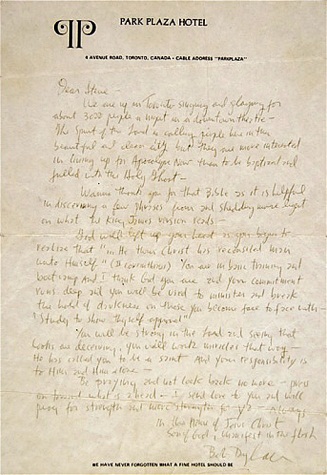
From the fantastic website Letters of Note ILYBYGTH recently dug up a missive by Bob Dylan dating from his Fundamentalist Phase.

In this April, 1980 letter, Dylan thanks his friend for a new Bible.  It’s not clear from the letter what edition the gift Bible was, but Dylan said the new edition helped him understand the King James Version.

Dylan wrote from Toronto.  His audiences, he said, heard the call of “the Spirit of the Lord,” but they were more interested in lining up to see Apocalypse Now than to be “baptized and filled with the Holy Ghost.”

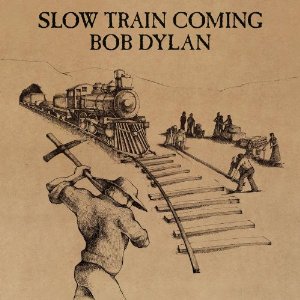
It’s news to me, but apparently any self-respecting Bob Dylan fan has long pondered the meaning of Dylan’s “Jesus Years.”  It seems between 1979 and roughly 1983, Dylan embraced evangelical Christianity and cranked out a few missionary albums, starting with “Slow Train Coming.”

The story goes something like this: in a drug-fueled crisis, with critics viciously panning his recent creative output, Dylan embraced the Word.  The meaning and sincerity of this period in Dylan’s life has been the subject of long debate among Dylan fans and other interested parties.  Some Jewish commentators have lamented Dylan’s apostasy.  Evangelicals have celebrated his recognition of their worldview.  But did he really mean it?  Some commentators conclude that Dylan blundered around his evangelical Christian faith just as he blundered through worlds of drugs and sex.  Others insist that Dylan later repudiated his Bible years as merely an unfortunate drug-fueled mistake.  Still others contend that Dylan represents the true power and healing grace of Biblical Christianity. 

A choppy documentary film about the “Jesus Years” seems only to have deepened the mystery and controversy.

Whatever fans and critics may conclude about the longevity of Dylan’s fundamentalism, this Toronto letter, at least, shows that for some stretch of time, Dylan talked the talk of evangelical Christianity.  His hopes for the Toronto crowds sound similar to those of any other fundamentalist preacher.

For ILYBYGTH readers, the meanings of Dylan’s fundamentalist years have different implications.  From one perspective, we can read Dylan’s conversion as an insight into the meanings of fundamentalist America.  When Dylan reached a late-1970s low, one of the preachers who understood his dark night of the soul, apparently, was Bill Dwyer of the evangelical Vineyard Fellowship.  At least according to documentary director Joel Gilbert, this Biblical outreach organization had become popular among the Southern California music scene, and Dylan fell into its outreach arm and embraced its apocalyptic message.

In this interpretation, the story demonstrates the often-surprising cultural power of fundamentalism.  Even in the midst of the famously Satanic rock-and-roll lifestyle, fundamentalism becomes a powerful cultural force.  Dylan and his associates were drawn to the inestimable power of Jesus’ saving grace.  It offered them a compelling personal, social, and cosmological message that made sense to them.  Fundamentalism, in this understanding, can hold its own among those most deeply immersed in the intensely hedonistic world of American celebrity.

Seen from another perspective, however, Dylan’s embrace of fundamentalist America can appear as nothing more than one drastic lifestyle choice at America’s all-you-can-take cultural buffet.  That is, Dylan clung briefly to fundamentalist Christianity just as he clung briefly to heroin, then later clung to fundamentalist Judaism.  Dylan chose Biblical Christianity, but other American celebrities fled from the intense despair of celebrity into the spiritual arms of yoga, veganism, Zen Buddhism, psychotherapy, or other anti-celebrity spiritual shelters.  In this reading, fundamentalist America is simply the rock to which a despairing Dylan clung.  It is not the bedrock of all American virtue, but rather just another option in an ultimately meaningless cultural panoply.  Dylan’s brief embrace of fundamentalist America only demonstrates, in this reading, the ways fundamentalism has lost its status as The One Truth.  Fundamentalism, in this reading, has become just another menu option for the spiritual thrill-seeker.

Whatever else it may mean, Dylan’s story can tell us something about the appeal of fundamentalist America to those outside its boundaries.  Whatever Dylan may have been experiencing as a crisis of the soul, when he reached out for the opposite, he found Bible-based evangelical Christianity.  To him­—and to generations of his fans and devotees—this kind of apocalyptic, Bible-based, aggressively proselytizing fundamentalist Christianity represented the opposite of everything he had stood for.  When his secular, hedonistic lifestyle led Dylan to an unsupportable personal crisis, he embraced fundamentalism as its shining opposite.

In the News: A Fundamentalist Epistemology?

The New York Times yesterday ran some excerpts from a discussion on its philosophy series, The Stone.

ILYBYGTH readers should check out the exchange, since it is one of the few recent forums in which the issue of creation/evolution is given a respectful, intelligent back-and-forth.  It also centers on the notions of a Biblical understanding of knowledge.

In this dialogue, philosopher Michael P. Lynch and physicist Alan Sokal discuss the reasons why there has been no simple cut-and-dried solution to the creation/evolution debates.  In this snippet, Lynch insists–correctly in my opinion–that the issue is not really the science of evolution, but rather the source of epistemic first principles.  That is, how do we come to know something?  Fundamentalists will insist that the first source of knowledge must be Holy Scripture.  If we “know” something that contradicts the Bible, we can’t really “know” it, any more than we can “know” that a dog is a cat.  The reason for the evolution/creation “stalemate,” Lynch argues, is that the arguments have simply circled round and round one another, each arguing convincingly from its own perspective.

In response, Sokal offers what seems to me to be a very concise and cogent explanation of the non-fundamentalist position.  Fundamentalists, he argues, DO share the epistemic principles of non-fundamentalists, except for a few irrationally privileged categories.  Here’s a snippet from Sokal:

The trouble is not that fundamentalist Christians reject our core epistemic principles; on the contrary, they accept them. The trouble is that they supplement the ordinary epistemic principles that we all adopt in everyday life — the ones that we would use, for instance, when serving on jury duty — with additional principles like “This particular book always tells the infallible truth.”

But then we have a right to inquire about the compatibility of this special epistemic principle with the other, general, epistemic principles that they and we share. Why this particular book? Especially, why this particular book in view of the overwhelming evidence collected by scholars (employing the general epistemic principles that we all share) that it was written many decades after the events it purports to describe, by people who not only were not eyewitnesses but who also lived in a different country and spoke a different language, who recorded stories that had been told and retold many times orally, and so on. Indeed, how can one possibly consider this particular book to be infallible, given the many internal contradictions within it?

Lynch responds with a defense that might hearten intellectual fundamentalists.  Here is just a small selection:

The second reason we can’t rest content with the fact that some principles are widely shared is that some debates are over the priority of principles. Some people reject the idea that scientific reasoning should always trump more traditional methods of knowledge. Thus, believers in creationism typically don’t deny induction and abduction (coming up with the best explanation of the data) full stop. Rather they deny that these principles have priority everywhere. Imagine, for example, a dispute over these two principles:

(A) Abduction from the fossil and physical record is the only method for knowing about the distant past.

(H) Consultation of the holy book is the best method for knowing about the distant past.

The friends of (H) aren’t rejecting abduction outright: they are merely asserting that in some situations abduction is trumped by the more fundamental principle (H). So we can’t just call them out for using abduction in some cases and not in others. And obviously, we can’t travel back in time and use observation (another commonly shared method) to settle who is right and who isn’t about the distant past. What that shows is that debates over even very specific principles like these can end up grounding out — either the participants will end up defending their favored principles by appealing to those very principles (citing the book to defend the book) or appealing to other specific principles that the other side shares but gives a lower priority. So shared “natural instincts” and methods can’t always win the day, simply because the problem isn’t always about what is in common. The problem is about what trumps what.

The root cause of the discussion is whether or not there is a distinctive fundamentalist epistemology.  Lynch defends the notion (without embracing or defending the claims of that epistemology), while Sokal dismisses it.  In other words, is the fundamentalist, Bible-centric understanding of human knowledge a legitimately different way of knowing about humanity and the universe?  Or is it simply an overly complicated apologetic?  That is, do fundamentalists merely claim to have a different way of knowing when it suits their theological needs?


The Bible in American Public Life

What does the Bible DO in America? What does it mean for fundamentalists to say that the Bible used to be—and ought to be again—“America’s Book?” Let’s start by taking a quick look at some stories from history and culture that help demonstrate the complicated role played by the Bible in American public life.

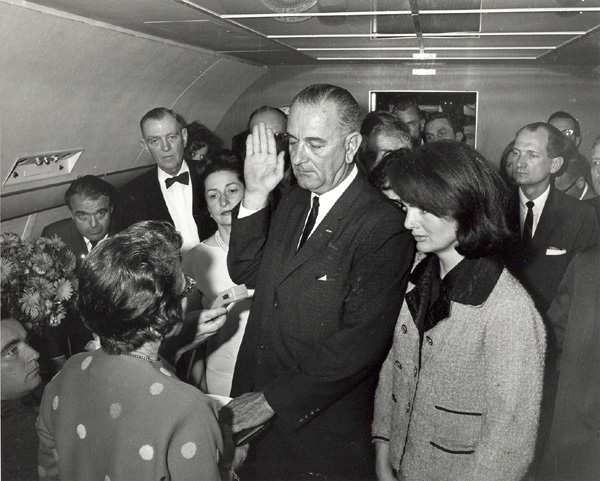
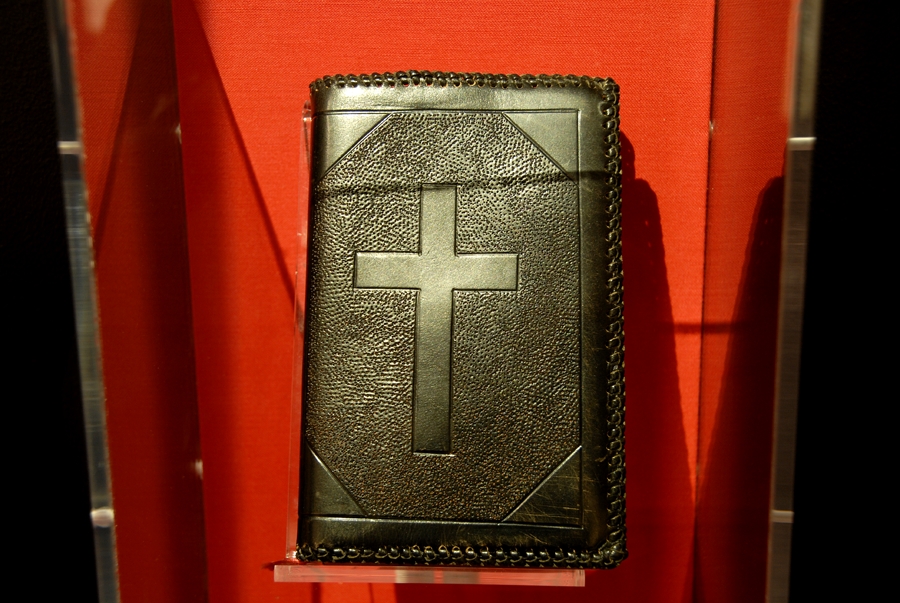
Story #1: November 22, 1963. With President Kennedy shot dead, the Secret Service scrambled to protect Vice President Lyndon Baines Johnson. He was hustled off to the airfield, riding low to keep his head down. Once Jacqueline Kennedy arrived, the swearing-in process went ahead on the overheated, overcrowded Air Force One. In order to make the inauguration official, a few things were required. They needed someone to perform the ceremony. LBJ tapped local judge and loyalist Sarah Hughes. They needed to record the ceremony for proof of its legitimacy. Someone found a Dictaphone that could serve in a pinch. And they needed a Bible. They searched the plane and found a Roman Catholic missal that had been a gift to the late President. It would do.

Story #2: Anywhere in America, anytime. Take a drive in any part of the country. Look at the road signs. If you’re lazy, just look at some maps. You can’t drive far without hitting a Bethel, or a Salem, or a Mt. Horeb, or any of a thousand more Biblical names.

But the question remains: so what? What does it mean that lots of people who founded towns often named them after Biblical places? What does it mean that in order for a President to be sworn in—even in desperate emergencies—people grabbed the Bible-est looking book they could find? Does this mean we live in a Biblical society? Or does it simply show that the Bible is a kind of inherited intellectual wallpaper for our culture?

Let’s take another look at our stories and see what we can deduce. First, what does it mean to have our physical landscape dotted with Bible-named towns? In the central New York region in which I live, these kinds of towns dominate the landscape. But they are not the only kinds of town names. Just a little north of me there is a cluster of towns named for ancient Greek places: Virgil, Ithaca, Marathon, Syracuse, and so on. One early settler, apparently, was a classics professor at Cornell and threw Greek names around. It doesn’t make the people who live there now any more Greek than living in “Manhattan” makes people Dutch or Algonquian.

Plus, it’s difficult to imagine many Americans these days really care about the Biblical roots of their landscape markers. In Wisconsin, for instance, Mt. Horeb is better known these days as the source of fancy mustard than as a descendant of the place where Moses received the Ten Commandments. Nevertheless, we must admit it tells us something about the Biblical nature of our public culture that so much of our landscape is identified this way. If place names are a jumble of history and culture, with places named for early settlers, for Indian names or mistaken interpretations of them, for strands from culture and religion…we must admit that the most common religious strand for these kinds of names is Biblical. If it doesn’t tell us much about life in Salem, or Bethel, or Mt. Horeb, it does tell us something about the cosmography of the first settlers of those towns. When they reached into their intellectual toolbox to find names for their muddy new towns, they found them in the Bible. Imagine, for instance, if those place names came from a different religious tradition. Instead of driving through Eden, Mt. Sinai, and Bethel, what if we drove through Singri, Bangalore, and Chitti? Of course, that would not make our culture Hindu any more than Biblical names makes it Biblical. But it DOES tell us something about the cultural and religious history of our landscape.

Fundamentalists might tell us that our culture is rooted in the Bible and Biblical place names are evidence of the deep organic roots of Biblicism in American culture. They might argue that the town founders of places like Mt. Horeb established themselves as the successors of Old Testament populations trembling in the felt presence of a Living God. Even if we disagree, I think it goes too far to dismiss the importance of the sacred history of our named landscape too blithely. Along with other important cultural roots, the Bible has stamped its cultural importance on our maps. It might not make the people living there Biblical, but it demonstrates at least that one of the wellsprings of American culture has long been the Bible.

But what about LBJ? Why does it matter that he was sworn in on a Catholic missal? As politico Larry O’Brien later remembered, the scene on Air Force One was chaotic. It was hot, overcrowded, somber, and anxious.

 There was a sense of trauma and threat. As the plan coalesced to inaugurate LBJ right then and there, aides scrambled to provide the officiating judge with a Bible. That, after all, had been the tradition. Though recent scholars and activists have insisted that Washington never really did so, (see comments below) most of the folks on Air Force One likely believed that Washington had added “So help me God” to the Oath of Office, then bent humbly to kiss the Bible.

Despite what later conspiracy theorists might claim, there is no Constitutional reason why LBJ—or any President—really needed a Bible to make the Oath official. The first President Roosevelt, for instance, did not use a Bible for his swearing-in, nor did John Quincy Adams. But as in so many things Presidential, tradition meant at least as much as Constitutionality.  Whether it began with Washington or only with Chester Arthur in 1881, the Kiss-the-Bible-So-Help-Me-God tradition has persisted through the twenty-first century.

So in order to make LBJ’s inauguration feel more official, more legitimate, the folks on Air Force One that November day felt they needed a Bible. But here’s the kicker: they didn’t use one. Instead, they found a Roman Catholic missal that President Kennedy had on board the plane. According to Larry O’Brien,  he assumed at the time that it was a Bible. After all, it had all the markings: a leather-y binding, a prominent cross on the cover.

So what does this mean for understanding the role of the Bible in Fundamentalist America? Like Biblical place names, it is a complicated story. First of all, it demonstrates the powerful symbolism of the Bible as America’s official book. To become President, it is traditional, though not required, to swear on a Bible, or even on two, as did Ike, Truman, and Nixon. So, in other words, when it comes to important, official acts, a Bible is the most prominent public book in America.

Consider other possibilities. The President might swear an oath on the Constitution. That, after all, is the document the new President is promising to defend. Nevertheless, in our tradition, when any promise is meant to be serious, it is sworn on a Bible, or even a stack of them. But when people on Air Force One found a Bible, it wasn’t actually a Bible at all. A missal is a collection of prayers connected to the Catholic sacred calendar. It is a religious book, to be sure, but not actually a Bible. Yet no one on Air Force One cared, or thought to check to make sure the book was an actual Bible. That tells us something about the role of the Bible in America’s cultural imagination. A Bible, for those folks on Air Force One, meant a religious book, a physically big book with a cross on the cover. They wanted, in other words, something that LOOKED like a Bible. It didn’t need to contain the actual words of the Bible to serve its purpose as an officializer of the inauguration. The Bible, in this context, is more of a symbol of a Bible than an actual collection of specific sacred scriptures.

This is not the way Fundamentalists think of the Bible. For Fundamentalists, the words of the Bible matter. The fact that Presidents take their oaths of office on a Bible may reassure Fundamentalist America that their Bible is (still) America’s official book. But for lots of other Americans, the Bible is just a symbol of a big, official-looking, historic-looking book. The words themselves don’t really matter. Presidents, in this view, are not swearing to enforce Biblical truths, but only following a quaint but harmless tradition in taking an oath on a Bible. This complicated double meaning of the Bible in public life will be the subject of the next few posts here at ILYBYGTH. At the very least, we agree that the Bible is not just another book for Americans. The Bible, like Biblical place names, has a unique role as part of the cultural wallpaper of American life. But not necessarily as the religious guidebook that Fundamentalists want it to be.

Required Reading: Louis Menand and the Left-Leaning Ivory Tower

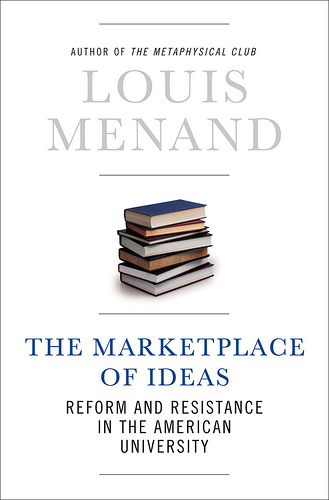
Louis Menand,  The Marketplace of Ideas: Reform and Resistance in the
American University.
  New York:  W.W. Norton, 2010.

Fundamentalists have long argued that America’s colleges and universities had been captured by a sinister left wing.  Now they have some evidence to back up their complaints.

Most often, those accusations branded mainstream American univeristies as hopelessly lost to pernicious non-fundamentalist ideas.  For example, Texas fundamentalist minister J. Frank Norris insisted in 1921 that the problem with America all started when some influential young Americans studied “in Chicago University where they got the forty-second echo of some beer-guzzling German Professor of Rationalism.”

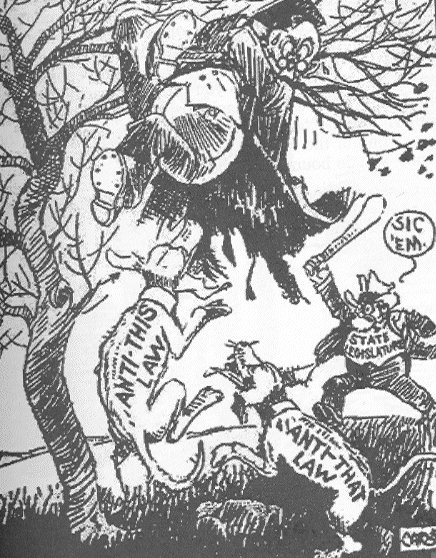
This hostility among fundamentalists toward the professoriate was noted by one cartoonist in the Wall Street Journal around the time of the Scopes Trial in 1925.  In this cartoon, hillbilly fundamentalists sic their legislative dogs on a hapless professor.

In the run-up to that Scopes Trial, the greatest fundamentalist scientist of the 1920s, George McCready Price, informed William Jennings Bryan confidentially that evolutionists had fallen prey to a debilitating group-think.  Because they only listened to one another, Price insisted, such evolutionists had become “out of date,–behind the times,–and don’t know it.”

This outright hostility toward the academic classes continued throughout the twentieth century.  For instance, one pamphlet from the American Legion in 1930 warned that too many college professors saw their jobs as indoctrinating each new generation of young, impressionable minds.  In this author’s opinion, college professors did not try to authentically educate their students, but only saw their jobs as a chance to make new “teachers of communism and atheism out of them.”

In the early 1960s, conservative California State Superintendent of Education Max Rafferty found the main culprit of America’s decline in the progressive, leftist orthodoxy promulgated in America’s institutions of higher education.  Rafferty insisted that colleges had created a new landscape of “temples . . . great universities which marble the land.”  These temples no longer pursued true intellectual endeavor, Rafferty claimed, but only passed along a deadened orthodoxy, “turning out swarms of neophytes each year to preach the gospel of Group Adaptation.  Their secret crypts and inner sanctums are the graduate schools.”

More recently, fundamentalist blockbuster author Tim LaHaye agreed.  In the twenty-first century, LaHaye believed, university faculties had placed themselves hopelessly in thrall to the false idols of the cultural Left.  After his huge publishing success with the Left Behind series, LaHaye set out to create a new biblical hero.  In Babylon Rising (2003), LaHaye described the adventures of biblical archeologist Michael Murphy.  In Murphy, LaHaye hoped to create a “true hero for our times,” one who united unwavering biblical faith with scholarly acumen and a dose of two-fisted machismo.  In one telling scene, Murphy is confronted by his smarmy secular dean.  This little episode tells us a lot about continuing fundamentalist attitudes toward the professoriate.

“Hold it, Murphy!”

A bony hand grabbed Murphy by his backpack as he left the hall. “Dean Fallworth.  What a fine example you set for the students by monitoring my lecture.”

“Can it, Professor Murphy.”  Fallworth was as tall as Murphy but cursed with a library-stack pallor that would make some mummies look healthy by comparison.  “You call that a lecture?  I call it a disgrace.  Why, the only thing separating you from a Sunday tent preacher is the fact that you didn’t pass the plate for a collection.”
“I will gratefully accept any donation you wish to make, Dean.  Did you need a syllabus, by the way?”

“No, Mr. Murphy, I have everything I need to get the university board to begin accreditation hearings for this evangelical clambake you’re calling a class.”

“Temper,” Murphy mumbled to himself.  “Dean, if you feel my work is unprofessional in any way, then please help me to improve my teaching skills, but if you want to bash Christians, I don’t have to stand here for that.”

“Do you know what they’re already calling this silly circus around the campus?  Bible for Bubbleheads, Jesus for Jocks, and the Gut from Galilee.”

Murphy couldn’t help but laugh.  “I like that last one.  I’m intending this to be a quite intellectually stimulating course, Dean, but I confess I did not post an I.Q. requirement for taking it.  The knowledge will be there, I promise you, but I will likely fall short of your apparent requirement that the only acceptable instructional method is to bore your students to an early ossuary.”

“Mark my words, Murphy.  Your hopes of this course surviving and your hopes of tenure at this university are as dead as whatever was in that bone box of yours.”

“Ossuary, Dean.  Ossuary.  We’re at a university, let’s try to use multisyllabic words.  If it doesn’t turn out to be legitimate, maybe I can get it for you cheap and you can keep your buttons in it.  Now, if you’ll excuse me, I have a new artifact to begin work on.”

In this vision of the world of higher education, only fundamentalists have remained true to the original mission.  Fundamentalist intellectuals, this line of reasoning goes, have retained their sense of inquiry and intellectual honesty.  They have not been seduced by the showy appeals of false science, such as evolution.  They have not been lulled by a peaceful-sounding pluralism that in practice degrades human dignity.  And they have not been willing to accept the hidebound leftist, secularist, evolutionist orthodoxy required of the mainstream academic.

This trope has remained so ubiquitous among fundamentalist activists that is tempting to dismiss it as sour grapes.  In this sour-grapes line of thinking, fundamentalists attack the intellectual pretensions of college professors since those professors show universal disdain for the Biblical belief of fundamentalists.  Fundamentalist attacks, this argument goes, actually prove the intelligence and perspicacity of college professors.

Louis Menand’s new book suggests otherwise.  Menand, best known for his Pulitzer-Prize-winning Metaphysical Club, now takes aim at the sclerotic intellectual culture of American higher education.  Menand is no fundamentalist.  Nor does he have an axe to grind against the left-leaning cultural politics of today’s universities.  However, he does agree with fundamentalist critics that the professoriate encourages group thinking and intellectual conformity rather than innovative ideas and iconoclasm.

Unlike fundamentalist critics of higher education, Menand does not blame evolution, socialism, or secularism for this state of affairs.  Rather, Menand’s critique is more prosaic.  In order to become a tenure-track professor in the humanities, Menand points out, aspiring professors must endure years, even decades, of powerless apprenticeship.  Those who survive this ordeal do so not by bucking the intellectual party line but rather by honing their ability to locate and placate the institutionally powerful.

In Menand’s view, this leads to a dangerous state of affairs in which “The academic profession is not reproducing itself so much as cloning itself” (153).  Until and unless research universities find a new way to train the next generations of faculty, Menand frets, the trend toward intellectual conformity will accelerate.  [UPDATE: For a full review of Menand’s book, be sure to check out the H-Education list review commissioned by Jon Anuik:  https://www.h-net.org/reviews/showrev.php?id=33892 Thanks, Jon, for this notice.  –Editor]

Fundamentalists won’t be surprised.  For generations they have dismissed the protestations of the kept intellectuals at America’s universities.  Menand’s book should serve to give them support from outside their own ranks for their deeply held distrust of pointy-headed professors.