What Went Wrong with America’s Schools?

Hell in a lunchbox. 

That’s where America’s public schools have headed, according to a recent essay by the Southern Baptist Theological Seminary’s President R. Albert Mohler Jr.

President Mohler makes an historical argument for the shocking, dangerous decline in American public education.  Does his case pass historical muster?

As I’ve argued in an essay in Teachers College Record (subscription required, but summary available), this historical argument about public education has been a mainstay of conservative thinking for at least fifty years.  Different conservative intellectuals have come up with different timelines and key events to explain the demise of high-quality, morally trustworthy public education.

Mohler echoes this intellectual tradition.

He argues that public schools began as locally controlled entities.  Beginning roughly a century ago, however, “progressive” reformers attempted an ideological coup.  Such folks, led by John Dewey, openly proclaimed their intention to turn schools into secular indoctrination camps.

Luckily, Mohler believes, such plans did not accomplish much until the second half of the twentieth century.  At that point, however, most schools were “radically transformed,” separated “from their communities and families.”

The results, Mohler warns, have been sobering:

Those who set educational policy are now overwhelmingly committed to a radically naturalistic and evolutionistic worldview that sees the schools as engines of social revolution. The classrooms are being transformed rapidly into laboratories for ideological experimentation and indoctrination. The great engines for Americanization are now forces for the radicalization of everything from human sexuality to postmodern understandings of truth and the meaning of texts. Compulsory sex education, the creation of “comprehensive health clinics,” revisionist understandings of American history, Darwinian understandings of science and humanity, and a host of other ideological developments now shape the norm in the public school experience. If these developments have not come to your local school, they almost surely will soon.

Is Mohler’s diagnosis correct?  Does his historical analysis match the record?

In this historians’ opinion, Mohler is guilty of cherry-picking and over-emphasizing.  It is demonstrably true that in the early twentieth century an array of school activists and intellectuals, clustered together under the amoebic heading of educational “progressivism” did try to implement wholesale changes in the nature of American public education.  It is also true that the US Supreme Court made decisions in the 1960s that could have revolutionary implications for the religious nature of public education.  Even more, it is true that leading organizations such as the National Education Association call for school policies that might dismay stalwart conservative Protestants. 

But contrary to Dr. Mohler’s conclusions, such historical facts do not add up to a public school system that “entered a Brave New World from which no retreat now seems possible.”

Historians have examined each of these important trends in American public education.  Arthur Zilversmit, for example, looked at the implementation of “progressive” education policies in the middle of the twentieth century.  In spite of earnest, well-funded efforts to revolutionize schooling, Zilversmit found, schools remained largely the same.  Why?  Zilversmit, sympathetic to the “progressive” project, blamed Americans’ “strange, emotional attachment to traditional schooling patterns.” 

How about the claim that the Supreme Court kicked God out of the public schools?  It is true that in 1962 and 1963 SCOTUS banned school-led mandatory Bible reading and prayer.  But as political scientists Kenneth Dolbeare and Phillip Hammond found to their surprise, most communities that prayed before the SCOTUS rulings continued to pray in public schools after them.  

Similarly, political scientists Michael Berkman and Eric Plutzer have argued that local school districts continue to function as local bureaucracies.  These “Ten Thousand Democracies,” according to Berkman and Plutzer, remain responsive to local demands and local values.     

This is bad news for President Mohler’s alarmist argument, but very good news for religious conservatives in the United States.  Most of America’s public schools remain closely connected to majority impulses in their local community.  Concerning hot-button culture-war issues such as prayer, evolution, and sex ed—not to mention broader notions such as school discipline, drug use, promiscuity, and general manners—local communities still control their local public schools. 

This local influence helps explain some stubborn trends that have long frustrated progressives like me.  Why, we ask, is evolution taught only spottily?  Why can’t public-school children learn honest, practical information about sex?  Why are public schools still home to coercive prayer practices?

These are all tough questions. 

But Dr. Mohler’s jeremiad raises even tougher ones:  If American public schools are so very conservative, why do conservative intellectuals deny it so forcefully?  Why don’t America’s conservative intellectuals trumpet the continuing traditionalism of American public education?
 

Do You See Christian Students Acting Strange Today?

Are some students at your local public school lingering around outside?  Holding hands?  Circling the flagpole?

More to the point: If they are, should we be alarmed?

That depends, of course, on your feelings about the thorny issue of religion in public education.

If you see students gathering around the flagpole today, they might be taking part in “See You at the Pole” Day.  According to the Christian Post, this tradition started in Texas in 1990.  Christian students met in prayer around their school flagpole.  The point, according to Doug Clark, director of field ministries for the National Network of Youth Ministries, is to encourage Christian students to come together to ask for God’s blessing on their role as missionaries in their schools.

Clark hopes to see somewhere between 1-2 million public-school students participating in the USA and around the world.  So don’t be surprised if you see some at your local school.

If you do, what does it mean?  For those of us who work for pluralist, inclusive public schools, do we need to be alarmed?  Is this an abrogation of a Constitutional separation of church and state?

I don’t think so.  Though twentieth-century SCOTUS decisions made clear that teachers and schools must not force prayer or Bible-reading on public-school students, they also made it very clear that the religious rights of students themselves must not be violated.  It can get tricky when students lead prayers that seem to have the support of the school administration, as in the recent flap in Kountze, Texas.  Students have every right to wave Bible signs, but they don’t have the right to imply that such mottos are the official dogma of a public school.

In this case, however, students are demonstrating the private nature of their prayer by meeting at the flagpole.  They are leaving the school building, not using any of the school’s bureaucracy to encourage the prayer.  Students’ rights must be protected as they engage in religious activity of any sort.

But what about the “missionary” aspect of this activity?  Students here are not just praying, they are specifically praying for inspiration, praying for the power to convert their fellow students to their faith.  Or at least that is the hope of adult leaders such as Doug Clark.  What about the rights of their fellow students, students of different religious faiths—or of no religious faiths—who might be targeted for missionary work?

Even here, too, we must not fear.  It may be unpleasant for a student to be approached for aggressive evangelical efforts.  But such unpleasantness is not a matter for outside interference.  If a student wants to talk to other students about faith, he or she has that right.  As long as it does not disrupt school activities, the right to make one’s self unpleasant must be protected.  As long as it does not imply that the school itself supports that evangelical effort, student missionary work in public school must be protected.

It certainly makes me personally uncomfortable to think that religious students might target my daughter for outreach efforts as part of her public-school experience.  But I recognize that such outreach efforts are part of other students’ rights.  As long as there is no bullying, no coercion, no disruption, and no implied or explicit support of such missionary work by the school administration, my daughter cannot be protected from other students’ free speech rights.

So, for those like me who want to be sure public schools are inclusive public spaces for students of all backgrounds, if you see groups of students gathering in prayerful huddles around your public-school flagpole, don’t be alarmed.  Students in public schools do not abandon their rights to publicize their religion when they walk through the schoolhouse door.


Yoga in School? Yes, No, Maybe So

Is yoga a religious practice?  Can it be taught in public schools?

Here at ILYBYGTH, we’ve been following the story in Encinitas, thanks to contributions from Natalia Mehlman Petrzela.  In that case, the judge said yoga was okay, in spite of the powerful argument made by religious studies scholar Candy Gunther Brown.

Today three evangelical writers weigh in at Christianity Today.  Can yoga be part of public education?

Laurette Willis says no way.  Yoga, she warns, turns children’s minds towards the “idols” of Hinduism and Buddhism.  Even if the practice is taught in a secular, physical way, it instills in young children “warm fuzzies” about Hindu imagery and theology.

Matthew Lee Anderson says, “It depends.”  If it is taught as physical exercise only, then it should be fine.  If it is used to proselytize for Hinduism, then no.

Amy Julia Becker says bring it on.  Yoga as physical exercise should be encouraged in public school.  What’s more, yoga as spiritual exercise should also be encouraged in public schools.  It is important for people of all religious faiths, Becker argues, to insist on the rights of children to engage in spiritual practice in public schools, as long as that practice is student-initiated and student-led.  Just as evangelical Christian students insist on their right to form public-school prayer groups, so evangelical Christian groups should insist on the rights of students of other religions to form their own spiritual groups.


Required Reading: Christian Jihadis and Presbyterian Ayatollahs

The Christian terrorists are coming for you.

That has long been the hysterical message about “dominionism” present in American media and even academic writing.  But is it true?

In an illuminating recent article in the Journal of Religion and Popular Culture, Michael J. McVicar analyzes the ways “dominionism” has been used as a rhetorical cudgel over the past thirty years.

Though McVicar specifies he’s not trying to offer an authoritative biography of dominionism, nor a prescription for handling dominionism, his article still offers a helpful guide to the ways this bogey has developed, among evangelical Protestants and among the broader culture.

As McVicar recounts, in the 2012 presidential primaries accusations of “dominionism’s” influence flew fast and furious.  Michele Bachmann and Rick Perry in particular stood accused of close ties to dominionism.  For many in the media, that implied a vague sort of theological imperialism, a desire to impose religious strictures on American public life.

McVicar traces the talk about “dominionism” back to criticism by evangelical writers in the 1980s of two Christian movements, Rousas J. Rushdoony’s Christian Reconstruction movement and Earl Paulk Jr.’s Kingdom Now movement.  Leading evangelical authors insisted that such movements did not and could not represent mainstream evangelical theology.

Most important, McVicar argues, these evangelical criticisms served to propagate the labels “dominionism” and “dominion theology.”

Soon, writers outside of evangelical circles appropriated evangelical critiques.  In the late 1980s and early 1990s, McVicar writes, secular critics “appropriated much of the evangelical press’s criticism of dominion theology while simultaneously reframing it within the discourses of political progressivism and cultural pluralism.”

Soon, McVicar argues, scholar/activists such as Sara Diamond popularized a caricature of dominionism as the “central unifying ideology for the Christian Right.”

Much of the treatment of “dominionism” in these journalistic and academic treatments has contributed to a frenzy over the connections between conservative Christianity in America and violent, militant religion in other parts of the globe.  For some, “dominionism” serves as proof that all conservative Christians secretly want to take over secular institutions.  For others, “dominionism” is nothing but a bogey of progressive nightmares.

McVicar pushes a more subtle line.  There is such a thing as dominionism, he avers.  However, talk about dominionism usually tells us more about the speaker than about the subject.  Evangelical critics have defined dominionism out of bounds for evangelical belief.  Secular and progressive critics have defined dominionism out of bounds for civil American culture and politics.

Of course, as regular readers of ILYBYGTH are keenly aware, these issues of definition and boundary construction are central to school politics.  I’ve argued in these pages that anti-dominionist rhetoric is more often a blunt instrument than a real effort to shape policy.  If conservatives want to establish schools that include prayer or Bible reading, for example, critics can accuse them of anti-American “dominionism.”  If conservatives want to restrict the teaching of evolution or of sexual information, critics can accuse them of creeping “dominionism.”

Such talk doesn’t help make better schools.  But understanding this kind of talk and the way it has developed historically does promise to help us understand how American education really works.

McVicar’s website tells us that he is working on developing these arguments in a book under contract with the University of North Carolina Press.

We’ll look forward to it.

Further reading: Michael J. McVicar, “‘Let Them Have Dominion:’ ‘Dominion Theology’ and the Construction of Religious Extremism in the US Media,” Journal of Religion and Popular Culture 25.1 (Spring 2013): pp. 120-145.


Decadence and the Fall of American Public Education

Things today ain’t as good as when I was young.

That’s the central notion, the vaguely articulated impulse, the often-unexamined presumption behind a good deal of conservative educational rhetoric.  Schooling these days has declined from glory days of the past.

In an essay in The American Interest, Charles Hill warns of the real consequence of decadence in American life.

As Hill notes, the idea of civilizational decline and fall is an old one.  Yet Hill insists that it retains explanatory power; Hill makes the case that twenty-first century America is sliding into a dizzying downward spiral.  Everything from technologically induced “screen culture” to awkward proletarianization of elites can be better understood as part of a lamentable decadence.

As Hill concludes,

Around the turn of the 19th to the 20th century, “decadence” arose as a romantically thrilling elitist fashion, providing a “sweet spot” in which a privileged, self-selected class could revel in dissolute practices while applauding their own cultural superiority. At the turn of the 20th to the 21st century something akin has emerged—call it a democratized form of decadence—among a far wider swath of the population, with the support of government and approbation of the cultural elite. Many observers have gazed upon such phenomena, then and now, and have seen mainly the sources of shifts in the art world. We move from the 1913 New York Armory Exhibition to mainstreaming of “street art” a century later rather effortlessly. But if what is at stake is world order, with national character and identity as its foundation stone, and democracy as the procedurally and practically most efficacious political form, then the fate of the art world may be the least of our concerns.

The essay is worth reading in its entirety.

Of particular interest here are its implications for American education.  Hill makes a few points about this himself.  For one thing, he notices the disturbing intellectual ramifications of “screen culture” especially among the young.  A generation accustomed to viewing people on computers, tablets, TVs, and phones, able to view without being viewed, Hill argues, adds a “new dimension” to old ideas about decadence.  Weaned on screen culture, Hill says, young people “can become oblivious to others.”

In a nuts-and-bolts way, Hill notes the way our current decadence has squeezed out learning in favor of training.

Of more consequence than the specific educational ramifications argued by Hill is the sense of decline Hill articulates.

As I’ve argued elsewhere, it is nearly impossible to understand the conservative impulse in American educational thought and activism without grasping the power of the idea of decadence.  Leading conservative intellectuals—even ones from very different backgrounds—have all grounded their educational philosophy on a notion that the educational system in the United States has ground down in a systematic pattern of decline.

In his landmark work Capitalism and Freedom, for example, free-market theorist Milton Friedman insisted that American public education entered a noticeable period of decline after the American Civil War when the government “gradually” (page 85) stumbled into the near-total “‘nationalization,’ as it were, of the bulk of the ‘education industry’”(page 89).

Conservative education leader Max Rafferty agreed about the decadence, but argued for a different time and cause.  The problem really began, Rafferty believed, in the 1930s, when “Dewey-eyed” reformers injected a deeply flawed notion of education into the American cultural bloodstream.  Instead of learning heroic truths and facing moral challenges, students in post-1930 “life-adjustment” classrooms only learned to revel in their own inability to determine right from wrong.  Such decadent teaching and learning, Rafferty argued in his 1963 book Suffer, Little Children, produced a weak generation, unable to combat the existential threat from “a race of faceless, godless peasants from the steppes of Asia [that] strives to reach across our bodies for the prize of world dominion.”

Though he viewed the goals of education very differently from Rafferty and Friedman, creationist leader Henry Morris agreed that public education had declined dramatically.  The root of the problem, Morris argued in his 1989 book The Long War Against God, lay in a one-two punch of Unitarianism and secularism.  The first blow had come in 1869, when Unitarians took over Harvard University.  Their example led American education away from its roots in what Morris considered to be authentic Christianity (pages 46-47).  The second decisive weakening came later, with John Dewey’s rising influence in public education.  That influence, Morris argued, led public schools away from religion into a markedly anti-religious humanism.

These examples could be multiplied nearly endlessly.  William J. Bennett, for instance, has argued with his Index of Leading Cultural Indicators that American culture as a whole—especially including its public schools—has declined terrifyingly since 1960.

It is taken as an article of faith among many conservative educational thinkers and activists that education today is worse than it has been.

This is more than the common griping about “kids these days.”  This is more than the old story about how when I was young I had to walk to school barefoot, through ten feet of snow, uphill both ways.

To understand conservative thinking about education, we have to understand this assumption of decadence.  Not many activists articulate this sentiment as clearly as the intellectuals described here.  Not many offer the careful examination of the meanings of decadence expressed by Charles Hill’s recent essay.

But behind many of the policies promoted by educational conservatives lurks this ubiquitous sentiment: things today are worse than they have been in the past.  Schools today are worse than they have been in the past.


Life, the Universe, and Nothing

Why is there something rather than nothing?

Is it reasonable to believe there is a God?

Has science buried God?

The Australian City Bible Forum recently posted two video discussions about these questions between prominent science-atheist Lawrence Krauss and religious apologist William Lane Craig.

What they didn’t discuss is what should be included in public schools.  Surprisingly, in the end it is the arguments of Lawrence Krauss that suggest a sort of intellectual dictatorship in science classes, a stern refusal to consider the claims of dissent, even when that dissent represents a majority opinion.  Of course, that is exactly the accusation made by leading creationists.  I don’t buy those creationist arguments, but I do want to understand why we can insist that creationist students learn science the way we define it.

The two veteran debaters did not engage in a formal debate on these timeless questions.  Rather, the City Bible Forum offered a “conversation” between the two speakers.  Each speaker had fifteen minutes to lay out his ideas.  Then the two were open to questions.

The moderator called for a “respectful, intelligent discussion.”  To that end, the evangelical organization invited moderators of very different backgrounds.  For the first discussion, the CBF asked TV journalist Scott Stephens.  For the third, a local atheist academic, Graham Oppy.

For those of us interested in understanding the conservative influence of evangelical religion in American public life, the discussions are worth listening to in their entirety.

Here at ILYBYGTH, I don’t really care very much about the nature of science or religion.  I don’t care very much about whether or not the universe was created ex nihilo.  I don’t care—as Craig and Krauss debate—whether or not an infinitely good God can cause the murder of Canaanite children.  Such things are interesting, but they only make up the background, IMHO, for the really interesting questions.  For me, the rubber only hits the road when we get to discussions about the ways these issues influence real life; the ways such ideas change policy in places such as public schools.

For example, the discussions can help illuminate one of the most stubborn mysteries of American public education.  To folks like me it remains endlessly surprising that so many Americans support the use of religion in public school.  As readers are aware, majorities of Americans support the inclusion of creationism in public-school science classes.  Americans also often support the notion that prayer and Bible reading can be parts of a public-school experience.

The wide-ranging discussion between Drs. Krauss and Craig sheds some light on this head-scratcher.  In the first conversation, “Has Science Buried God?” Professor Krauss acknowledges that religious belief is the default psychological state for most people.  Krauss agrees that “we all want to believe.”  Such desires, Krauss argued, only demonstrate our own intellectual weakness and laziness, our willingness to accept the simple in favor of the true.  “We have to work hard,” Krauss admonished, “to overcome that desire to believe.”

Not surprisingly, Dr. Craig disagreed. But more interesting to me is that even Professor Krauss conceded that most people will tend toward religious thinking.  Though Krauss repeated his accusation that teaching young children religious ideas amounted to “child abuse,” he still acknowledged that such ideas made the most sense to the most people.

If that is indeed the case, if most people will tend toward religious explanations of life, then it should come as no surprise that they want to teach such religious explanations to their children in public schools.

Indeed, for folks aware of the sometimes-ugly history of American education, Professor Krauss’ position raises some difficult questions.  For example, ought public schools impose ideas on children if those ideas are inimical to those children’s families?  In the 19th century, educational leaders often argued that the King James Version of the Bible must be read in every public school, in spite of the objections of Catholic leaders.  Since the Bible was the truth, these schoolmen reasoned, every child must be forced to hear it.

Such reasoning does not acknowledge the legitimacy of dissent.  It does not recognize the “public” nature of public education.  In order to include the entire community, authentic public education would have to recognize the legitimacy of the beliefs of the community.

Professor Krauss, no doubt, would protest that science classes must teach science, not religion.  But, as he should also acknowledge, the boundaries of science have at times been difficult to define.

If, as I do, we still want to insist that public schools teach evolutionary science and not creationism, we are left with the sticky question: Who decides what is “science”?  A majority of mainstream scientists?  That, I’m guessing, is how scientists like Professor Krauss would argue.

How will that majority opinion protect the legitimate views of dissenters?

And if we want to rely on majority opinion, what about the much larger popular majority that wants creationism taught as science?

Kicking Out the Christians: Duck Dynasty and “Facial Profiling”

Christians are a persecuted minority!

That’s the claim we hear over and over again from conservative religious folks.

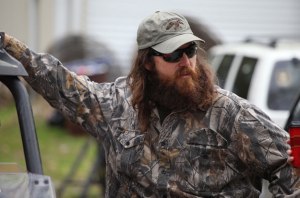
Today we get some surprising evidence that bearded holy men of the Christian faith really are punished unfairly.  Duck Dynasty star Jase Robertson was apparently kicked out of the Trump Hotel in New York City when an employee assumed he was homeless.

jase-robertson4

Robertson. Image Source: A&E

As the Christian Post reports, Robertson didn’t take the incident too seriously.  He called the episode a case of “facial profiling.”

It was not Robertson’s Christian faith, but rather his appearance, that apparently led to this embarrassing incident.  The big reality-show star didn’t make a fuss.  But other conservative Christians like the Robertson family have consistently complained that they are treated like despised minorities in American culture.

In 1980, for example, evangelical superstar Jerry Falwell called conservative Fundamentalists “the largest minority bloc in the United States.”[*]

These feelings among conservative Protestants have been especially strong in debates over public education.  Since the 1920s, conservative evangelical Protestants have complained that their rights have not been respected.  To cite just one example, in 1965 evangelical editor John R. Rice lamented the fact that conservative Christians were not only a minority, but a minority that had been consistently singled out for unique persecution.  “Why not have freedom in America as much for one minority as another?” Rice asked.  “Why not observe the rights of Bible believers as well as the rights of the infidels in the churches and infidels in courts or schools?”[†]

We have seen despised-minority rhetoric again and again in conservative calls to include creationism in public-school science classes.  In the early 1980s, creationists pushed laws that would include both evolution and creationism, in order to protect the constitutional rights of minority creationist students.  Laws such as Arkansas’ Arkansas’ Act 590 of 1981, for example, emphasized that such rules would “protect academic freedom . . . [and] freedom of religious exercise.”[‡]

Creationists have also often complained that their views are ignored out of an anti-scientific zeal to punish minority dissent.  In 1984, for example, creationist Jerry Bergman published his expose of anti-creationist persecution in American higher education.  Bergman himself claimed to have been denied tenure at Bowling Green State University solely for his religious beliefs.  “Several universities,” Bergman lamented,

state it was their ‘right’ to protect students from creationists and, in one case, from ‘fundamentalist Christians.’ . . . This is all plainly illegal, but it is extremely difficult to bring redress against these common, gross injustices.  This is due to the verbal ‘smoke-screen’ thrown up around the issue.  But, a similar case might be if a black were fired on the suspicion that he had ‘talked to students about being black,’ or a woman being fired for having ‘talked to students about women’s issues.’[§]

Kicking out a bearded Christian holy man from a fancy New York hotel won’t offer much clarity to this old dispute.  Jase Robertson himself did not seem at all offended that a hotel employee took him outside to a park when Robertson asked for directions to a bathroom.

Other conservative evangelical Protestants, however, have not laughed off this kind of thing so lightly.  In controversies about the nature of America’s public square, including its public schools, conservative Christians have consistently insisted that they had been treated like persecuted minorities.

It makes me wonder if Jerry Falwell was ever kicked out of a fancy hotel.


[*] George Vecsey, “Militant Television Preachers Try to Weld Fundamentalist Christians’ Political Power,” New York Times, January 21, 1980, A21.


[†] John R. Rice, “White Minorities Have Rights, Too,” Sword of the Lord 31 (3 September 1965): 1.


[‡] “Act 590 of 1981: General Acts, 73rd General Assembly, State of Arkansas,” in in Marcel C. LaFollette, ed., Creationism, Science and the Law: The Arkansas Case (Cambridge: MIT Press, 1983), 15.


[§] Jerry Bergman, The Criterion: Religious Discrimination in America (Richfield, MN: Onesimus Press, 1984), 43.

Yoga—Not for Public Schools


Does the Constitution allow US public schools to teach religion to children?

Only if that religion is not about the Bible, according to religion scholar Candy Gunther Brown.

Thanks to contributions from Natalia Mehlman Petrzela, we’ve been following a case from Encinitas, California.  Some parents complained that teaching yoga forced religion onto their children.  The program had been funded by the Jois Foundation, though classroom teachers developed the specific yoga curriculum on their own.  Recently, Judge John Meyer ruled that public schools may use yoga as an exercise program without violating the Constitution.  The school district, he decided, had sufficiently purged the religious heritage of yoga and engaged in yoga for sufficiently secular purposes.

One of the participants in that trial was Professor Brown.  In a recent interview at the Oxford University Press blog, Brown explains why she thinks Judge Meyer got it wrong.

As she testified at the trial, Brown explains why the yoga practices are inherently religious.  Such practices, in the vision of Ashtanga devotees,

will “automatically” lead practitioners to experience the other limbs and “become one with God,” in the words of Jois, “whether they want it or not.”

Brown argues that the practices in Encinitas would be—and indeed had been—perceived as religious by objective outside observers.  As she puts it,

EUSD teachers displayed posters of an eight-limbed Ashtanga tree and asana sequences taught by the “K. Pattabhi Jois Ashtanga Yoga Institute”; used a textbook, Myths of the Asanas, that explains how poses represent gods and inspire virtue; taught terminology in Sanskrit (a language sacred for Hindus); taught moral character using yamas and niyamas from the Yoga Sutras; used guided meditation and visualization scripts and taught kids to color mandalas (used in visual meditation on deities). Although EUSD officials reacted to parent complaints by modifying some practices, EUSD classes still always begin with “Opening Sequence” (Surya Namaskara) and end with “lotuses” and “resting” (aka shavasana or “corpse”—which encourages reflection on one’s death to inspire virtuous living), and teach symbolic gestures such as “praying hands” (anjalimudra) and “wisdom gesture” (jnanamudra), which in Ashtanga yoga symbolize union with the divine and instill religious feelings.

Furthermore, Brown charges, Judge Meyer ignored crucial evidence and even got his facts wrong.  School district teachers, Brown says, used Jois Foundation funds to take children to an Ashtanga conference.  Nor did teachers secularize the practice as much as Meyer implied.  Meyer stated in his decisions that religious terms such as the “lotus” position had been renamed with neutral names such as “criss-cross applesauce.”  But Brown points out that the term “lotus” appears 194 times in the spring curriculum guide.

So is yoga religious?

Brown makes a powerful case.  Simply because some teachers did not engage in the practice for primarily religious reasons does not make it a secular practice.  Simply because Judge Meyer did not think children would see the practice as religious does not make it so.

Atheists could pray for secular reasons, but teaching children to pray in public schools would not be constitutional.  Similarly, in other religious-dissent cases, the perception of religion has been decided by those who feel marginalized.  For instance, in the Schempp case (1963), the feelings of non-religious people that school prayer forced religion upon them carried legal weight.

The question forced upon us by Professor Brown is a good one: Do we allow yoga in public schools simply because we like it?  To be fair, do we need to recognize the dissent of conservative Christians who find the practice religious and therefore offensive?


Does Reading the Bible Make Children Violent?

Does reading the Bible lead to violent crime?  That’s the question nobody is asking these days.

Here at ILYBYGTH, we have to ask: Why not?

After all, it seems violent crime has been falling in the past few decades.  Those have been the decades in which American children no longer prayed or read the Bible in their public schools, officially at least.

Religious conservatives have long bemoaned the social dangers of kicking God out of public schools.  Is it only fair, then, to blame God for all the rapes, burglaries, and assaults that haven’t been happening lately?

That doesn’t seem like a comfortable suggestion for most religious conservatives.  Yet thoughtful conservatives must recognize that they have long warned about the dangers of removing traditional religion from public schools.  Some of those warnings, at least, seem to have been flipped on their heads.  Without mandatory Bible-reading in public schools, American society has grown noticeably less violent.

This is not what religious conservatives have predicted.

In 1942, for example, Bible activist W. S. Fleming insisted that more states must pass mandatory Bible laws for their public schools.  As I noted in my 1920s book, these mandatory Bible laws were a prominent but little-noticed element of 1920s educational culture wars.  Fleming, a former Chicago pastor and full-time activist for the National Reform Association, claimed that Bible laws for public schools would enable society to maintain basic morality.  Fleming pointed out that most states gave Bibles to prison inmates.  Why not skip the middle man, he asked, and deliver the Bibles to the schools?  If Ohio had followed this suggestion in 1925, he recalled, “as her neighbor, Pennsylvania, did, with the same result, more than half of her present 9,310 convicts would now be law-abiding citizens.”[*]

Two decades later, just after the Schempp decision by the US Supreme Court seemed to eliminate Bible reading from public schools, William Culbertson of Chicago’s Moody Bible Institute warned that the decision did not bode well for America’s public safety.  “No nation can turn its back on God without tragic consequences,” Culbertson cautioned.  “We have traveled a sorry road of unbelief in the less than two hundred years of our country’s history.  The Supreme Court decision—and our willingness in many cases to justify it—say plainly that a sorrier road may lie yet ahead!”[†]

Similarly, in the early 1980s, Donald Howard, creator of the Accelerated Christian Education curriculum and an energetic supporter of independent evangelical schools, preached a fiery jeremiad about the dangers of removing Bibles from public schools.  Because “the Bible by judicial review [had been] legislated out of the schools,” Howard warned, schools in the 1970s suffered from an array of terrible problems, including “X-rated textbooks,” 70,000 assaults on teachers in one year, violence, vandalism, alcohol and drug abuse, a profusion of “witchcraft and the occult,” and rampant deviant sexuality.  This lamentable situation, in Howard’s opinion, underscored the need for independent evangelical schools.  Only there, he argued, could students be safe from the perils of the now-Godless schools.[‡]

In the 1990s, prominent conservative intellectual William J. Bennett published his blockbuster Index of Leading Cultural Indicators.  This collection of worrisome statistics demonstrated, Bennett claimed, what happened when a society abandoned its traditional moral teachings.  Crime soared, despair ruled.  Though Bennett noted a dip in crime during the 1990s, he argued that since 1960 the trend was clear: less traditional morality meant more violent crime.

Less prominent conservatives, too, warned that schools without prayer and Bibles led directly to a wave of violent crime.  By “kicking God out of public schools,” Americans traipsed foolishly down the path to Sodom and Gomorrah.

Without prayer and the Bible, religious conservatives have insisted, public schools had turned into sin factories.  Young people did not learn to check their carnal instincts.  They killed and fornicated with abandon.

So what does it mean about Bibles in schools if violent crime has dropped precipitously in recent decades?

As reviewed in a fascinating article in this week’s Economist, violent crime has plunged in industrialized nations around the globe in the past twenty-five years.  As the article describes, talking heads have ascribed this happy circumstance to an array of possible causes: more abortions, fewer young men, better policing, even better violent video games.

Back in the 1950s, when the US Supreme Court had not yet “kicked God out of public schools,” violent crime skyrocketed.  To be consistent, we must ask: Did all that violent crime result from students reading the Bible?  Saying the Lord’s Prayer?  If conservatives predicted that removing Bibles from schools would cause more violent crimes, must they now acknowledge that the USA is a safer place without all that school Bible-reading?


[*] W. S. Fleming. God in Our Public Schools. 3rd ed. (1942; repr., Pittsburgh: National Reform Association, 1947), 90.

[†] William Culbertson, “Is the Supreme Court Right?” Moody Monthly 63 (July-August 1963): 16.

[‡] Donald Howard, “Rebirth of a Nation,” Facts About A.C.E. (Lewisville, TX: Accelerated Christian Education, n.d. [1982?]), 25.


UPDATE: Yoga Okay for Public Schools

When is a school prayer not a prayer?  According to Superior Court Judge John Meyer, once the “lotus” position has been transformed into “crisscross applesauce.”

As historian Natalia Mehlman Petrzela argued in these pages months ago, the fight in Encinitas, California over the teaching of yoga in public schools flipped some culture-war themes on their heads.  In this battle, conservative Christian parents fought against the use of religion in public schools.

Spearheaded by the National Center for Law and Policy, a conservative activist organization, Christian parents complained that teaching yoga amounted to promotion of a set of religious notions.

Judge Meyer ruled yesterday that the school district had stripped the yoga routine of its religious nature.  An objective observer, Meyer decided, would not perceive the practice as religious.  The program had been funded by a half-million-dollar grant from the Jois Foundation.  The judge found this entanglement “troublesome,” but not enough so to abandon the health program.

This kerfuffle resurrects some old school-prayer controversies in new ways.  First of all, does this case reveal a bias against Christian prayer?  That was the complaint of Dean Broyles of the National Center for Law and Policy.  As Gary Warth of the San Diego Union-Tribune reported, Broyles claimed, “If [the school practice] were Christian-based and other parents complained, it would be out of schools. There is a consistent anti-Christian bias in cases like this that involve schools.”  Could a case be made that non-Abrahamic religious traditions get more leeway in public schools?

Also, does this case open the door for a new spate of school-prayer policies?  In the early 1960s, the US Supreme Court ruled in Engel v. Vitale that school-sponsored prayers violated the Constitution.  The prayer in that case, however, had been composed by the State of New York as a broadly ecumenical prayer, one thought to offend no one.  Could this precedent open the door to a new sort of ecumenical school prayer?  A secular prayer?  If religious groups could argue the health benefits of a prayer and find a prayer practice sufficiently stripped of sectarian meaning, could Judge Meyer’s argument apply here?

Of course, as I’ve noted elsewhere about the Engel v. Vitale case, most evangelical Protestants supported the SCOTUS decision to ban a bland ecumenical prayer.  Would any conservative religious people want to include a prayer in public schools if that prayer had been secularized?  If Jesus on a cross had been transformed to “crisscross applesauce?”