Forget the Zombies, It’s a Bible Apocalypse

Kirk Cameron as Buck Williams

Ask Kirk Cameron.  One of the most compelling parts of a Biblical worldview is its clear explanation of the future.  And that future isn’t too rosy, at least for those outside of the charmed circle of Biblical Christianity.

How are those of us outside this circle to understand this prophetic tradition?  We might start by trying to understand the ways some conservative Protestants read the Bible.  After all, if one believes in an inerrant Bible, one is encouraged to interpret its words in the most obvious sense.  The dangers, in this tradition of Bible interpretation, come when readers exalt their own understanding higher than the words of Scripture.

And the most obvious interpretation of some Biblical books, such as Daniel and Revelation,  is that they are prophecies of what is to come.
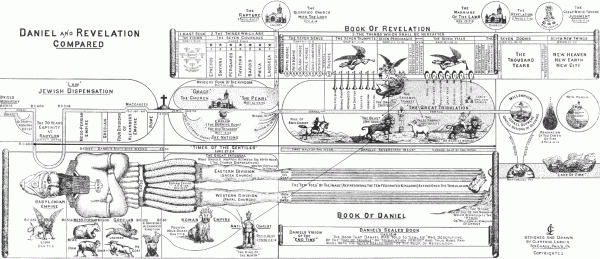
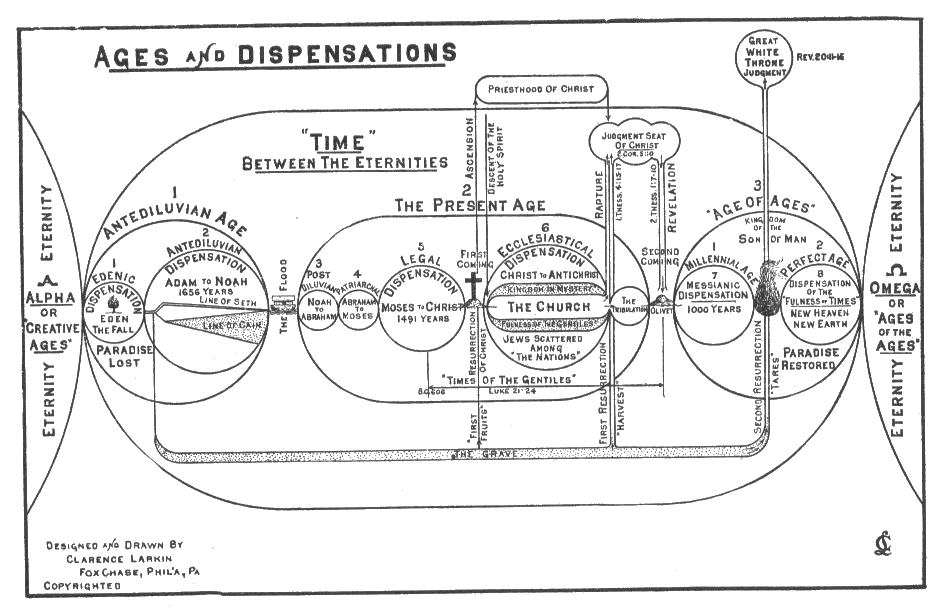
One of Clarence Larkin’s dispensational charts (1919)

Through a few quirks of history—though, of course, no Bible Christian would likely consider them accidental—one interpretation of these prophecies has come to exert an outsized influence on conservative evangelical Protestant belief in 20th­­- and 21st-century America.  This interpretation, burdened with the cumbersome name “dispensational premillennialism,” has become the dominant form of understanding Bible prophecy among the subset of evangelicals who call themselves small-f fundamentalists.

For those like me–outside of this tradition but trying to understand it–it is well worth our time to read some of the terrific academic histories out there.  The late Paul Boyer, of my alma mater, wrote a wonderful introduction to prophecy belief for outsiders.  Writing from closer to the tradition, Timothy Weber also offered a great guide to the history of this theology.  George Marsden also included a helpful introduction in his now-classic history of fundamentalism and American culture.

However, none of these terrific academic studies has reached the kind of audience that the prophecies themselves have claimed.  Just as the Bible’s continuing popularity must tell us something about the nature of popular religious belief in Fundamentalist America, so the popularity of rapture theology must hold some lessons.

In 1970, Hal Lindsey authored a runaway bestseller explaining this interpretation of the end days.  The Late Great Planet Earth sold millions of copies.  The book explained the themes of dispensational premillennial theology in an engaging and convincing way.  Lindsey and co-author Carole Carlson mapped the predictions of Daniel and Revelation onto world events of the 1970s.  As had generations of prophecy writers before him, Lindsey insisted that the world was entering the last days described to John in his Revelation.

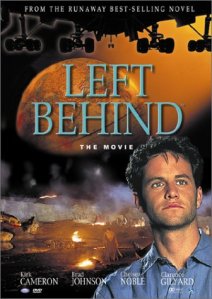
A generation later, Tim LaHaye and Jerry Jenkins repeated this feat with their Left Behind series.  Beginning in the late 1990s, this fictionalized apocalypse told the story of end times, as understood by dispensational premillennialists.  The series sold millions of copies, and soon spun off an empire of related products, including a kids’ version and the movie starring Kirk Cameron.

What does the wild popularity of these books and their apocalyptic messages tell us about Fundamentalist America?  One danger would be to assume that all of the millions of readers embraced the theology of rapture and Biblical apocalypse.  It seems unlikely that all the readers of these books included themselves in the roll of Bible believers.  Just as the popularity of Harry Potter does not imply an increase in the belief in magic, so the popularity of these books does not necessarily mean a huge bump in belief in this apocalyptic tradition.  Nevertheless, conservative evangelical Protestants since the 1920s have argued for the importance of this particular way of understanding the Bible.  These books helped cement that understanding in the popular imagination.

For many readers, whether or not they buy into the entire theology, The Late Great Planet Earth and the Left Behind books tell THE Biblical story of the last days, not just one interpretation.

For those of us hoping to understand the nature of Fundamentalist America, the books are worth reading.  As long as we avoid the trap of thinking that these books are the last word in what conservative religious people really think, this vision of the nature of reality can go a long way to decoding some traditional shibboleths of the Fundamentalist tradition, such as the dangers of the United Nations and the importance of a strong Israel.

In each case, the politics of today and tomorrow have been explained thousands of years in advance.  As Revelation explains, the Antichrist will appear as the savior of humanity.  He will unite nations into one humanitarian global government.  All will appear obviously to the good.  For dispensational premillennialists, this prophecy provides fodder for an unyielding campaign against internationalism.  In the United States, this tradition has fueled an intense animosity toward organizations such as the League of Nations and the United Nations.  Again, we must not assume too much.  Not every conservative anti-internationalist has based his or her opposition on Biblical prophecy.  But among those who do, that opposition takes on more weight than simple policy considerations.  The fight against internationalization becomes, for some Bible believers, a literal cosmic battle of Good vs. Evil.  Understanding those roots will guide us in understanding the sometimes-puzzling international policies of some religious conservatives.

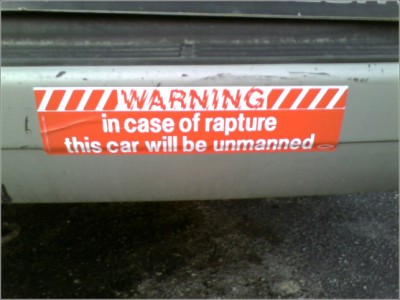
As reporter Buck Williams of the Left Behind series might explain, doubt and skepticism must end with the Rapture.  After that, the only option left for a dedicated Tribulation Force is to fight tooth and nail against the scheming Evil of Carpathia and His Global Community.

Further reading:

  • Timothy Weber, Living in the Shadow of the Second Coming: American Premillennialism, 1875-1925 (New York: Oxford University Press, 1979);
  • Paul Boyer, When Time Shall Be No More: Prophecy Belief in Modern American Culture (Cambridge: Harvard University Press, 1992);
  • George M. Marsden, Fundamentalism and American Culture, 2nd ed. (New York: Oxford University Press, 2006);
  • Tim LaHaye and Jerry Jenkins, The Left Behind Series (Tyndale House, 1995-2007);
  • Hal Lindsey and C.C. Carlson, The Late Great Planet Earth (Grand Rapids, MI: Zondervan, 1970).
Now in Paperback!

At long last, we have an affordable paperback edition of my 1920s book.  Buy it!!!!  My kid really does need a new pair of shoes.

Palgrave Macmillan is offering a 25% discount on its website.  Enter promo code “Conf2012” to get this edition for the low low price of $24.00.  Of course, you can also get a copy on Amazon for $26.40.

A warning, though: this book was a revision of my PhD dissertation at the University of Wisconsin.  It is targeted at a thoroughly nerdy audience.  I’m proud of it, but it represents academic writing with all of its hazards.  Even members of my immediate family have told me they enjoyed the first sentence very much.  After that it got a little dry.

But if you are interested in the long history of battles over religion, culture, and education in America’s public square, I can recommend the book without blushing.  There is not another book out there that explores all of the meanings of “fundamentalism” in the public school battles of the 1920s as well as this one.

Transubstantiation: Faith, Science, and the Public Square

“Catholics are crazy.”

Why don’t we hear people saying that?  Richard Dawkins accused anyone disbelieving evolution of being “ignorant, stupid or insane (or wicked, but I’d rather not consider that).” Does he accuse Catholics of the same thing?  Or why don’t we hear skeptics comparing the Catholic liturgy to a Flying Spaghetti Monster?

After all, one of the central features of Catholic liturgical tradition and theology is at least as radically anti-science as any kind of young-earth creationism.  But nobody seems to mind.

For purposes of full disclosure, I must note: I’m a big fan of Catholicism.  As the saying goes, ‘Some of my best friends . . .”  But even close friends must acknowledge the elephant at the altar, the rigid anti-science that lurks uncomfortably at the heart of the Catholic Eucharist.

We’re talking here about the Catholic doctrine of transubstantiation.  In Catholic doctrine, when a priest completes a special ceremony over bread and wine, the bread and wine are literally transformed into the body and blood of Christ.  Not symbolically, but substantially changed.  Of course, to all outward appearances, the bread and wine maintain their accidental attributes.  The senses, and even the most careful scientific detection, will see/hear/taste them only as bread or wine.  But in substance they have been transformed into the Real Presence, the living body and blood of the Christ.  I’m no theologian, and I invite correction on this subject, but as I understand the doctrine, the substance changes while the accidental outward properties do not.  Thus, for example, my body has two hands.  But the substance of my body does not change if I cut off one hand.  It is still my body, though the accidental properties change.  With the bread and wine, the substance transforms into the actual substance of blood and flesh.  But the accidental properties remain the same.  It will not taste like blood or flesh.  (If it did, I imagine this issue might be a little more controversial.)  It will continue to have all the outward appearances, down to the microscopic level, of bread and wine.  Yet it will not be.

This is a profoundly antiscientific notion at the heart of Catholic belief.  Instead of believing in the clear evidence of their senses, Catholics are supposed to believe that they are eating and drinking real flesh and real blood.  This notion is at least as antiscientific as more controversial doctrines such as young-earth creationism.  After all, creationists are not asked to disbelieve their own senses.  They are not required to contest the scientific measurements of things.  Instead, young-earth creationists are told that they have a superior science worked out, a true science that accords with the version of creation described in the Bible.  Catholics, on the other hand, officially believe that bread tastes like bread, smells like bread, looks like bread, has all the chemical properties of bread, and yet is not bread.  That must be difficult to swallow, pardon the pun.  Yet we don’t hear any complaints against it or attacks upon it from skeptics and anti-fundamentalists.  Why not?

There are two obvious reasons.  First, this doctrine doesn’t impinge on the public sphere the way creationism does.  After all, if it somehow mattered what public schools taught about the nature of bread, wine, and liturgical practice, then we could expect the notion of transubstantiation to become more controversial.  When the nature of the substance of the Eucharist was part of a public debate, as in the time of Martin Luther, then the doctrine of transubstantiation was indeed intensely controversial.  These days, in subjects such as contraception and abortion, where Catholic doctrine impacts public policy, we do hear a great deal about the nature of Catholic belief.  Since the doctrine of transubstantiation remains important only within the religion itself, skeptics may feel no need to challenge its inherent antiscientific nature.  After all, much religious belief is antiscientific.

Second, even many Catholics don’t embrace this doctrine enthusiastically or aggressively.  Catholics are not forced to defend the anti-science of transubstantiation the way creationists are forced to defend their Bible-based anti-science.  Catholics are assumed to agree with this foundational theological premise, but they are not put in a position to defend it publicly.  Allow me to give one example.  At the Catholic Church I attend, during harsh flu seasons parishioners are asked not to drink from the communal chalice if they have symptoms.  That makes great scientific sense, but little liturgical sense.  If the wine had actually been transformed into the substance of Christ’s blood, it doesn’t seem right that the H1N1 virus could attach itself.  Perhaps a Catholic apologist would reply that such things as viruses are only part of the “accidental” features of the wine.  The point here, though, is that to many Catholic parishioners, at least at my church, the transubstantiated blood is still regarded as very similar to wine.

So are Catholics crazy?  Do they cling to anti-scientific notions?  Does the core belief of Catholicism mean that ideas taken on nothing but faith must trump all evidence of the senses?  And if so, why don’t anti-fundamentalists seem to mind?


Olympic Fever and Reading the Bible like a Fundamentalist

Call Benny Hinn!  ILYBYGTH has caught Olympic Fever!

And in our delirium, we’ve hit upon a mental challenge for all our fellow non- and anti-fundamentalists out there.  Here’s the question: Why is mental discipline heroic in sports but anathema in non-fundamentalist intellectual culture?

For the elite athletes who compete in these international games, a key component of their success is mental discipline, mental toughness.  As journalists marveled about Michael Phelps the last time around, winning in the Olympics means being “mentally tough.”   For all peak athletes, it means developing a powerful single-mindedness in training, preparation, and competition.  As one study defined it, mental toughness means “an unshakeable perseverance and conviction towards some goal despite pressure or adversity.”

This is the quality that allows elite athletes to prepare.  It gets them into the pool, or onto the track, or into the gym, day after day, hour after hour, through grueling workouts.

This summer, we’ll see this kind of preparation pay off for some.  But we have to remember that the athletes themselves have no guarantee of victory.  The key to real mental toughness is realizing that these athletes subject themselves to this kind of regimen in spite of the fact that they might still lose.  They might devote years of their lives to preparation, to struggle and suffering, only to find that they did not win, or didn’t even make the Olympic team.

What does this have to do with Fundamentalist America?  For those of us outside of fundamentalism, the way many conservative Protestants read the Bible can seem ridiculous.  For those of us outside this tradition, it makes very little sense to read the Bible as a collection of inerrant writings.  We have been taught, instead, to question every assertion of authority; to approach every statement with profound and illuminating skepticism.

But for many conservative Protestants, the proper approach to reading the Bible is more like the preparation plans of elite athletes.  They read the Bible with “an unshakeable perseverance and conviction towards some goal despite pressure or adversity.”  In other words, those who read the Bible as an inerrant Book might simply be demonstrating the mental toughness necessary to compete at an elite level.  They may be fully aware of the “pressure or adversity” that comes from a skeptical mindset.  But they may consciously and knowingly set those doubts to the side in order to pursue the indefinite goal of greater spiritual understanding.

Is this really the way fundamentalists read the Bible?  I don’t know.  But I do wonder why many of us non-fundamentalists admire this kind of devotion in the realm of Olympic sports, but disdain it in the world of intellectual culture.


In the News: Fanaticism, Freedom, and Building Code Violations

It has all the elements of a Left Behind novel: Government thugs storm into a Bible meeting.  They threaten to arrest the pastor and fine his congregants for praying together.  They appeal for community support by accusing Bible-believing Christians of “fanaticism” and “intolerance.”

And that’s the way the story is being told in some of Fundamentalist America’s news outlets, such as Glenn Beck’s Blaze.  It is the tale told by the Bible pastor himself and his wife in recent YouTube videos.

Of course, neighbors and city officials in Phoenix tell a different story.

In any event, this story is worth the attention of all of us who are struggling to understand Fundamentalist America.

In short, as Ray Stern and Sarah Fenske have been following the story in the Phoenix New Times, Michael Salman is battling his neighbors over his desire to build a church in his backyard.  Several years ago, he built a shed-like structure and began hosting smallish worship services there.  He has been in a battle with the city ever since about code violations and his right to freedom of worship and freedom of assembly.

As Alan Weinstein, the director of the Law & Public Policy Program at the Cleveland-Marshall College of Law in Cleveland, commented in 2008,

“Say I just bought a 63-inch TV, and every Sunday at 11 a.m., I have 20 people over my house to worship at the church of the NFL,” Weinstein says. “There are probably football fans who do that every Sunday. And if they don’t stop that, they can’t stop a Bible study that’s meeting once a week, either.”

The city has insisted all along  that the issue is not about religion but about building and fire codes.  The neighbors, too, complain about Salman’s building plans.  They say his proposed church would be too close to a property line.  They say it would change the character of the quiet neighborhood of large homes and large lots.  But they also agree that Salman’s kind of religious zealotry left a bad taste in their mouths.  As Sarah Fenske reported in 2008,

When, at a neighborhood association meeting, one neighbor told Salman he didn’t like the plan, Andrea and Mike Julius watched Salman grow visibly angry. . . .

“It was clear at that point what we were dealing with,” Andrea Julius says. “I don’t want to say someone who seemed possessed, but not a cool-headed person.”

Tom Woods remembers thinking the same thing. When neighbors complained about how his project would affect their property values, Woods says, Salman was dismissive.

“He gave us a lecture on the fact that all of us were going to make money on our property, and if we were true Christians, we ought to be willing to sacrifice a little bit,” Woods recalls. “You can imagine, a few guys in the audience were all over him for that.

“That meeting is where the real animosity started. He made no effort at being conciliatory or cooperative. That really united the neighbors against him,” Woods says. “He was his own worst enemy.”

And Salman’s personal story and theology are somewhat different from what his neighbors might have hoped for.  In his youth, he was a drug-using, gun-toting member of a Phoenix street gang.  He served jail time for shooting up a rival’s house, nearly killing the rival’s mother.  In jail, he experienced a religious conversion.  Upon release, he dedicated his life to his new Bible ministry.  He embraced some beliefs decidedly outside the mainstream, such as the human-government-defying Embassy of God movement.  He also posted a series of sermons on YouTube, including this one in which Salman calls evolution “nothing but hogwash.”

But does that mean he shouldn’t be allowed to have a church in his backyard?  He doesn’t think so.

Does the fact that he wants to build a church mean that he can ignore building codes?  The city of Phoenix and his neighbors don’t think so.

Perhaps the most telling twist in this continuing story is that when Salman recently tried to turn himself in for some jail time, Phoenix authorities refused to arrest him.  As Ray Stern reported in the Phoenix New Times, when Salman reported to jail to serve a pending 60-day sentence, jail officials turned him away.

Salman had an easy explanation: “God granted me an injunction.”  Though Phoenix officials wouldn’t comment, the fear of bad publicity likely had more influence on their decision than the fear of God.

The Bible in America: Reading Prayerfully and Relating Autistically

Here’s a thought experiment: Could fundamentalists accuse the rest of us of a profound intellectual disorder?  Do non-fundamentalists fail to read the Bible properly?

As we’ve been discussing lately, conservative Protestants in Fundamentalist America insist on the importance of the Bible.  But in order to be meaningful, they often repeat, such reading must be done prayerfully.  This injunction is so ubiquitous it almost fades into meaninglessness.  That is, the instruction to read prayerfully is such a commonplace that it almost becomes part of the intellectual wallpaper of Fundamentalist America.  But if we stop and look carefully at the importance of reading prayerfully we might learn a good deal about the nature of the Bible in Fundamentalist America.  For us outsiders, an honest and humble attempt to understand the meaning of prayerful Bible reading might help us understand the meanings of the Bible in Fundamentalist America.

To do so, we need to take a look at what it might mean to read prayerfully.  As the Reverend Craig Ledbetter (to be fair, a voice from Fundamentalist Ireland, but the accent does not seem much different from that of Fundamentalist America) described recently, reading prayerfully means inviting the Holy Spirit to guide our understanding.  Without such a guide, Ledbetter writes, “much . . . will seem only foolishness.”  It means wrestling with the Bible, conversing with it, praying with it.  Anything else will lead to “a God of [one’s] own design.”

Or, as another advocate suggests, reading prayerfully means that the reading must be done with the “major goal . . . that we become more and more satisfied with God. Pray that this encounter through the word produces that fruit.”  Reading the Bible without that prayerful attitude will not result in any sort of meaningful religious experience.

In the words of another non-American Bible-lover, the Archimandrite Justin Popovich, those who do not have their questions answered from reading the Bible “have either posed a sense-less question or did not know how to read the Bible and did not finish reading the answer in it.”

This notion is the heart of our thought experiment.  What if a non-fundamentalist reading of the Bible meant that we simply do not know how to read the Bible?  What if it meant we non-fundamentalists read with some sort of overly “flat” approach?  Could non-fundamentalists be accused of reading with an autistic approach? 

Before we pick it apart any further, let’s start with a few givens.  First of all, autism spectrum disorders are a very diverse group of phenomena.  People with these disorders can think and behave in very different ways from one another.  But let’s take as a given that one distinguishing feature of autism is a tendency to understand other people as object-like.  This does not mean that people with autism are necessarily selfish or aggressive, but only that many people with autism do not relate to other people the way non-autistic people do.  Autistic people often relate in a distinctly unengaged, unemotional fashion.

Here’s another condition we need to set: reading the Bible prayerfully means investing one’s self in the reading.  It is very different from reading for information.  The Bible, read prayerfully, is one part of a dialogue, or even a multilogue.  The voices of the past, the voice of God, the voice of the reader, all can become part of a conversation in which the reader takes a profoundly active role.  Reading prayerfully means doing much more than simply reading to find out what the Bible says.  It means approaching the Bible with an open and humble heart.  It can mean treating the Bible as the inerrant Word of God, but it must mean reading with an understanding that what we read may be beyond our comprehension.  The fault, in that case, must be understood to be more than just an inadequacy of the text, but a failing of the reader as well.  Reading prayerfully means putting other things out of our mind and entering into the reading as if we are entering into an intimate conversation with God.  Reading prayerfully means praying to find understanding in the Bible.

For non-fundamentalist people like me, this is a foreign experience.  I have read the Bible, but I can’t say I’ve ever read it prayerfully.  When I read the Bible, I experience it as I’ve been taught to.  To me, it seems like a sometimes edifying, sometimes brutal, sometimes incomprehensible collection of traditional tales from Jewish and early Christian tradition.  I find it very difficult to understand why the words of this collection of tales should be presumed to be inerrant, just as I find it difficult to understand why one religious leader in Vatican City should be presumed to be able to speak infallibly.  I think there are lots of people who think the way I do.  It does not mean that I am not Christian.  I find it easy to be Christian and yet not look to the Bible as an inerrant collection of God’s word.

But let’s return to our thought experiment.  Many liberals, ex-fundamentalists, and secular people assert that fundamentalists have an infantile intellectual approach to the Bible.  Fundamentalist Bible exegesis is accused of missing the ambiguities and ambivalences that come with a more sophisticated reading.   Instead, this line of argument continues, fundamentalists are intellectually “frozen” into a simple inerrant reading of the Bible.  To be clear, I am not making this argument, only acknowledging that this is a common indictment of fundamentalist culture.  I imagine informed fundamentalists will recognize it as well.

But what if we put the shoe on the other foot?  What if we outsiders tried to imagine how fundamentalists could critique a non-fundamentalist reading of the Bible?  This is where the shaky analogy to autism comes in.  I wonder if fundamentalists could compare a non-prayerful reading of the Bible to autism. 

People like me who do not read the Bible prayerfully could be compared to people with autism spectrum disorders.  By not pouring myself into the reading, by not opening myself up to the possibilities of a new and profound truth coming to me during and through my Bible reading, I am approaching the reading “flatly.”  I’m reading the Bible the way some autistic people relate to other people.  They understand intellectually the concept of other people, but they often do not share the emotional experience of relating to people.

Is non-prayerful reading like that?  Do non-prayerful readers like me understand we can get information from the text, but not relate to the text in a way that prayerful readers do?  So, for instance, by reading the Bible as if it were just another book, do we misunderstand the possibilities of truly relating to the text?  Here’s an example: a non-prayerful Bible reader can certainly find parts of the Bible that seem to contradict one another.  There seems to be two different creation stories in Genesis, for instance.  Or, we can read about Noah drinking and cursing Ham and conclude that these supposed prophets were not so upright after all.  We can find in Abraham’s murderous faith clear signs of undiagnosed mental disorder.  Then we can dismiss the Bible as a parochial collection of outdated tribal tales.  We can wait for the Bible to overcome our skepticism; wait for the Bible to prove itself beyond a rational doubt.  And when it does not do that, we can allow ourselves to feel superior to those who still cling to its stories.

But that treats the Bible as if it were a mere object.  It relates to the Bible the way some autistic people relate to other people.  It does not approach the Bible with the necessary attitude.  Therefore, there is no surprise that the Bible does not share its lessons.  A human relationship in which only one person shares herself would also not prove very fulfilling.

Does it hold water?  I’m not sure.  But at the very least, this thought experiment might help non-fundamentalists see their theology through fundamentalist eyes.  By acknowledging our theological deficiencies from the fundamentalist viewpoint, we can begin to understand how different a fundamentalist understanding of the Bible can be.  We can avoid pat dismissals of fundamentalist intellectualism.  We can steer clear of an all-too-common smugness among secular intellectuals about the possibilities of non-secular intellectual culture.

Required Reading: Kicking God Out of Public Schools

We have looked recently at the effects on Fundamentalist America of the US Supreme Court’s rulings in 1962 and 1963.  These decisions ruled against the use of state-sponsored prayer and school-led religious devotions and Bible reading in public schools.  As any observer of Fundamentalist America is aware, many conservatives pinpoint these events as the date when God was “kicked out” of American public schoolsAs we’ve noted, the historical reality was much more complex.

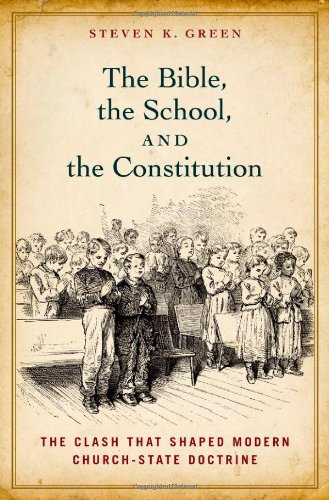
Happily, those interested in these questions now have a promising new book to help them muddle through the mishmash of Constitutional, cultural, educational, and devotional questions raised by this thorny issue.  At Religion & Politics, Michael Waggoner has offered a thoughtful review of Steven Green’s newish The Bible, the School, and the Constitution: The Clash That Shaped Modern Church-State Doctrine (New York: Oxford University Press, 2012).

Waggoner, a scholar of higher education at the University of Northern Iowa and editor of the academic journal Religion and Education, concludes that the most significant contribution of Green’s book is that it moves the discussion away from the 1960s and back to their proper arena: the 1860s.  As Waggoner notes,

“while many Americans believed in 1962—and continue to believe today—that the crisis over the proper relationship between religion and public education arose full blown in the chambers of the Supreme Court, in fact these changes were a century in the making.”

In Green’s telling, the significant struggle over the role of religion and public education took place in the second half of the 19th century.  The linchpin, Green argues in his third chapter, was not only the US Supreme Court’s 1962’s Engel and 1963’s Schempp rulings, but the Ohio Supreme Court’s 1870 Board of Education of Cincinnati v. Minor.*  In that case, the culmination of Cincinnati’s angry “Bible Wars,” the school board successfully defended its decision to remove the reading of the King James Bible from public schools.  The first plaintiffs, John D. Minor and a group of concerned citizens, complained that such a removal was illegal, impractical, and immoral.  One of their reasons was that “large numbers [of city school children] receive no religious instruction or knowledge of the Holy Bible, except that communicated as aforesaid in said schools.”

As Green argues, this case and the cultural controversies that accompanied it nationwide laid the groundwork for the Court decisions of the 1960s.  The “culture wars” of the 1860s and 70s demonstrated the nation’s growing unease with traditional Protestant domination of public life.  Minor’s argument that children would not learn about the Bible if not in public schools did not win over the justices of the Ohio Supreme Court.  Not only that, as Green details, activists who sought to marshal the forces of traditionalism soon realized they faced a fundamentally different political and cultural environment.  A coalition of Protestant ministers first proposed a “Christian Amendment.”  They hoped to answer Cincinnati’s anti-Bible ordinance with a change to the US Constitution clarifying the government’s role in promoting religion.  More successful was the Blaine Amendment.  Largely a move to isolate Catholic schools, Congressman James Blaine proposed an amendment that would clarify: public funds must never support religious schools.

Green’s book will not likely satisfy the critics who insist that God was kicked out of public schools in the 1960s.  But for those of us hoping to understand the long cultural conversation about the changing role of religion in the public square, Green’s book is a great new resource.

* A nerdy detail: as with “Schempp” and “Engel,” this case is usually incorrectly described as Minor v. Board of Education.  That was indeed the name of the original 1869 Cincinnati case that sought to get the Bible back into Cincinatti schools.  However, the Ohio Supreme Court case in 1870 was actually an appeal by the Board of Education against John Minor, thus Board of Education of Cincinnati v. Minor.

The Bible in America: Rightly Dividing the Word of Truth, Part II: Dispensational Premillennialism

“Daniel and Revelation Compared,” by Clarence Larkin, c. 1919

For most kinds of conservative Protestants, it is difficult to overestimate the importance of the Bible in theology and culture.  After all, at the heart of the Protestant Reformation was a call to return Christianity to reliance on Scripture, Faith, and Grace.  For outsiders trying to understand this segment of Fundamentalist America, a good starting point is an attempt to wrap our heads around a Biblical worldview.

As historian Timothy Weber argued in the early 1980s, one tradition of conservative evangelical Protestantism has long confronted a decisive Biblical dilemma.  In the early twentieth century, this self-identified “fundamentalist” group wrestled with this stubborn paradox: the Bible must be assumed to be clear and comprehensible to all readers, yet readers must be guarded against naïve misinterpretation.  In the end, Weber argued, the first generation of fundamentalist Bible teachers “fought hard to keep the Bible accessible to ordinary believers but in the end made them nearly totally dependent on themselves” (117).

Let me be as clear as possible: in these discussions we are not talking about the wider cultural traditionalist “Fundamentalist America” that usually fills these pages.  Instead, we’re focusing now on a small but influential subset of conservative evangelical Protestants, those few who fit the definition of small-f Protestant fundamentalism.

In the early twentieth century, this group rallied around a particular sort of Biblical interpretation.  Though not without dissent and voluble disagreement, a theology of dispensational premillennialism became for many conservative evangelical Protestants the only proper interpretation of the Bible’s message.

This post will attempt to introduce outsiders to this theology.  As with every topic in the kaleidoscopic world of Fundamentalist America, this introduction will include some broad-brush oversimplifications.  Especially important to remember is that this theology, like every theology or ideology, is constantly changing and subject to intense criticism and disagreement.  Outsiders should never allow themselves to relax into a false sense of self-satisfaction when it comes to understanding such notions.  We at ILYBYGTH write with full consciousness of our inadequate theological background and apologize for our stuttering and awkward presentation of these ideas.  However, with the broad-brush caveat in mind, we can lay out a few basic facts about dispensational premillennialism.

The theology came to the United States in the late 1800s, introduced by theologian John Nelson Darby.  Darby found that he could not convert many American evangelicals to his Plymouth Brethren sect, but his theology became surprisingly influential.

Christians have been arguing about both dispensations and the millennium for thousands of years.  Saint Augustine, for example, noted in his Confessions (Book III, Chapter 7) that naïve Christians complained of inconsistency with Old Testament rules.  “The people of whom I am speaking,” Augustine wrote, “have the same sort of grievance when they hear that things which good men could do without sin in days gone by are not permitted in ours, and that God gave them one commandment and has given us another.”

The answer, for Augustine as for Darby and subsequent generations of Christians, is that sacred history has been divided into discrete dispensations.  For American Protestant fundamentalists, this understanding of the Bible has been taught assiduously for generations.  In the first generation, Bible and prophecy scholars such as James M. Gray of the Moody Bible Institute, A.T. PiersonI.M. Haldeman, and Arno Gaebelein taught readers how to understand the divisions in sacred history.

But no other single work was more influential in teaching the fundamentalists’ new interpretation of Scripture than Cyrus I. Scofield’s annotated study Bible.  This commentary on the King James Version first appeared in 1909 and remains in print.  These days, it is also readily available online.  Scofield’s commentary led many readers to assume a dispensational premillennial reading was part of Holy Writ itself.  To give just one example, in a note to Exodus 19:8 (“And all the people answered together, and said, All that the LORD hath spoken we will do”), Scofield added this dispensational interpretation:

“The Fifth Dispensation: Law.  This dispensation extends from Sinai to Calvary—from the Exodus to the Cross.  The history of Israel in the wilderness and in the land is one long record of the violation of the law.  The testing of the nation by law ending in the judgment of the Captivities, but the dispensation itself ended at the Cross. . . . See, for the other six dispensations: Innocence (Gen. 1:28); Conscience (Gen. 3:23); Human Government (Gen. 8:20); Promise (Gen. 12:1); Grace (John 1:17); Kingdom (Eph. 1:10).”

Another prominent dispensational interpreter and popularizer was Clarence Larkin of Philadelphia.  Larkin’s dispensational charts laid out this theology for students of dispensational premillennialism.

The second half of this term, “premillennialism,” also has a long and storied history among Christians.  Christians traditionally fell into several interpretations of the second coming of the Christ.  Premillennialism, the notion that Christ will return to save a fallen world and usher in a thousand years of earthly peace and justice, remained popular for generations in the early church.  By the third century AD, however, mainstream Christianity welcomed a variety of interpretations of the millennium.  Postmillennialism became influential in American Protestantism throughout the nineteenth century.  In this reading, Christ would return at the end of a thousand years of earthly peace.

Darby’s theology introduced a new wrinkle into these traditional disputes.  Based on his interpretation of 1 Thessalonians 4:14-18,* Darby argued for a secret rapture of all true believers at the start of the end-times.  For many conservative evangelicals, this notion of a secret rapture has become the standard interpretation of the last days.  And, again, it is vital to remember that these ideas are the subject of intense dispute.  Schools of futurists, historicists, amillennialists, and many others insist on their own vision of the apocalypse.

Bumper Sticker Culture War-ning

For those of us trying to understand Fundamentalist America, simply understanding the basic outlines of dispensational premillennial theology will help.  Believers in this vision of Bible truth will see history and politics as primarily an unfolding of Bible prophecy.  The future, in this theology, is written and clear to all those who rightly divide the word of truth.  As historian Dwight Wilson argued in the 1970s, premillennial belief has had a decisive influence on American foreign policy for generations.  Candidates for the important role of the Antichrist have included Franklin D. Roosevelt, Mussolini, Hitler, and a succession of Roman Catholic Popes.  Central in every interpretation, however, is the decisive role of the state of Israel and the world’s Jews.

Those who view world politics and history through this lens will likely be difficult for outsiders to understand.  They will certainly be less likely to agree to pragmatic solutions or a two-state solution to the Palestinian/Israeli dispute, for instance, since they believe they have read the ending of this story in advance.

For such Bible believers, political activism is not intended to procure half a loaf.  Rather, the goal is to line up on the right side and to watch as prophecy unfolds.  Thus, returning Jews to Israel is an important part of divinely dictated history, but returning Palestinians to that same land is not.  Signing on to the program of a charismatic UN leader might mean condemning innocent souls to hell, not merely wasting aid dollars.  In sum, though it is important not to fall for scare stories about the power of Bible prophecy in determining US foreign policy, it is also important to understand the theological roots of some of fundamentalism’s most distinctive ideas.

*          “For if we believe that Jesus died and rose again, even so them also which sleep in Jesus will God bring with him.  For this we say unto you by the word of the Lord, that we which are alive and remain unto the coming of the Lord shall not prevent them which are asleep.  For the Lord himself shall descend from heaven with a shout, with the voice of the archangel, and with the trump of God: and the dead in Christ shall rise first: Then we which are alive and remain shall be caught up together with them in the clouds, to meet the Lord in the air: and so shall we ever be with the Lord.  Wherefore comfort one another with these words.”

Further Reading: Timothy P. Weber, “The Two-Edged Sword: The Fundamentalist Use of the Bible,” 101-120, in Nathan O. Hatch and Mark A. Noll, eds., The Bible in America: Essays in Cultural History (New York: Oxford University Press, 1982); see also Weber’s Living in the Shadow of the Second Coming: American Premillennialism, 1875-1982 (Chicago: University of Chicago Press, 1987) and Ernest R. Sandeen, The Roots of Fundamentalism: British and American Millenarianism, 1800-1930 (Chicago: University of Chicago Press, 1970); Dwight Wilson, Armageddon Now! The Premillenarian Response to Russia and Israel since 1917 (Berkeley: University of California Press, 1975).

All in the Family: The Westboro Baptist Church

–Thanks to EH

“God Hates Fags.”  That is the line that has attracted so much attention for Fred Phelps and his cultish Westboro Baptist Church.  This is the tiny family-based church from Topeka, Kansas that pickets the funerals of American servicemen and -women.  They insist that such casualties are God’s just punishment for America’s sinful ways.

ILYBYGTH’s attention was drawn to a fascinating interview with Nate Phelps, one of the pastor’s sons.  Nate grew estranged from the family church and has taken to public criticism.  Nate Phelps tells an horrific tale of cruelty and terror justified by dogmatic if erratic Biblicism.

We here at ILYBYGTH have only joked about Phelps’ brand of extreme fundamentalism.  We know it’s not funny, but we also feel that Phelps is not representative of Fundamentalist America.  Rather, as my new hero “Ivan Fyodorovich” perceptively commented during an online discussion about Nate Phelps’ story,

There’s some weird codependent relationship between Phelps and progressives.  I’m here a couple hours away from Topeka in Kansas City, where my sister and her family are heavily involved in an enormous evangelical community (which played prominent role in that revival Perry appeared at in Houston last year) that is activist in the same culturally conservative causes as as WBC is — opposition to gay marriage, anti-abortion, theocratic civil governance, and all part of End Time preperation — and she had never heard of Fred Phelps when I mentioned him a few years ago.  Because WBC is a non-entity in this larger world that is much more active, much more powerful and influential than WBC ever will be.
And yet those of us opposed to this worldview spend so much time on Phelps and so little time on the millions like my sister’s ministry.  The reason for that is that her ministry absolutely doesn’t want the sort of press that Phelps gets.  They are more influential without the press than they would be with it.  But Phelps wants this kind of press, though, because it’s not about being influential in achieving his worldview, it’s about the fact that he’s an evil fuck with a cult who loves the limelight.
The views that we despise in Phelps are views we rightly despise elsewhere.  And I’m not saying that we shouldn’t oppose him, really.  He’s noxious.  But he’s not really the face of the enemy.  In a way, he’s the face the enemy wants us to have of them.  We’re not helping our cause when we place some much importance and attention on Phelps.

In our opinion, Ivan Fyodorovich hits the nail on the head here.  Phelps’ WBC is part of Fundamentalist America.  Fair enough.  But for many outsiders, especially for many anti-fundamentalists, Phelps’ brand of Bible-based noxiousity ends up standing in for the real complexity of Fundamentalist America.  It does not lead to real understanding if we outsiders simply assume that Phelps’ pathology can be taken as a demonstration of the meaning of conservative Protestantism.  Please don’t misunderstand: I’m not trying to justify or dismiss Phelps’ angry sect.  We need to understand Phelps as one of the frightening possibilities of fundamentalism in America.  But we must not fall into the outsiders’ trap of assuming that Phelps is representative of anything except himself.

A much better place to begin would be with Ivan F.’s moving description of his family relationships that helps demonstrate a clearer picture of life in Fundamentalist America.

The Bible in America: Proof-Texting and the Cultural Divide

Quick: What does the Bible have to say about vegetarianism?  …about the war in Iraq?  …about Catholicism?

I don’t know the answers to these questions.  And, without meaning any disrespect, I can honestly say I don’t care.  I don’t think my ignorance on these issues makes me “ignorant.”  I don’t think it makes me uneducated.  I just don’t think the Bible’s opinions on these issues are important.  Don’t get me wrong: I’m not anti-Bible.  In fact, I’m confident I’d be better off if I had spent my youth memorizing the Psalms instead of the lyrics to the Gilligan’s Island theme song.  But I didn’t.  And I don’t feel the loss.

Just sit right back and you’ll hear a tale…

However, many citizens of Fundamentalist America would consider my ignorance deeply embarrassing.  For many conservative religious folks, especially among the Protestant denominations, the ability to cite Scriptural chapter and verse is one sign of an adequate spiritual education. 

This divide fuels America’s culture wars.  Many non- or anti-fundamentalists doubt that fundamentalists are even capable of rational, logical intellectualism.  (Consider a few examples: here, here, here, here, and here.)  The more ardently conservatives dig into their Bibles to prove their points, the more confident anti-fundamentalists become that conservatives have lost all claim to intellectual coherence.    

And many fundamentalists don’t seem to understand that their compilations of Biblical proof-texts carry very little weight outside the borders of Fundamentalist America.  They build arguments against homosexuality  or same-sex marriage based on collections of chapter and verse.  But such arguments are only compelling—or even comprehensible—if we accept the premise of the Bible proof-text in the first place.  As a result, different sides do not speak to one another.  They speak—or yell—past one another, scoring points that only the people on their own side can recognize.    

If we outsiders are to understand Fundamentalist America, we need to understand the proof-text tradition.  Why do religious conservatives care so much what Leviticus has to say about whether or not people should have sex with animals?   Why is it so important that evidence for a young earth can be found not only in Genesis, but also in Mark 10:6, 1 Corinthians 15:26, and Matthew 19:4,5? 

It is not a stretch to say that this style of proof-text argument had been, until the late 1800s or early 1900s, the standard style of theological disputation among Protestants.  In the nineteenth century, European scholars began to look at the Bible in a new way.  By the turn of the twentieth century, leading American Protestant theologians disputed the intellectual usefulness of the Scriptural proof-text.  In 1907, for instance, William Newton Clarke lambasted his more conservative colleagues for their continued reliance on this method.  “Even if,” Clarke argued, “a proof-text method were a good method in itself, it could not be successfully employed now, since the texts of the Bible have suffered such serious though unintended distortion.”  Since liberal theologians had come to disagree with the notion of an inerrant Bible, the method of proving an argument by assembling an overwhelming dose of chapter and verse no longer seemed compelling.

During the twentieth century, however, among Bible-centered Protestants—including self-styled fundamentalists, neo-evangelicals, Pentecostal groups, conservative Lutherans, and others—the proof-text tradition continued.  For those groups who maintained a faith in the Bible as inerrant, it remained convincing to prove every point with an assembly of relevant texts. 

Consider the following doctrinal statement from David Cloud’s Way of Life Ministries.  Each point is proven with an array of relevant texts. 

STATEMENT OF FAITH

Way of Life Literature
P.O. Box 610368, Port Huron, MI 48061
866-295-4143 (toll free), fbns@wayoflife.org
http://www.wayoflife.org


THE SCRIPTURES

The Bible, with its 66 books, is the very Word of God. The Bible is verbally and plenarily inspired as originally given and it is divinely preserved in the Hebrew Masoretic Text and the Greek Received Text. The Bible is our sole authority in all matters of faith and practice. The King James Version in English is an example of an accurate translation of the preserved Hebrew and Greek texts; we believe it can be used with confidence. We reject modern textual criticism and the modern versions that this pseudo-science has produced, such as the American Standard Version, the New American Standard Version, the Revised Standard Version, and the New International Version). We also reject the dynamic equivalency method of Bible translation which results in a careless version that only contains the general ideas rather than the very words of God. Examples of dynamic equivalency versions are the Today’s English Version, the Living Bible, and The Message.

2 Samuel 23:2; Psalm 12:6-7; Proverbs 30:5-6; Matthew 5:18; 24:35; John 17:17; Acts 1:16; 3:21; 1 Corinthians 2:7-16; 2 Timothy 3:15- 17; 2 Peter 1:19-21; Revelation 22:18-19

THE CREATION

We believe in the Genesis account of Creation and that it is to be accepted literally and not figuratively; that the world was made in six 24-hour days; that man was created directly in God’s own image and did not evolve from any lower form of life; that all animal and vegetable life was made directly and made subject to God’s law that they bring forth only “after their kind.”

Genesis 1; Nehemiah 9:6; Job 38:4-41; Ps. 104:24-30; Jn. 1:1-3; Acts 14:15; 17:24-26; Rom. 1:18-21; Col. 1:15-17; Hebrews 1:1-3; 11:3

THE WAY OF SALVATION (THE GOSPEL)

Salvation is by the grace of God alone, which means that it is a free gift that is neither merited nor secured in whole or in part by any virtue or work of man or by any religious duty or sacrament. The gift of God’s grace was purchased by Jesus Christ alone, by His blood and death on Calvary. The sinner receives God’s salvation by repentance toward God and faith in the Lord Jesus Christ. Though salvation is by God’s grace alone through faith, it results in a changed life; salvation is not by works but it is unto works. The faith for salvation comes by hearing God’s Word. Men must hear the gospel in order to be saved. The Gospel is defined in 1 Corinthians 15:1-4.

John 1:11-13; 3:16-18, 36; 5:24; 14:6; Acts 4:12; 15:11; 20:21; Romans 10:9-10,13, 17; Ephesians 1:7; 1:12-14; 2:8-10; Titus 3:3-8; Hebrews 1:3; 1 Peter 1:18-19; 1 John 4:10

CIVIL GOVERNMENT AND RELIGIOUS LIBERTY

We believe that civil government is of divine appointment for the interests and good order of human society; that magistrates are to be prayed for (1 Tim. 2:1-4), conscientiously honored and obeyed (Mat. 22:21; Rom. 13:1-7; Titus 3:1; 1 Pet. 2:13-14), except only in the things opposed to the will of God (Acts 4:18-20; 5:29); that church and state should be separate, as we see in Scripture; the state owing the church protection and full freedom, no ecclesiastical group or denomination being preferred above another. A free church in a free state is the Christian ideal.

We can see the proof-text tradition in David Cloud’s sermons as well. 

The way Cloud and Way of Life use proof-texts is just one example from a galaxy of possible examples out there.  Especially among Bible-based conservative evangelical Protestant groups, the proof-text is the method by which truth is established.  The Bible is the inerrant authority.  In order to make any point, about any subject, the name of the game is proof-texting.  Of course, among many conservative Protestants, the term “proof-text” has taken on negative connotations.  It should not mean that one simply has to slap a bunch of Bible citations together to prove a point.  In this continuing intellectual tradition, the cogency of the argument is based on the proper selection of texts.  How well do the selected texts establish the point at hand?  Does the author use each text in a way that respects the context and original meaning of the selected passage?  Does the author consider relevant passages that might disagree with this interpretation?  Or does a poorly educated pastor merely assume an air of false erudition by throwing Scriptural citations around willy-nilly

To be sure, it is an intellectual tradition that no longer carries weight in mainstream religion and culture.  Though large majorities of Americans might believe that the Bible contains the answers to all of life’s questions, those same majorities do not necessarily agree that the Bible should be the main intellectual authority in all matters.  Indeed, especially galling to many non- and anti-fundamentalists is proof-texters’ assumption that their particular religious tradition should be considered binding in matters of public policy.  In other words, it may be fine for Way of Life to demonstrate the validity of its creed through proof-texts.  But that does not mean that proof-texts can be used to demonstrate the need to teach religious doctrine in science classes. 

These are important arguments.  Proof-texters need to understand that their intellectual tradition does not carry weight outside the borders of Fundamentalist America.  But that is a much different thing than admitting to being non-intellectual or anti-intellectual.  If we outsiders can better understand the tradition of proof-texting, we will be better able to speak intelligently, reasonably, calmly, and even productively with Fundamentalist America.     

FURTHER READING: William Newton Clarke, The Use of the Scriptures in Theology (Edinburgh: T. & T. Clark, 1907); Timothy P. Weber, “The Two-Edged Sword: The Fundamentalist Use of the Bible,” Nathan O. Hatch and Mark A. Noll, eds., The Bible in America: Essays in Cultural History (New York: Oxford University Press, 1982), 101-120.