They’re Coming for your Children

Beware!  The State is coming for your children.

That is the reminder recently from some conservative Christian commentators.

As we’ve noted here at ILYBYGTH, the struggle for control over children between parents and the state has a long and bitter history.
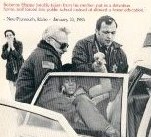
The cover of Sam Blumenfeld's 1981 Is Public Education Necessary depicted a teen being forcibly abducted from his home by agents of the State.  His crime?  Learning outside of government schools.

The cover of Sam Blumenfeld’s 1981 Is Public Education Necessary depicted a teen being forcibly abducted from his home by agents of the State. His crime? Learning outside of government schools.

Recent warnings have come from Elizabeth Mitchell of Answers in Genesis and Roger Kiska of the evangelical Alliance Defending Freedom.

The lesson from Germany is stark, both insist.  In that country, homeschooling parents have had their children taken away by the government.

Mitchell tells the story of the Wunderlich family.  By German law, the four children of this homeschooling family were arrested for violating a school-truancy law.  Mitchell warns that such threats are not limited to Germany.  “Those of us,” she insists,

who maintain that the Word of the Creator of the universe can be trusted from the very first verse work to provide answers to equip children and adults to understand science as well as the suffering in the world in the light of God’s Word. At the same time, we as Bible-believing Christians must not take for granted our freedom to speak the truth. . . .  we need to remain vigilant to guard against encroachments that chisel away at the freedoms we have in our own country.

Writing for the Alliance Defending Freedom, Kiska similarly warns, “today, the suppression of parental rights to teach and influence their own children isn’t restricted to overtly fascist regimes.”  In Sweden and Germany, “a land once shrouded under the Nazi flag,” homeschooling families have been attacked by government forces.  Such threats are not limited to Europe, Kiska insists.  He asks,

So, could Europe’s degree of intolerance and crackdown on homeschooling reach American shores anytime soon? It all depends on how vigilant we are in opposing decisions like the one in New Hampshire—and it’s precisely why ADF is fighting to protect parental rights in that case and abroad so that a very nasty cancer is not allowed to grow.

For outsiders like me, this anti-state rhetoric can seem strangely hyperbolic, even a “paranoid style.”  But dismissing these fears as mere social neurosis misses the point.  For many Americans of a conservative bent, the dangers of government aggression are of primary concern.  So, for instance, when pundits such as Allison Benedikt make an aggressive case for public education, many conservative writers express alarm.

This is more than just a paranoid style.  This is a thorough-going distrust of government power.  This distrust lies at the heart of conservative thinking in the United States.  Many conservatives still relish the pithy expression of this central idea by Ronald Reagan.  As Reagan put it, the most terrifying words in the English language are these: “I’m from the government and I’m here to help.”

For some conservatives, that government “help” might include the forcible abduction of children.  Folks like me might scoff at the extreme paranoia of such ideas, but we will be wise to understand that such warnings resonate with large numbers of Americans.


Public Schools Can’t Serve the Public

To be useful to the public, Christians must reject “public” education.

That’s the argument made recently by Stephen Richard Turley in the pages of The Imaginative Conservative.

As I’ve noted elsewhere, one of the fundamental questions of Christian-school advocates is whether or not to stay in public education.  Dr. Turley makes the case that real Christians must abandon so-called public education.  In doing so, Turley writes, Christians do not turn away from the public sphere, but rather embrace it.

Today’s public education, Turley argues, is by definition anti-public.  Today’s so-called public schools hope to squeeze religious life into the private margins.  By doing so, so-called public schools warp the public sphere, allowing only secular notions to flourish, Turley writes.

The only answer for Christians, Turley believes, is to remain dedicated to true public witness by embracing private schools.

Confused?  Read Turley’s entire essay.

As he concludes,

If Christians are to remain faithful to the biblical gospel, we must once again affirm the public witness of the church, particularly in the field of education. For such an affirmation not only awakens the soul to the True, the Good, and the Beautiful, but in embodying the Truth, it exposes the state-financed educational system which denies Truth as what it is: a lie. We cannot teach our students that Truth is relative and expect our politicians to be honest; we can’t claim that the Good has been replaced by situational ethics and expect Wall Street executives to ground their business decisions in anything other than profit, greed, and expediency; and we cannot relegate Beauty to personal preference and then feign shock when we encounter a urinal as part of an art exhibit.

Christians will never expose this lie as long as they support and fund it. Classical Christian education offers nothing less than a parallel public, a revelation of Truth that in its social splendor awakens wonder and awe in teacher and student alike, as together they fellowship in Him who is the divine renewal of all things.


Required Reading: Christian Jihadis and Presbyterian Ayatollahs

The Christian terrorists are coming for you.

That has long been the hysterical message about “dominionism” present in American media and even academic writing.  But is it true?

In an illuminating recent article in the Journal of Religion and Popular Culture, Michael J. McVicar analyzes the ways “dominionism” has been used as a rhetorical cudgel over the past thirty years.

Though McVicar specifies he’s not trying to offer an authoritative biography of dominionism, nor a prescription for handling dominionism, his article still offers a helpful guide to the ways this bogey has developed, among evangelical Protestants and among the broader culture.

As McVicar recounts, in the 2012 presidential primaries accusations of “dominionism’s” influence flew fast and furious.  Michele Bachmann and Rick Perry in particular stood accused of close ties to dominionism.  For many in the media, that implied a vague sort of theological imperialism, a desire to impose religious strictures on American public life.

McVicar traces the talk about “dominionism” back to criticism by evangelical writers in the 1980s of two Christian movements, Rousas J. Rushdoony’s Christian Reconstruction movement and Earl Paulk Jr.’s Kingdom Now movement.  Leading evangelical authors insisted that such movements did not and could not represent mainstream evangelical theology.

Most important, McVicar argues, these evangelical criticisms served to propagate the labels “dominionism” and “dominion theology.”

Soon, writers outside of evangelical circles appropriated evangelical critiques.  In the late 1980s and early 1990s, McVicar writes, secular critics “appropriated much of the evangelical press’s criticism of dominion theology while simultaneously reframing it within the discourses of political progressivism and cultural pluralism.”

Soon, McVicar argues, scholar/activists such as Sara Diamond popularized a caricature of dominionism as the “central unifying ideology for the Christian Right.”

Much of the treatment of “dominionism” in these journalistic and academic treatments has contributed to a frenzy over the connections between conservative Christianity in America and violent, militant religion in other parts of the globe.  For some, “dominionism” serves as proof that all conservative Christians secretly want to take over secular institutions.  For others, “dominionism” is nothing but a bogey of progressive nightmares.

McVicar pushes a more subtle line.  There is such a thing as dominionism, he avers.  However, talk about dominionism usually tells us more about the speaker than about the subject.  Evangelical critics have defined dominionism out of bounds for evangelical belief.  Secular and progressive critics have defined dominionism out of bounds for civil American culture and politics.

Of course, as regular readers of ILYBYGTH are keenly aware, these issues of definition and boundary construction are central to school politics.  I’ve argued in these pages that anti-dominionist rhetoric is more often a blunt instrument than a real effort to shape policy.  If conservatives want to establish schools that include prayer or Bible reading, for example, critics can accuse them of anti-American “dominionism.”  If conservatives want to restrict the teaching of evolution or of sexual information, critics can accuse them of creeping “dominionism.”

Such talk doesn’t help make better schools.  But understanding this kind of talk and the way it has developed historically does promise to help us understand how American education really works.

McVicar’s website tells us that he is working on developing these arguments in a book under contract with the University of North Carolina Press.

We’ll look forward to it.

Further reading: Michael J. McVicar, “‘Let Them Have Dominion:’ ‘Dominion Theology’ and the Construction of Religious Extremism in the US Media,” Journal of Religion and Popular Culture 25.1 (Spring 2013): pp. 120-145.


Beware: “Government Schools”

What’s the difference between a “government school” and a “public school?”

It seems a “government school” is one calculated to impose a sinister ideology of sloth, poor manners, high spending, and bestial morality on its students.

At least, that’s what reading today’s conservative headlines would lead one to believe.

Anyone who browses certain conservative writers and activists will soon notice this ubiquitous usage.  Again and again, we read about “government schools” instead of about “public schools.”

For example, pundit James Ostrowski warns readers to pull their children out of “government schools.”  There’s nothing more important if readers want to “save America, not to mention your own kids.  Government schools,” Ostrowksi warns,

Were not established out of any dire need for them but rather for a variety of crass religious, political and economic motives.  They were not immaculately conceived but rather were born out of a toxic stew of religious absolutism, Prussian militarism, utopian socialist leveling, special interest greed and power lust.

It is not only the history of “government schools” that troubles Ostrowski.  Today’s government schools, he insists, are “loaded with crime, bullying, drugs and sexual promiscuity.  They indoctrinate students into a false view of American history, one that is invariably favorable to ever-expanding government.”

Ostrowski’s jeremiad may sound far-fetched to some readers, but his strident anti-public-school-ism is widely shared among conservative commentators.

“Government schools” force students to act like slaves, we read.

“Government schools” expose children to drugs, sex, and even early deaths, we read.

It seems the phrase “public school” still retains too many positive connotations to suit the taste of some commentators.  In order to convince readers of the terrors of public education, many conservative activists seem to have adopted the label “government schools” instead.  With this flip of a rhetorical switch, those innocent red schoolhouses on the hill have been replaced by gloomy outposts of centralizing overreach.  “Government” schools carry all the terrifying baggage among some conservatives of any other government program.  If schools are outposts of the government, then they must be outposts of the regime to strip Americans of their traditional religion, their ferocious independence, and their hard-earned tax money.

I’ve been intrigued by this common rhetorical switch among conservatives lately.  It is a powerful yet simple change.  After all, no one can gainsay the fact that public schools are, indeed, government institutions.  But if we think of them as “public,” they seem to belong to us all.  If we think of them as the “government,” then we can rally Tea Party angst and energy to reject them.

The historian in me grew curious to track back this change in conservative school talk.  I looked back through all my overstuffed files and reading notes.

The earliest usage I could find traced back to the influential conservative pundit Sam Blumenfeld.  Blumenfeld wielded significant influence in the 1980s.  My research in the National Archives revealed that Blumenfeld’s work was promoted by the highest levels of William J. Bennett’s Education Department.

It was Blumenfeld that offered the earliest example I could uncover of calling public schools “government” schools.

In his 1981 book Is Public Education Necessary?  Blumenfeld warned that public schools did not live up to their own positive reputation.  Public schools did not work to promote democracy.  They did not function as religious and ideologically neutral institutions.  They did not wisely use public money.  They did not hire quality teachers.  In short, public schools, Blumenfeld argued, did not deserve their unassailed reputation as necessary governmental institutions.

In effect, Blumenfeld insisted, a student going to public school “emerges indoctrinated in a body of secular values as if he had gone to a sort of government parochial school.”

Now, I’m not suggesting that today’s conservative pundits are all deriving their use of the term “government school” directly from Sam Blumenfeld.  But his use was the earliest I could find.  My hunch is that Blumenfeld’s considerable influence among conservative educational activists did a great deal to promote the term’s widespread popularity today.


Decadence and the Fall of American Public Education

Things today ain’t as good as when I was young.

That’s the central notion, the vaguely articulated impulse, the often-unexamined presumption behind a good deal of conservative educational rhetoric.  Schooling these days has declined from glory days of the past.

In an essay in The American Interest, Charles Hill warns of the real consequence of decadence in American life.

As Hill notes, the idea of civilizational decline and fall is an old one.  Yet Hill insists that it retains explanatory power; Hill makes the case that twenty-first century America is sliding into a dizzying downward spiral.  Everything from technologically induced “screen culture” to awkward proletarianization of elites can be better understood as part of a lamentable decadence.

As Hill concludes,

Around the turn of the 19th to the 20th century, “decadence” arose as a romantically thrilling elitist fashion, providing a “sweet spot” in which a privileged, self-selected class could revel in dissolute practices while applauding their own cultural superiority. At the turn of the 20th to the 21st century something akin has emerged—call it a democratized form of decadence—among a far wider swath of the population, with the support of government and approbation of the cultural elite. Many observers have gazed upon such phenomena, then and now, and have seen mainly the sources of shifts in the art world. We move from the 1913 New York Armory Exhibition to mainstreaming of “street art” a century later rather effortlessly. But if what is at stake is world order, with national character and identity as its foundation stone, and democracy as the procedurally and practically most efficacious political form, then the fate of the art world may be the least of our concerns.

The essay is worth reading in its entirety.

Of particular interest here are its implications for American education.  Hill makes a few points about this himself.  For one thing, he notices the disturbing intellectual ramifications of “screen culture” especially among the young.  A generation accustomed to viewing people on computers, tablets, TVs, and phones, able to view without being viewed, Hill argues, adds a “new dimension” to old ideas about decadence.  Weaned on screen culture, Hill says, young people “can become oblivious to others.”

In a nuts-and-bolts way, Hill notes the way our current decadence has squeezed out learning in favor of training.

Of more consequence than the specific educational ramifications argued by Hill is the sense of decline Hill articulates.

As I’ve argued elsewhere, it is nearly impossible to understand the conservative impulse in American educational thought and activism without grasping the power of the idea of decadence.  Leading conservative intellectuals—even ones from very different backgrounds—have all grounded their educational philosophy on a notion that the educational system in the United States has ground down in a systematic pattern of decline.

In his landmark work Capitalism and Freedom, for example, free-market theorist Milton Friedman insisted that American public education entered a noticeable period of decline after the American Civil War when the government “gradually” (page 85) stumbled into the near-total “‘nationalization,’ as it were, of the bulk of the ‘education industry’”(page 89).

Conservative education leader Max Rafferty agreed about the decadence, but argued for a different time and cause.  The problem really began, Rafferty believed, in the 1930s, when “Dewey-eyed” reformers injected a deeply flawed notion of education into the American cultural bloodstream.  Instead of learning heroic truths and facing moral challenges, students in post-1930 “life-adjustment” classrooms only learned to revel in their own inability to determine right from wrong.  Such decadent teaching and learning, Rafferty argued in his 1963 book Suffer, Little Children, produced a weak generation, unable to combat the existential threat from “a race of faceless, godless peasants from the steppes of Asia [that] strives to reach across our bodies for the prize of world dominion.”

Though he viewed the goals of education very differently from Rafferty and Friedman, creationist leader Henry Morris agreed that public education had declined dramatically.  The root of the problem, Morris argued in his 1989 book The Long War Against God, lay in a one-two punch of Unitarianism and secularism.  The first blow had come in 1869, when Unitarians took over Harvard University.  Their example led American education away from its roots in what Morris considered to be authentic Christianity (pages 46-47).  The second decisive weakening came later, with John Dewey’s rising influence in public education.  That influence, Morris argued, led public schools away from religion into a markedly anti-religious humanism.

These examples could be multiplied nearly endlessly.  William J. Bennett, for instance, has argued with his Index of Leading Cultural Indicators that American culture as a whole—especially including its public schools—has declined terrifyingly since 1960.

It is taken as an article of faith among many conservative educational thinkers and activists that education today is worse than it has been.

This is more than the common griping about “kids these days.”  This is more than the old story about how when I was young I had to walk to school barefoot, through ten feet of snow, uphill both ways.

To understand conservative thinking about education, we have to understand this assumption of decadence.  Not many activists articulate this sentiment as clearly as the intellectuals described here.  Not many offer the careful examination of the meanings of decadence expressed by Charles Hill’s recent essay.

But behind many of the policies promoted by educational conservatives lurks this ubiquitous sentiment: things today are worse than they have been in the past.  Schools today are worse than they have been in the past.


Life, the Universe, and Nothing

Why is there something rather than nothing?

Is it reasonable to believe there is a God?

Has science buried God?

The Australian City Bible Forum recently posted two video discussions about these questions between prominent science-atheist Lawrence Krauss and religious apologist William Lane Craig.

What they didn’t discuss is what should be included in public schools.  Surprisingly, in the end it is the arguments of Lawrence Krauss that suggest a sort of intellectual dictatorship in science classes, a stern refusal to consider the claims of dissent, even when that dissent represents a majority opinion.  Of course, that is exactly the accusation made by leading creationists.  I don’t buy those creationist arguments, but I do want to understand why we can insist that creationist students learn science the way we define it.

The two veteran debaters did not engage in a formal debate on these timeless questions.  Rather, the City Bible Forum offered a “conversation” between the two speakers.  Each speaker had fifteen minutes to lay out his ideas.  Then the two were open to questions.

The moderator called for a “respectful, intelligent discussion.”  To that end, the evangelical organization invited moderators of very different backgrounds.  For the first discussion, the CBF asked TV journalist Scott Stephens.  For the third, a local atheist academic, Graham Oppy.

For those of us interested in understanding the conservative influence of evangelical religion in American public life, the discussions are worth listening to in their entirety.

Here at ILYBYGTH, I don’t really care very much about the nature of science or religion.  I don’t care very much about whether or not the universe was created ex nihilo.  I don’t care—as Craig and Krauss debate—whether or not an infinitely good God can cause the murder of Canaanite children.  Such things are interesting, but they only make up the background, IMHO, for the really interesting questions.  For me, the rubber only hits the road when we get to discussions about the ways these issues influence real life; the ways such ideas change policy in places such as public schools.

For example, the discussions can help illuminate one of the most stubborn mysteries of American public education.  To folks like me it remains endlessly surprising that so many Americans support the use of religion in public school.  As readers are aware, majorities of Americans support the inclusion of creationism in public-school science classes.  Americans also often support the notion that prayer and Bible reading can be parts of a public-school experience.

The wide-ranging discussion between Drs. Krauss and Craig sheds some light on this head-scratcher.  In the first conversation, “Has Science Buried God?” Professor Krauss acknowledges that religious belief is the default psychological state for most people.  Krauss agrees that “we all want to believe.”  Such desires, Krauss argued, only demonstrate our own intellectual weakness and laziness, our willingness to accept the simple in favor of the true.  “We have to work hard,” Krauss admonished, “to overcome that desire to believe.”

Not surprisingly, Dr. Craig disagreed. But more interesting to me is that even Professor Krauss conceded that most people will tend toward religious thinking.  Though Krauss repeated his accusation that teaching young children religious ideas amounted to “child abuse,” he still acknowledged that such ideas made the most sense to the most people.

If that is indeed the case, if most people will tend toward religious explanations of life, then it should come as no surprise that they want to teach such religious explanations to their children in public schools.

Indeed, for folks aware of the sometimes-ugly history of American education, Professor Krauss’ position raises some difficult questions.  For example, ought public schools impose ideas on children if those ideas are inimical to those children’s families?  In the 19th century, educational leaders often argued that the King James Version of the Bible must be read in every public school, in spite of the objections of Catholic leaders.  Since the Bible was the truth, these schoolmen reasoned, every child must be forced to hear it.

Such reasoning does not acknowledge the legitimacy of dissent.  It does not recognize the “public” nature of public education.  In order to include the entire community, authentic public education would have to recognize the legitimacy of the beliefs of the community.

Professor Krauss, no doubt, would protest that science classes must teach science, not religion.  But, as he should also acknowledge, the boundaries of science have at times been difficult to define.

If, as I do, we still want to insist that public schools teach evolutionary science and not creationism, we are left with the sticky question: Who decides what is “science”?  A majority of mainstream scientists?  That, I’m guessing, is how scientists like Professor Krauss would argue.

How will that majority opinion protect the legitimate views of dissenters?

And if we want to rely on majority opinion, what about the much larger popular majority that wants creationism taught as science?

Jesus, Measles, and the Fight against Science

Does Jesus want your children to get measles?

A recent outbreak at a Texas mega-church highlights the tangled connections between faith, schooling, and science.

The fight against evolution gets all the headlines, but as this story shows, the connections between religion, education, and science can get a lot more convoluted.

As journalist Liz Szabo reported in Religion News Service, Eagle Mountain International Church in Newark, Texas, seems to be ground zero for a recent measles outbreak.  Twenty-five people in all have been sickened, fifteen of whom have direct connections to the church.

A visitor to the church from an unnamed country in which measles are common seems to have sparked the mini-demic.  Pastor Terri Parsons has warned of the connections between vaccinations and autism, a connection mainstream scientists have decisively pooh-poohed.  However, Pastor Parsons has also now encouraged members of the EMIC community to get vaccinated against measles.

According to the RNS story, the infected young people are all home-schooled and apparently unvaccinated.

So does Jesus want children to get measles?  Of course not.

But skepticism runs deep among conservative Christians.  In this case, conservatives did not trust mainstream science’s claims that immunizations were a good idea.  Nor did they trust the state board of education enough to agree that all children of a certain age must get the measles vaccine.


Bullies, Schools, Homosexuality, and the Confederate Flag

Who is a school bully?  Can it be a teacher who disciplines students for wearing Confederate flags or for denouncing homosexuality?

That is the question conservative commentator Anthony Esolen asks today on The Public Discourse.

Esolen, Professor of English at Providence College, considers a recent case from Michigan.

In this compellingly tangled case of homosexuality, history, religion, and education, a teacher hoped to fight anti-homosexual attitudes among his students.  This teacher participated in a school event in which teachers and students wore t-shirts opposing anti-gay bullying.  The teacher showed his class a video about anti-gay bullying, then engaged in a discussion about it.  During the discussion, the teacher noticed that one student wore a Confederate-flag belt buckle.  The teacher ordered the student to remove the buckle.  When another student asked about the obvious contradiction between the student’s right to wear the buckle and the teacher’s right to wear the t-shirt, the discussion exploded.  The teacher eventually disciplined both students, one for the buckle, and one for insisting that his Catholic faith forced him to disapprove of homosexuality.

Esolen brings up these snarled issues in all their complexity.  Does a Catholic student have a right to disapprove of homosexuality?  Does a teacher have a duty to discipline dissenting students?  Can a student wear offensive belt buckles or t-shirts?  What ideas are too offensive to be protected in schools?

Also, importantly, Esolen considers whether an economics teacher should be engaged in these sorts of pedagogical discussions.  If teachers are, as Esolen argues, “a group of tutors hired by a group of parents,” shouldn’t those teachers respect parents’ beliefs more rigorously?

Evolution: Beyond Science and Religion

Outsiders are telling public school families that we must follow the rich man’s elitist religion of evolution, that we no longer have what the Kentucky Constitution says is the right to worship Almighty God.  Instead, this fascist method teaches that our children are the property of the state.

–Matt Singleton, Frankfort, Kentucky, July 2013

Why do so many Americans oppose the teaching of evolution in schools?

The knee-jerk answer is that people fight against mainstream science for religious reasons.

A news story out of Kentucky reminds us that we need to say, “Yes, but…”

Opposition to evolution education in the United States incorporates ideas about religion and science, but we can’t stop there.  If we hope to understand creationism, we need to unpick the tangled skein of ideas that can make up anti-evolution ideology.

This is something that science pundits such as PZ Myers and Jerry Coyne seem unwilling to acknowledge.  America does not face a clear-cut battle between “Science” and “Religion,” between “Knowledge” and “Ignorance,” but a much more stubborn conflict between convoluted collections of ideas, ideas that have grown together over time.  Some science advocates limit themselves to berating creationists for ignorance of evolution, to ridiculing creationists for reactionary adherence to religion.  Such attacks may satisfy our sympathizers, but by willfully mischaracterizing anti-evolutionism, these pro-“science” bloggers only compound the difficulties of healing culture-war divisions.

And those divisions are indeed more complex than activists on either side tend to admit.

Case in point: a notice recently in the Huffington Post drew our attention to this story from Kentucky’s Courier-Journal.  Reporter Mike Wynn described a public meeting over Kentucky’s adoption of the Next Generation Science Standards.  As Wynn reports, opponents of evolution offered comments to the state board of education.  Those comments offer a window into the complicated thinking of anti-evolution activists.

Matt Singleton, for instance, read a statement to the board describing his opposition to the new evolution-friendly science standards.

“Outsiders,” Singleton read,

Are telling public school families that we must follow the rich man’s elitist religion of evolution, that we no longer have what the Kentucky Constitution says is the right to worship Almighty God.  Instead, this fascist method teaches that our children are the property of the state.

As I argued in my 1920s book, anti-evolution activists have always made this sort of intellectual scattershot attack on evolution.  This kind of anti-evolutionism can’t be reduced to merely a theological or scientific argument.  If we hope to understand it, we need to understand the broad intellectual and cultural implications of the argument.  If we want to make sense of it, we must see it for what it is: an “anti-evolution” argument that moves far beyond the boundaries of religion or science.

Some evolution proponents might dismiss The Reverend Singleton’s rant as merely ignorant.  I admit, my first response when someone howls about “outsiders” and “fascist[s]” is to assume we have reached the territory of sea-monsters and sandwich-sign prophets.

But that sort of glib dismissal misses the point.  It does not help us understand why this bundle of anti-evolution ideas remains so politically potent.  Whatever we may think of the connections Singleton makes between region, religion, and rights, those connections make sense to significant numbers of Americans.  It is worth our time to try to understand them.

As a start, let’s try to list all the different reasons for opposing mainstream science education that Singleton packs into this paragraph.

1.) Evolution comes from somewhere else.  (“Outsiders”)

1a.) As an import, evolution is illegitimate.

2.) Evolution is for the rich. (“rich man’s . . . elitist”)

2a.) This elitism calls for popular opposition.

3.) Evolution is a religion. (“religion of evolution”)

3a.) As a religion, it can’t be taught in public schools.

4.) Evolution destroys traditional Baptist religion. (“we no longer have . . . the right to worship Almighty God.”)

4a.) As an attack on religion, it can’t be taught in public schools.

5.) Traditional religion is a Constitutional right. (“the Kentucky Constitution says is the right to worship”)

6.) Evolution is dictatorial. (“fascist method”)

7.) Evolution imposes illegitimate government control over children. (“teaches that our children are property of the state.”)

The Reverend Singleton does not want Kentucky schoolchildren to learn evolution.  But we woefully misunderstand his anti-evolutionism if we simply label him an opponent of “science” and move on.  We also miss the boat if we say too simply that Singleton’s opposition is due to “religious” reasons.  Singleton’s fight against evolution combines a complex bundle of ideas.  That bundle implies certain attitudes toward science and religion.  But it is misleading to say that Singleton is motivated only by “anti-science” attitudes.  Nowhere in his statement—at least in the part published by the Courier-Journal—does Singleton attack science.  And nowhere does Singleton argue that true Biblical faith demands belief in six literal days of creation.

In the American context, we might assume that Singleton believes such things.  But his political argument here includes a much broader bundle of ideas and slogans.

Anyone who hopes to improve evolution education in the United States must start by understanding the complexity of that bundle.  It is not enough to dismiss such arguments as “ignorant” or “irrelevant.”  They make sense to people such as The Reverend Singleton.  They also make sense to the politically powerful voting populace who continue to support the teaching of creationism in America’s science classrooms.


CSCOPE and the Dustbin of History

CSCOPE is dead.

Anyone who hopes to understand the sort of conservative crusade that killed CSCOPE should draw two lessons from the news.

First: Historians should be invited to more dinner parties.

Second: The question is not why CSCOPE was suddenly targeted, but rather why so many Americans are so deeply suspicious of educational experts.

But before we talk about such things, an update: As reported by the Houston Chronicle and Texas Freedom Network Insider, leading Texas politicians announced a few weeks back that the suddenly controversial curriculum management system would no longer be offering lesson plans for Texas school districts.

CSCOPE had come under attack from conservatives in Texas and around the country as promoting a witches’ brew of “progressive,” “Marxist,” “pro-Islam” ideas for Texas schools.  Liberals such as those at the Texas Freedom Network complained in exasperated tones about an irrational “witch hunt” against lessons that had been used without controversy for years.

What does any of this have to do with the loneliness of historians?  The book I’m now finishing looks at the 20th-century history of this sort of school controversy.  Again and again, conservatives discover that the teaching in their schools has been infiltrated by nefarious ideas such as evolution, socialism, progressivism, or filthy sex and violence.  In each case, once a set of textbooks or curricular program gained attention as an example of such ideas, it was quickly tossed out by conservative activists.

I hate to quote myself, but in this case an historian’s perspective makes this outcome seem predictable. As I noted a few weeks back, “CSCOPE might offer an ideologically balanced, pedagogically efficient way for Texas school districts to streamline their teaching systems.  But once it has acquired the reputation for leftist indoctrination, the writing is on the wall.”

This is why historians should be invited to more parties.  Especially if there is food.  Not because historians can predict the future.  Every case is different. But an historical perspective eliminates much of the surprise of unfolding events.  For those who know the 20th-century history of conservative activism in America’s schools, the anti-CSCOPE crusade seems remarkably predictable.

Another important lesson should be drawn from the premature death of CSCOPE.  The career of CSCOPE illustrates the profound cultural divide at the heart of America’s continuing educational culture wars.   Personally, I sympathize with the liberal critics of the Texas Freedom Network, who noted that many of the attacks against CSCOPE seemed “bizarre” or “paranoid.”  As a parent and citizen, I worry about the exaggerated attacks made on this curricular program.

Such attacks, however, must be understood as an irruption of a profound suspicion among Americans about what any outside interference in public school curricula.  Like other commentators, I am deeply skeptical about claims that CSCOPE was a vast conspiracy to subvert patriotic Christian values in Texas public schools.  But the important question is not why this particular program was targeted for attack after years of controversy-free use in schools. The question, rather, is why so many Texans jumped so quickly to join the anti-CSCOPE bandwagon.

This has been the case with every curriculum controversy in the past.  As historians Charles Dorn[1] and Jonathan Zimmerman[2] pointed out about the Rugg textbook controversy in the 1940s, though the Rugg textbooks were banished, similar books continued to be used widely.

In the Kanawha County blow-up of the 1970s, the same sentiment surfaced.  What had seemed like a humdrum approval process for a new set of reading textbooks became a violent struggle over the content of the curriculum.  In that case as in this, many observers scratched their heads and wondered why these particular books had suddenly become such lightning rods.

The depressing truth is that most Americans are deeply skeptical about the intentions of the people who write the books and lesson plans for our public schools.  With curricular materials such as CSCOPE, the Rugg textbooks, or the Interaction series adopted in Kanawha County, as soon as materials were accused of subversion, many Americans believed it.  As conservative leader Elmer Fike explained about the Kanawha County books, “You don’t have to read the textbooks.  If you’ve read anything that the radicals have been putting out in the last few years, that was what was in the textbooks.”[3]

The sudden outrage against CSCOPE shows us this same dynamic at work.  In Texas as in the rest of our nation, a politically powerful plurality are willing to believe outlandish accusations against relatively bland curricular materials.  Though the books and lessons themselves may be moderate in tone, a significant number of parents and politicians are quick to believe they have set out to destroy America.

Why did CSCOPE meet such a sudden and violent premature death?  Because for generations, a significant proportion of Americans have looked with grave suspicion at the intentions of “experts” who write such classroom materials.  Parents are not surprised to hear that textbooks contain hateful language and shocking subversion.  Such accusations confirm what too many parents already believe.

We will not understand the CSCOPE story, nor the similar stories sure to come in future years, unless we grapple with the fact that many parents maintain an awkward ambivalence toward public education.  Many parents may approve of their local schools, but they feel a need to defend those schools from the control of grasping autocrats at far-flung universities and think-tanks.  At the bitter heart of the CSCOPE saga lodges the uncomfortable truth that Americans do not trust educational experts.


[1] Charles Dorn, “‘Treason in the Textbooks:’ Reinterpreting the Harold Rugg Textbook Controversy in the Context of Wartime Schooling,” Paedagogica Historica 44:4 (August 2008): 477.

[2] Jonathan Zimmerman, Whose America? Culture Wars in the Public Schools (Cambridge: Harvard University Press, 2002), 79.

[3] Quoted in James Moffett, Storm in the Mountains: A Case Study of Censorship, Conflict, and Consciousness (Carbondale, IL: Southern Illinois University Press, 1988), 70.