What’s Wrong with Princeton?

Why is young-earth impresario Ken Ham mad at Princeton University? It doesn’t have anything to do with creationism…unless we really understand creationism.

You’d think Ken Ham wouldn’t give a fig about the goings-on at elite Princeton University. After all, Ham—the brains behind Kentucky’s Creation Museum and Ark Encounter—won’t even recommend evangelical colleges such as Wheaton. You’d think he’d have given up on no-longer-evangelical colleges like Princeton a long time ago. Yet Ham is furious at Princeton.

What’s Ham’s beef?

As Ham laments on his blog, Princeton’s Office of Religious Life co-sponsored an event supporting Planned Parenthood. As he puts it,

When universities like Princeton back Planned Parenthood, they abandon a commitment to dialoguing about healthcare or women’s rights. Rather they show a commitment to the violent ending of a life—the life of the unborn. And that is a commitment that harms women, families, and children. We need to stand up for those without a voice and encourage women to choose life for their babies. Abortion is nothing less than the sacrifice of children to the god of self.

SAGLRROILYBYGTH are sick of hearing it, but some folks might be wondering what any of that pro-life stuff has to do with creationism. Isn’t creationism about the ways humans came to be? Why are creationist activists talking about abortion, much less the activities of a purportedly untrustworthy university like Princeton?

As I’m arguing in my current book, if we really want to understand creationism, we have to come to grips with a couple of points highlighted by this story.

First, creationism as a whole doesn’t necessarily have anything to do with abortion. There are plenty of people out there who believe that God created humanity AND support the work of Planned Parenthood. When we talk about the tight connections between creationism and anti-abortion activism, we’re only talking about one type of creationism, the sort of creationism on offer at Ham’s Creation Museum.

foundations AIG

The REAL battle, as seen from Kentucky.


Second, as Ham is fond of pointing out, evolutionary thinking is not only about science, but about an all-enveloping worldview that undercuts true Christian belief. Creationism, as Ham sees it, is about more than young-earth science. It is about a deeply conservative sort of faith, one in which same-sex marriage, abortion, drug use, premarital sex, and a host of other social ills are the flowers of a poisoned evolutionary seed. For Ham and his young-earth creationist allies, the issues of abortion and evolution are intimately joined, even if they are not for other types of creationist.

Seen in this light, it makes perfect sense for Ken Ham to be mad at Princeton. For Ham, abortion IS a creationism question.


The Real Face of Radical Creationism

Smart people keep saying it, but it’s just not true. And for people like me who want more and better evolution education, the news gets even worse.

You’ve heard it before and you’ll hear it again. Even the best-informed science pundits think radical creationism is somehow uniquely American.

If we needed any more evidence that radical creationism is not at all “unique to the United States,” as Bill Nye asserts, we see news this morning from the besieged nation of South Korea. United Press International reports on the confirmation hearing of Park Seong-jin. Like many of his compatriots, Mister Park believes that this planet was created by divine fiat at some point about 6,000 years ago. Park is an engineering professor and nominee for the ministry of small businesses.

Moon-Jae-in-nominee-sparks-uproar-over-creationist-views

Park’s creationism is a complicated post-modern affair.

Park is not alone in his beliefs. As SAGLRROILYBYGTH are well aware, Turkey’s government has passed some radical anti-evolution laws in the recent past. Even here in the US of A, our leading radical creationist is an Australian import.

So don’t listen next time someone tries to tell you there is something uniquely American about radical creationism. It’s just not true.

And the news for secular people like me gets worse.

You’ll also hear people tell you that radical creationism is a vestige of ancient hypocrisies, destined to wither in the face of modernity and the march of science.

Turkish education minister cuts evolution

Durmus’s is a little more straightforward.

Alas, also not true. Radical creationism is profoundly modern, only really emerging into its own in the 1960s. And, though we might gnash our teeth and pull our hair about it, radical creationism is actually a very reasonable response to the changes in church and society that went on in the 1960s.

Let me be clear here: I don’t think radical creationism is true, or based on good evidence, or anything like that. But I am convinced that radical creationists often (not always) have decent reasons for their beliefs, at least as reasonable as most non-creationists’ belief in the truth of evolutionary theory.

Ken Ham

Only Ken Ham’s includes ziplines…

As I argue in my upcoming books (you’ll be able to get Fundamentalist U sometime soon. Why Is Jesus on a Dinosaur is still simmering), conservative evangelicals faced a tough choice in the late 1950s, and even if you don’t agree with it—I certainly don’t—the choice of radical young-earth creationism makes perfect sense.

That’s why it is not confined to hillbilly hollers and Kentucky amusement parks. Radical creationism is a global phenomenon, unintimidated by its lack of mainstream scientific credibility. It is not an ancient truth clinging on in pockets of know-nothingism, but a reasonable (if false and unnecessary) way to make sense of life in our modern world.

We Need More Wax in America’s Ears

Jonathan Zimmerman says let her talk. When we defend academic speech we disagree with, we defend ALL academic speech. Jonathan Haidt says let her talk, because she’s right. Stable marriages and “bourgeois culture,” Haidt agrees, really do help people improve their economic conditions. We here at ILYBYGTH want Professor Wax to have her say for different reasons. In short, we think we won’t be able to truly reform public education until we do. We’ll make our case this morning and we’re going for bonus points by working in both creationism and the Green Bay Packers.

aaron rodgers jesus

I don’t think St. Aaron attended Penn Law…

If you haven’t been following the frouforole emanating out of Philadelphia, here it is in a nutshell: Professor Amy Wax of Penn Law and Professor Larry Alexander of UCLA penned a provocative piece at Philly.com. If we really want to ease the burdens of poverty, they reasoned, we should encourage more people to embrace “bourgeois culture.” Such ideas have gotten a bum rap, Wax and Alexander said, but the notions of deferred gratification, stable two-parent households, and patriotic clean living are of enormous economic value.

The outcry was loud and predictable. Penn students rallied to shut down such “white supremacist” notions. Wax’s colleagues denounced her ideas in more nuanced form.

Any progressive historians in the room surely share Professor Zimmerman’s concern. After all, when academic speech has been banned and persecuted in this country, it has been progressive and leftist scholars who have borne the brunt of such punishment.

There is a more important reason to allow and encourage a frank and open airing of Professor Wax’s arguments. As recent polls have reminded us, Americans in general are profoundly divided about the meaning of poverty. For argument’s sake, we might say there are two general sides. Lots of us think that the most important cause of poverty is a social system that defends its own built-in hierarchies. Rich people stay rich and poor people stay poor. Lots of other people disagree. Many Americans tend to blame individuals for their poverty, to assume that personal characteristics such as grit and gumption are enough to solve the problem of poverty.

Professor Wax’s argument tends to support the latter view. And if you disagree with her, you might be tempted to try to shut her down.

That’s a mistake.

Why? Because her arguments just don’t hold water. And because the more often we can get discussions of poverty on the front pages, the more chances we’ll have to make better arguments, to explain that America’s anxiously held Horatio-Alger notions don’t match reality.

In other words, when it comes to tackling the problem of poverty in America, the biggest challenge is that people simply don’t want to talk about it. They want to rest in their comfortable assumptions that the system is fundamentally fair even if some people don’t have what it takes to get ahead.

I’m convinced that the truth is different. Personal characteristics matter, of course. Far more important, however, is the whole picture—the social system that puts some kids on a smooth escalator to riches and others in a deep economic pit with a broken ladder.

Because I’m convinced that the best social-science evidence supports my position, I want to hear more from people like Professor Wax. I want to encourage people who disagree to make their cases in the front pages of every newspaper in the country.

Sound nutty? Consider a couple of examples from near and far.

Radical creationists like Ken Ham want to protect children from the idea of evolution. They fear, in short, that students who hear the evidence for evolution will find it convincing. With a few prominent exceptions, radical creationists want to cut evolution from textbooks and inoculate students against evolution’s powerful intellectual allure.

Those of us who want to help children learn more and better science should welcome every chance to put the evidence for mainstream evolutionary theory up against the evidence for radical young-earth creationism. Mainstream science should never try to shut down dissident creationist science. That’s counter-productive. Rather, mainstream science should encourage frank and open discussions, knowing that exposure to the arguments on both sides will convince more and more people of the power of mainstream thinking.

Or, for my Wisconsin friends, consider another example.

If a Bears fan wants to clamber up on the bar and insist that her team is better than the Packers, it would be the height of folly to try to stop her from speaking her piece. Those of us who know the true saving grace of St. Aaron will instead happily let her slur through her argument, smiling and waiting for Thursday night. The more games we play, the more often the Packers will win.

When the evidence is on our side, it is always better to encourage all the debate we can get.

Creationist College History, Part II: Parting the Waters

I know, I know, it has been hard to sleep for the last couple days. With the cliff-hanger ending of my last guest post about evangelical colleges at Righting America at the Creation Museum, I’m sure it has been difficult to wait for the sequel.genesis flood 1961 ed

Well, wait no longer: Today at RACM you can read the second half of my argument about the way evangelical higher education influenced the career of American creationism.

What Goes on at Creationist Colleges?

Thanks to Bill and Sue Trollinger, the wizards behind Righting America at the Creation Museum, I’ve had a chance to share a few of my ideas about the vital role played by higher education in the evolution of American creationism.

Gustafson chimes cartoon bible a myth at many colleges

Evolution has always been forbidden fruit, but not always in the same ways. This cartoon came from Biola University’s student paper, c. 1939.

This morning RACM has kindly published the first half of my argument about the tangled and troubled history of creationism at America’s evangelical and fundamentalist colleges and institutes. As you might suspect, even though fundamentalists all agreed that evolution was bad, they didn’t agree on much more than that.

Check out the full two-part argument at Righting America at the Creation Museum.

What Is the REAL Deal with Fundamentalists and the Big Eclipse?

As Bart Simpson put it best, “The ironing is delicious.” Secular folks like me blast kooky fundamentalists for their wacky ignorance of science, while we ourselves show a curiously stubborn ignorance about what fundamentalists really believe. Tomorrow’s big eclipse gives us another example of the way most outsiders don’t understand conservative evangelical culture.

What are fundamentalists thinking about tomorrow’s eclipse? It might be tempting to agree with the right-wing watchers at Americans United for Separation of Church and State. The AU folks stumbled across a blog post from Billy Graham’s daughter Anne Graham Lotz. Lotz worried that the eclipse is meant as a warning of God’s impending judgment on the USA. Foolish Americans, Lotz warned, are blithely

preparing to mark this significant event with viewing parties at exclusive prime sites. The celebratory nature regarding the eclipse brings to my mind the Babylonian King Belshazzar who threw a drunken feast the night the Medes and Persians crept under the city gate.  While Belshazzar and his friends partied, they were oblivious to the impending danger.  Belshazzar wound up dead the next day, and the Babylonian empire was destroyed.

At Americans United, Rob Boston warned that this sort of blather proved the sad truth about “fundamentalist Christians these days.” Folks like Lotz, Boston wrote, wallow in their

utter repudiation of science. It’s not that they can’t understand it – they choose not to try. Furthermore, they often heap disdain upon it.

Now, I’m no fundamentalist and I’m not worried that the eclipse is a fulfillment of Joel 2:31 or Ezekiel 33:1-6. In fact, I don’t really care what the Bible says about eclipses or anything else. But as I work on my new book about American creationism and my soon-to-be-released book about the history of evangelical higher ed, I can’t help but protest that Boston’s viewpoint is astoundingly ironic. Secular anti-fundamentalists like Boston (and me) need to do more to understand the real relationship between conservative evangelical religion and mainstream science. Too often, it’s not that we can’t understand it, it’s that we choose not to try. And then we often heap disdain upon it.

…oh, the ironing!

In fact, even the most conservative radical creationist institutions in these United States are acting remarkably similar to mainstream institutions in their embrace of tomorrow’s eclipse as a way to bring science to the masses. To be sure, it’s a very different sort of science, what ILYBYGTH calls “zombie science,” but it is nearly the opposite of an “utter repudiation” of science. Radical creationists LOVE science; they engage in endless missionary outreach to bring their vision of real Biblical science to the benighted secular and moderate-evangelical multitudes.

At Answers In Genesis, for example, radical creationist missionaries are falling all over themselves to help curious people view the eclipse and draw the correct scientific lessons from it.

At fundamentalist Bob Jones University in Greenville, South Carolina, administrators are pulling out all the stops to use the eclipse to spread the word. Located right in the path of totality, BJU is hosting a huge party, with speakers explaining the proper way to understand the relationship between the Bible and science.

bju eclipse

Belshazzar at BJU?

Bryan College, too, another creationist stalwart, is throwing a viewing party on campus, with faculty experts offering lectures on the proper fundamentalist way to understand eclipses.

Are these radical-creationist institutions saying the same thing as secular institutions about the eclipse? Of course not. No secular scientific experts care much about the Bible’s explanation of eclipses. But just as secular scientific organizations are using eclipse mania to attract attention to their programs, so too are these creationist groups crowing about their scientific expertise and their many scientific resources.

So, even though some conservative evangelicals are warning people away from viewing parties and eclipse-related hubbubbery, many more are using the eclipse as a way to explain their vision of the proper relationship between God and science.

Do YOU Hate Science?

We all know the stereotypes: Conservatives love God and hate science, vice versa for progressives. But it’s utterly untrue, and every once in a while we see new evidence to prove it. These days, the frouforale over James Damore’s gender/diversity manifesto at Google has us asking the question again: Who hates science?

We’ll get to Damore’s story in a minute, but first, a necessary reminder. SAGLRROILYBYGTH are sick of hearing this, but I’m not interested in attacking or defending Damore. If I have to pick a side, I’ll generally stick with my progressive roots. Luckily, I don’t have to pick a side, so today I’ll bring up more interesting questions. I’m working these days on a new book about American creationism. One of the vital points to understanding creationism, especially the radical young-earth variant, is that creationists are not anti-science. Creationists LOVE science.

As anthropologist Chris Toumey puts it in his terrific and under-appreciated book God’s Own Scientists, radical creationists are just like the rest of America. They don’t dispute the authority of capital-s Science. In Toumey’s words, radical creationists have deep faith in the

plenary authority of science; that is, the idea that something is more valuable and more credible when it is believed that science endorses it.

For radical creationists, the problem isn’t science. The problem, rather, is that benighted false scientists have hijacked science and replaced it with ideologically driven materialism.

Of course, to the rest of us, creationists’ preference for their own bizarre “zombie science” makes their claims to love science hardly credible. To the rest of us, radical creationists seem to insist on their own outlandish scientific beliefs in the face of overwhelming evidence from real science.

Are Damore’s opponents guilty of the same thing?

If you haven’t followed the story, Damore was a Google engineer who was fired for a leaked ten-page memo. In the memo, Damore opined that Google’s diversity policy was deeply flawed. The goal of hiring equal numbers of male and female engineers, Damore wrote, didn’t match reality. In fact, Damore wrote, there are biological differences between men and women that make men—as a statistical group—more interested in engineering.

Like Larry Summers before him, Damore was fired and vilified for his words. And like ex-president Summers, Damore insisted he was only citing scientific data.

At least one scientist agrees with Damore. Writing in the Globe and Mail, Debra Soh argues that

the memo was fair and factually accurate. Scientific studies have confirmed sex differences in the brain that lead to differences in our interests and behaviour.

I’m no scientist, of gender or anything else. But conservative pundits have latched onto Soh’s comments to howl that progressives are just as blind to real science as are radical religious folks. As Benedictine pundit Rod Dreher frothed wordily,

Gender non-essentialists are the young earth creationists of the Left.

Maybe, maybe not. But in one thing, at least, Dreher is exactly right. Just like young-earth creationists, the anti-Damorists insist they have real science on their side. When it comes to culture-war issues—whether it’s the nature of gender or the origin of our species—everyone insists they are the side of true science.

The Dog That Didn’t Bark

Heading for the beach? Be sure to take along some classic beach reading: Chapter Three of our Teaching Evolution in a Creation Nation!NCSE TECN excerpt

The National Center for Science Education has posted an excerpt from our book on its website. I hope this brings in some new readers.

Now all you cheapskates out there can get a taste of our book without plunking down twenty bucks to read the whole thing.

In this chapter, I make my case that the crucial period in our twentieth-century battles over creationism and evolution education was not the 1920s with its Scopes Trial, or the 1960s with its flood of young-earth creationist activism. Rather, if we really want to understand the creation/evolution debate, we have to understand what happened on both sides between 1930 and 1960, when the battle moved out of the headlines.

At least, that’s the argument I try to make in this chapter. It’s no surprise to SAGLRROILYBYGTH, but I firmly believe that both sides in our current creation/evolution debate will benefit from understanding a little bit more about each other and about the history of their disagreement. And now, thanks to the National Center for Science Education, maybe a few more science geeks and teachers will check out our book.

The Real Intelligent Designer

Does it matter? Who cares if a gold-medal-winning engineering breakthrough came from a young-earth creationist? When it comes to understanding our creation/evolution debates, I think it matters a lot, especially for those of us who want more and better evolution education in our public schools.

Here’s what we know: Recently, young-earth impresario Ken Ham has crowed about the accomplishments of Professor Stuart Burgess. According to Ham, Prof. Burgess helped design a bike chain that was used by a gold-medal-winning UK cycling team. And, guess what: Professor Burgess is a committed young-earth creationist.

team-great-britian-olympic-bicycle-display

Reducible Complexity

SAGLRROILYBYGTH and others who share my obsession with all things creationist may wonder why we have to bring up this old chestnut yet again. We all know the script here. Young-earthers will trumpet the few engineers and doctors who hold young-earth beliefs. Mainstream scientists will point to the National Center for Science Education’s Project Steve. If there are a few science-y creationists, there are bajillions more science-y non-creationists.

We’ve all been around and around this debate before, but I think it’s worth bringing up again. As I’m arguing in my current book, if we really want to understand American (and UK) creationism, we have to abandon the satisfying but false notion that creationism is a product of mere ignorance.

Or, to be more precise, we need to wrap our heads around the fact that there are vastly different forms of ignorance. In some cases, people simply don’t know things. In other cases, though, some types of knowledge are blocked by competing types of knowledge.

Creationists can certainly display both sorts of ignorance. Some of them might just have never heard the arguments of mainstream evolutionary science. But the fact that there are any young-earth creationists who have scored big successes in science-y fields helps prove that the real difficulty results from the second type of ignorance. Creationists can be very successful in society, even in science-related fields, even if they “know” that mainstream evolutionary theory is bogus. Even if we don’t want to admit it, Ken Ham is correct in boasting that “Professor Burgess is definitely both a real scientist and a creationist!”

We don’t need to tangle with the endless debate about whether creationism is real science, dead science, or zombie science. We don’t need to gnash our teeth and exclaim that Burgess’s scientific accomplishments happened in spite of, not because of, his creationist beliefs. The point here is different. The fact that engineers like Dr. Burgess are both successful mainstream practitioners and convinced young-earth creationists matters for different reasons.

Why does it matter? Because it reminds us that creationism is not simply the product of isolation from modern knowledge. Creationists aren’t people who simply haven’t heard about evolutionary theory or modern science. Since that’s the case, we won’t spread knowledge of evolutionary beliefs merely by making it available. We won’t successfully teach evolutionary theory to Americans unless and until we recognize the fact that creationism is more than a deficit hoping to be fixed, an emptiness waiting to be filled, a naïve lack of knowledge seeking the best modern knowledge.

As I’ve argued in my recent book (co-written with philosopher Harvey Siegel), if we really want to teach evolution in this creation nation, we need to start by understanding this central fact about American creationism.

The fact that creationist engineers like Dr. Burgess can have outstandingly successful technical careers serves as more proof that creationism is something other than a lack of knowledge about evolution. When we’re designing bike chains, it doesn’t really matter how old the earth is. It doesn’t matter that mainstream evolutionary theory offers by far the best current explanation of the ways species came to be different from one another.

What does matter—at least for those of us who are trying to understand creationism as it really is—is that creationism is not a leftover from hillbilly isolationism. Creationism isn’t the result of a lack of exposure to modern ideas. Creationism, rather, is a different way of being modern.

Created in Nothing Flat

Okay, I’ll bite: What is the difference? News from Denver brings us back to an old chestnut: What is the difference between young-earth creationists and other dissident-scientists such as flat earthers? Certainly, there are differences in political power—we have a young-earther in the White House these days—but is there anything more than that? Or is it all just an accident of history?

The story from Denver’s flat-earth community points out some of the obvious superficial differences. At least in Denver, flat-earthers tend to be far more about government conspiracies than biblical hermeneutics.

And prominent creationists have always insisted that their beliefs have nothing to do with a flat earth. Back in the 1920s, for example, fundamentalist leader William Bell Riley fumed and fussed that his anti-evolution activism had nothing to do with “‘a flat earth’ . . . ‘an immovable world’ . . . [or] ‘a canopy of roof overhead.’” Those outdated scientific ideas, Riley insisted, were only used to poke fun at people who rejected the false science of evolution.

These days, too, young-earth creationists at Answers In Genesis insist that their scientific ideas have nothing to do with a flat earth. AIG’s Danny Faulkner admits that there are some similarities between the two views, since both have been ridiculed by people who don’t understand them. In the end, though, Faulkner concludes that most flat-earthers are either kooks or insincere.

Officially, AIG contends that since the spherical nature of the earth can be observed directly, the question of the earth’s shape belongs in the realm of “observational science.” That is, we can trust the mainstream facts in this case, even if we can’t trust scientists who speak ignorantly about “historical science.”

For those who know the history, though, the idea of a flat earth has had a remarkably similar history to the notions of a literal worldwide flood and a six-day creation.

As creationist-history guru Glenn Branch has described, in the 1920s the two movements had enormous similarities. Back then, most anti-evolution activists did not believe in a literal six-day creation. They did not insist that the earth was only about 6,004 years old. But a vocal minority did. Spearheaded by the indefatigable activism of George McCready Price, the ideas of a young earth and “flood geology” grew until they became in the 1960s key litmus tests for fundamentalist faith. (For more on that story, check out Ron Numbers’s masterpiece, The Creationists.)

As Branch describes, back in the 1920s flat-earthers also represented a small minority of the anti-evolution crowd. Like the young-earthers, flat-earthers could claim an energetic and charismatic spokesperson, Glenn Voliva. Voliva crusaded against the notion of a spherical earth. Like George McCready Price, Voliva insisted that he had the Truth, a truth evolutionists and round-earthers were too prejudiced to admit.

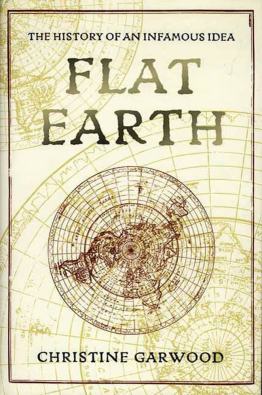
At the time of the Scopes Trial, Voliva hustled to Dayton, Tennessee to help prosecute John Scopes. Voliva’s hope, according to author Christine Garwood, was to “eliminate the twin heresies of evolution and a spherical earth.”flat earth garwood

But that’s where the two ideas went their separate ways. Whereas the outlandish notion of a literally young earth came to be accepted as true by large minorities of Americans, the outlandish notion of a flat earth became an internet quirk adopted by basement-dwelling conspiracy theorists.

So I ask again: What is the difference? I have a few ideas that I’m including in my current book about American creationism. In short, I think the answer lies not in dissident science, but in the mainstream world. By the 1960s, fundamentalist Protestants faced a new choice: Embrace mainstream evolutionary thinking and find a way to reconcile it with evangelical belief, or reject mainstream evolutionary science utterly and create a new creationist science.

When it came to evolution, the choice seemed simple, to many fundamentalists at least. Either kowtow to secular science or remain steadfast to young-earth beliefs.

Flat-earthers, though, never offered such a stark and simple choice. Belief in a flat earth (or a geo-centric solar system, for that matter) had always been embraced by some Biblical conservatives, but it never became a litmus test of orthodoxy.

At least, that’s the argument I’m trying to make in my new book.

What do you think?