Thank God You’re Wrong

When in doubt, look to the heavens.  These days, your view might be blocked by a billboard from the young-earth creationist outfit Answers In Genesis.

Image Source: Answers In Genesis

From Times Square. Image Source: Answers In Genesis

If you look closely enough, you might see a clue as to why the creation/evolution debates have been so divisive for so long.

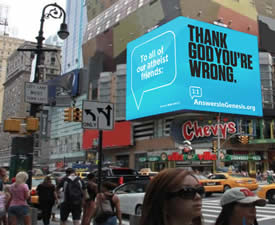
According to their press release, yesterday AIG rented billboards in high-visibility sites in New York’s Times Square and San Francisco’s Fisherman’s Wharf.  Soon similar billboards will hit the skies in Los Angeles.

The billboards announce, “To All Our Atheist Friends; Thank God You’re Wrong.”

Image Source: Answers In Genesis

San Francisco. Image Source: Answers In Genesis

AIG leader Ken Ham described the choice of wording.  AIG wanted to be “cordial and engaging,” he explained.  Though these high-profile billboards were an explicit response to Christian-bashing billboards posted by atheist groups, Ham said he wanted to take the high road.

Image Source: Answers In Genesis

An Atheist Billboard. Image Source: Answers In Genesis

“We are not angry at the atheists at all,” Ham wrote.  Instead, AIG feels “burdened” by atheists’ separation from God.

For those new to the creation/evolution debates, it might seem surprising that this latest publicity stunt does not mention creationism, dragons, or zip lines.  After all, AIG has had some success in the past with such creation-focused billboards.

But as Ken Ham repeats, creationism is not the main interest of his organization.  Rather, salvation is the point; creationism is merely the vital theme.

For those of us interested in conservative themes in American education, this distinction matters.

Many non-creationist commentators on the creation/evolution issue assume that if readers can be convinced of the scientific truths of evolution, the debate will be over.  Even the insightful philosopher Philip Kitcher seemed to fall into this trap in his book Living With Darwin.

These AIG billboards demonstrate the difficulty of the issue.  The young-earth creationists at AIG care a lot about creationism, but that is not their central concern.  Their central concern is salvation.  As long as evolution is seen as a threat to salvation, it will never be open to discussion and compromise.

More perspicacious religious minds understand this.  Francis Collins and the BioLogos Foundation set out to prove not only that evolution is true, but that evolution does not threaten salvation.  Without that focus on salvation, creation/evolution discussions will get nowhere.

These AIG billboards do more than attract attention in America’s big cities.  They demonstrate the true heart of the evolution/creation controversy.


What Color Are Your Fundamentalists?

Who are the “fundamentalists” who hope to keep America’s public schools religious?

Some of us may picture a Saddleback-type white suburban evangelical, driving around in a Biblically-sized SUV, worrying in equal measure about sin and soccer.

New!  School Prayer Barbie!

New! School Prayer Barbie!

But as Peter Berger reminds us this morning on The American Interest, that image of conservative evangelicalism might represent the past more than the future.

Berger notes the dramatic effects of immigration on the nature of American Christianity.  New immigrants tend to be Christian, and their Christianity tends to lean conservative.  As Berger concludes,

Both in their theology and religious practice, non-Western Christians are more conservative. Their worldview is strongly supernaturalist: The spiritual world, both benign and sinister, is very close—the Holy Spirit, the Virgin and the saints, miracles of healing—but also the devil and other malevolent spirits. This supernaturalism is strongest in the Pentecostal and charismatic movements, but it is also very visible in Catholic and mainline Protestant churches. But non-Western Christians are also more conservative in their moral convictions—very little sympathy here for the feminism, let alone the agenda of the gay movement, that has become so prominent in mainline Protestantism in America—and, I suspect, would be more prominent in American Catholicism, were it not for surveillance and intervention from Rome.

The implication of all this is simple and exceedingly important: Immigration will strengthen the conservative forces in American Christianity.

In the future, the fight over religion in America’s public schools may have a very different tone.  Instead of a ring of white conservative suburbs around every ethnically diverse urban core, we may see a shift to immigrant-led demands for more vibrant religion in schools.  Instead of whitebread traditionalism resisting a multicultural liberalism, we might have an ethnically diverse group of conservatives battling to keep morals pure in public education.

No More Talk: Popular Science Closes Its Comments

Why can’t we ever have a civilized conversation?

That’s the lament we hear all too often when it comes to issues such as evolution or climate change.

As science pundit Greg Laden noted recently, a new editorial policy at Popular Science shuts down conversation entirely.  The online version of the magazine will no longer be open to comments from readers.

Why?  Such comments, online editor Suzanne LaBarre explained, could have a negative impact on the way readers understand science.  She cited academic studies in which readers of hateful comments had changed their opinions about the scientific content of essays and articles.  “Trolls and spambots” had a negative impact on readers’ understanding of key scientific issues.

LaBarre concluded,

A politically motivated, decades-long war on expertise has eroded the popular consensus on a wide variety of scientifically validated topics. Everything, from evolution to the origins of climate change, is mistakenly up for grabs again. Scientific certainty is just another thing for two people to “debate” on television. And because comments sections tend to be a grotesque reflection of the media culture surrounding them, the cynical work of undermining bedrock scientific doctrine is now being done beneath our own stories, within a website devoted to championing science.

As a result, Popular Science.com comment forums will be closed.  Are such policies draconian?  Totalitarian?  Orwellian?  Is it a symptom of defeat among mainstream science popularizers that they can no longer accommodate disagreement?

Or, more chilling for those of us who want to see more and better science education in all sorts of institutions, could this new policy be a sign that mainstream academic science has been defeated at the popular level?  That is, is this new policy a sign that small-p popular science has become utterly unmoored from its connections to mainstream academic science?

When commenters, “cynical” or not, can close down the public conversation at such a storied institution as Popular Science, it demonstrates an epochal popular victory for non-mainstream science, whether that be creationism, climate-change denial, homeopathic medicine, or anything else.


What Went Wrong with America’s Schools?

Hell in a lunchbox. 

That’s where America’s public schools have headed, according to a recent essay by the Southern Baptist Theological Seminary’s President R. Albert Mohler Jr.

President Mohler makes an historical argument for the shocking, dangerous decline in American public education.  Does his case pass historical muster?

As I’ve argued in an essay in Teachers College Record (subscription required, but summary available), this historical argument about public education has been a mainstay of conservative thinking for at least fifty years.  Different conservative intellectuals have come up with different timelines and key events to explain the demise of high-quality, morally trustworthy public education.

Mohler echoes this intellectual tradition.

He argues that public schools began as locally controlled entities.  Beginning roughly a century ago, however, “progressive” reformers attempted an ideological coup.  Such folks, led by John Dewey, openly proclaimed their intention to turn schools into secular indoctrination camps.

Luckily, Mohler believes, such plans did not accomplish much until the second half of the twentieth century.  At that point, however, most schools were “radically transformed,” separated “from their communities and families.”

The results, Mohler warns, have been sobering:

Those who set educational policy are now overwhelmingly committed to a radically naturalistic and evolutionistic worldview that sees the schools as engines of social revolution. The classrooms are being transformed rapidly into laboratories for ideological experimentation and indoctrination. The great engines for Americanization are now forces for the radicalization of everything from human sexuality to postmodern understandings of truth and the meaning of texts. Compulsory sex education, the creation of “comprehensive health clinics,” revisionist understandings of American history, Darwinian understandings of science and humanity, and a host of other ideological developments now shape the norm in the public school experience. If these developments have not come to your local school, they almost surely will soon.

Is Mohler’s diagnosis correct?  Does his historical analysis match the record?

In this historians’ opinion, Mohler is guilty of cherry-picking and over-emphasizing.  It is demonstrably true that in the early twentieth century an array of school activists and intellectuals, clustered together under the amoebic heading of educational “progressivism” did try to implement wholesale changes in the nature of American public education.  It is also true that the US Supreme Court made decisions in the 1960s that could have revolutionary implications for the religious nature of public education.  Even more, it is true that leading organizations such as the National Education Association call for school policies that might dismay stalwart conservative Protestants. 

But contrary to Dr. Mohler’s conclusions, such historical facts do not add up to a public school system that “entered a Brave New World from which no retreat now seems possible.”

Historians have examined each of these important trends in American public education.  Arthur Zilversmit, for example, looked at the implementation of “progressive” education policies in the middle of the twentieth century.  In spite of earnest, well-funded efforts to revolutionize schooling, Zilversmit found, schools remained largely the same.  Why?  Zilversmit, sympathetic to the “progressive” project, blamed Americans’ “strange, emotional attachment to traditional schooling patterns.” 

How about the claim that the Supreme Court kicked God out of the public schools?  It is true that in 1962 and 1963 SCOTUS banned school-led mandatory Bible reading and prayer.  But as political scientists Kenneth Dolbeare and Phillip Hammond found to their surprise, most communities that prayed before the SCOTUS rulings continued to pray in public schools after them.  

Similarly, political scientists Michael Berkman and Eric Plutzer have argued that local school districts continue to function as local bureaucracies.  These “Ten Thousand Democracies,” according to Berkman and Plutzer, remain responsive to local demands and local values.     

This is bad news for President Mohler’s alarmist argument, but very good news for religious conservatives in the United States.  Most of America’s public schools remain closely connected to majority impulses in their local community.  Concerning hot-button culture-war issues such as prayer, evolution, and sex ed—not to mention broader notions such as school discipline, drug use, promiscuity, and general manners—local communities still control their local public schools. 

This local influence helps explain some stubborn trends that have long frustrated progressives like me.  Why, we ask, is evolution taught only spottily?  Why can’t public-school children learn honest, practical information about sex?  Why are public schools still home to coercive prayer practices?

These are all tough questions. 

But Dr. Mohler’s jeremiad raises even tougher ones:  If American public schools are so very conservative, why do conservative intellectuals deny it so forcefully?  Why don’t America’s conservative intellectuals trumpet the continuing traditionalism of American public education?

 

Creationism and Climate Change

What do creationism and climate-change skepticism have in common?

A lot, according to the leading young-earth creationist organization Answers In Genesis.

This morning we see an argument from AiG’s Elizabeth Mitchell about the dangers of climate-change science.  Dr. Mitchell is responding to the recent report from the Intergovernmental Panel on Climate Change (IPCC).

Why do Christian creationists care about climate change?

Dr. Mitchell’s essay offers a few ideas.

First, Mitchell warns that climate-change science is based on “dubious sources.”  She asks if mainstream climate-change scientists might build their case on mistaken assumptions.  Skepticism about evolutionary science, it seems, bleeds over into suspicion of all mainstream science.  If mainstream science has been proven, from creationists’ perspective, to be a naked emperor, then its conclusions on every topic must be treated warily.

Second, young-earth creationists are committed to the idea of a young earth and, for many, a catastrophic global flood.  Arguments about the changing climate from outside the circle of young-earth creationists assume a much older earth.  Climate-change science must rest on such assumptions.  Young-earth creationists, then, have a keen interest in making climate arguments that insist on a short lifespan and a global cataclysmic flood.

Finally, we see an important difference in the issues of evolution and climate-change.  Dr. Mitchell, at least, takes a much more irenic position toward Christians who DO agree with the mainstream science of climate change.

Christians, Mitchell argues, must weigh the evidence and make up their minds about the science of climate change.  It does not do violence to scripture, she implies, to believe the mainstream science on this issue.  The most important issue, Mitchell concludes, is that

Whatever position a Christian citizen chooses to take, he or she needs to understand the present in the true light of biblically documented, scientifically affirmed history rather than uniformitarian assumptions about the earth’s past—and future.


Is This Child Abuse?

Arch-creationist Ken Ham wants to train up a spiritual army of young Christian creationists.  Does that count as child abuse?

I’m no creationist, but I just don’t think so.

Ham trumpeted the training of a new generation of young “soldiers” at an Answers In Genesis conference at Atlantic Shores Baptist Church in Virginia Beach, Virginia.  By teaching young people the truths of young-earth creationism, Ham claimed he was “preparing them for the spiritual war going on around us.”

Image Source: Answers in Genesis

Image Source: Answers in Genesis

This language of child soldiers makes me nervous.  Plus, I don’t like the notion that young people are being turned away from real evolutionary science by this sort of religion posing as science.  To me, this seems like another painful example of the ways faith has been tangled unnecessarily with real evolutionary science, resulting in bad science and tortured theology.

But it is child abuse?

Leading skeptics have called it that, folks such as physicist Lawrence Krauss and biologist Richard Dawkins.  They assert that cramming this false science down young people’s throats counts as abuse.

Let’s look at both sides of this argument.

Why might someone call this child abuse?

1.)    These young people are being told things are true, when they really aren’t.  They are being taught, to cite just one example, that dinosaurs and humans coexisted a few thousand years ago.  Worst of all, relationships of close trust between parents, teachers, and children are being exploited to promote the veracity of this false science.  Loving mothers, loving fathers, caring teachers tell innocent young people that this is scientific truth.  Ingenuous young people take their word for it.  Such deception is abusive.

2.)    In this essay, Ken Ham explicitly calls them soldiers—spiritual soldiers, but soldiers nonetheless.  This seems a terrible violation.  Young people should not be exploited as culture-war cannon fodder.

Why might defenders disagree?

1.)    There is no threat or coercion here.  Though it may come as a surprise to outsiders like me, Answers In Genesis makes it very clear that believing in a young earth and recent special creation are not required for Christian salvation.  In other words, Ken Ham and his colleagues do not threaten young people with terrifying visions of hellfire if the children don’t embrace creationism.

2.)    The parents and teachers seen here are apparently sincere in their belief that creationism is true.  They are trying to pass that truth to their children and pupils.  There’s nothing abusive in passing along the best knowledge to the next generation.

3.)    Though science pundits such as Bill Nye have argued against it, believing the young-earth creationism of Answers In Genesis will not hurt the life chances of these young people.  According to Gallup polls, nearly half of American adults share a belief that humanity has only been around for a few thousand years.  And as I’ve argued elsewhere, careers in science-related fields do not seem thwarted by a belief in young-earth creationism.  Consider the case of US Representative Paul C. Broun Jr. of Georgia.  Broun is a fervent creationist, a medical doctor, and a member of Congress.  Not a bad career!

Image Source: Answers In Genesis

Image Source: Answers In Genesis

Is it child abuse?  No.  And calling it that is irresponsible.  After all, there is real child abuse out there.  It is horrific and terrifyingly common.  Calling this sort of science/religion education ‘child abuse’ is only an ill-considered scare tactic.

Perhaps this argument could use some illustration from another religious tradition.  Consider the recent career of child abuse in the Catholic Church.  As we all know only too well, the despicable actions of some priests and prelates in that church have caused untold suffering.

But the abuse perpetrated by members of the Catholic Church does not extend to its anti-scientific teachings.  After all, the Catholic Church teaches young people that certain wafers and wine can magically transform into flesh and blood.  And then young people are taught to eat that flesh and drink that blood.  For outsiders like me, teaching children to engage in this sort of ritual cannibalism is creepy and anti-scientific.  It is also demonstrably false: the wafers and wine are always really just wafers and wine.  Nevertheless, it is not child abuse for Catholics to teach their children this mystery of transubstantiation.  Calling such teaching ‘child abuse’ would disrespect the real suffering that real child abuse has caused within the Catholic Church.

A similar logic may apply in this case.  The young-earth creationism peddled by Answers In Genesis is not true.  But it is sincerely believed by its adherents.  Teaching those ideas to young people is not child abuse.

Unfortunately, we can picture what real abuse might look like in similar cases.  As Billy Graham’s grandson has pointed out recently, evangelical Protestant organizations have also engaged in real child abuse.  They have conspired, just as did the Catholic hierarchy, to cover up that terrible real abuse.  We could imagine a scenario in which a Protestant organization such as Answers In Genesis called together thousands of children and abused some of them.

But that is not the case here.  This was an educational gathering.  To call it ‘child abuse’ makes a mockery of the all-too-real threat of abuse.


Jesus Loves Teaching Evolution

Is there a way to talk about creation and evolution without anger?  Without getting defensive?  Can evangelical Christians teach evolution without alienating their staunchly creationist fellow Christians?

To cut this Gordian knot, Christian biologist Kerry Fulcher offers what he calls his “Pedagogy of Hospitality.”

Fulcher laments the anger and hostility that are so often generated by these questions.  How does he approach teaching evolution in a Christian, creationist environment?

By remembering that love comes first.

Fulcher offers a six-point guide for teaching evolution in a Christian way:

  1. Begin by disarming/diffusing, which creates an openness to listen and discuss vs. feeding the flame that threatens others and causes them to be closed to real dialogue.

  2. Create a reason for the audience to be engaged or care about the topic by helping them understand why open discussion or dialogue about the issue might be helpful to them.

  3. Recognize the complexity of the issue and how an individual’s faith can rightly or wrongly interact with it in foundational ways.

  4. Set the tone of discussion as one of mutual respect for individuals that honors right relationships above right answers.

  5. Set goals of education that promote greater understanding vs. advocacy that promotes winning the argument. This puts us in the uncomfortable position of being OK with others understanding our position without necessarily accepting or believing it.

  6. Honor the individual and their journey by remembering our own – It has taken years and a lot of study and thought to get where I am on this issue, so don’t expect others to make huge leaps in their own positions…be gradual.

Of course, for some pundits on various sides of the creation/evolution debates, Fulcher’s person-first approach raises hackles.  Some creationists might worry that the Bible must always come first, even if some people find it off-putting.  Some evolution advocates might lament this sort of truckling to religious superstition.  The legitimacy of science, they might say, must not be abandoned, even if it hurts the feelings of some religious listeners.

How can someone really understand evolutionary theory, critics might say, without somehow believing it?  Can belief really be separated from understanding?

Though I don’t share Fulcher’s religious faith, I do share his opinion that effective education of any sort must begin by understanding and even loving one’s students.  In the narrow question of evolution education, that means not attacking students’ faiths.  It means beginning and ending with the positive relationships between teacher and student that are at the heart of any good teaching.

Jon Stewart and Richard Dawkins

What happens to us when we die?

Does religion make society better?

Doesn’t science rely on faith?

Can’t intelligent people be both scientific and religious?

These are some of the questions leveled at leading science-atheist Richard Dawkins by Jon Stewart on the Daily Show recently.

For all of us interested in issues of science and religion, the short interview is well worth watching.

Stewart asks Dawkins some zingers, such as whether the world will be destroyed by human destruction or through more natural causes.  He challenges Dawkins to explain why faith is a negative force for society, even though it often seems so benign.

“It’s very easy to look at the dark side of fundamentalism,” Stewart said. “ … Sometimes I think we have to challenge ourselves and look at the dark side of achievement.”

Is science a threat?

Dawkins said he felt a little more optimistic about it.

As always, Dawkins expresses himself well.  Stewart gave him plenty of friendly opportunity to defend his argument that faith is inherently dangerous.


We’re All a Bunch of Losers

Both sides in our continuing culture wars assume they are losing.  Why?

We can see some recent examples from smart people on either side of the creation/evolution controversy right here on ILYBYGTH.

Recently, I argued that evolution was winning.  Winning big.

Some of the responses to that argument show that both sides are reluctant to admit they might not be losers in this fight.

For example, Tim, a self-identified homeschooling creationist, agreed that evolution was winning.  As he put it,

Creationists do not want creationism in public schools because it would taught incorrectly. Most pastors do not know how to accurately teach creationism, how in the world would we expect the average person to be able to? Does this in some sense prove evolution is winning? Sure, I could give you that. But we already know it will.

On the other hand, Bunto Skiffler took me to task for dangerously naïve optimism.  As he argued,

I believe General Westmoreland said something similar about our involvement in Vietnam before the start of 1968.

sincerely,
a person who lives in the fiefdom of Texas right now

Why doesn’t anyone want to admit they might be on the winning side?

I think the answer may lie with our very different definitions of winning and losing.

For evolution-promoters like me, creationists seem to be winning when they can impose any sort of non-evolutionary science in public-school classrooms.  Or even in private-school classrooms.  The fact that nearly half of American adults seem to agree with a strongly creationist idea about the origins of humanity makes it seem to folks like me that creationism is winning.

On the other hand, creationists might hearken back to a time when America’s public schools evinced a recognizably Protestant religiosity.  Back when kids in public schools read the Bible—the Protestant Bible, that is—prayed with their teachers, and generally learned that God wanted them to be better students.  Seen from that perspective, today’s public schools with their goals of pluralism and secularism might make it look as if evolution has won the field.

We must also consider the fact that pundits on both sides emphasize their own victimhood.  Reading the produce of Americans United or the Freedom from Religion Foundation makes American public schools seem under siege by powerful religious zealots.  On the other side, browsers of literature from the Alliance Defending Freedom or the Family Research Council might be forgiven for concluding that fire-breathing secularists crush any attempt at including healthy religion in public schools.

In other words, being a loser is attractive.

Each side emphasizes their own loser status in order to mobilize followers.  Evolution activists won’t be motivated to get off the couch if they are told that evolution is winning.  Creationist activists, similarly, might relax if they are told they need only be patient.

We’re all a bunch of losers in this fight.  Except, of course, we’re not.

I’ll say it again: Seen from an historical perspective, evolution education is winning.  If you don’t believe it, read my book.  Creation/evolution struggles have only deadlocked in the past thirty years or so.  In the 1920s, evolution barely made a dent.  Now evolution promoters feel put out if creationists have any influence at all.

Evolution is winning.  I’m not afraid to say it: I’m a winner.


Creationism’s Galileo Moment?

Creationist activist Dr. Don McLeroy said it: Give creationist kids evolution.

Why?

Because the evidence for evolution is so weak, creationist kids will be all the more convinced of the Bible’s truths.

McLeroy’s plea for evolution-heavy textbooks has left us controversy-watchers scratching our heads.  Did he really say that?

McLeroy leapt to national prominence a few years back in his role as chairman of the Texas State Board of Education.  As documented in the indispensable film The Revisionaries, McLeroy used his influence to promote a profoundly conservative vision of proper educational content for Texas schoolchildren.

Image Source: DonMcLeroy.com

Image Source: DonMcLeroy.com

As that film demonstrated, Dr. McLeroy had a knack for confounding the easy stereotypes of “right-wing” educational politicians.  For outsiders like me, it was odd to hear such a friendly, avuncular fellow insist that Texas schoolbooks needed more creationism and less “hip-hop.”

Earlier this week, Dr. McLeroy returned to testify in front of his former colleagues on the Texas school board.  This time, McLeroy surprised everyone by insisting that the board should adopt a new set of science textbooks, books that evolutionary scientists have praised for their evolutionary content.

The Texas Freedom Network has covered these hearings thoroughly.  In general, creationists have been opposing the new science books.

Not McLeroy.

Let the children read the books, McLeroy told the board.  The evidence for evolution is so weak, he insisted, that open-minded children will be convinced of evolution’s ridiculousness.

McLeroy’s testimony was so baffling to board members that a couple of them asked for clarification.  Mrs. Mavis Knight asked him if he was being facetious.  No, McLeroy explained (around minute seven of this ten-minute clip).  He really wanted students to read these evolutionary textbooks.

“Let the students,” McLeroy explained,

the inquisitive students, the ones that are not blind, look at the evidence in these books.  They don’t even give a hint to explain the complexity….Let’s get these books to the kids; let the little young student in the classroom ask, ‘Is this all the evidence that they can give?’ That’s why I think it’ll strike a major blow to the teaching of evolution.

Board member Thomas Ratliff also struggled to understand McLeroy’s position.  Did he really want kids to read evolutionary science?

Absolutely, McLeroy explained.  “I’m hoping a young creationist . . . will sit there and say, ‘Look, is this all the evidence they have? Well maybe God didn’t use evolution to do it.’”

As a stirring conclusion, McLeroy and Ratliff had this back-and-forth:

Ratliff: “So your position is that these books prove that evolution doesn’t happen and you want us to adopt them?”

McLeroy: “No.  I did not say ‘prove.’ I just say the evidence is weak.  I don’t prove anything.  I may be wrong.”

How are we to understand this strange phenomenon?  An arch-creationist plugging for excellent, evolution-rich science textbooks?  And even concluding that he may be wrong?

One commenter on the Texas Freedom Network Insider called McLeroy simply “delusional.”

But isn’t his testimony actually fairly logical?  Consistent?  Even admirable?

After all, creationists have long insisted that evolution falls apart on its own terms.  If they really believe that, doesn’t it make sense to expose people to its ridiculous claims?  After all, if evolutionary science really depends only on prejudice and closedmindedness, as creationists often assert (I’ve tracked this argument here and here, for example) , shouldn’t creationists simply give evolution writers enough rope to hang themselves?

Could McLeroy’s testimony be modern young-earth creationism’s Galileo moment?  When Galileo accepted his punishment for his argument that the earth went around the sun, he is said to have noted, “E pur si muove,”… “It still moves.”  Whatever bad scientists said, the truth was the truth.

McLeroy’s plea to expose children to good evolutionary textbooks can be taken in a similar way.  Supremely confident in the logical weakness of evolutionary theory, McLeroy can push for more and more of it.  Knowing, like Galileo, that whatever bad scientists said, the truth was the truth.