School Choice: Failing

We don’t normally hear criticism of school privatization from free-market conservative types.  But a recent essay by Michael Q. McShane in National Review included some harsh talk about vouchers and charters.

McShane, Education Fellow at the staunchly free-market American Enterprise Institute, complained that free-market solutions were not working.

Seems like a shocking admission for a conservative intellectual, until we get into McShane’s argument.

Vouchers aren’t working, McShane argues, because they are not being pushed hard enough.

McShane looks at the example of Milwaukee.  For twenty-five years, as McShane points out and as academic historians have agreed, Milwaukee has been one of the most “choice-rich” big cities in the nation.

The result?  As McShane notes, Milwaukee’s student test scores lag far behind Chicago and other big cities.

Some critics might conclude that “choice”—vouchers for parents to send children to private schools, charter schools that use public funding but avoid public-school bureaucracy, and rules that encourage parents to move their children between schools—has been proven a loser.

McShane says no.  What school systems really need, he argues, is a more thorough-going application of the principles of “choice.”  Ultimately, cities such as Milwaukee have only tinkered around the edges of the destructive public-school mentality.  Free-market solutions won’t really work, McShane believes, until cities allow the “creative destruction” that the market demands.

Private schools must be encouraged, he writes, to create new schools and new capacity, not merely fill existing seats.  In conclusion, McShane writes,

Private-school choice will drive positive change only when it creates high-quality private schools within urban communities. New schools and school models need to be incubated, funding needs to follow students in a way that allows for non-traditional providers to play a role, new pathways into classrooms for private-school teachers and leaders need to be created, and high-quality school models need to be encouraged and supported while they scale up. In short, policymakers, private philanthropy, and school leaders need to get serious about what’s necessary to make the market work.

Those of us hoping to make sense of conservative attitudes toward American education must grapple with this free-market thinking.  To scholars such as McShane, data that seem to prove the failure of free-market reform really only means such reforms have not been implemented thoroughly enough.


I PROMISE Not to Pervert or Subvert

Good news: I just got a promotion!

But to do so, I had to promise not to subvert the constitution of the United States.

Why?

The answer can tell us something about the history of conservative educational activism in the US of A.

As part of my move to the rank of Associate Professor at the august Binghamton University, State University of New York, I had to reaffirm my pledge to support the constitution of the USA and of the State of New York.  I also had to promise to “faithfully discharge the duties” of my new position.

As I discuss in my current book, The Other School Reformers, conservative school activists throughout the twentieth century insisted on this sort of loyalty oath as an iron-clad requirement for all teachers in public schools.  It seems quaint these days to think of asking enemy agents to solemnly promise not to undermine the American way of life, but from the 1930s through the 1950s and beyond, many leading conservatives considered such oaths a primary means of combating alien influence in American society.

In 1950, for example, conservatives in Pasadena, California, fretted that their award-winning school superintendent had aligned himself too closely with communist-friendly “progressives.”  One of the fixes the conservatives insisted on was to put the Daughters of the American Revolution in charge of administering new teacher loyalty oaths.

The move made sense at the time.  Throughout the 1930s, the DAR had led the fight to pass mandatory loyalty-oath laws in several states.  By the 1950s, the DAR had established itself as the leading proponent of teacher loyalty oaths.  Therefore, it makes sense to think that if we want to understand the reasoning behind such oaths, we should start with the DAR.

At the tail end of the 1920s, for example, Grace Brosseau, national leader of the DAR, told the annual meeting that teachers’ loyalty oaths made up a key component of the DAR’s strategy to improve American education.  Such oaths, Brosseau insisted, could help America’s mothers be confident that “instructors in your communities are of the right calibre and are teaching sound Americanism instead of instilling pernicious doctrines into the minds of their pupils.”[1]

At that same national meeting, the assembled DAR representatives passed a resolution in favor of such teacher loyalty oaths.  Why?  Because, in their words, “anti-American elements are incessantly working to overthrow our constitutional form of government.”  Teacher loyalty oaths could help, they thought, along with “greater care in the selection of instructors for our schools, more widespread interest in curriculum and textbooks and a deeper understanding of methods of instruction.”[2]

In the mid-1930s, a successor to Grace Brosseau agreed that teacher loyalty oaths constituted a key element of right-thinking conservative school reform.  As President General Florence Becker argued in 1935,

A Teachers’ Oath of Allegiance law is but a tardy recognition of the fact that of all public servants holding positions of trust and receiving pay from public funds, the teacher holds the key position of importance.  The education system should be kept free from government control, and the American people should not commit suicide by failure to provide teachers who have faith in America.[3]

One DAR activist in Michigan thought that a teacher oath would at least give parents some legal recourse if they found a subversive teacher in their local school, “spreading his un-American doctrines among our children.”[4]

In sum, it seems that teacher loyalty oaths resulted from anti-communist political pressure in the 1930s and 1950s.  Even at the time, other anti-communists wondered if such oaths mattered.  Would a foreign agent dedicated to subversion be deterred by such an oath?

These days, the United States does not face the threat of a large body of communist agents.  Does it make any sense to continue these loyalty oaths?


[1] Grace L.H. Brosseau, “Annual Message of the President General,” Proceedings of the Thirty-Eighth Continental Congress, National Society of the DAR (1929), page 11.


[2] “Resolution No. 16, Teachers’ Oath,” Proceedings of the Thirty-Eighth Continental Congress, NSDAR (1929), 681-682.


[3] Mrs. William A. Becker, Tapestry Weavers: an Address of Mrs. William A. Becker, President General, National Society, Daughters of the American Revolution at Fall State Conferences, 1935 (no publisher, no date, [likely DAR published, likely 1935.  Copy in the NSDAR archives, Washington, DC]), pages 6-7.


[4] Vivian Lyon Moore, “Michigan’s ‘Oath of Allegiance’ Bill,” DAR Magazine Volume 65 (July 1931), page 404.


A Conservative Plea for the Common Core

Don’t throw the conservative baby out with the Common Core bathwater. That’s the plea this morning from two leading conservative intellectuals.

Writing in the Weekly Standard, Chester Finn Jr. and Michael Petrilli rally conservative support for the new standards.

As we’ve noted in these pages, all sorts of conservative activists, from Phyllis Schlafly to the Heritage Foundation to the Tea Party, have denounced the centralizing tendencies of the Common Core.

The conservative credentials of Finn and Petrilli are difficult to dispute.  Both have long been leading voices for the movement to introduce market choices into public education and reduce the influence of unions and left-leaning schools of education.  Both have worked in conservative think tanks and conservative political administrations to fight for such measures.

They want conservatives to embrace the Common Core as the best available program to heal public education.  As they argue,

the fact that Obama thinks well of it doesn’t means there’s anything (else) wrong with it. This is understood by the many respected conservatives who back the Common Core, including such scarred veterans of the education-reform wars as Jeb Bush, Bill Bennett, John Engler, Chris Christie, Mike Huckabee, Sonny Perdue, Bobby Jindal, Rod Paige, and Mitch Daniels. They realize that academic standards are only the beginning, setting out a destination but not how to get there. They understand, however, that a destination worth reaching beats aimless wandering—and a big modern country is better off if it knows how all its kids and schools are doing against a rigorous set of shared expectations for the three R’s.

Finn and Petrilli offer three specific ways to use the Common Core to best conservative advantage.  Conservatives, they insist,

should maximize the good it can do and minimize its potential harm. Here are three useful steps:

  • Draw a bright line between the standards and the federal government. (Iowa Senator Chuck Grassley is onto one approach with his proposal to ban any further federal spending related to the Common Core.)

  • Overhaul No Child Left Behind as proposed by Senator Lamar Alexander and House education committee chairman John Kline, in effect rolling back the regulatory regime that has turned results-based school accountability into Uncle Sam’s business. (The tighten-the-screws alternative advanced by Senate Democrats would entangle Washington even further with states’ standards and accountability systems—as well as much more mischief.)

  • Continue to push aggressively in dozens of states for more school choice, both public and private—and allow voucher schools (and maybe charters, too) to opt out of their states’ standards and tests (Common Core or otherwise) if they can present alternatives that are just as rigorous. (Disclosure: the co-authors of this piece are still tussling over this one!)

Finn and Petrilli base their argument on a conservative vision of the recent history of American education.  As I’ve argued in the pages of Teachers College Record, conservative school reform proposals, no less than progressive ones, depend on their own interpretations of American history.

In this case, Finn and Petrilli remind their fellow conservatives that the fundamental ideas embraced by the Common Core, including elevated academic standards as well as rigorous standardized testing, began as conservative responses to a public education system that had strayed from its true mission. In the 1970s, they recount, control over public education had been seized by well-meaning but short-sighted leftists who emphasized equity at the expense of rigor.  After 1983’s Nation at Risk report, bold conservative reformers such as Ronald Reagan, Lamar Alexander, and William J. Bennett took steps to reverse that curse.

The solutions back then included increased public money for private education as well as ambitious new standards.  To lend heft to such standards, iron-clad standardized tests hoped to limit the ways educational bureaucrats could game the system.

The Common Core, Finn and Petrilli insist, represent an imperfect attempt to impose those higher standards.  In the end, by providing better information about school performance to parents and policy makers, the standards will fuel the conservative drive for greater privatization of public education.

So what is a conservative to do?  According to these scholars, the real conservative choice is to back the Common Core.  As they conclude, conservatives who take time to read the standards themselves “will be impressed by their rigor, thoroughness, solidity, and ambition—even their ‘conservative’ nature.”


What’s the Matter with Vermont? Nullification and the Politics of Public Schooling

Vermonters want out.  Some of them, at any rate.

In the pages of The American Conservative, Kirkpatrick Sale reviews a new volume about a surprisingly long-lived secessionist movement in the Green Mountain State.

What do the new nullifiers want?  According to Sale, the freedom-fighters depicted in Most Likely to Secede have several related goals.

Vermonters want to take back control from the federal government in such areas as food policy, gun control, marijuana laws, and, of most interest here, public education.

Learning, according to volume editor and essayist Ron Miller, can be done better in Vermont.  Learning can be liberated from costly and nonsensical federal mandates and standardized testing.

As quoted by Sale, Miller wants “holistic education . . . an educational culture that respects and encourages learning on a human scale, that supports caring and loving communities of learning.”

Such goals, Miller argues, put right-thinking Vermonters at odds with an “authoritarian educational policy” dictated by Washington DC.  Freedom will come from refusing federal dollars, so that Green Mountain schools can be liberated from the mandates of centralizing bureaucrats.

Does nullification stand a better chance in Vermont than it did in South Carolina?

When it comes to education policy, refusing federal dollars is a tall order for cash-strapped states.  This is especially true when the ultimate goal is as mushy as “holistic education.”  Conservatives of all stripes make a politically powerful argument when they advocate for direct local control of schooling, or when they fight to keep objectionable ideas out of local school curricula.

It is much harder to fight for local control when the goals of that control include a new vision of what education can be.  As historian Arthur Zilversmit demonstrated, anything new in schooling faces a brutal uphill battle.  As Zilversmit concluded, most Americans, presumably even in Vermont, share a “strange, emotional attachment to traditional schooling patterns” (page 169).

Independent schools, in Vermont or anywhere else, only stand a chance when they have independent funding.  That will not likely soon be the case for public schools in breakaway Vermont.


Core Wars

What do conservative activists hate about the Common Core State Standards?

A recent essay by conservative commentator Stanley Kurtz in National Review points out some conservative objections.

As we’ve noted recently, conservatives share with progressives a fervent opposition to the CCSS, though usually for different reasons.  Everyone from Phyllis Schlafly to the Heritage Foundation has warned of looming implications for culture, politics, religion, and education.  For those of us trying to understand conservative attitudes toward American education, these diatribes against the CCSS are a good place to start.

Kurtz was responding to an article in the Washington Post about Tea Party objections to the new shared standards.  Obama officials, Kurtz complained, responded with deceptive statements and obfuscation.  In the end, Kurtz argued,

. . . the Tea Party is right when it accuses the Obama administration of nationalizing education standards through the back door. The Founders opposed that for a reason. Once de facto nationalization is achieved, parents will lose their ability to influence their children’s education. Leverage that can be easily exercised at local school-board meetings or through representatives in state legislators will be lost to unaccountable federal bureaucrats (like Lois Lerner), and worse, to the even less accountable private education consortia that are developing the Common Core. So if educators try to impose politicized curricula or “fuzzy” math, parents will have no recourse.

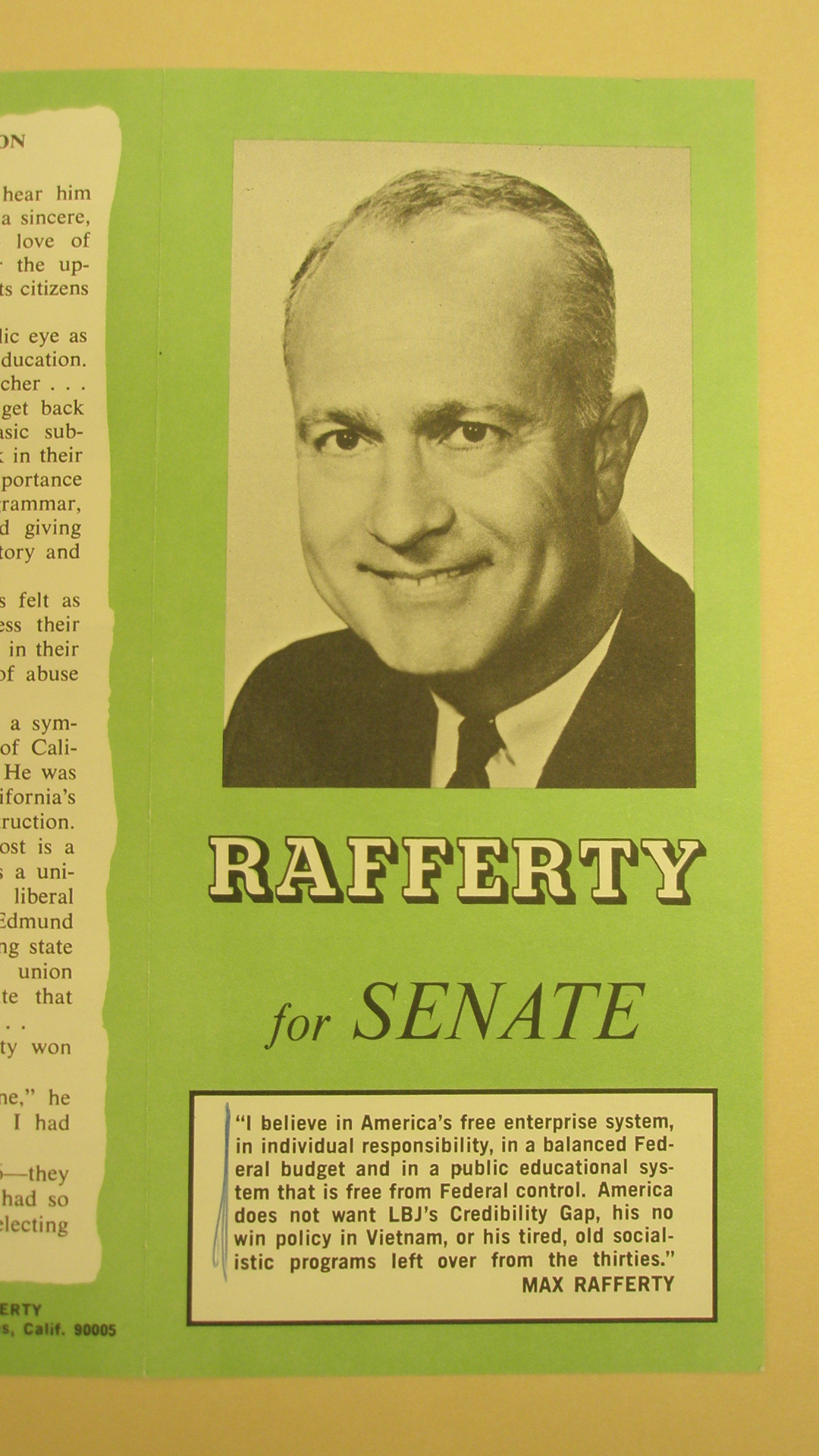
Kurtz’s “local control” argument echoes a long tradition among conservative education thinkers.  Most powerfully, California State Superintendent of Schools Max Rafferty pushed hard during the 1960s to combat increasing federal control.  Rafferty’s colorful prose often made the case more lyrically than I’ve seen it since.

In one speech from the archives,[1] Rafferty articulated a conservative position for local control that I suspect might still be appealing to today’s Tea Partiers.  As he told the California Small School Districts Association Convention on March 8, 1965,

You live and work in an out-of-the-way corner of this county.  A small town where the sky is still blue, where the roar and tension of freeway traffic has not yet penetrated; where a little boy can still run and play in open fields.  You’re there because you want to be.  You moved there deliberately a few years before because you liked that feeling of grassroots independence.  That unique sense of having an equal share in the controlling of one’s own destiny which has been the legacy of every American ever since the first little villages began to dot the New England countryside more than three centuries ago.  You’ve been happy there.  Your children are growing up clear-eyed and self-reliant with that indescribable look of quiet confidence which comes from life spent in a region where hills and trees are very real, very close at hand.  Where a neighbor is a lot more than someone who just happens to live close to you.  Suddenly, something goes wrong at your local school house, as things sometimes do.  Maybe it’s a new course of study which just doesn’t quite fill the bill.  Maybe it’s a neurotic old school administrator, we do run across one now and then!

No matter, you tell yourself, nothing can possibly happen in your community which can’t be solved by you and your neighbors, working and acting together in the traditional American spirit of mutual tolerance and good will.  But this time you’re wrong.  Shockingly, unbelievably wrong!  You and your friends try to arrange an appointment with your district superintendent to tell him of your problems and make your suggestions.  But you don’t have a district  superintendent anymore, in fact you don’t even have a district!  You try to contact your local school board, but it’s gone too!  A hundred miles away, a group of county or state officials meet once a month to decide the destiny of your children.  You don’t know any of them personally, in fact you never even heard most of their names!

But in our nightmare today, they tell you what your children will be studying.  They hire the teachers who will be molding the thinking and the behavior of your children throughout the years that lie ahead.  They decide whether or not the school bus is going to stop near your home or indeed if there is going to be a school bus at all.  Whatever they decide, you’re stuck with.

Rafferty worried about the Elementary and Secondary Education Act, the direct progenitor of No Child Left Behind.  As several of the commentators on Stanley Kurtz’s essay pointed out, the centralization of public schooling can be traced back through several generations of federal leaders, including President George W. Bush.

From the Hargis Collection.

From the Hargis Collection.

But that doesn’t mean that today’s version, the Common Core State Standards, will be greeted with anything but alarm among some sectors of conservative thought.


[1] This speech survives as a typescript in the Billy James Hargis Papers, University of Arkansas Mullins Library Special Collections, MC 1412, Box 48, Folder 2, Public Schools, 1950-1978 (1 of 2).  This collection of papers represents, IMHO, the best single-stop shop for any scholar hoping to understand the career of twentieth-century educational conservatism.  The Reverend Hargis was a leader in the Christian conservative movement in the second half of the twentieth century, and he was an avid collector of newsletters, correspondence collections, and other ephemera that shed a unique light on conservative thinking about education during the period.


Conservatives Look South

If educational progressives these days tend to wave Finland’s flag, perhaps educational conservatives will start to wave Mexico’s.

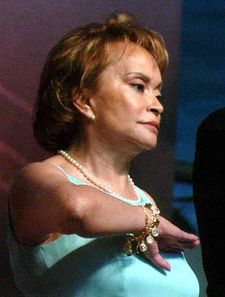
Mexico’s new president, Enrique Pena Nieto, has made aggressive moves against his country’s powerful teachers’ unions.  Most dramatically, the government arrested teachers’ union leader Elba Esther Gordillo, “La Maestra.

Gordillo had long been famous for her lavish lifestyle, suspicious on her relatively frugal official salary.

La Maestra in 2005

La Maestra in 2005

By moving against the teachers’ union, President Pena Nieto made some powerful enemies.  The Mexican union had ultimate power over teachers’ jobs, often creating hereditary no-work positions.

But by attacking the union he has also gained some influential friends and admirers.  The Heritage Foundation, for instance, a leading conservative think-tank in the United States, lauded Pena Nieto’s move as the first step toward “meaningful education reforms.”  In the United States, after all, conservatives like those at the Heritage Foundation have long attacked the pernicious anti-market power of teachers’ unions.

This conservative admiration for Mexican education policy has not always been the case.  As historian Ruben Flores of the University of Kansas argues in an upcoming book, a century ago it was educational progressives who fell in love with the Mexican education system.  Back then, according to Flores, United States progressives admired the centralization and efficiency of the Mexican system.

Today, it is union-bashing conservatives who look south.


CSCOPE Blues: Or, How I Learned to Stop Worrying and Love the Curriculum

**Warning: This post contains selections from textbooks that include potentially offensive language.**

Just when conservative Texans thought it was safe to go back to their public schools, they are told that a new curriculum will pervert their children’s values.

The culprit this time is CSCOPE, a curriculum “management system” designed in 2005-2006 and currently used in many Texas school districts.  The goal of the system was to streamline curricular decisions and align classroom teaching with state tests.

Recently, the curriculum has come under conservative fire.  Conservatives in Texas accuse the system of being President Obama’s plan to teach “our children how wonderful socialism is and that communism is even better.”  Nationally, pundits such as Glenn Beck have blasted the teaching system as a smear campaign against the nation’s founders.  The liberal Texas Freedom Network has publicized local attack ads that have accused CSCOPE of delivering “Communist, Marxist, Progressive, Leftist Dogma, Propaganda, and Indoctrination at the expense of taxpayers!”

Tea-Party_CSCOPEad

Source: TFN Insider

The Texas Freedom Network complains that such accusations veer dangerously into the “bizarre” and “paranoid.”  TFN writers point out that many Christian schools in Texas have adopted CSCOPE.  The curriculum system, the TFN argues reasonably, has long been used without a whisper of protest, even in conservative private schools.

Unfortunately for liberals like me and the TFN crew, animosity against CSCOPE is about more than just one set of classroom lessons.  This conservative crusade is about more than just CSCOPE, but involves a long and intractable history of suspicion against curricular systems in general.  Throughout modern American history, conservatives have worried—often with a great deal of justification—that curriculum systems hoped to do more than educate children.  In many cases, curricula have hoped to inject dramatic cultural change into America’s schools.

Many of the accusations, like the newspaper ad from Marble Falls and Burnet, seem outlandish and irrelevant.  But such sentiments often reflect the rightward edge of a widely held notion that school culture seeks to pervert the morals of the young.  In those cases, reasonable protests like that of the Texas Freedom Network do not make much of an impact.  Once a curriculum has become an object of conservative ire, the issue has grown beyond the details of any specific school lessons.  It has become a fight over the cultural control of American schools.

We saw this same dynamic in the 1970s.  When the school district of Kanawha County, West Virginia considered a new set of textbooks, wild rumors spread about the content of those books.  In some cases, distributed fliers included materials that were not in the books under consideration.  One flyer included instructions on the use of condoms from Sol Gordon’s Facts about Sex for Today’s Youth (1973).  In that book—again, not part of the series under consideration—Gordon explained sexual ideas in a frank manner.  The circulated flyer included excerpts meant to highlight this frankness.  “Some ‘street’ words for vagina,” Gordon wrote,

Are ‘box,’ ‘snatch,’ ‘cunt,’ ‘hole,’ ‘pussy.’  It is not polite to say any of these expressions.  However, since they are sometimes used, there is no need to be embarrassed by not knowing what they mean.

Many parents in Kanawha County objected to this sort of language.  The fact—as many liberals protested at the time—the fact that such language did not appear in any of the new textbooks did not change the political discussion.  Conservative parents objected as much to the tendency of school books in general as to the content of any specific books.  As conservative leader Elmer Fike wrote at the time of the controversy, “You don’t have to read the textbooks.  If you’ve read anything that the radicals have been putting out in the last few years, that was what was in the textbooks.”

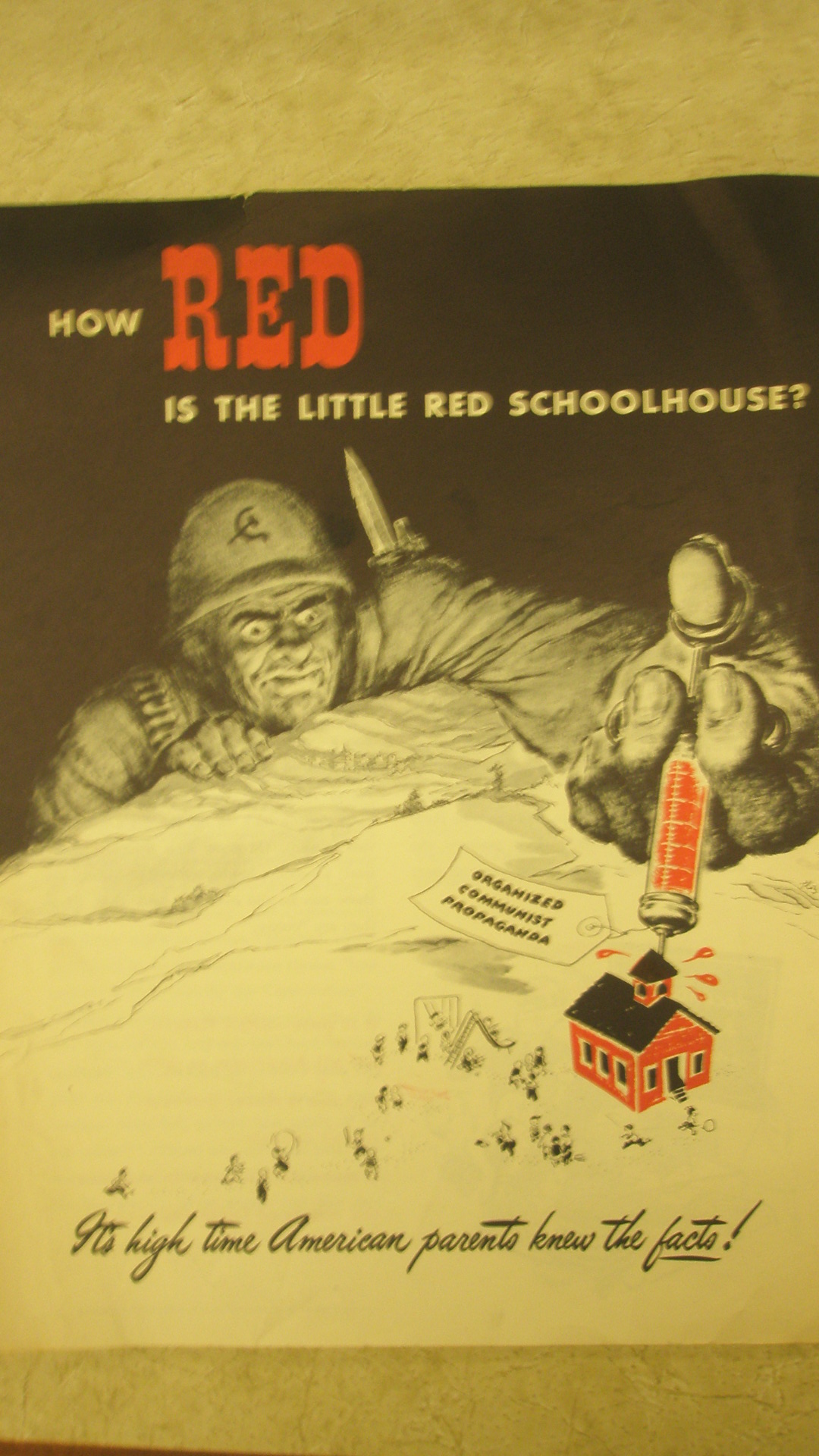
This sense that textbooks and school curricula might set out deliberately to change the morals of young people has a longer history, too.  The source of the cultural danger may have shifted, but at the start of the Cold War conservatives fretted about the threat from subversive communism in school books.  One pamphlet from 1949 Chicago asked, “How Red is the Little Red Schoolhouse?”

Cover imageA decade earlier, Harold Rugg had to defend his popular textbook series from charges of socialist, collectivist subversion.  As Rugg complained, many of his critics had never read the books themselves.  Conservatives, Rugg charged, would say, “I haven’t read the books, but—I have heard of the author, and no good about him” (Rugg, That Men May Understand, 1941, pg. 13).

Seventy-plus years later, Rugg’s books do not seem particularly subversive.  But just as CSCOPE’s critics bundle every anti-American rumor into the Texas curriculum system, so Rugg’s critics blamed him for every anti-patriotic sentiment of the day.

Most important, once school materials get a reputation for left-leaning propagandizing, whether it is Rugg’s books in 1940, or the Interaction series in Kanawha County in 1974, or the CSCOPE materials in 2013, the books seem sure to attract ferocious and effective political attack.  Sometimes, as in the newspaper ad from Marble Falls and Burnet, these attacks seem far-fetched.  But behind even such far-fetched notions lies a germ of uncomfortable truth.

Curriculum developers often DO want to introduce culturally challenging and provocative ideas into America’s schools.  Howard Rugg wanted his books to help along a sweeping “social reconstruction.”  One of the editors of the book series under consideration in Kanawha County dreamed that the controversial books might lead to “further innovations in schooling” [James Moffett, Storm in the Mountains, 1988, pg. 5].

Though CSCOPE insists it is “not designed to show favor toward any special interest group/ organization,” conservative critics can claim some justification for their worries.  For generations, curricula have been introduced to public schools that HAVE hoped to show favor to certain ideas.

CSCOPE might offer an ideologically balanced, pedagogically efficient way for Texas school districts to streamline their teaching systems.  But once it has acquired the reputation for leftist indoctrination, the writing is on the wall.

No matter how fervently the Texas Freedom Network or other supporters might protest, history has shown that in cases like this, among conservatives, school curricula are guilty until proven innocent.

Libertarian Editor: No More Classrooms, No More Books, No More Teachers’ Dirty Looks

Do we need teachers anymore?  Can’t computers do the job?

Speaking at Las Vegas Reason Weekend 2013, Reason Magazine editor Katherine Mangu-Ward peeked into the bold libertarian school future.

The question is not whether or not computers can replace people, Mangu-Ward pointed out.  They already do so in innumerable ways, such as ATMs.

For schools, however, the promise of computer-guided education has not been fully realized.  Mangu-Ward did not suggest we replace all teachers with computers, but rather that we employ a cheaper, better, blended model.

Too often, Mangu-Ward argues, the notion that schools are only “warehousing” young people gets a bad rap.  Schools SHOULD warehouse the young, but not necessarily in stark, depressing, dystopic ways.  Kids should stay in school for longer days, and for longer school years.

Computers can help make that feasible.  Mangu-Ward praised some KIPP schools that use computers to change the classroom dynamic.  Instead of twenty students with two teachers, some schools have thirty students with two teachers and fifteen computers.  Large numbers of students can be working on computers at any given time.

The students on the computers will likely be learning more, not less, than their human-led colleagues.  For-profit companies, after all, are producing effective online curricula on a competitive basis.  According to Mangu-Ward, the market will ensure that these curricula will be the best, cheapest options available.

Computers, after all, make great teachers, Mangu-Ward argued. Computers are infinitely patient.  Computers have impeccable memories. Truly great teachers might be able to keep track of all students this way, Mangu-Ward said, but unfortunately, “A lot of teachers really really suck.”

Mangu-Ward ended on an optimistic note.  “There are a lot of ways,” she said, “to choose not to be part of the dysfunctional school system that we have right now, and they are increasingly online.”

Mangu-Ward didn’t mention it, but this sort of tech-topia sounds eerily familiar to educational historians.  As Larry Cuban has demonstrated most convincingly, the history of American schooling has been peppered with plans to replace teachers with one machine or another.

In the 1950s and early 1960s, for example, educational television promised to broadcast the best teaching to students nationwide.  A plane even circled several states in the Midwest, broadcasting programs meant to MOOC their ways into students’ brains.

By the 1970s, those ambitious programs had largely come to naught.  As one disappointed technophile complained, “If something happened tomorrow to wipe out all instructional television, America’s schools and colleges would hardly know it was gone” [quoted in Larry Cuban, Teachers and Machines, pg. 50].

But could our situation now be fundamentally different?

First of all, the internet is different from TV.  Right now, schools and colleges would probably grind to an awkward halt if the internet fizzled suddenly.

Second, educational TV was largely a top-down government enterprise.  The US Congress shelled out $32 million in 1962 to pay for educational TV, for example.

Here, the programs will be both better and cheaper.  The market, Mangu-Ward predicts, will force for-profit companies to produce the best materials for the lowest price.

We’re left with two big questions:  CAN computers replace teachers? . . . and SHOULD they?

For the libertarian Katherine Mangu-Ward, the obvious answer to both questions is an emphatic YES.

President Carson 2016: The Education President?

What would a President Carson mean for education?

Recent reporting in the New York Times asks if prominent neurosurgeon Ben Carson is a 2016 GOP contender.  Carson has become hugely popular among conservatives.  In a recent speech at Conservative Political Action Conference, Carson received rousing applause when he mentioned that he had some good ideas . . . “if you should magically put me into the White House.”

Conservatives at CPAC loved Dr. Carson.  They should.  Carson has a dramatic life story and is a compelling public speaker.  His values are profoundly conservative.  He wants more public religiosity.  He wants a flat tax and a smaller public debt.  He wants America to beef up its military strength and return to a vision of the past in which Americans shared common values.

New York Times reporter Trip Gabriel noted that a recent Carson speech at a National Prayer Breakfast “criticized the health care overhaul and higher taxes on the rich, while warning that ‘the PC police are out in force at all times.’” True enough.  But those were just the starting points and final words of Carson’s half-hour talk.  By far the bulk of Carson’s address concerned the vital importance of education.

I wonder if reporter Gabriel ignored the bulk of Carson’s speech because Gabriel considered education to somehow be of lesser political interest than health care and tax policy.  If that’s the case, Gabriel couldn’t be more wrong.

Check out the speech itself if you have thirty minutes to spare.  You’ll see that Dr. Carson focused almost entirely on traditional conservative themes in educational policy and reform.

First of all, Carson lamented the sad state of American public education.  Citing statistics about high high-school dropout rates and low college completion rates, Carson deplored the fact that too many Americans are not getting a good education.  This had echoes of the ugly history of slavery, when it was illegal to educate a slave.  The lesson, Carson insisted, is clear: “When you educate a man you liberate a man.”

Carson shared his own remarkable educational history.  As a child, he grew up in a very poor household.  His mother had been married at age thirteen, soon abandoned by her bigamist husband.  She herself had only attained a third-grade education.  But she insisted ferociously that her two sons would be different.

She required young Ben and his brother to write two book reports per week for her to review.  Eventually, of course, Dr. Carson went on to his spectacular career as a leading pediatric neurosurgeon.

In Carson’s prayer-breakfast speech, he argued that Americans had always loved formal education.  But recently, Carson complained, “We have dumbed things down.”

That is not okay, Carson insisted.  America’s form of government requires a well-informed citizenry.  That is why Dr. Carson offers two programs for low-income youth: a college scholarship fund and reading rooms in low-income public schools.

Education, Carson promised, will prevent criminality.

More important, education will prevent cultural decay and decadence.  Look at Ancient Rome, Carson said.  “They destroyed themselves from within.  Moral decay, fiscal irresponsibility.”  The same thing could happen to the United States, Carson worried, if we don’t beef up our education system.

So what would a President Carson do for education?  Could he combine traditionally leftist education policies—such as financial assistance for the lowest income schools and students—with traditionally rightist policies—such as teaching traditional values and public religiosity in schools?

Even the superhuman brain surgeon himself couldn’t answer that.  But it is worth more consideration than some journalists and commentators seem willing to give it.

Broun and the Budget

US Representative Paul Broun (R-GA) garnered a lot of attention last year, including a commentary in the Chronicle of Higher Education by yours truly, for his claim that evolution, embryology, and the Big Bang theory were lies from the pit of hell.

Today Broun took to the pages of the New York Times to call for more drastic budget cuts.  Broun calls Representative Paul Ryan’s budget cuts too mild.  Instead, Broun insists, we need to cut the federal government drastically, including eliminating the Departments of Education and Energy.

Broun writes,

Constitutionally speaking, the federal government should not have a role in K-12 public education anyway. Overpaid Washington bureaucrats shouldn’t be deciding how to provide for teachers and students, whose own state and local governments are better equipped to understand their needs. A Heritage Foundation study showed that in 2010, the average salary of an Education Department employee reached $103,000 — nearly double the average public-school teacher’s salary. Let’s phase out a large portion of the department’s roughly $70 billion budget. We can transfer the remaining dollars directly to the states, where they will be used more wisely.

Broun’s missive demonstrates the tight connections between various strains of conservative educational ideology.  Does Broun want less evolution taught in public schools?  Yes.  Does he also want a smaller, leaner, more local government?  Yes.

In Broun’s conservative thinking, these are not utterly separate ideas, but facets of the same good ideas.  If education decisions were made closer to home, Broun argues, they would be made “more wisely.”  Local governments, Broun writes, are “better equipped to understand [teachers’ and students’] needs.”  In short, not only would an elimination the Education Department make good fiscal sense, Broun insists, but it would allow schools to respect the religious views of local creationist parents.