Can You Find the Conservative Education in This Picture?

Gracy Olmstead doesn’t mind tweaking the noses of her fellow conservatives.  She has encouraged them to relax about the dangers of the new(ish) Common Core State Standards, for example.  And now she wants conservatives to embrace Finland’s progressive-education model.

In today’s battles over classroom teaching and school organization, progressives often point to Finland as a guide.  Olmstead wants to claim Finland’s model as one for thinking conservatives.  I’ll admit: I’m stumped.  I can’t find the “conservative” elements Olmstead wants me to see in this picture.

A Conservative Model?

A Conservative Model?

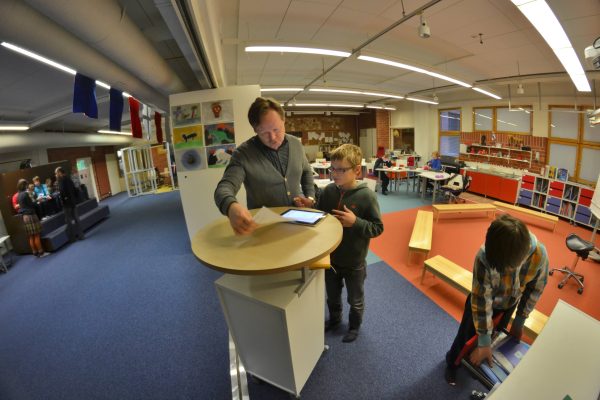
Famously, Finland’s schools shun standardized tests.  Finland’s teachers are an elite cadre of highly trained professionals.  Students in Finland’s schools spend little time cramming or regurgitating information.  Students are encouraged to play, to think, to roam outside the boundaries of classrooms and textbooks.

Most progressives love this model.

Olmstead does too.  She says it embodies the core conservative principle of subsidiarity.  For those of us who haven’t been paying attention to conservative rhetoric for the past couple of years, “subsidiarity” is an old term that has attracted some new conservative devotees lately.  Paul Ryan, for instance, famously invoked the Catholic notion of subsidiarity as the moral justification for his 2012 budget plan.  Though other Catholic intellectuals disputed Ryan’s definition, Ryan used the term as shorthand for Reagan-esque encouragement of localism in government.  The best solutions were those closest to the problems.  Central governments should play only a subsidiary role, tackling issues local folks cannot.

Olmstead finds this principle at the heart of Finland’s school plan.  No centrally imposed curriculum, no dictatorial imposition of one-size-fits-all schooling.  She notes that some conservatives might not like the lack of private options for schooling.  But she does not stress the fact that American conservatives will likely also rebel at the very practices of schooling in Finland.  Olmstead quotes progressive guru Linda Darling-Hammond’s description of Finnish schooling:

In a typical classroom, students are likely to be walking around, rotating through workshops or gathering information, asking questions of their teacher, and working with other students in small groups.

Now, Olmstead’s enlightened conservatism may find this image appealing.  But many American conservatives (not all!) connect traditional classroom practices with effective schooling.  Indeed, one of the constant themes of conservative educational activism throughout the twentieth century, I argue in my upcoming book, has been this connection between traditionalist classroom practice and traditionalist social morality.

I applaud Olmstead’s open-mindedness.  But I wonder how many other conservatives will join her in her embrace of the Finnish model.


Bashing the Common Core

Is there a “conservative” attitude toward the new(ish) Common Core State Standards?  Though as we’ve noted, conservatives disagree, the session at the on-going Conservative Political Action Conference about the standards sounded like a bash-fest.

In the pages of The American Conservative, Gracy Olmstead offered a fly-on-the-wall report.  Conservative luminaries such as Phyllis Schlafly, Lindsey Burke of the Heritage Foundation, Robert Enlow of the Friedman Foundation, and Jim Stergios of the Pioneer Institute took the CCSS to task for centralizing education.

Such centralization, Schlafly warned, does not occur in an ideological vacuum.  With more control from Washington comes more “liberal propaganda,” Schlafly insisted, as she has done before.  Enlow warned that centralization introduced yet another level of government control, blocking parents from their rightful control of their children’s education.  And Stergios insisted that the CCSS claim to be “state-led” was laughable.

Did this CPAC panel define the only “conservative” position on the Common Core?  As Stergios noted, many conservatives like the core.  He thought that opinion was “ludicrous.”  But correspondent Gracy Olmstead disagreed.  She noted that the standards still attracted fans and foes from all political sides.

“The Long Game” Is Coming to Binghamton

What do schools teach?  What SHOULD schools teach?  The problem is not that we don’t have an answer to this question.  The problem is that can’t agree on which answer is the right one.

Tomorrow night award-winning documentarian Trey Kay is bringing his latest radio documentary to the scenic campus of Binghamton University in sunny Binghamton, New York.  This work, “The Long Game: Texas’ Ongoing Battle for the Direction of the Classroom,” explores school politics in the Lone Star State.  As ILYBYGTH readers know well, those Texas politics tend to be more exciting versions of the sorts of school fights we hear all over the country: Can cheerleaders use the Bible at public-school football games?  Can textbooks preach a neo-Confederate vision of US History?  Can creationism and evolution jostle along side-by-side in public-school science classes?

long gameThe battles in Texas schools reflect our cultural disagreements over the proper form of public schooling.

Tomorrow evening, Trey will share an excerpt from his earlier documentary, “The Great Textbook War.”  Then we’ll listen to “The Long Game.”  Afterwards, we’ll benefit from Trey’s commentary, as well as that of world-renowned historian Jonathan Zimmerman of New York University.  Binghamton’s own Matt McConn, a recent émigré from Houston public schools, will also join the panel.

Unfortunately, we won’t be web-streaming the event.  But for all those who can make it to the Binghamton area, you are most welcome to attend.  The fun will begin at 6 PM, Thursday, February 27, in University Union room 120, on the campus of Binghamton University.  The event is free and open to the public.  Pre-registration has closed, but everyone is still welcome to come by without registration.

What Does Your Kid Sing in the Bathroom?

In the pages of Christianity Today, Andrea Palpant Dilley makes the case for private Christian schooling.  Her best argument?  Thanks to her new Christian school, Dilley’s daughter now sings “Holy, Holy, Holy” while going to the bathroom.

Dilley’s being humorous, of course, but her main point is this: despite legitimate arguments among evangelical Christians over the proper type of schooling, a good Christian school can push young people in healthy Christian directions.  A good school can help turn their souls and minds to the beauties and challenges of living a faith-filled life.  Does a Christian school guarantee that each kid will grow up to be a good Christian?  No.  But it gives young people a different set of mental furniture with which to fill their young heads.  Instead of singing the Ninja Turtles theme song, Dilley’s daughter sings “Holy, Holy, Holy.”

As I’ve reviewed in some of my academic publications, the decision to send children to private Christian schools is not a simple one.  Many Christian schools have been accused of being nothing more than “segregation academies.”  In practice, though, the racial politics of private schooling includes complicated decisions about where to send our children.

We have a few academic studies of these sorts of schooling decisions.  One 1991 study from Stanford wondered why parents chose Christian schools.[1]  Not surprisingly, the question turns out to be remarkably complex.  School founders and parents offered a mélange of explanations for their choice of a private Christian school, from bad discipline at public schools to creationist belief.  Similarly, a 1984 study from Philadelphia found that parents had many reasons for choosing private Christian schools.[2]  Again, parents listed public-school factors ranging from “secular humanism” to drug use and poor discipline.

Moreover, as Dilley notes, some Christian parents insist their children should remain in public schools in order to provide needed moral backbone in struggling schools.  Fair enough, Dilley acknowledges.  But for her daughter, the “Christian-school bubble” was the right choice.  Though the family had to scrape together money for tuition, Dilley’s daughter is able to attend a school that includes authentic diversity.  More important to Dilley, a Christian school also lets Dilley’s daughter learn the rich heritage and faith of evangelical Christianity.


[1] Peter Stephen Lewis, “Private Education and the Subcultures of Dissent: Alternative/Free Schools (1965-1975) and Christian Fundamentalist Schools (1965-1990),” PhD dissertation, Stanford University, 1991.

[2] Martha E. MacCullough, “Factors Which Led Christian School Parents to LeavePublic   School,” Ed.D. dissertation, TempleUniversity, 1984.

Registration Is Open!

You are invited.

In a few weeks, Binghamton University’s Graduate School of Education will be hosting a terrific event.  Documentarian Trey Kay will be sharing his new radio documentary, “The Long Game: Texas’ Ongoing Battle for the Direction of the Classroom.”  You probably remember Trey from his award-winning documentary about the textbook battle in West Virginia, 1974-1975.  In his new work, Trey explores the themes so close to the hearts of ILYBYGTH.  Should schools teach creationism?  Should they teach sex?  If so, how?  And what sorts of history should public-school students learn?  Should students be taught that America is awesome?  Or that the United States has some skeletons in its closet?  There has been no place more interesting than Texas to see these politics in action.

long game

After the listening session, Trey will offer a few comments.  He’ll be joined by the world-famous historian Jonathan Zimmerman of NYU.  ILYBYGTH readers will likely know about Zimmerman’s books, including especially his seminal work Whose America.  In addition, BU faculty member Matt McConn will say a few words.  McConn is new to New York, fresh from a long career as a teacher and school administrator in Houston.

There will even be cookies.

So please come on down if you’re in the Upstate area.  It will take place on Thursday, February 27, at 6 PM, in room G-008 in Academic Building A, on the beautiful main campus of Binghamton University.

We’d love to have you.  The event is free and open to all, but registration is required.  To register, please go to the BU registration site.

Charter Schools SHOULD Be Religious

H/T CS, JS, TK

Thanks to alert colleagues, I’ve been following the great series of articles in Slate about creationism and charter schools.  Most recently, we find a map of charter schools that seem to be teaching creationism.  According to this survey by Chris Kirk, plenty of tax-funded charter schools across the nation are teaching creationism.

But is there anything wrong with charter schools teaching creationism?

Don’t get me wrong: I think all students should learn the best science, even if they go to non-tax-funded schools or homeschools.  That should not be a legal requirement, but rather simply a goal for common education and citizenship.  In traditional public schools, we should demand a rigorously pluralist ethos.  No student from any religion or non-religion (or race, or gender identity, or etc.) should ever feel squeezed out due to his or her background.  And I don’t dispute Kirk’s accusation in this Slate piece that lots of charter schools are likely teaching creationism.  As Kirk puts it,

If you live in any of these states, there’s a good chance your tax money is helping to convince some hapless students that evolution (the basis of all modern biological science, supported by everything we know about geology, genetics, paleontology, and other fields) is some sort of highly contested scientific hypothesis as credible as “God did it.”

But let’s step back a moment and examine the real legal, educational, and constitutional issues here.  Let’s not forget that charter schools were created in order to offer more authentic diversity of educational models.  Should that diversity not include religious diversity?

According to a note in the Yale Law Journal a few years back, the proper line between religion and publicly funded charter schools is not as clear cut as journalists and policy-makers often assume.  In that 2008 piece, Benjamin Siracusa Hillman argues that charter schools ought to be allowed or even encouraged to include religious practices and beliefs.

Recent US Supreme Court decisions, Hillman argues (see esp. page 576), support a notion that school districts may legitimately include religious schools without violating the famous 1970 “Lemon Test.”  If a state or school district has a secular purpose in setting up schools—including even religious schools—those schools are more likely to pass constitutional muster.  The goal must not be to serve only one sort of religion.  Nor must school districts hope to exclude non-religious students, or students from other religious backgrounds.  Religious schools may fit into a broad charter school/voucher school network, the Court has suggested, as long as the first purpose is to improve education for all.

Hillman also analyzes the decision of a Michigan court in which parents sued a charter school for cramming religion into their publicly funded school.  The school, according to this federal court ruling, did no wrong in including religion, since it did not force students to engage in religious practice or adopt religious beliefs.

So can publicly funded charter schools teach creationism?  Or, even more provocatively, SHOULD charter school networks work to include schools that teach creationism?

The recent string of Slate articles implies that such practice ought to raise alarm bells.  But if we view creationism as an expression of a religious belief, it seems the rule is not quite so cut-and-dried.  Public school districts have much more leeway to include religious schools than many people seem to think.  Such ignorance can be politically useful.  For example, no one will mobilize to fight against teaching that might be perfectly legal and even desirable.  But some sections of our chattering classes might have better luck with breathless exposes of religion in publicly funded schools.


The Most Important Thing Anyone’s Ever Said

What is the most important line in the history of American education?  Something from Ben Franklin?[1]  Frederick Douglass?[2]  Horace Mann?[3]  John Dewey?[4]

According to Bruce Frohnen in the recent pages of The Imaginative Conservative, that honor goes instead to Annette Kirk.  Her line from the 1980s, Frohnen argues, offers traditionalist conservatives and anyone who cares about real education the only thread of hope in the blasted and devastated landscape of American public education.

Conservative intellectuals have long taken a dim view of the state of American education.  Frohnen opens his recent jeremiad with a nod to the terrible state of today’s schools.  “Can public education in the United States be saved?” Frohnen asks.

Given the stranglehold of teachers’ unions over school districts and state legislatures, the constant meddling of an ideologically motivated federal Education Department, the sheer weight of bureaucracy, and the commitment to mediocrity? Perhaps not.

But traditionalists such as Frohnen are not the only ones who tend to throw the school baby out with the modern bathwater.  Leftist historian Michael Katz, for instance, opened a new era of revisionist educational historiography in 1968 with his assertion that schooling in the United States has always been “conservative, racist, and bureaucratic.”[5]  Also from the left, Marxist economists Samuel Bowles and Herbert Gintis denounced American public education in 1976 as a tool of the economic elite.   Libertarian historian Joel Spring famously denounced the cookie-cutter domineering of “The Sorting Machine.”

Frohnen agrees with these folks about the terrible state of public education in the USA.  But it’s hard to imagine Professors Katz, Spring, Bowles, or Gintis agreeing with Frohnen about school’s saving grace.  According to Frohnen, the only glimmer of hope in the last generation has been a line inserted by Annette Kirk into the 1983 blockbuster report A Nation at Risk.

You history nerds out there might think that Frohnen is referring to some of the most famous lines of that report.  Every survey of American educational history, for instance, talks about the reports catchy warning about a “rising tide of mediocrity.”  Most surveys, too, note the apocalyptic edge to the report’s conclusion.  “If an unfriendly foreign power,” the report noted, “had attempted to impose on America the mediocre educational performance that exists today, we might well have viewed it as an act of war.”  Ouch!  Take that, teachers’ unions!

But those memorable lines were not the ones to which Frohnen referred.  No, the most saving line of the report, Frohnen argues, was one inserted by the true conservative Annette Kirk.  In Frohnen’s words, Kirk made sure that the report included the principle that “parents are the first and primary educators of their children.”

Thanks to this perspicacious inclusion, American education has been saved from the worst strangleholds of state-dominated educracy.  Parents in the United States, Frohnen points out, still have the freedom to free their children from the school system entirely.  Homeschooling offers such parents their last best hope of seeing their children truly educated.


[1] “Genius without education is like silver in the mine.”

[5] Michael Katz, The Irony of Early School Reform: Educational Innovation in Mid-Nineteenth-Century Massachusetts (Cambridge, MA: Harvard University Press, 1968), 3.

Kopplin, Creationism, and Liberal Book Burnings

A network of charter schools in Texas uses religious textbooks.  Bad religious textbooks.

That’s the accusation leveled last week by anti-creationism activist Zack Kopplin in the pages of Slate.

For anyone who has looked at the textbooks cranked out by conservative religious presses, as I have, the charges sound true.  But does this sort of expose rely too heavily on shock value?  Does it really tell us anything about what goes on in those charter schools?  Or does it rely on the dangerous mentality of the book burner?

Kopplin’s investigation uncovered the dodgy content of books used by Responsive Education, a network of charter schools that claims 65 schools and a plan to open more in the coming year.  Kopplin, a young but seasoned activist, found textbooks rife with creationist-friendly ideas.  Moreover, the textbooks promote a religious vision of history and repeatedly promulgate half-truths and lies as historic fact.  The books take a questionable tone about homosexuality and seem to embrace a distressingly patriarchal vision of proper family life.  Worst of all, Kopplin argues, these textbooks are used in public schools, schools that ought to be open and welcoming to all students, not just religious conservatives.  These slanted textbooks are peddling fake science, bad history, and sectarian “values,” and they’re using tax money to do it.

Let me repeat: Kopplin’s charges ring true to me.  I agree that public schools must not push theology.  But as I finish up my current book manuscript about the history of conservative school activism in the twentieth century, I can’t help but notice the disturbing echoes of Kopplin’s crusade.  His anti-textbook campaign seems to revive the worst elements of wartime book burning.

Sound outlandish?  Let me offer some specific examples.

First and most worrisome, Kopplin relies on the tried-but-false McCarthyite tactic of guilt by association.  In his article, Kopplin points out that some ResponsiveEd schools might assign readings from the Patriots’ History of the United States, a skewed and partisan book.  To discredit the book, Kopplin notes that the book is beloved by conservative blabbermouth Glenn Beck.

More troubling, Kopplin tars ResponsiveEd schools with all the sins of every right-wing theocrat with whom they can be associated.  Consider, for example, Kopplin’s takedown of Oklahoma businessman and curricular contributor Tom Hill.  Hill, Kopplin charges,

is a follower of Bill Gothard, a minister who runs the Institute in Basic Life Principles, a Christian organization that teaches its members to incorporate biblical principles into daily life. IBLP is considered a cult by some of its former followers. Gothard developed character qualities associated with a list of “49 General Commands of Christ” that Hill adopted for his character curriculum. Hill then removed Gothard’s references to God and Bible verses and started marketing the curriculum to public schools and other public institutions.

The values taught by Responsive Ed can often be found word for word on Gothard’s website. The Responsive Ed unit on genetics includes “Thoroughness: Knowing what factors will diminish the effectiveness of my work or words if neglected.” The only difference is that Gothard’s website also adds “Proverbs 18:15” after the quote.

What does this really prove?  That some of the origins of ResponsiveEd’s curriculum can be tied to conservative evangelical Protestants?  Is that illegal?  Is that even worrisome?  After all, taken another way, Kopplin’s accusation can be taken as proof that ResponsiveEd’s curriculum has been DE-Biblicized.

This sort of guilt-by-association has a terrifying history in American educational and political history.  Too often, left-leaning or liberal groups earned labels of “subversion” by association with communist thinkers or organizations.  Consider, for instance, the widely circulated “spider-web chart” used by patriotic activists in the 1920s, 1930s, and 1940s.  Any alleged association with leftist organizations, the chart accused, meant that organizations must not be trusted.
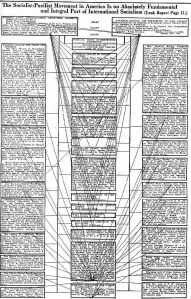
Image Source: Women's and Social Movements in the U.S.

Image Source: Women’s and Social Movements in the U.S.

In the late 1930s, a conservative campaign took off against a set of social-studies textbooks by left-leaning author Harold Rugg.  Time and again, those accusations were based on these guilt-by-association tactics.  Since Rugg taught at Teachers College Columbia, it was alleged, since he was a member of the Frontier Thinkers intellectual group, and since some members of that group had made statements or editorial decisions friendly to communism or Soviet Russia, Rugg was charged with treasonous intent.  His books were charged with all manner of subversive crime.  Just as anti-Rugg activists swung too wildly against Rugg’s books, so Kopplin seems over-ready to ban ResponsiveEd books based on questionable associations.

Another parallel between Kopplin’s article and earlier book-burning crusades is that Kopplin’s charges do not have much to do with actual classroom practice.  As Kopplin admits, he never actually witnessed the teaching in ResponsiveEd schools.  Rather, he relates that one classroom he looked at had the distinctive set up of an Accelerated Christian Education classroom.  Kopplin cites ILYBYGTH friend and guest writer Jonny Scaramanga as evidence that such classrooms teach terrible Bible-based schlock.

But here’s the problem: just as conservative book-burners in the 1940s gave too little thought to the ways Rugg’s textbooks might actually be used, so Kopplin does not offer any evidence about the actual goings-on in ResponsiveEd classrooms.  Anyone who has spent any time teaching knows that textbooks do not dictate classroom practice.  Take the most obvious example: What should we make of public-school classrooms that use the Bible as curriculum?  As religion scholar Mark Chancey has argued recently, the Bible can and should be taught.  But HOW it is taught makes all the difference.

I’m not saying that the ResponsiveEd curricular materials are wonderful.  But I am saying that jumping to conclusions about the practices at any school based mainly on textbooks is a fundamental mistake.

This is getting long, but here is one other creepy similarity between Kopplin’s article and earlier book-burning campaigns.  Like earlier campaigns, Kopplin’s charges have been passed along uncritically by allies seeking to discredit ResponsiveEd.  Intelligent, well-meaning critics such as Diane Ravitch, the Texas Freedom Network, and Americans United for Separation of Church and State have trumpeted the conclusions of Kopplin’s expose.

None of these liberal organizations seems troubled by Kopplin’s sketchy evidence or guilt-by-association tactics.  As an historian who has spent the better part of the last few years stuck in the anti-communist hysteria of the 1930s and 1940s, this knee-jerk boosterism alarms me.  For many patriotic book-burners in the 1940s, Elizabeth Dilling’s The Red Network served as a similar sort of convenient sourcebook for denunciation.  Too many conservative activists—even intelligent, well-meaning ones—repeated outlandish charges and baseless accusations from Dilling’s book.  The fact that a textbook author such as Harold Rugg showed up in Dilling’s pages served as proof positive for many school activists that his books must not be allowed in America’s public schools.

Creepiest of all, Kopplin’s language often echoes almost verbatim the language of 1940s book-burners.  For example, Kopplin engages in a sinister sort of hermeneutic when he says the following: “Some of Responsive Ed’s lessons appear harmless at first, but their origin is troubling.”

In other words, Kopplin admits that the books themselves might not be so bad, but since they came from conservative religious sources, we must automatically attack them.  This smacks too much of what political scientist Michael Rogin has described as “political demonology.”[1]

Consider some of the similar language from the 1930s/1940s anti-Rugg textbook fight.  One of the leaders of that anti-book battle, R. Worth Shumaker of the American Legion, told a correspondent that the dangers of the Rugg books only became clear if one went “back of the scenes.”  Reading the books themselves, Shumaker admitted, made them seem bland and harmless.  But once an earnest researcher discovered Rugg’s leftist connections, the slant of the textbooks became obvious.

Another American Legion activist agreed.  Hamilton Hicks admitted in a 1941 article that “intelligent people” could read Rugg’s book and find nothing wrong with them.  “Dr. Rugg,” Hicks accused, “is far too adept a propagandist to disclose his real purpose in any one textbook.”[2]  Just as Zack Kopplin warns that the ResponsiveEd textbooks might seem harmless until we understand their origins, so anti-Rugg activists admitted that Rugg textbooks might seem fine until their sinister backstory was uncovered.

We verge from activism to hysteria when we denounce textbooks for reasons other than the textbooks themselves.  If textbooks seem harmless, the first appropriate conclusion is that the textbooks are likely harmless.

So what is a liberal to do?  Kopplin makes an important point: public schools ought not cram dead science and bad history down students’ throats.  As organizations such as Texas Freedom Network have done, this situation calls for more rigorous examination.  What really goes on in ResponsiveEd schools?  They should not be allowed to use tax dollars to teach sectarian religion and false facts.  It is important for all of us to remember, however, the profound costs of over-hasty accusations.  Calling for book burnings is never an appropriate tactic.

Kopplin has made some serious charges.  So far, however, those charges have not been backed up by adequate proof.  More is at stake here than just one charter-school network.  If we veer into hysteria rather than activism, we repeat the worst mistakes of our history.


[1] Michael Paul Rogin, “Ronald Reagan,” The Movie and Other Episodes in Political Demonology (Berkeley: University of California Press, 1987), xiii.

[2] Hamilton Hicks, “Ours to Reason Why,” American Legion Magazine (May, 1941): 6, 51.

How to Save the GOP

What can conservatives do to shed their image as “a party of plutocrats who get a kick out of kicking the poor when they’re down”[?]

Writing in the pages of libertarian flagship Reason Magazine, A. Barton Hinkle pleads with conservatives to get on the charter-school bus.

Liberal politicians such as President Obama and New York City Mayor Bill De Blasio have handed conservatives a golden opportunity, Hinkle argues.  When liberals close down charter schools and limit vouchers, they doom low-income children to “reactionary” public schools.  By promoting market reforms, allowing parents to choose among a variety of schools, conservatives can kill two birds with one stone.

First, conservatives will be able to introduce a significant measure of market discipline into a social institution firmly dominated by entrenched and bloated unions.  Second, conservatives will be able to claim without flinching that they represent society’s least powerful.  Charter schools and voucher opportunities can benefit low-income parents the most.

Can this strategy work?  Can conservatives take the wind from liberals’ sails by promoting school privatization?

We’ve seen recently how it can fail.  Mayor De Blasio’s recent challenger Joe Lhota went all-in for charter schools.  Didn’t help.

Perhaps other conservative politicians will manage to do better.


Save the Date!

Keep your evening free on Thursday, February 27th.  Here on the beautiful campus of Binghamton University in sunny Binghamton, New York, we’ll be hosting a listening session and panel discussion about Trey Kay’s new radio documentary, “The Long Game: Texas’ Ongoing Battle for the Direction of the Classroom.”

Readers may remember Trey Kay’s earlier award-winning radio documentary, “The Great Textbook War.”  In that piece, Trey explored the 1974-1975 battle over schooling and textbooks in Kanawha County, West Virginia.  In that fight–a fight that is also the subject of a chapter in my upcoming book–conservatives worried that a new textbook series presented students with perverted values and distorted grammar.

In his new documentary, Trey looks at ongoing ideological battles in Texas.  As filmmakers such as Scott Thurman and activists such as Zack Kopplin have demonstrated recently, there has been no better field for exploring cultural conflicts in education than the great state of Texas.

The details of our upcoming February 27 event are not yet finalized, but the general plan is clear.  We’ll be listening to “The Long Game,” then Trey and NYU’s electrifying historian Jon Zimmerman will offer a few comments, followed by a general discussion and Q & A.  I’ll post more details as they come available.