FROM THE ARCHIVES: Fundamentalism vs. Communism, c. 1949

In the twenty-first century, it can be difficult to remember the menace once posed to Fundamentalist America by communism.  Of course, it was not only Fundamentalist Americans, but most Americans, who shared a strong anti-communism, at least since the 1930s.  As historian Ellen Schrecker has argued, anti-communism WAS Americanism.

It is too easy to limit our understanding of anti-communism to a narrow campaign against one political group.  In Fundamentalist America, the fight against communism took on a broad array of meanings.  “Communism” itself came to include a vast spectrum of purportedly anti-American ideas, including anti-theism, progressive education, declining manners, anti-capitalism, disrespect for tradition, and so on.  Not surprisingly, the fight against communism came to include such notions as support for more public religion.  It often included support for traditional families and social relationships.  It also included a fight for more traditional teaching, both in content and in method.

To cite just one example, as President General Anne Minor of the staunchly anti-communist Daughters of the American Revolution insisted in 1923, Americans “want no teachers who say there are two sides to every question.”  Teachers must teach a strict patriotic traditionalism.  They must tell their students the correct answer, with the correct social values, every time.  Those “progressive” teachers who waffle and squirm, who infect their students with a crippling moral relativism, would eventually create a generation of insipid, unpatriotic Americans unable to defend against the menace of communism.

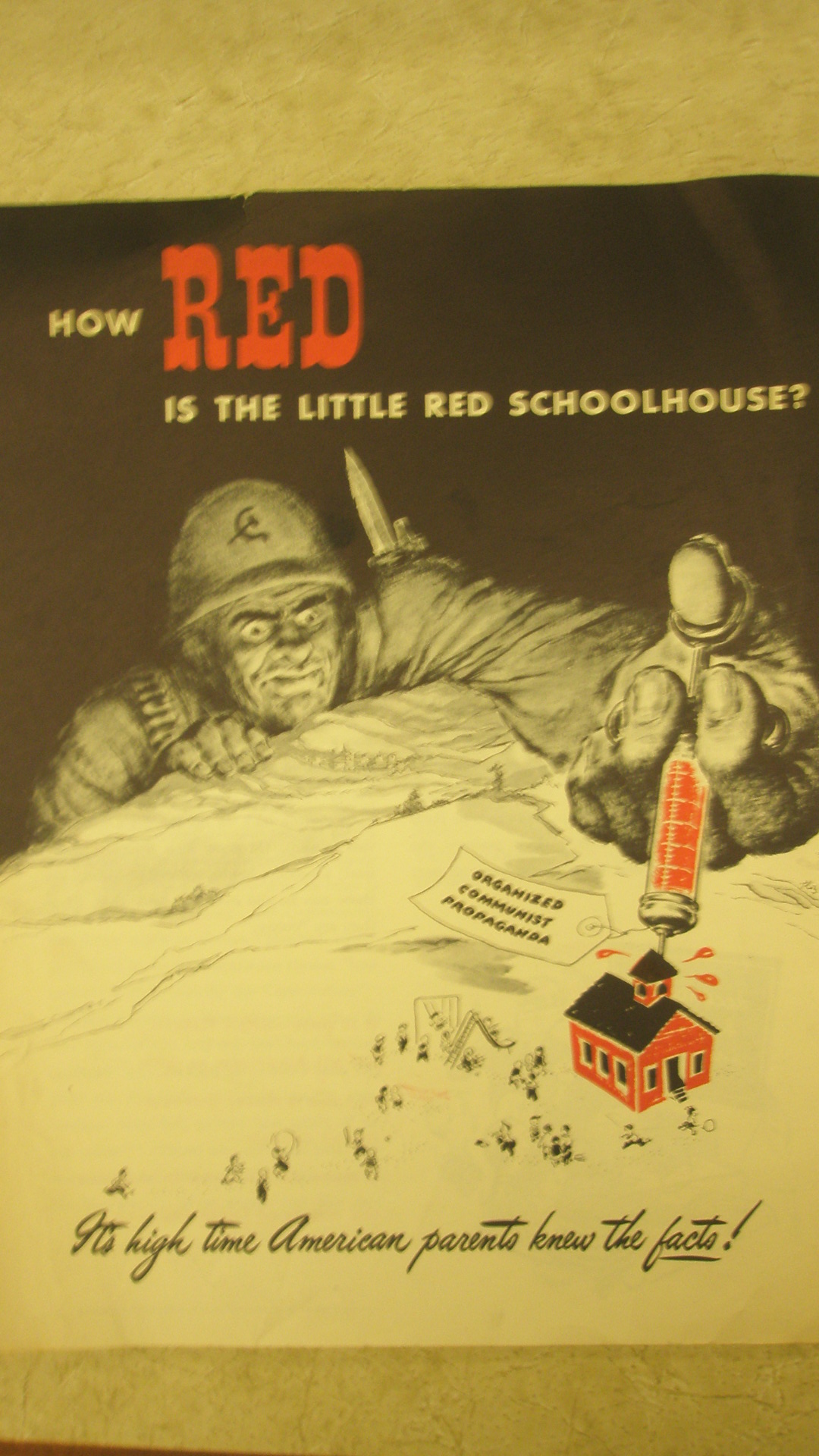
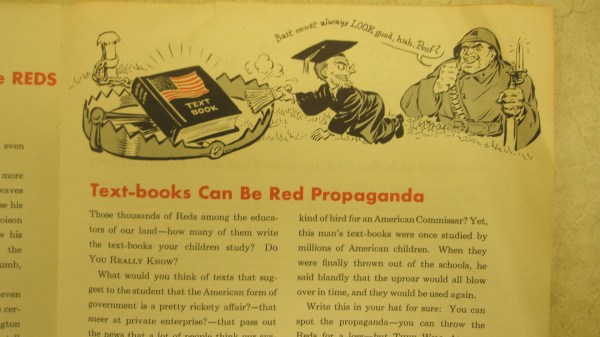
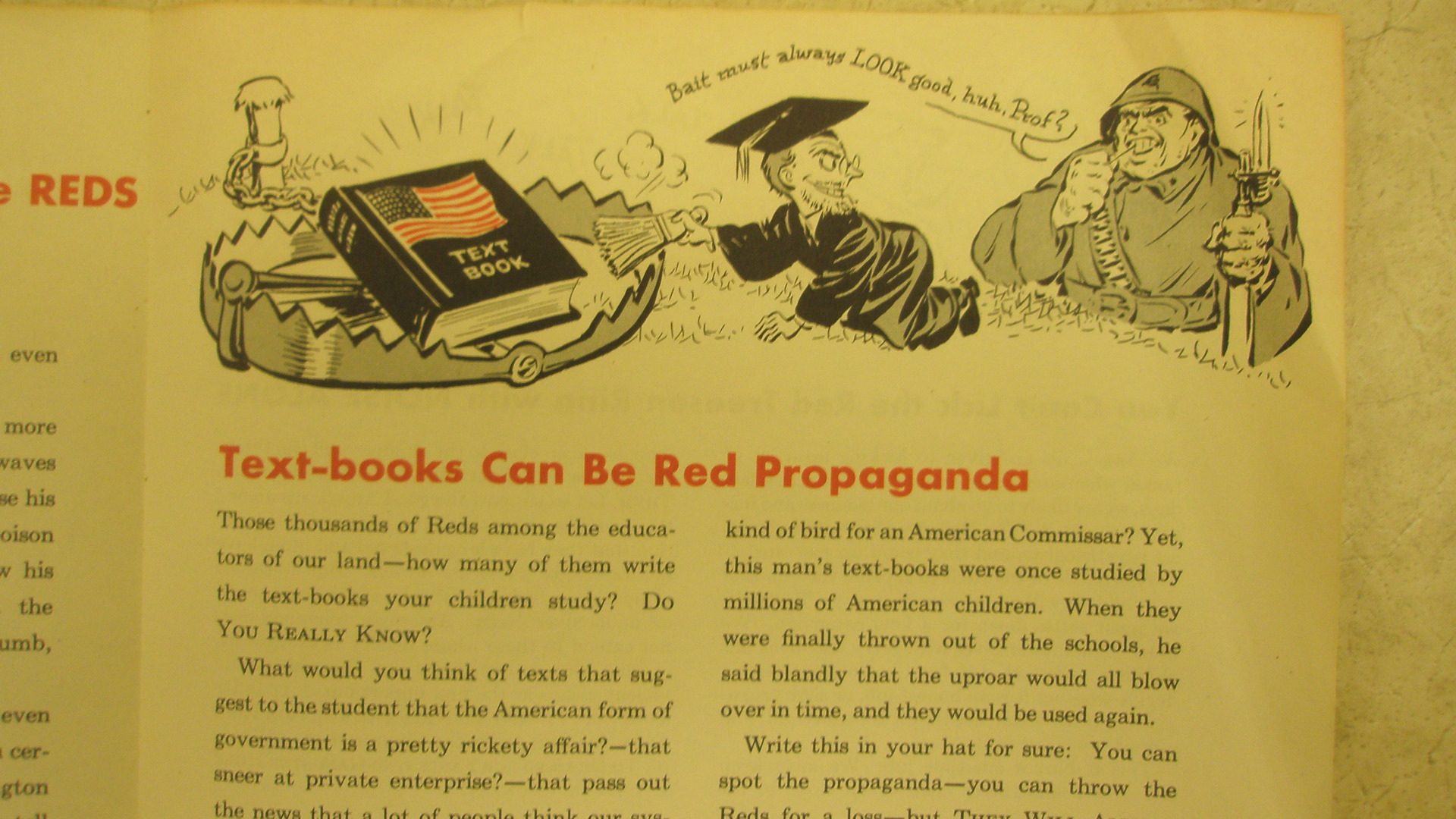
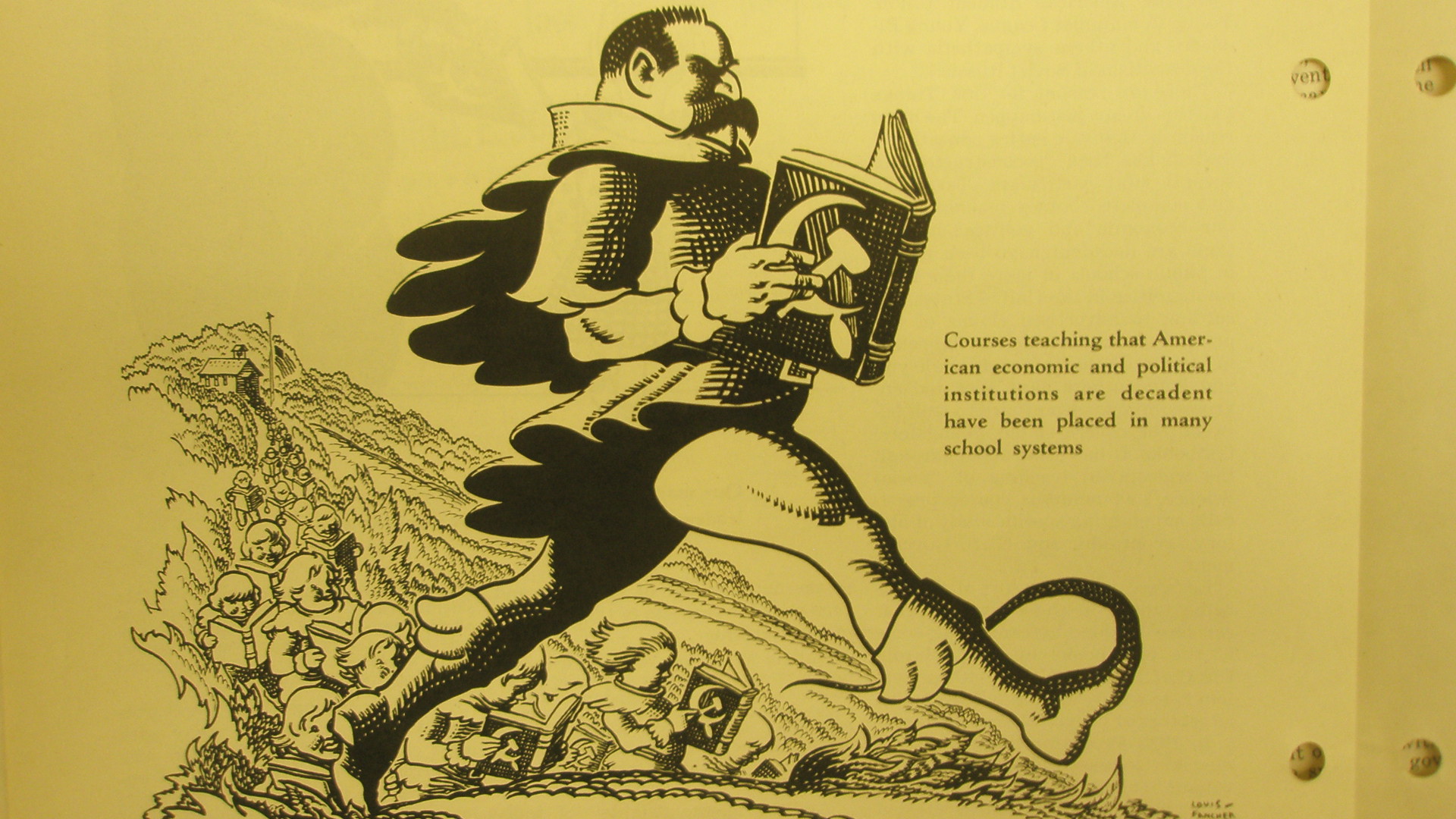
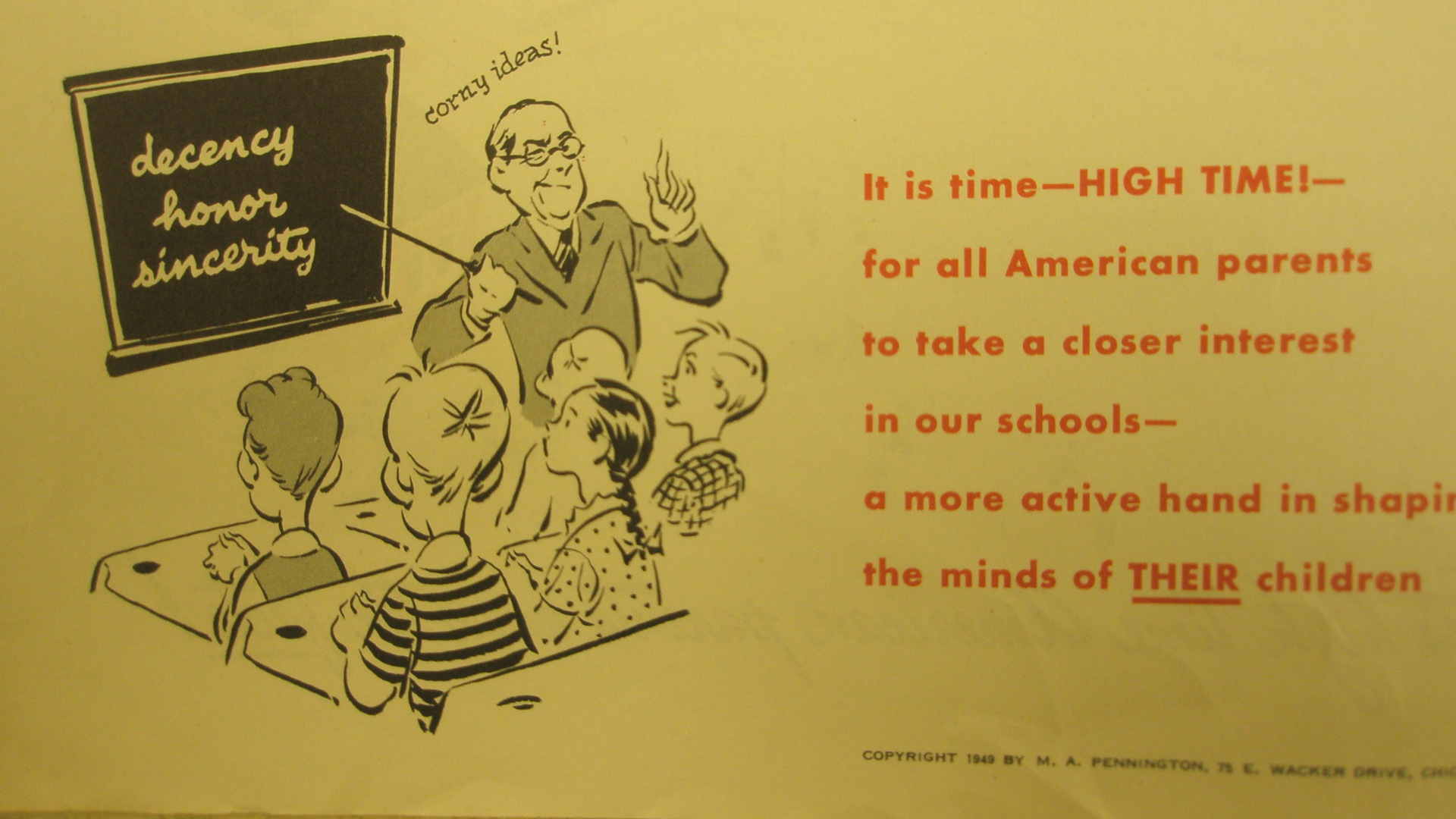
As always, a picture is worth a thousand words.  In this case, I’ll share some cartoons from an anti-communist pamphlet from 1949.  These cartoons demonstrate one common ideological thread in Cold War Fundamentalist America.  At the time, activists like the one who published this brochure felt that Communism threatened a two-pronged attack.  The danger included a military menace from Soviet Russia.  But it also meant internal subversion by dupes who did the work of the Red Army.  Intentionally or not, such subversive activity helped to weaken the resolve of America, making a communist takeover that much easier.

Further Reading: Ellen Schrecker, Many Are the Crimes: McCarthyism in America (Princeton: Princeton University Press, 1998); Jonathan Zimmerman, Small Wonder: The Little Red Schoolhouse in History and Memory (New Haven: Yale University Press, 2009).

This one shows the vast sweep of cultural ideology folded into the fight against communism. Not only must patriots fight communism, they must also fight to uphold traditional values.

Parents squeezing the “Red” out of textbooks.

As historian Jonathan Zimmerman has argued, the image of the “Little Red Schoolhouse” has long been a potent political symbol. In this cover image, the cartoonist makes a connection common in Cold-War anti-communism. “Reds” worked hard to subvert the Red Schoolhouse.

The scheming, bearded academic has long been an object of suspicion in Fundamentalist America. Here, he does the work of the Red Army.

FROM THE ARCHIVES: Fundamentalist Pied Pipers

I’m up to my eyeballs in my book manuscript about conservative educational activism in the 20th century.  There are plenty of recurring themes.  Just like every other sort of activist, conservatives return again and again to images or ideas that work.  On a recent research trip I found another example of a common theme among educational conservatives: the Pied Piper.  For decades, conservatives have warned of Pied Pipers leading children out of their schoolhouses and into damnation.  The specific tune might change.  Sometimes, it is the dangerous sound of evolution.  At other times, it is communism, or atheism, or lack of Bible awareness.  I’ll include a few of the most striking images here.  Enjoy!

EJ Pace, Christian Cartoons, 1922

I thought the cartoon above captured the spirit of the 1920s Protestant fundamentalist school campaigns so well that I used it as the cover of my first book.  It comes from a wonderful book of cartoons by the evangelical artist EJ Pace.

EJ Pace, 1931

This is another gem from EJ Pace.  This one appeared in the newsletter of the Evangelical Theological College, a seminary new in the 1920s.  It later became the Dallas Theological Seminary, a leading training school for conservative Protestant ministers.  Of course, there’s not an actual Pied Piper here, but I’m including it because it has the same theme of students being led from their school (you can see it way in the background) down to the chasm of unbelief in God.  The cartoon was an advertisement for a Bible campaign that never really got off the ground.  The plan was to deliver 1,000,000 Bibles to college students so that they might better resist the intellectual and spiritual dangers of higher education.

From “Our ‘Reconstructed’ Educational System,” Nation’s Business, April, 1940

Here we see a different sort of Pied Piper.  Instead of evolution or the lack of Bibles, the threat here is communistic school textbooks.  Stalin as Piper is able to lead the students out of their little red schoolhouse down a dangerous path.  In this use of the Pied Piper theme, the danger comes from improper, un-American teaching.  But the basic message is the same.

I imagine there are lots of Pied Piper cartoons floating around out there for all different sorts of educational ideas.  The idea that improper education–whatever that might mean–is leading our young people down a dangerous path is too obvious to be restricted only to patriotic or religious conservatives.  However, I don’t know if any other cartoon could possibly match the excitement of seeing Stalin in tights and pointy-toed shoes.

FROM THE ARCHIVES: Bible in America: Bibles to the Backwoods

A few years back I stumbled across a remarkable Bible campaign.  Beginning in 1921 and continuing throughout the twentieth century, Bible evangelists based at Chicago’s Moody Bible Institute delivered Bibles, New Testaments, and tracts to underserved regions.  This campaign, which began as part of the Bible Institute Colportage Association and eventually became part of the Moody Literature Mission, delivered millions of Bibles and religious literature to the Southern Appalachian region, as well as the Ozarks, western logging camps, Louisianan Catholic schools, prisons, hospitals, and other venues in which missionaries thought people were hungry for the Word. 

            At the time, I focused my study on the missionaries’ use of Appalachian public schools as a distribution network for this religious literature.  I published some of my findings in an academic journal [“The Quiet Crusade: The Moody Bible Institute’s Outreach to Public Schools and the Mainstreaming of Appalachia, 1921-1966,” Church History 75:3 (September 2006): 565-593.]

            Looking over my notes as I thought about the meanings of the Bible in Fundamentalist America, I came across my collection from this research.  As usual, there was a lot more material than what I could use in the article. 

            This will be the last of these collected posts from BICA and MBI. See other posts from this series HERE and HERE.  Most of the material is available at the Moody Bible Institute in downtown Chicago.  The people there were very accommodating and friendly on my visits, and the archive is certainly worth a visit if you’re in the area. 

            I won’t argue that these materials somehow capture any single essence of fundamentalist attitudes about the power of the Bible.  That would be far too simplistic.  But I do believe that the attitudes toward the Bible expressed in these materials give a window into a commonly held fundamentalist vision of the nature of Holy Scripture.  As we’ll see, the Bible missionaries from Chicago believed the Word had a unique power.  The Gospels, to them—and, I argue, to many fundamentalists in the 1920s and since—meant more than just a collection of edifying religious messages.  As we’ll see, many of these Bible missionaries held a fundamentalist belief in the saving power of this powerful text. 

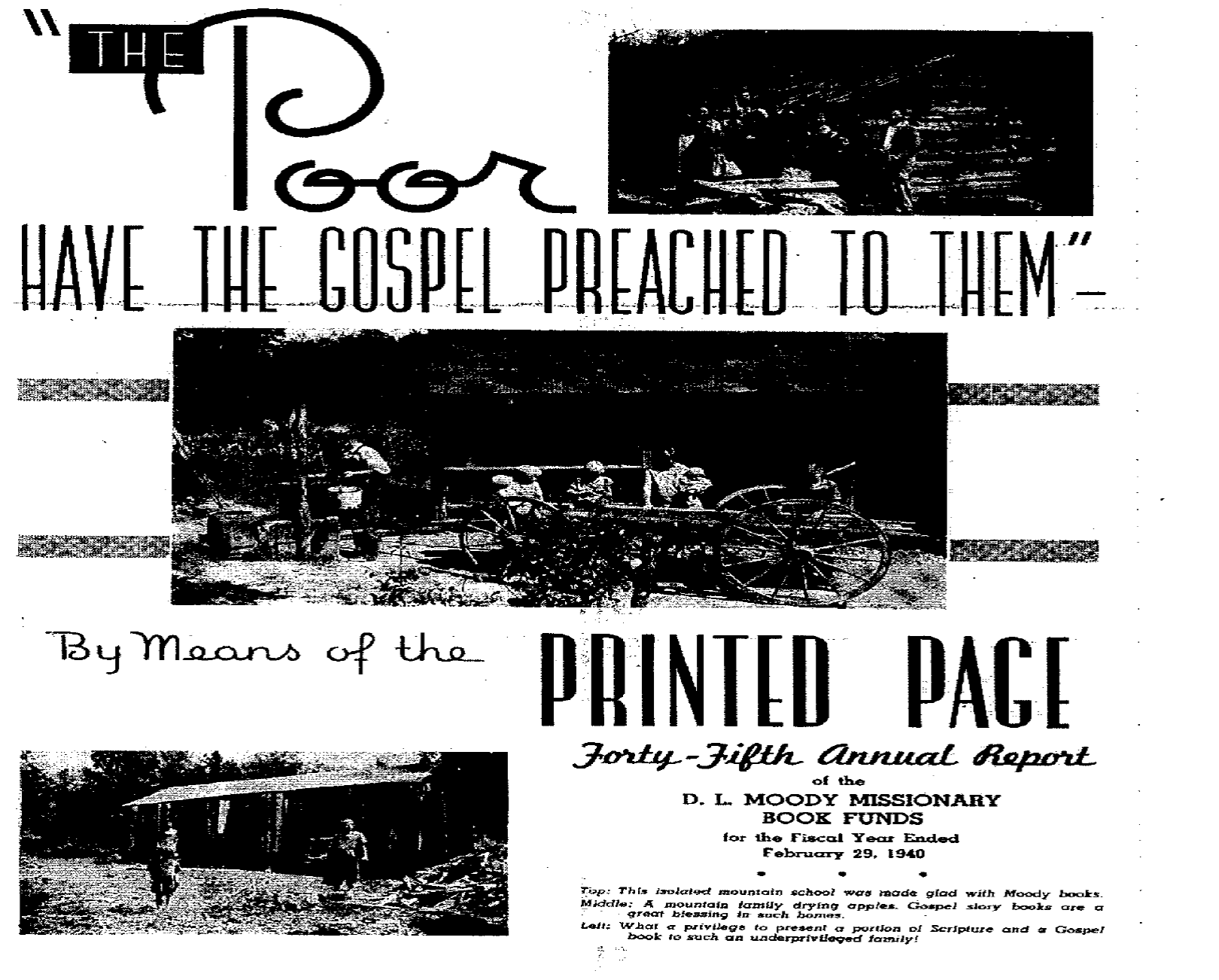
The inspiration for the Moody Bible Institute missionaries to deliver Bibles to the Southern Appalachian region came from the apparent lack of reading material of all kinds in the region.  In the 1920s, ‘30s, and ‘40s, the Chicago missionaries saw the “mountaineers” as particularly ready for literature outreach.  The reasons to send Bibles instead of humans were many.  First of all, Bibles were cheaper and easier to crate and ship.  Second, the Bible had a supernatural power to convert.  As one missionary proclaimed in 1921, the Gospels formed “the most unique, the most startling, the most compelling, and most unearthly message that has ever commanded God’s attention.”  No matter how talented a human missionary, he or she could not hope to compare with the words of the Gospel itself.  But another reason why Bibles made good missionaries was because the people of the region desperately wanted reading material of any kind.  Folks starved for reading material, the argument went, would eagerly read the Bible if only they could get one.  And by reading the Bible, they would be convinced by its supernatural power; they would embrace Fundamentalist Protestantism.  As one fundraising brochure from 1940 called it, this crusade could preach the gospel to the poor by using the “printed page.”

Many children from the region craved book ownership, it seemed, much more than they craved enlightenment.  Many of the Chicago book missionaries capitalized on that notion to satisfy young people’s lust for books with a healthy desire for the Gospel.  This picture of children in front of their log school was meant to show children’s appreciation for the Gospel.  It also shows, though, how much young people liked to have a book of their own.

These images from the Moody Bible Institute’s outreach tell us something about fundamentalist attitudes toward the Bible.  For many people, especially those without access to many books, the Bible served as both a religious text and a status symbol.  Both the Appalachian schoolkids and the Chicago Bible missionaries accepted this premise.  The Chicago missionaries played up this appeal by instituting a traditional Sunday-school Gospel-memorization strategy.  If schoolkids memorized a certain number of Bible passages, the missionaries would reward them with a Bible of their own.  Missionaries saw the lust for Bibles as a healthy desire for spiritual uplift.  Some of the schoolkids eagerly participated in the memorization program merely out of their desire to own books of their own.  They conflated their desire for ownership with their desire for salvation.

Also, this campaign shows us how evangelical Protestant missionaries in the early twentieth century tended to present their targets as different from themselves.  The missionaries may have been well-to-do—or at least middle-class—urban, Northern whites.  The folks they hoped to reach with their Bible outreach were consistently presented as something else.  Here, that other-ness was the “mountain” aspect of Appalachian life.  The little kids with their tiny log school, the farmers with their ancient wagon technology, or even simply the description of targeted populations as “The Poor,” all of these markers separated the missionaries themselves from those they hoped to reach.  As we’ve seen, by the middle of the twentieth century these Fundamentalist Protestant Bible missionaries had shifted their understanding of their targets.  Instead of consistently distancing their targets from themselves, by the mid-1940s these Bible missionaries presented their targets as white middle-class urban and suburban people.  This shift in Bible outreach tells us a great deal about the changing nature of Fundamentalist America in the twentieth century.  These Bible missionaries came to see themselves as reaching out in their own neighborhoods, to people like themselves. They no longer assumed that the only ones in need of soul-saving work were in far-away locations with exotic cultures.  Fundamentalist America came to see itself as working close to home.


FROM THE ARCHIVES: Fundamentalists and Federal Aid to Schools

If only Rick Perry could have remembered what he planned to abolish, he might have won the 2012 Republican Presidential primary.  If he had won, he might really have carried out his threat to get rid of the federal Department of Education, along with Energy and Commerce.  Or maybe not.  After all, Ronald Reagan had also promised to eliminate the Department of Education.  In the end, Reagan merely treated the department shabbily.  These days, it seems every self-respecting conservative insists that the Federal Department of Education is an outrage.  Devvy Kidd of WorldNetDaily, for example, insists the department “must be abolished” due to its “chilling” trend toward “communism.”

This hostility toward federal money for local schools has not always been a bedrock belief of American conservatives.  In the 1920s, as Douglas Slawson’s terrific 2005 book The Department of Education Battle describes, the fiercest opponent of a cabinet-level federal department of education was the Catholic Church.  It follows, then, that one of the fiercest PROponents of such a department was the 1920s Ku Klux Klan.  The 1920s Klan, after all, focused much more intensely than did later Klans on fighting the power of the Catholic Church.  It also focused much of its public activism on defending its vision of the “Little Red Schoolhouse.”  For God and Country, the 1920s Klan argued, the USA needed a cabinet-level Department of Education.

By the late 1940s, however, opposing federal aid to local schools had become an article of faith among American conservatives.                        

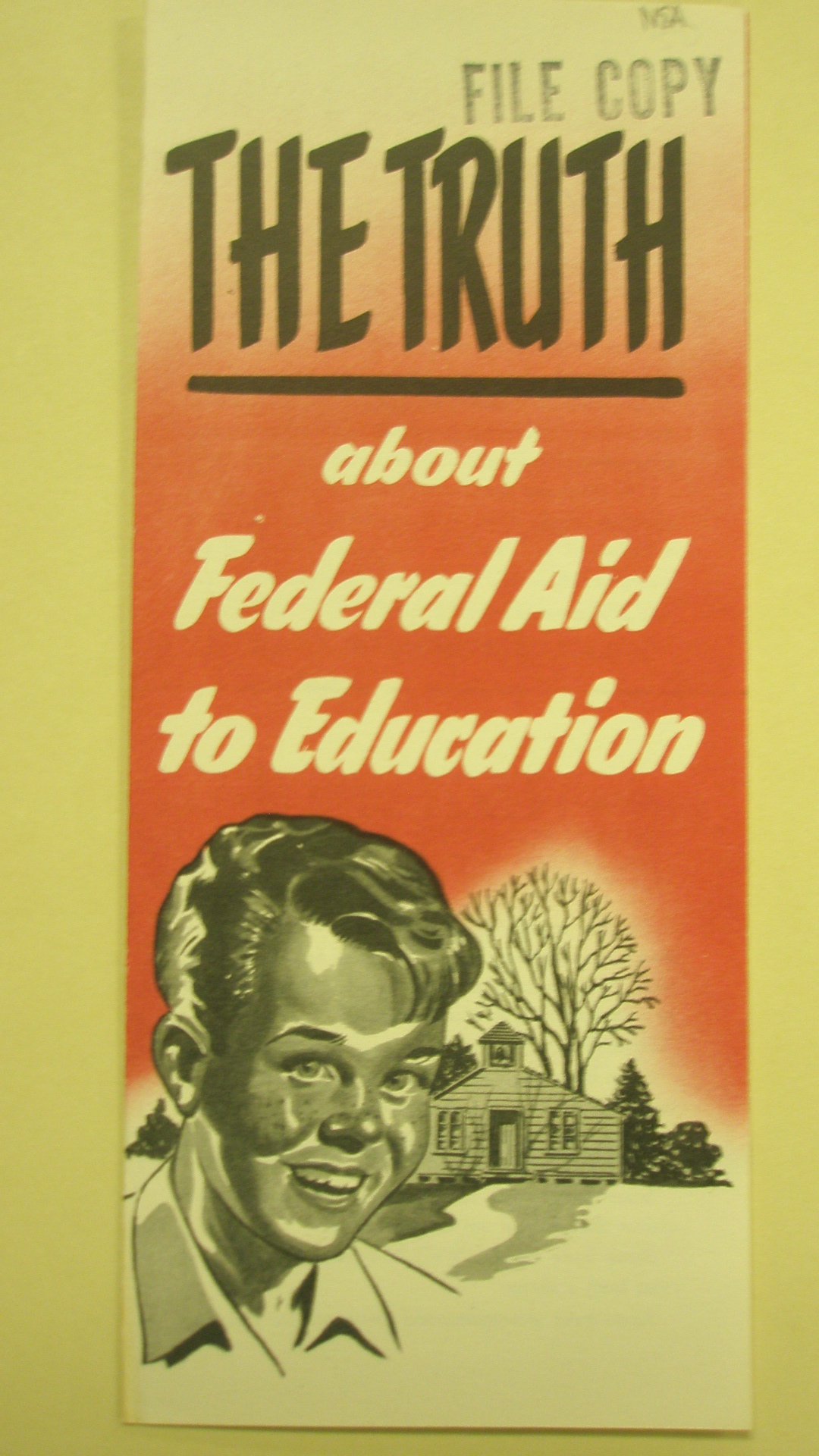
Perhaps because the National Education Association fought so fervently for more federal funding for local schools, as we can see with this 1948 NEA brochure, conservatives insisted that such aid would be merely the camel’s nose under the tent.  Such aid would inevitably include more federal control over local schools.

As one earnest Daughter of the American Revolution warned her conservative sisters in 1943,

“The citizens of the United States do not want the Federal Government to supervise education from the cradle to the grave, from nursery school to adult education. . . .  It is not difficult to see another huge arm of the Federal Government in the making, and more chains being forged to shackle the unthinking. . . . socialist-minded educators would use the funds to build ‘a new social order’ and . . . training in fundamentals [will be] neglected.”

Other conservatives in the 1940s and 1950s agreed.  Allen Zoll, a professional right-wing activist and founder of the National Council for American Education, published a couple of hugely influential pamphlets in the 1940s. 

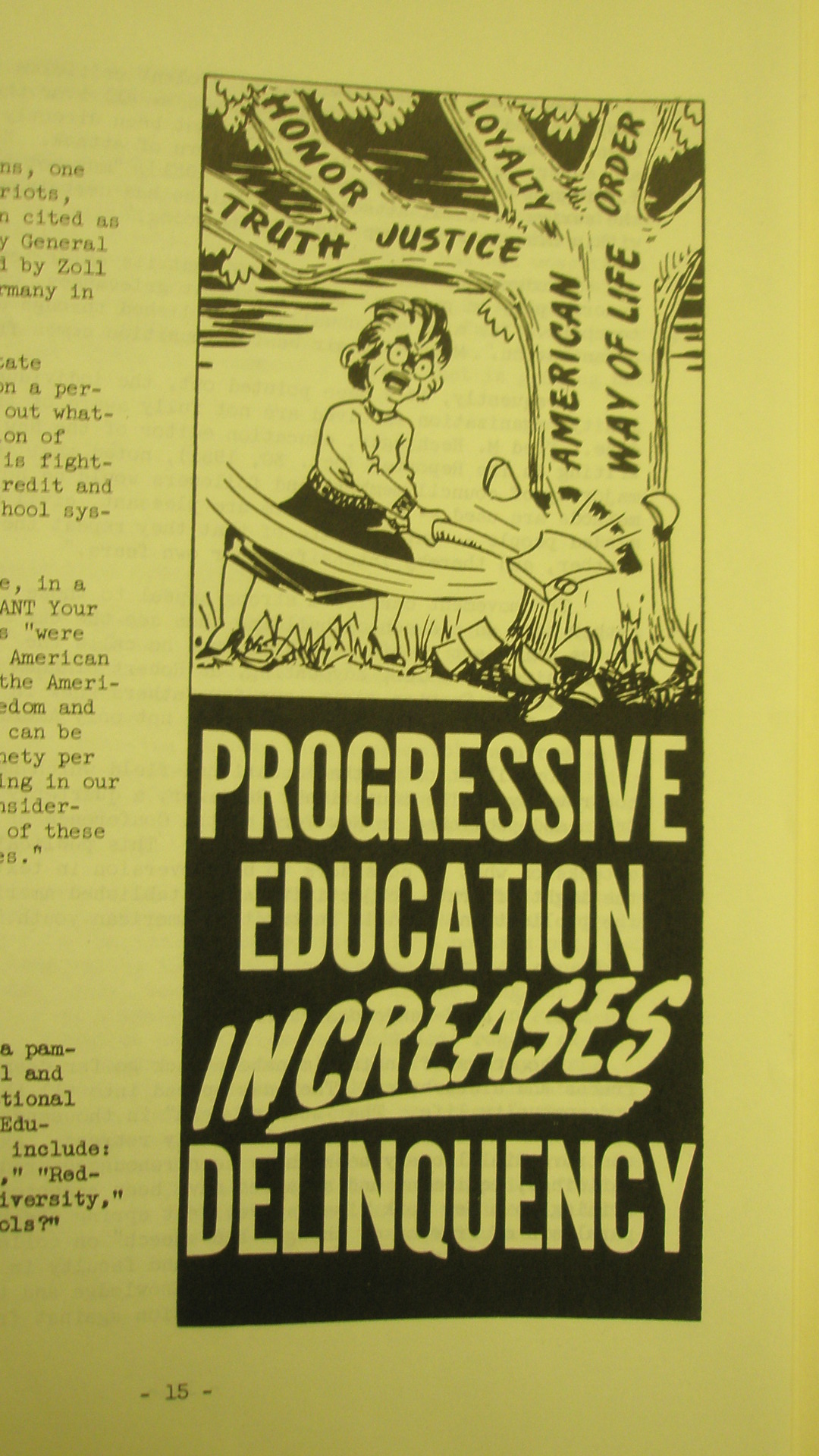
In one of them, “Progressive Education Increases Delinquency,” Zoll warned readers that contemporary education no longer taught students the traditional, fundamental values of American society.  He insisted,

The tragic and terrifying thing about all this is that it represents not merely rebellion against a moral code, but denial that there can be any binding moral code.  It is a fundamental revolution in human thinking of the first order: it is mental and ethical nihilism.  If it goes on unchecked, it will mean not merely tragedy for millions of individuals, it will mean the disintegration and final extinction of the American society.”

In another pamphlet from the late 1940s, “They Want YOUR Child,” Zoll warned that the NEA’s drive to secure federal funding for local schools was a conspiracy of the darkest order, a “conspiracy against the American way of life, against everything that we hold dear, . . . probably the most completely organized, ruthless design against other people ever set in motion in all human history.”

Inevitably, Zoll insisted, federal aid to local schools would lead to federal control over local schools.  Once schools fell for that trap, they would be controlled by an aggressive mind-controlling educationist bureaucracy.  The scheming of “progressive” educators such as Theodore Brameld, William Heard Kilpatrick, and George Counts would soon lead to a softening of the youth of America, a start of the slide to socialism, secularism, and destruction.

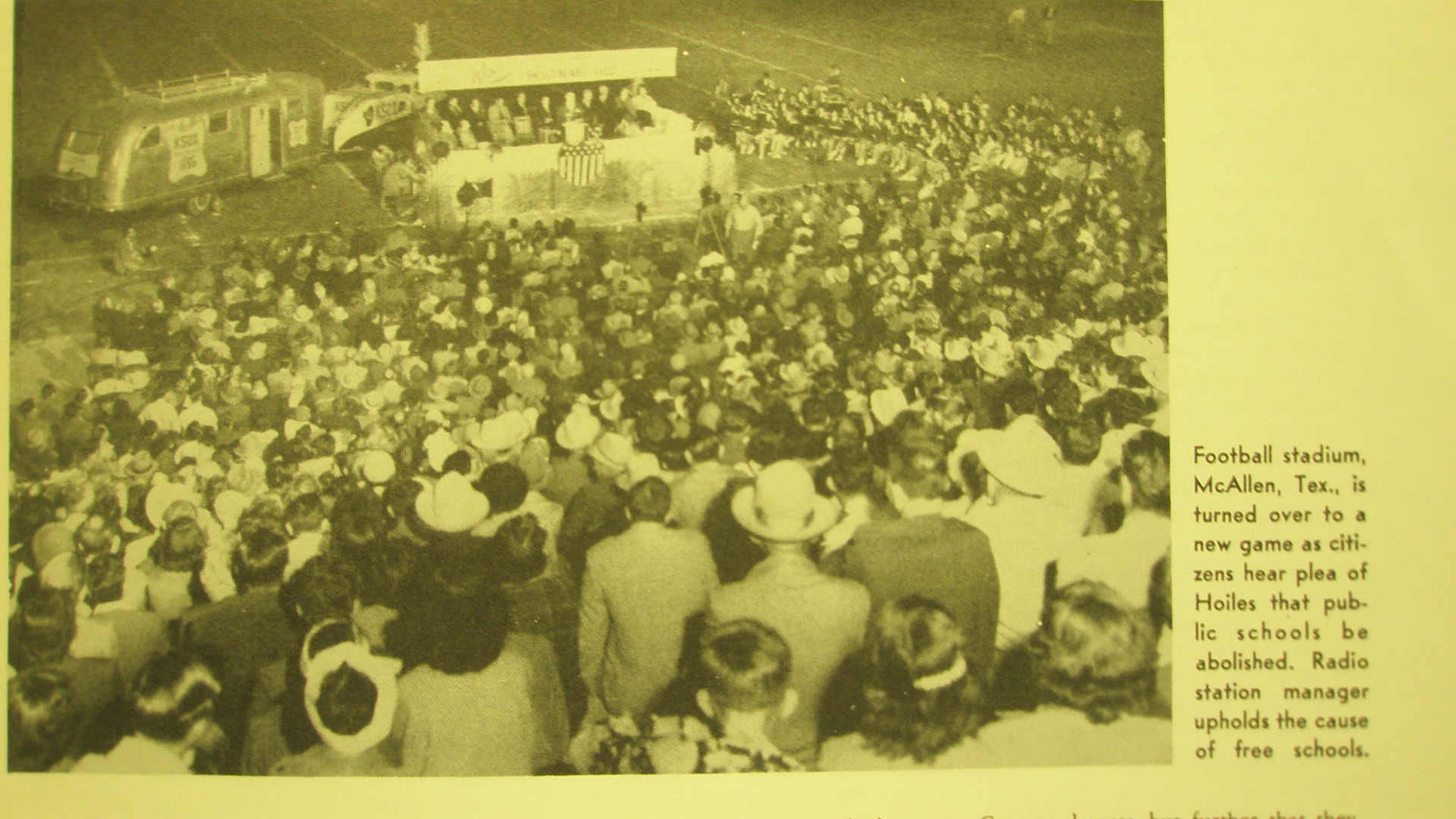
Some conservatives in the 1950s took this fight against federal funding one step further.  Although they never represented a majority conservative viewpoint, some insisted that all public monies for schools represented government tyranny.  One eccentric proponent of this maximalist position in the 1950s was R.C. Hoiles.  Hoiles had earned a pile of money—one journalist in 1952 estimated $20,000,000—with his Western media empire.  In his editorials for his newspapers, Hoiles argued that all public schools implied government tyranny.  In one from The Marysville-Yuba City (CA) Appeal Democrat, February 28, 1951, for example, Hoiles argued,

“Very few people realize to what degree the government has grabbed the authority to indoctrinate the youth of the land.  We cannot reverse our trend toward socialism as long as the youth of the land comes in contact and is trained by teachers who believe that they have a right to do collectively what they know would be immoral if done by an individual.  In short, the youth of the land is coming in contact with men who are communistic in their thinking, if we properly define communism.  Here is a good definition of communism written by David Baxter.  ‘Communism is the conclusion that more than one person, or a majority of persons, have a right to do things collectively that it would be wrong and immoral for one person to do.’  Can anyone improve upon this definition of communism?

            “According to this definition, is not every believer in tax-supported schools a believer in communism, whether he knows it or not?”

Hoiles also issued a standing challenge to debate this issue.  On February 2, 1952, a radio personality took him up on his offer.  Thousands of people crammed into the football stadium to hear the debate between Hoiles and Roy Hofheinz.  Among the rhetorical gems Hoiles unloaded at that debate included the following:

“Every board of education is government; therefore, it is force.  It is not reason or eloquence—IT IS FORCE!  It is a fearful master—it certainly does not seem rational that understanding and education can be promoted by the force of a policeman . . . “

“There are many ideas as to what is a good government.  But only one idea can be taught in government schools.  And that idea cannot be anything unfavorable to existing government institutions.  It would be impossible to find any teaching in government schools unfavorable to government schools.  It would be impossible to find anything taught in government schools unfavorable to existing state administration.  We cannot now find anything taught in government schools really unfavorable to New Dealism.

            “We believe it would be next to impossible to find anything taught that preaches old-fashioned American individualism as against our modern New Deal fraternalism in government.  Thus we believe that government schools’ teaching in regard to government must favor administration policies, whatever they may be.  Hitler and Hirohito used government schools to promote their regimes. 

            “Stalin is using Russian government schools to promote his regime.  Karl Marx made free public schools one of the points in his famous ‘Communist Manifesto.’  Any government delights in having schools to propagandize its doctrine.” ….

“It has often occurred to me that if an overwhelming majority of Americans really favor the present system of education, it should not be necessary to compel anyone to support it.  A system as sound and popular as tax-supported public schools are supposed to be should be well supported on a voluntary basis.” 

Funding of schools will likely always be a contentious issue.  Taxpayers, especially those who have no children or send their children to private schools, have a dollars-and-cents reason to oppose public schooling.  Perhaps the powerful tradition in Fundamentalist America of opposition to federal funding—or even to any public funding—of local schools can be reduced mainly to a desire to keep more money from the hands of the tax man.  But there also seems to be a deeper ideological connection.  Since the 1940s, at least, fighting against federal funding for local schools has become an article of conservative faith among some citizens of Fundamentalist America.

FURTHER READING: Douglas J. Slawson,  The Department of Education Battle, 1918-1932; Public Schools, Catholic Schools, and the Social Order (University of Notre Dame Press, 2005; Madeleine P. Scharf, “The Education Finance Act of 1943,” Daughters of the American Revolution Magazine 77 (October 1943): 635-637.

FROM THE ARCHIVES: Bible in America: The Power of Books

A few years back I stumbled across a remarkable Bible campaign.  Beginning in 1921 and continuing throughout the twentieth century, Bible evangelists based at Chicago’s Moody Bible Institute delivered Bibles, New Testaments, and tracts to underserved regions.  This campaign, which began as part of the Bible Institute Colportage Association and eventually became part of the Moody Literature Mission, delivered millions of Bibles and religious literature to the Southern Appalachian region, as well as the Ozarks, western logging camps, Louisianan Catholic schools, prisons, hospitals, and other venues in which missionaries thought people were hungry for the Word. 

            At the time, I focused my study on the missionaries’ use of Appalachian public schools as a distribution network for this religious literature.  I published some of my findings in an academic journal [“The Quiet Crusade: The Moody Bible Institute’s Outreach to Public Schools and the Mainstreaming of Appalachia, 1921-1966,” Church History 75:3 (September 2006): 565-593.] 

            Looking over my notes as I thought about the meanings of the Bible in Fundamentalist America, I came across my collection from this research.  As usual, there was a lot more material than what I could use in the article. 

            For the next few posts, I’ll pull up various pamphlets, brochures, and other materials from this archival collection.  Most of the material is available at the Moody Bible Institute in downtown Chicago.  The people there were very accommodating and friendly on my visits, and the archive is certainly worth a visit if you’re in the area. 

            I won’t argue that these materials somehow capture any single essence of fundamentalist attitudes about the power of the Bible.  That would be far too simplistic.  But I do believe that the attitudes toward the Bible expressed in these materials give a window into a commonly held fundamentalist vision of the nature of Holy Scripture.  As we’ll see, the Bible missionaries from Chicago believed the Word had a unique power.  The Gospels, to them—and, I argue, to many fundamentalists in the 1920s and since—meant more than just a collection of edifying religious messages.  As we’ll see, many of these Bible missionaries held a fundamentalist belief in the saving power of this powerful text. 

The most powerful book, fundamentalists agree, is the Bible.  Among conservative Protestants, the Bible is often considered to have supernatural power on its own.  The Chicago book missionaries of the Bible Institute Colportage Association and Moody Literature Mission were no exceptions.  They believed the Bible could transform lives.  But the Chicago book missionaries also believed in the power of non-Biblical literature.  Especially as a counterweight to an expanding pulp press, Bible-friendly fiction could be an important way to save souls.  In this post, I’ll describe an example of each type of book that the Chicago book missionaries distributed.

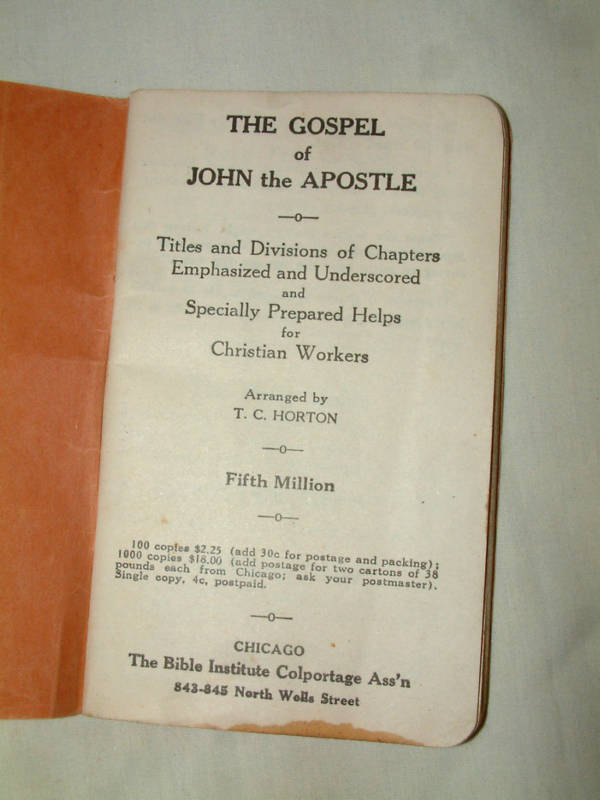
First, the Bible.  The most commonly distributed Bible book wasn’t the entire Bible, but rather a special edition of the Gospel of John.  This edition was edited by TC Horton in 1922.  At the time, Horton was at the peak of his career.  He was a minister and organizer in the Los Angeles area.  He was best known in 1922 as the editor of the Kings Business, the magazine of the Bible Institute of Los Angeles (now Biola University).

Horton’s attitude toward this little volume was clear from the verse on the front cover.  Sorry, it’s hard to read in this photo, but the verse says,

  Here is a little book for you!

                        Just take it, now, and read it through.

                        Page sixty-six, verse thirty-one,

                        Believe it, and the work is done!

If any curious reader followed this clue, he or she would find the following verse: “But THESE ARE WRITTEN, THAT YE MIGHT BELIEVE THAT JESUS IS THE CHRIST, THE SON OF GOD; AND THAT BELIEVING YE MIGHT HAVE LIFE THROUGH HIS NAME.”

In case readers didn’t follow the cover clue, Horton repeated the message on the inside cover.  Horton insisted that the Gospel of John was “the incomparable piece of English Literature.”  But it was not only good literature.  It was inspired by God in order specifically to convert people to Biblical Christianity.  If only people would read these words, Horton believed, their lives would be transformed.  As Horton insisted, this supernatural power was the reason why this Gospel “should be placed, as far as possible, in the hands of every man, woman, and child in the world.”

As we’ve seen, fundamentalists in America have embraced this mission.  In a campaign that sometimes seems bewildering to non-fundamentalists, Bible missionaries have worked to get people to see these Gospel words.

The files of the book missionaries shed some light on this attitude toward the saving power of Gospel words.  The first director of the Bible Institute Colportage Association, William Norton, told stories of the instant power of the words of the Gospel.  In 1921, Norton told a story of a man given a Gospel tract.  At first, the man ignored it.  “Coming to a hedge,” Norton related, “he stuck the tract into the hedge.”  However, thanks to the awesome power of the words of the Gospel, “it was too late; his eyes had caught a few words of the tract which led to his conversion.”  In another story from 1921, a vicious murderer found a copy of a Gospel tract.  “Through reading the Gospel of John this man saw the error of his way, changed his manner of living, and moved to the Bear Creek community in Scott County, Tenn.”

For Bible missionaries like the ones from Chicago, this power of conversion came from the power of the Gospels.  The words were inspired by God to lead to this kind of conversion.  It only made sense, then, to distribute those words as widely as possible.  This attitude toward the words of the Gospel has informed the outreach of Fundamentalist America in ways that remain bewildering to folks who don’t understand the impulse.  But if we can understand this book, these words, as inspired by God to lead people to salvation, we can understand something about the Fundamentalist desire to get these words in front of as many people as possible.  For the Chicago book missionaries, this meant delivering hundreds of thousands of copies of these tracts and Gospels to children across the nation.

Among fundamentalists, only the Bible had the kind of supernatural power that could lead people to instant conversion, merely by seeing the words.  But other kinds of books, too, could help.  The Chicago book missionaries also distributed hundreds of thousands of copies of short novels.  These books weren’t as powerful as the Bible, but they could still work to combat the trend toward sin in popular literature.  As one missionary warned in 1937, they needed uplifting books “during these difficult days when much pernicious literature is being widely distributed by religious cults, atheistic organizations and anti-Christian societies, whereby many are being deceived and destroyed.”

Back in 1921, William Norton had called these books “true-to-the-Bible literature.”  One of the most popular was Rosa’s Quest, originally published in 1905.

In this story, a poor girl is lost in a big city.  Her Christian mother had died, and just before she died she told Rosa to find her in the “beautiful land.”  Unfortunately, the girl lacked any Christian education.  She wandered around the city, rebuffed by nominal Christians who did not reach out to her.  Finally, a missionary on a city bus explains the Word of God to Rosa.  Rosa is converted, then adopted by a wealthy secular family.  In the end, Rosa converts all of her new family using the Gospel.

In the eyes of Bible missionaries, books like this did not have the same supernatural power as the Gospel itself.  They could not change lives simply by being read or heard one time.  But missionaries still reported that the books could help save souls.  One missionary in 1921 reported that the children she worked with were “very enthusiastic” about Rosa’s Quest.   One child from Madison County, Kentucky, wrote to the BICA to thank them for the free books, and noted that he felt “like little Rosa in Rosa’s Quest.  I have found the way to heaven.”  Another recipient wrote in 1937,

“FROM KENTUCKY: ‘In the year 1929, one of my friends loaned me some of your books entitled “Little King Davie,” “The Way Home,” “The Robber’s Grave,” “A Peep behind the Scenes,” and others.  I was thirteen years of age.  God definitely spoke to me through the books and gave me a peep behind the curtains which hid my heart.  In the same year I received a heart-felt experience from God, and also a call into His service.  I am now a missionary in the mountains of Kentucky.”

For the conservative Protestant missionaries of the Moody Bible Institute, books had power.  Some of them, if they contained the actual words of the Gospels, could have supernatural power.  Those words, distributed in books, tracts, and leaflets, emblazoned on billboards, eventually printed on Tim Tebow’s face, could change a life in an instant.  Other books, like Rosa’s Quest, merely provided information about how such change could happen.  They did not save lives the same way the Gospel could, but they kept young people from reading literature that could confuse them or lead them into sin.


FROM THE ARCHIVES: Bible in America: Bible Evangelism to the Crabgrass Frontier

A few years back I stumbled across a remarkable Bible campaign.  Beginning in 1921 and continuing throughout the twentieth century, Bible evangelists based at Chicago’s Moody Bible Institute delivered Bibles, New Testaments, and tracts to underserved regions.  This campaign, which began as part of the Bible Institute Colportage Association and eventually became part of the Moody Literature Mission, delivered millions of Bibles and religious literature to the Southern Appalachian region, as well as the Ozarks, western logging camps, Louisianan Catholic schools, prisons, hospitals, and other venues in which missionaries thought people were hungry for the Word. 

            At the time, I focused my study on the missionaries’ use of Appalachian public schools as a distribution network for this religious literature.  I published some of my findings in an academic journal [“The Quiet Crusade: The Moody Bible Institute’s Outreach to Public Schools and the Mainstreaming of Appalachia, 1921-1966,” Church History 75:3 (September 2006): 565-593.] 

            Looking over my notes as I thought about the meanings of the Bible in Fundamentalist America, I came across my collection from this research.  As usual, there was a lot more material than what I could use in the article. 

            For the next couple-few posts, I’ll pull up various pamphlets, brochures, and other materials from this archival collection.  Most of the material is available at the Moody Bible Institute in downtown Chicago.  The people there were very accommodating and friendly on my visits, and the archive is certainly worth a visit if you’re in the area. 

            I won’t argue that these materials somehow capture any single essence of fundamentalist attitudes about the power of the Bible.  That would be far too simplistic.  But I do believe that the attitudes toward the Bible expressed in these materials give a window into a commonly held fundamentalist vision of the nature of Holy Scripture.  As we’ll see, the Bible missionaries from Chicago believed the Word had a unique power.  The Gospels, to them—and, I argue, to many fundamentalists in the 1920s and since—meant more than just a collection of edifying religious messages.  As we’ll see, many of these Bible missionaries held a fundamentalist belief in the saving power of this powerful text. 

For many fundamentalist evangelists, the merest exposure to the words of the Gospel can have a saving power.  It can serve as an inoculant to sinful doctrines and sinful ignorance.  For example, one post-World War II brochure trumpeted its success in exposing students in public schools to the Word.  These students were described as “otherwise unreached boys and girls.”  By giving them Bibles, these missionaries proclaimed they had been “introduced to the way of salvation for the first time, with many of them accepting Christ as their personal savior.”

In the view of these fundamentalist missionaries, the dangers to these students—depicted as white, fairly affluent suburbanites—came from both ignorance and false doctrine.  This brochure warned of other missionaries: “Jehovah’s Witnesses, Mormons, Catholics and Seventh Day Adventists,” all of whom were “making devastating inroads among these gospel-hungry communities.”  In the view of these Bible missionaries, young people did not need anything beyond the Bible to be protected from this threat.  If these students could simply be exposed to the “true message of eternal life” from the Bible, missionaries would be able to “capture them for the Lord Jesus before they are ensnared by the evil one.”

There is a good deal here of interest for those who hope to understand Fundamentalist America.  As I write, the 2012 Republican presidential primaries are slogging along, with (Catholic) Rick Santorum fighting (Mormon) Mitt Romney and (Converted Catholic) Newt Gingrich for the vote of the Fundamentalist Faithful.  Romney’s Mormonism sometimes comes up as an issue for conservative Protestant voters.  We don’t see as much, though, about the threat of Santorum’s Catholicism.  We have wondered here about this “Fundamentalist Mystery.”  This brochure from sixty-odd years ago paints a very different picture of the relationship between fundamentalist Protestants and conservative Christians of other groups.  The relationship between the two has long been tense.  Some historians have argued that it was only the “pro-life” movement that emerged in the 1970s that brought the two together.  But there had been other rapprochements, with prominent Catholics such as William F. Buckley Jr. leading a broader conservative movement in the years after World War II that attracted many Protestants as well as Catholics.

In this Protestant brochure, written around the same time that Buckley began his long career as the intellectual darling of Fundamentalist America, Catholics, Mormons, Seventh day Adventists and Jehovah’s Witnesses are not seen as part of a broad conservative coalition, but rather as deadly, aggressive threats to the health of America’s unreached masses.

For those outsiders who hope to understand Fundamentalist America, another interesting lesson from this brochure is the perceived power of the Gospel among these literature missionaries.  This point is so central to this tradition that it usually went unremarked, but if we want to understand Fundamentalist America, we need to explore the meanings of this Biblicism in a little more detail.  First of all, we need to note that this tradition is strongest only in this segment of today’s broad Fundamentalist coalition.  Conservative Catholics, for example, don’t historically place the same emphasis on the miraculous power of Bible text.  For these Chicago book missionaries, however, the assumption was that the words of the Bible, especially those of the four Gospels, had the power to effect soul-saving conversions on anyone who read them.  The challenge, then, for the missionaries was only to get the Word out there.  If these white suburban schoolkids could somehow be persuaded or cajoled into looking at the Gospels, their souls would be saved.  Again, this assumption is so powerful among a segment of today’s Fundamentalist Americans that it usually goes without comment.  But it explains a good deal that is puzzling to non-fundamentalists.  So, for example, when people at sporting events hold up signs with Biblical chapter and verse—either as Broncos’ quarterback Tim Tebow or just as a guy in the bleachers—the hope is the same.  If they can simply convince people to look at John 3:16, the tradition goes, sinful or ignorant people will be eternally saved.  This is the impulse behind much of the fundamentalist effort to Biblicize public space.  If students in public schools can be exposed to the words of the Bible, they will be saved.  If billboards can proclaim the words of the Gospel, readers will be saved.  If court sessions can start with a Bible reading, sinners will be saved.  All of these goals only make sense once we understand the enormous power some Fundamentalists grant to the words of the Gospel.  The merest exposure is presumed to have eternal power.

Another interesting point about Fundamentalist America that this brochure reveals is its presumption about its readers.  This is a fundraising brochure that trades on its readers’ sense of duty.  The duty is to save as many souls as possible.  The public schools, in this brochure, present an “opportunity” to reach many imperiled young souls with only a small effort and expense.  The central point of this public-school campaign is that students in schools are likely to be reading.  Why not help make that reading material Biblical?  At least among this particular postwar Fundamentalist community, the missionaries did not need to explain that their readers should want to save souls.  Instead, the assumption was that Fundamentalists worked in contest with other spiritual missionaries—Mormons, Catholics, Seventh day Adventists, and Jehovah’s Witnesses—to capture as many souls as possible.

This Fundamentalist requirement to save souls helps explain some of the puzzle of Fundamentalism.  Many non-fundamentalists have complained about the aggressive nature of Fundamentalist America.  In the 1920s, for instance, famous atheist Clarence Darrow put it something like this, “I don’t mind them going to heaven their way, but I don’t want them to stop me going to hell my way.”  Other non-fundamentalists, these days, say they don’t understand why fundamentalists care if other people do things like marry same-sex partners.  Once we see the centrality of soul-saving outreach to the Fundamentalist tradition, we can get a better sense of the reason for this aggressive insistence on the morality of everyone, not only the Fundamentalist community itself.

Finally, this brochure shows us the ways some Fundamentalists starting seeing whitebread suburban America as the newest “mission field” for their outreach work.  In the nineteenth and early twentieth centuries, a lot of this outreach was directed away from mainstream middle-class American life.  Earlier fundamentalists assumed that the core of American middle-class culture was safely aware of the Gospels, safely educated and inoculated from the spiritual dangers of life.  Of course, some of those folks might still choose a life of sin, but at least they knew the saving message of the Gospels.  After World War II, some fundamentalists—like these Bible missionaries—began to see their role in American culture differently.  Their missionary outreach no longer had to be only to “outsider” groups, whether that be in sub-Saharan Africa, Latin America, Asia, among immigrant communities in big American cities or among isolated mountain families in places like the Southern Appalachians.

Instead, some fundamentalists started to see themselves as surrounded by a vast mission field.  Even in affluent white communities they began to see their role as one of outreach and salvation.  Much as later fundamentalists such as Jerry Falwell would complain that they were a minority group, so these postwar evangelists saw themselves as one missionary enterprise among others, competing for the souls of middle-class white kids in suburban public schools.


FROM THE ARCHIVES: The Bob Dylan Bible Apocalypse

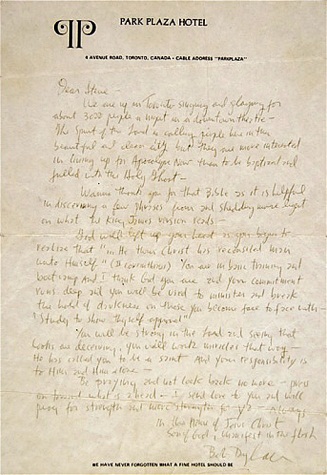
From the fantastic website Letters of Note ILYBYGTH recently dug up a missive by Bob Dylan dating from his Fundamentalist Phase.

In this April, 1980 letter, Dylan thanks his friend for a new Bible.  It’s not clear from the letter what edition the gift Bible was, but Dylan said the new edition helped him understand the King James Version.

Dylan wrote from Toronto.  His audiences, he said, heard the call of “the Spirit of the Lord,” but they were more interested in lining up to see Apocalypse Now than to be “baptized and filled with the Holy Ghost.”

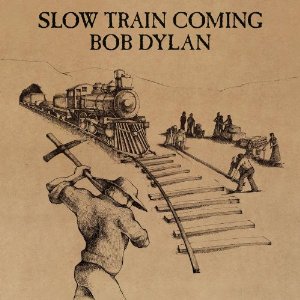
It’s news to me, but apparently any self-respecting Bob Dylan fan has long pondered the meaning of Dylan’s “Jesus Years.”  It seems between 1979 and roughly 1983, Dylan embraced evangelical Christianity and cranked out a few missionary albums, starting with “Slow Train Coming.”

The story goes something like this: in a drug-fueled crisis, with critics viciously panning his recent creative output, Dylan embraced the Word.  The meaning and sincerity of this period in Dylan’s life has been the subject of long debate among Dylan fans and other interested parties.  Some Jewish commentators have lamented Dylan’s apostasy.  Evangelicals have celebrated his recognition of their worldview.  But did he really mean it?  Some commentators conclude that Dylan blundered around his evangelical Christian faith just as he blundered through worlds of drugs and sex.  Others insist that Dylan later repudiated his Bible years as merely an unfortunate drug-fueled mistake.  Still others contend that Dylan represents the true power and healing grace of Biblical Christianity. 

A choppy documentary film about the “Jesus Years” seems only to have deepened the mystery and controversy.

Whatever fans and critics may conclude about the longevity of Dylan’s fundamentalism, this Toronto letter, at least, shows that for some stretch of time, Dylan talked the talk of evangelical Christianity.  His hopes for the Toronto crowds sound similar to those of any other fundamentalist preacher.

For ILYBYGTH readers, the meanings of Dylan’s fundamentalist years have different implications.  From one perspective, we can read Dylan’s conversion as an insight into the meanings of fundamentalist America.  When Dylan reached a late-1970s low, one of the preachers who understood his dark night of the soul, apparently, was Bill Dwyer of the evangelical Vineyard Fellowship.  At least according to documentary director Joel Gilbert, this Biblical outreach organization had become popular among the Southern California music scene, and Dylan fell into its outreach arm and embraced its apocalyptic message.

In this interpretation, the story demonstrates the often-surprising cultural power of fundamentalism.  Even in the midst of the famously Satanic rock-and-roll lifestyle, fundamentalism becomes a powerful cultural force.  Dylan and his associates were drawn to the inestimable power of Jesus’ saving grace.  It offered them a compelling personal, social, and cosmological message that made sense to them.  Fundamentalism, in this understanding, can hold its own among those most deeply immersed in the intensely hedonistic world of American celebrity.

Seen from another perspective, however, Dylan’s embrace of fundamentalist America can appear as nothing more than one drastic lifestyle choice at America’s all-you-can-take cultural buffet.  That is, Dylan clung briefly to fundamentalist Christianity just as he clung briefly to heroin, then later clung to fundamentalist Judaism.  Dylan chose Biblical Christianity, but other American celebrities fled from the intense despair of celebrity into the spiritual arms of yoga, veganism, Zen Buddhism, psychotherapy, or other anti-celebrity spiritual shelters.  In this reading, fundamentalist America is simply the rock to which a despairing Dylan clung.  It is not the bedrock of all American virtue, but rather just another option in an ultimately meaningless cultural panoply.  Dylan’s brief embrace of fundamentalist America only demonstrates, in this reading, the ways fundamentalism has lost its status as The One Truth.  Fundamentalism, in this reading, has become just another menu option for the spiritual thrill-seeker.

Whatever else it may mean, Dylan’s story can tell us something about the appeal of fundamentalist America to those outside its boundaries.  Whatever Dylan may have been experiencing as a crisis of the soul, when he reached out for the opposite, he found Bible-based evangelical Christianity.  To him­—and to generations of his fans and devotees—this kind of apocalyptic, Bible-based, aggressively proselytizing fundamentalist Christianity represented the opposite of everything he had stood for.  When his secular, hedonistic lifestyle led Dylan to an unsupportable personal crisis, he embraced fundamentalism as its shining opposite.

From the Archives: Ralph Spitzer, TD Lysenko, and the Left-Wing Attack on Science

In any culture-war debate these days, we can count on a few predictable ideological combinations.  The conservative/traditional/Right side will fight for freer markets, smaller government, more patriotism, more traditional social mores, and greater public Christianity.  The progressive/liberal/Left side will fight for greater egalitarianism, more robust government, and multiculturalism.

One of the other relatively consistent ideological markers these days seems to be an attitude toward science.  Conservatives, whether they like it or not, are now the side of anti-science.  Whether it is evolution or human-caused climate change, the Right is now the side that is skeptical of the claims of mainstream science.  Of course, as with any issue in this culture-war minefield, we need to be careful to note that this does not mean that these culture warriors are necessarily against science as such.  Rather, many conservatives will adopt an attitude of profound skepticism toward the directions in which mainstream research-university-based science research has gone.  REAL science, they might insist, will confirm their claims.  But ‘science falsely so called,’ in the minds of many cultural conservatives, has come to dominate the academy and academic press.  They are not anti-science, these conservatives might insist, only anti-false science. To the person on the street, though, it is easy to conclude that the Right is the side that always opposes science.

During a recent stint with some 1940s newspapers, I came across a story that complicates those comfortable assumptions.  Ralph Spitzer’s story is a good reminder of the reasons why we need to keep these storylines complicated.  It points out the danger of assuming any necessary relationship between science and politics.  Spitzer was fired from his teaching job at Oregon State College (now Oregon State University) in 1949 for his political beliefs.  At the time, he joined a swelling number of higher-education faculty who had lost their jobs for affiliation with Communist- or purportedly “Communist-front” organizations.

But unlike Joseph Butterworth, Herbert J. Phillips, and Ralph H. Gundlach, all fired from the University of Washington for their Communist Party membership or sympathy, Spitzer was also fired for his opposition to mainstream science.

Oregon State President August Strand accused Spitzer of betraying not only America, but also science.  Strand alleged that Spitzer’s public comments in favor of the prominent Soviet scientist TD Lysenko pushed Spitzer outside the range of legitimate scientific discussion.  By endorsing Lysenko, Strand accused, Spitzer had denounced the mainstream science of genetics and natural selection.  Thus, Spitzer was fired not only for being a communist sympathizer, but for being a sympathizer of communist anti-science.

Historian David Joravsky has argued that the popular understanding of Lysenko’s argument has become something of a durable myth.  Most people remember Lysenko’s scientific regime, if they remember it at all, as an ideological attack on genetics.  According to Joravsky, some have remembered Lysenkoism as an attack on the capitalist assumptions of genetics.  This myth presents Lysenko as a totalitarian ideologue, refusing to acknowledge the truth of genetics, due to mental blocks derived from Stalinism.  Humans, according to the Lysenko myth, must remain malleable in nature.  They must be able to form themselves into new beings, pushing a neo-Lamarckian understanding of human heredity to the fore.  In other words, according this Lysenko myth, humans must not have heritable DNA, since we know from Marxism/Leninism/Stalinism that humans can be recreated by new conditions.  Changes made in one lifetime can be passed on to future generations.

According to Joravsky, the truth of the Lysenko affair was far less ideological.  In Joravsky’s reading, the real thing was not theoretical or even political, except in the grubbiest of senses.  “Not only genetics but all the sciences that impinge on agriculture were tyrannically abused by quacks and time-servers for about thirty-five years,” Joravsky argued.   This was not done out of an ideological demand that humans be understood to be perfectable, but only because of a “self-deceiving arrogance among political bosses.”  The whole thing was mainly “brutal irrationality in the campaign for improved farming.”

In 1948, the Soviet scientific establishment, after long years of back and forth debate between anti-Mendelian Lysenkoists and modern geneticists, finally prohibited the science of genetics altogether.  This was the decision that Spitzer lamely defended.

Before we look at Spitzer’s defense, however, we need to take a closer look at the Lysenkoist vision of science.  What did Lysenko himself say?

Lysenko in 1935 gained control over the new science of agrobiology.  He engaged in a series of big new programs.  Each suggested a quick agricultural fix, such as a way to plant wheat in cold and arid areas, or to grow potatoes in warmer climes.  Instead of becoming implicated in the inevitable failure of these panaceas, Lysenko moved on in each case to identify himself with a new type of problem and quick solution.  Those who demurred from his over-optimistic and unscientific solutions were in danger of being labeled “wreckers” for their anti-Soviet pessimism.

By 1945, Lysenko insisted that plants such as oaks would thin themselves.  Out of community feeling, Lysenko argued, the weakest would kill themselves.   Thus, no thinning by hand was required.  This notion effectively repudiated the modern notion of natural selection.  It embraced a thoroughly unmodern notion that organisms would pass along inherited attributes, a notion usually referred to as “Lamarckism.”  In this case, Lysenko and his disciples argued, in effect, that the inherited characteristics of plants and animals could be radically changed by changes in their environment.  Most famously, Lysenkoites insisted that rye could grow on wheat plants, given the right environment.  This could, Lysenko’s disciples insisted, instantly increase agricultural yields in cold, dry climates.  Furthermore, Lysenkoite science insisted that the fellow-feeling among oak trees allowed for a massive planting policy.  Peasants could scatter acorns and let the resulting clusters of oak trees thin themselves.  With very little cost, this policy would lead to a massive forestation of the Russian steppe, turning its dry cold climate into a moist, warm one.  Such grandiose promises made modern scientists nervous.  They did not see the evidence on which these claims were based, because in Lysenkoist science no such evidence was required.

Lysenko’s Soviet approach to science was not the idiosyncratic tyranny that some have taken it for.  It grew out of a long Russian tradition of skepticism toward European culture in general.  Like the nineteenth-century Panslavists, some Russian chauvinists, before and after the 1917 Revolution, insisted that Western culture, including Western science, did not fit the Russian or Soviet world.

For example, before the Revolution, soil scientist SK Bogushevski denounced western methods of science as inapplicable to Russia.  As with American creationists, this kind of Russian anti-science did not generally denounce the idea of science.  Rather, as with the “anti-scientists” in twentieth-century American conservative circles, Russian and Soviet anti-scientists denounced mainstream science as misguided.

For example, in the early Soviet era, President Kalinin of the Agricultural Institute told his faculty, “There must be barbarism so that, from this soil, democratic, simple science can emerge.”  Similarly, in an early telegram to Lenin, Stalin articulated a vision of an alternate, superior version of science.  Stalin had insisted the Navy attack a fortress.  Naval experts pooh-poohed the plan.  But it worked.  And after it worked, Stalin wrote, “The naval specialists declare that taking [the fortress] by sea subverts naval science.  All I can do is bemoan so-called science.”  This kind of attitude toward science—that the nominal scientific experts really did not know what they were doing—sounds very similar to the kind of science promoted by Biblical creationists in twentieth-century America.  Of course, the preferred model of science was different for American creationists than it was for Stalinist Lysenkoists.  For Biblical creationists, real science derives from Scripture.  For Soviet or Russian ideologues, real science derives from chauvinist Russian or Soviet ideology.  Having pure, correct science, in this view, did not mean deriving it from religious sources, but rather from indigenous Russian peasant wisdom.

Throughout his career, Lysenko called his version of science “Michurinism.”  Michurin had been an agricultural outsider, a fruit-tree breeder with distinctly original and anti-scientific ideas about science and agriculture.  His popularity resulted largely from his aggressive style.  In 1930 a Bolshevik literary magazine (October) promoted Michurin as a “people’s” scientist: the editors declared the needed goal to “Michurinize” the country:

to knock out sleepiness with punches, with demands, with insistence, with daring.  With daring to master and transform the earth, nature, fruit.  Is it not daring to drive the grape into the tundra!  Drive!  Drive!  Drive! Into the furrows, into the gardens, into the orchards, into the machines of jelly factories. . . .  Faster and faster, . . . faster comrade agronomists!

Clearly, this isn’t much of a scientific argument.  Nevertheless, it WAS a powerful cultural argument about science and the nature of science.  Outside of scientific circles, and outside of the Soviet Union’s sphere of influence, this departure from mainstream science did not win a lot of support.  But it did convince one cultural A-lister.  In 1951, Bertholt Brecht composed a long, remarkable poem in celebration of Lysenko’s anti-science.  (Thanks to Robert C. Conrad and Ralph Ley who translated it into English in Autumn, 1976 issue of New German Critique, pp. 142-152).          “The Rearing of Millet” lionized Lysenkoite science as the true Soviet science.  It made heroes of peasants in their pre-scientific “hut labs,” exploring ways to leapfrog over Western agricultural science with Soviet zeal and Stakhanovite exertion.  A few stanzas will suffice to convey the poem’s flavor:

It was ten times that of previous years.

All winter, huddled around the oven’s fire

They praised in the village Berziyev’s millet seed.

But the old man thought only of an even better kind.

Dream the golden if!                                        

See the beautiful sea of millet rise!

Sower, know

That they are already one: tomorrow’s deed and today’s surmise!

…. So let us always with newer skills

Change this earth’s effect and form

Happily measuring thousand-year-old wisdom

With the new wisdom one year old.

Dream the golden if!

See the beautiful sea of millet rise!

Sower, know

That they are one: tomorrow’s deed and today’s surmise!

Clearly, for Brecht as for much of the Soviet scientific establishment, something was going on beyond the boundaries of modern scientific endeavor.  A portion of Soviet scientists embraced “Michurinism” as science, not for scientific reasons, but for either pragmatic political considerations or excessive ideological zeal.  They dreamed that they could overthrow accepted scientific “wisdom/ With the new wisdom one year old.”

To be fair, these reasons did not get far outside of the zone of Soviet influence.  Not even Ralph Spitzer supported this kind of Soviet science.  Nor did Spitzer actually denounce modern genetics or the idea of natural selection.  Spitzer was not a geneticist or an agronomist.  Rather, he was a chemist, and his damning support for Lysenkoism came in a letter he wrote to Chemical and Engineering News.  In his letter, Spitzer took issue with an article that had dismissed Lysenko’s claims to superior science.  Spitzer contended that the Soviet Union’s Party control over science did not differ in essential ways from the financial control of basic research in the capitalist world.  In both systems, Spitzer argued, only that research could be conducted that won the support of influential higher-ups in the establishment.

In addition to Spitzer’s and Spitzer’s wife activism in favor of Progressive Party candidate Henry Wallace, this moderate level of support for Lysenko was enough for President Strand.  “I do not deny the right under the law to work for the Communist Party,” Strand conceded in a public statement after the firing, “but I do claim that the administration of the college has the right to terminate an annual contract.  We do not care to have Dr. Spitzer as a permanent part of the staff!”

For Strand, the issue was not one of science vs. anti-science, but rather Americanism vs. Communism.  Spitzer’s sin was not that he clung to an alternative notion of science, but rather that he defended the legitimacy of the Soviet method of funding science.

Beyond the sad result for Spitzer’s career, this brush with Lysenkoism in the American academy should be of interest to everyone interested in America’s creation/evolution debate.  There are at least four notable parallels between Soviet and American anti-science.

First of all, the crux of the Lysenko Affair, according to David Joravsky, was that between roughly 1935 and 1965, Soviet scientists could not safely dispute the scientific truth of the official ideological line.  Thus, Stalin’s nod of support in favor of Michurinism meant that all Soviet scientists who wanted to continue working had to at least offer lip service to the scientific truths of Lysenko’s ideas.

The outrage to mainstream scientists, in the cases of both Lysenkoism and American Biblical creationism, is that a political or religious source is given primacy over scientific discoveries.  For American creationists, the Bible lays down the orthodox line.  Whatever does not agree with it must not be scientifically true.  For Soviet scientists, especially in the high period of Lysenkoite influence between 1948 and 1952, whatever disagreed with Lysenko could not be officially recognized as scientifically legitimate.

Another intriguing similarity is the use of scientific-sounding language to buttress claims of scientific legitimacy by both Lysenko and Biblical creationists.  Lysenko famously used language that Soviet scientists found maddeningly vague.  He refused to offer scientifically valid evidence for his claims.  In its place, he dished out rhetorical gems such as the following:

The work of the Institute of Plant Breeding and Genetics (Odessa) is based precisely on the established facts of such an absolutely definite sequentiality of the connection of the development of the hereditary base in stages, and of the latter in organs and characters. . . .

These solitary bottlenecks will be overcome in the process of segregation of the heterozygote by means of a mutual replacement of the bad index of one form by the analogous good index of the second, and conversely.

Non-scientists can be forgiven for finding these kinds of sentences meaningless.  However, trained scientists also found them to be nothing but fluff.  Critics of American Biblical creationism make the same charge against the science-like rhetoric of prominent creationists.  In a recent article defending the notion that complex organs imply intelligent design, Jerry Bergman employed some scientific-sounding rhetoric:

Likewise, the left RLN has a different anatomical trajectory than one would first expect, and for very good reasons.  In contrast to [paleontologist Donald] Prothero’s claim, the vagus nerve (the longest of the cranial nerves) travels from the neck down toward the heart, and then the recurrent laryngeal nerve branches off from the vagus just below the aorta (the largest artery in the body, originating from the left ventricle of the heart and extending down the abdomen). The RLN travels upward to serve several organs, some near where it branches off of the vagus nerve, and then travels back up to the larynx.

I’m not commenting here on the validity of Bergman’s claims.  But I do want to point out that modern American Biblical creationists value this kind of tone, a clinical authorial voice that implies a thorough mastery of the latest in mainstream science.  Whenever mainstream scientists examine the scientific validity of such claims, however, they invariably conclude that there is no real science behind them.

Third, both Lysenko and American creationists tend at times to belittle the academic nature of mainstream science.  Lysenko argued that mainstream science did not care enough about practical results.  Such scientists, Lysenko insisted, waited too long to produce their findings.  They waited for experimental results while Soviet peasants starved.  “It is better to know less,” Lysenko famously quipped, “but to know just what is necessary for practice.”  Similarly, American creationists have tended toward a deep skepticism toward mainstream science.  In spite of what some critics have assumed, creationists have usually not presented themselves as opponents of science as a whole.  Rather, American creationists have tended to argue that mainstream scientists been led down an unscientific path.  Like Lysenko, American creationists have offered their science as superior to the kinds of immoral and impractical science coming of major research universities.

Finally, one important parallel between Lysenkoism and American Biblical creationism has been the effect of each on teaching.  Those interested in American creationism will not be surprised to hear that high-school textbooks in America have tended to downplay the importance of evolution.  For example, Ella T. Smith’s 1938 edition of Exploring Biology (Harcourt, Brace) informed readers that “Evolution is a fact.  Plants and animals do change and have been changing.” In this edition, she told readers that for humans, too, “The fossil evidence is conclusive that man himself did not appear suddenly on the earth in his present form, but has gradually developed from a much more primitive species.”  The results of political pressure on publishers can be seen in the next editions of Smith’s book.  In the 1954 edition of this book, Smith backed away from her calm assertion about the facticity of evolution.  She told readers that evidence “leads scientists to the conclusion that the plants and animals of today are the changed descendants of the plants and animals of the past.”  There was another word to describe that change, Smith included, “That word is evolution.”  But Smith tended to use the word “change” instead.  When she described “the modern point of view,” for instance, Smith gave a bland description of evolution: “Biologists agree today that plants and animals have changed in the past, and continue to change.”  Even that vague reference to evolution did not satisfy the powerful critics.  By the 1959 edition, long references to “evolution” in the indexes of earlier editions had been cut down to one line.  Smith’s 1959 edition informed readers only that “The history of living things is a long one.  Much of it is still unknown.”  A ten-page section on the history of evolutionary theory was eliminated entirely, and in its place Smith offered a brief suggestion that students do a report on evolutionary theorists such as Darwin, Alfred Russel Wallace, Lamarck, or Hugo De Vries.

A similar progression marked the development of high-school textbooks in the Soviet Union.  One prominent textbook, Osnovy Darvinizma, by MI Melnikov, removed all mention of chromosomes and genes from its 1941 edition, though Melnikov had been an ardent supporter of the science of genetics before then.  According to David Joravsky, secondary science education in the Lysenko era became “a mixture of natural history, old-fashioned Darwinism, and meaningless chatter about Michurinism.”  As the political strength of Lysenkoism increased, so did the proportion of textbook content devoted solely to Lysenkoist ideas.  It was only in 1966 after Lysenko had been deposed that secondary-school textbooks in the Soviet Union again included any measure of modern science.

Certainly, there remain enormous differences between the Lysenkoist critique of mainstream science and the creationist one.  For evolutionists and mainstream scientists, however, it is important to note that attacks on the legitimacy of their work can come from many different directions.  Ralph Spitzer’s academic leftism demonstrated just as much contempt for the impartiality of mainstream science as would the right-wing critique of science by any creationist.

For creationists, it must be of significant interest that the mainstream scientific establishment can be threatened so significantly by political regimes.  The ability of Lysenko to promote his vision of proper science for decades, despite the vociferous objection of the mainstream scientific establishment, must offer an intriguing glimpse into the possibilities of alternative science.

FURTHER READING: “Lysenko Theory Sets off West Coast Imbroglio,” Harvard Crimson, May 25, 1949; Tom Bennett, “The Spitzer Affair: President Strand and the Communist Threat,” The Oregon Stater (February, 1997): 21-25; “College Ousts Professor Over Theory,” Pasadena Star News, February 24, 1949, pg. 2; David Joravsky, The Lysenko Affair (Harvard University Press, 1970); Valerii Soifer, Lysenko and the Tragedy of Soviet Science (Rutgers University Press, 1994); Loren Graham, Science and the Soviet Social Order (Cambridge: Harvard University Press, 2002); Jerry Bergman, “Recurrent Laryngeal Nerve Is Not Evidence of Poor Design,” Acts & Facts 39 (2010): 12-14.



From the Archives: Of Penises and Progressive Schools

Like most other culture-war issues, the enduring battles over the proper form and function of schooling have tended to fight with caricatures rather than realities.  Each side has produced compelling fictions about the dangers of ‘tyrannical’ traditional schools or ‘anarchic’ progressive ones.  Among fans of progressive education, the generations have not produced a more damning portrait of traditional schooling than Dickens’ Mr. Gradgrind.

Gradgrind hammered home his bullheaded vision of the proper goal of schooling:

‘“Now, what I want is Facts.  Teach these boys and girls nothing but Facts.  Facts alone are wanted in life. Plant nothing else, and root out everything else.  You can only form the minds of reasoning animals upon Facts: nothing else will ever be of any service to them.  This is the principle on which I bring up my own children, and this is the principle on which I bring up these children.  Stick to Facts, sir!”

‘The scene was a plain, bare, monotonous vault of a school-room, and the speaker’s square forefinger emphasized his observations by underscoring every sentence with a line on the schoolmaster’s sleeve.’

A little bit later in the story, Gradgrind receives a visit from an official in the government bureau of education.  The two reach perfect agreement on the essence of proper schooling:

‘“Fact, fact, fact!’ said the gentleman.  And “Fact, fact, fact!” repeated Thomas Gradgrind.

‘“You are to be in all things regulated and governed,” said the gentleman, “by fact.  We hope to have, before long, a board of fact, composed of commissioners of fact, who will force the people to be a people of fact, and of nothing but fact.  You must discard the word Fancy altogether.  You have nothing to do with it.  You are not to have, in any object of use or ornament, what would be a contradiction in fact.  You don’t walk upon flowers in fact; you cannot be allowed to walk upon flowers in carpets.”’

This sketch of the cruelties of traditional education from 1854 could just as easily be a conversation from 1954 or 2004.  The caricature of traditionalist education is that it harps senselessly and incessantly on the need for young children to memorize and regurgitate ‘Facts, Facts, Facts!’  Every traditionalist since 1854 has lambasted “progressive” schools for including fads and frills, of ignoring the overwhelming importance of ‘Facts, Facts, Facts!’

For their part, traditionalists can’t hope for a more ridiculous picture of the perils and puerility of progressive education than we find in the 1955 novel Auntie Mame, by Patrick Dennis.  This is a title that resonated powerfully with Americans when it first came out.  It stayed on the New York Times bestseller list for over two years, and sold over two million copies.  Inevitably, it was made into a Broadway play and musical, then into a Hollywood movie.  Apparently, the musical still makes an appearance every now and again.

The novel tells the story of young Patrick Dennis, a ten-year-old orphan sent in 1929 to live with his free-spirit Aunt Mame.  Mame lives the life of the New York intellectual avant-garde to the hilt.  At first, young Patrick is terrified by the outlandish characters his aunt surrounds herself with, but he soon embraces her slapdash bohemian elegance.

When it comes time to send the boy to school, Aunt Mame subverts his dying father’s last request that the boy be sent to a “conservative school.”  Instead, she finds Patrick a place in a “completely revolutionary” school run by her friend Ralph, a man who scolds Mame for allowing the boy to read.

When young Patrick arrives at the “progressive” school, he falls in with a school regime that typified contemporary stereotypes of the foibles of progressive education.  The portrait so perfectly captures the enduring caricature of excessive progressive schooling that I’ll include a good long chunk of it here:

When we got there, the big room was filled with naked children of all ages racing around and screaming.  Ralph came forward, as naked as the day he was born, and shook hands cordially.

‘Isn’t he lovely,’ Auntie Mame gushed.  ‘Just like a Praxiteles.  Oh, darling, I know you’re going to love it here!’

A square little yellow-haired woman, also naked, rushed up and kissed Auntie Mame.  Her name was Natalie.  She and Ralph were running the school together.

‘Now you just tag along with Ralph and enjoy yourself, my little love, and I’ll see you back at the flat in time for tea.’

Auntie Mame departed with a gay wave and I was left alone, the only person in the place who was wearing any clothes.

            ‘Come in here and disrobe, yes?’ Natalie said, ‘then join the others?’

            I always felt a little like a picked chicken at Ralph’s school, but it was pleasant and I never had to do anything.  It was a big, stark, whitewashed room with a heated linoleum floor, quartz glass skylights, and violet ray tubes running around the available ceiling.  There were no desks or chairs, just some mats where we could lie down and sleep whenever we wanted, and, in the center of the room, a big white structure that looked like a cow’s pelvis.  We were supposed to crawl in, around, and over this if we felt like it, and whenever one of the younger children did, Ralph would give Natalie’s broad bottom a resounding smack and chuckle, ‘Back to the womb, eh Nat!’

There was a communal toilet—‘Nip the inhibitions in the bud’—and all sorts of other progressive pastimes.  We could draw or finger-paint or make things in Plasticine.  There were Guided Conversation Circles, in which we discussed our dreams and took turns telling what we were thinking at the moment.  If you felt like being antisocial, you could just be antisocial.  For lunch we ate raw carrots, raw cauliflower—which always gave me gas—raw apples, and raw goat’s milk.  If two children ever quarreled, Ralph would make them sit down with as many others as were interested and discuss the whole thing.  I thought it was awfully silly, but I got quite a thorough suntan.

But I didn’t stay long enough at Ralph’s school to discover whether it did me good or harm.  My career there—and Ralph’s too, for that matter—ended just six weeks after it began.

Ralph and Natalie, under the misapprehension that their young followers did any work at school, organized an afternoon period of Constructive Play so as to send us all home in a jolly frame of mind.  The general idea was that the children, all except the really antisocial ones, were to participate in a large group game that would teach us something of Life and what awaited us beyond the portals of the school.  Sometimes we’d play Farmer and attend to the scrubby avocado plants Natalie grew.  At other times we’d play Laundry and wash all of Ralph’s underwear, but one of the favorite games of the smaller fry was one called Fish Families, which purported to give us a certain casual knowledge of reproduction in the lower orders.

It was a simple game and rather good exercise.  Natalie and all the girls would crouch on the floor and pretend to lay fish eggs and then Ralph, followed by the boys, would skip among them, arms thrust sideways and fingers wiggling—‘in a swimming motion, a swimming motion’—and fertilize the eggs.  It always brought down the house.

On my last day at Ralph’s we’d been playing Fish Families for about half an hour.  Natalie and the girls were on the linoleum and Ralph started to lead the boys through the school of lady fish.  ‘A swimming motion, a swimming motion!  Now! Spread the sperm, spread the sperm!  Don’t forget that little mother fish there, Patrick, spread the sperm, spread the . . .’

                        There was a sudden choking sound.

                        ‘My God!’ a familiar voice gasped.

            We all turned around and there, fully dressed and looking like the angriest shark in the sea, stood [Patrick’s “conservative” trustee] Mr. Babcock. . . . With one deft motion, he yanked me out of the melee.  ‘God damn it!  You get your clothes on and hurry.  I want to talk to that crazy aunt of yours and I want you to be there with me!’  He threw me in the dressing room.  ‘As for you, you filthy pervert,’ he shouted to Ralph, ‘you haven’t heard the last of this!’ . . .

The next day Ralph’s school was raided by the police, and the tabloids, caught in a lull between ax murders, became profoundly pious about all of progressive education.  Over delicately retouched photographs of Ralph and Natalie and the student body were headlines such as SEX SCHOOL SEIZED, with articles by civic leaders and an outraged clergy that all seemed to begin: ‘Mother, What Is Your Child Being Taught?’

Some of the emphasis on Freud as a panacea for curing children of traditional hang-ups seems a bit dated, but the notion of over-eager progressive school leaders establishing bedlams under the cover of freeing young minds does not.  Every generation of progressive school leader has suffered from comparisons—voiced or silent—to this kind of caricature of the dangers of progressive schooling.

Of course, progressive educators will counter that this kind of cartoonish depiction says nothing about the realities of progressive education.  More important, though, to understanding the seemingly permanent culture war over the proper nature of education, this stereotype of the eventual result of progressive schooling has always had enormous cultural power.  Many traditionalists have argued that any opening in the traditional school regime will lead eventually to some sort of chaotic free-for-all.  For most traditionalists, however, Patrick Dennis’ rose-colored nostalgia for the bumbling Freudian ineptitude of Ralph and Natalie mistakes the more common result.  Not only will students “never have to do anything” constructive in such muddle-headed progressive schools, but the students will soon be robbed of any sense of traditional morality.  They will descend, as in Ralph’s game of Fish Families, to little more than scrabbling beasts, learning that they should consume raw vegetables from the field, that they ought to defecate in public, and that they should see the end and goal of their animal existence as nothing more than laying eggs and spewing sperm.

READINGS: Charles Dickens, Hard Times, For These Times (New York: Signet Classics, 1961); Patrick Dennis, Auntie Mame (New York: Vanguard Press, 1955).