What Was School Like in 1831?

For education historians, finding out what actually went on in classrooms is tricky. It’s easy enough to find old textbooks, old curricular standards, etc. But in order to find out what regular students did on any given regular school day it tough.

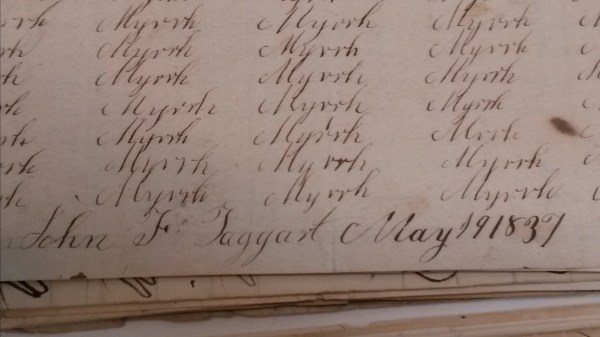
John F Taggart May 19 1831 SAMPLE OF STUDENT WORK in 1831

I wonder if this boring work led the students to murmur…?

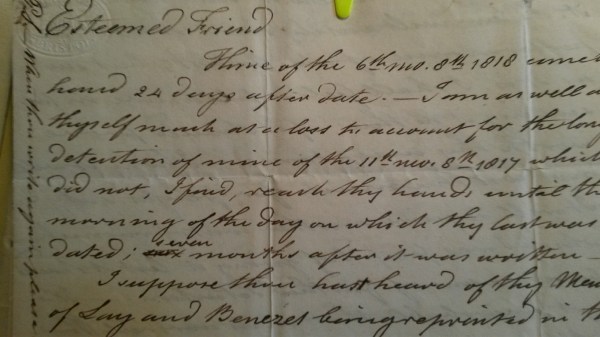
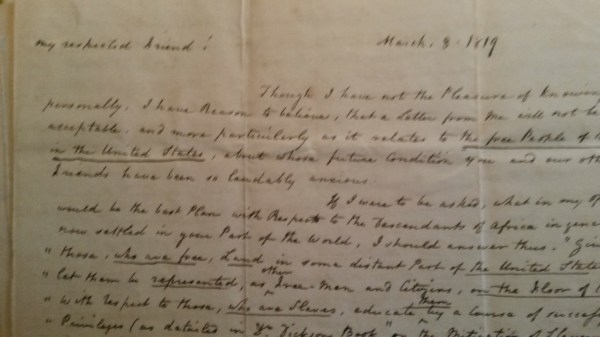
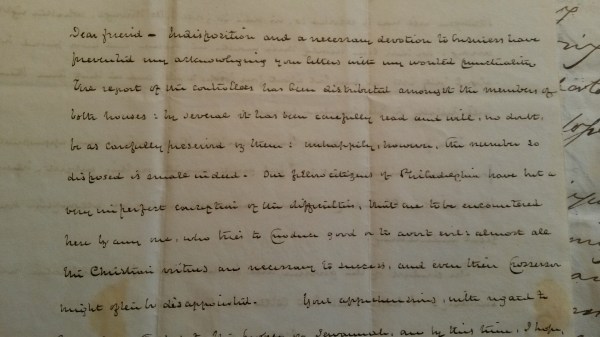
I stumbled across a clue from May 19, 1831 in the archives yesterday. I’m working with the papers of Joseph Lancaster for my new book, and it turns out someone used the backsides of old school worksheets to make records of Lancaster’s correspondence.

So, by mere chance, we can know what John Taggart did for at least part of his school day, May 19, 1831. We can even see the one time he forgot a “y.”

Hello, Worcester!

Things might get a little quiet around the ILYBYGTH International offices for a few weeks. I’m off in scenic Worcester, Massachusetts, studying at the American Antiquarian Society. Thanks to the AAS, I’ve got a generous Alstott Morgan fellowship to support me here for a full month.

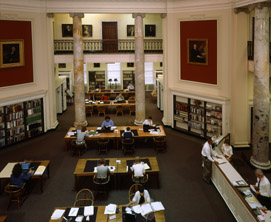
AAS reading room

My nerdy new home away from home…

I’m excited. The AAS has seventeen boxes of papers from Joseph Lancaster. [For more about this research, see here.] I can’t wait to dive in. Why, oh why, did Lancaster believe his “system” could solve urban poverty in one generation? And why did so many otherwise intelligent people believe him?

I’ll see if his papers hold the clue.

From the Archives IV: The Handwriting Is Off the Wall

Do you miss handwriting? I thought I did, but my research experience this week has me wondering. As I dug through the Philadelphia archives working on my new book, I’ve been confounded by the arcane art of penmanship.peanuts.1967.04.25

Most of my archive work over the past decade or so has been in twentieth-century collections. As SAGLRROILYBYGTH might recall, I’ve enjoyed leafing through old pages of type-written correspondence. I feel an acute nostalgia for the days of elaborate letterhead.

What I never had to wrestle with, though, is page after page of hand-written correspondence. Some of it is absolutely gorgeous. I have no idea how long it would take to write this way. Some of it is terrible and impossible to read—Charlie Brown level penmanship.

I’ll share a few of the most elaborate bits here for your Sunday morning delectation.

random handwritig 1random handwriting 2random handwriting 3random handwriting 4random handwriting 5

From the Archives III: Déjà Vu All Over Again

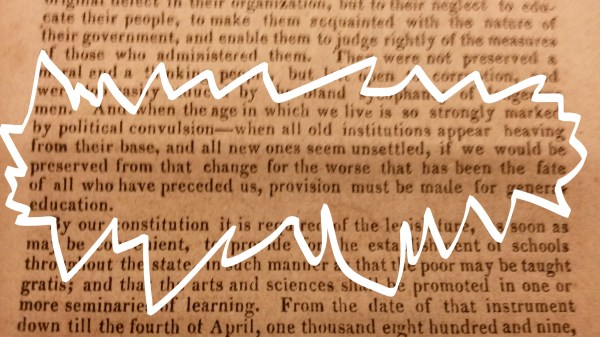
Close your eyes and it might be difficult to guess the decade, much less the century. Fears of a brash, vulgar populist President, a traumatic sense of rapid decline in our public institutions, and a desperate dream that stability might be right around the corner. Sound familiar?Inked1831 house report 1 political convulsions_LI

As SAGLRROILYBYGTH are sick of hearing, I’m down in the Philadelphia archives these days researching my new book. I keep stumbling across head-scratchers that are too good not to share. This bit is from an 1831 report on education from the Pennsylvania house of representatives. They were worried that politics had gotten out of hand. They hoped that high-quality public schools could offer some hope for the future. As they put it,

when the age in which we live is so strongly marked by political convulsion—when all old institutions appear heaving from their base, and all new ones seem unsettled, if we would be preserved from that change for the worse that has been the fate of all who have preceded us, provision must be made for general education.

Clearly, the sorts of political upheaval we’re living through now have a long history.

Should we be reassured or depressed?

From the Archives II: A Dream Deferred

Sad but true: American public schools are segregated places. Kids’ chances of going to school with someone from a very different economic background are slim and getting slimmer. As I continue my work in the Philadelphia archives, I’ve come across another bit of evidence that this was not what Americans wanted.

mt vernon school philly

School for all (boys)…at least in theory

In 1828, the education committee of the state senate of Pennsylvania issued a report. There was no disagreement, they said, about the immense value of public education. As they put it,

The diffusion of education among the great body of the people, is an object very near the hearts of the benevolent and humane. It is conceded to be the most powerful means of furthering the cause of morality and religion; and its importance to a country possessing a republican form of government, is universally admitted.

Moreover, schools funded by the public should serve to unite the public. At Pennsylvania’s public schools, the committee promised (with emphasis added):

All the rising generation of a great community are instructed in the rudiments of learning. The doors of the common school houses are open to all without distinction, and the children of the rich and the poor meet there in the participation of a common benefit, upon terms of the most perfect equality. Such a system is above all praise, and deserves imitation every where.

At least, that was the dream. So far, it hasn’t happened. The children of the rich tend to go to schools with other children of the rich. Likewise for the children of the poor. But then again, it has only been 190 years. Maybe we’ll get there soon.

From the Archives: Bad News for Striking Teachers

History might not be destiny, but it can be depressing. As I’ve worked in the Philadelphia archives for my new book, I’ve found some reminders that teachers have always had to shell out their own money just to do their jobs.

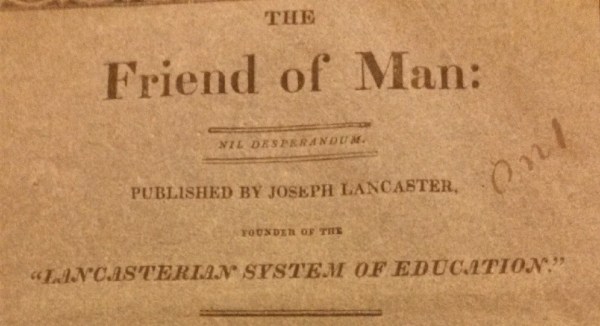
Friend of Man 1 cover

Working without pay has always been considered part of the job…

These days, teacher protests have focused on both low pay and low school funding. As in Oklahoma, teachers have generated sympathy and political power by pointing out how shoddy their classrooms are, and how often they dip into their own wallets to pay for basic classroom materials.

oklahoma textbooks 1

Teachers shouldn’t have to pay for everything, but they’ve always had to…

As I read Joseph Lancaster’s 1821 newsletter I couldn’t help but notice a disturbing parallel. When Lancaster started his career as an educator, he wrote, he visited the nearby town of Stockport, near Manchester. The schools had been terrible until teachers stepped up. They needed better supplies. They needed an expensive new school building. As Lancaster described, the teachers

as a body, offered to work extra hours at their trades, and from their own earnings, to save and devote the sum of five hundred pounds sterling to the proposed building—within twelve months.

Joseph Lancaster told this as a happy tale, showing the possibilities of education if we all pulled together. Almost two hundred years later, though, I can’t help but be a little bummed out that teachers are still expected to donate their scanty mite in order to keep the school lights on.


Dayton Dilemmas II: The Devil Made Them Do It

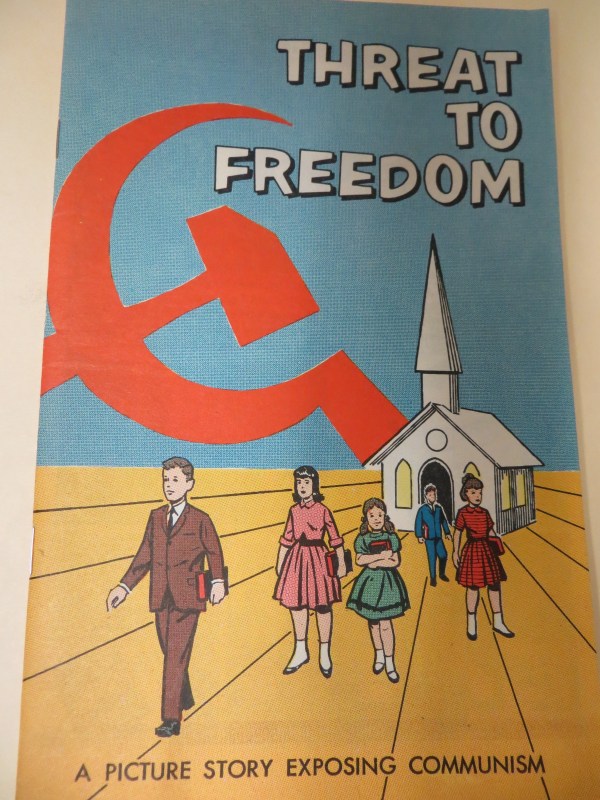
SAGLRROILYBYGTH: If you want small, unsatisfying, boring meals, don’t come to Dayton. As far as I can tell, thanks to hospitable hosts, life in Dayton is a steady stream of fantastic meals and challenging, thought-provoking conversation. At a talk yesterday at the University of Dayton about the connections between white evangelicals and “Make-America-Great-Again” patriotism, one grad student brought up an absolutely essential point. Namely, when it comes to understanding fundamentalist politics, we can’t leave out Satan.dayton flyers

We’ve talked about this topic recently when it comes to the specific topic of creationism. As I’m arguing in my upcoming book about creationism, secular folks like me have often misunderstood the nature of creationist thinking. We have assumed that creationists are making decisions based on secular reasonings. We forget that many creationists understand the world in supernatural terms, at least in some measure. When we do, we give up any chance of really understanding radical creationist thought.

The same is true for understanding the politics of conservative evangelical intellectuals.

cover

From the Bob Jones University archives…

In my talk yesterday, I tried to explain the long tradition of MAGA patriotism among white evangelical intellectuals and academics. Today’s leading evangelical intellectuals often don’t like the idea, but in the twentieth century evangelical higher education was firmly committed to the notion that their schools would teach a certain sort of defiant, nostalgic patriotism.IMG_1648

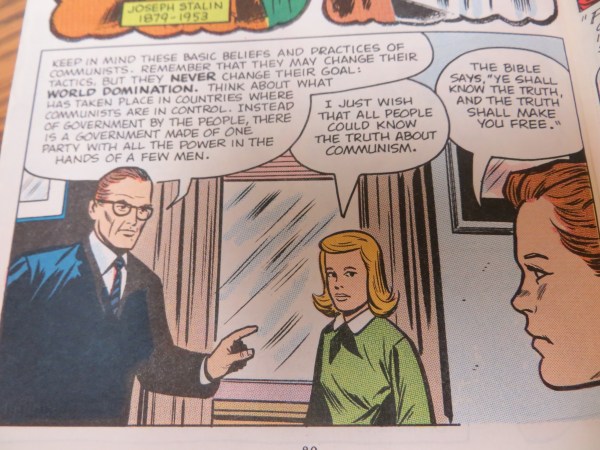
One graduate student—a self-identified “recovering fundamentalist”—brought up a key idea: If we really want to understand how conservative evangelicals could combine their faith so tightly with their nationalism, we need to remember the supernatural context. Especially in the twentieth century, this student pointed out, the cold war often took on the shape of an apocalyptic showdown between the Soviet Union and the United States.

IMG_1649

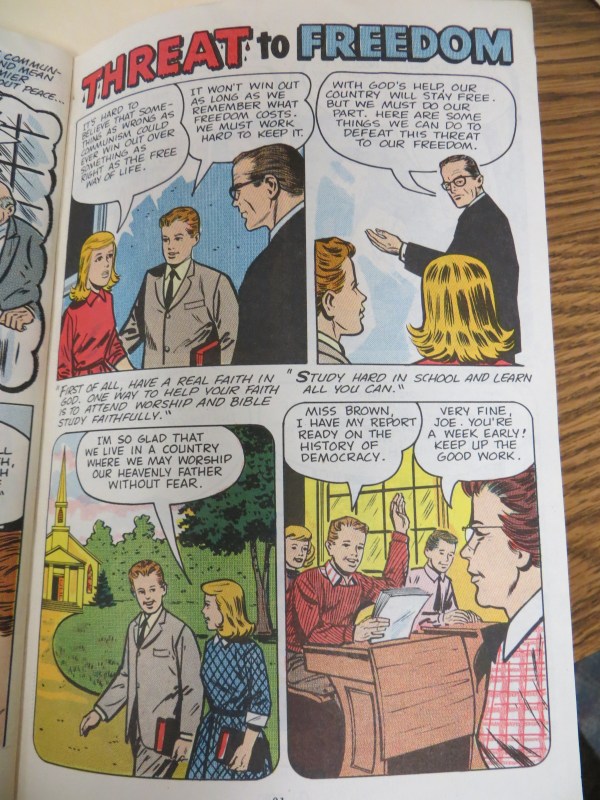
How to mix church and country, Bob Jones style…

For many fundamentalists at the time, the supernatural connections were too obvious to need explaining. The Soviet Union was the political incarnation of Satan. It was a nation and empire wholly guided by the devil’s machinations. Its goals were nothing less than both worldly and eternal domination.

It wasn’t much of a leap, then, to mix together a patriotic faith in the United States with a religious devotion to evangelical Christian values. Defending traditional Americanism was entirely equal to defending true evangelical religion, and vice versa. When the eternal mixed so profoundly with the national, it was not at all difficult or unusual for white fundamentalists to mash together their religious faiths with their patriotic fervor.

The Problem with Theoretical Children

Two hundred years is a long time to bang your head against a wall. When it comes to school reform, though, that’s what we seem to do. I’m just back from an archive trip in Philadelphia and I’m spooked by the parallels between school-reform mistakes back then and those pointed out just this week by a savvy teacher in New York.

The New York teacher, Emily Kaplan, tells a story any experienced teacher can relate to. She studied at a great university, learned all she could about children and teaching. When she got to her first classroom, she immediately ran into a situation she had never prepared for: One of her students just wouldn’t/couldn’t stop farting. It’s funny, but it’s more than funny, too. As Kaplan puts it, most of our big-picture ed-reform plans are made for “theoretical children.” As she explains,

Theoretical children are useful: they are predictable, generalizable. They lend themselves easily to an agenda; nothing they do is inexplicable. Their development is linear, their roadblocks routine. They exist neatly in quantified data; they are easily essentialized. Theoretical children don’t cry for no reason, they don’t laugh out of turn; theoretical children certainly don’t fart.

Theoretical children are discussed often by scholars and policymakers, but theoretical children don’t populate our classrooms— because theoretical children don’t exist.

Kaplan is right on. Every real teacher knows that plans need to be held lightly; theories need to be embraced tentatively. As I’m learning in my new research, the effort by experts to change schools based on what children theoretically will do has always plagued our school-reformm dreams.

Last week I began the archival grunt work for my new book. I’m exploring the school-reform plans of Joseph Lancaster and his devotees. Two hundred years ago, nearly exactly, the Pennsylvania legislature passed a law mandating Lancaster-style schools for Philadelphia. Why were the lawmakers so excited about this educational plan?

lancaster schools

Nothing can go wrong if the system is right.

In large part, Lancaster convinced politicians that he had figured out a perfect system. He pitched a school set-up that would deliver cheap, effective literacy, numeracy, punctuality, and nondenominational Protestantism to poor children. In 1803, for example, he published his flawless system, a system built on the actions of “theoretical children.”

As Lancaster explained, school discipline had long been a problem, but he had solved it. He outlined at painful length and detail the way he had supervising boys—“monitors”—track the behavior of their fellows. Students who misbehaved would have logs tied around their necks. They would be shackled together with other miscreants. If that didn’t work, they might be

put in a sack, or in a basket, suspended to the roof of the school, in the sight of all the pupils, who frequently smile at the birds in the cage.

Lancaster didn’t like shaming his students this way, but he thought it was the perfect solution. As he explained, when the misbehaving student

Finds how easily his punishments are repeated—that he himself is made the instrument—and no respite or comfort for him, but by behaving well, it is more than probable he will change for the better.

In theory, the plan was perfect. In theory, anyone could follow the simple steps laid out for good student behavior. In theory, students responded well to Lancaster’s machinations.

Guess what—it didn’t work. As Emily Kaplan points out, children don’t exist only in theory. They fart. They rebel. And sometimes, if you tie a log around their neck or hang them in a birdcage, they don’t respond well.

When Did Conservatives Demand Local Control?

I’m no conservative, but I respect several conservative thinkers and writers. We may disagree—sometimes fiercely—but folks such as Rod Dreher, Patrick Deneen, and Mark Bauerlein are always worth reading, IMHO. In education, I put Rick Hess in this category. In a recent piece about localism, though, Hess makes some mistaken claims about the history of educational conservatism. I can’t figure out why.

OLYMPUS DIGITAL CAMERA

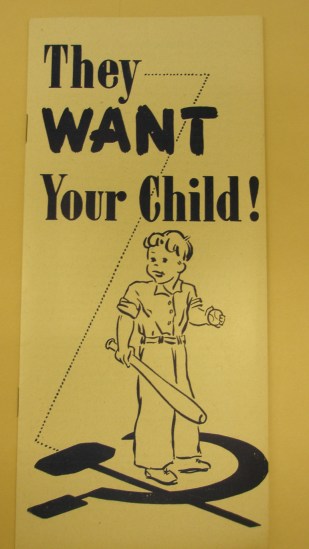
The first worry wasn’t desegregation, but communist subversion.

He’s not alone. Back when my book about the history of educational conservatism came out, I did a brief interview with conservative journalist John Miller. He wanted to know about the long history of conservative desire for charter schools. As I told him, there wasn’t one. The charter movement only became a darling of most conservative thinkers at the very tail end of the twentieth century. Before that, only a few lonely free-marketeers embraced Milton Friedman’s charter plan. (I have described this history in a different academic article, if you’re interested.)

Conservatives aren’t the only ones who don’t like to look their history square in the face, of course. Progressives don’t like to be reminded that WE were the racist ones back in the 1920s, as I also describe in The Other School Reformers.

Hess is too smart and too ethical to distort conservative school history in the usual ways. He frankly acknowledges that conservatives turned to localism in order to protect their right to racial segregation. As he and his co-author put it,

After Brown v. Board in 1954, demands for more “rational” and “less political” oversight were joined by a compelling moral claim—that many communities (and even states) could not be trusted to do right by all their students. Thus, the post-Brown era was marked by school reform agendas—in the states and in Washington—that frequently sought to reduce or even eliminate local control. These strategies came from both the right and left, from both legislatures and the courts, and included new directives regarding desegregation, standards, testing, discipline, funding, teacher quality, school interventions, magnet schools, school choice, and more.

In this telling, federal influence after 1954 pushed states and towns to desegregate. Conservatives pushed back, demanding local control in order to preserve segregated schools. In one sense, he’s not wrong. Brown v. Board marked a milestone in conservative thinking about schools and education. But 1954 was not the watershed year. For American conservatives, the big switch came earlier, in the New Deal era.

OLYMPUS DIGITAL CAMERA

A later effort (1963), but wow.

Through the 1920s, leading conservative public figures tended to call for increased federal involvement in local schools. By the 1940s, conservatives recoiled in horror at the notion of federal control.

What happened?

It wasn’t Brown v. Board. Brown v. Board strengthened conservative animosity toward the idea of federal educational leadership a thousandfold. But it did not create that animosity. Starting in the 1920s, conservative thinkers and activists became convinced that the academic leaders of educational thinking had gone to the socialist dogs.

In the 1930s, conservatives mobilized against the “experts” at places such as Teachers College, Columbia University. As one business leader warned an ally in the American Legion in 1939, professors such as Harold Rugg and George Counts

have been weaning [sic] over to their side a large and increasing population of educational authorities. This ties in with the whole progressive-education movement, which is another thing which some of old-fashioned believers in mental discipline believe is helping to weaken the moral strength and self-reliance of our youth.  That may not come under the heading of Americanism or un-Americanism, but it is a closely related consideration because the progressive educators and the spreaders of radical un-American doctrines are to a large degree the same people and they mix their two products together and wrap them up in one package.

For this patriotic conservative, the leading educational experts could no longer be trusted.

By the 1940s, it had become standard thinking among conservatives—all sorts of conservatives—that federal control meant leftist control. They warned one another that “they” were after your children. For decades, they investigated textbooks for subversive squirrels and other communist rats.

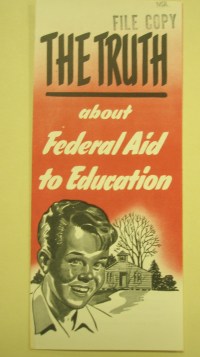
The trend was so powerful that organizations such as the National Association for Education tried to fight back. Federal aid to education, they told anyone who would listen, was nothing but a better way to fund local schools.

OLYMPUS DIGITAL CAMERA

NAE: Don’t hate me cuz I’m federal… (c. 1950)

Conservatives didn’t buy it.

By the time SCOTUS ruled in favor of school desegregation, conservative thinkers and activists had long distrusted the influence of the federal government. They had long since turned to the idea of local control as the only way to protect decent education.

To this reporter, it seems today’s conservatives would want to trumpet this version of conservative educational history, not ignore it. I can’t help but wonder: Why don’t they?

Fundamentalists Forget their Furious Family Feud

Maybe there’s hope for every family feud. The death of Billy Graham last week inspired an outpouring of love and respect from people whose fundamentalist forefathers loathed Graham’s revivals. Creationist impresario Ken Ham, for example, never one to water down his fundamentalist faith, had nothing but praise for Graham’s ministry. The archives tell a much different story.

Some of today’s no-compromise conservatives seem to have forgotten the legacy of their fundamentalist forefathers. Ken Ham, for example, praised Graham’s evangelistic outreach. As a child he listened to a Graham rally in Australia. As Ham recalled,

I remember people going forward in this church after listening to him and committing their lives to Christ.

Of course, it’s never kosher to speak evil of the dead. Ken Ham, however, lauded the whole body of Graham’s evangelistic outreach, from the 1950s through today. Ham included no whisper of accusation about Graham’s work.

Does he not know the backstory? Or have fundamentalists given up their ferocious feelings about Graham’s revivals in the 1950s?
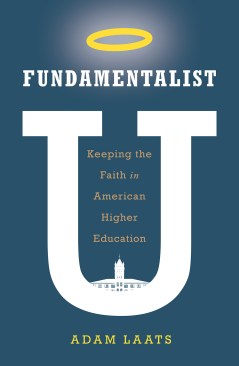
Cover art final

Yes, there is a place to read the full story…

To be sure, Graham’s passing has attracted some criticism from intellectuals. Historian Matthew Avery Sutton blasted Graham’s reactionary politics. D.G. Hart recalls the fact that many conservative Protestants were “not exactly wild about Graham’s ministry.”

The epochal anger and denunciations sparked by Graham’s outreach, however, seem to have been forgotten by some latter-day fundamentalists themselves.

I look into this history in my new book about evangelical higher education. In a nutshell, Graham’s revivals split the conservative evangelical community. The sticking point was follow-up. At Graham’s hugely popular services, audience members who felt Jesus’s call were put in touch with a sponsoring church. Those churches included more liberal Protestant churches as well as more conservative ones.

Fundamentalists worried that Graham’s preaching was leading souls directly into the pit of hell, by sending them to false churches to learn poisoned theology. These fears weren’t limited to a few right-wing wackos; they were a prominent part of conservative evangelical thinking in the 1950s, 1960s, and 1970s.

In 1963, for example, Samuel Sutherland of Biola University denounced Billy Graham. To a correspondent who accused Sutherland of cooperating with Billy Graham, Sutherland wrote,

I do appreciate the truth found in the Word of God which Billy Graham proclaims.  We appreciate also the souls that are saved and who find their way to Bible-believing churches and thus are nurtured in our most holy faith.  We deplore quite definitely, and have said so publicly, that there are so many doctrinally questionable individuals who are identified in prominent ways with the campaign and we are disappointed beyond words in the knowledge that so many of those who profess faith in the Lord Jesus Christ at the crusades will doubtless find their way into churches where the Word of God is not proclaimed and where they will not have a chance to know what the Gospel is all about or what it means, actually, to be born-again.  I am with you.

In 1971, one outraged fundamentalist wrote to Moody Bible Institute President William Culbertson to express his disgust at the Graham crusades. As he put it, the Graham crusades only sent people into false churches, such as “Luthern” [sic], “Jehovah’s Witnesses, Seventh Day Adventists, Christian Scientists, etc.”
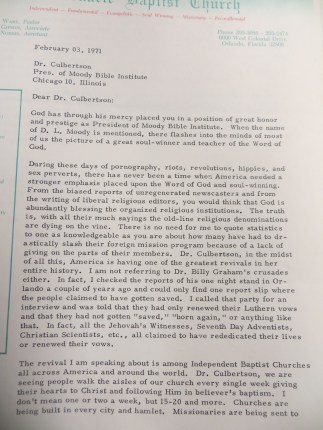
anti culbertson anti graham letter 1

Fundamentalists didn’t like Billy Graham…

For a fundamentalist, that was a serious accusation.

Such accusations flew fast and furious around the world of fundamentalist higher education. The magazine of Biola University ran one typical reader letter in 1958. Reader Dorothy Rose condemned Graham as a false Christian and a servant of world communism. Rose warned (falsely) that Graham had been expelled from two “outstanding, sound Bible colleges.” As Rose wrote direly,

It is easy to be popular with the high-ups and with the press if we are willing to compromise.  But what is the cost spiritually?

No one denounced Graham more fiercely than Graham’s former mentor Bob Jones Sr. In 1958, for example, Jones wrote to a fundamentalist ally,

No real, true, loyal, Bible friend of Bob Jones University can be for the Billy Graham sponsorship . . . . [Billy Graham is] doing more spiritual harm than any living man.

Fundamentalists have come a long way. When it comes to the legacy of Billy Graham at least, no-compromise conservatives seem to have forgiven, or more likely, forgotten the divisive nature of Graham’s ministry.