Should he stay or should he go? The alt-right has been howling for James Livingston’s professional blood. Rutgers seems willing to punish him. Is this a case of academic racism? Or of academic freedom? I know there are no simple equivalencies among different sorts of racism, but it seems to me we DO have a relevant precedent for this case.
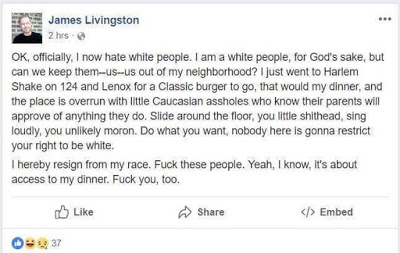
Rude, yes. Racist?
Here’s what we know: History professor James Livingston attracted a lot of negative attention for his anti-white screeds on Facebook. He railed against white people for their sense of entitlement and their arrogant ignorance. As he put it,
OK, officially, I now hate white people. I am a white people, for God’s sake, but can we keep them — us — us out of my neighborhood? I just went to Harlem Shake on 124 and Lenox for a Classic burger to go, that would be my dinner, and the place is overrun by little Caucasian assholes who know their parents will approve of anything they do. Slide around the floor, you little shithead, sing loudly, you unlikely moron. Do what you want, nobody here is gonna restrict your right to be white. I hereby resign from my race. Fuck these people. Yeah, I know, it’s about my access to dinner. Fuck you, too.
And, in a later post,
I just don’t want little Caucasians overrunning my life, as they did last night. Please God, remand them to the suburbs, where they and their parents can colonize every restaurant, all the while pretending that the idiotic indulgence of their privilege signifies cosmopolitan–you know, as in sophisticated “European”–commitments.
Is this racism? And therefore cause for dismissal? Livingston says no. He defended his comments as partly satirical, partly ridiculous, but also non-racist. There is no such thing as anti-white racism, Livingston explained. As he put it,
Racism is the exclusive property of white, mostly European people in this part of the world (the western hemisphere), because such people were able to impose their will on 9 million Africans via a labor system called slavery, and benefit from the economic and social capital of that system unto this day—regardless of their class standing, then or now.
Rutgers disagreed. The administration concluded that Livingston’s comments violated the university’s discrimination and harassment policies and damaged the university’s reputation. As the administration explained,
Professor Livingston clearly was on notice that his words were offensive, yet instead of clarifying that he meant to comment on gentrification, he chose to make another belligerent barb against whites. Given Professor Livingston’s insistence on making disparaging racial comments, a reasonable student may have concerns that he or she would be stigmatized in his classes because of his or her race. As such, Professor Livingston’s comments violated university policy.
What to do? Can the university fire a tenured professor for offensive comments? Rutgers says yes. The administration announced it will soon decide the proper disciplinary action, up to and including discharge. Will Creeley of Foundation for Individual Rights in Education (FIRE) says no. As he told IHE,
Rutgers has effectively subcontracted out its obligations as a public institution under the First Amendment to outraged internet mobs. . . . The real concern for us is that this is part of a trend, and if would-be internet trolls see that flooding universities with hate mail and being loud online is a successful way to silence faculty members whose views they disagree with, that will be repeated.
How can this baby be successfully cut in half? How can an academic’s right to freedom of thought and expression be balanced with a university’s duty to protect its reputation and its students from angry professors?
To this reporter, it seems like we’ve been here before. Rutgers could follow the example of Penn last year. SAGLRROILYBYGTH might remember the case of law-school professor Amy Wax. Wax had already attracted negative attention for her recommendation of “bourgeois culture.” In a radio interview, Wax noted that she hadn’t had any top-notch African American students in her class. People were outraged.
What did Penn do? They didn’t fire Wax. They defended her right to academic freedom. But they DID remove her from teaching a mandatory class. It would not be fair to force students to take a class from a professor that had such pre-conceived notions about racial disparities, they concluded.
Could Rutgers do something like that here? As the Rutgers administration noted, students were leery of taking a class from Professor Livingston, who clearly has preconceived notions discriminatory against white people. So just have Livingston teach optional courses. Make a public statement condemning his attitudes but defending his right to speak them publicly.
Would that be a fair solution in this case?










 I Love You but You're Going to Hell