How to Kill Fundamentalist Higher Education

[UPDATE: thanks for letting me know about the bad link. It’s fixed now.]

Want to kill uber-conservative evangelical Protestant colleges and universities? The recipe is simple: Have a lot more news stories like this one from Milwaukee.

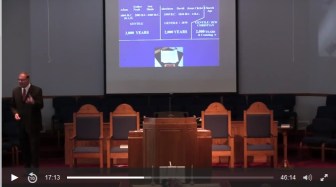
Schmidt young earth timeline

Schmidt preaches the young-earth gospel…

Outsiders like me might not get it at first. We might think that fundamentalist colleges are happy to live in a little bubble, utterly protected from trends in the wider world. And, to some degree, they are. But when it comes right down to the hard facts, even the most conservative evangelical institutions care what people think about them. They have to. If colleges want to attract students and their tuition dollars, they have to prove that students’ college experiences will help them professionally. Colleges have to be able to assert that they are more than an educational punchline.

As I found out in the research for my recent book about the history of fundamentalist higher education, even the staunchest fundamentalist schools like Bob Jones University and Pensacola Christian College yearn for mainstream respect.

Even though they traditionally eschewed accreditation, fundamentalist universities and colleges promised that their educations were not only theologically and culturally pure, but also good preparation for professional careers. Bob Jones University liked to assert that its students’ GRE scores were higher than similar schools. Founder Bob Jones Sr. often claimed that his school would do more than protect students’ faith—it would prepare them to be faith-filled doctors, engineers, lawyers, and teachers.

His decision to avoid accreditation, Senior often noted, was not due to lack of campus resources. Rather, it was only a measure of BJU’s spiritual superiority. As founder Bob Jones Sr. bragged in 1950,

Bob Jones University is probably the only one in America that could join an association that does not join, and we refuse to join. We believe . . . that a Christian institution should make its own policies in line with the purposes it has in view and that no association of any kind should dictate the administrative policies of the institution.

For most institutions of higher education, though, accreditation has always represented a crucial mark of respectability. Schools that could not afford to earn accreditation have always risked losing students to accredited schools.

It makes sense. Why would a student spend tuition dollars at a university when those classes would not be recognized by other institutions? Why would students attend an undergraduate college when their degree wouldn’t qualify them to enter any graduate schools?

As a recent story from my adopted hometown of Milwaukee demonstrates, evangelical colleges risk losing credibility if they aren’t accredited. Here’s what happened: The current acting sheriff, Richard Schmidt, often brags about his advanced degrees. He has one PhD, he likes to say, and he is working on a second. His election signs tout him as “Dr.” Smith.

So what’s the problem? Unfortunately for Schmidt, his degrees are only from unaccredited evangelical colleges. He earned his undergraduate degree from Hyles-Anderson College. His doctorate comes from the defunct Northland International University.

The Milwaukee report skewers this sort of higher education mercilessly. Not only are both schools unaccredited, but they split their classes and majors by gender. The more serious topics of Bible study, for example, are considered to be for men. Women can focus on challenging courses such as “secretarial procedures,” “crock-pot cooking,” and “The Christian Wife.”

hyles anderson women program

Sorry, I can’t go out tonight. I’ve got my big final in Crock-Pot tomorrow…

This embarrassingly shoddy college poses a career risk for Acting Sheriff Schmidt. For our purposes, the bigger threat is to fundamentalist higher education itself. If conservative evangelical students and families see that unaccredited colleges are the butt of jokes, they just won’t attend. And if degrees from these schools prove a hindrance to professional success—as they are for Sheriff Schmidt—students will take their tuition dollars elsewhere.

In the end, if you want to kill off fundamentalist higher education, all you have to do is laugh at it.

Thanks to N(M)S for the tip.

More Evidence: Christians Don’t Know Christianity

It can be a tough pill to swallow. If we want to be brutally honest, however, we need to acknowledge that religion is about something besides religion. New survey data confirm our hunch that a religious identity isn’t necessarily about religion itself, but about something more complicated.parents-feeling-and-observations

In my recent book about evangelical higher education, I argued that we can only understand fundamentalism and conservative evangelicalism if we abandon our tendency to define these things theologically. After all, there wasn’t really an orthodoxy involved in fundamentalism. There couldn’t be. Although fundamentalism and conservative evangelicalism were certainly religious movements, their institutions were not driven solely by theological considerations. Instead, as with every human endeavor, evangelical colleges jumbled together religion, culture, politics, and other factors to come up with a mish-mash of beliefs, beliefs that “felt right” to students, professors, alumni, and parents.

Seth Dowland recently made a convincing case along these lines. As Professor Dowland argued,

what most distinguishes white American evangelicals from other Christians, other religious groups, and nonbelievers is not theology but politics.

Surveys have shown that a majority of evangelical Protestants don’t actually hold traditional evangelical core beliefs. They might call themselves “evangelical” or “born again,” but only a minority of them agree with all four of these notions:

  • The Bible is the highest authority for what I believe.
  • It is very important for me personally to encourage non-Christians to trust Jesus Christ as their Savior.
  • Jesus Christ’s death on the cross is the only sacrifice that could remove the penalty of my sin.
  • Only those who trust in Jesus Christ alone as their Savior receive God’s free gift of eternal salvation.

Being an “evangelical,” then, is not a theological position. It might INCLUDE theological tendencies, but it is something more than a religious identity. And, of course, it’s different for different people. Plenty of evangelicals ARE defined by their theological beliefs. Just not a majority.

Today we see more survey evidence that evangelicals and other Protestants don’t restrict their beliefs to evangelical or Protestant theology. A large majority think that God wants them to prosper financially. Among evangelicals, a solid 75% majority think so.

We might think that these prosperty-gospellers simply don’t know because they don’t really go to church. But prosperity beliefs are STRONGER among those who attend church more frequently.

What’s the takeaway? Like all of us, evangelical Protestants are complicated. For those of us trying to understand evangelical history, the vital message is clear: “Evangelical” identity is about much more than simple theology.

Cheap Date!

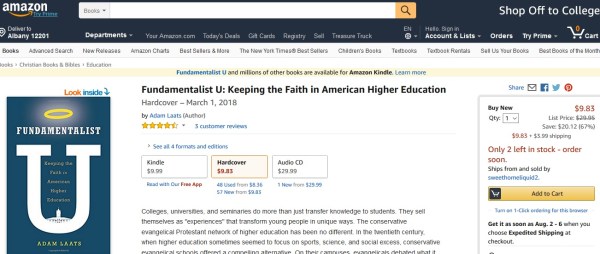
Been waiting to pick up a copy of Fundamentalist U? Wait no longer! Sales have been brisk and by the secret algorithms known only to Jeff Bezos, the price right now is lower than it has ever been.fire sale fuSo get em while they’re hot.

From the Archives: Emily Post at Evangelical U

What were evangelical colleges for? As I argue in my new book, evangelical and fundamentalist schools promised to do lots of things at once. Thanks to alert SAGLRROILYBYGTH DW, we have new evidence of two of those things from Indiana Wesleyan University.Marion COllege rules c 1946 1

As DW discovered on a recent campus visit, Indiana Wesleyan (former Marion College) recently posted these dining-hall rules from 1946. They are more than just a nostalgic goof, though. As did the interdenominational conservative evangelical colleges I focused on in my book, back in 1946 Marion’s leaders were trying to accomplish two deadly serious goals in their dining hall.

First, many evangelical colleges needed to introduce their students to middle-class social norms and aspirations, as I note in my book. As one student at Chicago’s Moody Bible Institute remembered, back in the 1920s many MBI students

were raw farm boys, you know, and so on and so forth. If you’d had a smattering of education: fully high school or not, never mind, as long as you were really on fire for Christ, you know. And some who didn’t know very much about etiquette and that kind of thing.

For many evangelical students, especially Bible-institute students, the middle-class norms expected of college graduates had to be taught explicitly and enforced rigorously. Clearly, at Marion College, some students needed reminders, as rule number 9 points out,

It is considered proper courtesy for the gentleman to allow the lady at his right to serve herself before he serves himself; the lady in turn should receive this courtesy with lady-like appreciation.

Plus, at all evangelical colleges in the period, and in fact at almost all colleges in the period, social interactions between men and women were rigidly policed. Administrators needed to be able to assure parents that no hanky-panky would be going on. marion college rules c 1946 2

Mealtimes, at most schools, offered students a rare opportunity to interact with the opposite sex, and all college administrators worked to prevent students from taking advantage. That’s why the final rule on this list is very clear:

All men are expected to leav [sic] the dormitory immediately following the meal excepting after the evening meal when they may stay in the parlor on Wed. evenings until 7:30 and on Friday evenings until 10:30.

These rules might seem like quaint relics these days, but they are more than mere quirks. They show us how higher education combined many functions. In addition to academic instruction, students were supposed to pick up religious zeal and upward social mobility, all while being rigidly controlled. At the time, parents expected college students to learn more than just a profession; at conservative religious colleges especially, parents wanted children to learn how to mingle in society politely, and above all, safely.

Thanks, DW!

What Would Abbie Say?

The news from Kansas: It’s still possible to rile the rubes by disrespecting the flag. In most other ways, though, we Americans seem to have totally changed our attitudes about what constitutes “disrespect.” It’s hard not to wonder what Abbie Hoffman would say.

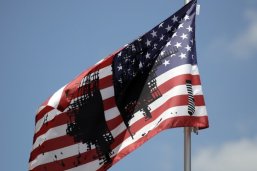
kansas u flag

Revoking your artistic license…

Here’s what we know: The University of Kansas has moved a controversial display of the US flag. The display, a piece by artist Josephine Meckseper, was titled “Untitled (Flag 2).” She flew the flag with a picture of a striped sock on it, as well as an array of busy lines. Meckseper claimed her work was meant to highlight the fractured, divided nature of current American politics.

In a way, Kansas proved her right. Outraged veterans and politicians insisted the work was disrespectful. They insisted the campus remove the flag. Governor Jeff Colyer agreed, and the university complied.

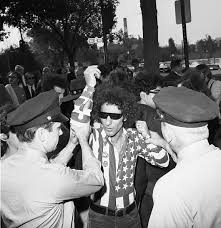
What would Abbie say? Hoffman was famously arrested for wearing a shirt made from the US flag in 1968. Since then, everything related to the politics of flag-fashion seems to have changed. These days, prominent patriotic conservatives tend to wear the flag without giving it a second thought. It’s even easy to buy flag underwear.

abbie hoffman flag shirt

Respect the threads…

According to the flag code, the key seems to be the intention of the wearer. No one is supposed to wear an actual flag. But is it disrespectful to wear a flag-patterned shirt, as US Air Force General Richard Myers did in 2005?

There’s more: The code says the flag should never be displayed horizontally, but USA-loving football fans routinely cheer at such displays.

NFL: Oakland Raiders at New York Jets

They love America, but they don’t seem to like the traditions of proper flag etiquette…

To this reporter, it appears that Americans no longer care about the details of patriotic flag etiquette. As long as people seem to be cheering for the flag, they can do anything they want with it.

However, the instant someone seems to be disrespecting the flag, either in a fashion sense, an artistic sense, or a kneeling-NFL sense, a certain sort of patriotic conservative will predictably react angrily. In Kansas’s case, that sort of anger is politically impossible to resist.

Fundamentalist U & Me: Kurt Morris

Welcome to our latest edition of Fundamentalist U & Me, our occasional series of memory and reflection from people who attended evangelical colleges and universities. [Click here to see all the entries.] The history I recounted in Fundamentalist U only told one part of the complicated story of evangelical higher education. Depending on the person, the school, and the decade, going to an evangelical college has been very different for different people.

This time, we are talking with Kurt Morris, a mental health advocate, writer, storyteller, and speaker in Boston. Morris attended Taylor University from 1997 to 2001 and has a masters in Library Science from Indiana University, Bloomington, and a masters in American Studies from the University of Massachusetts, Boston.Kurt Morris

ILYBYGTH: How did you decide on Taylor? What were your other options? Did your family pressure you to go to an evangelical college?

I never really wanted to go to college but didn’t know what else to do with my life and my parents pushed the idea of how important it is to get a college education. I went to Taylor because I was too scared to go anywhere else. I dealt with a lot of anxiety as a teen (and still do to some extent) and the idea of going to school where I wouldn’t know anyone was terrifying to me. Especially a big state school. My sister went to Taylor and so I knew that I would at least know her and her friends. Also, my parents agreed to pay for college if I went to a Christian college, but not if I went to a non-Christian college.

ILYBYGTH: Do you think your college experience deepened your faith? Do you still feel connected to your alma mater? What was the most powerful religious part of your college experience?

I don’t think my college experience necessarily deepened my faith, nor did it make it weaker. It just kind of was. I can’t think of any powerfully religious part of my experience beyond evening floor prayers and chapels. I feel slightly connected to my alma mater, mainly because I’m part of a Facebook group of alumni who are quite liberal.

ILYBYGTH: Would you/did you send your kids to an evangelical college? If so, why, and if not, why not?

I don’t have kids and don’t know if I will, but I’d let them make their own decision on where to attend college. However, given that my partner and I aren’t Christians, it would be rather odd if our children did want to attend an evangelical college.

ILYBYGTH: Do you still support your alma mater, financially or otherwise? If so, how and why, and if not, why not?

I don’t support my alma mater in any way. I never have and never will. I haven’t kept them in the loop as far as my contact info so I haven’t received any solicitations in probably ten years or more. As I’m not a Christian and as I didn’t really enjoy my experience there I don’t see any reason to support them.

ILYBYGTH: If you’ve had experience in both evangelical and non-evangelical institutions of higher education, what have you found to be the biggest differences? The biggest similarities?

I went to state schools for my graduate degrees and loved them. When I went to the first one I still considered myself a Christian (although I was slowly falling away from the evangelical movement in which I was raised) and when I went to the second grad program I wasn’t a Christian. It was great to be around diverse groups of people with open minds. Going to an evangelical college, especially one like Taylor that is in a rural setting, can place you in a bubble.

I’d say beyond the basic structure (both have buildings, classes, professors, homework, projects) there were few similarities. At Taylor we had rules about when men and women could be in one another’s rooms. You couldn’t live off campus until your senior year. You couldn’t drink, do drugs, or smoke. People often had issues if you cussed or didn’t go to church or chapel.

The classes at Taylor, while they provided a good foundation in history, were never intellectually challenging. I never felt like I had to really dig and question my beliefs like I did in my grad programs. Things definitely skewed conservative at Taylor while they skewed incredibly liberal for my grad programs.

ILYBYGTH: If you studied science at your evangelical college, did you feel like it was particularly “Christian?” How so? Did you wonder at the time if it was similar to what you might learn at a non-evangelical college? Have you wondered since?

I only took a couple general education requirements for my science classes. One was environmental science and one was geography, which had a lot to do with geology. I didn’t feel like they were particularly Christian. I imagine the classes at a non-evangelical college would be somewhat similar as far as subject matter but it’s not something I’ve thought about.

ILYBYGTH: Was your social life at your evangelical college similar to the college stereotype (partying, “hooking up,” drinking, etc.) we see in mainstream media? If not, how was it different? Do you think your social experience would have been much different if you went to a secular institution?

Ha ha ha! It was definitely not similar. I was a pretty straight-laced kid in college so I wasn’t really interested in partying anyway. I partied much more in my graduate programs although even that was slightly more reserved than what one sees in the media. At Taylor I spent a lot of time going to concerts in nearby college towns and being into music. Some people drank at those shows but I wasn’t interested in drinking anyway so it wasn’t a big deal to me. I’m not really sure if my situation would’ve been different at a secular institution. I might’ve just latched on to a church and spent most of my time with those folks. I find it hard to imagine I would’ve partied and hooked up with people when I was college-aged, even at a state school. I was a pretty insecure, depressed, anxious kid.

ILYBYGTH: In your experience, was the “Christian” part of your college experience a prominent part? In other words, would someone from a secular college notice differences right away if she or he visited your school?

I think someone from a secular college definitely would’ve noticed a difference. In fact, the few times my friends who went to the nearby state school came to visit they thought the place was weird. The vernacular used and the rules were so foreign to them. And these people were Christians, too!

ILYBYGTH: Did you feel political pressure at school? That is, did you feel like the school environment tipped in a politically conservative direction? Did you feel free to form your own opinions about the news? Were you encouraged or discouraged from doing so?

Taylor definitely skewed politically conservative. I felt I could form my own opinions about the news. I was pretty liberal as far as political interests go—I was reading Noam Chomsky and Howard Zinn if that says anything. I picked them up on my own after hearing about them through interviews with punk bands I listened to. I’m sure the school would’ve loved to have us all have the same opinions on political issues, but I didn’t care. That said, I certainly skewed conservative on a number of social issues: gay marriage, abortion, etc. I still felt those were bad things but no longer feel that way.

ILYBYGTH: What do you think the future holds for evangelical higher education? What are the main problems looming for evangelical schools? What advantages do they have over other types of colleges?

I think as Church membership declines and more young people come out as non-believers (as statistics show is happening) some schools will have a difficult time staying open. I’m sure there will be some mergers and closings. Still, I don’t think we’re going to see the end of evangelical colleges in our lifetimes. One thing they certainly provide is a safe setting for believers. Evangelical colleges are bubbles where one can theoretically grow in one’s faith and not feel threatened. That’s a very comforting proposition (and somewhat the reason I attended Taylor) so I think as long as there are people who feel threatened by the secular world, there will be a place for evangelical schools.

Thanks, Kurt!

Did YOU attend an evangelical college? Are you willing to share your experiences? If so, please get in touch with Adam at the ILYBYGTH editorial desk at alaats@binghamton.edu

Papal Fundamentalism

It’s not what they meant to happen, but it seems to be happening a lot these days. As we heard from recent King’s College graduate Christian McGuire, some smart young evangelicals are turning to the Catholic Church. Evangelical-watchers have been seeing it lately everywhere we look. Thanks a tip from a SAGLRROILYBYGTH, for example, I ran across these charismatic folks who are enamored with Catholic tradition. It might feel like a new trend, but this “papal fundamentalism” has been predicted since the 1920s.

RollinLyndeHartt

Called it.

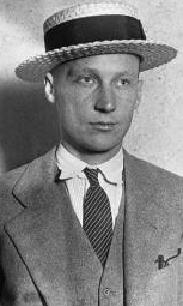
Rollin Lynde Hartt called it in 1925. Hartt may not be a household name today, but during the 1920s he was considered a leading expert on fundamentalism in the popular press. The Rev. Hartt was a liberal Congregational minister, dedicated to puncturing what he saw as the profoundly negative implications of the surging fundamentalist movement among his fellow Protestants. He hoped fundamentalism would wither and die away, but he feared (correctly) that fundamentalism wasn’t going anywhere.

When Hartt predicted the coming-together of the fundamentalist movement and the Catholic Church—what he derided as “Papal Fundamentalism”—he meant it as an insult. Hartt thought fundamentalism shared Catholicism’s un-Christian fetish for merely human authority. As Hartt put it in a 1925 magazine article,[1]

there is something essentially Catholic about the Fundamentalists’ demand for reliance upon authority; and in temperament every good Fundamentalist is a good Catholic.

HT: DW

[1] Rollin Lynde Hartt, “The Disruption of Protestantism,” Forum 74 (November 1925): 680-683.

Fundamentalist U & Me: Christian McGuire, Patrick Henry College

Welcome to our latest edition of Fundamentalist U & Me, our occasional series of memory and reflection from people who attended evangelical colleges and universities. [Click here to see all the entries.] The history I recounted in Fundamentalist U only told one part of the complicated story of evangelical higher education. Depending on the person, the school, and the decade, going to an evangelical college has been very different for different people.

This time, we are talking with Christian McGuire, a recent graduate from Patrick Henry College (PHC). Mr. McGuire graduated last month and now works in communications at a think-tank in Arlington, Virginia.

I first met Christian through an article in National Review about odd intellectual fads at conservative evangelical colleges. Christian told me about a more popular attraction at Patrick Henry. Read on to hear more about his experiences:

ILYBYGTH: When and where did you attend your evangelical institutions?

I attended PHC from 2014 to this May.

ILYBYGTH: How did you decide on that school? What were your other options? Did your family pressure you to go to an evangelical college?phc logo
I applied to a variety of other colleges. PHC was the only evangelical school I considered. The others—Georgetown, UChicago, Berkeley, etc.—were all secular. At first, I was fairly unconvinced that I would want to attend PHC, a relative no-name compared to the other schools on my list. After attending, however, I was definitely drawn in by how welcoming all of the students were. I was also impressed by PHC’s law school track record, which fit nicely with my post-graduate plan at the time. PHC students have very high average LSAT scores and punch far above their weight in admission to top law schools, as well as important judicial clerkships. I think it probably helped that my father was also very impressed by PHC; his approval was probably more emotionally significant than I understood at the time. But I was definitely not pressured to make any particular choice.

ILYBYGTH: Do you think your college experience deepened your faith? Do you still feel connected to your alma mater? What was the most powerful religious part of your college experience?

I think my college experience was important to my faith, but definitely not in the way that I (or PHC administrators) expected. I converted to Catholicism in the second semester of my freshman year, after five years of theological study and discussion. That definitely defined the rest of my college experience. Some people—students, professors, administrators—were downright hostile to Catholicism, and I am not the type of personality that can keep a low profile. So I think some of my spiritual development came from adversity. On the other hand, PHC’s best classes generally contained spiritual wisdom that was certainly, and perhaps even especially, applicable to me as a Catholic. Some classes even strengthened my convictions, although I am sure that result was inadvertent.

In one sense, I think I will always be connected to my alma mater. I was lucky to exit college with many strong friendships, and those relationships will always be an indirect link to PHC. On the other hand, I think that after a couple of years of trying to reform what I saw as the faults of PHC, I eventually grew disheartened and gave up. So I am not as emotionally invested in the college as I was a couple of years ago.

The most powerful religious experience did not really occur within the context of my college career—my confirmation into the Church. However, it was attended by many PHC students, and I think it helped jump start a movement towards the Church at PHC.

ILYBYGTH: Would you/did you send your kids to an evangelical college? If so, why, and if not, why not?

I don’t see college selection as the job of the parent, so if I had a child that wanted to go to an evangelical school, I would let them. On the other hand, since I am no longer evangelical and would not raise my children as such, I would be a little surprised at such a decision.

ILYBYGTH: Do you still support your alma mater, financially or otherwise? If so, how and why, and if not, why not?

No, not yet. I might donate in the future, although I would probably focus on donating to specific departments or goals within PHC, rather than the institution as a whole.

ILYBYGTH: If you studied science at your evangelical college, did you feel like it was particularly “Christian?” How so? Did you wonder at the time if it was similar to what you might learn at a non-evangelical college? Have you wondered since?

A preface: I reject the notion that fundamentalist “science” is “Christian” in any meaningful sense of the word. Usually evangelical institutions such as PHC differentiate themselves from mainstream science by rejecting the theory of evolution, but strictly historical interpretations of the first chapters of Genesis don’t represent the only or best approach to the biblical text. St. Augustine, for example, famously dissented from a strongly literal exegesis of these chapters despite predating Darwin by more than a millennia. So I slightly object to the wording of this question.

PHC taught a fundamentalist interpretation of Genesis, which was only really an issue in their biology and “earth science” classes. Humorously, the college was forced to offer earth science instead of biology the year I took the class, because their accreditors discovered that the professor who taught biology was not sufficiently credentialed to teach the subject.

During that class, I occasionally was bothered by the bias present in our discussion of Earth’s origins. I remember one test question asking me to outline the “evolutionist” view on something and contrast it with the “biblical” view of something. However, I think the professor made a real effort to educate us on what we would be taught at a secular institution overall.

ILYBYGTH: Was your social life at your evangelical college similar to the college stereotype (partying, “hooking up,” drinking, etc.) we see in mainstream media? If not, how was it different? Do you think your social experience would have been much different if you went to a secular institution?

PHC social life was very different from that stereotype. The college enforces fairly strict standards of conduct that ban alcohol consumption, enforce curfews for Freshmen and Sophomores, and prohibit sex outside of marriage. Of course, not everyone follows those rules. But overall, social life is still much tamer at PHC than elsewhere, even at other Christian colleges that I know of. I think part of the reason is that homeschooled backgrounds (PHC is overwhelmingly composed of former homeschoolers) tend to encourage a deference to authority.

ILYBYGTH: In your experience, was the “Christian” part of your college experience a prominent part? In other words, would someone from a secular college notice differences right away if she or he visited your school?

Incredibly so. Everything that PHC does is very consciously evangelical: mandatory chapels are held every single week day, professors are evaluated at the end of every semester on how well they integrated a biblical worldview into their class, prayer often opens classes. And this isn’t just a focus that comes from the administration—students are very invested in their faith as well, on average. Debates about theology are common in the dining hall, and social interactions on campus often include prayer, spiritual encouragement, or some other form of religious flavoring. PHC, I think, was always afraid of going the way of more prominent Christian institutions—starting out staunchly Christian, but ending up only nominally religious. A lot of safeguards were built into the school’s founding documents. For example, the school cannot change its Statement of Faith without losing its land deeds.

ILYBYGTH: Did you feel political pressure at school? That is, did you feel like the school environment tipped in a politically conservative direction? Did you feel free to form your own opinions about the news? Were you encouraged or discouraged from doing so?

The school’s environment was unquestionably conservative. The school’s founder and first president, Michael Farris, was a conservative legal activist who currently heads the Alliance Defending Freedom, one of the most prominent conservative legal groups in the nation.

At the same time, PHC was unblinkingly devoted to exploring all sides of most debates. While the majority of students were conservative, it was completely socially acceptable to make arguments that went against normal conservative positions on economics or foreign policy. I would say that there was only a real taboo on dissenting from pro-life political positions, and maybe a half-taboo on dissenting from the conservative consensus against gay marriage.

ILYBYGTH: What do you think the future holds for evangelical higher education? What are the main problems looming for evangelical schools? What advantages do they have over other types of colleges?

I think that evangelical schools, and PHC in particular, are up against more cultural headwinds than ever before. If you read conservative Christian commentators, you will discover that a lot of them are still trying to forge a post-Trump consensus on what the future of political Christianity is. Some want to continue the political alliance they have made with the Republican party, but many Christian intellectuals and young evangelicals are disgusted by that prospect. As a result, colleges like PHC that focus on “leading the nation and shaping the culture” (one of PHC’s slogans) are at a crossroads. Less political evangelical colleges won’t have quite the same burden, but they still have to deal with increasing secularization among young people.

However, I think that as conservative Christianity becomes more and more at odds with the culture writ large, there will be an additional emphasis on forming explicitly Christian bonds. Those who remain devout in their faith are probably more likely to want to attend Christian schools where they can deepen their intellectual understanding of the faith. A lot of Christians are wondering in the Trump era, “where do we go from here?” Maybe evangelical colleges can be part of that answer.

Thanks, Christian!

Did YOU attend an evangelical college? Are you willing to share your experiences? If so, please get in touch with the ILYBYGTH editorial desk at alaats@binghamton.edu

Three Reasons to Read Fundamentalist U

Thanks to Justin Taylor for finding three reasons to recommend Fundamentalist U.

Cover art final

Three reasons to put this on your summer reading list…

Taylor is senior vice president at Crossway books and a scholar of evangelical history. I appreciate his description of the book as a “unique and important project.”

What are Taylor’s three reasons for reading? You’ll have to click over to find out.

How to Break College

Left or Right; SJW or TPUSA; the news from Washington shows that campus activism is hitting higher education where it hurts. Activists should forget about inviting Milo or occupying quads. Instead, they should recognize their true power and consider what target they want to point it at.

Here’s what we know: Due to student activism from both left and right, universities in Washington state are feeling a financial pinch. At Evergreen State, for example, widely publicized left-wing activism has led to a steep drop in applications and enrollments. At the University of Washington, campus Republicans received a six-figure settlement due to their complaints about unfair treatment.

That sort of dollars-and-cents bottom line is the kind of thing school administrators can’t ignore. By and large, they can endure endless accusations of racial insensitivity from the left. They can blithely listen to accusations of biased “totalitarian” campus climates from the right.

But if colleges lose enrollments, they wither and die. And if they lose lawsuits, they can’t function.

So here’s the question for this generation of student activists: What is your real target? Just as in the SDS years, students need to be strategic about their aims, because they have the ability to inflict serious damage if they choose.

sterling hall bombing

Sterling Hall, University of Wisconsin, 1970