What They Missed about Liberty Online

Want to understand evangelical higher education these days? Then you need to read the recent exposé of Liberty University’s online program in the New York Times. But when you do, remember that they left out a central piece of the picture.

moody literature mission

Early distance-learning programs at MBI claimed to reach the world with cutting-edge technology, c. 1947. These “mountaineers” got free Gospels if they read them in school. And, yes, that is their school building.

The Liberty Online story is a big one. As the Times article describes, Liberty now claims $2.5 billion (yes, that’s B-illion with a B) in net assets, largely from its online department. Because Liberty is a non-profit, it is not subject to the same oversight as for-profit schools such as Corinthian and the University of Phoenix.

Some online students, the article describes, felt pressured to sign up and ripped off with the results. As one unhappy former Liberty student told the Times,

What’s killing me is that I went into this program to try to change my situation . . . and I’m worse off than I was at the beginning.

It’s an ugly story. There is no doubt that Liberty’s online program has been a cash cow. As we’ve noted here at ILYBYGTH, there’s also no doubt that Liberty’s Jerry Falwell Jr. has plowed his online profits back into the brick-and-mortar campus. Sports, star faculty, and campus facilities all get plenty of funding. Recently, the Liberty football squad used that money to fulfill one of the school’s long-standing dreams by defeating top-ranked Baylor.

But the Times story leaves out a crucial part of the historical context. The way they put it, Liberty’s online program came about as part of an experiment, an “educational novelty.” As the article explains,

One educational novelty that Falwell dabbled in, starting in the mid-’70s, was an early form of distance learning. Liberty would mail lecture videotapes and course packets to paying customers around the country — at first just certificate courses in Bible studies, and by the mid-’80s, accredited courses in other subjects as well.

The inspiration, according to the NYT, was the work of John Sperling and the University of Phoenix. I don’t doubt that President Falwell Jr. admired Sperling’s business model. I don’t dismiss the importance of the notion that Falwell has treated his school, as he told NYT, “like a business.”

However, if we really want to understand Liberty’s online success, we have to also understand its context as part of the history of evangelical higher education. It is difficult for some secular people (like me) to notice or acknowledge, but evangelical schools and missionary institutions have always led the way with finding new ways to use new technology to deliver distance education.
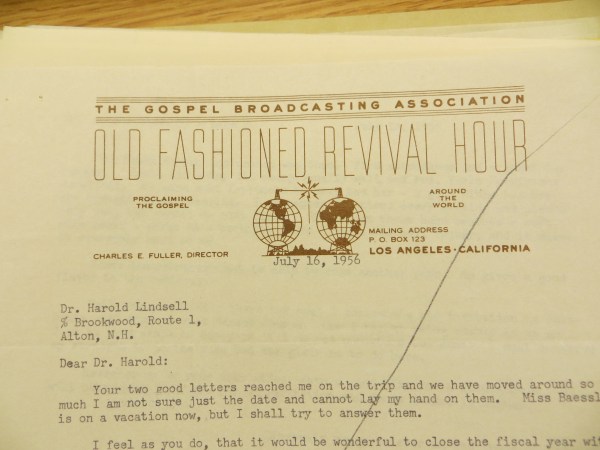
letterhead from BGC 3

Check out the 1950s-era “high-tech” logo! More evidence of the evangelical obsession with technology and distance learning, from Fuller Seminary, c. 1956.

Perhaps the best example might be the Moody Bible Institute in Chicago. No matter the decade, no matter the technology, the Moody educational empire has found ways to expand its reach using new technological means. The drive is obvious: For MBI and other evangelical institutions, the primary goal is to deliver the Gospel to as many human eyes and ears as possible, as fast as possible. If new technology will help accomplish that mission, all the better.

To note just a few of the best-known programs, MBI was a pioneer in early radio, with its WMBI established in 1926 to bring the Word to the world. By 1940, WMBI’s Radio School of the Bible had over 10,000 registrants. In 1942, WMBI claimed to broadcast its programs through 187 radio stations across the USA, Canada, China, and Latin America.

In the 1940s, MBI set up its Moody Institute of Science, distributing missionary science films to a wide audience.

At the same time, MBI carried out less-well-known distance-learning programs as well. As I discovered in the MBI archives, from the 1920s through the 1960s the Moody Literature Mission delivered millions of books and tracts to readers throughout the country and throughout the world.

The point of these distance-learning programs was always the same. MBI, like all evangelical colleges and universities, had a mission of missions. It was dedicated to training young people to carry the Gospel around the world. And, unlike some people’s image of stuffy Luddite conservatives, evangelical institutions were always pioneers in every type of technology: print, radio, film, and internet.

So when the Jerry Falwells experimented with distance education, they weren’t innovating at all, really. Rather, they were merely continuing the long tradition of evangelical higher education—using all available means to deliver the Gospel around the world.

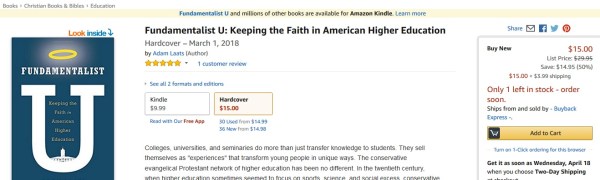
Keeping the Faith in Evangelical Colleges

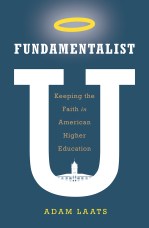
Thanks to Eric Miller and Religion & Politics for publishing an interview this afternoon about Fundamentalist U.Bob-Jones-GettyImages-50615822-780x508

Professor Miller asked questions that got right at the heart of the book: What does it mean to be a “real” college? How did students react to the strict rules at evangelical colleges? Do evangelical schools have academic freedom?

Click on over to read the entire thing.

At first, I thought Professor Miller was simply a peculiarly acute reader, but it turns out he himself spent some time in evangelical higher ed, so he really knew what he was talking about.

Cheapskate Corner!

Okay, SAGLRROILYBYGTH: No more excuses. You can’t afford NOT to buy your copy of Fundamentalist U now.

amazon saleApparently sales have been brisk. By the mysterious logarithms of our Amazon overlords, that means they lower the sticker price. I noticed this morning that Amazon has lowered the price to a measly fifteen bucks! So get yr copy today.

There Is No Free-Speech Crisis at Evangelical Colleges

Have you seen it yet? Sarah Jones recently excoriated evangelical higher education as the home of the real free-speech crisis. Students and faculty alike, Jones reported from experience at Cedarville University in Ohio, are continually deprived of any right to authentic self-expression. She’s right. But that doesn’t mean there’s a free-speech crisis at evangelical colleges. There can’t be.

cedarville-logo-social-media-default

No one said it was for freedom of speech…

Why not? It’s not for the reasons Pietist Schoolman Chris Gehrz describes, though he makes an important point. As he argues, different evangelical schools have hugely different records and policies when it comes to free speech.

And it’s not because Jones misses the boat on the ways evangelical colleges restrict student and faculty speech. I agree with her entirely that the environments of many evangelical campuses can be restrictive, oppressive, and even dangerous. When students don’t feel free to report sexual assault or abuse, for example, they are put in a horrible position.

Yet even granting the truth of Jones’s alarming exposé, I don’t agree that evangelical colleges represent the real free-speech crisis in American higher education. They can’t. Evangelical colleges don’t have a free-speech crisis any more than my school faces a religious crisis for not adequately teaching students how to be good Christians. We don’t want to train good Christians. And evangelical colleges have never wanted to open their chapels, classrooms, and cafeterias to unrestricted speech.

Rather, as I argue in my recent book about evangelical higher education, restricting free speech is a central, defining element of the tradition. It sounds sinister when I say it like that, but it’s true. Professor Gehrz is absolutely correct that some schools today have stricter rules than others, but for almost a century now, the point of evangelical higher education is precisely to impose certain restrictions on faculty and students, restrictions abandoned by mainstream colleges.

To suggest that these restrictions are part of a “crisis” misses the point. Please don’t get me wrong: I sympathize whole-heartedly with Jones and the other students and faculty who dislike their alma maters’ heavy hand. I would dislike it, too. But that heavy hand is not a “crisis.” It can’t be. It is the entire raison d’etre of evangelical higher education.

Consider the promises of evangelical leaders throughout the twentieth century. Explaining the purpose of his new college in Florida, founder Bob Jones Sr. explained it this way in 1928:

Fathers and mothers who place their sons and daughters in our institution can go to sleep at night with no haunting fear that some skeptical teachers will steal the faith of their precious children.

At Bob Jones College, as at all the schools that joined the fundamentalist movement in the 1920s, restricting faculty speech was a primary purpose, not an unfortunate necessity. Unlike mainstream colleges, including mainline Protestant ones, fundamentalist colleges would willfully impose strict lists of mandatory beliefs for faculty members. They would impose long list of behavioral rules for students. And they insisted always that their goal was to shape students’ hearts in a certain religious direction.

Lest readers think the tradition was only in the 1920s, or only at fundamentalist Bob Jones University, consider this quotation from relatively liberal Wheaton College in 1963. President V. Raymond Edman told recalcitrant students about his vision for Wheaton. “This college,” Edman told students,

will be a place Christian parents can send their children to with the confidence that their faith will be established and not shaken.

In other words, the entire point of the network of dissenting evangelical colleges was to police faculty belief and student thought. Evangelical colleges that restrict speech these days don’t face a crisis. They fulfill a promise.

Dayton Dilemmas II: The Devil Made Them Do It

SAGLRROILYBYGTH: If you want small, unsatisfying, boring meals, don’t come to Dayton. As far as I can tell, thanks to hospitable hosts, life in Dayton is a steady stream of fantastic meals and challenging, thought-provoking conversation. At a talk yesterday at the University of Dayton about the connections between white evangelicals and “Make-America-Great-Again” patriotism, one grad student brought up an absolutely essential point. Namely, when it comes to understanding fundamentalist politics, we can’t leave out Satan.dayton flyers

We’ve talked about this topic recently when it comes to the specific topic of creationism. As I’m arguing in my upcoming book about creationism, secular folks like me have often misunderstood the nature of creationist thinking. We have assumed that creationists are making decisions based on secular reasonings. We forget that many creationists understand the world in supernatural terms, at least in some measure. When we do, we give up any chance of really understanding radical creationist thought.

The same is true for understanding the politics of conservative evangelical intellectuals.

cover

From the Bob Jones University archives…

In my talk yesterday, I tried to explain the long tradition of MAGA patriotism among white evangelical intellectuals and academics. Today’s leading evangelical intellectuals often don’t like the idea, but in the twentieth century evangelical higher education was firmly committed to the notion that their schools would teach a certain sort of defiant, nostalgic patriotism.IMG_1648

One graduate student—a self-identified “recovering fundamentalist”—brought up a key idea: If we really want to understand how conservative evangelicals could combine their faith so tightly with their nationalism, we need to remember the supernatural context. Especially in the twentieth century, this student pointed out, the cold war often took on the shape of an apocalyptic showdown between the Soviet Union and the United States.

IMG_1649

How to mix church and country, Bob Jones style…

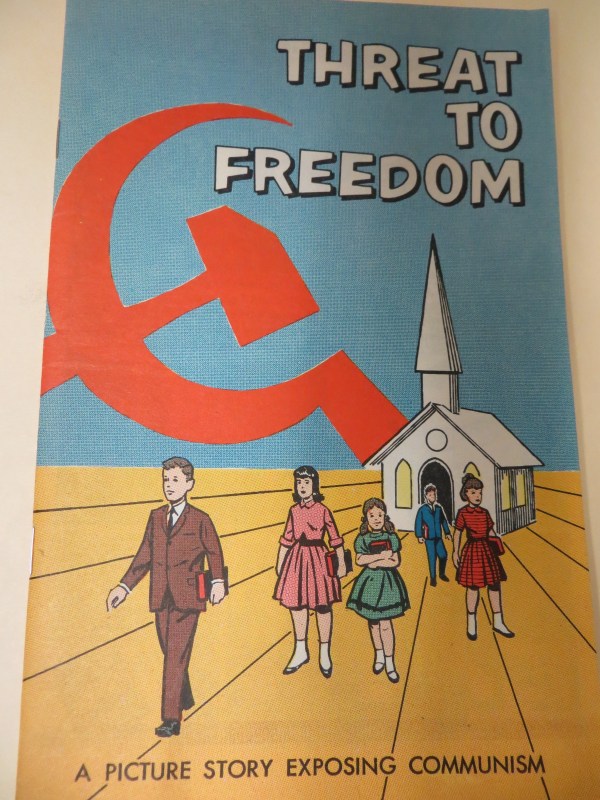
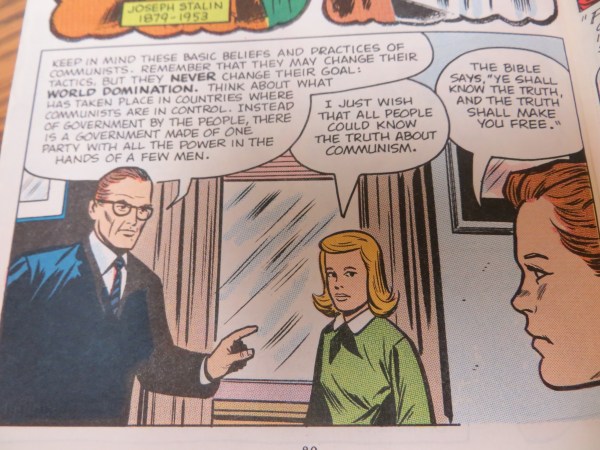
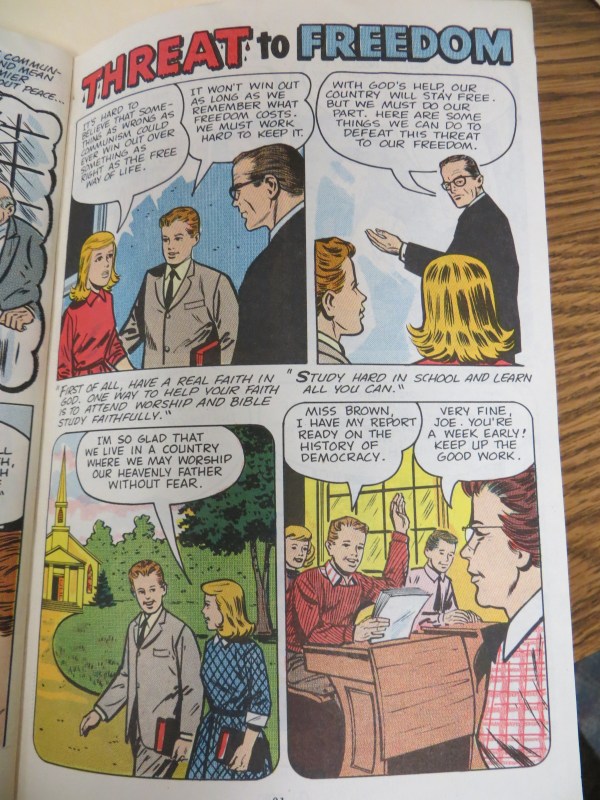
For many fundamentalists at the time, the supernatural connections were too obvious to need explaining. The Soviet Union was the political incarnation of Satan. It was a nation and empire wholly guided by the devil’s machinations. Its goals were nothing less than both worldly and eternal domination.

It wasn’t much of a leap, then, to mix together a patriotic faith in the United States with a religious devotion to evangelical Christian values. Defending traditional Americanism was entirely equal to defending true evangelical religion, and vice versa. When the eternal mixed so profoundly with the national, it was not at all difficult or unusual for white fundamentalists to mash together their religious faiths with their patriotic fervor.

Dayton Dilemmas I: WBR and Christian Nationalism

How could they do it? How could earnest, intelligent, educated Christians ever mash together their faith with their patriotism? That’s the tough question people were asking yesterday at the University of Dayton. I don’t have an easy answer, but I do think the case of William Bell Riley helps shed some light on it.dayton flyers

First, the background: Thanks to the dynamic scholarly duo of Professors Bill and Susan Trollinger, authors (among other things) of Righting America at the Creation Museum, I’m down in sunny Dayton, Ohio these days. Yesterday I talked with members of the Flyer community about my recent book, Fundamentalist U. I focused on the long tradition in evangelical higher education of combining conservative evangelical Protestant faith with a certain sort of Make-America-Great-Again patriotism.

The argument I tried to make is that white fundamentalists have always felt a deep sense of proprietary interest in the United States. For white fundamentalists, America has always been “our” country. Over the course of the twentieth century, in schools and society, fundamentalists have felt kicked out by trends toward secularism and political liberalism. They have repeatedly rallied to politicians who have promised to Make America Great Again.

righting america at the creation museumTrump’s not the first. As audience members pointed out, we can go back to Reagan and Nixon to find coded and not-so-coded appeals to “law-and-order,” the “silent majority,” and “shining cities on a hill.” For white evangelical voters, particularly the more politically conservative among them, those campaign promises have always been enormously appealing.

Some of the intellectuals in the audience—steeped in a very different tradition, the Catholic intellectual tradition—asked the tough question: How could any Christian of any denominational background ever mix up their priorities so badly? How could any Christian confuse his (primary) devotion to his religion with his (secondary) devotion to his country?

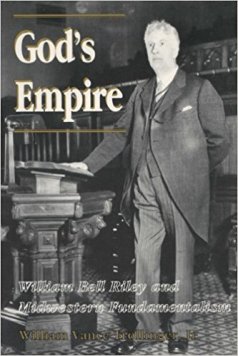
I had the chance to talk with Professor Bill Trollinger about the question. Bill is the universe’s greatest expert in the life and career of 1920s fundamentalist leader William Bell Riley. Riley, like many early fundamentalists, was a devoted Baptist. For Riley, in the early 1920s fundamentalism was a campaign to take back his denomination from the worrisome liberal trends that had begun to creep in.

American Baptists, ever since the days of Roger Williams, have placed an enormous emphasis on the freedom of the church from the government, and on the inviolate primacy of religious devotion over any political loyalty. By the twentieth century, however, Baptist fundamentalists like William Bell Riley seemed to have lost their yen for avoiding entanglement with government. Riley and other Baptist fundamentalists pushed hard to establish (or, as they would put it, re-establish) their evangelical religion in a more prominent place in public life. They wanted greater influence on public affairs. They hoped for increased influence on government decisions, such as banning alcohol, gambling, and other immoral activities.gods empire

How did that happen? How did ardent Baptists become so enthusiastic about “taking back America”?

Professor Trollinger and I came up with a short list, and I hope SAGLRROILYBYGTH will add their two cents.

How did fundamentalists like Riley combine their devotion to their religions with their devotion to the USA?

1.) Riley would always agree that church and state should be separate, but that the church must always represent the conscience of the society.

So although there must never be church control of government, government leaders should always be guided by religious leaders. Riley’s career could be characterized, in fact, by his increasing bitterness and resentment at his perceived lack of Main-Street influence. By the end of his life, Riley had become a vengeful, anti-semitic extremist, dedicated to sour conspiracy theories to explain his failure to establish himself in the level of public leadership to which he felt entitled.

2.) Riley wanted influence and was in part blinded by patriotic tradition.

Like many fundamentalists since, Riley failed in some measure to maintain his own Baptist tradition, even though he would never admit that. For Riley, as for many fundamentalists of later generations, America became representative of a Christian community. The division between church and society—if not church and state—became blurred in Riley’s mind and in his activism.

3.) The devil made them do it.

For many fundamentalists, political activism was intimately, necessarily connected and equated with religious activism. Patriotism was inseparable from faith. Why? Because of their belief in literal, incarnate supernatural entities acting through political entities. But we’ll save that for our next post.

Censorship at Christian Colleges

Want to get fired? Try this: Run a controversial story in a newspaper at an evangelical college. This week, Liberty University’s Erin Covey complains that her reporting is being blocked. She’s not the first student reporter to have this experience. On the contrary, student editors have always worked under constant threat.

At issue today is an anti-Trump/anti-Falwell revival going on near Liberty University. Shane Claiborne and his progressive evangelical allies are hosting a Red Letter Revival service, challenging Liberty’s president to join them or change his “toxic” Trump-loving ways.

When student reporter Erin Covey shared her coverage of the revival with Liberty’s leaders, she was told to squelch the story. As she tells it, Liberty’s administration told her,

No let’s not run any articles about the event. That’s all these folks are here for — publicity. Best to ignore them.

Covey plaintively wondered,

We often wonder: Do other private schools deal with this? What are the levels of freedom that other school papers have? Do we have the same freedoms — is this common?

When it comes to school newspapers—including student newspapers–censorship and content control have been universal practices in the history of evangelical higher education. As I describe in my recent book, this has been true at all evangelical schools, no matter how liberal or how conservative.

Earnestine Ritter

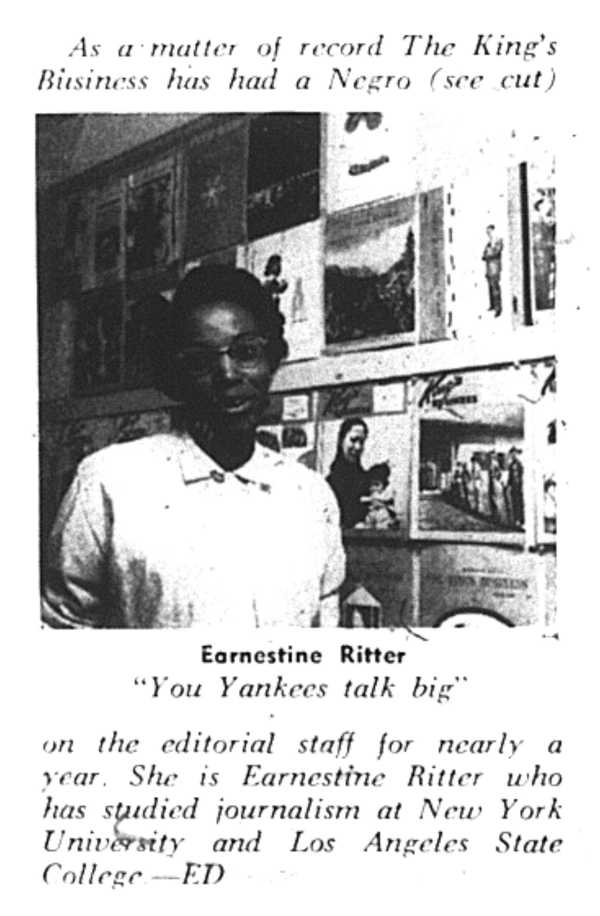
How to get fired at Biola, c. 1957.

Why? Let me share one example from Biola that exemplifies this tradition. In 1957, editor Lloyd Hamill took a strong anti-segregation position. He excoriated white evangelicals who opposed racial integration. As he put it,

No Spirit-controlled Christian can escape the solid fact that all men are equal in God’s sight.  Integration is not only the law of our nation, it is also the plain teaching of the Bible.

Biola, Hamill wrote, didn’t only endorse integration. It practiced it, employing an African American journalist on staff. A deluge of letters flooded Biola. More than 90% of them attacked Hamill’s position, though a few supported him. What did Biola’s administration do? As Biola’s president explained privately to Billy Graham. Hamill was sacked immediately. Biola did not want to endorse

the very foolish letters he wrote and statements which he made.

Granted, the situation is somewhat different. Hamill worked at the college’s magazine, not a student publication. But I think the rule still holds.

Why do evangelical colleges censor their publications so rigorously? Why can’t Erin Covey cover an anti-Falwell revival?

It’s not an accident and it’s not only Liberty. All evangelical colleges live under constant scrutiny. The evangelical public is always wondering if school X or Y has gone soft. The publications coming out of schools—including student newspapers—have always received endless scrutiny from interested members of the evangelical public.

Whatever appears in a student newspaper is often taken to represent more than one student’s opinion. It is taken, at heart, to represent the current moral climate of the school. For students like Erin Covey and editors like Lloyd Hamill, the result is clear: Don’t rock the boat.

Who Cares about Fundamentalist U?

It’s not just a topic for evangelical intellectuals. Recently, journalist Lauren Gilger asked me some great questions about my new book. Among the most pressing is this one: Why should the rest of us care about evangelical higher ed?

KJZZ_Gen_BlackBlue

Why care about evangelical colleges?

You can listen to the whole interview at Phoenix’s KJZZ: The Show.

Which of These People Will Save the Humanities?

At many colleges, humanities enrollments are down. So far down that schools such as one University of Wisconsin campus are scrapping entire humanities departments. What can academics do? Two pundits this week have suggested different solutions. We have a different proposal to make.

savior 1

…is it students reading Beowulf?

At the Chronicle of Higher Education, Mark Bauerlein makes a counterintuitive proposal. If humanities programs want to survive and thrive, Professor Bauerlein argues, they need to woo freshmen and wow their parents. As he puts it, “right now, nothing is more crucial than the preferences of 19-year-olds.”

You might think the way to do that would be to lighten up on grades and assignments. Offer an easy A and students will line up…right? Professor Bauerlein describes a program that does the opposite. Teachers at the University of Oklahoma have revived W.H. Auden’s 1940s-era syllabus. It forces students to do a ton of reading and reflection. And the students seem to like it.

Bauerlein’s conclusion? Make humanities courses unapologetically difficult. Stop apologizing for Western Civilization:

Design your Western-civ or Great Books course and ramp it up to Auden levels. Be frank about the reading challenge. Boast of the aged, uncontemporary nature of the materials. Highlight the old-fashioned themes of greatness, heroism and villainy, love and betrayal, God and Truth, and say nothing against intersectionality and other currencies. Your antagonists are mediocrity, youth culture, presentism, and the disengagement of professors and students. You occupy a competitive terrain, and your brand is Achilles, Narcissus, the Wyf of Bath, Isolde, and Bigger. Let’s see what happens. Let the undergrads decide.

Could it work? Maybe. I’ve stopped being surprised by the numbers of students who want to be challenged. Yes, many—maybe most—students approach their classes as mere hurdles to be overcome to get to the next goal. But a reliable stream of students want something else.

savior 2

…is it budget-controlling conservative hawks?

From across the pond, we get a very different prescription for saving the humanities. At Times Higher Education, Musa al-Gharbi gives us another idea. If we want to save classes in philosophy, sociology, history, literature, etc., al-Gharbi says, academics should court conservative politicians. After all, when conservatives think humanities departments have been taken over by leftists, they will not hesitate to close them down. And then progressives themselves suffer. As al-Gharbi puts it,

It is generally women and people of colour – usually progressives – who pay the cost when administrators are encouraged to weigh into political disputes. These same groups will also bear the brunt of continued erosion of public trust in institutions of higher learning.

The value of scientific fields is widely appreciated, but social research is a different matter entirely. Given that women, people of colour, LGBTQ scholars and leftists are better represented in the humanities and social sciences than in most other disciplines, they will disproportionately suffer when social research is devalued and defunded.

In other words, if we want to save the humanities, we need to help influential conservative politicians see that courses in history, literature, and so on are not merely training grounds for leftist radicals.

Could that work? In Wisconsin, at least, the shutdown of Stevens Point humanities courses was a direct result of long-simmering conservative outrage. Cultivating conservative political support for humanities classes might help maintain budgets.

I’ve got a different suggestion, though. As I argue in my new book about evangelical higher education, there is one constant truth about higher education in these United States. Whether students choose a fundamentalist college, an Ivy League redoubt, or a community-college approach, a driving factor in student decisions has always been professional credentials.

Heather Gerken

…or is it someone different?

That is, whatever college students choose, most of them (or at least, their parents) insist that their work must lead to a better career. Like all institutions, evangelical colleges fail when they can’t deliver on that promise. The same is true for humanities programs. Some humanities courses are thriving. At Yale, for example, history is back as the most popular major.

Why are students flocking to history courses at Yale? As Professor Bauerlein argues, many of them are likely attracted by the intellectual rigor and challenge of the major. And, as Prof. al-Gharbi explains, some of them are probably intrigued by the ideological diversity of academic history. The bulk, though, are hoping that the history major will situate them well to apply to law school. That’s been the tradition for long years.

So who should academics be trying to convince of the value of humanities courses? Is it freshmen looking for old-fashioned intellectual challenge? Or is it conservative politicians looking askance at faculty politics? I think both ideas have merit.

But if humanities programs really want to survive, they need to convince students, parents, and law-school deans that their programs are the best way to fulfill the most important purpose of American higher education: preparation to move up the career ladder.

R-E-L-A-X…

Is the sky falling for evangelical colleges? Rod Dreher says yes. I say no.

Dreher is responding to a recent NPR piece describing the tensions at evangelical colleges over student sexuality and gender identity.

As the article describes, colleges aren’t sure what to do. For many conservative evangelicals, homosexual practice is unacceptable. But so is rejecting and harassing Christians. To Dreher, the conundrum is proof that evangelical colleges—like all evangelical institutions—need to take drastic Benedictine steps. As Dreher puts it,

the environment in which traditional Christian colleges and educational institutions work is rapidly changing: politically, legally, and culturally. We cannot count on anything anymore. . . . Somehow, faithful small-o orthodox Christians have to figure out how to educate within this hostile new heterodoxy. We will have to form new institutions, ones built to be resilient in the face of anti-Christian modernity.

Sounds scary. But as I argue in my new book about the history of evangelical higher education, this predicament is nothing new. To the contrary, this dilemma has been the driving force behind evangelical higher education for a hundred years now. Consider this plea from Dean Lowell Coate of Marion College, c. August, 1923. Mainstream higher ed, Dean Coate fretted, had been taken over by “evolution, destructive criticism, and liberalism.” What evangelicals needed, Coate insisted, was to

ignore the whole worldly system, and organize courses independent of the world’s stereotyped curricula, engage the strongest conservative scholarship in America, raise the educational standard above the present unchristian philosophy, stablish [sic] it upon ‘the faith once for all delivered to the saints,’ and then challenge the world to meet the new scholarship.

Guess what? It worked. The fundamentalist movement of the 1920s set up a startlingly successful network of colleges, universities, seminaries, and institutes. Evangelical colleges have faced the challenge of rapid change for almost a century and they have always found a way to remain true to both their religious mission and their academic aspirations.

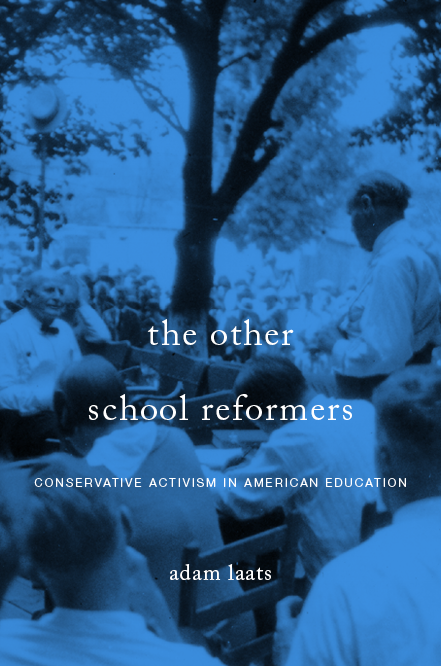
Cover art final

Is the sky falling? Yes, but it has been falling for over a century now…

Now, as SAGLRROILYBGTH are tired of hearing, I don’t have a dog in this fight. I’m not evangelical, nor am I personally invested in evangelical higher ed. If I were, though, I would listen to Aaron Rodgers and not Rod Dreher. The challenges faced by schools today are serious and dire—but they are not more serious and dire than the challenges that have always confronted evangelical academics.