Is “Gay” the New “Black” at Evangelical Colleges?

It’s not a simple question, but there is a simple answer. A recent story from NPR about LGBTQ+ issues at evangelical colleges has people asking: Are today’s official anti-gay policies at most evangelical colleges the 21st century equivalent of their 1950s racist policies? Short answer: No.
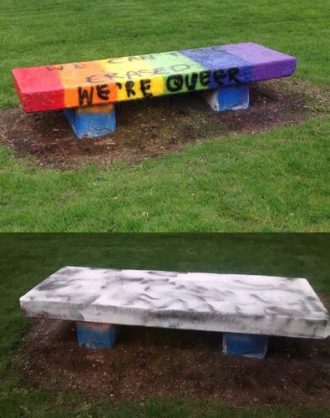
wheaton rainbow bench

It’s not easy. The rainbow bench at Wheaton was covered over…

As the article describes, many campuses such as Calvin and Multnomah send profoundly mixed messages about non-heterosexual identities among students. On one hand, students are carving out for themselves friendly spaces on evangelical campuses. They are finding emotional support among sympathetic faculty and fellow students.

This matches other reports, such as one from Liberty University a few years back. It is different at different schools, of course, but students have already introduced LGBTQ+ rights on most evangelical campuses.

On the other hand, most schools still have official rules banning non-married, non-heterosexual sexual expression. As the NPR article describes, people at evangelical colleges are often confused. The chaplain at Calvin, for example, put her position this way,

You’ve got those two values. . . . We love our LGBT people. We love our church of Jesus Christ. We love Scripture. So those of us who do this work are right in the middle of that space. We are living in the tension.

It’s hard not to ask: Is this just an updated version of the struggle over segregation and racism at evangelical colleges? As I argue in my recent book, evangelical and fundamentalist schools had a shameful racial legacy in the twentieth century. (For the record, so did non-evangelical schools.) Though many evangelical colleges had been founded as explicitly anti-racist or cross-racial missionary institutions, by the early twentieth century they had imposed rules and policies against interracial dating. They discouraged non-white applications.

Are today’s battles over sexual and gender identity just new versions of this old conflict? In at least one important way, the answer is a clear no. When evangelical activists fought against their schools’ racism in the twentieth century, they were able to pull from their own evangelical history to make their cases. At Wheaton College, for example, faculty activists such as James Murk and John Alexander were able to point to the incontrovertible fact that the school had been founded by Jonathan Blanchard, an ardent cross-racial Christian activist.

There is no similar history for LGBTQ+ activists to pull from. They can say—and they do—that loving all people is an essential part of their religion. But they are not able to pull from their own evangelical history to make their cases.

To be clear, I’m all for LGBTQ+ rights. I’m proud to work at a school where there can be no institutional discrimination based on sexual identity or gender identity. Speaking as an historian, though, I have to make the obvious point: It will be harder for LGBTQ+ Christians to stake their claims than it was for anti-racist white students.

HT: EC
Can Jesus Make a Profit?

It’s true—there are lots of topics that I had to leave out of my new book about evangelical higher education. Among the most difficult choices was the decision to focus tightly on one group of interdenominational evangelical schools that had its roots in the 1920s fundamentalist movement. Lots of important and interesting evangelical colleges got (mostly) left out of the story: Oral Roberts University, Regent University (VA), and Patrick Henry College, to name a few.

grand-canyon-university_2015-03-23_14-34-58.004

Cactus, cross…and ka-ching?

A recent call from a journalist has me yearning to have been able to include one of the most unusual and idiosyncratic stories in the history of evangelical higher education—the tangled tale of Grand Canyon University.

Like a lot of evangelical schools, Grand Canyon University started out as humbler Grand Canyon College, an institution catering to local Southern Baptists. With such a small draw, the school had trouble keeping the lights on. In an effort to attract more students, it adopted an interdenominational evangelical posture. So far, so ho hum. All evangelical colleges—well, almost all—could tell similar tales in the 1960s, 1970s, and 1980s—tales of dwindling enrollments and desperate attempts to lure more students.

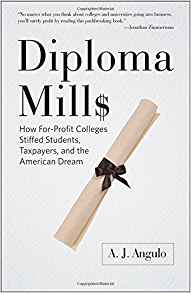
What makes GCU so interesting is its radical 21st-century attempt to rewrite the Christian college playbook. In order to stay afloat, in 2004 GCU converted into a for-profit institution. There’s nothing new about for-profit higher education. As my friend and colleague A.J. Angulo has argued so powerfully, the for-profit sector has a long and often shameful history.

What IS unusual is an evangelical college hoping to join the for-profit club. To be sure, plenty of evangelical colleges make money. Most famously, Liberty University made gagillions of dollars in online education in the past dozen years. But that money isn’t a profit for shareholders; it is plowed back into campus resources, including the newly respectable Liberty football team.

diploma mills

Tsk, tsk. Not a club I’d think Christian colleges would want to join…

If recent news is any indication, there are good reasons why evangelical colleges don’t try to make a profit. In Phoenix, GCU has recently agreed to buy back its right to be a non-profit school. It won’t be cheap. The school plans to spend almost a billion dollars (yes, that’s B-illion with a B) to buy back its stock.

Some of the benefits are concrete. As a non-profit institution, GCU will once again be eligible to accept tax-deductible donations. It will be able to participate in NCAA sports and compete for research grants. As all colleges must do to survive, these trappings will allow GCU to look like a “real” college.

The quest to maintain status as a “real” college has always animated evangelical schools. They have fretted that their doctrinal peculiarities and severe campus rules would cause higher-ed outsiders to look down their noses at them as mere “church colleges.”

So GCU’s desire to reclaim its non-profit status makes perfect sense in the longer story of evangelical higher education. This morning I’ve got a different question. All evangelical colleges want to have sports, research, and the other trappings of “real” colleges. But they’ve also insisted on their status as “real” Christian institutions, though they have never been able to agree on a precise definition of that term.

So here’s the question: How could GCU have ever moved into the for-profit world? Could an evangelical college ever hope for respect if it made a profit off of its students? Wouldn’t that undermine its claims to being a truly Christian institution?

No Joke: Catholic College Cuts off Comic’s Crudeness

There’s campus free speech and then there’s campus free speech. Does a comedian have any sort of “free-speech” right to intentionally and directly violate a contract? Even if he’s trying to make a point?

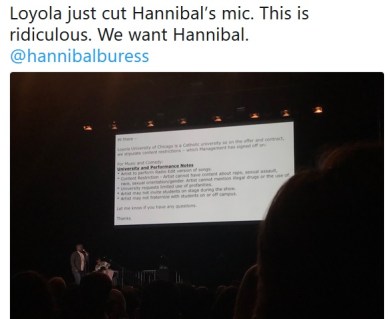
hannibal buress tweet loyola

From a student tweet…

Here’s what we know: The Chronicle of Higher Education is reporting on a free-speech stunt by comedian Hamilton Buress. The well-known comic (so I’m told. I’d never heard of him, but that doesn’t mean much) had signed a contract for his bit at Loyola University in Chicago. He had agreed not to discuss certain subjects, including sexual abuse, rape, race, or sexual and gender orientation.

Buress didn’t only ignore the contract. He projected an image of the list of forbidden topics, then proceeded to make a joke about each one in turn. When he got to a joke about child sexual abuse by the Catholic church, the (Catholic) university cut off his mic.

What do you think?

Me, I’m torn. On the one hand, the guy signed a contract. He agreed not to make certain jokes.

On the other hand, Buress’s deliberate and provocative method of spurning the contract, IMHO, is more than just comedy. It makes a powerful point about the need to speak freely about sensitive topics.

Would I want him to perform at my kid’s fifth birthday party?  Probably not. But do I think his stunt was a healthy shake-up of campus stultification? I think so.

The Dilemma of the Fundamentalist Intellectual

It’s tough to be a conservative evangelical intellectual these days. As a recent exposé at Religion & Politics makes clear, they are still addicted to mainstream academic credentials, even when those credentials can be nearly impossible for them to achieve.

Why is it so difficult for conservative evangelicals to earn mainstream academic credentials? In part, it’s due to the stark and growing divide between mainstream institutions and evangelical intellectual assumptions. As I’m arguing in my new book about evangelical higher education, in the late nineteenth century conservative evangelicalism lost its place as the presumed intellectual backbone of America’s colleges and universities. I think historian Jon H. Roberts said it best. In the late 1800s,

Truth claims based on alternative epistemologies—tradition, divine inspiration, and subjective forms of religious experience—increasingly lost credibility within the academy.  In addition, the recognition that knowledge itself was fallible and progressive cast doubt on the legitimacy of venerable doctrines.  Claims that ongoing inquiry would eliminate error and establish truth fostered an iconoclasm toward orthodoxies.

In response, conservative evangelicals—calling themselves “fundamentalists”—built a dissenting network of higher-educational institutions. It wasn’t only brick-and-mortar schools. Fundamentalists created their own accrediting agencies, athletic leagues, alumni organizations, and more. These independent evangelical institutions allowed academics to rack up titles and honors without participating in mainstream thinking. As we’ve noted recently, the fetish for credentials has always included a frenzy of cross-institutional honorary doctorates.

sacred secular university

The empire really was in ruins.

But it’s still not enough. Throughout the twentieth century and continuing today, conservative evangelicals have yearned for more than just their own credentials. They have oohed and aahed at their colleagues who have earned mainstream academic respectability.

One notable case occurred during the mid-century creationism wars. Back in the 1940s and 1950s, evangelical intellectuals squared off (again) over the question of a young earth. Did belief in the Bible require belief in a literal six-day recent creation? In a literal world-wide flood?

At the 1948 meeting of the creationist American Scientific Affiliation at Calvin College, for example, geochemist J. Laurence Kulp battled with Calvin botanist Edwin Y. Monsma. Monsma defended the young-earth position. Kulp trashed it as mere “foolishness.” With his PhD from Princeton and his faculty berth at Columbia, Kulp’s mainstream credentials helped carry the day. As historian Ronald L. Numbers described, many ASA members were “ready to follow Kulp in boldly shedding the trite fundamentalist apologetics of the past.” Creationism, yes. Young earth, no.

At least in part, Kulp’s bona fides from outside the charmed circle of fundamentalist institutions helped convince many conservative evangelical intellectuals that Kulp’s ideas had oomph.

The_Creationists_by_Ronald_Numbers

Creationists love credentials…

Today, we see a sad case of inflated credentials from another evangelical intellectual. As Professor Jill Hicks-Keeton of the University of Oklahoma points out, a recent publicity appearance to promote the new Museum of the Bible highlighted conservatives’ desperate drive for mainstream academic credentials.

Professor Hicks-Keeton describes the spiel of Jeremiah Johnston of Houston Baptist University. Professor Johnston hopes, in his organization’s words, to “teach Christians to be Thinkers and Thinkers to be Christians.”

But in his quest to wow evangelical audiences, according to Hicks-Keeton, Dr. Johnston played fast and loose with his resume. Hicks-Keeton sleuthed a little deeper. As she puts it,

Johnston’s academic credentials sound impressive: “He has studied at Oxford,” the pastor said. The CTS [Christian Thinkers Society] website’s bio for Johnston includes a list of presses with whom he has published, led by one of the most prestigious in the guild: Oxford University Press. During his talk to the congregation, Johnston repeatedly performed such credentials for church members by dropping academic words the average churchgoer would not have encountered (shema, protois, verisimilitude) and by flagging his own academic work. . . . A closer look at his curriculum vitae reveals that his educational pedigree is unrelated to Oxford University, a premiere institution of scholarship. The “Oxford” mentioned by Pastor Daniel is actually the Oxford Centre for Mission Studies—identified by its website as “an independent Christian charity.” Johnston’s publications with OUP amount to four brief, co-authored contributions to encyclopedias and edited volumes, which are not subjected to the rigors of peer review.

Ouch. For any academic—evangelical or not–these charges sting.

Why would Professor Johnston puff up his credentials, when they are so easy to deflate? I don’t know Johnston, but my hunch is that he shares the century-old dilemma of all fundamentalist intellectuals. In spite of their long efforts to free their minds from the shackles of mainstream academic thinking, they are still wed to the same hierarchy of prestige as everyone else.

We’re Trending!

You might have trended before. I don’t think I have. I’m a little dizzy…

IHE FU story

Does this mean I’ll need new outfits?

How Did Christian Colleges Become Racist?

People keep asking: Why are white evangelicals so racist? This week we see it in The Atlantic and at Forbes. At leading evangelical colleges—in the North anyway—there’s a big, obvious answer that this week’s pundits don’t mention.

Here’s what they’re saying:

  • Michael Gerson wondered what happened. At his alma mater Wheaton College in Illinois, a strident anti-racism among white evangelical leaders slipped away.
  • Chris Ladd places the blame on slavery and the lingering dominance of Southern Baptists. As Ladd writes,

Southern pastors adapted their theology to thrive under a terrorist state. Principled critics were exiled or murdered, leaving voices of dissent few and scattered. Southern Christianity evolved in strange directions under ever-increasing isolation.

The question should bother all of us, white or not, evangelical or not. Why do so many white evangelicals seem comfortable or even enthusiastic about Trump’s Charlottesville-friendly MAGA message?

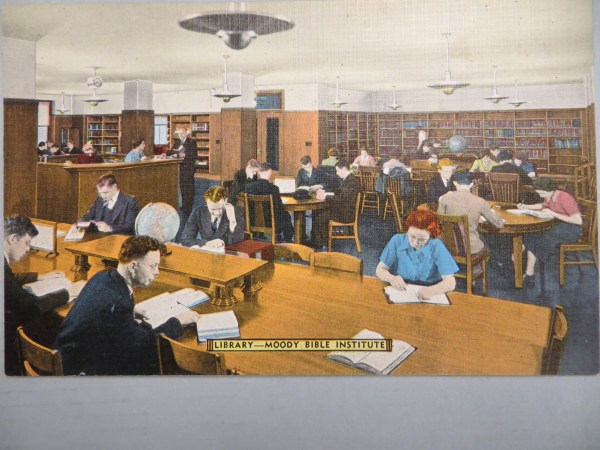
1940s postcard library

Not a lot of diversity, c. 1940s

Since neither Gerson nor Ladd bring it up, I will. At some of the leading institutions among white evangelicals, there is an obvious culprit. It’s not the political power of the slave state. It’s not craven lust for political influence. As I’m arguing in my new book about evangelical higher education, Christian colleges have always been desperate to keep up with trends in mainstream higher education. And those trends pushed white evangelicals to mimic the white supremacy of mainstream higher education.

Of course, evangelical colleges were happy to stick out in some ways. In the classroom, for example. Evangelical institutions of higher education have always prided themselves on teaching dissident ideas about science, morality, and knowledge. In social trends, too, evangelical colleges didn’t mind having stricter rules for their students about drinking, sex, and dress codes.

When it came to academic luster, however, fundamentalist academics in the first half of the twentieth century were desperate for the respect of outsiders.

At Gerson’s alma mater, for example, President J. Oliver Buswell quietly discouraged African American attendance in the 1930s. Why? There’s no archival smoking gun, but Buswell explicitly discouraged one African American applicant, suggesting that her admission would lead to “social problems.”

When we remember the rest of Buswell’s tenure, his reasons for discouraging non-white applicants become more clear. Against the wishes of other Wheaton leaders at the period, Buswell fought hard for academic respectability. He tried to decrease teaching loads, increase faculty salaries, and improve faculty credentials. As Wheaton’s best historian put it, Buswell

passionately believed that one of the best ways to earn intellectual respect for fundamentalist Christianity would be to make certain that Wheaton achieved the highest standing possible in the eyes of secular educators.

In the 1930s, that respect came from a host of factors, including faculty publications and student success. It also came, though, from limiting the number of African American students and the perceived “social problems” interracialism would impose.

Buswell and Wheaton weren’t the only northerners to impose segregation on their anti-racist institutions. Cross-town at Moody Bible Institute, leaders similarly pushed segregation in order to keep their institution respectable in the eyes of white mainstream academics.

Like other white evangelical institutions, in the late 1800s Moody Bible Institute was committed to cross-racial evangelical outreach. On paper, in any case. And MBI always remained so on paper, but by the 1950s the dean of students broke up an interracial couple. The dean was not willing to say that there was anything theologically wrong with interracial dating, but he separated the couple anyways, worried that public interracialism would “give rise to criticism” of MBI and its evangelical mission.

Why do so many of today’s white evangelicals seem comfortable with Trump and his white-nationalist claptrap? Why didn’t they hold on to the anti-racism that had animated white evangelicals in the past? Both Ladd and Gerson make arguments worth reading.

On the campuses of northern evangelical colleges, though, there was another powerful impulse. For evangelical college leaders, being a real college meant earning the respect of white non-evangelical school leaders. Between the 1930s and the 1950s, uncomfortable as it may be to acknowledge, mainstream white college leaders expected racial segregation. White evangelical college leaders weren’t more racist than non-evangelicals. They were just more desperate to seem like “real” colleges.

HT: DL, EC

Genesis, Free Speech, and Hate Speech

What would arch-creationist Ken Ham say if someone accused him of hate speech? We don’t have to guess. At his recent talk at the University of Central Oklahoma, Ham defended his vision of proper Christian morality. Did he capture ancient Christian wisdom? Or spout off twenty-first century bigotry?

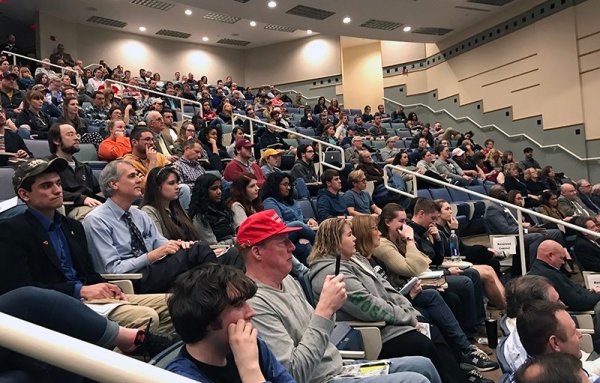
ham speech audience UCO

Part of the 500-person audience at UCO.

As SAGLRROILYBYGTH recall, we’ve tussled over this issue recently. When UCO rescinded Ham’s original invitation, we wondered if free speech was still alive. I argued at the time that free speech was something of a red herring in this case–and many similar college cases. The real issue is sponsorship. The student organization at UCO did not want to pay Ham to speak, due to Ham’s views on sexuality and marriage.

In the end, UCO President Don Betz squared the circle by using money from a separate slush fund to pay for Ham’s visit. And the talk went off without a hitch. During the Q&A, one audience member asked Ham directly about gay rights. Here’s how the interchange went, according to Religion News Service:

One questioner — a self-described “spirit-filled Christian” and member of the LGBTQ community — said: “I sought the Lord and churches for why I feel attracted to the same sex. I found the church nor churches’ traditional view on (LGBTQ) fit my experience of hearing the Lord speak directly to me. Science, not the church, gave me peace. How can you say my experience of still being a child of God isn’t valid?”

Ham said he would start by asking how the person heard from God: “My way of dealing with that would be to say, ‘Let’s judge what the actual written word of God says. Let’s judge what you’re saying against what it says.’

“Because I have a different worldview in relation to marriage and gender doesn’t mean I hate that person,” Ham added. “Sometimes, people accuse us of hate speech because we disagree with them. It’s a clash of worldviews. That doesn’t mean we hate someone. In fact, the Bible commands us to love everyone, and that’s what we do.”

What do you think?

From my perspective, Ham’s answer sidesteps the central point. I don’t want to put words in anyone’s mouth, but my hunch is that anti-Ham protesters at UCO didn’t care if Ham personally hated or loved them. The real question is whether or not he wanted to take away their civic rights to marriage equality.

Fundamentalists Forget their Furious Family Feud

Maybe there’s hope for every family feud. The death of Billy Graham last week inspired an outpouring of love and respect from people whose fundamentalist forefathers loathed Graham’s revivals. Creationist impresario Ken Ham, for example, never one to water down his fundamentalist faith, had nothing but praise for Graham’s ministry. The archives tell a much different story.

Some of today’s no-compromise conservatives seem to have forgotten the legacy of their fundamentalist forefathers. Ken Ham, for example, praised Graham’s evangelistic outreach. As a child he listened to a Graham rally in Australia. As Ham recalled,

I remember people going forward in this church after listening to him and committing their lives to Christ.

Of course, it’s never kosher to speak evil of the dead. Ken Ham, however, lauded the whole body of Graham’s evangelistic outreach, from the 1950s through today. Ham included no whisper of accusation about Graham’s work.

Does he not know the backstory? Or have fundamentalists given up their ferocious feelings about Graham’s revivals in the 1950s?

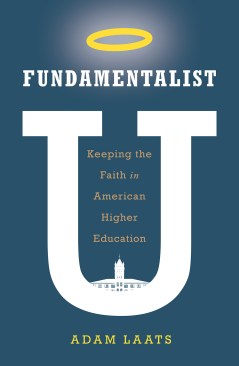
Cover art final

Yes, there is a place to read the full story…

To be sure, Graham’s passing has attracted some criticism from intellectuals. Historian Matthew Avery Sutton blasted Graham’s reactionary politics. D.G. Hart recalls the fact that many conservative Protestants were “not exactly wild about Graham’s ministry.”

The epochal anger and denunciations sparked by Graham’s outreach, however, seem to have been forgotten by some latter-day fundamentalists themselves.

I look into this history in my new book about evangelical higher education. In a nutshell, Graham’s revivals split the conservative evangelical community. The sticking point was follow-up. At Graham’s hugely popular services, audience members who felt Jesus’s call were put in touch with a sponsoring church. Those churches included more liberal Protestant churches as well as more conservative ones.

Fundamentalists worried that Graham’s preaching was leading souls directly into the pit of hell, by sending them to false churches to learn poisoned theology. These fears weren’t limited to a few right-wing wackos; they were a prominent part of conservative evangelical thinking in the 1950s, 1960s, and 1970s.

In 1963, for example, Samuel Sutherland of Biola University denounced Billy Graham. To a correspondent who accused Sutherland of cooperating with Billy Graham, Sutherland wrote,

I do appreciate the truth found in the Word of God which Billy Graham proclaims.  We appreciate also the souls that are saved and who find their way to Bible-believing churches and thus are nurtured in our most holy faith.  We deplore quite definitely, and have said so publicly, that there are so many doctrinally questionable individuals who are identified in prominent ways with the campaign and we are disappointed beyond words in the knowledge that so many of those who profess faith in the Lord Jesus Christ at the crusades will doubtless find their way into churches where the Word of God is not proclaimed and where they will not have a chance to know what the Gospel is all about or what it means, actually, to be born-again.  I am with you.

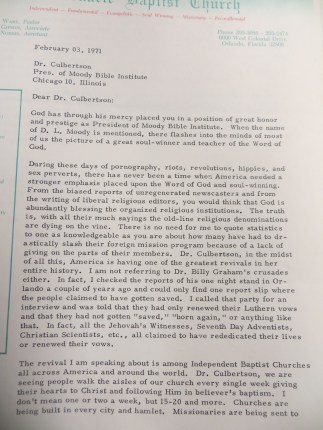
In 1971, one outraged fundamentalist wrote to Moody Bible Institute President William Culbertson to express his disgust at the Graham crusades. As he put it, the Graham crusades only sent people into false churches, such as “Luthern” [sic], “Jehovah’s Witnesses, Seventh Day Adventists, Christian Scientists, etc.”

anti culbertson anti graham letter 1

Fundamentalists didn’t like Billy Graham…

For a fundamentalist, that was a serious accusation.

Such accusations flew fast and furious around the world of fundamentalist higher education. The magazine of Biola University ran one typical reader letter in 1958. Reader Dorothy Rose condemned Graham as a false Christian and a servant of world communism. Rose warned (falsely) that Graham had been expelled from two “outstanding, sound Bible colleges.” As Rose wrote direly,

It is easy to be popular with the high-ups and with the press if we are willing to compromise.  But what is the cost spiritually?

No one denounced Graham more fiercely than Graham’s former mentor Bob Jones Sr. In 1958, for example, Jones wrote to a fundamentalist ally,

No real, true, loyal, Bible friend of Bob Jones University can be for the Billy Graham sponsorship . . . . [Billy Graham is] doing more spiritual harm than any living man.

Fundamentalists have come a long way. When it comes to the legacy of Billy Graham at least, no-compromise conservatives seem to have forgiven, or more likely, forgotten the divisive nature of Graham’s ministry.

Poison Pens at Evangelical Colleges

What’s going on at Taylor University in Indiana? According to a recent anonymous newsletter, the evangelical campus is seething with

gossip, slander, backbiting, profanity, vulgarity, crude language, sexual immorality (including adultery, homosexual behavior, premarital sex and involvement with pornography in any form), drunkenness, immodesty of dress and occult practice.

Zoiks!

Taylor’s administration struggles to respond to this conservative carping. For those in the know about the history of evangelical higher education, this sort of anonymous poison-pen assault has always been part of life at Christian colleges.

As I found in the research for my new book, critics from both the evangelical left and the fundamentalist right have often resorted to anonymous open letters in their attempts to influence policy at their schools. The archival files bulge with letters and newsletters of this type.

At Biola University, for example, a self-identified group of disgruntled fundamentalists buttonholed President Samuel Sutherland with a list of concerns in 1969. As they wrote anxiously,

we are deeply concerned about danger signs showing themselves among some of our conference speakers and members of the student body! Indications now present seem to point to a trend that the school is moving from its Biblical foundation.  May God prevent such a tragedy!

The students were concerned with the slackening of the student dress code, particularly for women. The rules stated that skirts and dresses must not be shorter than one and a half inches above the knee. As the conservative students complained, though,

the failure of a number of Biola girls to adhere to the dress rule is altogether too evident.  Excessive bodily exposure of Biola girls has even been seen in the seminary section of the library and has proven a hindrance to study. . . . We urge the administration to be rigorous in enforcing the rules and regulations of Biola Schools.  IN particular, the dress length rule should be observed because of its obvious Biblical basis.

Rock and roll, too, had snuck onto campus. As the protesters warned,

Unfortunately, many students here are experiencing a diet of music consisting primarily of the popular beat of the day.  Our group does not advocate avoidance of popular tunes!  However we do oppose the trend toward an exclusive diet of rock and roll even to the extent that our religious music is to be constructed around the beat.

All in all, the fundamentalist protesters in 1969 worried about the very continuation of Biola as a safe evangelical school. As they concluded,

Many great schools of the past today are under the sway of heresy.  We do not believe that loss happened within a few months.  We believe the erosion was gradual.  May God help all of the administration and faculty at Biola Schools to become more alert in detecting danger signs and in taking action to prevent the deterioration that has begun here.

These sorts of anonymous pleas for reform and renewal haven’t only come from nose-out-of-joint fundamentalists. Liberal students, too, have penned their share of open letters. The archives are full of em, but my personal favorite comes from Moody Bible Institute.

anti john rice demonstration warning letter

From the MBI Archives: BEWARE!

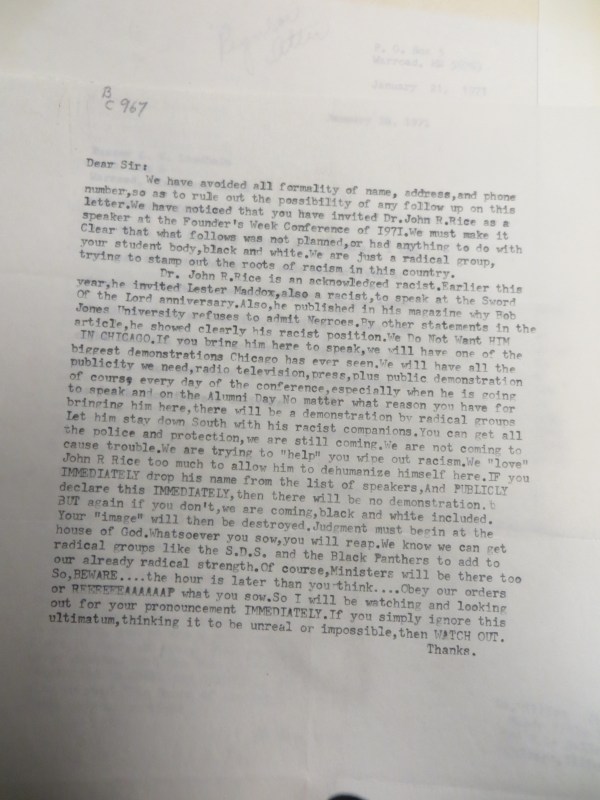
In 1971, MBI invited John R. Rice to speak at its annual Founder’s Day event. Before he could make the trip to Chicago, Rice came out in favor of the racial segregation at Bob Jones University. What was MBI to do? The leadership didn’t want to endorse Rice’s brand of Southern-fried racism. But they also didn’t want to anger his considerable fundamentalist following. As they dithered, they received an anonymous letter warning them to cancel Rice’s appearance.

The letter claimed to be written by non-students. To this reporter, however, the tone sounds awfully similar to the phrasing used by evangelical students everywhere and the letter-writers seem to know a lot more about Rice and MBI than any outsider would. For example, they had read Rice’s publication, Sword of the Lord. They knew about Rice’s recent support for racial segregation at Bob Jones U.

What should MBI do? The letter writers made threats:

We Do Not Want HIM [Rice] IN CHICAGO. If you bring him here to speak, we will have one of the biggest demonstrations Chicago has ever seen.

It would get ugly. As the letter concluded,

BEWARE . . . . the hour is later than you think. . . . Obey our orders or REEEEEEAAAAAP what you sow.

In the end, MBI canceled Rice’s speech. Perhaps the administration shared the letter-writers’ concern that their “ ‘image’ will . . . be destroyed.”

What will happen at Taylor? The conservative newsletter complains that the current campus is going to the dogs, according to Inside Higher Education. In classes, the newsletter exclaims, students learn

permissive views of human sexuality, hostility toward creationist perspectives, rejection of the rule of law (especially on the immigration issue) and uncritical endorsement of liberal-progressive ideas[.]

Such poison-pen missives have had a big impact in the past. Perhaps Taylor’s administration will take the path of least resistance and make some move to mollify the “conservative underground.”

Dress for Success!

Well, friends, March 1st is just around the corner. And that means the official release of my new book, Fundamentalist U: Keeping the Faith in American Higher Education. Cover art final

I’ve heard from none of you that you plan to “Harry-Potter” this release. That is, that you plan to camp out all night at the bookstore on Wednesday, February 28th, dressed as your favorite personage from Fundamentalist U. For those of you who will be doing so, I’ll share here a few images of the people you might choose to dress up as.

I’m not sure how many of them were in Hufflepuff…

All of these people play important roles in the history of conservative evangelical higher education. For bonus points, can you match the pix to the names? Or the names to the relevant institutions?

Here they are, in no particular order:

  1. Mark Noll
  2. Elisabeth Howard Elliot
  3. Russell Mixter
  4. Henry Morris
  5. James M. Gray
  6. Clifton Fowler
  7. Hudson Armerding
  8. Charles Blanchard
  9. Larycia Hawkins
  10. J. Oliver Buswell

Have fun, and see you at the bookstore!