From the Archives III: Playing the Rice Card

Editor’s Note: I am happy to say that my book about the history of evangelical higher education has entered its final production stages. We are on track to release Fundamentalist U by January 1, 2018. The sad fact, though, is that so much great archival material got cut from the final draft. In this series, I’ll be sharing some of these too-good-too-lose gems from my work in the archives.

Were white evangelicals racist? Short answer: Yes. Long answer: Yes, but.

In Fundamentalist U, I’m working hard to tease out the ways evangelical and fundamentalist colleges, institutes, universities, and seminaries wrestled with questions of race and racism in the twentieth century. It wasn’t easy, but I had to cut one of the most intriguing sections of my chapter.

Here’s what happened: In 1970, fundamentalist publisher John R. Rice came out in favor of Bob Jones University’s racial-segregation policy. The leaders of Moody Bible Institute had just invited Rice to give one of the most prominent speeches in their annual Founder’s Week celebration.

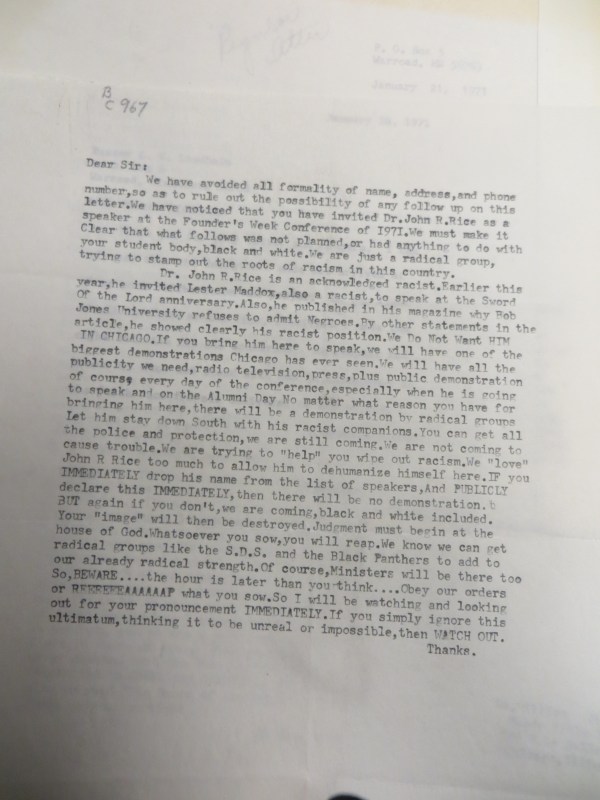
What was MBI to do? Like most white evangelicals in the era, they had moved away from the unabashed racism that they had shown since the 1930s. But they hated to alienate Dr. Rice and the potent strain of unreconstructedly racist fundamentalism that he represented.anti john rice demonstration warning letter

As MBI’s leaders hemmed and hawed, they received a clumsy letter opposed to Rice’s appearance at MBI. The authors go to awkward lengths to insist they are not students at MBI—and honestly I have no evidence that they were—but the language and content of the letter seem to suggest that it was written by MBI students.

What does this tell us about white racism at evangelical institutions? Here are some of my thoughts and I’ll welcome yours:

1.) White evangelicals in 1970 often opposed their historic racism.

2.) They often did so as part and parcel of their evangelical belief.

3.) Institutions—even ones that wanted to move away from their segregated pasts—hesitated to alienate powerful fundamentalist factions.

4.) Students at evangelical schools closely watched the goings-on at secular colleges and often mimicked the activism of their secular peers.

5.) Student activists often misunderstood the attitudes of their school administrators.

In this case, at least, MBI President William Culbertson was as ardently anti-racist as any student, but he didn’t want to hurt his school by insulting John R. Rice too publicly. When the cards were down, however, Culbertson went ahead and cut off Rice, consequences be damned.

As Culbertson wrote to John R. Rice, they both agreed on theology, but they had split on questions of race and racism. If Rice were to come speak at MBI, Culbertson concluded, it would give

the impression that the Institute agrees with your views in this regard. This cannot be.

From the Archives II: The Scams and the Sacred

Editor’s Note: I am happy to say that my book about the history of evangelical higher education has entered its final production stages. We are on track to release Fundamentalist U by January 1, 2018. The sad fact, though, is that so much great archival material got cut from the final draft. In this series, I’ll be sharing some of these too-good-too-lose gems from my work in the archives.

Fundamentalists never knew whom to trust. It made sense. After all, since the 1920s, fundamentalists had been telling one another that mainstream institutions had gone to the dogs. Colleges like the University of Chicago, magazines such as Time, denominations such as the Methodists…all had once been trustworthy—in the eyes of fundamentalists—and all had succumbed to a deadly mania for secularism and liberalism. Any school, any church, any preacher could have its or his head turned by the siren song of liberal theology. Any school could slide into soul-damning modernism at any time. This deep skepticism of everyone outside of the charmed circle of trusted fundamentalist institutions, ironically, made it easier for scam artists like George Martin to fleece the faithful.
IMG_1872

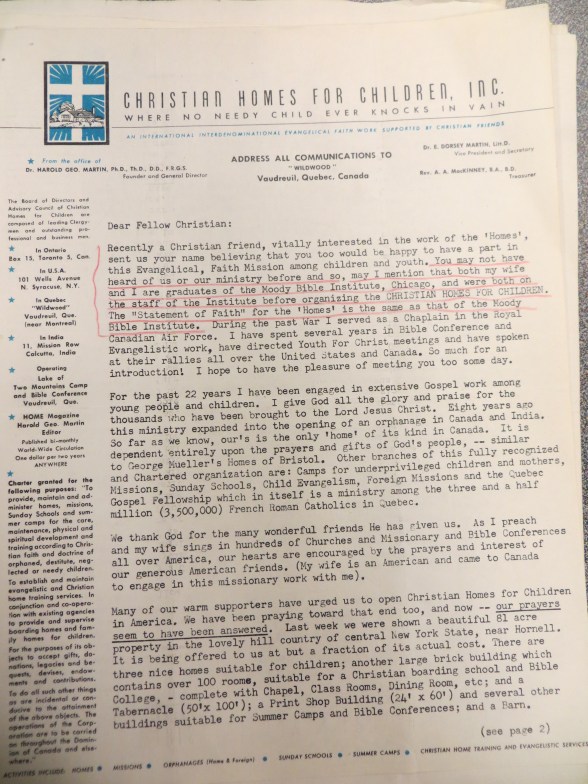
Martin pleads for fundamentalist funds, based on his MBI background

How did he do it? It wasn’t a quirk, or an isolated case. Rather—at least, this is the argument I’m making in Fundamentalist U—con men like Martin were able to take advantage of a central, defining element of American fundamentalism.

Here’s the story: Martin ran an orphanage and college in Hornell, New York. In the 1950s, he solicited funds and donations for this fundamentalist project. Fundamentalists were no dummies; before they sent him money, they wanted to know he was trustworthy; they wanted to know that he had good theology and sound finances. They wanted to know their money was really going to spread the Gospel and to teach new generations of fundamentalists.

But how could they know for sure? Because fundamentalism was a staunchly interdenominational protest movement, it had no governing boards, no presbyteries, no denominational supervision. The only way for fundamentalists to know if an institution was trustworthy—financially or theologically—was by reputation and rumor.

So vouching played a key role in defining fundamentalism in practice. Fundamentalists nationwide looked to reliable authorities to vouch for various institutions. And Martin knew it. He boasted of his connection to the most venerable evangelical institution of all, the Moody Bible Institute. And he advertised in impeccably trustworthy fundamentalist magazines such as Sunday School Times.IMG_1875
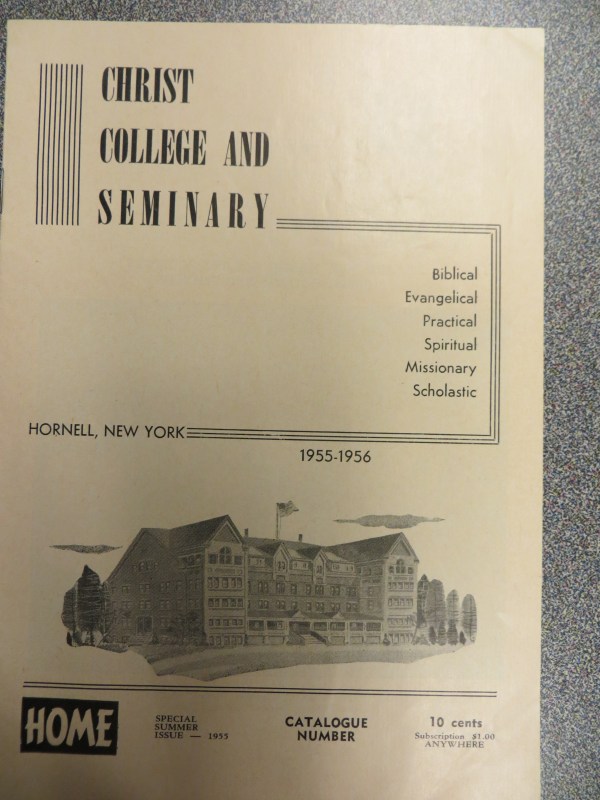
Nevertheless, rumors continued to circulate that Martin’s operation was nothing but a scam. Local fundamentalists denounced him, and secular journalists from Maclean’s magazine published a damning expose. Donations, the Maclean’s article described, didn’t fund gospel work but rather luxury cars and houses for Martin and his family.

That brings us, though, to the fundamentalist pickle. Since the 1920s, fundamentalists had warned one another that mainstream magazines such as Maclean’s were not to be trusted. After all, such magazines called ALL fundamentalists con men and scam artists. Even the most respected institutions such as Moody Bible Institute were not much respected outside of fundamentalist circles.

Some fundamentalist leaders tried to police their own ranks. Keenly aware of their responsibility to their fundamentalist readers, the editors of Sunday School Times interrogated Martin about his finances. In 1954, they demanded more information—detailed information—about Martin’s income and expenses. They demanded full disclosure.

Martin refused.

What could SST do about it? Not nothing, but not as much as editor Harry F. Jaeger hoped. In the world of American fundamentalism, Jaeger could not simply kick Martin out. There was no process for disbarment, excommunication, or banishment.

But SST and other fundamentalist institutions weren’t powerless. Jaeger sent a powerful message to the fundamentalist community by pulling Martin’s ads from SST. The magazine would no longer offer Martin its implicit endorsement. And Jaeger could and did use his influence to sway other fundamentalist leaders.

For example, he wrote to Moody Bible Institute president William Culbertson to warn him of Martin’s scams. Martin, after all, based his reputation largely on Martin’s record as an MBI alum. MBI should worry, Jaeger wrote, that its reputation was being abused. As Jaeger put it,

Under the circumstances, it seems to me that his work should not be presented to the Christian public for support.

What did MBI do? As usual in the world of American fundamentalism, they were extremely hesitant to condemn a fellow fundamentalist, especially if the evidence came mainly from secular critics. But they didn’t ignore the criticisms, either. To start, they stopped running Martin’s ads in Moody Monthly, in spite of Martin’s protests.
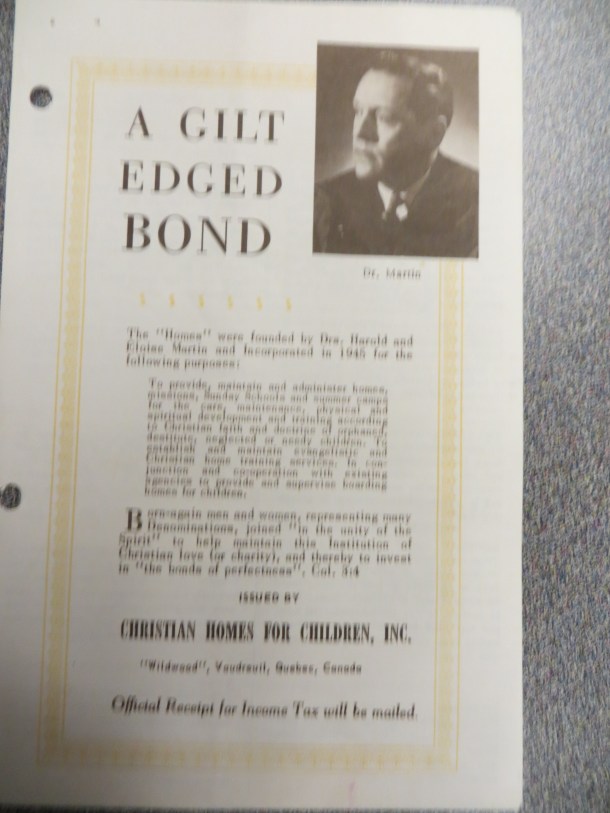
IMG_1888

Your money, please…

When fundamentalists wrote to MBI for assurance, though, MBI only gave them the run around. In 1963, for instance, one administrator wrote to an inquirer, saying he had “no firsthand knowledge of the organization.”  He noted that the popular magazine Maclean’s had just written a damning expose of Martin’s school.  MBI itself, however, was not sure “whether the article is fair or factual.”

The fundamentalist public, after all, had grown accustomed to unfair treatment at the hands of mainstream journalists. Was Martin merely being misrepresented by hostile secular and liberal critics, as he claimed? Or did he really take the money of well-meaning fundamentalist backers and buy himself fancy cars and houses, as his critics insisted?

There was no easy way for the fundamentalist community to know for sure. They relied almost exclusively on reputation. If Martin claimed to be part of the Moody Bible Institute alumni community, then he must be trustworthy…right?

Only years later, when local evangelical sources had corroborated the charges made by the Maclean’s reporter did MBI administrators begin sounding a more clearly negative note.  Even then, in 1968, MBI administrators did not actively denounce Martin and his fraudulent school.  Rather, they only responded to inquiries with batches of clippings about Martin’s depredations.

It made fundamentalists nervous. It was very difficult to tell who was really representing the fundamentalist movement and who wasn’t. Both legit schools and fakes would be denounced in the mainstream press as bogus. And established institutions such as Moody Bible Institute were extremely reluctant to expose anyone’s shady dealings.

Fundamentalism was built on a shaky structure—supported mainly by reputation and rumor. And this set-up made for predictable abuses. Scam artists like George Martin weren’t the exception, but rather a predictable result of the lack of any higher (human) authority in the world of twentieth-century fundamentalism.

From the Archives I: Extremism in the Defense of Bible Prophecy Is No Vice

Editor’s Note: I am happy to say that my book about the history of evangelical higher education has entered its final production stages. We are on track to release Fundamentalist U by January 1, 2018. The sad fact, though, is that so much great archival material got cut from the final draft. In this series, I’ll be sharing some of these too-good-too-lose gems from my work in the archives.

You may have heard it before. There is a myth circulating in nerd circles about the history of fundamentalism in the twentieth century. It’s not true and historians have punctured it convincingly. If we needed any more proof, the archives are full of evidence.

As the old story goes, fundamentalists were humiliated at the Scopes trial in 1925. They retreated in anger and disgust from participation in mainstream life, building up a network of inward-looking institutions such as colleges, church networks, and parachurch organizations. Then—depending on which version you hear—either Billy Graham in 1957 or Jerry Falwell in 1976 broke out of this self-imposed fundamentalist ghetto to leap back onto America’s center stage.

It’s hooey, as historians such as Matthew Sutton and Daniel K. Williams have shown. As Professor Sutton put it in American Apocalypse, the “rise-fall-rebirth” story just doesn’t match the historical record. Fundamentalists never retreated from political involvement or mainstream cultural engagement. In Sutton’s words, fundamentalists’

agenda was always about more than correct theology; it was also about reclaiming and then occupying American culture.

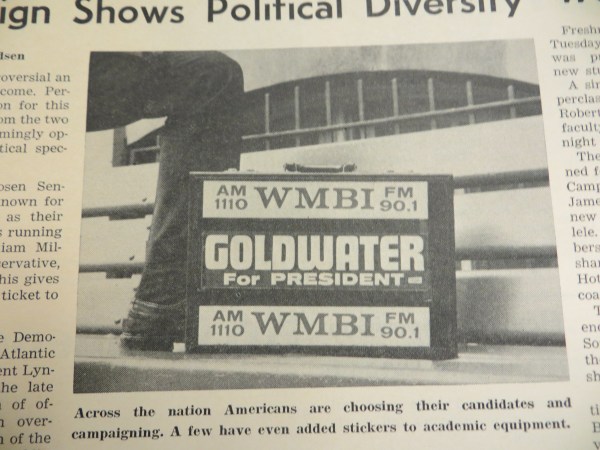
I’m making this argument in my book as well. Even at schools such as the Moody Bible Institute that were supposedly the most otherworldly, the most focused on Bible prophecy and the farthest removed from the nitty-gritty politics of the so-called “New Christian Right,” fundamentalists never withdrew from politics, never retreated from mainstream involvement. As this photo makes clear, in the 1960s MBI ardently engaged in partisan politics, pushing hard for a conservative Goldwater presidency.1964 WMBI and Goldwater

It wasn’t only in the 1960s, either. MBI’s leaders always fought in the political arena. Back in the 1920s, for example, President James M. Gray worried that MBI’s radio station had come under undue political pressure. What did Gray do? “The time for fighting has begun,” he warned. He used every weapon in reach to oppose the new radio regulations, including the Capitol-Hill influence of Missouri Senator James M. Reed.

Gray’s political activism was not the exception, it was the rule. No matter where you look in the archives, you see fundamentalists and neo-evangelicals fully engaged in mainstream politics. There was no retreat. There was no withdrawal. And, of course, that means Jerry Falwell’s 1970s leap into politics was not as ground-shaking as Falwell liked to say it was.

College Has Gone to the Dogs

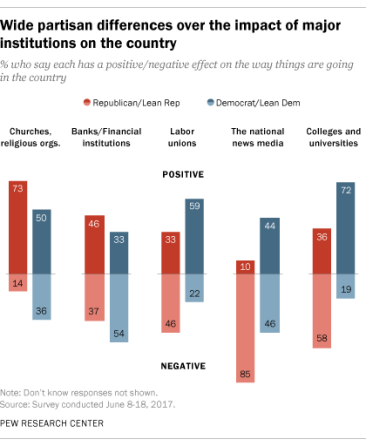
Who hates college? Nobody, really. But if you squinted your eyes a little when you read the recent Pew poll results, you might be fooled into thinking conservatives had suddenly turned against higher education.PP_17.06.30_institutions_lede_party

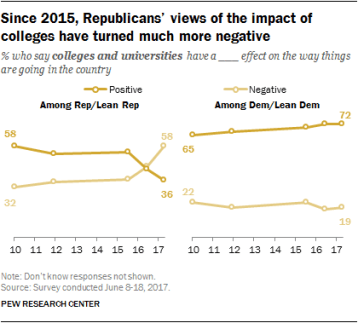
Here’s what we know: Since 2010, Pew has surveyed American adults about their feelings toward major institutions. In just the last few years, more and more respondents who identify as Republican or Republican-ish say that higher education is having a negative overall effect on American society. In 2010, only a third of Republicans thought so. Today, it is up to 58%.

What’s going on? As always, Pew wisely doesn’t jump to hasty conclusions. My guess is that many of us chatterers will rush to say that conservatives in general are anti-intellectual, or that conservatives think college is a waste of time. Or, given the sudden shift in numbers, maybe that conservatives are dismayed by the snowflake protests that seem to be sweeping American campuses.

Maybe, but I think there’s more to it.

First of all, obviously, we can’t equate “conservative” with “Republican.” True enough, these days most conservatives’ votes have been captured by the GOP. Not all, though. And certainly not all Republicans are conservatives.pp second graph

I think there’s also something more important going on. As SAGLRROILYBYGTH are sick of hearing, I’ve been up to my eyeballs for the past few years in research about American higher education. The group of conservative dissenting college founders I’m studying was often accused of being anti-intellectual and anti-college. They were neither.

As I’m arguing in my upcoming book, Protestant fundamentalists cared a lot about ideas and about college. They loved college. But if you only listened to their rhetoric, it would be easy to assume too quickly that they were somehow opposed to higher education.

Consider, for example, one apocryphal story that made the rounds among 1920s fundamentalist pundits. It was supposed to be a letter home from an evangelical college grad. As he supposedly told his mother,

My soul is a starving skeleton; my heart a petrified rock; my mind is poisoned and fickle as the wind, and my faith is as unstable as water. . . . I wish that I had never seen a college.  I hope you will warn the young men of the impending danger just ahead of them.

For fundamentalists in the 1920s, college was a terrible spiritual danger. But that didn’t mean they were against college. Rather, they were fervently against college done wrong. They were against the trends that they correctly perceived to be driving mainstream trends in higher ed.

What did they do? They didn’t stop sending their kids to college. Rather, they founded their own institutions, reliably fundamentalist colleges such as Bob Jones College (now Bob Jones University) and Bryan University (now Bryan College). They also flocked to existing reliably fundamentalist institutions such as Wheaton College and the Moody Bible Institute.

My hunch is that today’s Pew respondents are similar. When they tell pollsters they don’t trust college or “the media,” it doesn’t mean they don’t like higher education or newspapers. Rather, it means they don’t trust the smarmy elites that they think run such institutions.

Here’s what I wish I could do: Have the Pewsters add some follow-up questions. When people say they don’t trust colleges, ask them if they want their kids to go to college anyway. And then ask them what would restore their trust in higher education.

Here’s what I think people would say: Even if they don’t trust college, they want their children to attend. But they would prefer to find a school that reflected their own values, instead of the radical leftism that many people think dominates colleges today.

From the Archives: Klan Kollege

Higher ed can be exclusionary. For students who don’t have the funds for tuition or the money for SAT prep classes or the ability to focus on four (or more) years of post-secondary education, college has always been out of reach. At some schools, though, there has been another sinister reason why college was not for everyone. Scott Jaschik reports today in Inside Higher Education about the Ku Klux Klan konnections of Wesleyan College in Atlanta. It’s an important story, but they left out the most extraordinary part.

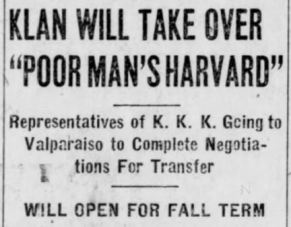
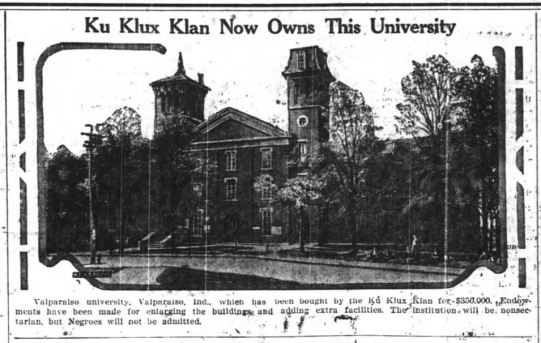
Wesleyan’s story has plenty of shockers. Students had been proudly affiliated with the Klan since the late 1800s, with sports teams sporting the name “Tri-Ks” until the 1990s. Students hazed one another in masks with nooses. The school didn’t admit an African-American student until 1968. But the story of Wesleyan is not the most intriguing story of the Ku Klux Klan in higher education. At the height of its influence, the “second” Klan in the 1920s made plans to purchase its own Klan Kollege.Daily-Republican-Rushville-IN-August-16-1923

A little background: The 1920s Klan was very different than its earlier and later incarnations. As I note in my book about educational conservatism, in the 1920s the Klan was still violent and racist, but it had much more mainstream credibility than later Klan groups.

During the 1920s, ambitious leader Hiram Evans planned to use the issue of education to bring together the millions of Klan members nationwide. As I’ve argued in an academic article, the plan was to mimic anti-immigrant mainstream educational ideas left over from World War I. Public schools, Evans believed, could be the tool to “Americanize” the nation.

fiery cross pic valpo

Spoke a little too soon…

At the height of its popularity, the 1920s Klan ran the states of Indiana and Oregon. They were enormously politically powerful. As part of their soaring ambition, they hoped to invest in the future by building their own university.

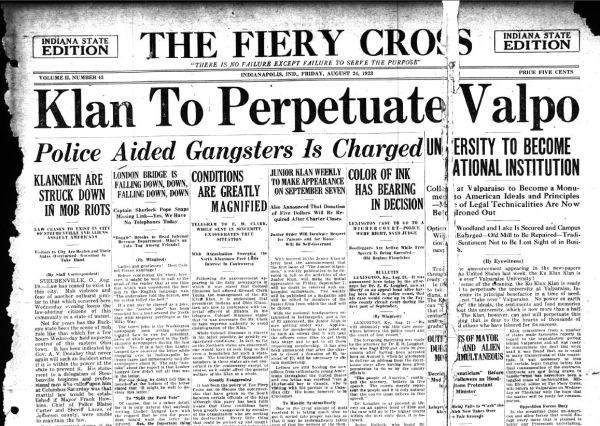
How? They proposed to purchase the financially strapped Valparaiso University in Indiana. It would become a dedicated Klan school, an institution that would teach the principles of Ku Kluxism, Indiana-style. Valpo would become the “Poor Man’s Harvard,” Klan leaders promised. The school would teach the anti-immigrant, anti-Catholic ideology of the 1920s Klan. As they explained in their Indiana newspaper,

Those un-American and alien forces that would disrupt every move that is planned to better any Protestant undertaking are busy stirring up strife and discord where possible in an attempt to block the project. The futility of such attempts, however, is realized when it is noted that whatever the Ku Klux Klan starts out to do, it always does. In this instance, the Klan has started out to make Valparaiso a great national institution; to make it a monument to American ideals and principles.

Fiery-Cross-August-24-1923

Big dreams of Klan Kollege

It didn’t work. Due to feuding between the powerful leader of the Indiana Klan and the national leadership in Atlanta, the money fell through at the last minute. It still shows, though, how higher education has always been central to America’s long-running culture wars. For the 1920s Klan to cement its role as a real leader in American culture, it wanted to have its own college. Other conservative groups–from fundamentalists to free-marketeers–have had more success.

Shut Up. No YOU Shut Up.

Is it really that simple? Do our current campus “free-speech” debates boil down to a simple shouting match? As we’ve seen, conservatives and progressives have both fought to defend speech they agree with. And both sides have a history of threats and intimidation against speech they don’t. In spite of these similarities, I can’t help but think the two sides are very different. Correct me if I’m wrong.

As SAGLRROILYBYGTH are well aware, conservative activists have lately pushed a spate of campus free-speech laws. They hope to force colleges to allow controversial conservative speakers and ideas.

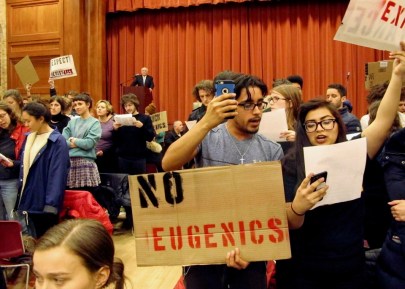
middlebury protesters

Shutting down Charles Murray at Middlebury

Some conservatives think that progressive activists have clamped down on free speech. They cite cases such as the recent hounding of Bret Weinstein at Evergreen State or the smack-down of Charles Murray on Middlebury’s campus.

We can’t forget, though, that conservative activists have also clamped down on progressive campus speech. Most recently, we see threats and attacks on John Eric Williams at Trinity (Connecticut) and Dana Cloud at Syracuse. Professor Williams had shared a provocative article about the recent shooting at a Congressional baseball practice. Cloud had called for more counter-protests against anti-Sharia protesters.

Sarah Bond twitter

…a different sort of thing.

They aren’t alone. Sarah Bond of the University of Iowa was harassed after she pointed out that most classical statues weren’t originally white. Tommy Curry of Texas A&M was attacked for talking about the history of anti-white violence.

We could go on:

In each case, conservatives attacked progressives for using racist, threatening, or violent speech. In each case, activists conducted campaigns to publicize, demonize, and criminalize professors’ speech.

So, in some ways, we’ve come to the old school-yard standoff. Both sides insist on free speech for their own views and both sides use violence and intimidation to shut off speech by their opponents.

We can take it even further. Both sides seem untroubled by the actual content of their opponents’ speech. At Middlebury, for example, progressive protesters seemed unaware of Charles Murray’s actual topic. And in Iowa, conservative protesters did not bother to read Professor Bond’s argument about historical whiteness.

Does that mean that the two sides are roughly equal? I don’t think so.

I might be confused by my own sympathies, but to my mind the two sides are very different. On one hand, we have student protesters on campuses shouting down speakers they find dangerous. At Middlebury, it descended into thuggery and violence. On the other hand, we have conservative legislators and online commentators hoping to earn points by publicizing the things progressive professors say.

Time after time, we see the same political blocs lining up: Progressive protesters pull from student ranks and shout down conservative speakers. They make their campuses unwelcome zones for conservative pundits. Conservative protesters line up lawmakers and online networks to fire professors, charge them with crimes, and threaten their physical safety, wherever they might be.

Those aren’t the same.

The political power—yes, including the potential of vigilante violence—of conservatives seems far higher. In short, I would rather be Professor Weinstein facing an angry crowd of unreasonable students than Professor Williams walking alone at night. Anonymous threats online against progressive professors scare me. Student protesters at an announced speech don’t.

I understand I’m biased. I sympathize with my fellow progressive professors and our activist students. Not that I think we are always right or free of dangerous tendencies, but the worst-case scenario of left-wing student violence seems far less dangerous than its opposite number.

From the other side, I’m swayed and intimidated by the enormous political power of conservative educational activists, both legally and outside the law. As I wrote in my recent book about twentieth-century educational conservatism, the vigilante violence in school controversies has always been dominated by conservative activists. From the Ku Klux Klan to the American Legion to Kanawha County’s extremists, the use of political violence has been most often the tool of the right.

From that perspective, it seems to me to be unfair to lump all anti-free-speech protests together. Yes, both sides are prone to frightening excesses. And yes, both sides seem willing to defend free speech only when they agree with it. But that doesn’t make them the same.

Free Speech Firestorm Jumps the Creationist Gap

Everyone supports free speech. But these days, academic “free speech” has become the latest creationist tactic to wedge creation-friendly science into schools. Mostly, that has been a K-12 effort, but it seems like creationist tactics have piggybacked their way into higher education.

The latest incarnation comes from the University of Wisconsin. Conservative lawmakers have promoted a bill to protect free speech on campus. To be fair, the conservatives who push Wisconsin’s bill insist that it has nothing to do with classroom topics, creationist or otherwise. The target, they insist, are leftist radicals who won’t allow conservative speakers on campus.

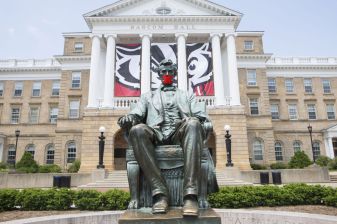
Wisconsin free speech

Let creationism ring?!!?!???

In Wisconsin’s case, the headline-grabbing incident was a talk by conservative pundit Ben Shapiro. In November 2016, Shapiro was shouted down for about twenty minutes before campus police kicked out the shouting protesters. Conservative lawmakers hope their bill will guarantee a balanced ideological environment; an infusion of conservative ideas on campus. The bill is patterned after other campus free-speech bills, inspired by the Goldwater Institute in Phoenix.

To this reporter, though, it seems like the current higher-ed furor over free speech has leaped the curricular gap. Here’s what I worry about: Campus free-speech efforts will be used to protect the “free speech” of creationists and other conservative folks locked out of mainstream science. Attempts to box out creationist ideas will be stymied.

Full disclosure: I can’t even pretend to be neutral on this one. I love my alma mater and I quake at the notion that lawmakers would pass any sort of law demanding or prohibiting certain forms of teaching. It’s not just an intellectual or political thing, either. If big granting organizations such as the National Science Foundation or the National Institutes of Health think UW is shackled by creationist science, they will be less likely to fund UW-based projects. Alumni will shy away from sending in donations. Students will be less likely to bring their tuition dollars. In short, the possible negative ramifications of a move like this could be huge.

But at this point, my dear SAGLRROILYBYGTH, you may be asking yourself a smart question: What does this conservative political move to welcome conservative speakers have to do with creationism?

First, the background: For years now, creationists have pushed for “academic freedom” bills in K-12 schools. The idea is to protect teachers and students from harassment or discrimination if they choose to voice their creationist ideas. Seattle’s Intelligent-Design mavens at Discovery Institute, for example, have offered the following language in their “academic-freedom” petition:

Teachers should be protected from being fired, harassed, intimidated, or discriminated against for objectively presenting the scientific strengths and weaknesses of Darwinian theory. Students should be protected from being harassed, intimidated, or discriminated against for expressing their views about the scientific strengths and weaknesses of Darwinian theory in an appropriate manner.

The idea is to mandate the intellectual rights of creationists in K-12 schools, to protect teachers and students from any sort of negative reaction to their zombie science. If successful, these bills put science education in a legal gray area. A school can’t insist on teaching mainstream science. Teachers can’t insist that students learn it.

We’ve seen glimmers of this sort of creationist “academic freedom” dispute in higher ed, too. Remember Eric Hedin at Ball State? He earned tenure after facing charges of preaching intelligent design. Or Mark Armitage at Cal State Northridge? He successfully sued after facing discrimination for his creationist publications.

The Wisconsin bill, however, introduces a new element to these creationist “academic freedom” battles in higher education. According to Madison’s Capital Times, the bill’s sponsor is a convinced young-earth creationist. His bill would create a Council on Free Expression. Creationist students who feel persecuted could file complaints with this Council.

In the give-and-take in the Wisconsin legislature, skeptical Representative Terese Berceau questioned Jesse Kremer, the bill’s sponsor, on this question. What if, Berceau asked, a student in a geology class argued that the earth was only 6,000 years old?

“Is it okay for the professor to tell them they’re wrong?” Berceau asked during the lengthy session on May 11.

“The earth is 6,000 years old,” Kremer offered.  “That’s a fact.”

Representative Kremer insisted the new law would not affect classroom discussions. But he affirmed that a creationist student—any student—who felt discriminated against could take his or her complaint to the Council on Free Expression.

Again, I know I’m not thinking clearly and calmly on this one. I’m nervous about the possible ramifications of Kremer’s bill and I’m likely to make creationist mountains out of conservative molehills.

Am I being overly paranoid? Or will conservative free-speech bills end up giving creationist students in college the ability to jam up the works of mainstream science classes? Will efforts to set up an intellectual preserve for conservative ideas on campus end up giving creationists more control over college classes? And, most important, will that new creationist influence stymie the mainstream science that usually goes on in Madison?

Are Evangelicals Unfit for Office?

Remember Larycia Hawkins? Senator Bernie Sanders does. In a recent hearing, Bernie suggested that a Wheaton College grad was unfit for office since he publicly supported his alma mater in its fight against Professor Hawkins.

During the recent presidential campaign, Candidate Sanders sounded friendlier to evangelical Protestants. He even ventured into the fundamentalist lion’s den, making a speech at Liberty University.

Down in Virginia, Bernie didn’t make a secret of his disagreement with conservative evangelical politics. But he did say some friendly things about Liberty, such as the following:

You are a school which tries to teach its students how to behave with decency and with honesty and how you can best relate to your fellow human beings, and I applaud you for trying to achieve those goals.

This week, Bernie wasn’t applauding. He suggested that any earnest evangelical was unfit for public office.

Before we get to his ferocious criticism of evangelicalism, let me say a few words of clarification: I like Bernie. I’m no evangelical myself. I’m just a mild-mannered historian who has written a book about the history of schools such as Wheaton and Liberty.

And maybe I’ve spent too much time in the archives of evangelical institutions, but Bernie’s recent accusation seemed pretty surprising to my ears. I’m at a loss to know how we should understand this situation.

Here’s what we know: according to Christianity Today, Senator Sanders was questioning Russell Vought in his hearing for his appointment in the Office of Management and Budget.

Vought is a Wheaton alum and had defended the school’s decision to initiate termination proceedings against tenured political science Professor Larycia Hawkins. Hawkins had sparked controversy by wearing hijab and asserting that Christians, Jews, and Muslims all worship the “same God.”

Vought disagreed. He applauded Wheaton’s firm stance. Only evangelical Christians, Vought wrote, can truly be saved. Only through the redemptive power of Jesus’s sacrifice can people come to God. As Vought put it bluntly,

Muslims do not simply have a deficient theology. They do not know God because they have rejected Jesus Christ his Son, and they stand condemned.

Bernie didn’t like it. He challenged Vought:

Are you suggesting that all of those people stand condemned? What about Jews? Do they stand condemned too? I understand that Christianity is the majority religion. But there are other people who have different religions in this country and around the world. In your judgment, do you think that people who are not Christians are going to be condemned?

It’s a pickle. For secular folks like me (and Bernie), Vought’s language seems pretty harsh. Is sounds as if he is damning to hell everyone who doesn’t agree with him. And, in a way, he is. But Vought’s belief is nothing radical. In fact, however, it is one of the central tenets of evangelical belief. The National Association of Evangelicals recently offered a four-point statement of basic evangelical belief:

  • The Bible is the highest authority for what I believe.

  • It is very important for me personally to encourage non-Christians to trust Jesus Christ as their Savior.

  • Jesus Christ’s death on the cross is the only sacrifice that could remove the penalty of my sin.

  • Only those who trust in Jesus Christ alone as their Savior receive God’s free gift of eternal salvation.

Some evangelical pundits were quick to lambaste Bernie. Russell Moore of the Southern Baptist Convention called Bernie “breathtakingly audacious and shockingly ignorant.” Senator Sanders, Moore charged, was trying to impose an utterly unconstitutional religious test for office.

I don’t know what to think. On the one hand, I agree with Bernie. Vought seemed to make his point in a particularly offensive way, using language calculated to seem harsh and intolerant. I don’t want public officials who see non-evangelicals as somehow inferior. And there are plenty of evangelicals who agree with me. Even at Wheaton, after all, plenty of earnest evangelicals decried the school’s decision to oust Professor Hawkins.

On the other hand, Vought’s statement was nothing but basic evangelical belief. Perhaps Vought said it more loudly than people like me find polite. But Vought and anyone else is perfectly free to think the rest of us are condemned. As a religious belief, that doesn’t do me any harm. In fact, however, I am no more offended by Vought’s belief that I am condemned than I am by scientologists’ notions that I am not “clear.”

What do you think? Is Bernie right to raise the red flag? Or should Vought and his comrades be free to voice their religious beliefs loudly and proudly?

Trump Makes Conservative College Dreams Come True

You can hear the cheering all the way from Michigan to Washington DC. The long-held dreams of Hillsdale College just might be coming true. This unique conservative institution has labored for 50+ years to become the premier intellectual training ground for American conservatism, and its influence in the Trump administration seems proof that it’s really happening.

hillsdale college

Take that, Harvard!

SAGLRROILYBYGTH are well aware of the Hillsdale story, but for those readers who aren’t, here it is in a nutshell: Back in the 1960s, the college dedicated itself to a self-consciously dissenting notion of conservative American higher education. Hillsdale is generally friendly to evangelical thinking, but it has never really been an integral part of the network of conservative evangelical schools I’m focusing on in my new book, Fundamentalist U. Some elements of its mission, though, are very similar.

Back in the early 1980s, for example, one of the fundamentalist schools I’m studying proclaimed its culture-war mission: In 1981, Liberty University’s Ed Hindson declared,

A few thousand highly committed and thoroughly trained young people, who were willing to put their Christianity to work in every sector of our society, could see America changed in our life time.

If you substitute “conservatism” for “Christianity” in Hindson’s sentence, you’d end up with something like what Hillsdale is looking for. Hillsdale’s newfound influence in the Trump administration seems proof that the plan is working, at least in part.

What does “conservative higher education” mean in Hillsdale, Michigan?

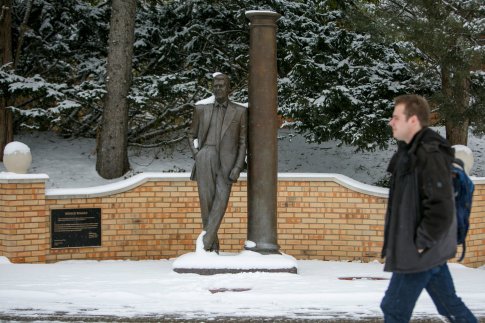
The school stridently refuses to accept any government funding. Its core curriculum teaches a traditional vision of the European canon, guided by “Judeo-Christian values.” Its campus proudly features statues of conservative heroes such as Margaret Thatcher and Ronald Reagan. The faculty have always welcomed leading conservative thinkers, including Russell Kirk back in the 1970s, and today’s superstar conservative-evangelical historian and public intellectual D. G. Hart.

hillsdale college reagan statue

The Gipper chillin on campus…

When your humble editor read this morning that Hillsdale President Larry Arnn is getting some rare and valuable one-on-one time with Secretary Betsy DeVos, we wondered just how far Hillsdale’s star had risen with the new administration.

Turns out, pretty far.

In all the hubbub-ery following Trump’s inauguration, we missed one story: Back in February, President Arnn claimed to be on a short list for DeVos’s job. And, according to the school newspaper, Hillsdale alumni filled some important roles in the Trump administration. Josh Venable (Class of 2002) became chief of staff in the Ed Department. David Morrell (2007) served as associate counsel to Trump. And two alums, Brittany Baldwin (2012) and Stephen Ford (2010) wrote speeches for the President and VP.

At least, they did back in February. In the current fast-changing White House, maybe they are out by now.

The bigger point, however, remains the same. Hillsdale’s dreams, like those of other conservative schools such as Liberty University, Patrick Henry College, and The King’s College, has long been to exert more influence in government and politics. Hillsdale doesn’t talk about the “Christian” part as much, but the goal is very similar.

Those of us who scratch our heads and wonder how any intellectual—progressive, conservative, or other—could support the clown-prince buffoonery of Trump would do well to appreciate the ways Trumpism is making long-held conservative dreams come true.

I Have a Date!

It wasn’t something I could say very often in high school…or in college…or throughout the 1990s, for that matter. But I can say it now: I’ve got a date! In this case, I only mean a publication date for my upcoming book, Fundamentalist U: Keeping the Faith in American Higher Education.

There’s still a lot to do. The copyeditor at Oxford will take a whack at my manuscript. Then she’ll send me a list of suggested changes and edits. I’ll give the whole thing the once-over and send it back. Then they produce proofs. At that stage, I will fine-tooth-comb the proofs, looking out for any typos. Most important—and most time-consuming—I will also prepare an index. It takes a lot of time, but with my second book I found indexing to be surprisingly satisfying intellectual endeavor.

So when will the new book hit the shelves? January 1, 2018.

At least, that’s our current plan. Things can happen and slow down the process, but if all goes well, the new year will have a new book for company.