Required Reading: Gloege on MBI

It’s not just a metaphor, not just a handy way of speaking. According to Timothy Gloege, fundamentalism acts like a business because it was founded like a business. In his terrific new book Guaranteed Pure: The Moody Bible Institute, Business, and the Making of Modern Evangelicalism, Gloege digs into the history of America’s premier Bible Institute to uncover the reasons for these tight connections. Along the way, he tells us a lot about the history of evangelicalism and of evangelical higher education.Gloege Guaranteed Pure
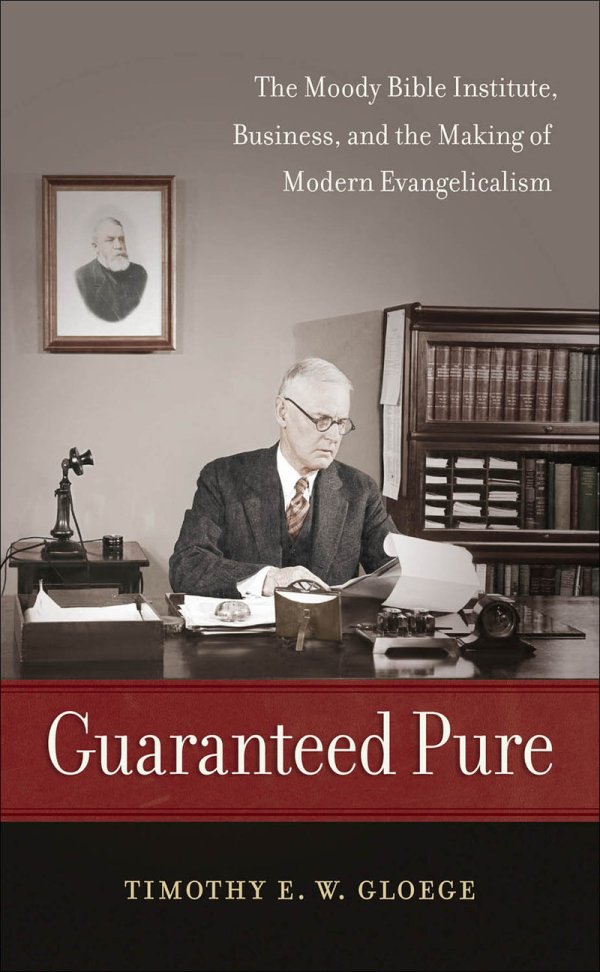
As SAGLRROILYBYGTH are sick of hearing, I’m up to my ears in writing my new book about fundamentalist/evangelical higher education. And Guaranteed Pure is the best book on the subject I’ve read in a long time.

For those in the know about evangelicalism and evangelical education, the centrality of MBI doesn’t need explaining. Started in the 1880s by Bible evangelists and their corporate backers, MBI became a juggernaut of publishing, broadcasting, and education. By the mid-twentieth century, MBI loomed large among evangelicals as a brick-and-mortar institution, a solid headquarters for a fundamentalist movement that often ran on shoestrings and prayers. As Gloege puts it near the end of his story (pg. 227), “It is difficult to think of an interwar fundamentalist that did not have or attempt to establish some connection to MBI.”

For those who are unfamiliar with these histories, Gloege’s book would be a great place to start. He offers vivid and fully realized portraits of central personalities such as Reuben Torrey. He fleshes out the complicated relationship between different types of conservative evangelicals around the turn of the twentieth century, from California Pentecostals to Minneapolis Fundamentalists and everything in between.

No matter how well you know these connections, you’re sure to find something enlightening in Guaranteed Pure. For example, Gloege offers the best history I’ve read of the emergence of The Fundamentals, a twelve-volume series of books that is often seen as the first articulation of emerging fundamentalism.

As Gloege recounts, the big-business ethos that emerged in the end of the 1800s did more than just set the tone for the founding of Moody Bible Institute. Rather, leaders such as Henry Crowell of Quaker Oats applied the same emerging modern attitudes toward marketing and profits to MBI as he did to oatmeal. That didn’t mean Crowell was cynical or insincere. Rather, it merely helps us make sense of the sometimes-strange career of early fundamentalism.

For example, every attempt to define early fundamentalism clearly quickly runs up against seemingly insuperable problems. Historian Matthew Sutton, for instance, in his recent book American Apocalypse offered a compelling definition. The thing that set radical evangelicals apart from other religious traditions, Sutton argued, was their overweening concern with the coming apocalypse. In Sutton’s words, it was “fundamentalists’ anticipation of the soon-coming apocalypse [that] made them who they were” (pg. 3).

True enough, but we quickly run into problems. There were leading intellectuals such as J. Gresham Machen who explicitly didn’t fit that label, yet who were considered—even by themselves—to be the brains of the fundamentalist impulse. And there were leading fundamentalist schools such as Bryan University (later Bryan College) that considered and rejected a statement about the coming premillennial apocalypse in their all-important creed.

Professor Sutton knows these things, but by asserting a theological definition on a wide-ranging movement he was forced to trim some edges here and there.

Gloege offers a way out of this pickle. Instead of giving us a rigid definition of fundamentalism, Gloege instead defines it in action. As he puts it (pg. 3),

Fundamentalism is often described in terms of manifestos and theological propositions. Yet at MBI at least, the life force of the movement was its corporate evangelical framework, which operated at a more foundational level. It functioned as a set of unexamined first principles—as common sense. Once developed, these principles became for conservative evangelicalism what the rules of grammar are to a conversation: something used rather than analyzed.

How could Machen be a fundamentalist intellectual if he hemmed and hawed about the fundamentalist movement? How could Bryan University be a fundamentalist school if it eschewed fundamentalist end-of-the-world theology?

Easy. They could be fundamentalists if everyone knew they were. They could be fundamentalists if it seemed like common sense to include them.

Gloege’s priceless contribution in terms of pinning this sort of definitional jello to the wall is not the only major contribution of his book. For those of us interested in evangelical higher ed, Gloege’s business context makes some things clear in new ways.

For example, evangelical colleges are famously anxious about the public image of their students. Depending on the decade, students were not allowed to smoke, drink, dance, or attend plays or movies. Even when they were not at school. Why? Because students were not seen as consumers of evangelical education, they were seen as its product. They were its advertisements, its guarantors of purity.

As Gloege describes, in the 1910s MBI published a painstakingly detailed student guide. Every aspect of student life was regulated, theoretically at least. Why was this so important? In Gloege’s words (pg. 159),

the students and faculty were themselves a form of promotion for the institute. MBI served as a sort of test kitchen demonstrating the effectiveness and purity of its message. No longer conceptualized primarily as workers learning on the job, students were treated as products of the Bible Institute.

Of course, such big-business thinking permeated all sorts of institutions at the time, not just MBI or evangelical colleges. As historian Roger Geiger argues in his new history of American higher education, not only MBI but all institutions of higher education were undergoing a transformative triple revolution during this same period.

Indeed, Gloege could easily have expanded his argument beyond the walls of the MBI. As I’m arguing in my new book, too, there’s no better way to make sense of fundamentalism and evangelicalism in the twentieth century than by uncovering the history of its most important institutions.
Ben Carson Wants Federal Control of Higher Education

If you’d like to be popular at a GOP event these days, don’t wear an Education Department lapel pin. As they have for decades now, conservative presidential candidates these days are falling all over themselves in their threats to eliminate the Education Department. But not Ben Carson! The uber-conservative neurosurgeon has something he wants the Ed Dept. to do.

SAGLRROILYBYGTH are tired of hearing this, but I’ve pointed out in my recent book and in the pages of Time.com that conservatives have not always hated the idea of federal influence in education. Back in the 1920s, cultural conservatives wanted the federal government to pump money into educational programs that would make America more conservative. Some conservative intellectuals these days have made similar noises—if the Ed Dept. can push conservative programs, some conservatives think, then conservatives need to get over their antipathy.

Dr. Ben Carson’s plan for the Ed Dept. goes even further. As he told Glenn Beck, Carson wants the federal government to seize control of higher education.

Here’s the plan: Carson hopes the Ed Dept. will “de-fund” colleges that ban conservative speakers. The department, Carson explained, should “monitor our institutions of higher education for extreme political bias and deny federal funding if it exists” [about 3:41 of the interview].

It’s not clear exactly what Dr. Carson thinks such defunding will mean. Nor can I tell how “extreme political bias” would be defined. But such quibbles largely miss the point.

For us at ILYBYGTH, the remarkable take-away from Carson’s candor is that he wants to assert sweeping new powers for the Education Department. This is a departure from both the past fifty years of mainstream conservative thinking and from the past hundred-fifty years of Seventh-day Adventist tradition.

Adventists, after all, have never been supporters of government power. Not even to push society in ways they might prefer. As liberal pundits have become eager to point out, Carson’s rhetoric about strong Americanism is a marked departure from SDA tradition. These days, Dr. Carson displays a weirdly non-SDA penchant for a powerful, intrusive government.

It’s certainly the case with Carson’s recent comments about the Education Department. I can’t imagine that SDA universities such as Loma Linda or Pacific Union College would endorse more federal control of their activities.

What Joe Biden Didn’t Mean to Say

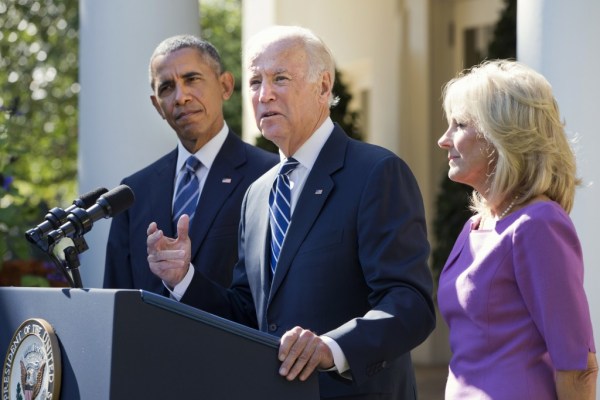
Unlike the GOP, the Democratic presidential hopefuls seem united about education policy, to the point of boringness.  In his promise not to join the race, however, VP Joe Biden made some odd historical claims about schooling.  Surely he didn’t mean to imply what my nerdy ears heard.

Say, it ain't so, Joe...

Say, it ain’t so, Joe…

The Democratic leaders seem to have rallied around the promise of free or reduced college tuition for all.  That was the point Vice President Biden made.  “We need to commit,” Biden intoned,

To 16 years of free public education for all our children.  We know that 12 years of public education is not enough.  As a nation, let’s make the same commitment to a college education today that we made to a high school education 100 years ago.

With apologies to the SAGLRROILYBYGTH, let me clarify at the outset: I am no Biden-basher.  I will be voting Democrat in the upcoming presidential election.  Guaranteed.

But that doesn’t mean that Democrats get a free pass to Stupid.  Let’s politely ignore for the moment Biden’s implication that students in the USA now receive 12 years of public education.  For most kids, the real number is thirteen years, including kindergarten.  In many states, it is fourteen years or more, including pre-k and preschool.  But let’s not focus on such details.

The real stumper in VP Biden’s claim is that the United States committed to free high school for all in or around 1915.  That just doesn’t fit, for two reasons.  First, the history of high school attendance and tuition is much more depressing and complicated than Biden implies.  Second, there is a much more obvious parallel that he and other leading Democrats could draw.  Why don’t they?

To take them one at a time: Every nerd knows that a majority of 14-17-year-olds did not begin attending high school until the 1930s, not the 1910s.  Moreover, most so-called “public” high schools—the line between “public” and “private” schools as we know them was vague—stopped charging tuition by the 1870s, not the 1910s.  As historian extraordinaire William J. Reese has demonstrated in his book The Origins of the American High School, the high school has had a long and jagged path from elite finishing school to mass institution.  There was no obvious transformation 100 years ago.

Here’s the worst part for Biden: The reason more kids began attending high school in the 1930s was depressingly obvious.  The Great Depression crushed the economy and squeezed the most vulnerable workers out of scarce jobs.  For young people, there was often no viable option outside of school.  I know Biden didn’t mean it, but his promise to revisit America’s commitment to high-schooling for all implies a desire to return America’s economy to the dumpster.

Nerds have another question for Democrats: Why don’t they make the more obvious parallel?  This great nation has a long history of free college tuition.  Some of the best of our public institutions began with free (ish) tuition for locals.  If we want to go back that far, The University of Pennsylvania was opened as a radical new vision of higher education, one that would be attainable to all.  Cornell University, too, promised that students could work their way through without worrying about tuition costs.

In more recent and relevant history, the University of California system—still home to our country’s most prestigious public universities—long promised a tuition-free education for residents.  The City College of New York, too, was built on the idea of free elite college educations.

Of course, students still paid in one way or another.  School was not absolutely free but rather a mish-mash of fees and living costs.

When they talk about free college, why don’t Democratic leaders talk about this history?  Maybe they do and I just haven’t paid close enough attention.  But in recent debates and speeches, Secretary Clinton, Senator Sanders, Governor O’Malley and now VP Biden all repeated this dream of free college as a new thing, an innovation, a shiny promise.

Why don’t they sell it instead for what it is: One of America’s most cherished traditions of higher education?

I have a hunch.  Democratic leaders don’t want to be seen as old-school leftists, rewarming the failed policies of the 1780s, 1860s, 1930s, or 1960s.  Instead, they want to appear to offer the public something new, something bold, something untried and remarkable.

I’m all for it.  My beloved university is not tuition-free for all, but it fulfills the promise of affordable public higher education for many of our students.  I believe in the American tradition of affordable and attainable higher education for those who want it.

But I also believe in learning from the past.

Time to Bury the Fundamentalist Hatchet?

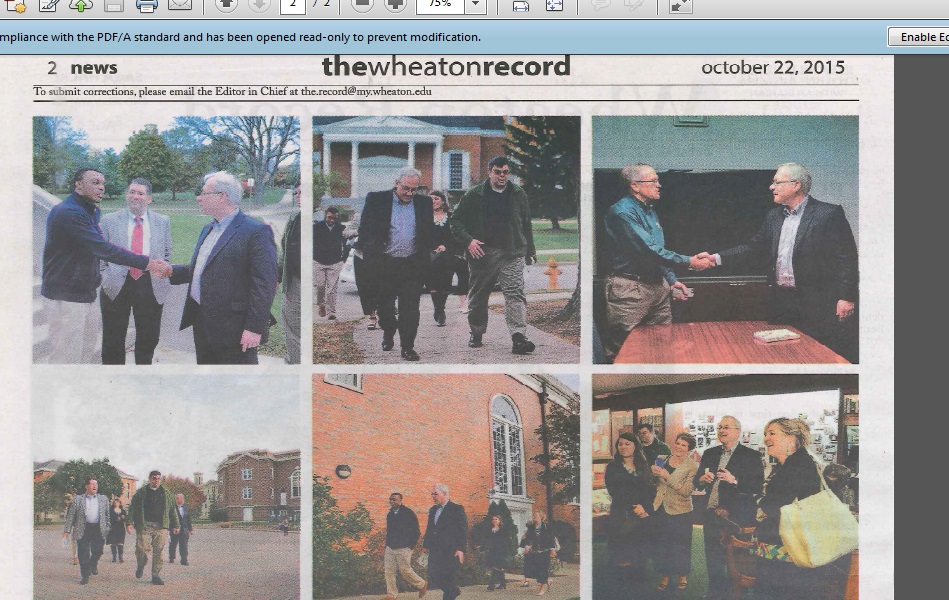
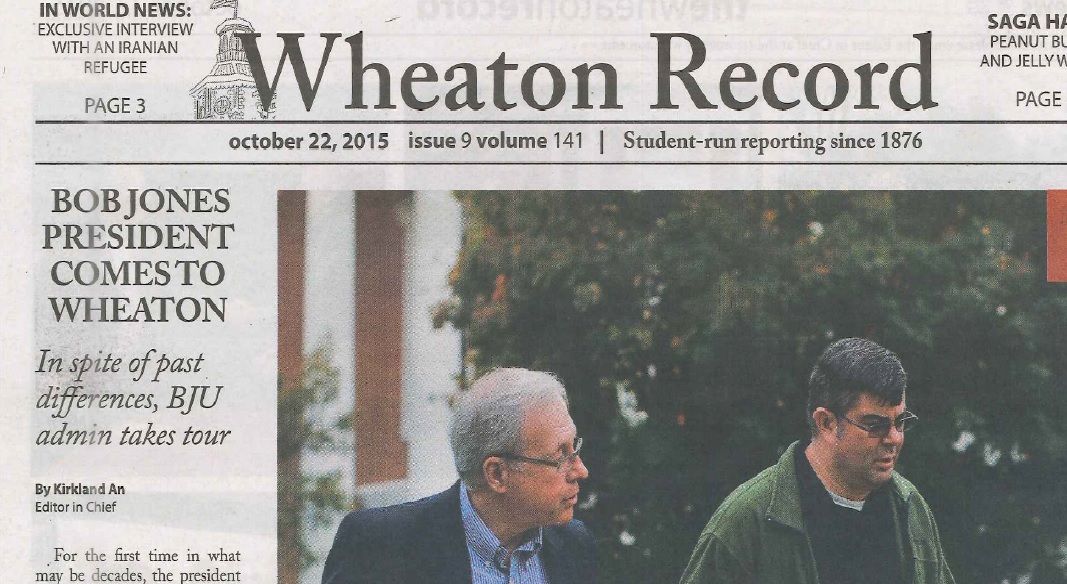
Maybe there’s hope for us all. In the world of evangelical higher education, the relationship between fundamentalist Bob Jones University and evangelical Wheaton College has always been a rocky one. According to a story in the Wheaton Record [sorry, not available online], last week BJU president Steve Pettit visited Wheaton’s campus, the first time a Jones leader has done so in a long time. There were smiles all around. Does this mean that the times they are a-changin?

Smiles, everyone, smiles...

Smiles, everyone, smiles…

For those who don’t know their history, last week’s visit may have seemed like no big deal. The leader of one evangelical college visited another evangelical college. What’s the big whoop? As I’m discovering in the research for my new book about the history of conservative evangelical higher education, this détente may signal an important shift in the worlds of fundamentalism and evangelicalism.

Since the beginning in the 1920s, leaders of the two schools fought viciously. BJU founder Bob Jones Sr. accused sitting Wheaton president J. Oliver Buswell of jealousy. Jones wrote,

Dr. Buswell and his field staff working under him were putting out propaganda everywhere that Bob Jones’ credits had no value and that we were misrepresenting facts when we told students that our graduates were admitted to leading graduate schools. . . . [Buswell is a] conceited, frustrated, ambitious, disappointed man.

Ouch. For his part, Buswell retorted that he had never said such things, had never been anything but friendly and helpful to Jones’s new school. What he had done, Buswell admitted, was protest against the sin-friendly policies at Bob Jones College. For those who don’t know their Wheaton history, it may come as a shock to find out that in the early days, Wheaton accused Bob Jones of not being fundamentalist enough. Wheaton’s President Buswell had critiqued Bob Jones’s new school in a review of a book of Jones’s sermons. The sermons themselves were first-rate, Buswell wrote.

But Dr. Jones, let me ask you a question or two. Your own educational program is reeking with theatricals and grand opera, which lead young people, as I know, and as you ought to know, into a worldly life of sin.

Double ouch.

Things never got much better from that point on. Bob Jones Jr., son of the founder and second president of Bob Jones University, told a story of his father’s traveling days. One time, Jones Sr. was on a train with some Wheaton students. One of the students, “trying to be very smart,” asked Jones how Bob Jones College could allow dramatic productions and still call itself fundamentalist. As Bob Jones Jr. explained,

Wheaton used to turn up their self-righteous noses at our drama, but they played inter-collegiate football, which we had had to give up at Bob Jones University because we found the people were betting on our games, littering our campus with whiskey bottles when they came out to see us play; and we found that inter-collegiate athletics were a definite blight to our spiritual lives.

By the 1970s, the relationship turned from one of frigid civility to outright hostility. In 1974, Bob Jones III officially changed the status of Wheaton in BJU’s internal coding system from “Friendly” to “Unfriendly.” Jones’s secretary explained the shift in an internal memo:

The above school or organization has been coded “F”; however, Dr. Bob III, has changed the code now to “U” to make our coding system more consistent. It has been a problem for some people because an organization or school would be coded “F” but we would treat them like “U” people.

From that point on, BJU officials would not even maintain their polite façade of cooperation with Wheaton officials. In 1977, an administrator from Wheaton wrote to Bob Jones III to ask for guidance in establishing a student drama program. He asked if Jones would offer some tips from its long experience with such programs. Through a secretary, Jones informed the Wheaton official, “because of the Neo-Orthodox position of Wheaton College, we are unable to give you the assistance you request.”

Pettit visits wheaton 2

No self-righteous noses here…

Given that protracted and ugly history, President Pettit’s visit to Wheaton’s campus seems revolutionary indeed.

Have things turned a corner? Does President Pettit’s visit really signal a thaw in this long evangelical cold war? Several signs point to yes.

First of all, Pettit is no Jones. For the first time in the history of BJU, the school is not led by a direct descendant of the founder. Maybe that gives Pettit a little more wiggle room to ignore family feuds.

Also, BJU is changing. It now claims accreditation as well as athletic teams. It has apologized for its history of racism.

Wheaton is changing, too. As did BJU in the 1970s and 1980s, Wheaton has tussled with the federal government. Just as BJU did in the 1980s, Wheaton insists that its religious beliefs must give it some leeway when it comes to federal rules.

If Wheaton sees itself pushed a little more out of the mainstream, and Bob Jones University pushes itself a little more toward that mainstream, they might just meet somewhere in the middle. There will always be some jealousy between these two giants of evangelical higher education, but it seems possible that the worst of the fundamentalist feud may have passed.

Why Didn’t They Talk about Schools?

There was plenty of talk. Senator Sanders admitted he was “sick and tired of hearing” about Secretary Clinton’s emails. Senator Webb jabbed Wall Street. Governor O’Malley championed the middle class. And Governor Chafee was also there. But nobody said anything about K-12 education. Why not?

There was some talk about higher education. Both Senator Sanders and Secretary Clinton insisted we need some way to relieve student debt loads, maybe with free college tuition. Governor O’Malley bragged about low tuition rates in his state.

But only Secretary Clinton mentioned early childhood education, saying offhand that every child needed it to live up to his or her “God-given potential.”

Seems odd. The Democratic Party, after all, is the party of both Head Start and Race To The Top. The Democrats’ Big Tent includes both “Test-Em-n-See” Arne Duncan and Curmudgucrat Peter Greene.

It seems in the high-stakes world of primary debates, these stark differences between leading Democratic voices would offer a chance for some lively back-and-forth on key issues. What should we do with the Common Core? How should teachers be evaluated? How do we know if a school is doing a good job?

We didn’t hear it.

Loudmouth education parvenu Campbell Brown calls it a conspiracy. The Democratic Party, she claims, is in the back pocket of the teachers’ unions. They don’t even dare RSVP to her debate invitation.

Peter Greene thinks the answer is even simpler: “when it comes to public education in this country, none of the candidates actually gives a shit.”

In The Atlantic, David Graham thought there was just nothing much to disagree about. “Overall,” Graham opined, “the Democratic candidates simply don’t have the same divisions that the Republicans one [sic] do.”

But none of those explanations makes sense. This sort of forum offers candidates a chance to grab attention. Clinton’s identification with the Obama administration makes her an easy target. Yet none of them took it.

Here in the Great State of New York, we’ve seen how protest candidates can and do win votes by blasting other Democrats. I’m stumped why none of these candidates—not even the fire-breathing Senator Sanders—took this opportunity to do so.

Here’s my hunch: In the fervent calculations of any serious presidential campaign, candidates must make careful bets about issues and positions. In the face of Mr. Greene’s assertion that the candidates don’t care, I think candidates will care about what they think voters will care about.

Why didn’t candidates make political hay about K-12 education? Because they thought it would not win them any votes. With their finely tuned political antennae, these leading candidates concluded that Democrats in general did not want to hear about it.

Compare that to the GOP, where every candidate is forced to pay lip service to creationism. Compare that to the GOP, where every candidate falls all over him- or herself to show off his or her penchant for “education reform.”

Leading Democrats, in contrast, don’t air their differences in public. Why not? I’m no cynic, but it seems obvious to me that all candidates have agreed implicitly that their differences will not give them a competitive advantage. In short, none of them is willing to bank on a groundswell of support for iconoclastic progressive educational notions.

HateMyProfessor.com

HT: JG

Can fundamentalist colleges trust their faculty? We see this week an unfortunate blow-up in the continuing saga of power struggles at Bryan College in Tennessee. Does this bitter squabble between president and faculty represent an inherent problem for conservative evangelical schools? The history of these colleges suggests something along those lines.

According to Chattanooga’s Times Free Press, Bryan President Stephen Livesay has doubled down on his fight for control. As we’ve documented in these pages, for the past few years the college has gone back and forth in its struggle, with faculty approving a no-confidence vote last spring, and members of the board resigning this past summer.

He said, he said, c. 1953

He said, he said, c. 1953

As SAGLRROILYBYGTH are sick of hearing, I’m up to my elbows in my new book about the twentieth-century history of conservative evangelical colleges. Time and again, administrators and trustees have demonstrated a deep distrust of their faculty.

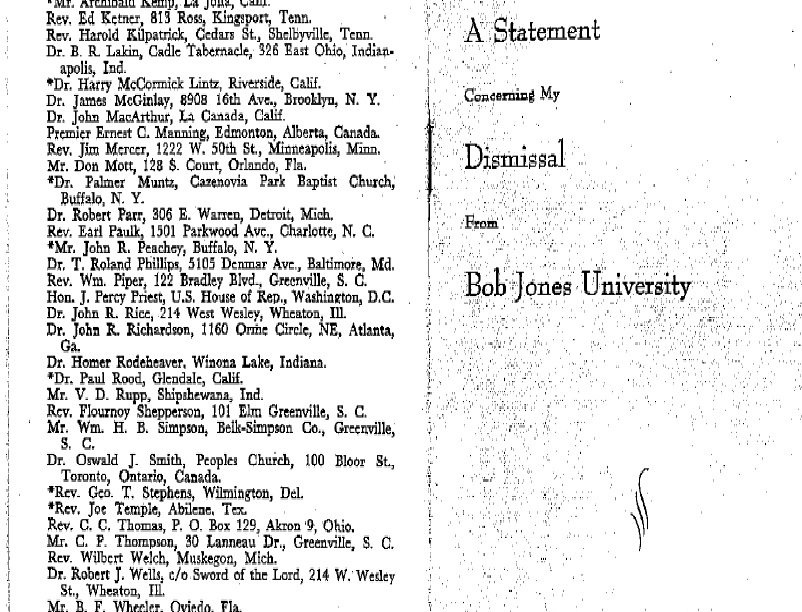
In the 1930s, for example, Bob Jones College purged a suspect group of teachers. One of the fired faculty, Joseph Free, penned a protest letter. He had previously worked at three different colleges, Free wrote,

two of them orthodox. (But not obnoxious.) My loyalty was never questioned. . . . It simply never occurred to me that I was not free to express my opinions and I did express them. How was I to know that loyalty meant dictatorship?

Perhaps more famously, this pattern was repeated at Bob Jones University in the 1950s. Ted Mercer was fired in the summer of 1953, accused of a host of crimes including planning a “revolt of many faculty members.” Mercer himself claimed to have been blindsided by his dismissal. Maybe he had become too popular with students and faculty. Perhaps Bob Jones Sr. was too zealous in his jealousy of other administrators. In any case, Mercer went on to a long career at Bryan College.

The abiding distrust of faculty at fundamentalist colleges has not been unique to Bryan and Bob Jones U. At Wheaton College as recently as 1961, faculty scientists were pressed into a needless and humiliating mea culpa. After a conference on evolution and creationism in 1960, anxious trustees forced Wheaton administrators to tighten the school’s official position on the origins of humanity. No longer would it suffice for faculty to agree that God created. Since 1961, they have had to affirm that Adam and Eve were real historical personages and the true parents of the species. Professor Russell Mixter had to affirm his orthodoxy over and over again in order to allay the fears of Wheaton’s guardians of orthodoxy.

Nor was Dr. Mixter’s ordeal out of the ordinary at Wheaton. As historian Michael S. Hamilton wrote in his brilliant 1994 study of Wheaton’s history, the board of trustees has always been distrustful of the faculty. In Hamilton’s words, trustees have believed “the faculty represented the single greatest danger to maintaining the college’s Christian character.”

As usual, Hamilton’s history proves prescient. According to the Times Free Press, new rules at Bryan College seem intended to crush any whisper of faculty independence. New rules restrict professors’ ability to call meetings, for example. As the TFP explains,

Under this new policy, a faculty member is required to go through a seven-step process that includes approval from the Academic Council, a written rationale stating the purpose of the meeting and a waiting period of at least a week.

This sort of contrived impotence may seem shocking to those unfamiliar with the unique traditions of fundamentalist higher education. Within that charmed circle, however, it seems like nothing more than a new take on an old tradition: When the going gets tough, the faculty get blamed.

Fundamentalist Colleges Save Lives

Maybe they were right. One of the hallmarks of conservative evangelical colleges has always been a clampdown on student behavior. The goal was to protect student morals, but a side benefit seems to have been protecting student health. A new study finds…surprise, surprise…that smoking pot and binge drinking lead to more risky sex among undergrads.

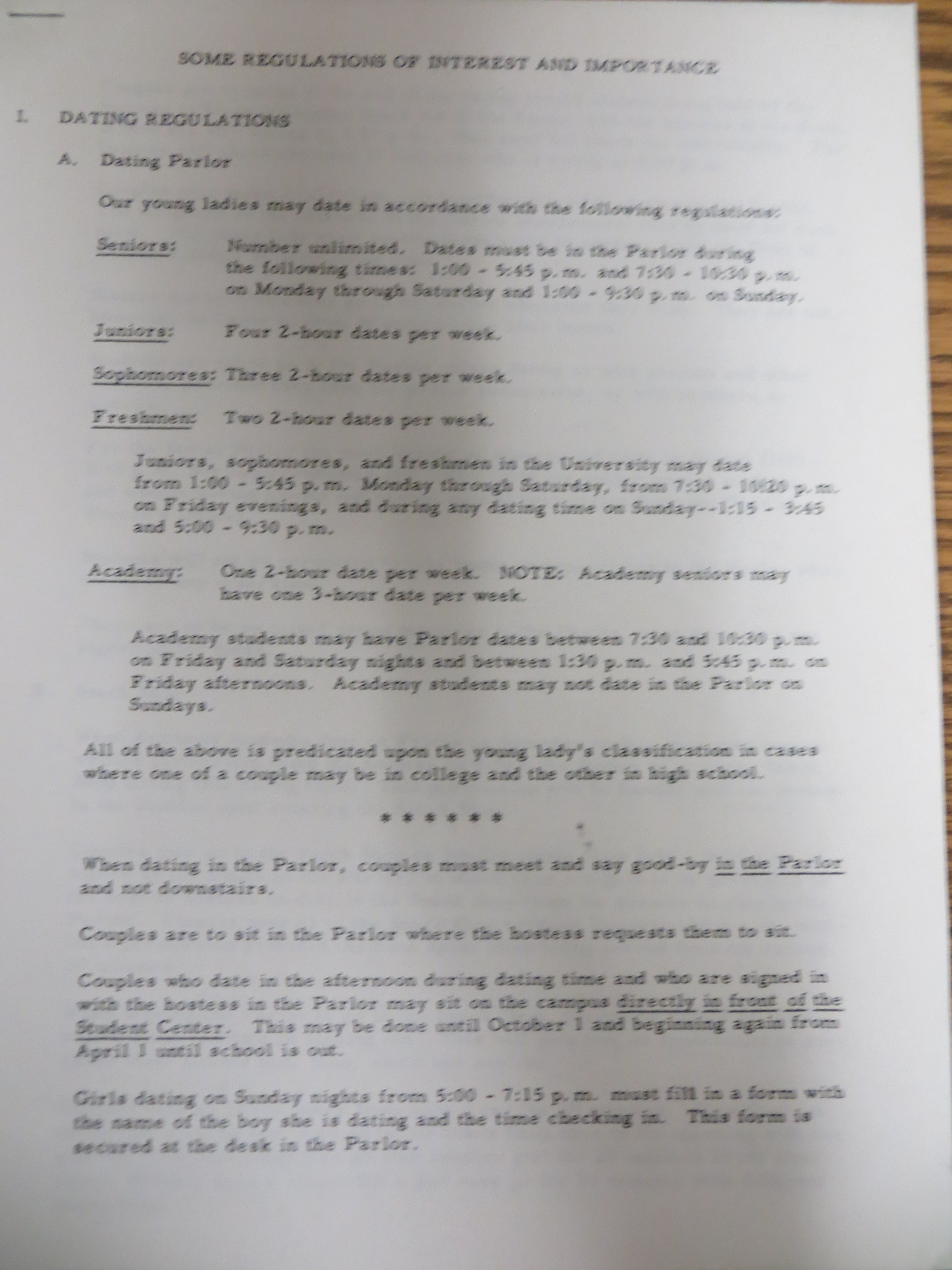
A hundred years ago, conservative evangelical Protestants reeled from the horror stories oozing out of America’s elite colleges. Fundamentalist preachers warned their flocks that colleges in the 1910s no longer protected students’ faith or morals. As a result, fundamentalists founded their own network of rigidly conservative schools. In addition to fundamentalist theology, all of these colleges adopted draconian rules for students: No smoking, no dancing, no drinking…and certainly no unmarried sex.

The view from 1931, Bob  Jones-style.

The view from 1931, Bob Jones-style.

As I work on my new book about the history of these schools, I’m struggling to make sense of these ubiquitous student rules. It’s easy enough to find the paper trail in the archives. At Bob Jones College, for example, founder Bob Jones Sr. placed the burden of avoiding sex on women.

Jones explained his thinking in an open letter from the 1920s:

The Bob Jones College discourages extravagance in dress AND INSISTS UPON MODESTY.

We request our girls to wear simple dresses in classes. We have a laundry where these dresses can be laundered.

The girls in the Bob Jones College voted to wear their dresses two inches below the knee cap. This is short enough for style and long enough for decency.

The girls in the Bob Jones College last year had the reputation of being the most attractive group of girls in the country, and as a whole, they dressed very simply.

There is one regulation which we wish our girls to thoroughly understand. WE DO NOT ALLOW OUR GIRLS TO WEAR EACH OTHERS CLOTHES. The only exception is in the case of sisters.

Bob Jones College was not alone in the effort to control sex by controlling women. One student who attended Wheaton College in the 1920s remembered a similarly strict regime of sexual policing. “Well,” this former student remembered in a 1984 interview,

The control was rather tight. Of course, that was in those days when . . . when the separation of the sexes was very strict, and the . . . the regulations were . . . dress regulations and so forth were quite strict.

Did students find ways to get around these rules? Of course. It’s harder to find, but as I delve into the archives of these colleges I find examples of students being punished for drinking, smoking, attending movies, and, of course, hooking up. One student at Bob Jones College was caught climbing out of his girlfriend’s dorm window at midnight. He said they had been praying together. A student at Wheaton remembered his roommate speaking to his girlfriend through a system of prison wall-taps.

All in all, though, the draconian system of student rules meant a different campus experience than at non-fundamentalist colleges. Over the years, the rules have loosened up, but they remain more restrictive than at other schools.

What has been the result? On the one hand, the system of sexual policing seems to pushed sex on campus into dangerous and degrading directions. Bob Jones University, for example, admitted its terrible and terrifying record of ignoring and even tacitly encouraging sexual abuse and victimization.

But we can’t help but think that stricter rules against drugs and alcohol must do something to protect students, as well. Don’t get me wrong: I’m no apologist for evangelical universities. I’m not evangelical myself; I don’t work at an evangelical college; I don’t dream of a school in which students don’t use drugs or have sex.

However, there seems to be demonstrable evidence that drinking and using drugs leads to risky behaviors. The researchers at Oregon State found direct connections between smoking pot, binge drinking, and unhealthy sexual practices. Students who used more drugs on any given day were more likely to have sex without a condom, for example.

The stricter rules about drugs and sex at evangelical colleges were put in place to protect student morals, not their health. As I’ve argued before, if we want to understand conservative attitudes about sex, we need to shift out of the medical mindset. However, perhaps there has been a positive side-effect.

I would love to see a study like this in which researchers looked at student behavior at a variety of schools. Did school rules against booze and sex discourage risky behaviors? Or did the added illicitness simply push students to take more risks?

Creation College Scorecard

How can you do it? How can outsiders push colleges to do more of what they want? The rage these days is to issue rankings. Since colleges are ferociously competitive and many of them are teetering on the brink of insolvency, college leaders are willing to do what it takes to move their colleges up any ranked list. Everyone from President Obama to young-earth impresario Ken Ham is issuing their own unique college scorecards.

Whom can a creationist trust?

Whom can a creationist trust?

In each case, influential outsiders promise that their scorecards offer students and parents a helping hand. President Obama, for example, insisted that his new scorecard was “meant to help students and parents identify which schools provide the biggest bang for your buck.” Ken Ham, too, promises that his Answers In Genesis ministry now has

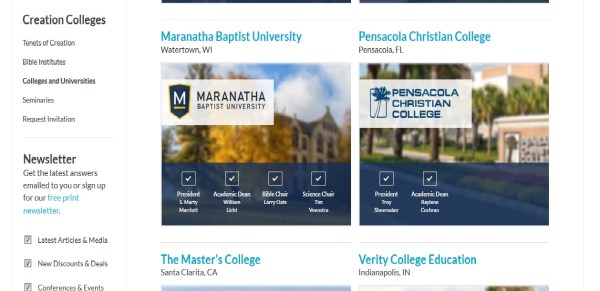
resources to help young people (and their parents) with the upcoming college years. In addition to our annual College Expo weekend for students thinking about attending a Christian college (which will be here at the Creation Museum this November 6 and 7), we have just updated our special CreationColleges.org web site. It helps young people (and parents) narrow the overwhelming process of choosing a college even more.

These scorecards, though, do more than just provide information. They pressure schools to move in a certain direction. If college presidents want to move their schools up the list of rankings, they will make changes based on the scorecard’s values.

And college presidents DO want to move their schools up the rankings. Any rankings. Colleges and universities these days are locked in a death-struggle for students and tuition dollars. If they can’t attract ever-increasing numbers of applicants, they won’t survive.

President Obama wants schools to pay more attention to student finances. His recent scorecard compares schools based on their financial performance: How much do average graduates earn? How much debt to students accumulate?

Ken Ham is playing the same game. His recently updated Creation College guide offers families information about the ways colleges measure up to Ham’s definition of creationist orthodoxy. Students can see if a school teaches young-earth creationism. They can also see if the president has agreed, and if other key leaders in the Bible and Science Departments have signed on.

Clearly, some conservative evangelical colleges will be tempted to do whatever it takes to get Mr. Ham’s stamp of approval. Some, like Bryan College, have already tightened their statements of faith and pushed out controversial teachers. Others will consider making similar moves.

Don’t like it?  Then why not try putting together a college scorecard of your own?  You could rank colleges based on whatever criteria you choose.  What are the most Benedict-Option-friendly colleges?  What are the most progressive colleges?  What colleges are the best for teaching evolutionary science?  Etc.!

The Handwriting on the Wall for Christian Colleges

It doesn’t look good.

For small colleges of any sort, the future looks grim. A new report from Moody’s (the investor service, not the Bible institute) offers some scary predictions about the iffy future of small schools. For conservative evangelical colleges, however, this looming financial crisis also represents a uniquely religious crisis. Will small evangelical colleges be able to resist the growing pressure to become more radical in their orthodoxy?

Look out, Daniel!

Look out, Danny!

Inside Higher Education describes the sobering financial outlook. In the next few years, college closings will likely triple. Why? Fewer students means fewer tuition dollars, which means fewer scholarship dollars, which means fewer students. Rinse and repeat.

Among conservative evangelical schools, we’ve already seen the trend. Former evangelical schools such as Northland University, Tennessee Temple, and Clearwater Christian have all closed their doors. In some cases, the “Wal-Marts” of Christian colleges have emerged even stronger. Cedarville University, for example, has offered to accept all students from Clearwater Christian. As with non-evangelical schools, the big will likely get bigger and the small will get gone.

For small evangelical colleges, this presents a double pickle. In desperate need of more students, schools will likely become extra-timid about offending conservative parents and pundits. As I’ve argued before, young-earth impresarios such as Ken Ham already exert outsize influence on college curricula. If Ham publicly denounces a college—which he likes to do—you can bet young-earth creationist parents might listen.

We’ve seen it happen at Bryan College. Rumors of evolution-friendly professors caused administrators to crack down. Any whiff of evolutionary heterodoxy, and schools might scare away potential creationist students.

At other evangelical colleges, too, as we’ve already seen in schools such as Mid-America Nazarene or Northwest Nazarene, administrators desperate for tuition dollars will be tempted to insist on a more rigidly orthodox reputation.

Things aren’t looking good for small colleges in general. But conservative evangelical schools face this special burden. In order to attract the largest possible number of students in their niche, they might have to emphasize more firmly the things that make them stand out from public schools. In the case of conservative evangelical schools, that distinctive element has always been orthodoxy.

In the past, well-known schools such as Bryan College might have relied on their long history as staunchly conservative institutions. They might have assumed that conservative evangelical parents would trust their orthodoxy, based on their long-held reputation as a bastion of conservative evangelical education. These days, no-holds-barred competition for students will mean that every school must guard its image far more aggressively.

Can a College Be Christian?

After Ben Carson’s stupid and hateful comment that the USA should not have a Muslim president, Baylor theologian Roger Olson noted that we really could not have a Christian president, either. In my current work about evangelical colleges, I’m struggling to define what it meant to be Christian at school, too. It raises an ancient question: Can an other-worldly religion (successfully) run worldly institutions?

Olson noted that the only sincere evangelical to sit in the Oval Office in recent decades has been Jimmy Carter. And Carter, Olson argued, was a terrible president. Not by accident, either, but because he was an honest-to-goodness Christian. As Olson put it,

I am not cynical, but neither am I naïve. America is no longer a true democracy; it is run by corporations and the super-rich elite. Occasionally they don’t get their way, but, for the most part, they do. One reason they do not seem to is that they do not agree among themselves about everything. So, sometimes, a president, a senator, a congressman, has to choose between them in decision-making. But, in the end, the policy remains that “What’s good for business is good for America” even when what’s good for business is bad for the working poor (to say nothing of the destitute).

No, given how modern nation states work, I do not think a real Christian, a true disciple of Jesus Christ who seeks to put first the kingdom of God and God’s righteousness, can be president of the United States or any modern nation state.

The deeper question of belief and institutional necessity is one I’m wrestling with these days. As I write my new book about the history of evangelical higher education, I find myself struggling to offer a satisfactory definition of what it has meant to be a fundamentalist. It’s a question that has bedeviled historians (and fundamentalists) for a good long while, so I feel I’m in good company.

For good reasons, historians have insisted that we need a fairly narrow definition of fundamentalism. In his great book Revive Us Again, Joel Carpenter argued, “more generic usage obscures more than it illumines” (page 4). Carpenter was leery of commentators who slapped a “fundamentalist” label on any and all conservatives or conservative Protestants. As he argued,

Labelling movements, sects, and traditions such as the Pentecostals, Mennonites, Seventh-day Adventists, Missouri Synod Lutherans, Jehovah’s Witnesses, Churches of Christ, black Baptists, Mormons, Southern Baptists, and holiness Wesleyans as fundamentalists belittles their great diversity and violates their unique identities (4).

If we need a straightforward definition for those reasons, Matthew Sutton’s recent definition of fundamentalism as “radical apocalyptic evangelicalism” will do the trick. Certainly, fundamentalist theology was defined by its vision of end-times as well as by the centrality of those apocalyptic visions to the movement.

But such definitions don’t seem to match the ways fundamentalism has been defined in its leading institutions. At the colleges I’m studying—schools such as Wheaton College, Bob Jones University, Bryan College, Biola University, The King’s College, and similar schools—there’s more to the school than just theology.

When these schools called themselves “fundamentalist” (and they DID, even relatively liberal schools such as Wheaton), they meant more than theology. They meant more than just “radical apocalyptic evangelicalism.” They meant more than just “not-Mennonite-or-Pentecostal.”

Defining fundamentalism as it was used in fundamentalist institutions is a trickier issue than simply defining fundamentalist theology. By and large, when schools talked about themselves as “fundamentalist,” they meant that the professors and administration all signed on to fundamentalist theology. But they also meant that the students would have a vaguely conservative atmosphere in which to study. No smoking, no dancing, no etc. They also meant that students would be controlled and guided in their life choices. And they also meant that students would be more likely to socialize with similarly fundamentalist friends and future spouses.

I’m not sure how to define that kind of fundamentalism. I like the way historian Timothy Gloege has done it in his new book about the Moody Bible Institute. Gloege focuses on what he calls the “corporate evangelical framework” that guided MBI since its founding in the 19th century.

What did fundamentalism mean in Chicago?

What did fundamentalism mean in Chicago?

As Gloege argues, at a school like MBI, fundamentalism was more than a set of “manifestos and theological propositions.” Rather, it worked as a set of “unexamined first principles—as common sense.” Fundamentalism, Gloege writes, is better understood as a certain “grammar” than as a list of religious beliefs.

That kind of definition seems closer to the ways it was used in the schools I’m studying.

Roger E. Olson argues that it will be impossible for any sincere evangelical Christian to be president. There are simply too many worldly factors that violate the otherworldly morality of Christianity. Similarly, evangelical colleges have not defined themselves merely along theological lines. They couldn’t. Instead, they have defined what it has meant to be a “fundamentalist” based on a range of factors. Of course, they care about student religious belief. But they also care about student fashions, patriotism, diets, and social lives. And such things were usually considered a central part of making a school authentically “fundamentalist.”

Can a college be Christian? In the sense that Roger E. Olson is asking, I guess not. Just as every president has to violate evangelical morality, so every institution of higher education has to consider a range of non-religious factors in order to survive.