Government Pretends Conservative Schools Don’t Exist

To be fair, it goes both ways. As I’ve argued here, there, and everywhere, conservative intellectuals have long disputed the influence of the federal government in education. Now, President Obama jabs back: A new college scorecard simply left leading conservative schools off its list. The message is clear, and creepy even for non-conservatives like me.

In President Obama’s release of the new guide to colleges two weeks ago, he promised,

Americans will now have access to reliable data on every institution of higher education.

EVERY institution. If you don’t see a school on the list, it doesn’t exist.

Except they do. And the ones that were left off have glaring similarities. All of them are robustly conservative schools. Schools such as Grove City College in Pennsylvania, Hillsdale College in Michigan, Christendom College in Virginia, New Saint Andrews College in Idaho, and Wyoming Catholic College.head-in-sand

The schools were left off because they refuse to accept federal dollars for their students. Because of that, they do not have to file student data with the federal government. Because of that, the feds don’t have the information they need to put these schools on the scorecard.

Naturally, the schools themselves didn’t like it. According to the Washington Post, Paul McNulty of Grove City College issued the following statement:

However well-intentioned, the Scorecard as it exists now is incomplete and does not fully disclose comprehensive data that families need to make informed decisions. For now, the Department should, at the very least, include a disclaimer that the Scorecard is not comprehensive or reflective of all college and universities.

Hillsdale College had it worse. When the student newspaper inquired as to why Hillsdale was left off the list, it was told that the school granted a plurality of certificates, not degrees. Hillsdale told Fox News that it just wasn’t true. Hillsdale students are almost all in degree programs.

I’m no conservative, but I think these schools have every right to complain. To my mind, the creepy part of this story comes on two different levels.

First, I worry about any ranking of higher education based mainly on economic factors. I don’t think anyone intended for this scorecard to be the only measure of educational quality, but President Obama made no secret of the values inherent in this scorecard. As he put it,

You’ll be able to see how much each school’s graduates earn, how much debt they graduate with, and what percentage of a school’s students can pay back their loans…

That’s helpful information, but I don’t like the implication that such factors are the proper way to measure higher education. Even worse, any scorecard that claims to rank all colleges really should. By leaving out conservative schools who have not played ball with the federal government, this scorecard seems to be making a crude power play.

Again, I don’t agree with the guiding philosophies of any of these schools, but I think they have every right to be included in any list of “every” college out there.

Progressive Microaggressions

HT: DK

Are we progressive professors guilty of our own species of microaggression? Fredrik deBoer says yes.

DeBoer teaches at Purdue and blogs about culture and higher ed. In a recent post, deBoer worried that his progressive colleagues seem strangely willing to mock and belittle their conservative students. Not in the classroom. In spite of conservative laments about overt professorial hostility, deBoer claims that most left-leaning faculty “are so sensitive to the impression that they’re biased against their conservative students that they bend over backwards to accommodate them.”

But deBoer accuses his allies of a curious blind spot. They tend to mock conservative students on Facebook and other social-media outlets. DeBoer comes to the smart conclusion:

People are really, really invested in consistency and fairness. And if academics don’t make a huge improvement in projecting them, they will be the razor with which our throats are slit.

He’s referring to two particular recent episodes. At Duke, some conservative students protested against a leftist summer reading assignment. At North Carolina, a student accused the school of coddling terrorists.

As deBoer reports,

many academics I know have reflexively, unthinkingly laughed off these conservative complaints. They’ve bombarded social media with “lols” and “wtfs.” They’ve mocked these students as rubes. They’ve given every outward appearance of not even attempting to evaluate these students’ claims with the same care, sensitivity, and fairness that they evaluate the claims of progressive students invoking the language of trauma and triggers. In other words, they’ve rushed to confirm every complaint conservative critics of the academy have made, and the most damning one in particular: that we treat our progressive students with more kindness and approval than our conservative students, and that we use the formal procedures of the university to do it.

I wholeheartedly agree with Dr. DeBoer’s warnings, but I think he could take it one step farther. Not only do my fellow progressive academics tend to assume too much about their campuses and their social-media worlds, but they do so out of a woeful and widespread ignorance. Some of us assume that young people will somehow naturally sympathize with left-leaning ideas. We couldn’t be more wrong.

If the campaign against microaggressions has any moral heft, it is because it is at heart a campaign against ignorance. Yet as sociologists such as Elaine Howard Ecklund have argued, many scholars display shocking ignorance about their own students.

Even if we progressive professors are polite to our conservative students, are we guilty of microaggressions that only the students themselves notice? Do we betray our own ideals by failing to learn more about our students’ backgrounds? Are there things we don’t even notice about our classes that might make conservative students feel unwelcome?

Why Do People Go to College?

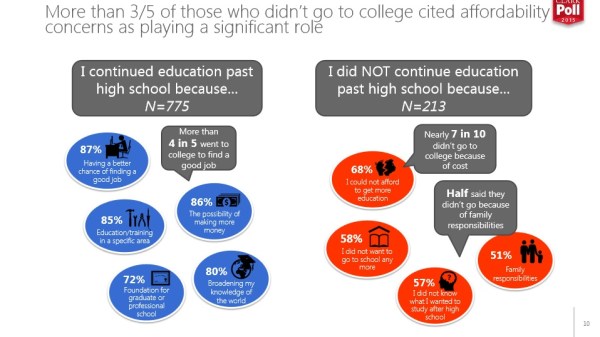
Do young people go to college to become better people? Or to earn more money? The obvious answer, it seems, is “Yes.” A new poll from Clark University suggests that most young college graduates went to school for both economic and mind-expanding reasons.

What do you wanna do with your life?

What do you wanna do with your life?

Jeffrey Jensen Arnett and his colleagues at the storied Clark University polled 1,000 adults between the ages of 21-29. The results confirmed the argument of historian Roger Geiger, who concluded that attending college has always been about “knowledge, careers, and culture.”

Large majorities of respondents wanted a better economic future. But they also wanted to increase their “knowledge of the world.” And, of course, many of the bolder respondents admitted that they were attracted by “the potential to have fun.”

Polls like this provide yet more evidence that the death of the humanities has been greatly exaggerated. As smart people have pointed out, people still go to college for more than pecuniary reasons. Young people still want to have their minds blown. College students certainly hope their degree will help them make more money, but that’s not the only reason they go to college.

Are Schools Guilty in Sexual Assault Cases?

It is a sobering question to ask: Do schools—all schools—put kids in danger? Another terrifying news story of rape at school demonstrates the point. Because schools take authority over young people, because schools put young people together, because schools necessarily put students in close private contact with peers, coaches, and teachers, schools of all sorts become the arena for rape, assault, and abuse. No type of school seems immune, but each type of school has its own unique blend of dangerous cultural components.

Exception?  Or rule?

Exception? Or rule?

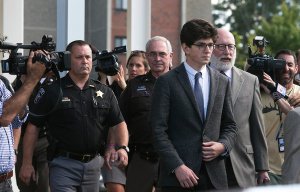
The story of Owen Labrie at the elite St. Paul’s School in New Hampshire proves that parents can’t buy themselves out of this dilemma. Labrie was accused of participating in a tradition of a “senior salute,” in which students target younger students for sexual conquests.

Before we look more closely at the Labrie case, though, we need to ask some uncomfortable questions:

  • Do all schools inadvertently support rape culture?
  • Is there no way to protect vulnerable young people?
  • Does the culture of school push administrators to downplay the sexual dangers of their institutions?

In recent years, I’ve been exploring the troubled history of evangelical colleges and universities. As we’ve explored in these pages, such schools have a history of sweeping cases of sexual assault under the rug. At some of the more conservative schools, loyalty to the administration has trumped care for victims of assault and abuse.

But such schools are not alone. Though I’ve been accused of ignorance and insensitivity for pointing this out, secular and pluralist colleges also have a terrible record of ignoring sexual crimes on their campuses.

What’s worse, these things are not incidental or accidental. The history and culture of these schools contributes directly to the atmosphere of sexual aggression. In some schools, for example, football coaches and players have been elevated to godlike status. They have been protected from punishment for terrible crimes. At other schools, administrators pointedly ignore an alcohol-soaked “party culture” that attracts students but leaves them woefully vulnerable to assault and abuse.

As the recent case at St. Paul’s School shows, even the fanciest private prep schools haven’t avoided this dilemma. Though the school has denied it, some involved parties have accused St. Paul’s of fostering a culture of entitlement, a culture of callous arrogance, which turned vulnerable students into sexual targets.

Both sides agree that Owen Labrie and a younger student met on a school rooftop. They engaged in some kissing at first. Then the sexual activity escalated. The victim accused Labrie of ignoring her repeated attempts to stop. Labrie denied that they had had vaginal intercourse and denied that the victim had said “no.” The jury seems to have split, acquitting Labrie of the most serious felony rape charges but convicting him of several counts of electronic predation.

Who is guilty here? The victim’s family charged that the school “allowed and fostered a toxic culture that left our daughter and other students at risk to sexual violence.” As the New York Times reported, even Labrie’s defense accused the school of creating “an educational haven with a troubling culture of sex, entitlement and misogyny.”

Is the school culpable? Even more troubling, we need to ask if schools in general are culpable. Elite schools create environments of entitlement. Football schools create environments of hero-worship. Fundamentalist schools create environments of victim-blaming. Secular schools created environments of drunken hook-ups.

All schools, it seems, have their own dangerous mix of cultural factors. It can’t be enough for school administrators to issue statements of remorse, if those same administrators have tacitly condoned the things that encouraged sexual assault and abuse in the first place.

A Socialist in the Liberty Lion’s Den

Ronald Reagan. Mitt Romney. Ted Cruz. Jeb Bush. ….Bernie Sanders?

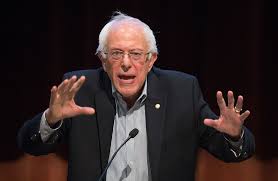
For decades, Liberty University has played host to leading conservative politicians. From Reagan to Romney, (Jeb) Bush to Cruz, presidential hopefuls have visited the campus to make speeches about Jesus and American greatness. So it’s no surprise that a leading presidential candidate will make a speech at next month’s convocation. But hold on to your fair-trade coffee: This year the presidential hopeful on the Liberty docket will be none other than Bernie Sanders. Why would this self-proclaimed non-religious socialist rabble-rouser from the hippie hills of Vermont want to journey to the unofficial headquarters of fundamentalist politics? Why would Liberty want to include him?

Could he grab some votes?

Could he grab some votes?

First of all, let me admit that this is old news. I’ve been on vacation recently and I’m just now catching up on all the latest culture-war headlines. A few weeks ago, Liberty published its schedule for its fall convocation. Along with predictable right-wing notables such as Texas’s Louis Gohmert and presidential hopeful Ben Carson, Liberty will welcome Senator Sanders.

As the SAGLRROILYBYGTH are well aware, I’m up to my eyeballs in research for my new book about the history of evangelical/fundamentalist higher education. Liberty was a latecomer to that story, but it soon became a 500-pound gorilla in the world of Christian higher education. Thanks to its huge and lucrative online program, Liberty can claim enormous cash reserves. It has used that money to build big sports programs, big libraries, and big convocation rosters.

Yet in spite of all its parvenu riches, Liberty has struggled to overcome its image as a fundamentalist madrassah. When Ted Cruz made a speech on campus a few months back, outsiders like me gasped that Liberty’s students were forced to attend. The school, journalists exclaimed, still imposed rigid lifestyle requirements on its students. The school, some writers implied, was trapped in the past.

Perhaps the invite to Bernie Sanders resulted from an ambition to overcome this provincial reputation. As current president Jerry Falwell Jr. told the Washington Post, his school is only doing what great universities do. Liberty, Falwell said, is taking up the mantle of true higher education. As he put it,

A university is supposed to be a place where all ideas are discussed. . . . That’s what we’re doing.

But what’s in it for Senator Sanders? In a statement, he explained that he hoped to pull a Pope Francis at the conservative campus.

It goes without saying that my views on many issues — women’s rights, gay rights, education and many other issues — are very different from the opinions of some in the Liberty University community. I think it is important, however, to see if we can reach consensus regarding the grotesque level of income and wealth inequality in our country, about the collapse of the middle class, about the high level of childhood poverty, about climate change and other issues.

Before we pooh-pooh Sanders’s dreams, let’s remember that today’s Liberty University is much different from the rigidly political campus of the 1980s. Back in Jerry Falwell (Sr.)’s heyday, the school was a proud incubator of right-wing politics. These days, as faculty member Karen Swallow Prior has argued, there is much more cultural wiggle room for students.

The dress code has been lifted. There has even (briefly) been a College Democrats club.

This leaves us with a few tough questions to consider:

  • Is it possible? Can Liberty University transform itself from a southern fundamentalist college to a Great American University?
  • And, could Senator Sanders convince any Liberty students that they are part of a progressive alliance, part of a left-leaning movement that has excited the base of the Democratic Party?

Why Campuses Have Become Timid

You’ve heard the lament: College campuses these days have become intellectual hothouses; students force teachers and administrators to crush any hint of controversial thinking; students insist on atmospheres purged of ideas that might upset them. In the new issue of The Atlantic, Greg Lukianoff and Jonathan Haidt offer an analysis of the phenomenon. But why didn’t they invite a historian to their party? For two smart guys, their answers are sadly shorn of any of the historical context that best explains our current “snowflake” syndrome.

The authors review the recent happenings on college campuses. Professors complain that they are muzzled and beleaguered. Students who offend are crushed under the bootheels of climate enforcers. Comedians no longer perform on college campuses.

Macro-aggressions . . .

Macro-aggressions . . .

Instead of feisty arenas in which a universe of ideas battle ferociously, some college campuses have become daycare centers at naptime, the authors charge. Why?

The recent trend toward what Haidt and Lukianoff call “vindictive protectiveness,” they argue, results from generational trends. Today’s college students grew up wearing helmets everywhere. They grew up on Facebook; they grew up in an era of vicious partisan polarization. The results, they conclude, are more than sad. They are scary portents of the ways campuses have pushed students to think in negative ways.

All these things make sense, but they ignore the obvious explanation from the history of higher education itself. Instead of as a psychological “vindictive protectiveness,” an historian of higher ed might explain today’s student activism as an exhibition of “insurgent inclusionism.”

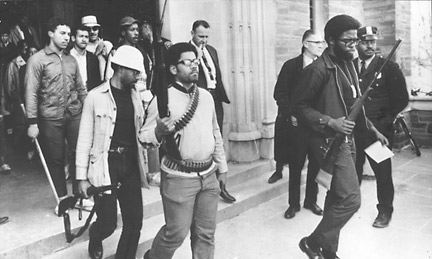
Today’s sometimes-excessive zeal for inclusionism might be traced most immediately to campus tumults of the 1960s. To take examples only from my home state of New York, battles at Columbia, Cornell, and City College of New York all laid the historic seeds for today’s campus activism.

At Columbia, student leftists took over the administration building and helped set a precedent that evil lurked incarnate behind the carved doors of deans’ offices. At Cornell, students demonstrated that no excess of violence would be too much in order to promote their agenda. At CCNY, the very structure of the school itself was turned on its head.

These were all very different episodes, but all of them set the precedent for student moral activism. The good guys in every case were those who were willing to go to any extreme—even shotgun-wielding threats—to create “inclusive” atmospheres.

The moral definitions were established. Those who resorted to extreme measures to promote more egalitarian campuses, places more welcoming to non-white, female, and underrepresented students were the good guys. Those who resisted were the bad guys.

These days, talk of “trigger warnings” and “safe spaces” seems an obvious historical development of that moral logic. Insurgent inclusionism dictates extreme tactics to be sure that no historically underrepresented group is left out. Why do student activists take such extreme measures against “microaggressions?” Because such things are seen as the latest flowering of white, male campus elitism.

Haidt and Lukianoff are likely aware of this obvious historical trajectory. I understand that they are mainly interested in other questions. Furthermore, I’m a fan of Haidt’s work. I considered it a big compliment when a recent reviewer planned to teach a culture-war class using my recent book along with Haidt’s Righteous Mind. As a psychologist, however, Haidt seems to ignore the obvious historical logic for our current campus climate, and that historical logic is important.

Without it, it’s easy to get caught up in the alarmist tone of the article. As I’ve argued before, today’s campuses are not as monotonous and timid as these sorts of articles imply. We should not tremble at the thought that student activists are up in arms for moral causes—even if we disagree with the tenor of their protests.

Campus activists these days consciously model themselves on the strident moralism of their 1960s ancestors. Do some of their protests verge into the merely silly? Yes. But overall, the logic of their protests has developed from the best traditions of student activism.

We don’t need to define away student protests as psychologically suspect.

The Crack Appears at Christian Colleges

It wasn’t hard to predict, but I’m surprised it has come so quickly.

World Magazine reported recently that a potential split had developed among the members of the Council for Christian Colleges and Universities. Two schools, it seems, have liberalized their policies about homosexual employees. Will this lead to a break in the CCCU? If so, it might be the last blow for a network that started with big ambitions.

SAGLRROILYBYGTH will know that I hardly ever get anything right. It is famously difficult for historians to use the past to predict the future. But in my current research, I see time and again that issues such as homosexuality have divided the family of evangelical colleges and university. It was not very hard to see that the recent SCOTUS decision about same-sex marriage would lead to a split among evangelical schools.

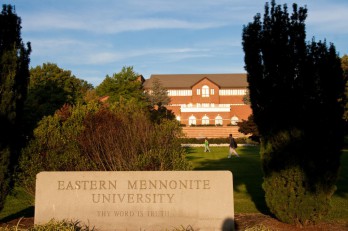
eastern mennonite university

A founding member of the CCC upsets the applecart…

Exactly three months ago in these pages, I put two and two together: the Supreme Court decision in favor of same-sex marriages would present evangelical schools with a terrible dilemma.

Sure enough, Goshen College and Eastern Mennonite University recently announced their plans to hire non-celibate homosexual faculty. They do not necessarily want to leave the CCCU, though. Leaders of the CCCU network are wondering: Will this lead to a split? Will member schools be forced to choose between a homosexual-friendly evangelical network and a traditional gay-is-not-okay one?

Unfortunately, the history of the CCCU offers little help on that question. In its early days as the Christian College Consortium, the network had some grandiose dreams. Some leaders, such as Hudson Armerding of Wheaton College, fantasized about a multi-campus evangelical university. The dream was to concentrate resources in order to keep up with secular colleges.

As far back as the 1950s, some evangelical college leaders toyed with this idea of a California-style mega-versity. Some schools, Armerding hoped, could offer more intense engineering programs. Others might focus on missionary preparation or languages. Yet others could host pre-med degrees. All of them would contribute toward a central graduate campus, too.

In this way, the future CCCU would remain orthodox in religion, yet be able to compete with big public and rich private universities.

As Armerding put it in a confidential letter to his fellow school leaders in 1955,

Each particular college would offer the same undergraduate instruction for the first two years and then would offer a limited number of majors for the final two undergraduate years and graduate studies leading to the doctorate. . . . There would be the possibility of mobilizing the entire evangelical community to support the proposed Christian university, challenging their loyalties through familiar and accepted institutions to which this constituency had already committed itself. Hence the continuing support of the university would be relatively assured. The geographic distribution would make possible a nation-wide impact upon the social and cultural life of the nation and would facilitate the educating of students who might otherwise be unable to travel to one central location.

Speaking from Gordon College near Boston, President James Forrester wrote in 1961 to evangelical intellectual leader Carl F. Henry to support the idea:

I have wondered if a beginning might not be made toward the consolidation of some of the evangelical effort at the undergraduate level on such a campus as ours. This could be done under a federated scheme similar to Oxford, Cambridge, the University of Toronto, Claremont College, and other associated programs. I think particularly of King’s and Barrington and wonder if some person who transcends the entrenched interest of our three schools, could bring together in conference key personnel for a discussion of this possibility. I do find that the limited assets available to Christian higher education in the area are divided among Wheaton, King’s, Barrington, and Gordon. All of us struggle with capital problems and operating deficits. . . . I am also conscious that with such a fractured effort as we now represent, we are no match for the consolidated interests of educators committed to the philosophical position of a naturalistic humanism in the university field. I also feel that this could be the natural groundwork from which could be extended ultimately your magnificent concept of a great Christian university.

It didn’t work out that way. In practice, the CCCU became a loose association of schools. So loose, in fact, that no one seems really sure what will happen now. Member colleges pledge vaguely

To advance the cause of Christ-centered higher education and to help our institutions transform lives by faithfully relating scholarship and service to biblical truth.

Can they do that if they welcome non-celibate homosexual faculty and staff? Or do those schools need to go elsewhere? If they do, how many of the 181 member schools will they pull with them?

From grand 1950s dreams of a powerful and aggressive evangelical multiversity, it seems evangelical colleges will be split yet again into smaller and smaller organizations.

Does It Matter Where Your Kid Goes to College?

Relax.

That’s one message we might take away from Kevin Carey’s recent piece in the New York Times. He argues that the vast gulf between the “best” universities and the rest is nothing but an illusion. That certainly fits with my experience in the past twenty years as a graduate student and professor. But is it also true about the gulf between mainstream colleges and dissenting religious ones?

Carey insists, in a nutshell, that students will do just as well whether they go to Harvard or Podunk U. Or, to be more precise, Carey argues that the differences between elite schools and the rest are more about marketing than about actual educational impact.

...it doesn't!

…it doesn’t!

To back up his claims, Carey relies on the 2005 edition of a study by Ernest Pascarella and Patrick Terenzini. There are some differences between schools, of course. As Carey puts it,

But these findings are overwhelmed in both size and degree by the many instances in which researchers trying to detect differences between colleges found nothing.

“The great majority of postsecondary institutions appear to have surprisingly similar net impacts on student growth,” the authors write. “If there is one thing that characterizes the research on between-college effects on the acquisition of subject matter knowledge and academic skills, it is that in the most internally valid studies, even the statistically significant effects tend to be quite small and often trivial in magnitude.”

As the SAGLRROILYBYGTH are well aware, I’m up to my eyeballs in work on my new book about conservative evangelical Protestant higher education. These schools exist because most people think it matters a great deal where kids go to college. Not only in terms of making connections and building a career, but in terms of learning good values and building a life as a certain sort of Christian.

As evangelist Bob Jones Sr. explained in 1928, he founded his college in order to help parents relax. “The fathers and mothers who place their sons and daughters in our institution,” Jones promised,

can go to sleep at night with no haunting fear that some skeptical teacher will steal the faith of their precious children. Your son and daughter can get in the Bob Jones College everything that they can get in any school of Liberal Arts.

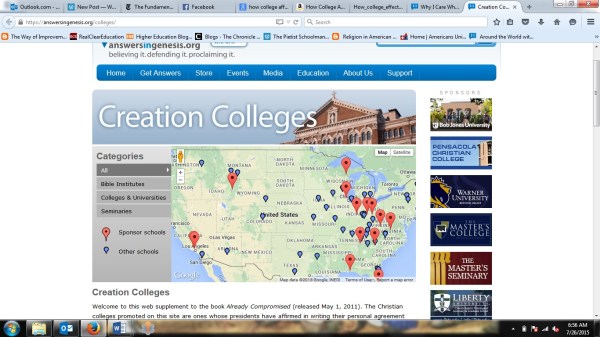
These days, too, conservative religious leaders spend a good deal of time and effort helping parents find the right schools for their kids. As I argued a while back, creationist leader Ken Ham of Answers In Genesis offers lists of “safe” schools, schools that reliably teach young-earth creationism and ONLY young-earth creationism.

Can college make a difference?

Can college make a difference?

Kevin Carey’s recent look at the research prompts some important questions.

  • If the academic and professional difference between mainstream schools is not as great as we all think, is the difference between mainstream schools and religious schools also not as great as we think?
  • Might it be possible for conservative parents to relax about where their kids go to school, and instead focus on helping their kids make the most out of whatever school they DO attend?
  • Do religious students fare well at secular/pluralist schools?

Faculty Fudge Factors at Creationist Colleges

Ding! There it is again—the sound of another evangelical professor being ousted for harboring evolution-friendly ideas.  Some of us outsiders might think that evangelical colleges would slowly become more relaxed about evolution as time went on.  As this case shows, we’d be wrong.  The history of the past century has demonstrated that many evangelical colleges have grown MORE uptight, not less, about proving their creationist credentials.

In this case, the school is Bethel College in Indiana and the professor is Jim Stump. As Karl Giberson described recently, the flap at this Bethel [n.b., there are about one bajillion Bethel Colleges out there and it’s easy for outsiders to mix them up] echoes the trends of the past hundred years: Time and again, creationist colleges have sought to tighten both the image and reality of unshakeable creationist orthodoxy among their faculty.
Stump removal...

Stump removal…

As I’m uncovering as I work on my new book, this pattern has been the dominant theme at conservative evangelical colleges since the 1920s.

Beginning in the 1920s and repeated every generation, schools have tightened the requirements on their faculty. In every generation, some professors have sought to follow a middle path—exploring the science of evolution while remaining firmly committed to their religion. In every generation, nervous college administrators have sought to prove to the creationist community that their school will not tolerate any such thing.

In the 1920s, most schools agreed on ironclad faculty creeds. The hope was that these creeds would prevent faculty from becoming too friendly to evolutionary thinking. At flagship Wheaton College in Illinois, for instance, the trustees in 1926 adopted a creed that all faculty, staff, and administration had to sign annually. They included the following statement:


4. We believe that man was created in the image of God; that he sinned, and thereby incurred, not only physical death, but also that spiritual death which is separation from God; and that all human beings are born with a sinful nature, and in the case of those who reach moral responsibility become sinners in thought, word and deed.

At the time, this statement was thought to define the proper “fundamentalist” attitude toward creation. In 1960, however, a conference about evolution and creationism on Wheaton’s campus attracted ferocious criticism from the more stalwart creationists among the fundamentalist/evangelical community. Too many of the assembled theologians and scientists, critics thought, embraced the principle of evolution.

Among Wheaton’s faculty, zoologist Russell Mixter came in for the fiercest criticism. In spite of his protestations to the contrary, Mixter was accused of teaching and preaching evolution in his classes. In order to calm the storm, Wheaton’s administration altered its faculty creed. At the end of 1961, the school agreed to add the following item:

By Article IV of its ‘standards of faith,’ Wheaton College is committed to the Biblical teaching that man was created by a direct act of God and not from previously existing forms of life; and that all men are descended from the historical Adam and Eve, first parents of the entire human race.

The pattern continues today. At schools such as Bryan College and Northwest Nazarene University, creeds are tightened and faculty are ousted in order to preserve an impeccable reputation for creationism. Time and again, the sticking point has been the historicity of Adam & Eve. It is not enough, evangelical communities insist, for faculty vaguely to endorse the idea of a God-directed creation. Especially when it comes to the origins of humanity, some evangelicals require a belief in a real, literal origin in two real, literal people.

According to Karl Giberson, the folks at Bethel College in Indiana have taken this tradition one step further. Under pressure from the sponsoring denomination, the Missionary Church, Bethel now requires faculty to advocate its firm position on the historicity of Adam & Eve. In the past, at Bethel as at other evangelical colleges, faculty members could sign their annual statements of faith even if they thought that such statements did not require them to disavow mainstream evolutionary science. This policy hopes to push faculty members into a tighter relationship with the denomination’s official position on evolution.

Furthermore, from now on Bethel faculty are not allowed to take leadership positions in organizations that disagree on this point. As BioLogos leader Deborah Haarsma argued, Bethel’s new policy puts evangelical scholars like Jim Stump in a very difficult position. Stump has served as the content manager for BioLogos, an organization that embraces “evolutionary creationism.” The new Bethel policy, in effect, forced Stump to choose between the two organizations.

As the sophisticated and good-looking regular readers of I Love You but You’re Going to Hell (SAGLRROILYBYGTH) are well aware, I am a fan of the BioLogos approach. I’m no evangelical, but I think the way forward in our continuing evolution/creation battles is for both sides to agree to the science of evolution and the freedom of religious belief. As I argue in my upcoming book Teaching Evolution in a Creation Nation (due to hit shelves in February 2016), secular folks like me need to recognize the right of religious dissenters to disbelieve the claims of evolution, even as religious folks need to recognize the duty of public schools to teach evolution as the best available science.

But as I argue in my other upcoming book, schools like Bethel are also in a difficult position. In order to maintain intellectual credibility, they must embrace changing norms of academic excellence. But in order to maintain religious credibility, they must conspicuously root out any whiff of compromise. Not on every issue, but on issues such as evolution and same-sex marriage that seem to make up the foundations of their faiths.

As a result, over the course of the past ninety years, many evangelical colleges–including the relatively “liberal” ones–have made their policies more rigid when it comes to faculty beliefs about human origins.  The recent news from Mishawaka is only the latest attempt by an evangelical college to remove faculty fudge factors.


Is THIS the Future for Christian Colleges?

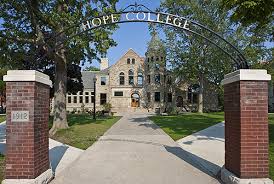
Now what do we do? That is the question plaguing conservative college administrators nationwide. Since the Supreme Court decision in favor of same-sex marriages, many evangelical schools have wondered if they will have to change the way they do things. In Michigan, Hope College has announced its accommodation with the ruling. Will other Christian colleges do the same thing?

The gateway to the future?

The gateway to the future?

As the Sophisticated and Good-Looking Regular Readers of I Love You but You’re Going to Hell (SAGLRROILYBYGTH) are well aware, questions of homosexuality and same-sex marriage have long bedeviled evangelical colleges. For non-evangelicals, it might come as a surprise to hear that the issue is contentious. After all, at most evangelical schools, the official doctrine clearly and resolutely condemns homosexual activity.

Yet at all sorts of schools, the campus community is much more welcoming. At Gordon College recently, the president’s reminder that the school officially bans “homosexual practice” brought furious protests from students and faculty. Even at the far more conservative Liberty University, faculty members do not always take the harsh tone we progressives might expect.

As our Supreme Court decided the constitutionality of state bans on same-sex marriage, many evangelicals fretted that their decision would trash traditional rules on their campuses.

At Hope College in Michigan—a school in the Reformed Church tradition—the leadership and campus has experienced similar turbulence on the issues of homosexuality. In 2010, for example, the administration provoked protests when it banned the film Milk. More recently, the campus has welcomed homosexual student organizations, though the administration has continued to endorse the Reformed position on homosexuality.

In its most recent announcement, the school’s leaders have declared their intention to abide by the SCOTUS decision. From now on, same-sex married partners of college employees will be eligible for the same benefits as heterosexual partners. The administration again affirmed its respect for the Reformed Church’s official doctrine that homosexuality is a sin. That does not mean, however, that the school will contravene the law.

Is this the path other schools will follow? Unlike pluralist colleges, evangelical schools face intense pressure to stay true to traditional beliefs and norms. As Professor Michael Hamilton wrote in his study of Wheaton College,

The paradigm that has dominated Wheaton through the century holds that colleges, more than any other type of institution, are highly susceptible to change, and that change can only move in one direction—from orthodoxy toward apostasy. . . . The very process of change, no matter how slow and benign it may seem at first, will always move the college in a secular direction, inevitably gathering momentum and becoming unstoppable, ending only when secularization is complete.

Hope College may find itself the front line for this debate within the Reformed Church in America. The church as a whole has gone back and forth for decades about the proper Christian reaction to homosexuality. Is it better to embrace the sinner? Or to drive out the sin? Conservatives within the RCA will doubtless take this announcement as proof that Hope has gone soft. Progressives will celebrate it as a small step towards equity.

Other evangelical schools will face similar scrutiny. If they openly welcome homosexual students, faculty, and staff, they will be subject to withering condemnation from conservatives. If they don’t, however, they’ll risk being sidelined, branded as anti-gay bigots.