Racist Fundamentalists…It’s Complicated

Sometimes the archives can make things too complicated. White fundamentalists have always been accused of racism—a charge they’ve vehemently denied. But what do we do when an African American fundamentalist agrees with the racism of his white fellow fundamentalists?

First, a quick historical sketch: Since the 1920s, as I argued in my first book, fundamentalism got tangled up with ideas about Southern Pride. Conservative religion has often become part and parcel of a broader cultural conservatism, one that included support for racial segregation and white supremacy.
Racist? Or just fundamentalist?

Racist? Or just fundamentalist?

By the 1970s, leading white fundamentalists became some of the most public supporters of racial segregation. Most famously, Bob Jones University steadfastly clung to its whites-only policy long after many white Southerners and white fundamentalists had grudgingly moved on. Some historians, such as Randall Balmer, have insisted that white racism among fundamentalists was the real root of the so-called New Christian Right that emerged in the 1970s.

I disagree. There is no doubt that white fundamentalism—especially in the South—has long had close ties to white racism. There is more to the story, however, than quick condemnations of conservative religion as a front for white supremacy.

In my recent work at the archive of the Moody Bible Institute, I came across a document that reminds us how messy history is. In 1970, the leaders of Moody dis-invited prominent fundamentalist John R. Rice from Moody’s big annual Founder’s Week event. Why? Because Rice had come out in support of the segregationist policies of Bob Jones University.

As President William Culbertson informed members of the Moody community,

Moody Bible Institute has for 85 years welcomed young people of all races and nationalities to its tuition-free training in the Bible. Through times of changing social mores the policy has always been to emphasize the salvation from God by which all men who believe are made one in Christ. We have sought, and do seek, to apply the spiritual principles set forth in the Word of God to the practical problems of our culture. We believe that there is nothing in the Bible that forbids interracial relationships. We are absolutely opposed to injustice and exploitation. We are dedicated to the proposition that we are debtors to all men.

Moody Bible Institute, Culbertson told anyone who would listen, still agreed wholeheartedly with John R. Rice’s fundamentalist theology. Moody refused to compromise with those who would modernize the Bible or water down fundamentalist religion. But Moody could not be seen as part of a racist, segregationist movement.

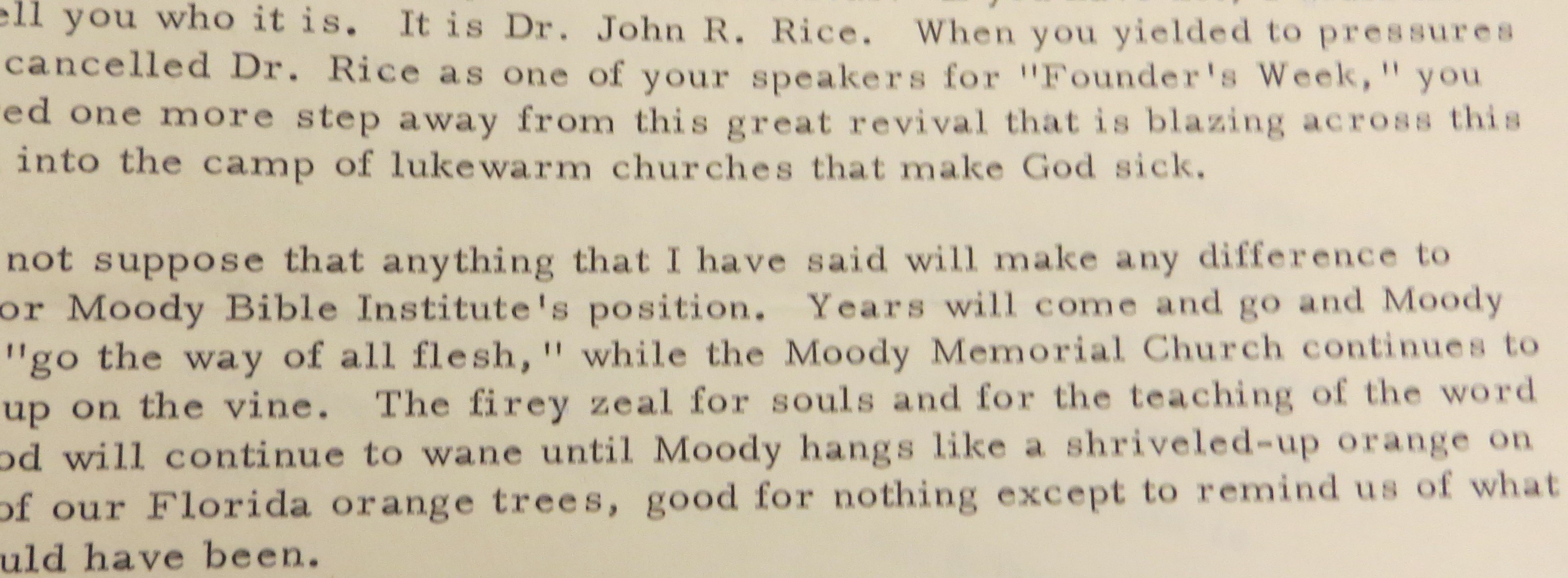
Naturally, John R. Rice and his supporters blasted this decision. More evidence, one Rice supporter charged, that Moody had

moved one more step away from the great revival that is blazing across this land into the camp of lukewarm churches that make God sick. I do not suppose that anything that I have said will make any difference to you or Moody Bible Institute’s position. Years will come and go and Moody will ‘go the way of all flesh,’ while the Moody Memorial Church continues to dry-up on the vine.

Among the fat stack of angry letters supporting John R. Rice, one stands out. It came from William H. Dinkins of Selma, Alabama. Dinkins was an African American fundamentalist and, in his words, someone who “stand[s] with Dr. Rice for fundamentalism and the old-time religion and all that goes with it.” Too often, Dinkins charged, “We Negroes [sic] . . . try to inject Civil Rights into every circumstance, without sensing the effect of what we are doing.” When it comes to religion and the Word of God, Dinkins continued, “Civil Rights is an extraneous issue, and ought not to be in question, and I feel that responsible people ought not to be effected by such pleas.”
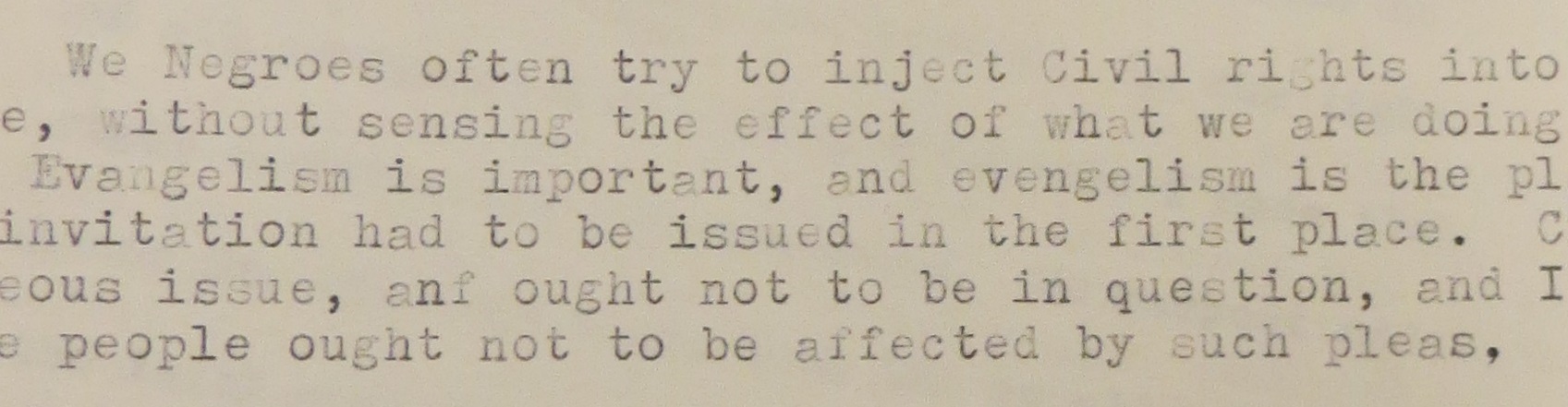
The view from Selma, 1971

The view from Selma, 1971

Dinkins’s letter raises difficult questions about race and religion. First of all, we wonder if this letter was legitimate. Could someone have faked it in order to create an impression of biracial support for racial segregation? If not, we wonder how common such sentiments have been. As historian Jeffrey Moran has argued, white fundamentalists have long tended to ignore their African American co-religionists, at best. And, as John Dittmer and others have showed, in the early days of the Civil Rights movement many African American leaders in the Deep South supported segregation, at least temporarily and pragmatically.

In the early 1970s, was there really any support for racial segregation among African American conservatives? Did fundamentalism trump race?

From the Archives: To Educate a Fundamentalist

What do fundamentalists learn in school? As I continue my research into evangelical higher education this week at the Moody Bible Institute archives, I’ve found a couple of clues about what went on in fundamentalist classrooms.

It is always one of the trickiest things for historians to pry behind the classroom door. We can study the institutional goings-on at schools. We can look at the paper trail of rules, curriculum changes, textbook decisions, and the like. But it is extremely difficult to discover what real students really did.

Thanks to the voluminous collections at MBI, I’ve found some hints of what fundamentalist learning looked like. One scrapbook collection from the early 1940s includes assignments and study guides. For example, this student turned in eighteen assignments from a book on missions. (The first fourteen were on time, the last four late. What happened during those last weeks?) The assignment was clear: Students were to read the book The Progress of World-Wide Missions, by Robert H. Glover. They were to write answers to a series of questions posed by the instructor.IMG_1938[1]

For this student, at least, the process was one of regurgitating facts and opinions from the book. She did not offer any of her own thoughts on the subject, nor did that seem to be encouraged.

This student also left behind her set of study guides about Biblical dispensations. The theology taught at MBI hinged on dispensational premillennialism. Bible history (and future) was divided into a series of periods, or dispensations. In each dispensation, God ruled according to dispensationally appropriate guidelines. In order to make sense of the Bible, according to this system, it was necessary to understand the various dispensations at work.IMG_1954[1]

It seems fair to assume that these study guides were meant to provide students with help memorizing the details of each dispensation. When students had memorized these facts forward and backward, they could presumably read the Bible correctly. This system was the key to “rightly dividing the Word of Truth.” Without it, students and their future missionary targets could end up with woefully misleading interpretations of Scripture.

From the Archives: Good GPA, Good SATs, “Well-Rounded,” and…

How did fundamentalist colleges select their students? Despite my hilarious title this morning, until World War II admissions were not usually based on standardized test scores or high-school grades and activities. During my research this week at the Moody Bible Institute, I found one example of admission standards from 1930 that tells us a lot.

Sometime between World War I & World War II, American colleges and universities developed standard admissions procedures. Until then, students could take an examination to prove they were prepared. Some colleges worked out deals with local high schools to admit all their graduates. Plus, colleges often admitted many students who were not adequately prepared, then sent them to the school’s preparatory department.

In the 1920s, as Roger Geiger argues in his new book, colleges such as Yale and Princeton devised standardized tests. Not to offer an equal playing field, but to test for those qualities polished by the kinds of prep schools fancy families preferred. In fact, one intended consequence of these tests was to give schools some justification for turning down new numbers of qualified Jewish applicants.

Fundamentalist colleges and Bible institutes had different standards. At many fundamentalist colleges, students from any religious background were welcome, as long as they observed the lifestyle rules and attended mandatory religious services.

At Moody Bible Institute, on the other hand, incoming students had to prove they were on board with the school’s fundamentalist theology. Until the 1940s, new students did not have to prove they had completed high school. But they had to offer solid proof that they were invested in the school’s soul-winning ambition.

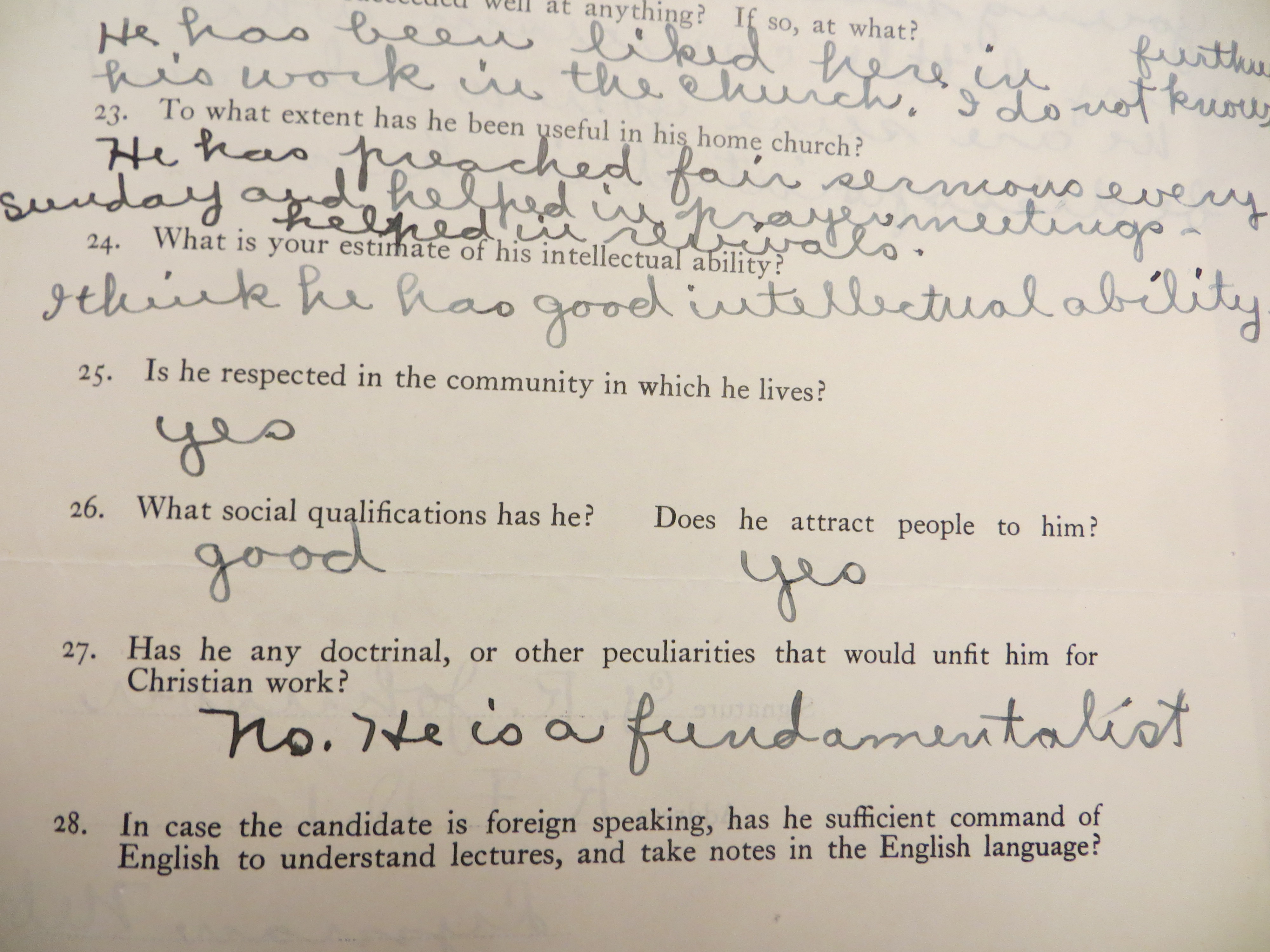
Each applicant in the 1920s and 1930s had to offer three references. Those folks were asked to fill out a four-page reference form. Some of the questions were fairly ho-hum: How long have you known the applicant? Is the applicant strong intellectually? But others were unique to this kind of conservative evangelical institution: “Has he to your knowledge ever backslidden? If so, when, and what were the circumstances?” “Has he a genuine love for souls?” “Is he discreet in his conduct toward women?” “Has he any doctrinal, or other peculiarities that would unfit him for Christian work?”

One referee offered a telling answer to this last question on an application from 1930. Is the applicant theologically peculiar? “No, he is a fundamentalist.”

1930...

1930…

In 1930, to this referring pastor at least, being a “fundamentalist” meant eschewing any of the heterodox theological options available. Fundamentalists in this era worried not only about secularism and atheism, but also about close theological cousins that might lure away earnest believers. As I argued in my first book, in the 1920s fundamentalism struggled to define itself against such conservative near neighbors as Seventh-day Adventism, Christian Science, or Pentecostalism.

The theological reefs and snares included some terms that have been lost to time. In the 1920s, fundamentalists worried about “Bullingerism” and “Russellism” among their ranks. The danger was not only that such students would not embrace the school’s mission. The stark danger was that such attractive theological ideas could spread like wildfire among the student body.

Schools such as MBI worked hard to be sure each incoming student was free from such spiritual contagion, just as they tried to be sure incoming students were free from tuberculosis and smallpox.

Academic Freedom vs. Creation College

nnu crusaders

President Alexander’s Last Crusade?

What is a college president to do? At conservative religious colleges, leaders are in a real pickle. Hosting faculty with unpopular beliefs could lead to a loss of tuition dollars. Getting rid of them could lead to charges of dictatorial ambition. At Northwest Nazarene University in Idaho, President David Alexander fired Thomas Jay Oord. Now Alexander has to deal with the consequences.

First, some background. According to Christianity Today, Alexander’s administration claims that the firing was due to financial straits. Professor Oord taught theology for a decade at the college and had earned a reputation for teaching evolution and “open theology.”

The faculty senate at NNU has protested the administration’s move. The school’s financial future is rosy, according to the faculty. Oord’s firing, they say, is more about reputation than budget.

As at many other conservative religious colleges, that reputation can be difficult to protect. As we’ve discussed in these pages, college leaders face intense pressure to remain orthodox. Parents and alumni control the pursestrings. Such folks can be ferocious defenders of traditional values.

School leaders are forced not only to keep teaching orthodox, but to avoid any appearance of liberalism. If a professor like Oord becomes well known for favoring theistic evolution, it can tarnish the creationist reputation of a college. Parents will send their creationist children elsewhere. Alumni will keep their money.

From the Archives: What’s a Popular Fundamentalist to Do?

It’s not easy being the king. During my digging yesterday in the Moody Bible Institute archives, I came across a plaintive letter that typified the social difficulties some fundamentalists have experienced in higher education.

Help...I'm popular!

Help…I’m popular!

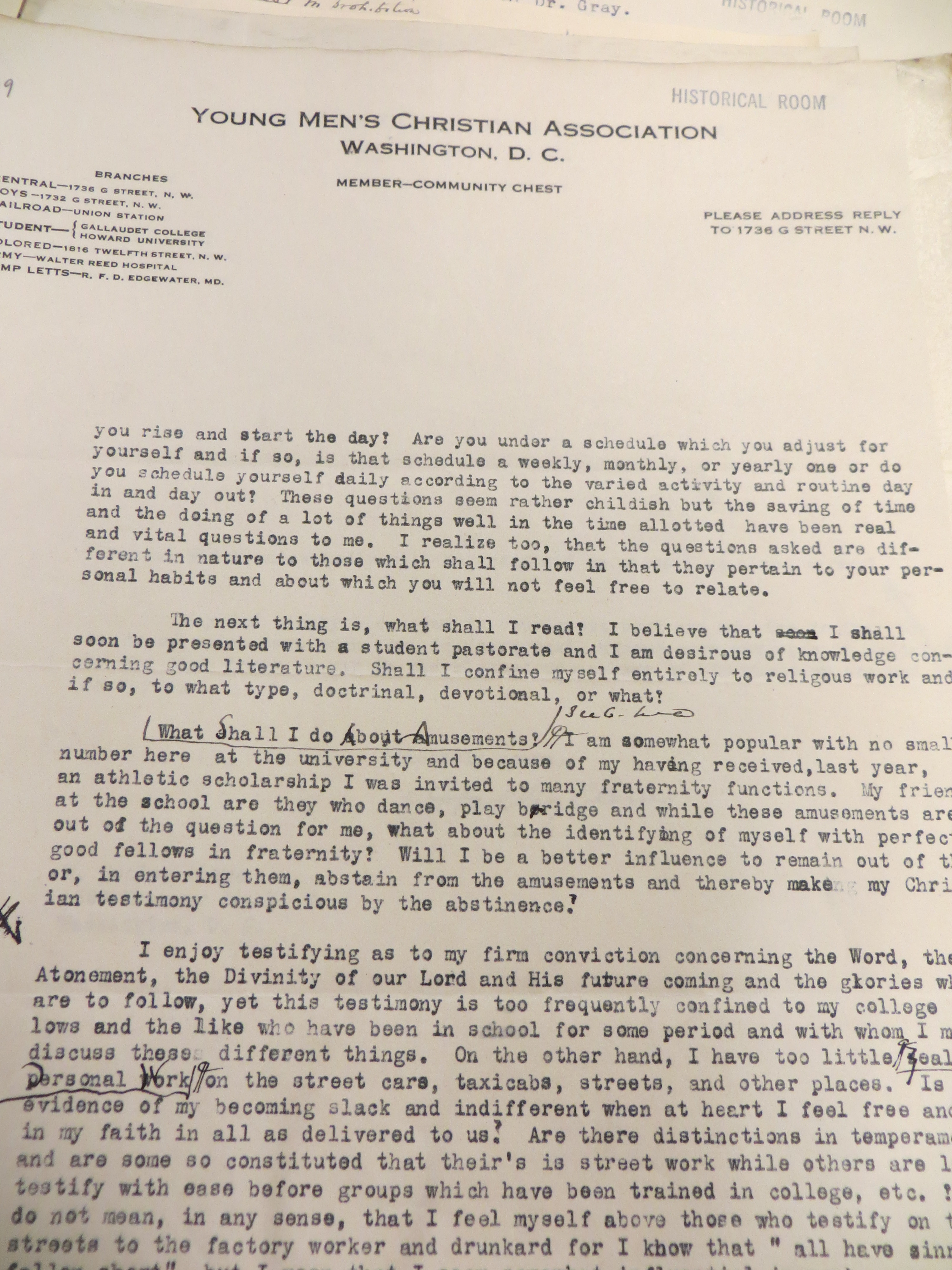
Here’s the background: An alumnus wrote to President James M. Gray in 1930, asking for advice. This former MBI student had moved on to George Washington University after his preparatory time at the Institute. MBI, the student reported, had prepared him for life in the secular academy. As he told President Gray,

During my first year here at the school I encountered much by way of modernism, so called, especially in such departments as history and natural science. While none of the teaching has perturbed me, yet the atmosphere is not nearly so buoyant as that at Moody.

So far, so good. One of the primary goals of Bible institutes has been to prepare students to enter secular higher education. Once inoculated against secularism and liberalism by one or two years of Bible study, the thinking went, students could go to regular colleges and learn to be productive Christian members of society.

Even when that plan worked, as with our 1930 letter-writer, it was not always easy. This MBI alumnus could handle the religious and intellectual challenges of life at a secular school. But it was harder to figure out the social ones. He did not know what to do about good friends who were not fundamentalists. As he asked President Gray,

What shall I do about amusements? I am somewhat popular with no small number here at the university and because of my having received, last year, an athletic scholarship I was invited to many fraternity functions. My friends at the school are they who dance, play bridge and while these amusements are out of the question for me, what about the identifying of myself with perfectly good fellows in fraternity? Will I be a better influence to remain out of them or, in entering them, abstain from the amusements and thereby make my Christian testimony conspicuous by the abstinence?

MBI Kind of Town…

What did you do after high school? Did you go to a “college?” Or was it a “university,” “institute,” a “normal school,” or maybe a “professional school?” For generations of ambitious Protestant missionaries, the Moody Bible Institute in Chicago has been the best-known institution of evangelical higher ed. So much so that MBI has clung to the “BI” name much longer than many other evangelical colleges.

DOWNtown funk...

DOWNtown funk…

I just rolled into Chi-town on the last of my research trips this year. As SAGLRROILYBYGTH are well aware, I’m working on a book about the history of evangelical higher ed. This year, I’ve traveled to Bob Jones University, Wheaton College, Biola University, Gordon College, and Liberty University.

MBI is last, but certainly not least. I’ve logged my share of time in these archives over the years, especially while working on my PhD dissertation and first book. MBI is not the oldest Bible Institute, but it has remained far and away the most influential.

For those outside of the orbit of evangelical culture, the primary goal of Bible institutes has been to provide quick and affordable education for missionaries. In order to serve effectively on the mission field, many evangelicals have believed, missionaries need a thorough knowledge of the Bible. In order to bring people to true salvation, missionaries need a proper knowledge, too.

Beginning in the late 1800s, Bible institutes popped up in American cities nationwide. Many of them attracted students without a lot of academic preparation. These students, after all, were not heading into the traditional professions, but rather heading out to spread the Gospel in every land. They did not need to know Latin and trigonometry, but rather only the Bible and maybe some basic medicine and language skills.

Over the decades, many of these Bible institutes turned into colleges or universities of one kind or another. This was part of the triple revolution in higher education that Roger Geiger describes in his new book, The History of American Higher Education. By 1940, Professor Geiger argues, the wild diversity of early institutions of higher education had become standardized, a recognizable modern system of American higher education.

In this system, no one went to college without first completing a high-school education. They looked forward to an education that would prepare them for specific professions. Colleges themselves closed their preparatory departments or split them off into stand-along high schools. Universities had shaken out into a relatively stable hierarchy of prestige and social influence. At the top were wealthy old schools such as Harvard and the University of Michigan. At these universities, undergraduate education rollicked along in a cloud of sports, fraternities, and social climbing, while the schools themselves fought viciously to increase their research footprint.

As this modern system regularized itself in the years after World War I, several types of institutions phased out. These evolutionary also-rans included many institutes of technology, proprietary medical or legal schools, “female institutes,” normal schools, and—though Professor Geiger doesn’t mention them—most of the Bible institutes.

These old-fashioned types of higher education did not disappear. Rather, most of them changed to offer the new standard bachelor’s degrees. Many of them built new dormitories and fielded sports teams. And most of them took their place in the competitive hierarchy that arched from Harvard down to Podunk State College & Grill.

A very few exceptions stood out from this winnowing process, at least symbolically. Some of the old-fashioned institutions of higher education had been so successful in the 1800s that they felt no need to change their names, even as they usually adopted some of the features of modern higher education. Most notably, the Massachusetts Institute of Technology never changed its name to call itself a “college” or a “university.” MIT began as one of a scramble of “institutes of technology” in the years surrounding the Civil War. Unlike today’s MIT, the early institutes did not focus on recognizably pure modern research. Instead, they mostly provided students with a more practical mechanical education meant for workers in industrial workshops.

As more and more students wanted to spend their tuition dollars at a “college” or “university” that took its place in the ever-more-rigid hierarchy after World War I, most of these “institutes of technology” turned themselves into “colleges” or “universities.”

Following a somewhat similar pattern, since 1940 most of the crop of Bible institutes that sprang up around the turn of the twentieth century turned themselves into “colleges” or “universities.” Biola University, for example, began its life as the Bible Institute of Los Angeles—BIOLA, get it? Gordon College, too, had its roots as the Boston Missionary Training School. As early Gordon President Nathan Wood remembered, the first name change—to Gordon College of Theology and Missions—resulted from student pressure.   Three class presidents, Wood recalled, requested

a change of name to one which would express the collegiate and theological work of the school. . . . It meant much to them as future Alumni.

To put it in terms Wood never used, the Gordon students recognized early the congealing patterns of modern American higher education. A “training school” did not convey the same prestige and professional opportunities as did a “college.”

For some stand-out schools, however, these rules did not apply. Moody Bible Institute was so well known among evangelicals its name sufficed to keep students coming. There was no need for it to change its name to acknowledge the changing environment of American higher education. Like MIT, MBI had created such a unique niche in higher education that it kept its old fashioned name and much of its old-fashioned structure. Also like MIT, MBI took on many of the features of modern higher education. Unlike in its early days, MBI now offers college degrees, not just Bible training.

Doubtless, I’ll find some evidence here in the archives about efforts over the years to change MBI’s name. Unlike smaller schools, however, MBI had the size needed to stand out as an island in the new seas of modern higher education.

Schools of Social(ist) Work

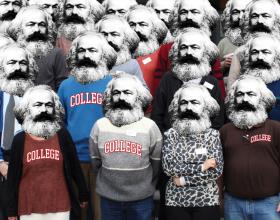
America’s colleges and universities have become left-wing indoctrination factories. At least, that has long been a favorite conservative complaint. Today in the pages of the Weekly Standard we see another example of the “closing of the campus mind.” Why do so many conservatives seem to take such intense pleasure in the supposed leftist domination of American higher education?

Bearded weirdos...

Bearded weirdos…

In today’s Weekly Standard, Devorah Goldman shares her horror story from Hunter College’s School of Social Work. As a conservative, Ms. Goldman was asked politely not to participate in class discussions. She had to hold her tongue as she read anti-conservative textbooks. She had to hold her tongue as professors imposed racist, ideologically slanted ideas on her classes.

Goldman’s story of abysmally closed-minded universities seems to resonate among conservative intellectuals. As we’ve seen recently, some conservative academics have interpreted recent events as the death knell for conservative thinkers at mainstream universities. Elsewhere, critics have wondered if higher education as a whole has been irredeemably lost to true open-mindedness.

As a non-conservative who writes a lot about conservatism and education, these complaints raise two difficult questions for me.

  1. First, why do so many conservative thinkers seem to emphasize the leftism of colleges? That is, why do conservatives seem to take such bitter joy from an exaggerated assumption that they are no longer welcome in higher ed?
  2. Second, why don’t these conservative intellectuals recognize the long tradition of conservative laments about higher ed? In every case, it seems as if conservatives think higher ed has just recently switched over to the dark side.

Let’s take the second of these questions first. As Ms. Goldman’s story shows, every conservative complaint implies that the closing of the college mind is a recent phenomenon. But conservatives (and liberals, for that matter) have been protesting against the goings-on at mainstream colleges for almost a century.

In 1987, for example, Chicago’s Allan Bloom scored a surprise best-seller with his Closing of the American Mind. Bloom worried back then that universities had become nothing but indoctrination factories.

Even earlier, conservative godfather William F. Buckley Jr. began his long career with an indictment of the culture at his alma mater. In God and Man at Yale (1951), Buckley blasted the sneering secularism and lax morality of his school.

Some people think Buckley invented modern conservatism, but the same themes go way back. In the 1930s, for instance, Congressman Hamilton Fish excoriated leading schools as subversive breeding grounds for communists. Fish named names. Columbia, New York University, City College of New York, the University of Chicago, Wisconsin, Penn, and North Carolina, Fish charged in 1935, had become “honeycombed with Socialists, near Communists and Communists.” As I note in my new book, Fish and other anti-communist conservatives in the 1930s assumed that leading colleges had recently been hopelessly lost to left-wing collegiate cabals.

Back in the 1920s, too, religious conservatives warned each other that recent events had caused the loss of mainstream colleges. As I’m digging into in my current research, fundamentalists such as Bob Jones Sr. convinced themselves and anyone who would listen that 1920s trends had moved college into the enemy camp. Too many schools, Jones charged, attacked the faith of conservative students. As Jones put it,

I had just about as lief send a child to school in hell as to put him in one of those institutions. We are spending millions of dollars on education in this country, but if that is the kind of education we are going to have we would be better off without our universities and colleges.

In every case, each generation of conservative activist has implied that these lamentable changes were recent occurrences. In every case, conservatives suggest that higher ed “these days” has been taken over by left-wingers. If this is such a long and strong tradition among conservatives, why do they keep insisting it is a recent phenomenon?

And why do conservatives seem so eager to emphasize their own victimhood? I don’t doubt Goldman’s story. I can imagine that some teachers and some schools really do insist on an ideological conformity. But there are plenty of other schools that do not. Why don’t conservatives spend more mental energy trumpeting their own dominance of some forms of higher education?

Recently, for example, conservative academic extraordinaire Robert George praised his school’s new academic-freedom rule. Why don’t more conservative intellectuals join Professor George in proclaiming the continuing academic clout of conservative or conservative-friendly ideas?

Some might think that conservatism only dominates less-prestigious schools. Ms. Goldman, for example, would likely have had a very different experience at a less prominent school of social work. But as the case of Professor George makes clear, leading schools such as Chicago and Princeton have long served as congenial homes for conservative intellectuals.

Instead of tearing their hair and gnashing their teeth due to the supposed loss of higher education, why don’t conservative intellectuals celebrate their continuing influence at many leading colleges?

University Apocalypse

Are conservative religious academics forced these days to live “deeply closeted” lives? Have elite universities become so hostile to conservative religious thought that openly acknowledging their religion would be career suicide for academics? In the aftermath of the recent debate over gay rights and religious freedom in Indiana, one elite academic shares his worries in the pages of The American Conservative.

We have to ask: Are things really so dire for conservative academics?

Private?  or Closeted?

Private? or Closeted?

First, though, some context. Readers may remember Jonathan Zimmerman’s (liberal) plea to include more conservatives on campus. And leading schools such as Colorado University have adopted programs to bring conservative thinking to liberal colleges. Both conservatives and non-conservatives agree: Good universities need to recruit actively among a wide diversity of intellectual types.

New voices say it’s not happening.

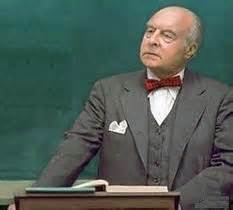
Crunchy conservative Rod Dreher recently shared his conversation on these issues with an anonymous professor at an elite law school. This professor worried that the “overculture” had reacted with frightening intellectual totalitarianism to the recent Indiana case. At leading colleges, “Prof. Kingsfield” warned, religious conservatives are no longer welcome.

“A college professor who is already tenured is probably safe,” Dreher tells us, summing up “Kingsfield’s” story.

Those who aren’t tenured, are in danger. Those who are believed to be religious, or at least religious in ways the legal overculture believes constitutes bigotry, will likely never be hired. For example, the professor said, he was privy to the debate within a faculty hiring meeting in which the candidacy of a liberal Christian was discussed. Though the candidate appeared in every sense to be quite liberal in her views, the fact that she was an open Christian prompted discussion as to whether or not the university would be hiring a “fundamentalist.”

“Kingsfield” also argues that conservative schools will likely face increasing pressure from accrediting bodies. He cites the recent experience of Gordon College. In that case, a re-articulation of a long-standing school policy against sexual activity among students—including homosexual students—created a firestorm of controversy.

Rod Dreher included as a follow-up several emails from academics claiming to have been discriminated against in higher ed.

Do you buy it?

There are a few caveats we need to keep in mind. First, Professor “Kingsfield” seems to be talking about trends at elite colleges. I’ve been told many times by the sophisticated and good-looking regular readers of I Love You but You’re Going to Hell (SAGLRROILYBYGTH) that their experiences in non-elite colleges have been very different. One correspondent, for instance, told me that his colleagues in a large second-tier state school explicitly taught their students to teach in a conservative religious way.

Also, we need to remember that we’re only talking about one conservative tradition here. Generally, non-religious conservatives have had a very easy time fitting into the culture at elite universities. Folks such as the late Milton Friedman, surely, have not faced any sort of career danger for their conservative ideas.

In my experience, my fellow progressive academic folks really do often combine a shocking ignorance of conservative religious culture with a casual contempt for conservative religious ideas. One of the reasons I started this blog, in fact, was due to the fact that so many of my fellow progressives seemed utterly hostile to and uninformed about American conservatism.

On the other hand, my beloved medium-sized public university seems fairly welcoming to religious conservatives. Perhaps because I talk too much about conservatism and fundamentalism, more than one of my faculty colleagues have shared their religious beliefs and background. They don’t trumpet their beliefs, but they don’t hide them either.

My colleagues keep their beliefs private. That’s not the same thing as keeping them “deeply closeted,” though. Are things really so bad for conservative religious academics?

Briefing from the Evolution Mission Field

HT: BM

There is apparently more going on at the University of Kentucky than basketball.* Professor James J. Krupa has offered a description of his trials and travails as he tries to cram evolution down the throats of creationist students on that historic culture-war battlefield.

Teaching or preaching evolution?

Teaching or preaching evolution?

I’m all for evolution education. But Professor Krupa’s missive shows some of the dangers of an old-school attitude among some mainstream scientists, what I’ve called the “missionary supposition.”

First, though, let me acknowledge that I don’t have any street cred when it comes to science education. I’m a mild-mannered historian. My only experience teaching science came during one short year in which I taught middle-school science, along with reading, history, math, swimming, and camping. So when I critique Prof. Krupa’s approach, I have to do it with the full knowledge that I don’t really know what I’m talking about.

Professor Krupa shares what he calls his “relentless efforts” to teach introductory biology classes to non-majors at the University of Kentucky. As he notes, the university has had a long history as a front-line institution in the fight over evolution education. Back in the 1920s, Kentucky’s state legislature barely defeated an anti-evolution law. Prof. Krupa explains that the leaders of his school led the fight for evolution. He doesn’t seem aware of how much they gave away in that fight. The only reason Kentucky’s anti-evolution lawmakers agreed to let their bill die, as I related in my 1920s book, was because they received a solemn promise that evolution would not be taught in the state’s schools, even without the anti-evolution law.

That tradition lingers in Kentucky’s K-12 schools. Professor Krupa is quite right in his assertion that few of his students these days have had much evolution education. He shares his experiences with hostile students. Across the course of a semester, the door of his lecture hall often bangs shut as protesting students storm out.

Though I imagine he’d deny it, Krupa seems to derive some satisfaction from these creationist protests. He writes off the large section of his students whose

minds are already sealed shut to the possibility that evolution exists, but need to take my class to fulfill a college requirement.

More interesting to Krupa are students on the fence, students who are “open-minded” about evolution. If he can just explain evolution in all its power and beauty, Krupa implies, he can win those students for real science.

Krupa carefully avoids describing his mission as one to get students to “believe” evolution. Among many scientists, such language is frowned upon. After all, we don’t try to get people to “believe” in gravity or germs. Rather, since these things are inarguably true, the attitude goes, we only want students to “accept” and “understand” them.

This is just as it should be, sort of. As philosopher Harvey Siegel and I argue in our upcoming book, teachers too often seek to change students’ beliefs about life and divinity. It seems to make sense, at first, that if students understand evolution, they will come to believe that it is the best way to understand the origins of diverse species. But students’ beliefs should be beyond the purview of science teachers. The goal for evolution education should be for students to know and understand evolution. What they believe about it is their own business.

Professor Krupa nods to this distinction. At the end of his semester, he writes, he discusses the notion that evolution need not conflict with religious belief. Many Christians accept evolution. There is no need to assume that evolution somehow implies atheism, or leads to atheism.

So far, so good. But Prof. Krupa suffers in two ways from the missionary supposition among mainstream scientists. First, he takes it as his mission to preach the truths of evolution. As he puts it,

I’m occasionally told my life would be easier if I backed off from my relentless efforts to advance evolution education. Maybe so. But to shy away from emphasizing evolutionary biology is to fail as a biology teacher. I continue to teach biology as I do, because biology makes sense only in the light of evolution.

Krupa took the job, he explains, inspired by the mission laid out by biologist EO Wilson. These introductory classes, Krupa believes, might be “the last chance to convey to [students] an appreciation for biology and science.” And in spite of setbacks, Krupa maintains the clear-eyed self-assurance of every missionary. As have all sorts of missionaries, Krupa assumes that the truth of his message is so powerful that simply hearing it will blast away all resistance, at least among the “open-minded.” As he explains,

After a semester filled with evidence of evolution, one might expect that every last student would understand it and accept it as fact. Sadly, this is not the case.

Such a result should not be surprising to anyone who knows the history of missionary work. Too often, old-school Bible-toting missionaries plopped down among local populations and set to work enlightening them. The truth of the Bible, many felt, was so compelling that non-Christians only needed to have it explained clearly in order to convert.

Like these old-school missionaries, Prof. Krupa is well-intentioned but surprisingly naïve. He repeatedly notes his hostility toward creationism, yet he complains that creationist students and community members seem hostile back. He describes creationists as having their “minds sealed shut.” He notes that they “take offense very easily.” The explanations creationist students offer are mind-blowingly ignorant and laughably simplistic.

What does Professor Krupa want? In spite of his careful insistence that he is not trying to change students’ beliefs, he clearly hopes to do more than simply help students to know and understand what evolutionary theory says. He wants his students to get “an appreciation” for evolution, not just an understanding.  In some cases, he relates, his evolutionary lectures are “a message that . . . gets through.” One evangelical student came back to visit after taking Krupa’s class. Though this Christian student had resisted, he eventually thanked Krupa for “turning his world upside down.”

To Krupa, such moments savored of sweet success. Missionaries, after all, have the ambitious goal of changing worlds, of “opening . . . eyes,” and of blowing minds.

With those goals, it is no wonder that Professor Krupa has had a difficult time of it. He has suffered from more than just inadequate K-12 teaching. He has suffered, it seems, from his own missionary supposition.

Don’t get me wrong: I’m not saying we shouldn’t teach evolution to creationists. We should. But it does not help if we assume that creationists are idiots. Instead, we should endeavor to learn all we can about the creationists in our classes. As with all students, we should treat them respectfully and even lovingly.

Many of the sophisticated and good-looking regular readers of I Love You but You’re Going to Hell (SAGLRROILYBYGTH) have real experience teaching science at the college level. Am I off base here? To get students to understand science and evolution, do teachers need to share Krupa’s missionary supposition?

________________________________________________________________________________

*For you nerdwads out there, that is a humorous reference to a popular sporting event going on right now, the NCAA men’s basketball championship. Kentucky has a historic winning streak going on.

Getting Stoned at Bob Jones University

Is it now okay to be gay at fundamentalist Bob Jones University? Last week, former president and current chancellor Bob Jones III apologized for vicious anti-gay rhetoric from 1980. But this does not mean that homosexuality is now an accepted thing at BJU.

Time to celebrate?

Time to celebrate?

For those like me outside the orbit of fundamentalist colleges, the cultural politics of BJU can come as a shock. BJU has a long history of holding out against progressive social trends. Until the twenty-first century, for example, the South Carolina university proudly opposed interracial marriage.

As I’m finding as I research Bob Jones and other fundamentalist colleges, BJU has always been an outlier. The family leadership has a long tradition, when challenged, of doubling down on its own opinions as God’s Truth. Any criticism from within or without merely strengthened the leaders’ resolve. Again and again, this has led to purges of dissenting faculty, students, and administrators.

For those in the know, then, the recent apology for anti-homosexual rhetoric seems like another welcome change. In a press release, BJIII responded to a petition from a gay-rights group at BJU. In 1980, at a White House press conference, then-president BJIII suggested that the appropriate punishment for homosexuality was stoning. Here’s what he said back then:

I’m sure this will be greatly misquoted. But it would not be a bad idea to bring the swift justice today that was brought in Israel’s day against murder and rape and homosexuality. I guarantee it would solve the problem post-haste if homosexuals were stoned, if murderers were immediately killed as the Bible commands.

In his recent apology, BJIII distanced himself from such shocking language. As he put it,

I take personal ownership of this inflammatory rhetoric. This reckless statement was made in the heat of a political controversy 35 years ago. It is antithetical to my theology and my 50 years of preaching a redeeming Christ Who came into the world not to condemn the world, but that the world through Him might be saved. Upon now reading these long-forgotten words, they seem to me as words belonging to a total stranger—were my name not attached.

So can gay people at BJU now come out of their fundamentalist closets? Apparently not. As anti-fundamentalist Jonny Scaramanga noted, BJIII’s apology still condemned homosexuality. The statement apologized for the threat of stoning, not for labeling homosexuality a sin. BJIII carefully noted that he did not believe stoning was the appropriate punishment for “sinners.” He never apologized for considering homosexuality itself a sin.

Nevertheless, as the response from the gay-rights group BJU Unity makes clear, homosexuals are part of the BJU community. As I’m finding in my current research, they always have been. BJIII’s apology is not nothing, but it does not welcome homosexuals openly into BJU’s fundamentalist family.