GOP Race Kicks Off…at Fundamentalist U

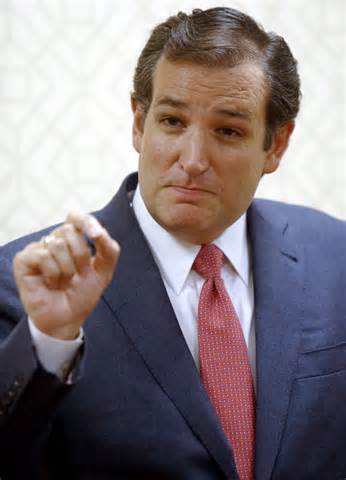
…and they’re off! Senator Ted Cruz of Texas plans to announce his formal candidacy for president today, according to the Houston Chronicle. And he’s making the announcement at Liberty University.

Why Liberty? As the Sophisticated and Good-Looking Regular Readers of ILYBYGTH (SAGLRROILYBYGTH) are well aware, I’m working on a history of fundamentalist higher education. These schools–places like Liberty, along with more liberal cousins such as Wheaton College and Biola University, and more conservative ones such as Bob Jones University—are central institutions of American conservatism.

Cruz at Fundamentalist U

Cruz at Fundamentalist U

Not only do they represent conservative evangelical belief, but also a vaguer (and politically powerful) sense of cultural traditionalism. The campuses of Wheaton, Liberty, and Bob Jones are not just in-your-face religious environments, but also places where you wouldn’t see until recently a man with long hair or a woman with a short skirt.

Not only that, but college campuses also represent cutting-edge learning. Fundamentalist and evangelical colleges are not only religious, not only conservative, but also forward-looking places. By hosting scholarship and teaching, evangelical schools represent the future.

For all these reasons, at least since Reagan, GOP candidates have made it a point to campaign at these campuses. As CNN noted this morning, everyone from Romney to McCain, Rick Perry to Michele Bachmann has put in an appearance.

It makes sense. And it leads us to an interesting question: If you planned to run for president, where would YOU make your announcement? I have an idea of what I’d do.

Who Cares about Adam?

I don’t get it. Even after all these years studying conservative Christianity and creationism, I still don’t really get it. I mean, I understand the logic and history, but I have a hard time making sense of the ferocious emotion that goes into debates over the existence of an historical Adam & Eve. An author interview in Christianity Today outlines some of the tricky questions involved.

Who cares?

Who cares?

But first, a primer for those like me on the outside looking in: The debate over the historicity of Adam & Eve has a long history in conservative evangelical Protestantism. For us outsiders, making sense of this issue will go a long way toward helping us understand the theological underpinnings for young-earth creationist belief. Without making sense of this theology, it can be easy for mainstream scientists and observers to conclude mistakenly that young-earth creationism is nothing but some kind of cult of personality, a quirk of history.

At least since the 1960s (of course it is an ancient belief, but in 1960 it gained popularity among conservative American evangelicals as a vital theological notion central to orthodox belief), conservative evangelicals have insisted that the obvious meaning of Genesis is that God created two first humans in the Garden of Eden. These two, Adam & Eve, became the progenitors of the entire human race. Theologically, creationists have insisted, our belief in an historical Adam & Eve underpins our trust in the Bible. As Simon Turpin of young-earth ministry Answers In Genesis expressed it,

The debate over whether Adam was historical is ultimately a debate over whether we trust what the Scriptures clearly teach. If we cannot be certain of the beginning, then why would we be certain about what the Scriptures teach elsewhere? The uncertainty of truth is rampant in our culture partly due to the influence of post-modernism which is why many believe the issue over Adam’s historicity is unimportant.

For many creationists, believing the plain truth of the creation story in Genesis means believing in the trustworthiness of Jesus Christ. As Andrew Snelling of the Institute for Creation Research explained,

It is impossible to reject the historicity of the book of Genesis without repudiating the authority of the entire Bible. If Genesis is not true, then neither are the testimonies of those prophets and apostles who believed it was true.

Of course, for mainstream scientists, the notion that human genetic diversity came from only two original humans does not fit the evidence. In order to have today’s genomic sequence, I’m told, humanity must have begun with thousands of original humans.

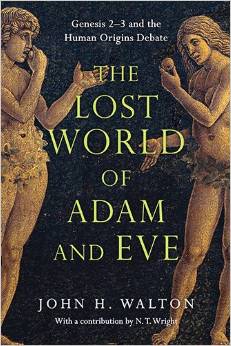
John Walton of Wheaton College explains to Christianity Today why evangelicals can accept this science while still remaining true to a conservative reading of Scripture. In his new book, The Lost World of Adam & Eve, Walton argues that Adam & Eve can be read as the “priests” of early humanity, not the only two first humans.

Again, for those of us outside of conservative evangelicalism, the controversial nature of such claims can be hard to figure. Recently, theologian Peter Enns was booted from Westminster Theological Seminary for advocating similar ideas. Walton explains in this interview why it is possible to respect the authority of the Bible while still reading Genesis in a way that is not contrary to modern science. Walton insists that

You can affirm a historical Adam, but that doesn’t have quite the implications for biological human origins that are often assumed.

The key, Walton argues, lies in reading Genesis as the original readers would have. To them, Walton says, creation would be more about how the world of Adam & Eve was “ordered,” not just how it was “manufactured.” We can understand Adam as both a real person, a real creation, and as an “archetype” for humanity. Though there may have been other early humans, Walton explains, Adam & Eve served as the ones in God’s sacred space.

Why do such ideas matter? Again, for folks like me trying to understand conservative Protestantism from the outside, it can be difficult to make sense of the ferociously controversial nature of such arguments.

Yet they are at the heart of conservative evangelical Protestantism. As I argued in my 1920s book, conservative evangelicals have never agreed on the proper relationship of Genesis to either modernist theology or science. From J. Gresham Machen in the 1920s to Harold Lindsell in the 1970s, conservative intellectuals battled to affirm the notion that any compromise is deadly to faith.

And as I’m finding in my current research, these battles have long sent shock waves through the world of conservative higher education. Recently, Bryan College has firmed up its insistence that faculty members affirm their belief in an historical Adam & Eve. In 1961, Wheaton College did the same thing.

And fundamentalists are not the only ones who will spring to repudiate theories like Walton’s. Leading atheist pundits, too, agree that Genesis requires an historical Adam & Eve. Jerry Coyne, for example, laments the apologism of folks like Walton. Of course, Coyne does not want people to reject mainstream science in favor of a belief in an historical Adam. Rather, he hopes people will simply accept the obvious conclusion that the Bible is a book of myths.

If all of these whirling debates make your head hurt, join the club. For those of us outside the circle of evangelical Protestantism, it can be very difficult to understand the ferocious feelings at play in the Adam debate. But that ferocity lies at the heart of evangelical belief. Historically, any attempt to rationalize our reading of the Bible, any attempt to explain away the most obvious interpretation of Scripture in favor of one that accords with modern science, any effort to bring our faith into harmony with science…all have been seen as the beginnings of apostasy.

For evangelical readers, Adam & Eve matter. For those of us trying to understand conservative Christianity, this complicated debate will be a good place to start. Why would professors lose jobs over it? Why would Christianity Today dedicate a major article to this interview with John Walton? Why will Walton’s position provoke such furious responses?

Fundamentalism and the Modern University

Are evangelical colleges modern? Or, with their insistence that knowledge has its roots in God’s Holy Word, are they somehow trapped in medieval ideas about knowledge and the purposes of higher education? The answer is more complicated than it might seem at first.

As the sophisticated and good-looking regular readers of ILYBYGTH (SAGLRROILYBYGTH) are sick of hearing, I’m hard at work on my book about evangelical higher ed. In the twentieth century, Protestant fundamentalists opened or transformed a network of colleges dedicated to protecting fundamentalist faith. If students are led astray at mainstream secular colleges, the thinking went, fundamentalists needed their own schools to teach each new generation of Christians how to be educated and evangelical.

As part of my reading list, I’m deep in Roger Geiger’s new book, The History of American Higher Education (Princeton University Press, 2015). I’m writing a full review for Teachers College Record and I’ll be sure to post links to that review when it comes out.

Are fundamentalists colleges modern? Or are they trapped in the 1600s?

Are fundamentalist colleges modern? Or are they trapped in the 1600s?

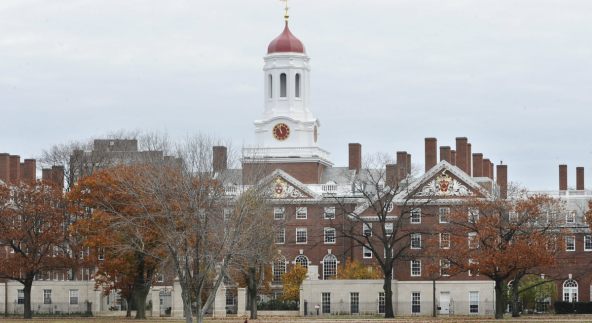
In the meantime, though, Professor Geiger’s survey of the first colleges raises some tricky questions for fundamentalist higher education. As with so many early American institutions, colleges such as Harvard and Yale represented the tail end of medieval traditions, just as they were changing into recognizably modern ways of thinking.

Conservative evangelicals like to point out that America’s leading colleges were often founded as religious schools. It’s true. Harvard and Yale were both intended, first and foremost, to defend orthodox Puritanism. Not only were they ferociously religious, but they envisioned their role in a radically non-modern way. Instead of serving as an institution that encouraged new thinking, Harvard and Yale in the 1600s and early 1700s both saw their role as passing along established truth. As Prof. Geiger puts it, in the early decades, “The corpus of knowledge transmitted at Harvard College was considered fixed, and inquiry after new knowledge was beyond imagining.”

Orthodoxy at these early schools was defended with a rigor that would make twentieth-century fundamentalists proud. Harvard’s first president, for example, was ousted for theological reasons. President Henry Dunster came to believe that infant baptism was not a scriptural practice. As a result, the General Court summarily got rid of him. In their words, no one could lead a college if they “manifested themselves unsound in the faith.”

Both Harvard and Yale made explicit their goals. In early years, Yale explained its primary religious mission:

Every student shall consider the main end of his study to wit to know God in Jesus Christ and answerably to lead a Godly sober life.

It was not much different at Harvard:

the main end of [a student’s] life and studies is, to know God and Jesus Christ which is eternal life, Joh. 17.3

In all these aspects, life at Harvard and Yale between the 1630s and 1720s seems remarkably similar to life at fundamentalist colleges in the early twentieth century. For schools such as Wheaton College, Bob Jones College, Bible Institute of Los Angeles, or Gordon College, these Puritan echoes resounded loudly. At all these fundamentalist schools, leaders insisted that the first goal was to help students understand themselves as Christians. The first intellectual challenge was to study seemingly distinct bodies of knowledge to see the hidden connections put in place by God.

In this way, then, it seems as if fundamentalist colleges—even those more liberal schools that eventually abandoned the “fundamentalist” label—hearken back to a pre-modern vision of higher education.

We have to be careful, though, before we assume too much. In other important ways, twentieth century dissenting religious colleges participated fully in the central intellectual tradition of modern higher education.

According to Professor Geiger, colonial higher education went through a revolutionary change in the 1720s-1740s. During that period, endowed professorships at Harvard gave some faculty members the independence to pursue new forms of knowledge. These professors began to incorporate the ideas of new thinkers such as Isaac Newton and John Locke.

The radical change came not only from the newness of the ideas, but from the notion that the college or university should be the place to explore such new ideas. As Professor Geiger puts it,

The significance and prestige of Newtonian science altered college teaching by introducing the experimental lecture employing apparatus, creating a demand for specialized professors and establishing the expectation that the curriculum should incorporate new knowledge.

A fundamental characteristic of the modern university emerged in the decades before the American Revolution. College, more than any other institution, came to be seen as the province of cutting-edge thinking. As Professor Geiger points out, even before Ben Franklin made his famous experiments with lightning, John Winthrop at Harvard used his endowed Hollis Chair funding to purchase equipment that would allow him to demonstrate the properties of electricity.

Just as the fundamentalist colleges of the twentieth century clung to the pre-modern notion that universities ought to pass along established truths, those same fundamentalist schools fully participated in the modern notion that universities ought to explore new truths.

An evangelical scientist, for example, such as Russell Mixter at Wheaton College in the 1950s, believed that no amount of human investigating could overturn the truths of Scripture. But Mixter (and others like him) also saw himself as an intellectual specialist, a scientist exploring the outer boundaries of biology to discover new things about God’s creation.

Are fundamentalist and evangelical colleges modern? In this sense, they certainly are. The faculty at twentieth- and twenty-first century conservative colleges are divided into academic disciplines. Each of them is expected to carry out research in his or her field. The definition of those fields may be different from the ones at secular institutions, but the fundamentally modern notion of research remains central.

At the same time, though, by envisioning themselves as the guardians of students’ faiths, fundamentalist colleges hearken back to the pre-modern roots of the Ivy League. As Professor Geiger argues about 17th century Puritan higher education, “the deeper purpose of the college course and the overriding preoccupation of the institutions were to demonstrate the truth of Christianity.”

Today’s evangelical colleges would agree.

Racists Welcome

Is even the vilest speech protected? The expulsions of racist chanters at the University of Oklahoma has riled up conservative commentators. No matter how hateful the speech, some say, colleges have no right to expel students for exercising their rights to say it. I can’t help but think that the real target of conservative ire is the current vibe on college campuses.

In this case, the speech in question was undeniably horrifying. Frat members sang along that Sigma Alpha Epsilon would never welcome an African American member. Of course, they used a much more offensive term than “African American.” They cheerfully shouted that they could lynch any offender. Horrible stuff.

But is it protected?

Eugene Volokh of the Volokh Conspiracy thinks so. There is no exception to free-speech rights for racist language, even language that creates “hostile environments.” Unless one is issuing specific threats, one may even use language that suggests violence.

Voices of protest?  Or drunken howl?

Voices of protest? Or drunken howl?

At National Review, David French agrees. In its rush to justice, French says, the university failed to observe basic constitutional principles. It was entirely right and just for the national officers of the fraternity to punish the Oklahoma chapter. And it seems fair that the Sooner football team will now lose a prize recruit—to Alabama, no less. But such private-party sanctions are different than official university sanctions.

As have many other conservative commentators, French identifies the broader problem as one of higher-education ideology careening out of control. “Our public universities,” French writes,

are becoming national leaders in trampling the Constitution to legislate their brand of “inclusive” morality.

I understand the argument. And generally, in these pages, I try to refrain from injecting my own opinions. I can’t help but wonder, though, if these conservative intellectuals have over-stepped in their constitutional rationalizations. It seems some conservatives are too quick to protest any action by the leaders of today’s universities.

As I argue in my new book, this anti-university tradition among conservative intellectuals has a long history. Beginning in the late nineteenth century, conservative thinkers bemoaned the changes taking place at leading schools. Instead of passing along time-tested truths, universities made it their job to subvert and question those ideas.

These days, many conservatives lament, universities have become special homes for welcoming certain sorts of offensive speech. For instance, as Professor Volokh points out, many kinds of hateful speech—even violent speech—have long been recognized as protected on campus. No student would be sanctioned for displaying pictures of African American militants wielding shotguns and intoning, “By Any Means Necessary.”

There seems to be an important difference, though, between speech meant to protest against existing conditions and the SAE’s brand of exuberantly hateful race-baiting. The students in this case were not engaged in thoughtful commentary on unfair conditions. They did not hope to attract attention to their cause by using intentionally inflammatory language.

Instead, this looks like a drunken outburst of knee-jerk segregationism, a case in which vino exposed a terrible veritas. When exposed, the expelled students did not defend their actions on the grounds of free speech. Rather, they humbly acknowledged the shamefulness of their actions.

Indeed, it might have been more compelling as a free-speech case if the students had defended their outburst. If, that is, students had been even more painfully racist; if they had been intentionally offensive and if they had knowingly provoked this sort of reaction, then they would have a better claim to constitutional protection. It seems to me, though, that these students are merely petty campus despots, shouting in secret language that they abjure in public.

Does it count as an exercise of free speech when even the speakers find it offensive?

Fundamentalist University Can’t Stay Afloat

Looks like the world of fundamentalist higher education will be shrinking at the end of this semester. Chattanooga’s Tennessee Temple University will be closing its doors, merging with nearby Piedmont International University. In spite of accusations by some critics, this closing does not prove that fundamentalist colleges can’t make it in today’s society. After all, these kinds of closings are all too common among all sorts of schools.

On their Last Crusade...

On their Last Crusade…

Officially, TTU will close due to the lack of financial support from alumni. Instead of the needed three to five million dollars trustees hoped for, TTU alumni coughed up a meager $65,000.

Critic David Tulis blamed the closure on the insular theology of the school. Leaders had grown too fond of their own dispensational truths and “Christian Zionism,” Tulis charged. TTU had allowed itself the unaffordable luxury of inbred intellectualism and backwater academics.

There may be truth in such charges, but anyone familiar with the shaky history of higher education will know that all sorts of schools close for all sorts of reasons.

Most recently, the closing of Virginia’s Sweet Briar College has sent tremors through the world of higher education. If a storied institution with a fat endowment can be run out of business, who is safe?

Among evangelical colleges, too, these sorts of closings and mergers are not unique to the more conservative fundamentalist type. In the 1980s, Barrington College merged with nearby Gordon College. Financial pressures can obviously become overwhelming, irrespective of theological positions.

In the case of Barrington and Gordon, as I’m finding in my current research, these two (relatively) liberal evangelical schools had long been rivals. As late as 1961, the president of Barrington declared that he would never consider joining with Gordon in any sort of money-saving merger. The only way for Barrington to succeed, President Howard Ferrin insisted twenty-five years before the schools’ eventual merger, was by “stressing its differences from Gordon.”

We must remember also that colleges from this fundamentalist Baptist tradition can do very well financially. Most obviously, Virginia’s Liberty University makes more money than it knows what to do with. By making savvy investments in online education, the leaders of Liberty have proved that a fundamentalist school can thrive in today’s turbulent higher-education market.

But not every fundamentalist school. The leaders of Tennessee Temple have promised that current students will be able to finish their academic programs, one way or another. Also, as President Steve Echols ruminated,

countless lives have been forever changed and will continue to be changed through the heritage of Tennessee Temple University.

In spite of what some pundits might assert, this news from Chattanooga does not mean that fundamentalist higher education is on the way out. The financial struggles at TTU, after all, serve as more proof that fundamentalist universities and colleges often have more in common with non-fundamentalist schools than their leaders might like to admit.

Christian School Causes Student to Abandon Creationism

How can parents make sure their children don’t lose their faiths? Enrolling them in religious school is not enough. As a recent story from the BioLogos Forum makes clear, education ranges far beyond schooling. Too many hasty critics, religious and secular alike, have assumed that we can control education by controlling schooling. It’s just not that simple.

This Christian learned to embrace evolution, but not in school...

This Christian learned to embrace evolution, but not in school…

In the pages of the BioLogos Forum, college sophomore Garrett Crawford shared his educational story. Crawford was raised in a conservative evangelical household. He went to a Christian school, one that presumably hoped to shield Crawford’s faith from secularism. While at that school, Crawford relates, he grew curious about the scientific evidence for evolution. After a lot of reading and study, Crawford concluded that he could no longer believe in young-earth creationism. After a lot more reading and study, Crawford concluded that Christian faith does not require a belief in a young earth. It is entirely theologically legitimate, he decided, to accept the science of evolution.

In Crawford’s case, his education took him in directions his school never intended.

Such stories shouldn’t surprise us. After all, with just a moment or two of reflection, we can all think of ways that our “education” has differed from our “schooling.” Yet in all of our tumultuous educational culture wars, pundits rush to make sweeping claims about education based on scanty evidence from schools.

We’ve seen this recently in the pages of the New York Times, when philosopher Justin McBrayer declared–based on data that was not just slim, but positively anorexic–that Our Schools Were Training Amoral Monsters.

Among conservative Christians, too, this tradition of school-bashing has a long history.  In the 1970s, for example, fundamentalist school leader A.A. “Buzz” Baker decried the tendency of many conservative Christians to rush into school-founding for the wrong reasons. In his book The Successful Christian School (1979) Baker warned that too many parents and pastors rushed to open new schools because they thought

Public education has failed! It is failing to provide a good academic education while exposing our children to a godless, secular-humanistic approach to life.

Leading young-earth creationists have long assumed that the best way to protect their children’s faith is by attending creationism-friendly schools. Ken Ham, for example, argued that Christian colleges and universities can lead students astray from true faith when they abandon young-earth thinking. As he put it,

the real issue concerns Christian colleges, universities, and seminaries that break away from the authority of Scripture in Genesis—held to by the majority of scholars up through the Reformation—and teach students that God’s Word doesn’t mean what it says. That’s what makes students doubt the truthfulness of the Bible as a whole, and can be a major reason many of them walk away from the Christian (not “creationist”) faith, as we see happening in our culture today.

From the other side, many secular or liberal critics insist that fundamentalist schools are nothing but indoctrination factories. As friend of ILYBYGTH (FOILYBYGTH) Jonny Scaramanga told the BBC, his fundamentalist schooling experiences were nothing short of “horrendous.” During his sojourn in a fundamentalist school, Scaramanga remembers, he did nothing but recite back theological nostrums. The school was so socially crippling, Scaramanga relates, for the rest of his life he was “always playing catch up.”

Scaramanga’s own case, however, shows that schooling of any sort is only one part of a person’s education. Scaramanga himself has now become a leading voice in the anti-fundamentalist education scene. Like Garrett Crawford, Scaramanga’s education took him in directions that his schooling never intended.

The take-away? Of course we should all care about the way schools operate. Better schools will help produce better educations for all students. At the same time, though, we all need to remind ourselves that formal schooling makes up only one slice—sometimes a small slice—of a person’s education.

How many of us, after all, can say that we came out the way our schools intended?

Anti-Semitism at UCLA and the Anti-Christian University

Can a qualified student be barred from a student organization because she is Jewish? That is the awkward debate from UCLA that has attracted national attention recently. Here at ILYBYGTH, we have to ask a different awkward question: How is this debate different from the one about conservative evangelicals on campus? UCLA’s student leaders have apologized for the anti-Semitic slant of this incident, but many universities have intentionally de-recognized Christian organizations due to their Christian beliefs.

As the New York Times reported, Rachel Beyda’s confirmation hearing on February 10 turned into a painful debate about her Judaism and her affiliation with campus Jewish groups. Beyda is a sophomore pre-law student, hoping for a place on the student judicial council. At the February 10 meeting of the Undergraduate Students Association Council, her qualifications were questioned. One councilwoman asked Beyda,

Given that you are a Jewish student and very active in the Jewish community … given that recently … [inaudible] has been surrounding cases of conflict of interest, how do you see yourself being able to maintain an unbiased view … [inaudible]?

Eventually, Beyda was voted in, but the agonizing back-and-forth about Judaism and bias has caused the university and the student group to apologize. They had not meant to imply that Jewish students have a special sort of bias; they did not mean to say that Jewish students have divided loyalties. Such ideas, they affirmed later, have a long and ugly history in American history.

As the New York Times points out, this sort of anti-Jewish attitude has become more common on college campuses, largely due to protest against Israel’s politics. The Boycott, Divest, and Sanction movement in support of Palestinian rights has attracted widespread support among college leftists. It has become increasingly difficult for students to separate their anti-Israel ideas from anti-Semitic ones.

As the New York Times’s Adam Nagourney writes, this incident

has set off an anguished discussion of how Jews are treated, particularly in comparison with other groups that are more typically viewed as victims of discrimination, such as African-Americans and gays and lesbians.

What about the anti-evangelical bias of many universities? As we’ve seen here at ILYBYGTH, evangelical groups such as Intervarsity Christian Fellowship have been de-recognized at many pluralist colleges, including the Cal State system.

First, a few caveats: I’m no evangelical myself. I’m not asking this question as an apologist for conservative Christianity. Indeed, I vehemently disagree with most conservative evangelical political and theological positions. Nor am I unaware of the fact that these are different situations. I understand that Intervarsity has been derecognized not because of its ethnic background, but because of its discriminatory beliefs. Intervarsity members are not barred from leadership in campus activities because they might have “divided loyalties,” to use the ugly rhetoric of the recent UCLA discussion. Rather, the group as a whole is pushed out because it does not allow non-evangelicals to take leadership positions in its own group.

Having said all that, I think the Intervarsity case is another prime example of the ways “discrimination” is often used in conflicting and short-sighted ways on today’s college campuses. The student council members at UCLA insisted that they did not mean to imply that Jewish people somehow could not be full members of the university community. In short, the student-council members suffered from an overzealous interpretation of discrimination. Some council members apparently believed that there was something “discriminatory” about being Jewish.

Similarly, Intervarsity has been de-recognized because its leadership policy is discriminatory. It really is. Only those who affirm Intervarsity’s statement of faith can be leaders. This rules out students engaged in active homosexual relationships, not to mention Jewish students, Muslims, Catholics, and even liberal Protestants.

The awkward result, of course, is that Intervarsity itself has been discriminated against. Can’t some student groups engage in some forms of discrimination? Isn’t it fair for a religious group to insist that its leaders be part of its religion? Yes, such policies are frankly discriminatory. But is all discrimination necessarily beyond the bounds of proper campus thinking?

Let me repeat: I do not think the two situations are identical. I’m no member or fan of conservative evangelical student groups. But it does seem as if the zeal to purge campuses of any group that might be “discriminatory” has led to weird and troubling sorts of discrimination. Like the confused student council members at UCLA, some zealous campus voices seem to overcompensate in their desire to purge discrimination.

Religious Students, Secular Schools

HT: HH

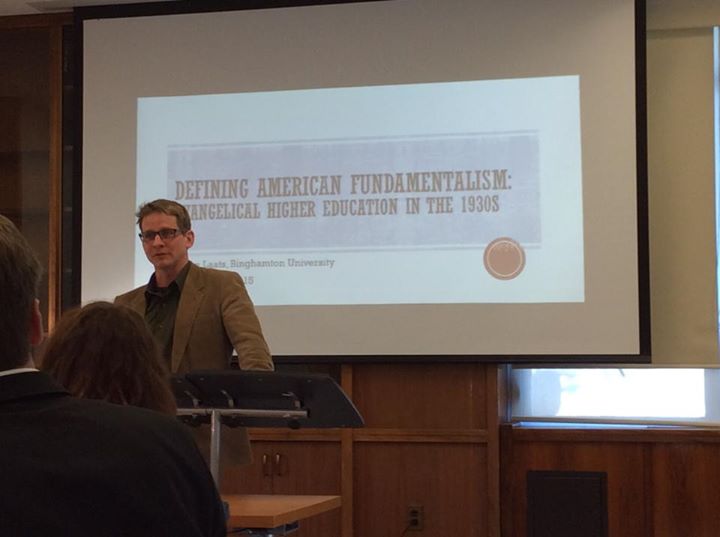
Thanks to all those who came out Wednesday to participate in my talk at Binghamton University about fundamentalist colleges in the 1930s.  Not only was a good time had by all, but the conversation made clear that even at this, our most “secular” of colleges, religion is thriving.  Despite the ignorant nostrums of elite secular academics and fuming fundamentalists, conservative religious students and faculty seem to thrive at pluralist schools like ours.

Don't hate me  because I'm beautiful...

Don’t hate me because I’m beautiful…

For those who are just tuning in, this talk was part of our series in “Religion in the Modern University.”  I shared my current research into conservative evangelical colleges.  The conversation after the formal talk revealed that both students and faculty at our beloved public university come from all sorts of religious backgrounds, including conservative evangelical Protestantism.

Unlike the schools I’m studying, our “secular” college does not actively encourage any specific sort of religious belief.  Nevertheless, our school proves a congenial home for students and faculty who hold conservative evangelical beliefs.

This flies in the face of some common assumptions about secularism and higher education.  As sociologist Elaine Howard Ecklund found in her study of elite secular academics, many of them have absolutely no idea of the high level of religious belief at their own non-religious elite universities.

Fundamentalists, too, have long assumed that “secular” colleges were hostile to their sort of religious belief.  As fundamentalist college founder Bob Jones Sr. was fond of saying in the 1920s, he would

just about as lief [sic] send a child to school in hell as to put him in one of those institutions.

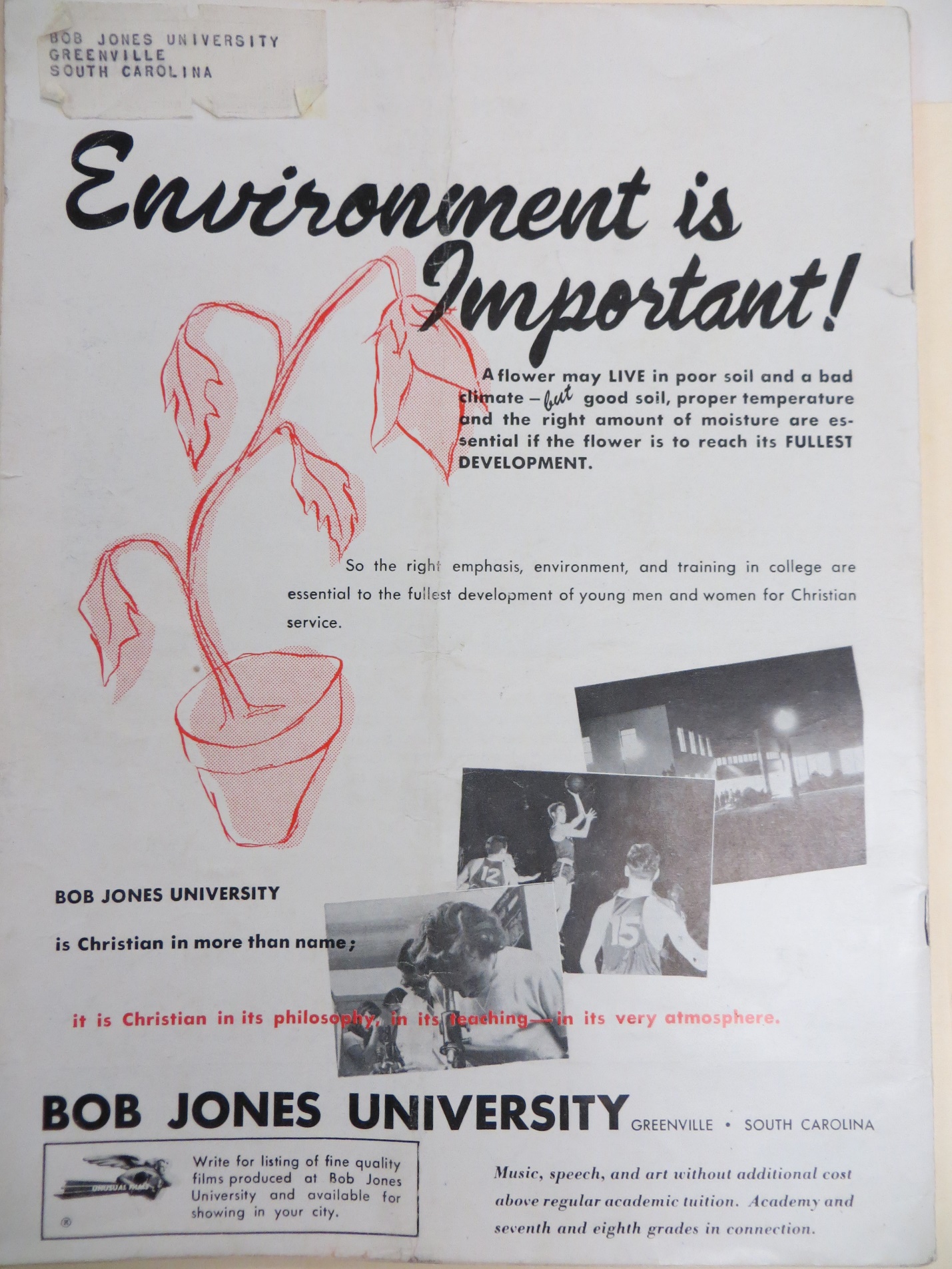
At Bob Jones University, as at other fundamentalist universities, this notion that only a truly fundamentalist school can protect students’ faith remained central throughout the twentieth century, as this 1956 advertisement demonstrated.

Fundamentalist students, fundamentalist schools

Fundamentalist students, fundamentalist schools

More recently, too, creationist leader Ken Ham took me to task for questioning his insistence that creationist families must send their children to young-earth-friendly colleges.  As Ham concludes,

at the very minimum I do urge parents to ensure they do all they can to equip their children to be able to defend the Christian faith against the attacks of our day, and to stand uncompromisingly on the authority of the Word of God.

Does that mean that religious students need to go to schools that share their faith?  I don’t think so.

I certainly understand the many differences between a pluralist school like our beloved Binghamton University and schools with a unified religious message.  But we need to remember that so-called “secular” colleges like ours are often very friendly places to creationists and fundamentalists.

Jesus and American Sniper

HT: SD

Every smart Christian knows that real religion is bigger than any one country, any one patriotic tradition. But in the United States, conservative evangelicalism has become so tightly bound with traditions of patriotism and national pride that it can be difficult to separate the two. Just ask Randy Beckum.

Until Monday, Dr. Beckum served as both University Chaplain and Vice President for Community Formation at Mid-America Nazarene University, a small-ish holiness school in Kansas. After a controversial chapel talk, Beckum found himself out of a job. Beckum had wondered aloud if America’s fascination with the film American Sniper meant that “our culture is addicted to violence, guns, war, revenge and retaliation.”

Evangelical Christians need a reminder, Beckum said, that

We have to be very careful about equating patriotism with Christianity.   We never say God and…anything.  God is above all, everything else is underneath. I love my country and am thankful for freedom. But the earliest Christian creed was very politically incorrect and dangerous. Jesus is Lord and Caesar is not. We have put “our way of life”/freedom on the top rung.

For those of outside of the world of MidAmerica Nazarene University, these seem like rather unremarkable sentiments. But at that school, they sparked a firestorm of controversy. As one MNU student tweeted, “So your [sic] saying that my long list of family members in military [sic] are not good Christians?”

MNU President David Spittal denied that Beckum’s removal from the VP job had anything to do with the patriotism controversy. But Blake Nelson, a “resident educator” at MNU, objected. As Nelson wrote in an open letter to the MNU community,

When one exercises his or her right to wrestle with big questions, and is demoted the next week, it feels as if we have all been demoted. If someone’s job security isn’t safe in the aftermath of their wrestling with the Word of God, none of us are safe. No matter what language it is couched in, a demotion like this creates fear where there should be freedom. Whether or not it was intended to be, this is an implicit attack on free expression. If it looks like a duck, and quacks like a duck, it’s probably a duck. The message is clear. This is a censure.

For conservatives throughout the twentieth century, too, it has been difficult to separate patriotism from religious sentiment. As I argue in my new book, educational conservatives have long blended the two into an organic whole. Conservative Texas leaders Mel and Norma Gabler, for example, always linked creationism, traditional Protestantism, patriotism, and free-marketism in an seamless conservative fabric.  As an admiring biographer wrote in 1986,

They understood why the new history, economics, and social study texts trumpeted Big Brother government, welfarism, and a new socialistic global order, while putting down patriotism, traditional morality, and free enterprise. Simply stated, Mel and Norma realized that the Humanists in education were seeking to bring about the ‘social realism’ which John Dewey and other ideologues had planned for America.”

Dr. Beckum and the MNU community are finding out just how hard it can be for conservatives to separate out their love for Jesus with their love for America.

Harvard Brings Lynching Back

Have college campuses welcomed a new generation of lynch mobs? It is a disturbing question raised recently by Harvard Law School Professor Janet Halley in the pages of the Harvard Law Review.

New home of the academic lynch mob?

New home of the academic lynch mob?

Last November, Halley publicly critiqued Harvard’s new policy for handling accusations of sexual assault. Under pressure from the federal Office of Civil Rights, Harvard and many other schools, Halley charged, felt

immense pressure to decide flimsy, weak, doubtful and difficult cases favorably to complainants, or face the wrath of a government agency that can cut off all federal funding to the entire institution.

In her commentary in the Harvard Law Review, Halley takes her argument a step further. How can we decide cases of alleged sexual assault, Halley asks, when policy is decided more by emotion than by reason? As she asks, new policies at many schools include

a commitment to the idea that women should not and do not bear any responsibility for the bad things that happen to them when they are voluntarily drunk, stoned, or both. This commitment cuts women off — in theory and in application — from assuming agency about their own lives. Since when was that a feminist idea?

More disturbing, Halley raises the obvious but horrifying parallel. In America’s brutal history, there is plenty of precedent for what can happen when those accused of sexual assault have no legal right to defend themselves. We call it lynching. As a new report from the Equal Justice Initiative makes painfully clear, America’s white population often brutalized and murdered African American men on the merest whiff of accusations.

Is it hyperbole to suggest that today’s campus-rape rules threaten to bring back such lynch-mob mentalities? The danger, Professor Halley suggests, is that colleges are under intense pressure to convict someone accused of sexual assault, even if there is not enough evidence to do so. She cites a widely publicized case from Hobart and William Smith Colleges. In that case, the college decided that it did not have enough evidence to charge anyone with sexual assault, in spite of ample evidence that a rape had occurred.

Halley does not suggest that the victim was lying or making it up. But she worries that colleges will feel pressure to convict someone in such cases, even when there is not enough evidence to do so. In this case, Halley argues that the rush to bring justice for the victim blinds us to the rights of the accused. As she puts it,

the Colleges had to assign blame to one or more of their students despite their complete lack of direct evidence about which of them actually deserved it.

Halley wonders if such policies will bring lynching back. She writes,

American racial history is laced with vendetta-like scandals in which black men are accused of sexually assaulting white women that become reverse scandals when it is revealed that the accused men were not wrongdoers at all.

These are difficult charges to hear, much less evaluate. After all, the more obvious moral challenge facing colleges is not the violent history of lynching, but the shameful history of ignoring the pleas of victims of sexual assault. For decades, universities—including the evangelical schools I’m studying these days—covered up campus rape in an ill-conceived quest to preserve their reputations as safe havens for young people.

Nevertheless, these are vital questions we must ask. Do Professor Halley’s worries have merit? Are colleges these days—in an understandable rush to correct past abuses—heading too far in the other direction? Must the rights of the accused be protected with the same vigor as the rights of the accuser?