Hate Speech: The Blog Defense

I know, I know, it is not the main point of the story. I can’t help but be amazed, though, at one of the defenses this embattled professor gave. So, yes, he compared sexual-assault accusations to “spin the bottle.” And he called the Democrats the “sissy party” and suggested that all judicial appointees be required to commit sexual assault. He defended his comments as satirical, but he also gave, to my mind, a much more poignant defense.

langbert

Sure, I said it, but I didn’t think anyone was listening…

Here’s what we know: according to Inside Higher Ed, Brooklyn College Professor Mitchell Langbert made some pretty outrageous public comments after the Kavanaugh hearings. For example, Prof. Mitchell opined,

If someone did not commit sexual assault in high school, then he is not a member of the male sex.  The Democrats have discovered that 15-year- olds play spin-the-bottle, and they have jumped on a series of supposed spin-the-bottle crimes during Kavanaugh’s minority, which they characterize as rape, although no one complained or reported any crime for 40 years.

The Democrats have become a party of tutu-wearing pansies, totalitarian sissies who lack virility, a sense of decency, or the masculine judgment that has characterized the greatest civilizations: classical Athens, republican Rome, 18th century Britain, and the 19th century United States. They use anonymity and defamation in their tireless search for coercive power.

The Kavanaugh hearing is a travesty, and if the Republicans are going to allow the sissy party to use this travesty to stop conservatism, then it is time found [sic] a new political party.  In the future, having committed sexual assault in high school ought to be a prerequisite for all appointments, judicial and political.  Those who did not play spin-the-bottle when they were 15 should not be in public life.

Predictably, students at Brooklyn College protested. Such hateful speech, they insist, should be grounds for Langbert’s termination.

In his defense, Prof. Langbert revised his blog post, adding an introductory disclaimer describing his post as satirical, that his point was precisely to underscore the ridiculousness of the current political climate. As he put it,

It is intended to be taken in the same light as Swift’s claim that Irish children should be eaten. I was surprised to learn that some readers took me literally, claiming that I advocate rape.

To this reporter, the satire in Prof. Langbert’s original post is pretty easy to miss. I might call it an example of hyperbolic rhetoric, but as a high-school English teacher, I would never use this example to illustrate the complicated genre of satirical writing.

SAGLRROILYBYGTH might disagree about whether or not this counts as satire, but this morning I’d like to focus on a different aspect of this case. When asked about his controversial blog post, Prof. Langbert offered a much sadder defense as well. Not only was it meant to be satirical, Langbert said, but usually only about twenty people per week visited his blog.

Does that make it okay? We all know some forms of speech are not protected. For example, shouting “Fire” in a crowded theater is not acceptable. However, what if you shouted “Fire” to an empty room?

Why Can’t Evangelical Colleges Change?

Who decides the rules at evangelical colleges? In Fundamentalist U, I argued that school leaders were tightly constricted by a lowest common denominator of populist evangelicalism. Yes, deep theological ideas mattered, but more important was the absolutely non-negotiable need for colleges to be perceived by the broader evangelical public as absolutely “safe.” The events at Asuza Pacific University this week seem to confirm my thesis.

asuza pacific

[No] Ch-ch-ch-ch-changes…

Here’s what we know: A few days ago, Asuza Pacific announced a new policy for LGBTQ+ students. Like all students, they could now freely engage in romantic relationships, but sex was out of bounds. It was a bit of an odd decision to outsiders, since APU maintained its insistence that the only proper sexual relationship was a heterosexual marriage. Nevertheless, it represented a pretty big change for a conservative evangelical college.

As we’ve reported in these pages, the question of homosexuality on evangelical campuses has driven a wedge between conservative evangelical schools. I’ve argued recently that the issue of homosexuality, along with other culture-war bloody shirts such as young-earth creationism, is leading to the creation of a “new fundamentalism” in some colleges.

And so, predictably, APU’s announcement led to conservative pushback. Pundits such as Rod Dreher called the policy switch

a feeble attempt by one of the country’s largest conservative Evangelical colleges to satisfy the Zeitgeist while maintaining the fiction that the school is still conservative and Evangelical on human sexuality. . . . some APU students leave college with their faith in tatters, having been transformed into Social Justice Warriors by a college that sells itself as conservative and Evangelical[Emphasis in original.]

As I pointed out in Fundamentalist U, no evangelical college is immune to this kind of pressure. Throughout the twentieth century, conservative gadflies have been able to influence the goings-on at evangelical schools by warning that students might not be “safe” on their campuses.

No matter what administrators might like to do, maintaining their public image as impeccably safe spaces for conservative evangelical youth is absolutely essential. This is not a quirk of Asuza Pacific or a relic of the twentieth century. Just ask Larycia Hawkins. Or Randy Beckum. Or Stephen Livesay.

We should not be surprised, then, to find out this morning that APU reversed its decision. The board announced that the policy change had never been approved. APU, the board declared, was still an unquestionably safe place for conservative evangelical students. As the board put it,

We pledge to boldly uphold biblical values and not waver in our Christ-centered mission. We will examine how we live up to these high ideals and enact measures that prevent us from swaying from that sure footing.

In the language of evangelical higher education, yesterday and today, “change” might be good. But “wavering” has always been beyond the possible. If a university hopes to survive, it must pander to popular conservative ideas about sexuality, politics, race, and any other difficult topic. It absolutely must continue to attract student tuition dollars and alumni donations. Any threat to that bottom line, no matter how theologically sound or spiritually attractive, will always be crushed.

Higher Ed as a Weapon

Looks like the tradition continues. As the Brett Kavanaugh hearings sweep over Washington DC like a brushfire, Liberty University is back to its old 1970s tactics. Turns out clean-cut well-dressed conservative Christian students are a potent political weapon.

liberty busses at kavanaugh hearing

From Jack Jenkins…

Here’s what we know: Jack Jenkins has reported that two Liberty University busses pulled up to the Kavanaugh hearings this morning. Presumably, Jerry Falwell Jr. is pulling a few pages from his dad’s political playbook.

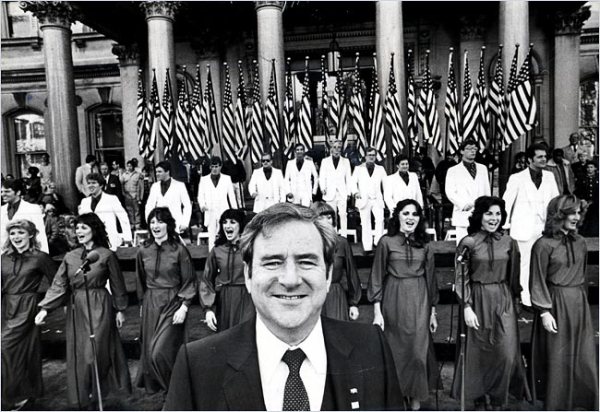
Back in the 1970s and 1980s, Jerry Falwell Sr. was fond of using Liberty University students to twist arms on Capitol Hill. Most famously, he sent his “I Love America” bus tour around to various state houses to sing and dance about America.

The goal was to attract attention to Falwell’s conservative policy plans. He hoped to get headlines and push politicians to get on the Liberty bus. Politically, that is.

That wasn’t all.

I didn’t have room to include much of this in Fundamentalist U, but Falwell Sr. employed students as smiling lobbyists. In early 1980, for example, he had students hand-deliver his “95 theses for the 1980s” to US Representatives.

falwell i love america tour

La la la…we love Americaaaaa

Charles F. Bennett, of Florida’s 3rd district, told Falwell that Bennett was delighted to receive the information directly from a

Fine young Christian student.

And Carroll Hubbard, of Kentucky’s 1st district, wrote to Falwell to say that he was posting the 95 theses on his desk. As Rep. Hubbard put it,

You are an inspiration to my family and me. 2 Chronicles 7:14.

For Jerry Falwell Jr., then, sending busloads of students to support Judge Kavanaugh is anything but a surprise.

A Doomed Experiment in Christian Higher Ed

I’ll say it: It’s not gonna last. Everyone knows historians make terrible prognosticators, but in this case I’m feeling pretty confident. A two-year old experiment in a new kind of evangelical college experience has only one slim chance of survival.

created institute

Sounds great. Won’t last.

The experiment at issue is CreatEd Institute in North Carolina. The new school hopes to offer conservative evangelical Protestants a new way to experience higher education. Instead of traditional classes and majors, CI has an 18-month cohort approach. All students progress together through core ideas, relying on something like a Great Books approach. After that time, students can move into a professional apprenticeship program in a field of their choosing.

Will it work? Its boosters promise the world. As the website explains,

What is Truth? What is beauty? What is society? Who is God? What does it mean to be fully human? Who am I? These are the questions students wrestle with, and find answers to, in the CreatEd Core.

Our 16-month, discussion-based program inspires students through an engaging study of the Great Books built upon the biblical narrative. We pair history’s most creative, insightful thinkers with the Truth of God’s Story. Rather than offering dozens of unrelated courses, the intentional sequenced curriculum of the CreatEd Core brings meaning to learning, igniting a passion in our students as they make connections between themselves, God’s Word, and His world.

By including a “Guild” program, CI hopes to be more than just a dream factory. CI insists it will prepare students better than traditional colleges for an authentic, successful Christian life and career.

CI faces big hurdles. It has not earned any accreditation and says it won’t try to. Its model only allows it to welcome small batches of students. The cost per student is accordingly high: $39,820 for the first two years, and more if students want to proceed into the apprenticeship program.

There is only one way a school like this will survive and thrive and the founders of CI don’t show any signs of recognizing it.

Think about it: How many tuition-paying students can an experimental school like this attract? It apparently hopes to appeal to the homeschool and “classical” evangelical school crowd. For families with the wherewithal to afford the CI program, though, there is way too much competition.

Consider, for a moment, what a CI student would be giving up. Without accreditation, none of the credits from a CI transcript will transfer. And without offering a bachelor’s degree program, graduates will invest time and money without any recognized professional credential.

Why would students choose such a thing?

In the variegated world of American higher ed, there is a long-standing precedent and model. Deep Springs College in California has a long history of offering a very similar program from a non-evangelical perspective. Students at Deep Springs go on a two-year intellectual journey. At the end, however, they often transfer to elite universities to complete their degrees.

How has Deep Springs thrived for a century? For one thing, it is free. Second, it is able to brag that its students are being prepared to trounce all competition in professional success. As they state prominently,

Alumni have gone on to become leaders in a number of fields, some receiving MacArthur Grants, Pulitzer Prizes, and Truman and Rhodes Scholarships. Today, Deep Springs is often cited as an example of the transformative experience that higher education can offer.

Unless CreatEd can pull off an evangelical version of Deep Springs, it is doomed. Unless, that is, the school can promise that its students will not suffer professionally for their experience, CI will go the route of so many other experiments in higher education: Big dreams and a quick expiration.

Fundamentalist U & Me: Alexis Waggoner and Biola

Welcome to our latest edition of Fundamentalist U & Me, our occasional series of memory and reflection from people who attended evangelical colleges and universities. [Click here to see all the entries.] The history I recounted in Fundamentalist U only told one part of the complicated story of evangelical higher education. Depending on the person, the school, and the decade, going to an evangelical college has been very different for different people.

This time, we are talking with Rev. Alexis James Waggoner. The Rev. Waggoner is an ordained minister with the Christian Church (Disciples of Christ) and received her M.Div from Union Theological Seminary in the City of New York. She works in the field of religious scholarship — as a Minister of Christian Education, and as the Education Director for a non-profit dedicated to religious literacy. She also serves as a Chaplain in the Air Force Reserves. She graduated from Biola University in 2003.

ILYBYGTH: How did you decide on Biola? What were your other options? Did your family pressure you to go to an evangelical college?

“Pressure” is the wrong word – my parents presented it to me like a (conservative, Evangelical) Christian college was my only option. The other “options” were all similar (Westmont, Asuza, etc).

image1

Alexis Waggoner today

ILYBYGTH: Do you think your college experience deepened your faith? Do you still feel connected to your alma mater? What was the most powerful religious part of your college experience?

While I have SO many problems now with schools like Biola, I think it was actually a good fit for me at the time. I grew up insulated and very conservative so Biola was actually a rather “diverse” place for me to be, in that it wasn’t as monolithic as my upbringing had been. It did deepen my faith at the time. And in no small way, it set me on a path that led me where I am today. My family would probably say this is for the worse; I would say it’s for the better. So something about being exposed, in a small way, to differing ideas about Christianity made me want to keep digging and questioning, and find out what else was out there that I hadn’t been exposed to.

ILYBYGTH: Would you/did you send your kids to an evangelical college? If so, why, and if not, why not?

Absolutely, 100% not. For reasons that will likely become obvious below! I am completely removed from the evangelical environment of my upbringing and find the movement to be harmful at best, abusive at worst.

image3

Teach . . . the children well . . .

ILYBYGTH: Do you still support your alma mater, financially or otherwise? If so, how and why, and if not, why not?

No. I did for a while but as my theology and ideology diverged more and more, I realized I no longer could, in good conscience, support a place that contributed to social conservatism, Christian supremacy, othering of the LGTQI community, less-than-full inclusion of women, etc.

ILYBYGTH: If you’ve had experience in both evangelical and non-evangelical institutions of higher education, what have you found to be the biggest differences? The biggest similarities?

I went to Biola, and – ten years later – to Union Theological Seminary; two schools that are almost as opposite on the “Christian” school spectrum as you can get. I could write a dissertation on the differences; some are probably pretty obvious. The biggest similarity, though, is that both engage in religious fundamentalism. They both have lines you can’t cross, things you can’t admit to, stuff you can’t question – they just lie on completely opposite sides of the spectrum. As someone who now identifies as an extremely liberal, non-orthodox Christian, who is part of a progressive denomination, serving in a liberal church in NYC … I wish this was something we in the progressive movement did better. We fall into the same traps as our Evangelical counterparts, the same things that we critique them for. I am fascinated by the work that needs to be done that could lead to an actual conversation instead of both extremes yelling past each other.
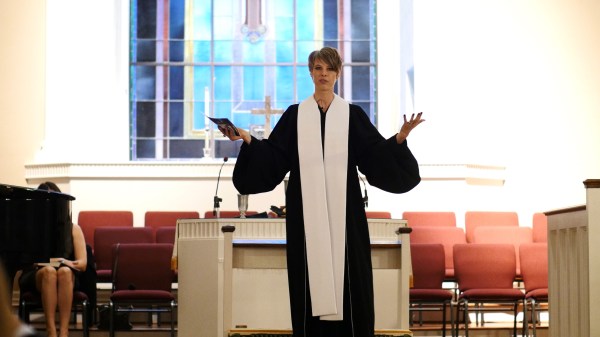
image2

Fighting fundamentalism…

ILYBYGTH: If you studied science at your evangelical college, did you feel like it was particularly “Christian?” How so? Did you wonder at the time if it was similar to what you might learn at a non-evangelical college? Have you wondered since?

I was a liberal arts major so I took the basic science classes, I don’t remember much but I do remember – and here’s where the relative “diversity” of thought I mentioned above comes into play – being taught evolution. At least as a theory. I can’t remember exactly how it was presented; but it was done so in enough of a way that it was one of the threads of my fundamentalist upbringing that began to unravel. I’d been taught that creationism IS fact, and there are a few fringe people out there who believe this crazy thing called evolution but it’s not really that big a deal. I came to see that it was actually the opposite, and the fact that that piece of my education had been so off made me wonder what else could be wrong with my beliefs and assumptions. You can begin to see why I have mixed feelings about Biola. 🙂

ILYBYGTH: Was your social life at your evangelical college similar to the college stereotype (partying, “hooking up,” drinking, etc.) we see in mainstream media? If not, how was it different? Do you think your social experience would have been much different if you went to a secular institution?

It definitely was not the stereotypical experience, and I’m sure it would’ve been different had I been at a secular college. I had friends and roommates for whom partying and hook-up culture was more of the norm (well, a sub-culture norm). But there was also the pressure to keep purity pledges and that sort of thing. I think my experience was somewhere in between.

ILYBYGTH: In your experience, was the “Christian” part of your college experience a prominent part? In other words, would someone from a secular college notice differences right away if she or he visited your school?

Oh absolutely yes. We had mandatory chapels, and we had to take a mandatory 30 units of Bible classes so that everyone ended up with a minor in Biblical Studies.

ILYBYGTH: Did you feel political pressure at school? That is, did you feel like the school environment tipped in a politically conservative direction? Did you feel free to form your own opinions about the news? Were you encouraged or discouraged from doing so?

Here again was where I learned about relative diversity of thought within Christianity. The school absolutely skewed conservative, politically, but there were some student groups who pushed those boundaries. And I remember thinking something along the lines of, I didn’t know you could be anything but Republican and be a Christian! Here again, the small level of exposure I had at Biola to other ways of thinking, began to erode my fundamentalist foundations. Which is pretty ironic. My parents sent me to an Evangelical school to (I assume) further educate me in their belief system and cement my faith. At the time I suppose it did that, somewhat, but in the long run it was the questions I began asking at Biola that led to the whole thing (over many, many subsequent years) eventually all falling apart for me.

ILYBYGTH: What do you think the future holds for evangelical higher education? What are the main problems looming for evangelical schools? What advantages do they have over other types of colleges?

As much as it pains me to say it, the advantage they have is, in a world that is becoming more and more polarized, they have dug in their heels and continue to offer an option to people who buy into the narrative that Christians are being assaulted and persecuted. Many people have this worldview and so for them, the “safety” that these schools offer is appealing. However, on the other side of the coin, I believe that the future of evangelical education is similar to the future of the evangelical church. While there is drastic entrenchment, and thus there will likely always be a market for fundamentalism, younger generations continue to be more diverse, more liberally minded, less willing to deal with the exclusivism preached by these churches and universities. So I guess as long as they can survive on the backs of those they’ve convinced to become more entrenched, they will. But I’m hoping the evangelical church as a whole (as we know it) soon will either reinvent itself or become relatively obsolete.

Thanks, Alexis!

Did YOU attend an evangelical college? Are you willing to share your experiences? If so, please get in touch with Adam at the ILYBYGTH editorial desk at alaats@binghamton.edu


But What Do Conservative Students Think?

The headline caught my eye, but the actual survey sidestepped the main question. From what I can tell, we still don’t know the most important data of all.

CHE conservative students

Conservative students doing their thing…

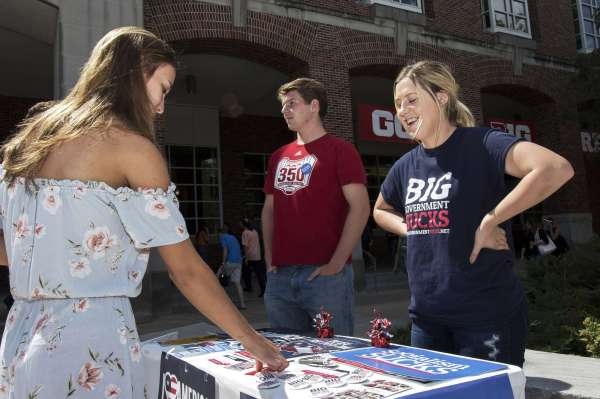
At Chronicle of Higher Education, Steve Kolowich followed up on the political poopstorm that enveloped the University of Nebraska recently. SAGLRROILYBYGTH might remember the story. A conservative student activist felt berated by a progressive grad student and faculty member. The story caught the imagination of both local conservative politicians and the national culture-war paparazzi. The university was called to political account. Did they mistreat and abuse conservative students?

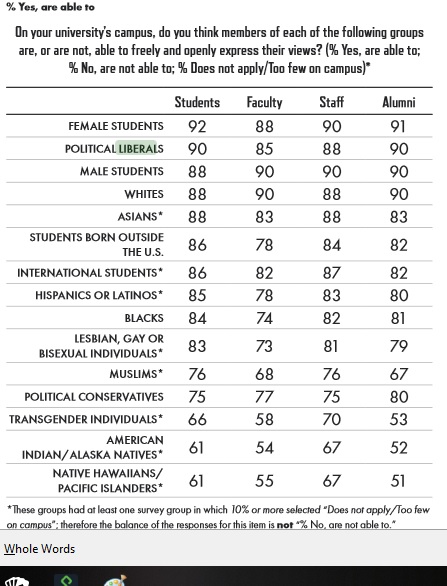
Apparently, as part of the process, the university teamed up with Gallup to conduct a campus climate survey. They wanted to know if students, faculty, staff, and alumni valued free speech. They wanted to know if conservatives felt free to speak their minds on campus. From what I can tell, however, it seems like they avoided the main question.

gallup u nebraska

Conservative students SHOULD feel free to talk…but DO they?

Most respondents thought that liberals were definitely able to “freely and openly express their views.” A large majority—though not quite so large as for liberals—thought that conservatives were too.

Maybe I’m reading the results wrong, but from what I can tell the survey avoided the main point. It asked respondents to identify as students, staff, faculty, or alumni. It asked respondents to identify by race, gender, and sexuality. But it didn’t ask students to identify by ideology. In other words, we might know how 4,403 student respondents felt, but we have no idea how conservative students felt, compared to liberal students.

To my mind, the survey missed the main point. We don’t only want to know how ALL students thought conservative students should feel. We really want to know how the conservative students themselves felt, and, importantly, if there was a meaningful distinction between how conservative students felt and how other students thought conservative students felt.

In other words, I’m not interested in what the campus as a whole thinks about conservative students. I want to find out what conservative students themselves think.

Gay Students and the New Fundamentalism

The distinction between “new evangelicalism” and “fundamentalism” was never all that clear. As a story from my neighborhood this week shows, though, it is getting easier to see the difference on the campuses of evangelical colleges and universities. We seem to have a new fundamentalist checklist, not of policies necessarily, but of institutional attitudes on certain key issues.

campbell csu

Out and out.

As I described in Fundamentalist U, the split between fundamentalists and new evangelicals was not a clean break on evangelical campuses. Between the late 1940s and, say, the late 1980s, there were a lot of continuing close connections between evangelical schools that remained with the “fundamentalist” branch of the family and those that had moved to the “new evangelical” side.

These days, generally, the “fundamentalist” label is out of fashion, even among fundamentalist stalwarts such as Bob Jones University. But the meaning remains, and these days we are seeing a clearer and clearer dividing line between evangelical colleges and no-longer-fundamentalist-in-name-but-fundamentalist-in-spirit institutions.

How do you know these days if a school is fundamentalist? It’s not necessarily a question of policies, but rather a spirit in which certain hard-line positions are maintained and a zeal with which they are publicized. ALL evangelical colleges and universities will be creationist, for example. And all will—from a mainstream perspective—have discriminatory policies against LGBTQ+ students and faculty. All conservative-evangelical schools will also tip toward conservative politics and cultural traditionalism.

The fundamentalist branch of the family, though, will insist on the hard edge of these positions in a consistently aggressive way and they will go out of their way to publicize their hard stand on these issues. Fundamentalist schools will trumpet their insistence on the following:

  • Young-earth creationism ONLY;
  • Political and cultural traditionalism;
  • And, most relevant for our purposes today, a loud, publicized hard line against any whiff of homosexuality on campus.

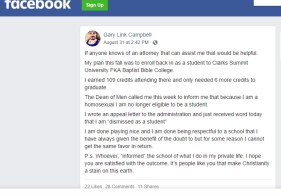
Consider the news from Clarks Summit. A former student has tried to re-enroll. Gary Campbell dropped out in 2005, only six credits shy of his degree. After a rough stint in the Navy, Campbell now wants to return. The school says no.

According to Campbell, the Dean of Students contacted him to let him know Campbell won’t be allowed to return, because Campbell is homosexual.

To be clear, from a mainstream perspective, all evangelical colleges discriminate against LGBTQ+ students and faculty. Even firmly non-fundamentalist evangelical institutions such as Gordon College and Wheaton College have issued reminders recently that gay is not okay.

But Clarks Summit University’s stance has a hard edge to it that helps define the new fundamentalism. Campbell’s sexual identity was apparently revealed to administrators by a fellow student, at least according to Campbell. The school could easily have re-admitted Campbell quietly.

Instead, the school’s administration chose to use this case as a chance to publicize its hard line. When journalists called about Campbell’s story, the university issued the following statement:

As a Christian college, we expect all students to act in a way that is consistent with our biblical belief system. We have always clearly stated those beliefs and have exercised the freedom to uphold our faith. . . . To prepare students for worldwide service opportunities, CSU clearly affirms biblical sexuality. We clearly communicate to all prospective students that we adhere to biblical truths, and expect them to do the same. That is part of what has made CSU a successful educator for more than 80 years. We would be happy to assist any former or prospective student who does not choose to agree with those faith standards to find another school in order to finish a degree.

These days, to be a fundamentalist institution means flying and flaunting the fundamentalist flag. It means taking every opportunity to enforce hard lines on sexual identity.

We see the same phenomenon in other issues such as creationism or political conservatism. In order to remain attractive to fundamentalist students and parents, school administrators take drastic steps to ratchet up their commitment to young-earth creationism or knee-jerk political conservatism.

What does it mean to be “fundamentalist” these days in evangelical higher education? As has Clarks Summit University, it means taking and, importantly, publicizing a hard line on issues of sexuality, creation, and political conservatism.

Fundamentalist colleges want their level of commitment to be known. They hope students, alumni, parents, and donors will recognize their positions and reward them with continued enrollments, donations, and support.

Who Owns 9/11 on Campus?

Memory is a slippery thing. On college campuses, left-wing protesters pull down memorial statues and right-wingers put up memorial shrines. Should a college allow conservative students to “remember” 9/11 the way they want to? Or do colleges have an obligation to a higher kind of memorial?

Here’s what we know: Ripon College in Wisconsin attracted a lot of negative attention from conservative commentators. The school’s administration was accused of banning its local chapter of Young Americans for Freedom from putting up memorial posters for 9/11. The school replied that it had not banned anything; in fact the school had celebrated earlier YAF 9/11 memorials.

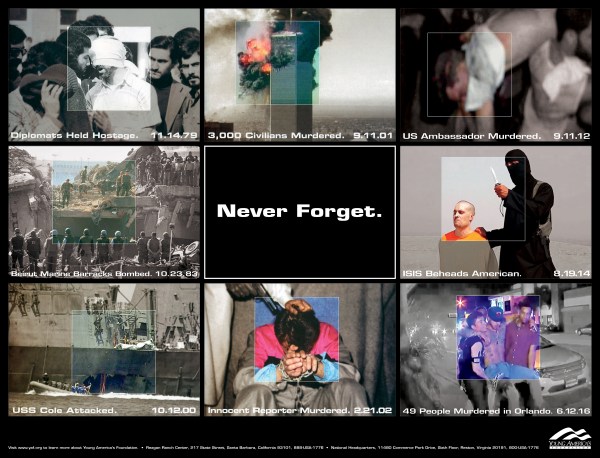
In this case, the memorial at issue was not the standard display of 2,997 American flags to memorialize the people murdered on 9/11. Instead, YAF wanted to put up a graphic “Never Forget” poster. The school charged that the posters targeted Islam unfairly and would make Muslim students feel unwelcome and attacked.

Never-Forget-Poster-2016-10-inch-wide

Too much? Ripon thinks so…

The parent Young America’s Foundation complained that the posters “merely depict history.” The school’s attitude against the posters, YAF’s Spencer Brown wrote, clearly shows “anti-conservative bias” at the school.

One Ripon College professor objected that history is never merely depicted. As Professor Steven A. Miller put it,

Most campuses don’t hold special ceremonies for Pearl Harbor Day, Emmett Till’s lynching, the Oklahoma City bombing, or Benedict Arnold’s switching teams.

What do you think? Should a college ban violent posters as memorials? Or do students have every right to free speech as long as they are not making threats?

My heart’s with Prof. Miller. As he concludes,

When we say we want students to remember 9/11, or the Civil War, or any of the many other tragedies that dot American history, we must accept that worthwhile remembering takes work. Colleges are one place where that work takes place, in the form of historical research, critical writing, and, above all, teaching new generations to think carefully through history in its full context. Students engage with difficult questions that challenge conventional wisdom and undermine the kinds of easy answers that lead amateur critics of academia to tweet about rip-offs. It may sometimes be uncomfortable, but that’s a necessary element of confronting, considering, rethinking, and growing.

Every day in class, I see my students struggle with the past, with all its uncertainty and all its consequences. This does not happen only once a year, and it is not easy, but that’s what it means to never forget 9/11.

Will Liberty Get on the Ozark Train?

For those people who still think evangelicalism should primarily be defined by theological distinctions, consider the news: Yet another conservative evangelical college is considering dropping its Nike contract over the anthem-protest issue. How does theology explain that one?

falwell on nike

Football, America, and God too.

SAGLRROILYBYGTH will remember that the College of the Ozarks already announced its anti-Nike stance in the wake of Nike’s Colin-Kaepernick ad. They may also recall our point here at ILYBYGTH that such staunch knee-jerk conservative patriotism was not the exception, but the rule for evangelical universities in the twentieth century.

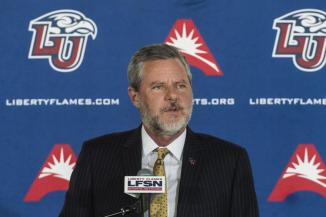
Some might say that COE’s uber-patriotism is just an odd outlier in the world of evangelical higher education. Today it looks like COE might have more company. According to President Jerry Falwell Jr., Liberty University in Virginia is considering scrapping its sponsorship deal with Nike. Unlike College of the Ozarks, Liberty is a cash-rich up-and-comer in the world of NCAA athletics.

As Liberty University’s Jerry Falwell Jr. told USA Today:

We’re exploring the situation. . . . If Nike really does believe that law enforcement in this country is unfair and biased, I think we will look around. If we have a contract, we’ll honor it, but we strongly support law enforcement and strongly support our military and veterans who died to protect our freedoms and if the company really believes what Colin Kaepernick believes, it’s going to be hard for us to keep doing business with them.

But if it’s just a publicity stunt to bring attention to Nike or whatever, that’s different. We understand that. We understand how marketing works. But they’re going to have to convince us that they’re not proactively attacking law enforcement officers and our military. If that’s the reason behind using this ad, we’re going to have a hard time staying.

For many Americans, Falwell’s defiant conservative patriotism makes sense. For a lot of people, it’s probably even admirable. But how is it part of evangelical religion?

In short, it’s not, if we try to define evangelicalism only by theological notions such as a reverence for Scripture and an emphasis on soul-winning.

But! If we understand American evangelicalism—the Falwell/Liberty kind, at least—as a conservative cultural mish-mash, including conservative ideas about religion, but also about race, the South, gender rules, sexuality, and so on, then Falwell’s aggressive militarism fits perfectly.

An Exception? Or a Rule?

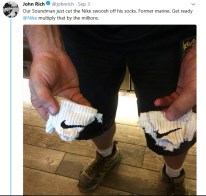
Conservatives are cutting up their socks in protest. And at least one evangelical college has dumped Nike over its defense of Colin Kaepernick’s anthem protests. Some in-the-know commentators think this is way out of bounds for evangelical schools. Historically, though…not so much. Is knee-jerk patriotism the rule or the exception at conservative evangelical colleges?

nike sock protest

Take that, anti-anthem mega-corp!

As I argued in Fundamentalist U, during the twentieth century aggressive conservative patriotism played a large role at all the evangelical colleges I studied. At some, such as The King’s College and John Brown University, it became a central focus. In the mid-1960s, at least, notions of fusing traditional patriotic conservatism with evangelical conservatism held a lot of appeal for many evangelical academic types.

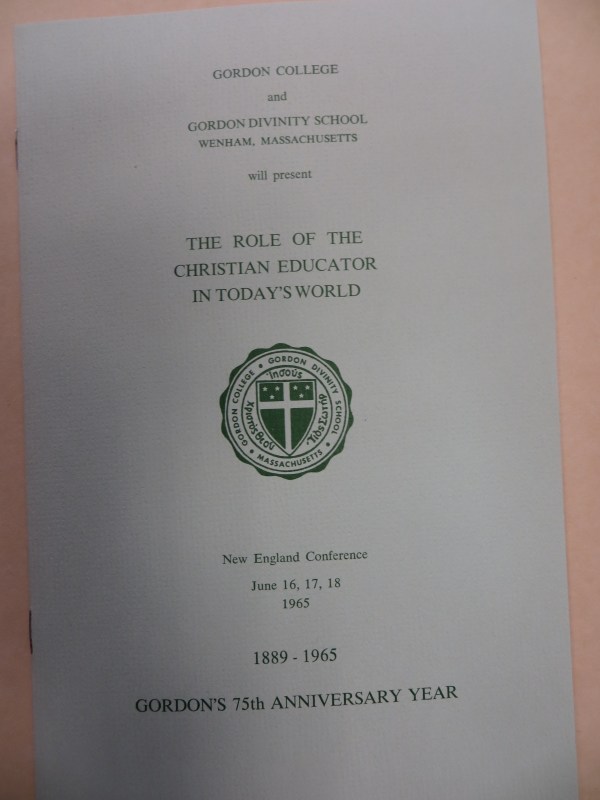
A “Freedom Forum” planned at Gordon College in 1965, for instance, offered the following rationale:

What philosophy shall give direction to the material world we are developing?  Shall the long-felt influence of the Christian ethic be brought to bear on current history?  Dare we succumb to the seemingly plausible suggestions that in our time government-over-man is preferable to America’s long proven concept of man-over government?

Can we survive as a people, even with our unparalleled abundance of things, if our thinking excludes our traditionally motivating intangibles . . . . [sic ellipsis in original] reverence for God, total human concern for the individual, an abiding dedication to preservation of our Constitution and a cherishing regard for personal Freedom? [sic]

The Christian educator occupies a unique position of leadership from which emanate those spiritual emphases which give salutary meaning and purpose to life, not only individual but national.  Waiting for that leadership are millions of earnest Americans who need help in their endeavor to ‘prove all things and hold fast that which is good.’ . . .

Objective: Inclusion in the curricula and teaching emphasis in Christian colleges of a pervading high regard for Freedom in its spiritual, economic and political dimensions and to create an informed student-citizen leadership needed to safeguard and extend Freedom in the years ahead.”

In the end, under pressure from Gordon faculty to avoid too close collusion with the political “extreme right,” the vaunted Freedom Forum didn’t happen. But there was always—and I think still is—a very strong push among many evangelicals to tie their conservative patriotic impulses to their religious beliefs.

american studies conference 1966 program

For God and Country…or Country and God…?

This is true not only for uber-patriotic schools such as Harding, John Brown, and the College of the Ozarks. Giants like Liberty University and smaller schools such as Mid-America Nazarene still have a hard time figuring out the relationship between religion and patriotism, with patriotism often coming out on top.

In this case, College of the Ozarks certainly seems like a Nike-hating outlier. But is the impulse to in-your-face conservative patriotism really so out of bounds for other conservative evangelical colleges? I don’t think so.