As we’ve seen, Falwell has a rough track record in quotable quotes. As the president of a huge evangelical Christian university, he has in the past misquoted the Bible. That has to hurt.
In his recent interview with The Guardian, President Falwell compounded his errors. If it were someone else speaking, I would be tempted to think Falwell was making a subtle and hilarious gibe. In reality, though, I think he just got mixed up.
Here’s what we know: In the recent Guardian interview, Falwell lauded President Trump to the skies. Not only did Falwell support Trump for strategic reasons, he actually believed Trump to be a morally good person. As Falwell put it,
Ever since I’ve known him, he’s been a good, moral person, a strong leader, a tough leader – and that’s what this country needs.
That’s a difficult position for me to understand. I can understand backing a bad person who is fighting for your side. I can understand backing an immoral character who fulfills important promises. But I can’t understand how anyone would call Trump a “good, moral person.” Maybe some SAGLRROILYBYGTH can explain that one to me.
The point this morning, though, is different. In his encomiums to President Trump, President Falwell insisted that he and Trump were totally on the same page. As Falwell told the Brits,
I usually tweet something similar to what he tweets a day or two before him. We think alike.
And, apparently unintentionally, Falwell went on to prove his intellectual similarity to Trump by making a glaring historical error. I can’t tell for sure, but I think Falwell got confused about what century America’s Civil War was in. America had not been this polarized in a very long time, Falwell said.
not since the civil war. I don’t know where that takes you. I can’t imagine a war breaking out in a civilised society in the 21st century. But if this was the 18th century, I think it would end up in a war. It’s scary.
I hate to be this guy, but anyone could tell you that America’s Civil War happened in the 19th century, not the 18th.
I know, I know, it’s an understandable mistake, sort of. And I don’t think Falwell meant to be funny, but how hilarious would it be if he wanted to prove his similarity to the fact-averse Trump by insisting on making at least one glaring error per public appearance?
Feeling blue about the Kavanaugh confirmation? Me, too. But let’s not join the goofs who keep saying that this is some sort of unprecedented act of naked partisanship. Let’s not listen to writers like this who call Justice Kavanaugh “patient zero” spreading “virulent political fevers” to a once-staid SCOTUS. We don’t have to dip far into SCOTUS history—we don’t even have to mention the words “Warren” or “Watergate”—to notice that Kavanaugh’s brand of bare-knuckled political judgeship has a long and ugly backstory.
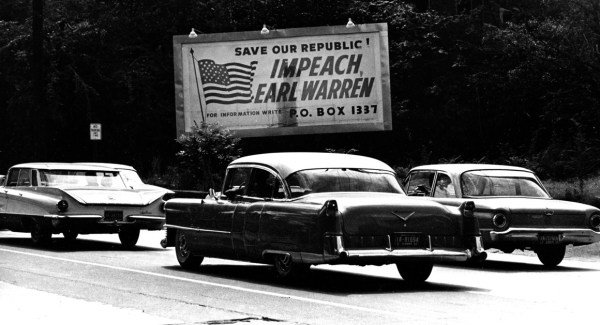
The cars were different, but the anger was the same…
As I found over and over again in the research for my book about twentieth-century conservatism, SCOTUS debates have never been polite or gentlemanly. Just ask Earl Warren, a perennial punching bag for the Birchers and their conservative friends.
Chief Justice Warren might have been the most prominent, but he was far from the only lightning-rod of controversy in recent SCOTUS history. Fewer people these days might remember the trials and tribulations of Justice William O. “Wild Bill” Douglas.
Were the attacks on Justice Douglas temperate? Polite? Bi-partisan?
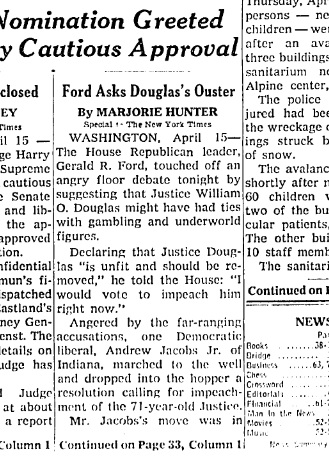
Consider the following: On the floor of the US House of Representatives, for example, future President Gerald Ford initiated impeachment proceedings against Justice Douglas on April 15, 1970. According to the New York Times, Representative Ford accused Douglas of writing “hard-core pornography,” of pushing “hippie-yippie style revolution.” Douglas, Ford charged, was connected to organized crime and deserved to be kicked to the curb due to Douglas’s connections “with some of the most unsavory and notorious elements in American society.”
Porn, gangsters, and hippie-yippies…
Not polite. Not bi-partisan. And, like more famous elements of the Nixon era, not at all disinterested. The New York Times speculated that the real reason for the impeachment proceedings against Justice Douglas was payback for Congressional rejections of other Nixon judicial appointees.
So I, for one, will continue to be bummed by the rancor and contumely expressed during the Kavanaugh hearings. I continue to feel dismayed by Mitch McConnell’s naked power-grab in the non-confirmation of Merrick Garland. I am outraged by the thought of a stolen SCOTUS majority and I will work to elect anti-Trump, anti-Kavanaugh representatives and senators.
But I can’t pretend that this sort of ugliness has not been part and parcel of SCOTUS politics for a long time.
Here’s the latest: Chalkbeat describes a newish network of charter schools that started in a Texas border town. The IDEA network (originally “Individuals Dedicated to Excellence and Achievement”) serves mostly low-income students, mostly Latinx. As have many charter networks, it claims big successes in improving student test scores and sending graduates to college. And as have many charter networks, it has attracted criticism for siphoning off lower-need students from public schools and for its dictatorial methods.
And from a historian’s point of view, there’s the rub. As I’m finding out these days as I research the Lancasterian mania in the early decades of the 1800s, old dreams for America’s public schools were big. Lancasterian schools were lauded for improving basic academic skills of low-income students, but they fell apart because low-income parents wanted something more than mere holding pens for their children. They wanted their children to attend schools in which they could mix and mingle with students of all economic backgrounds; schools that did not segregate off poor children to be yelled at and drilled with basic academic skills.
Public schools were supposed to do all that. They were supposed to be schools for the entire public, not only those who could afford tuition. Most important, they were intended to do more than train students to do basic math or literacy. Public schools were supposed to teach the young public–all the young public–that they were America. They were meant to attract all students together, not segregate out the poor for harsher treatment.
Lancasterian schools didn’t do all that. And today’s crop of “no-excuses” charter schools for low-income students seems to have smaller ambitions as well. Some charter schools hope to yell at students to make them be better citizens. Students sit silently at lunch, march militarily down halls, and chant rote answers to repetitive test-driven curricula.
At New York’s famous Success Academies, for example, students are famously dictated to for their own good. Teachers and students follow a scripted set of behavioral norms. Students are directed to sit with their hands folded properly, their backs straight, and their eyes always on the teacher. As the New York Times exposed a few years ago, the tone could sometimes get creepy.
In this vision of good public education, students are thought to need intense behavioral control for their own good. Silent lunches, single-file marching in silence from class to class, and instant obedience are the hallmarks of the “no-excuses” approach. As Joan Goodman of the University of Pennsylvania has argued, the goal is submission. As Dr. Goodman put it,
To reach these objectives, these schools have developed very elaborate behavioral regimes that they insist all children follow, starting in kindergarten. Submission, obedience, and self-control are very large values. They want kids to submit. You can’t really do this kind of instruction if you don’t have very submissive children who are capable of high levels of inhibition and do whatever they’re told.
In New York and other big cities these days, this approach is often touted as the latest thing, a new idea to help low-income students overcome unfair social hurdles to achieve academic success. As I’m finding in the archives, however, it’s the oldest approach in the books.
Notes from 1804…or is it 2016?
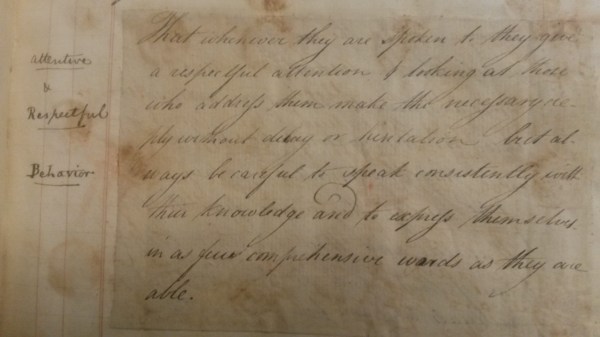
In an 1804 note, for example, school reformer Joseph Lancaster clarified the proper way schools must exert total control over students from low-income homes. As Lancaster argued,
That whenever they are spoken to they give a respectful attention by looking at those who address them make the necessary reply without delay or hesitation but always be careful to speak consistently with their knowledge and to express themselves in as few comprehensive words as they are able.
Way back then, urban schools in Philadelphia, New York, Baltimore, Albany, and elsewhere were already forcing low-income students to endure the rigors of a no-excuses approach. As Lancaster went on,
That they forbear talking to each other at meals—school hours or reading unless there be sufficient occasion. That they avoid running in the house but walk uprightly and take care to shut all doors after them (that they know out [sic] to be) with as little noise as possible.
That was what “no excuses” looked like 200 years ago. Public schools—REAL public schools—were supposed to be different. They were intended to be a meeting ground for all children. They were the embodiment of an American educational dream—a place where rich and poor could learn together, with equal chances for all.
I don’t blame parents and students for choosing the best available school. Not at all. But I lament the loss of the bigger dream, the hope that public schools would bring the entire public together.
I know, I know, it is not the main point of the story. I can’t help but be amazed, though, at one of the defenses this embattled professor gave. So, yes, he compared sexual-assault accusations to “spin the bottle.” And he called the Democrats the “sissy party” and suggested that all judicial appointees be required to commit sexual assault. He defended his comments as satirical, but he also gave, to my mind, a much more poignant defense.
Sure, I said it, but I didn’t think anyone was listening…
If someone did not commit sexual assault in high school, then he is not a member of the male sex. The Democrats have discovered that 15-year- olds play spin-the-bottle, and they have jumped on a series of supposed spin-the-bottle crimes during Kavanaugh’s minority, which they characterize as rape, although no one complained or reported any crime for 40 years.
The Democrats have become a party of tutu-wearing pansies, totalitarian sissies who lack virility, a sense of decency, or the masculine judgment that has characterized the greatest civilizations: classical Athens, republican Rome, 18th century Britain, and the 19th century United States. They use anonymity and defamation in their tireless search for coercive power.
The Kavanaugh hearing is a travesty, and if the Republicans are going to allow the sissy party to use this travesty to stop conservatism, then it is time found [sic] a new political party. In the future, having committed sexual assault in high school ought to be a prerequisite for all appointments, judicial and political. Those who did not play spin-the-bottle when they were 15 should not be in public life.
Predictably, students at Brooklyn College protested. Such hateful speech, they insist, should be grounds for Langbert’s termination.
In his defense, Prof. Langbert revised his blog post, adding an introductory disclaimer describing his post as satirical, that his point was precisely to underscore the ridiculousness of the current political climate. As he put it,
It is intended to be taken in the same light as Swift’s claim that Irish children should be eaten. I was surprised to learn that some readers took me literally, claiming that I advocate rape.
To this reporter, the satire in Prof. Langbert’s original post is pretty easy to miss. I might call it an example of hyperbolic rhetoric, but as a high-school English teacher, I would never use this example to illustrate the complicated genre of satirical writing.
SAGLRROILYBYGTH might disagree about whether or not this counts as satire, but this morning I’d like to focus on a different aspect of this case. When asked about his controversial blog post, Prof. Langbert offered a much sadder defense as well. Not only was it meant to be satirical, Langbert said, but usually only about twenty people per week visited his blog.
Does that make it okay? We all know some forms of speech are not protected. For example, shouting “Fire” in a crowded theater is not acceptable. However, what if you shouted “Fire” to an empty room?
It’s not easy to be a social-studies teacher these days. We are supposed to inspire our students to love history and to become active citizens, but we’re not supposed to dictate political beliefs to students. We are encouraged to share our own biases and political commitments with students, but we’re not encouraged to tell students what to think. Our job is to help form moral persons—real empowered humans—but we aren’t hired to cram our morality down anyone’s throats.
Civics ed? Or sinister indoctrination?
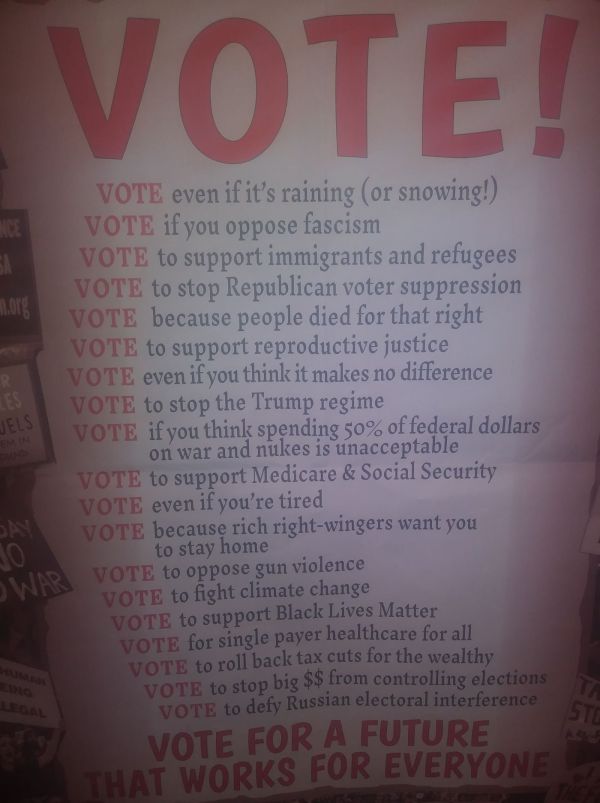
Given all that, we ask today: Did this Philly school teacher go too far? The chair of Pennsylvania’s Republican Party says yes. He says a flyer handed out by Philadelphia Central High teacher Thomas Quinn crosses way over the line.
The flyer encourages students to vote. Nothing very controversial there. But it also tells students to support Black Lives Matter, abortion rights, and to oppose the “Trump regime.”
It will come as no surprise to SAGLRROILYBYGTH that I support this whole platform. I would love it if every student voted this way. But that’s not the most important point here. The real question is about the proper political role of a good teacher.
What do you think? Should social-studies teachers encourage students to vote a certain way?
Looks like the tradition continues. As the Brett Kavanaugh hearings sweep over Washington DC like a brushfire, Liberty University is back to its old 1970s tactics. Turns out clean-cut well-dressed conservative Christian students are a potent political weapon.
From Jack Jenkins…
Here’s what we know: Jack Jenkins has reported that two Liberty University busses pulled up to the Kavanaugh hearings this morning. Presumably, Jerry Falwell Jr. is pulling a few pages from his dad’s political playbook.
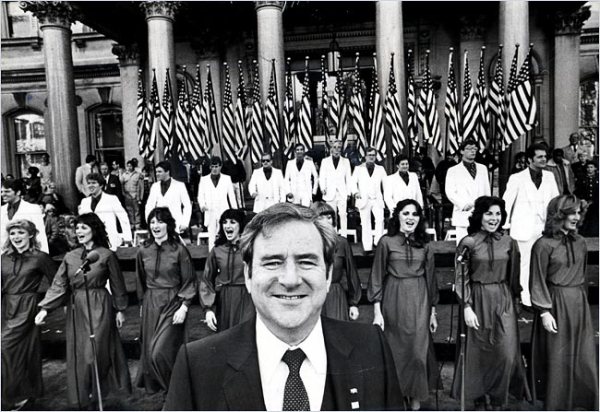
Back in the 1970s and 1980s, Jerry Falwell Sr. was fond of using Liberty University students to twist arms on Capitol Hill. Most famously, he sent his “I Love America” bus tour around to various state houses to sing and dance about America.
The goal was to attract attention to Falwell’s conservative policy plans. He hoped to get headlines and push politicians to get on the Liberty bus. Politically, that is.
That wasn’t all.
I didn’t have room to include much of this in Fundamentalist U, but Falwell Sr. employed students as smiling lobbyists. In early 1980, for example, he had students hand-deliver his “95 theses for the 1980s” to US Representatives.
La la la…we love Americaaaaa
Charles F. Bennett, of Florida’s 3rd district, told Falwell that Bennett was delighted to receive the information directly from a
Fine young Christian student.
And Carroll Hubbard, of Kentucky’s 1st district, wrote to Falwell to say that he was posting the 95 theses on his desk. As Rep. Hubbard put it,
You are an inspiration to my family and me. 2 Chronicles 7:14.
For Jerry Falwell Jr., then, sending busloads of students to support Judge Kavanaugh is anything but a surprise.
In case you’ve been napping, here’s a quick update: The political landscape in Arizona has led to some woeful watering down of the state’s science standards. Concerned scientists have weighed in, pleading with the state board of education to reject the shoddy new standards.
In their letter, the American Institute of Biological Sciences warns,
The proposed standards fail to properly address important aspects of evolution science and remove climate change science from the high school curricula.
Right on. Thanks to AIBS for weighing in. There’s no doubt that Arizona should maintain high-quality science standards.
This morning, though, we have to ask a question. To back up their point, AIBS offers two compelling reasons, but they leave out an obvious third one. Why?
I don’t think it’s because AIBS chose to stick only with science, their area of expertise. After all, one of their main points is economic. If Arizona wrecks its science standards, it will be shooting its economy in the foot. As AIBS puts is,
Arizona has made important investments in its universities. This has enabled companies throughout the state to hire skilled graduates who can leverage the knowledge generated by scientific research to create new products and expand existing markets. Importantly, in coming years, a growing number of jobs will require scientific expertise, even when those jobs do not require a college degree. Thus, it is important that science be properly taught to all students and at all grade levels.
According to the Arizona Commerce Authority, “Bioscience and health care in Arizona are thriving industries, treating patients and conducting groundbreaking research that will change the world. Arizona research institutions, industries and clinical care facilities collaborate in unique ways to create new products and improve care and outcomes.” The Authority reports on its website that bioscience and health care industries generate $21.4 billion in annual earnings for the state, and in 2015 were responsible for about 320,000 jobs in Arizona. Arizona will jeopardize its prior investments and future economic opportunities if it waters down science standards by eliminating essential scientific concepts and fields of study to placate political interests.
Exactly true. The economic knock-on effects of clamping down on mainstream science and science education will be huge. But that’s not the only reason AIBS gives for keeping good science standards.
As they argue, good education itself demands it. All of us should insist on the best for our kids, including the absolute best science education.
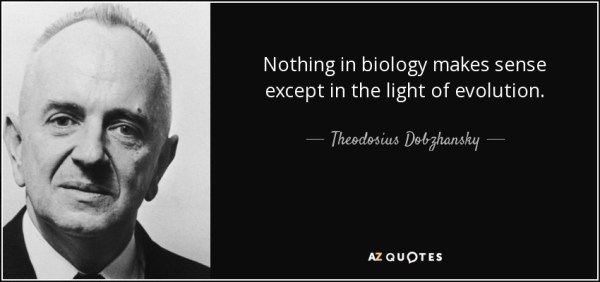
They cite the famous words of leading scientist Theodosius Dobzhansky,
“nothing in biology makes sense except in the light of evolution.” Dobzhansky offered these words decades ago, but they still ring true. Evolution is required to understand biology . . .
So far, so good. AIBS is 100% correct. Good science education is good in itself, and to be good it must include real evolutionary science. It’s also good for practical reasons, such as booming economic benefits.
But why, oh why, did AIBS leave out the other, screamingly obvious, part of their argument?
…Why not use the second-most famous Dobhansky quotation, too?
Why would AIBS do so? Consider their audience. If they want to stick to the science, fine. But clearly they don’t. They use economic arguments to speak to all Arizonans. Why not use the obvious religious argument as well? Why not point out that lots and lots (and lots) of creationists have absolutely no religious problem with real evolutionary theory?
Here’s what we know: The Dallas Morning News reported on the recent conclusions of the Texas state board of education. SAGLRROILYBYGTH may remember other famous flaps on the board as captured by the fascinating documentary The Revisionaries. Back in 2012, conservatives on the board cut out “hip-hop” and inserted “country music” on the list of essential school knowledge. They wanted more Reagan, more NRA, and more conservatism in general.
Today’s board has cut the requirement that schools teach about Helen Keller and Hillary Clinton. But they have also cut conservative icon Barry Goldwater. Plus, they have inserted stronger language that slavery was the primary cause of the Civil War.
How did these decisions get made? A work group was tasked with evaluating historical persons and terms according to a list of questions. As the Dallas Morning News reported,
The 15-member work group came up with a rubric for grading every historical figure to rank who is “essential” to learn and who isn’t. The formula asked questions like, “Did the person trigger a watershed change”; “Was the person from an underrepresented group”; and “Will their impact stand the test of time?”
Out of 20 points, Keller scored a 7 and Clinton scored a 5.
By way of comparison, “Texas Rangers” got 16 points and “local members of the Texas Legislature” got 20. The state board didn’t have to honor these recommendations. For example, the work group recommended the removal of Billy Graham (4 points) but the state board decided to keep him.
So here’s the real question: Why are history lists composed this way? Why do political boards compile list of essential terms and facts that teachers must teach, even if no student really learns them?
For those of us who want secular public schools and mainstream evolutionary science only in public-school science classes, the news from Arizona could be either a glass half-full or half-empty. Either way, though, it serves as a clear reminder of how creationism wins.
Here’s what we know: In Arizona, the superintendent of public instruction picked Joseph Kezele to serve on an eight-person board reviewing state science standards. Kezele is the president of the Arizona Origin Science Association. He is an ardent young-earth creationist. In his work on the board, he has nudged the standards toward more skepticism about mainstream evolutionary theory.
To this reporter, the story reveals the most important reason creationists win. As I’m arguing in my new book, it’s not really about evolutionary science itself. Before we get to that main reason, though, let’s look at some of the contributing factors:
1.) Creationists win by being polite.
Kezele’s fellow board members don’t like his radical creationism, but they do like him. As the University of Arizona’s William Roth told the Phoenix New Times, in all their interactions Kezele was “polite and thoughtful.”
2.) Creationists win by taking advantage of their grandparents’ work.
Though Arizona Christian University itself was founded only in 1960, it is part of the evangelical higher education network I described in Fundamentalist U. Since the 1920s, creationists founded their own network of universities specifically, in part, to provide a home for creationist scientists like Kezele.
These days, creationists like Kezele can only have higher-ed credentials because of the work of their parents, their grandparents, and in some cases, their great-grandparents. The fundamentalists who stormed out of mainstream colleges and started their own schools built a network that is still providing credentials and paychecks to radical creationists today.
3.) Creationists win by not asking for much.
In Arizona, according to Professor Roth, Kezele never tried to “foist any kind of creationism” on the committee. As Roth put it,
I never got the impression that he was really arguing for the inclusion of creationism in the standard. . . . I think he was pretty aware of the court rulings that religion is not going to be taught in science class.
Kezele did nudge the committee, though. For example, Kezele put his feet down to insist that the language be changed. Instead of explaining evolution as “THE” explanation for speciation, the new standards call evolution “AN” explanation. It’s a huge difference, to be sure, but worlds removed from actually adding any specific creationist content to the standards.
4.) Most important, creationists win these days for reasons that have nothing really to do with evangelical theology or evolutionary science.
It’s just politics. The superintendent who appointed Kezele wants creationism and evolution both to be included in public school science classrooms. But if she had not been elected, someone else who also favors creationism probably would have. As Arizona Central reported, Superintendent Diane Douglas was re-elected sought re-election from among a field crowded with creationism-friendly candidates. [Thanks to GB for the correction!]
Of the five Republican candidates for the job, four ardently supported teaching some sort of creationism in public schools. They may have had their personal reasons for wanting it, but they also made an obvious political calculation. If anyone is going to be elected in Arizona, that is, she must promise to make public schools creationism-friendly.
The reasons the candidates gave for supporting creationism in public schools were all about culture-war politics, not theology or science.
Candidate Frank Riggs, for example, argued that students needed creationism to be good Americans. As he put it, high-school students
should know what our founding fathers believed and put in our founding documents . . . “that all men are created equal, that they are endowed by their Creator with certain unalienable Rights.” . . . We can’t skip over that, or we do a huge disservice to our students.
Another candidate, Tracy Livingston, poured some unadulterated MAGA rhetoric into the mix. Why should public schools include creationism? In her answer, Livingston bemoaned the “fact” that
Schools don’t even allow Merry Christmas anymore.
Why support creationism in public schools? For candidate Livingston, at least, it was part of a culture-war playbook. To Make America Great Again, schools needed to give Christianity a special spot. Children needed to be taught in a vaguely Christian atmosphere, one that included creationism.
It’s not science. It’s not even really religion. Instead, the main reason for creationist victories is simple, ugly, culture-war politics.
How do creationists win? Lots of reasons. They win if they are polite. They win if they take advantage of the long work of previous generations, establishing creationist institutions that can provide credentials. They win if they don’t ask for much, but insist on a little.
Most importantly, though, they win because they own the Republican Party in some locations. To win election as state superintendent of public education, candidates raced to out-creationist one another. Creationism has become yet another culture-war red flag. It’s not really about theology or science, but about what side you want to be on.
The headline caught my eye, but the actual survey sidestepped the main question. From what I can tell, we still don’t know the most important data of all.
Conservative students doing their thing…
At Chronicle of Higher Education, Steve Kolowich followed up on the political poopstorm that enveloped the University of Nebraska recently. SAGLRROILYBYGTH might remember the story. A conservative student activist felt berated by a progressive grad student and faculty member. The story caught the imagination of both local conservative politicians and the national culture-war paparazzi. The university was called to political account. Did they mistreat and abuse conservative students?
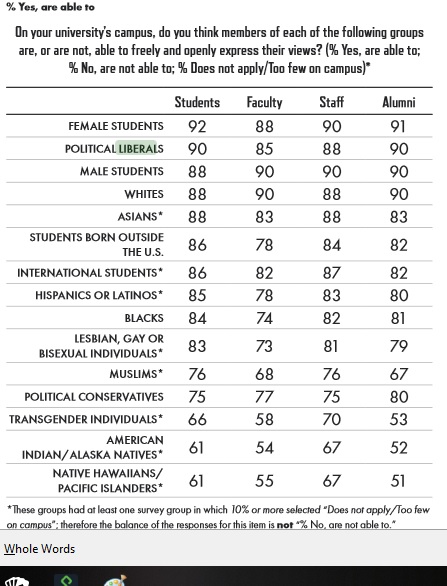
Apparently, as part of the process, the university teamed up with Gallup to conduct a campus climate survey. They wanted to know if students, faculty, staff, and alumni valued free speech. They wanted to know if conservatives felt free to speak their minds on campus. From what I can tell, however, it seems like they avoided the main question.
Conservative students SHOULD feel free to talk…but DO they?
Most respondents thought that liberals were definitely able to “freely and openly express their views.” A large majority—though not quite so large as for liberals—thought that conservatives were too.
Maybe I’m reading the results wrong, but from what I can tell the survey avoided the main point. It asked respondents to identify as students, staff, faculty, or alumni. It asked respondents to identify by race, gender, and sexuality. But it didn’t ask students to identify by ideology. In other words, we might know how 4,403 student respondents felt, but we have no idea how conservative students felt, compared to liberal students.
To my mind, the survey missed the main point. We don’t only want to know how ALL students thought conservative students should feel. We really want to know how the conservative students themselves felt, and, importantly, if there was a meaningful distinction between how conservative students felt and how other students thought conservative students felt.
In other words, I’m not interested in what the campus as a whole thinks about conservative students. I want to find out what conservative students themselves think.









 I Love You but You're Going to Hell