Are Christian Colleges No Longer Possible?

The dream has been the same for a hundred years. Is a recent move by Trinity Western University a sign of changing times? Must more-conservative evangelical colleges and universities choose between their two most cherished purposes?

twu_primary-logo_cmyk_0

Christian sexuality? Or Christian lawyers?

Here’s what we know: According to Christianity Today and Inside Higher Education, TWU has elected to drop its mandatory “community covenant” for students. The Canadian Supreme Court had blocked TWU’s efforts to establish a law school, based on the discriminatory anti-LGBTQ covenant. In short, in order to open an evangelical law school, TWU has eliminated its core lifestyle rules for students.

What’s the big deal?

As I argue in my book about the history of evangelical higher ed, schools like TWU have always promised to do two things at once. As a special sort of religious school, they promised to shepherd and guide the faith of their students in specific directions. At the same time, though, they have insisted that their graduates would be perfectly prepared to enter the professions. Going to a “Christian” school, in other words, wasn’t supposed to be a retreat from the world, just a better, particularly evangelical preparation to thrive in that world.

As Bob Jones—one of the most famous evangelical college leaders of the twentieth century—put it in 1929,

It is our plan to train and educate strong, outstanding Christian leaders.  This is what America needs—lawyers, doctors, business man, teachers, preachers, all strong leaders.

Evangelical colleges have always promised both halves of this equation. Students would receive top-notch professional training as well as relentless Christian guidance.

In its recent decision, TWU seems to have had to choose between preparing evangelical lawyers and insisting on its conservative definition of evangelical lifestyles. TWU will no longer force students to agree to its many rules, including the legally problematic ban on sexual relationships outside of heterosexual marriage.

Previously TWU students had to “affirm” the following statement:

sexual intimacy is reserved for marriage between one man and one woman, and within that marriage bond it is God’s intention that it be enjoyed as a means for marital intimacy and procreation.

From now on, students will apparently no longer be bound by the rules of TWU’s covenant. But they will be free to become lawyers. [Insert gratuitous Jonah Hill gag here, at :52 in the clip below.]

For the most conservative sorts of evangelical colleges, does this mean the end? Must they choose between their two goals?
Liberty U Continues the Ugly Tradition…

The story has leaked out already, but WORLD put it all together, with some depth. Student editors and reporters at Liberty’s student newspaper told their tale of administration bullying and Trumpish power-grabs. I’m sorry to say that such administrative antics are not unusual for student newspapers in evangelical higher education.

liberty6

…all the news that fits [the Falwells’ vision]…

If you haven’t seen WORLD‘s story yet, it’s worth your time. Liberty’s hatchet man was Bruce Kirk. Kirk upbraided the student editors for trying to act like real journalists. After students tried to publish news of the controversial Red-Letter Revival last year, Kirk warned them that the student newspaper ought only to make the university look good. According to WORLD, Kirk told the students,

in the real world, which this isn’t, let’s just be honest, right? … You will be beholden to an organization, to a company. … That is just part of life. And it’s part of life for all of us by the way. Put journalism aside for a second. Do I get to do everything that I want to do or does Jerry dictate what I get to do? … Somebody else decides what you do and what you don’t say or do.

When student editor Erin Covey asked a question, Kirk tried hard to shut her down. Liberty University, Kirk told her, is not all that different from any other “family business.” Kirk went on,

it’s a family business, it is. I mean, Jerry Falwell and his dad Jerry before him and that’s how this university was founded, right? It wasn’t founded by somebody else. It was founded by the Falwells. . . . It’s their paper. They can do what they want. … If things aren’t followed, they’ll get stricter.

And get stricter they did. According to WORLD, student editors soon found themselves out of a job.

As SAGLRROILYBYGTH are aware, I don’t have a dog in this fight. I’m no evangelical myself, nor did I attend an evangelical college. As I found in the research for my recent book, however, the recent goings-on at Liberty are not very far from the traditional norm. As I’ve pointed out in the book and in these pages, censorship has always been part and parcel of the student and faculty experience at evangelical institutions.

It might not be polite to point out, but I think it’s true: speaking historically, there can’t be any sort of free speech crisis at evangelical colleges. I hate to quote myself, but this is how I put it earlier, and I stand by it:

Evangelical colleges that restrict speech these days don’t face a crisis. They fulfill a promise.

That’s Not How Religious Schools Work

You’ve probably seen it by now: The case of Shelly Fitzgerald has attracted a ton of attention. She is a counselor at a Catholic school in Indiana, under pressure to resign due to her same-sex marriage. Some critics have suggested that the case demonstrates the essential bigotry of religious schools. But that’s not how religious schools have ever worked. Instead, this case shows the eternally contested nature of religious schools.

Here’s what we know: Ms. Fitzgerald has worked at her Catholic high school for fifteen years. She has been in a same-sex marriage for twenty-two years. An anonymous activist outed her to the school administration and archdiocese. As a result, Fitzgerald has been asked to resign or separate from her partner. Alumni, meanwhile, are protesting in her favor.

What can this episode tell us about the nature of religious schools? It’s not what my friend the Friendly Atheist thinks. As Hemant Mehta noted, this sort of anti-gay policy should not come as any surprise. It is literally written in the contract signed by employees. As Mehta argued recently,

don’t get mad at the school for being run by bigots. Blame the Church for its rules and blame the parents for sending their kids here. Hell, blame Fitzgerald for taking a job with them when she should’ve known this day would come.

SAGLRROILYBYGTH might agree that such blanket denunciations are simplistic, perhaps willfully so. As I argued in my recent book about evangelical higher education, religious schools have NEVER operated as simple outlets for orthodoxy. Instead, they have served as forums where adherents of a religion hash out what they really care about in terms of God, politics, and culture.

Consider a few recent examples.

At Gordon College near Boston, the president ignited a local firestorm. How? By reminding Gordonians and the public about Gordon’s long-established rules and policies concerning same-sex relationships. President Lindsay did not make up any new rules. He didn’t fire anyone or punish anyone. But even by simply publicly noting the institution’s rules, Lindsay caused a furor among students, neighbors, and alumni.

Or consider the case of Wheaton College’s conspicuous not-firing of Larycia Hawkins. Professor Hawkins came under fire for publicly sporting hijab and writing that Christians, Muslims, and Jews all worshipped the same God. She didn’t break any rules, but she was still forced out.

What’s our takeaway? In religious schools the rules are not the rules. They are one weapon that partisans of different visions can use to change practice at their institutions.

The rules at any religious school are not etched in stone. Rather, in every case, the rules are a negotiation, a guess, a political statement, an aspiration. If you want to understand a religion, don’t look only at statements of faith or official policies. Instead, put in the time to understand how students, teachers, administrators, and church leaders view their schools.

Why Not Go All the Way?

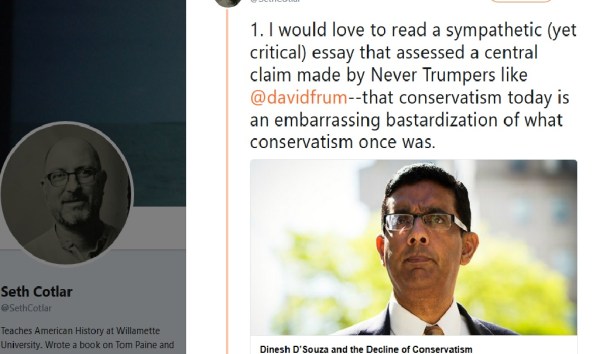
Is Trumpism a monstrous reality-show perversion of true conservatism? Or has Trumpism merely exposed the true racism and anti-intellectualism lurking in the heart of American conservative thinking? Historian Seth Cotlar raised these questions again in a recent Twitter thread. Can Never-Trump conservatives like David Frum take bitter solace in the notion that Trumpism has trumped true conservatism? Or must all conservatives recognize that Trump is nothing more than their movement’s Smerdyakov? The back-and-forth highlights a fundamental truth about conservatism—and political punditry in general—that doesn’t get enough attention.cotlar tweet

Let’s start at the beginning: Professor Cotlar draws attention to the fact that conservative thinkers did not suddenly in 2016 start to mouth muddle-headed and shamelessly demagogic notions. As Cotlar shows, back in the 1990s Newt Gingrich was fond of taking obviously ridiculous positions for political gain. And Cotlar mentions the longer history. Back in the 1950s, Cotlar notes, conservatives were making similar Trumpish noises.

All true and fair, IMHO. Not only for conservatives, but for progressives as well. Not only since the 1950s, but throughout the twentieth century, conservatives and progressives both struggled to define themselves. Conservatives and progressives both wondered how to draw meaningful boundaries around their movements. Was it “progressive” to support Stalin’s purges? Was it “conservative” to indulge in feverish conspiracy theories about the Warren Court?

Indeed, instead of ever thinking about “true” conservatives (or progressives) fighting against “pretenders” or “RINOs,” we need to recognize the obvious historic fact that there IS no such thing as a single, real conservatism (or progressivism).

All we have ever had is a cacophony of contenders for the label. At some points in history, say in the mid-1950s or mid-1990s, conservatives might have rallied around a particularly charismatic or compelling vision of what they wanted conservatism to look like. In the end, however, the history of conservatism is only a history of a battle to claim the mantle of “true” conservatism in the face of the many contenders.

Consider just a couple of examples from the twentieth century. In the 1920s, for example, the revived Ku Klux Klan made a serious play to represent mainstream conservative thinking. As I argue in my book about educational conservatism, national leader Hiram Evans hoped to use the mainstream issue of public education to transform the reputation of the Klan. Yes, the group was racist, xenophobic, and bigoted. And yes, plenty of Americans felt uncomfortable with the Klan’s reputation for vigilante violence and secret ritual. In spite of that reputation, Imperial Wizard Evans hoped—with good reason—that he could reshape the Klan’s reputation as the bastion of “true” conservatism.

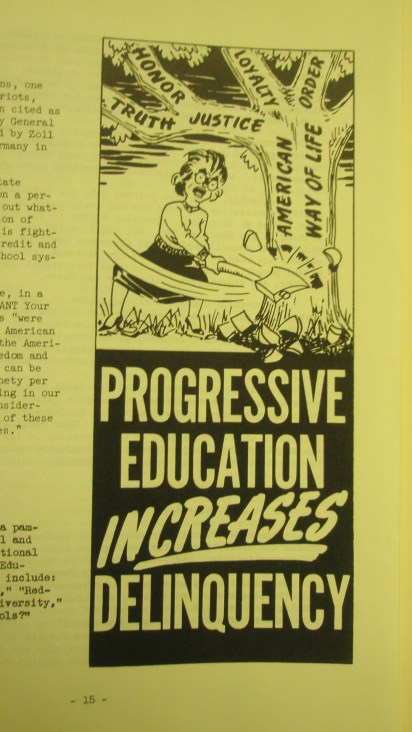
Zoll, Progressive Education Increases Delinquency

Is this “real” conservatism?

In the 1950s, too, conservatives battled for the right to be considered the “real” conservatives. Time and time again, radicals such as Allen Zoll warned residents of Pasadena, California that left-wing conspirators planned to brainwash children in public schools. As Zoll wrote in one widely circulated pamphlet,

We had better stop smiling. There IS a conspiracy.

To non-conservative journalists, Zoll’s hysterical, bigoted rhetoric captured the tone of American conservatism. They assumed that Zoll’s claims to be a conservative spokesman should be taken at face value. So much so that they were often surprised to meet different types of conservative thinkers. For instance, one of the conservative leaders of the 1950s school controversy in Pasadena was Louise Padelford. Padelford was no less strident than Zoll when it came to combatting progressive trends in education. Her tone was worlds removed, however. As one journalist wrote in surprise when he met her, Padelford had

clear blue eyes that look out at the world with wide-open frankness; her ear is keen, her wit quick, and her smile enchanting.

The journalist’s surprise might seem silly to anyone familiar with the true complexity of American politics. There’s no reason why a conservative can’t have a quick wit and an enchanting smile. At the time, though, to one journalist at least, to be “conservative” meant to be Zollish and trollish.

Time and again, conservatives throughout the twentieth century battled to claim the title of the “real” conservatives. Was it mild-mannered but strident Ivy-League PhD Louise Padelford? Or was it rabble-rousing pamphleteer Allen Zoll?

As Professor Cotlar points out, it has always been both. Not just since the 1990s, but throughout the twentieth century. And if we want to make sense of the tension between self-proclaimed Never-Trump conservatives and foolhardy Trumpish demagogues, we need to go all the way.

Namely, we need to recognize that there has never been—NEVER—a single true conservative movement. Not in the offices of the National Review. Not in the hard drive of David Frum.

Conservatism, like all keywords, has always only been a prize up for contention.

Why Civics Education Can’t

It would be nice. It sounds logical. But pumping state standards full of more civics-education requirements won’t produce a more civil society. It can’t. As a recent report reveals, most civics education classes in practice are limited to the same old outlines of government checks and balances, calculated to turn students into nappers, not active citizens.

brookings citizenship

More talk than action…

Not that we don’t want civics education to work. As pundits continue to repeat, Americans in general could use more knowledge about government and about citizen rights and responsibilities. As one writer opined,

A functioning democracy depends on an informed citizenry, including baseline knowledge of societal laws and institutions. Bafflingly, many schools no longer teach children how our government works, and what basic rights Americans are guaranteed.

And it’s not that school leaders haven’t tried. Many states have instituted new curricular rules about civics classes. A new law in Washington state, for example, drew praise from the editors of the Seattle Times. By requiring more time in civics class, the editors celebrated, the new law was

positive news for our democracy. Students who enter adulthood understanding government and their role as citizens are better equipped to participate in elections and hold officials accountable.

I hate to be a sourpuss, but I have to disagree. Not that educated adults aren’t a good thing. Rather, I disagree that mere standards and curriculum changes are enough to do the trick. As I found in the research for my book about the history of American educational conservatism, there is good reason why the centuries-old dreams of civics educators have never really come to fruition.

In a nutshell, civics education can’t work because Americans can’t agree what it is supposed to do. As a recent Brookings report highlighted, schools are very spotty when it comes to delivering the goals of civics education.

If high-quality classroom-based education in civics means anything, it should tend to include some basics. As the Brookings folks put it, there are ten goals:

  1. Classroom instruction in civics, government, history, law, economics, and geography

  2. Discussion of current events

  3. Service learning

  4. Extracurricular activities

  5. Student participation in school governance

  6. Simulations of democratic processes and procedures

  7. News media literacy

  8. Action civics

  9. Social-emotional learning (SEL)

  10. School climate reform

Unfortunately, most civics education is limited to classroom discussions and stale memorization of schoolhouse-rock-level government info.

As the Brookings report found (emphasis added by me),

the most common practices are classroom instruction, knowledge building, and discussion-based activities. These are far more common than participatory elements of learning or community engagement. . . . The lack of participatory elements of learning in state accountability frameworks highlights a void in civics education, as experts indicate that a high-quality civics education is incomplete without teaching students what civic participation looks like in practice, and how citizens can engage in their communities.

In short, most civics classes aren’t able to do the most important parts of real civics education. They aren’t able to engage students in projects that students find meaningful and have an actual impact on public life.

Why not? Ask any teacher. From sex-ed to creationism, any topic that carries the scantiest whiff of controversy is anathema in most schools. Students often care a lot about social issues, but their teachers are hamstrung when it comes to helping students get politically active.

Imagine it: What if a student group decided that their civics project would be a protest against a local abortion provider? Or if students wanted to march in a gay-pride parade? Such activism should be the goal of all civics education, but it is the rare teacher and the rare principal who is willing to take the inevitable heat.

Most schools are caught in a bind. On one hand, they are called on to teach students their duties as active citizens. On the other, if students engage in activism that members of the public disagree with, schools and teachers will inevitably be attacked for it.

Would you want YOUR tax dollars to teach kids to actively oppose a cause you agree with? It’s easy to support civics education in the abstract, but when it comes right down to it, the most we can really agree to is a bland, passive sort of civics information.

Civil Debate? Catcall? Or Creationist Ruse?

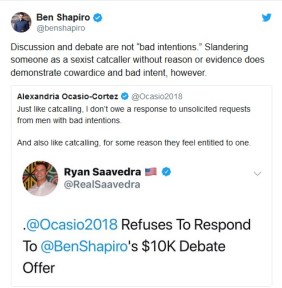
What would YOU call it? Conservative pundit Ben Shapiro says it’s nothing but civil debate. Leftist darling Alexandria Ocasio-Cortez dismisses it as a mere catcall. SAGLRROILYBYGTH might be reminded of something else: a long-standing creationist plea for attention.catcall ocasio cortez

Here’s what we know: Ben Shapiro offered a cool ten grand to Democratic primary winner Alexandria Ocasio-Cortez to debate. If you’ve been on vacation too long, you might need a little backstory. Ocasio-Cortez attracted tons of attention recently with her upset win in a New York Democratic primary election. She has electrified the Sanders left with her energy and victory.

On Twitter, Ocasio-Cortez denounced Shapiro’s offer as nothing more than “catcalling.” Shapiro responded that he only wanted “discussion and debate.”

I’m curious to hear what you think: is it legitimate for Shapiro to offer $10,000 for a debate? Or is that merely an extension of rude, aggressive unsolicited male attention?

And finally, how about this: is Shapiro’s debate offer a remix of an old creationist tactic? For years now, radical creationists such as Joseph Mastropaolo have offered $10,000 to any mainstream scientist willing to debate the facts of evolutionary science. In the opinion of one mainstream scientist, such tactics are obviously a “scam designed to lure the unsuspecting” into a shoddy creationist publicity stunt.

Is that what’s going on here? Is Shapiro merely hoping to attract attention? Or does he really want to engage in a civil debate? Or, as Ocasio-Cortez accuses, is this the equivalent of verbal street thuggery?

How to Kill Fundamentalist Higher Education

[UPDATE: thanks for letting me know about the bad link. It’s fixed now.]

Want to kill uber-conservative evangelical Protestant colleges and universities? The recipe is simple: Have a lot more news stories like this one from Milwaukee.

Schmidt young earth timeline

Schmidt preaches the young-earth gospel…

Outsiders like me might not get it at first. We might think that fundamentalist colleges are happy to live in a little bubble, utterly protected from trends in the wider world. And, to some degree, they are. But when it comes right down to the hard facts, even the most conservative evangelical institutions care what people think about them. They have to. If colleges want to attract students and their tuition dollars, they have to prove that students’ college experiences will help them professionally. Colleges have to be able to assert that they are more than an educational punchline.

As I found out in the research for my recent book about the history of fundamentalist higher education, even the staunchest fundamentalist schools like Bob Jones University and Pensacola Christian College yearn for mainstream respect.

Even though they traditionally eschewed accreditation, fundamentalist universities and colleges promised that their educations were not only theologically and culturally pure, but also good preparation for professional careers. Bob Jones University liked to assert that its students’ GRE scores were higher than similar schools. Founder Bob Jones Sr. often claimed that his school would do more than protect students’ faith—it would prepare them to be faith-filled doctors, engineers, lawyers, and teachers.

His decision to avoid accreditation, Senior often noted, was not due to lack of campus resources. Rather, it was only a measure of BJU’s spiritual superiority. As founder Bob Jones Sr. bragged in 1950,

Bob Jones University is probably the only one in America that could join an association that does not join, and we refuse to join. We believe . . . that a Christian institution should make its own policies in line with the purposes it has in view and that no association of any kind should dictate the administrative policies of the institution.

For most institutions of higher education, though, accreditation has always represented a crucial mark of respectability. Schools that could not afford to earn accreditation have always risked losing students to accredited schools.

It makes sense. Why would a student spend tuition dollars at a university when those classes would not be recognized by other institutions? Why would students attend an undergraduate college when their degree wouldn’t qualify them to enter any graduate schools?

As a recent story from my adopted hometown of Milwaukee demonstrates, evangelical colleges risk losing credibility if they aren’t accredited. Here’s what happened: The current acting sheriff, Richard Schmidt, often brags about his advanced degrees. He has one PhD, he likes to say, and he is working on a second. His election signs tout him as “Dr.” Smith.

So what’s the problem? Unfortunately for Schmidt, his degrees are only from unaccredited evangelical colleges. He earned his undergraduate degree from Hyles-Anderson College. His doctorate comes from the defunct Northland International University.

The Milwaukee report skewers this sort of higher education mercilessly. Not only are both schools unaccredited, but they split their classes and majors by gender. The more serious topics of Bible study, for example, are considered to be for men. Women can focus on challenging courses such as “secretarial procedures,” “crock-pot cooking,” and “The Christian Wife.”

hyles anderson women program

Sorry, I can’t go out tonight. I’ve got my big final in Crock-Pot tomorrow…

This embarrassingly shoddy college poses a career risk for Acting Sheriff Schmidt. For our purposes, the bigger threat is to fundamentalist higher education itself. If conservative evangelical students and families see that unaccredited colleges are the butt of jokes, they just won’t attend. And if degrees from these schools prove a hindrance to professional success—as they are for Sheriff Schmidt—students will take their tuition dollars elsewhere.

In the end, if you want to kill off fundamentalist higher education, all you have to do is laugh at it.

Thanks to N(M)S for the tip.

More Evidence: Christians Don’t Know Christianity

It can be a tough pill to swallow. If we want to be brutally honest, however, we need to acknowledge that religion is about something besides religion. New survey data confirm our hunch that a religious identity isn’t necessarily about religion itself, but about something more complicated.parents-feeling-and-observations

In my recent book about evangelical higher education, I argued that we can only understand fundamentalism and conservative evangelicalism if we abandon our tendency to define these things theologically. After all, there wasn’t really an orthodoxy involved in fundamentalism. There couldn’t be. Although fundamentalism and conservative evangelicalism were certainly religious movements, their institutions were not driven solely by theological considerations. Instead, as with every human endeavor, evangelical colleges jumbled together religion, culture, politics, and other factors to come up with a mish-mash of beliefs, beliefs that “felt right” to students, professors, alumni, and parents.

Seth Dowland recently made a convincing case along these lines. As Professor Dowland argued,

what most distinguishes white American evangelicals from other Christians, other religious groups, and nonbelievers is not theology but politics.

Surveys have shown that a majority of evangelical Protestants don’t actually hold traditional evangelical core beliefs. They might call themselves “evangelical” or “born again,” but only a minority of them agree with all four of these notions:

  • The Bible is the highest authority for what I believe.
  • It is very important for me personally to encourage non-Christians to trust Jesus Christ as their Savior.
  • Jesus Christ’s death on the cross is the only sacrifice that could remove the penalty of my sin.
  • Only those who trust in Jesus Christ alone as their Savior receive God’s free gift of eternal salvation.

Being an “evangelical,” then, is not a theological position. It might INCLUDE theological tendencies, but it is something more than a religious identity. And, of course, it’s different for different people. Plenty of evangelicals ARE defined by their theological beliefs. Just not a majority.

Today we see more survey evidence that evangelicals and other Protestants don’t restrict their beliefs to evangelical or Protestant theology. A large majority think that God wants them to prosper financially. Among evangelicals, a solid 75% majority think so.

We might think that these prosperty-gospellers simply don’t know because they don’t really go to church. But prosperity beliefs are STRONGER among those who attend church more frequently.

What’s the takeaway? Like all of us, evangelical Protestants are complicated. For those of us trying to understand evangelical history, the vital message is clear: “Evangelical” identity is about much more than simple theology.

A Creationist Surprise

SAGLRROILYBYGTH can skip this post entirely. For those who are already familiar with the real contours of American creationism, there’s nothing new in this story. But for those who think American creationism means only Kentucky’s arks and Texas’s fist-thumping school-board leaders, read on. Real American creationism—even the radical young-earth sort—can be found where you might least expect it.

AP creationism

Big Apple, Small Timeline

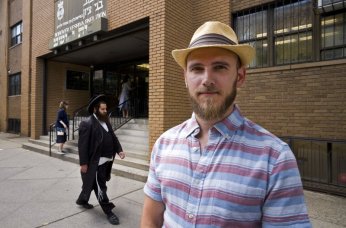
The Associated Press yesterday poked a New York City sore spot. For years, critics and victims have charged the city’s “ultra” Orthodox yeshivas with cruel educational neglect. Today’s story confirms it. Boys in these schools are typically taught scanty secular knowledge. They can graduate, for example, without having learned much English, non-sacred history, or math. Girls tend to learn more about secular subjects, but their overall educational status is decidedly lower than that of boys.

As yesterday’s story tells the tale,

At the ultra-Orthodox Jewish schools Pesach Eisen attended in Brooklyn, most of the day was spent studying religious texts with classes taught in Yiddish. One class at the end of the day was spent on secular subjects including English and math, enough to be “able to go to the food stamps office and apply.”

“Everything was super basic. … Nobody took it seriously, so even if you were a studious person you had no chance,” said the now-32-year-old Eisen, who had to take remedial classes and study intensively on his own before he succeeded in graduating from college in 2016.

These Hasidic schools are once again the subject of lawsuits. It’s not only the schools themselves that are under fire, but Governor Andrew Cuomo and the state Department of Education. Critics charge the government with lackadaisical investigation and enforcement of legal minimums of educational standards, even for private schools.

It’s not only secular history, math, and English-language that gets shunted aside. For the approximately 115,000 students in these schools, modern science is extirpated. As one student told the AP,

They erased anything about dinosaurs. . . . Anything more than 5,000 years old was erased.

So when you go out looking for American creationism, don’t just steer South to the Ark Encounter and the Texas school board room. Be sure to spend some time in the Big Apple where radical creationism is thriving.

Teachers Are Smarter than Elon Musk

Here’s a Sunday-morning challenge for you: How is it possible that the smartest people in the world aren’t able to figure out something that has been public knowledge for hundreds of years and that every good teacher figures out quick? As Professor Zeynep Tufekci brilliantly argued last week, the Elon Musks, Bill Gateses, and Mark Zuckerbergs of the world can’t fix schools. And though Prof. Tufekci makes a great case, it’s not new.

elon musk submarine

Elon Musk power-tube to the rescue!

Tufekci builds her case on Elon Musk’s petulant performance in Thailand. Like many of us, Musk was fascinated by the story of the trapped soccer team in Thailand. Unlike many of us, Musk has billions of dollars and twenty-two million Twitter followers. So Musk directed some lackeys to build a fancy new submarine-machine to rescue the soccer players. When local rescuers rejected Musk’s help, Musk complained on Twitter. Musk seemed unable to recognize that there was a better way to approach this problem.

As Prof. Tufekci wrote,

The Silicon Valley model for doing things is a mix of can-do optimism, a faith that expertise in one domain can be transferred seamlessly to another and a preference for rapid, flashy, high-profile action. But what got the kids and their coach out of the cave was a different model: a slower, more methodical, more narrowly specialized approach to problems, one that has turned many risky enterprises into safe endeavors — commercial airline travel, for example, or rock climbing, both of which have extensive protocols and safety procedures that have taken years to develop.

This “safety culture” model is neither stilted nor uncreative. On the contrary, deep expertise, lengthy training and the ability to learn from experience (and to incorporate the lessons of those experiences into future practices) is a valuable form of ingenuity.

Musk and his ilk do not limit their can-do arrogance to Thai cave rescues. As Tufekci argues, in public schooling as well, Silicon Valley richies tend to think they can plunk down their money, dig out incompetence, and fix schools in one fell swoop.

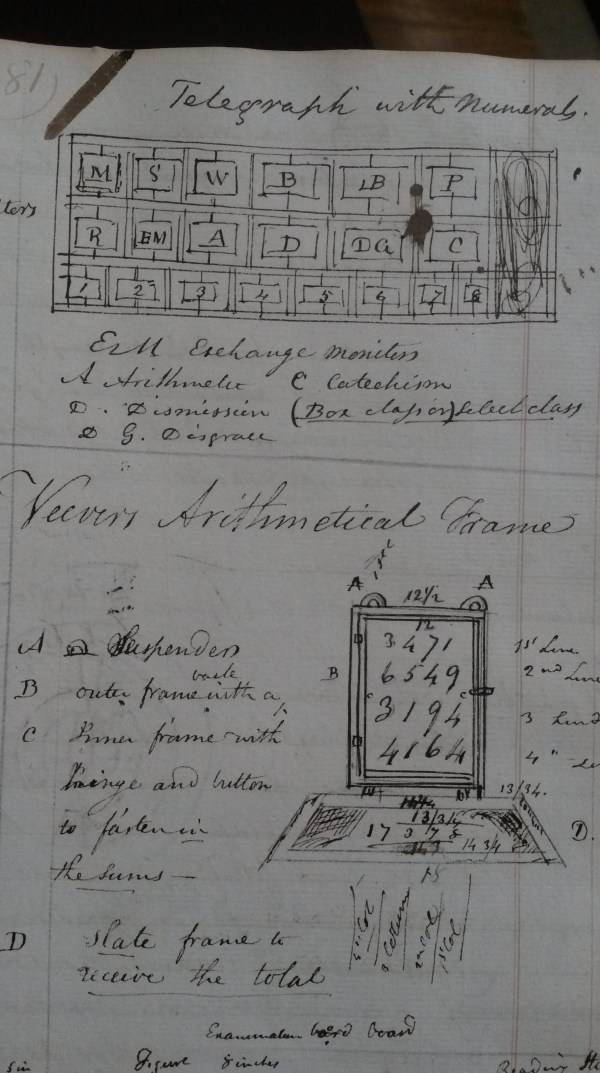
The Musks and Zuckerbergs of the world might be forgiven if we were in brand-new territory. But we’re not. As the late David Tyack and Larry Cuban argued so brilliantly over twenty years ago, school reformers have always tried to fix complicated educational problems with poorly prepared prescriptions.

Telegraph with numerals sketch

The technological solution to bad schools, c. 1805.

Time and time again, as Tyack and Cuban relate in Tinkering Toward Utopia, outside “experts” swoop in to fix schools with The Big New Thing. Closed-circuit television, market-based evaluation models, computerized personalized learning systems…all have been vaunted as the new solution. In every case, veteran teachers look for the good and reject the useless. In every case, teachers use the parts of the new system that help them do the real work of education, while quietly packing away the useless bits in a hallway closet.

And as I’m arguing in my new book about the historic roots of urban school reform, the Musk/Zuckerberg fallacy goes back to the very beginning. Back in the early 1800s, a young educational entrepreneur in London thought he had the solution to urban poverty. Joseph Lancaster promised that his elaborate new system—replete with cutting edge technology—would allow one school master to educate hundreds of low-income urban kids.

It didn’t work. But perhaps Lancaster can be forgiven, since his assumptions were fairly new and untested. The Musks of today have no such excuse. As Professor Tufekci concludes,

Education is a complex topic, and making a lot of money in tech is not a qualification for solving educational problems.

It’s something we have known for centuries. It is something that every teacher figures out right away. Why can’t our tech gurus see it?