These Twelve Teachers Terrify Me

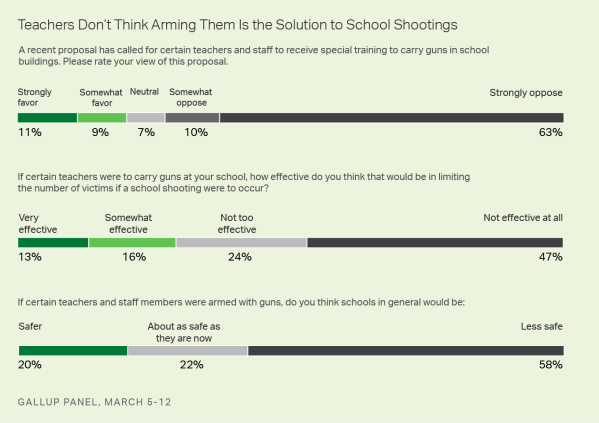
Me, I don’t think more guns in school are a good idea. But if we were to go ahead with such a plan, we have to find a better way to figure out who our gun-toters will be. A recent Gallup poll offers a frightening scenario.

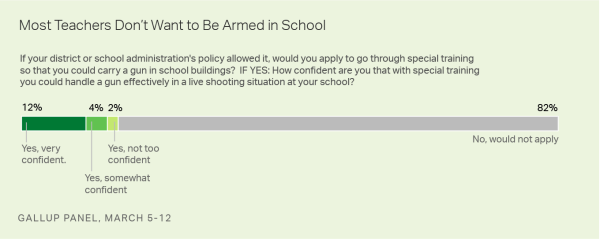
The poll finds that teachers overall don’t want guns. Nearly three-quarters (73%) of polled teachers oppose the idea. A significant majority (58%) think it will make schools less safe.gallup on teachers with guns

The scary result is different. Some teachers (18%) said they’d be willing to carry guns at work. Of those, two-thirds told pollsters they were “very confident” that “with special training [they] could handle a gun effectively in a live shooting situation at [their] school.”gallup on teachers with guns 2

Am I crazy? Or are these twelve-out-of-a-hundred teachers who think they know just what to do with a deadly weapon the LAST people who should be packing heat in school? Have we forgotten the lessons of Farva?

The Dilemma of the Fundamentalist Intellectual

It’s tough to be a conservative evangelical intellectual these days. As a recent exposé at Religion & Politics makes clear, they are still addicted to mainstream academic credentials, even when those credentials can be nearly impossible for them to achieve.

Why is it so difficult for conservative evangelicals to earn mainstream academic credentials? In part, it’s due to the stark and growing divide between mainstream institutions and evangelical intellectual assumptions. As I’m arguing in my new book about evangelical higher education, in the late nineteenth century conservative evangelicalism lost its place as the presumed intellectual backbone of America’s colleges and universities. I think historian Jon H. Roberts said it best. In the late 1800s,

Truth claims based on alternative epistemologies—tradition, divine inspiration, and subjective forms of religious experience—increasingly lost credibility within the academy.  In addition, the recognition that knowledge itself was fallible and progressive cast doubt on the legitimacy of venerable doctrines.  Claims that ongoing inquiry would eliminate error and establish truth fostered an iconoclasm toward orthodoxies.

In response, conservative evangelicals—calling themselves “fundamentalists”—built a dissenting network of higher-educational institutions. It wasn’t only brick-and-mortar schools. Fundamentalists created their own accrediting agencies, athletic leagues, alumni organizations, and more. These independent evangelical institutions allowed academics to rack up titles and honors without participating in mainstream thinking. As we’ve noted recently, the fetish for credentials has always included a frenzy of cross-institutional honorary doctorates.

sacred secular university

The empire really was in ruins.

But it’s still not enough. Throughout the twentieth century and continuing today, conservative evangelicals have yearned for more than just their own credentials. They have oohed and aahed at their colleagues who have earned mainstream academic respectability.

One notable case occurred during the mid-century creationism wars. Back in the 1940s and 1950s, evangelical intellectuals squared off (again) over the question of a young earth. Did belief in the Bible require belief in a literal six-day recent creation? In a literal world-wide flood?

At the 1948 meeting of the creationist American Scientific Affiliation at Calvin College, for example, geochemist J. Laurence Kulp battled with Calvin botanist Edwin Y. Monsma. Monsma defended the young-earth position. Kulp trashed it as mere “foolishness.” With his PhD from Princeton and his faculty berth at Columbia, Kulp’s mainstream credentials helped carry the day. As historian Ronald L. Numbers described, many ASA members were “ready to follow Kulp in boldly shedding the trite fundamentalist apologetics of the past.” Creationism, yes. Young earth, no.

At least in part, Kulp’s bona fides from outside the charmed circle of fundamentalist institutions helped convince many conservative evangelical intellectuals that Kulp’s ideas had oomph.

The_Creationists_by_Ronald_Numbers

Creationists love credentials…

Today, we see a sad case of inflated credentials from another evangelical intellectual. As Professor Jill Hicks-Keeton of the University of Oklahoma points out, a recent publicity appearance to promote the new Museum of the Bible highlighted conservatives’ desperate drive for mainstream academic credentials.

Professor Hicks-Keeton describes the spiel of Jeremiah Johnston of Houston Baptist University. Professor Johnston hopes, in his organization’s words, to “teach Christians to be Thinkers and Thinkers to be Christians.”

But in his quest to wow evangelical audiences, according to Hicks-Keeton, Dr. Johnston played fast and loose with his resume. Hicks-Keeton sleuthed a little deeper. As she puts it,

Johnston’s academic credentials sound impressive: “He has studied at Oxford,” the pastor said. The CTS [Christian Thinkers Society] website’s bio for Johnston includes a list of presses with whom he has published, led by one of the most prestigious in the guild: Oxford University Press. During his talk to the congregation, Johnston repeatedly performed such credentials for church members by dropping academic words the average churchgoer would not have encountered (shema, protois, verisimilitude) and by flagging his own academic work. . . . A closer look at his curriculum vitae reveals that his educational pedigree is unrelated to Oxford University, a premiere institution of scholarship. The “Oxford” mentioned by Pastor Daniel is actually the Oxford Centre for Mission Studies—identified by its website as “an independent Christian charity.” Johnston’s publications with OUP amount to four brief, co-authored contributions to encyclopedias and edited volumes, which are not subjected to the rigors of peer review.

Ouch. For any academic—evangelical or not–these charges sting.

Why would Professor Johnston puff up his credentials, when they are so easy to deflate? I don’t know Johnston, but my hunch is that he shares the century-old dilemma of all fundamentalist intellectuals. In spite of their long efforts to free their minds from the shackles of mainstream academic thinking, they are still wed to the same hierarchy of prestige as everyone else.

Extremely Mainstream

It’s uncomfortable. Listening to a high government official denounce evolutionary theory and Islam makes me nervous for the future of the USA. More important, though, it brings us back to a tough question: When is an idea “extreme?” Our answers matter, because extremism can be kicked to the curb, but strong disagreement can’t.

pruitt

Terrible? Yes. Outside the mainstream? No.

To SAGLRROILYBYGTH, this discussion will feel familiar. In recent weeks, we’ve been wondering if young-earth creationism really counts as “hate speech.” We’ve debated whether tax-funded student groups should be free to discriminate. We’ve examined the decisions of conservative Californians to shun a speaker they considered “extreme.

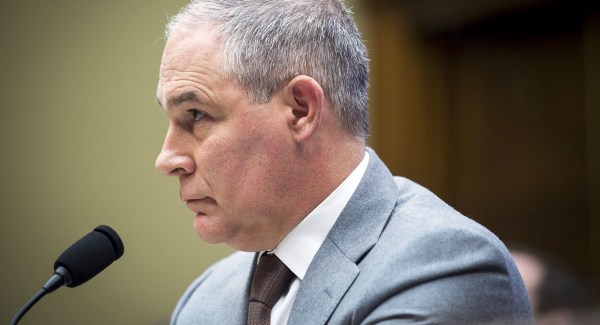
The details of the story this week are different, but the issue is the same. Scott Pruitt, former state senator and current head of the Environmental Protection Agency, has had some of his old laundry aired in public. In thirteen-year-old radio interviews, Director Pruitt talks about a range of issues, from science to the Second Amendment.

Is evolution really the best explanation for the diversity of species? Quoth Pruitt,

There aren’t sufficient scientific facts to establish the theory of evolution, and it deals with the origins of man, which is more from a philosophical standpoint than a scientific standpoint.

Should some kinds of guns be banned? Not according to Pruitt:

If you can tell me what gun, type of gun, I can possess, then I didn’t really get that right to keep and bear arms from God. . . . It was not bequeathed to me, it was not unalienable, right?

Is Islam a religion that deserves constitutional protection? Pruitt thinks so, but he didn’t object when one of the interviewers called Islam

not so much a religion as it is a terrorist organization in many instances.

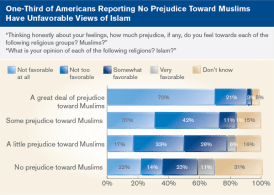
To a person like me, those ideas are both ridiculous and frightening. Ridiculous because they articulate a vast ignorance of the history of our Constitution, of evolutionary science, and basic knowledge about Islam. Frightening, because they articulate a vision of proper government that could include radical violations of Constitutional rights and dangerous inaction concerning gun control.gallup islam

But here’s the rub. The author of a Politico article about Pruitt’s 2005 interviews denounces Pruitt’s

stances that at times are at odds with the broader American mainstream, and in some cases with accepted scientific findings. [Emphasis added.]

For starters, I won’t call attention to the goof in the article about the Supreme Court’s 1947 Everson decision. The author thinks SCOTUS ruled against tax-funded bussing for Catholic schools in that landmark case, but in fact the decision went the other way.

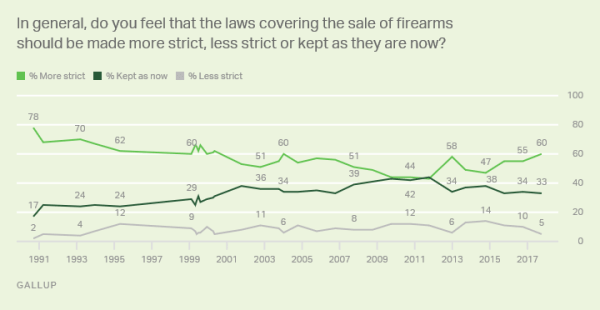
The real issue here is not SCOTUS history, but rather the difficult definition of “mainstream.” I’ll admit it: I’m angry about Pruitt’s views. I’m angry that someone with such opinions would be posted to the head of a scientific government agency. But that doesn’t mean that Pruitt’s ideas are out of the mainstream. When an idea is shared by a plurality of Americans, how can it possibly be out of the mainstream?gallup guns

Gallup polls, for example, indicate that more than a third of American respondents who say they are not prejudiced against Muslims still have an unfavorable view of Islam. Yes, you read that right. Of the people who say they are NOT prejudiced against Islam, 36% still say they don’t like it. Of the people who say they ARE prejudiced against Muslims, that number jumps to 91%.

Similarly, the number of Gallup’s respondents who think America needs stricter gun laws has dropped in the last three decades. In 1991, 78% of respondents wanted stricter gun laws. In 2017, that number was only 60%.

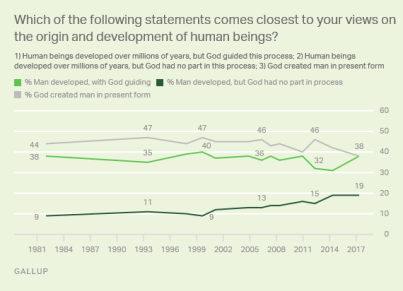
The same is true with evolution. Large majorities of Gallup respondents agree that humanity was either created recently or created by God over time. At best, mainstream evolutionary theory has captured the hearts of a small minority of Americans. It’s only “mainstream” among a small coterie of scientists.gallup creationism poll may 2017

If Director Pruitt agrees with large segments of the American population—sometimes a majority—how can his views be called “at odds with the broader American mainstream”?

The distinctions matter. If an idea is extreme, or discriminatory, or illegitimate, or non-mainstream, it seems fair to push that idea outside the boundaries of polite political or cultural discussion. If not, we have to talk about it.

Like it or not, Director Pruitt’s terrible ideas are as American as apple pie.

Billy Graham and Bob Jones

The news is in: Billy Graham has passed away at age 99. I’m not among his evangelical followers, but over the past several years I’ve gotten to know Billy Graham as I’ve worked on my new book about evangelical higher education.

Billy Graham

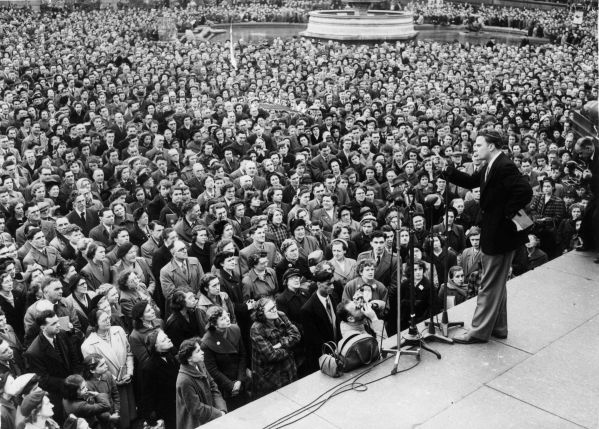
Graham preaching to the multitudes, London 1954.

In the 1940s and 1950s, Graham became the embodiment of a new spirit among American fundamentalists. He reached out to other Protestants to help lead big revival services all across the world. Some fundamentalists thought he went too far. (For details, check out my archival survey of fundamentalist fury about Graham’s revival successes.) As I note in my book, Bob Jones Sr. in particular had a long and tempestuous relationship with Graham.

Graham had started his college career at Bob Jones College. After a year, though, Graham left, ending up with an anthropology major from Wheaton. Jones and Graham kept in close contact and their correspondence is the best single source I’ve found to understand the rift between fundamentalists and new-evangelicals.

By the 1950s, Jones actively warned fundamentalists not to trust Graham or any institution that welcomed Graham. Jones’s letters show both the reasons and the personal anguish involved. Below I’ll quote from a five-page single-spaced letter Jones wrote to Graham in 1951.

                Here is the difference between your mistakes and mine: My mistakes grew out of the way I did things because I did not know how to do them.  After I got the right kind of advice, I quit making them.  Your mistakes have not grown out of your lack of information or your inability to get information.  Your mistakes have grown out of the fact that you are not building your evangelistic campaigns on the right foundation and the right principles.  Billy, if you build a house on the right foundation, the storms and wind may blow that house down, but you do not have to ever rebuild the foundation. . . .

In your heart, you love Jesus, and you are happy to see people saved; but your love for glamour and your ambition (which is the strongest ambition I have ever known any man in evangelistic work to have) and your desire to please everybody are so dominant in your life that you are staggering from one side of the road to the other. . . . You, in your effort to please, are putting yourself on the spot. . . .

Most of the material that goes out about you, you put out. . . .

I could tell you much more, Billy; but it does not do any good to talk to you.  You will agree with a fellow, but you go on just as you are, and that is the discouraging thing about it. . . .

You are popular like any showman is popular, but you have no real grasp upon the hearts of the people like Billy Sunday and other men had. . . .

[When you were young, you begged me] to call you one of my boys and told me that you got your slant on evangelism at Bob Jones  University.  My evangelistic heart was touched, and I put about you the arms of evangelistic affection.  I came back here to the school and told everybody that you were one of our boys.  I did not tell them what kind of a record you made here.  I took at face value what you said about going to Florida because of your health.  I asked all of our boys to pray for you.  I asked my friends to pray for you.  Remember, Billy, that was before you made the headlines. . . .

you began to think that probably the best thing for you was at least on certain occasions and in certain places not to let people know that you were here [as a student at Bob Jones College] and that, as you had said, you got your slant on evangelism here.  So you began to sort of soft pedal. . . .

Now that you are in the headlines, the fact that I ever said that you were one of our boys because you told me to, and people know about that, and you cover it up gives the idea that we are trying to hang on to your coat tail because you are in the headlines; but we are not, Billy. . . .

I still love you…

Who Still Loves Trump? Not Just the Usual Suspects

I thought I understood why so many white evangelicals supported Trump. New information about other conservative Trumpists has me wondering about it all over again.

First and foremost, we need to remember that political opinions are always a mish-mash. Some conservative white evangelicals might support Trump for hard-nosed political reasons, such as control of the Supreme Court. Others might simply revile Hillary Clinton so much that they’d support anyone else. Noting all those caveats, I thought the single biggest reason for white evangelical support for Trump was the hat.

Trump make america great again

Is it the hat? Or something more?

As I’m arguing in my new book, conservative white evangelicals have long felt a sense of usurpation. They have felt kicked out of the elite universities that they themselves founded. They have felt kicked out of mainstream science organizations. They have felt kicked out of mainstream cultural attitudes about sex and behavior.

When candidate Trump promised to “Make America Great Again,” the promise carried a particularly heavy appeal for some conservative white evangelicals. They had long thought that America had gone to the dogs, that it had kicked God out of its classrooms and off its TV screens. The idea of restoring America to a mythic golden-age past has enormous appeal among some conservative white evangelicals.

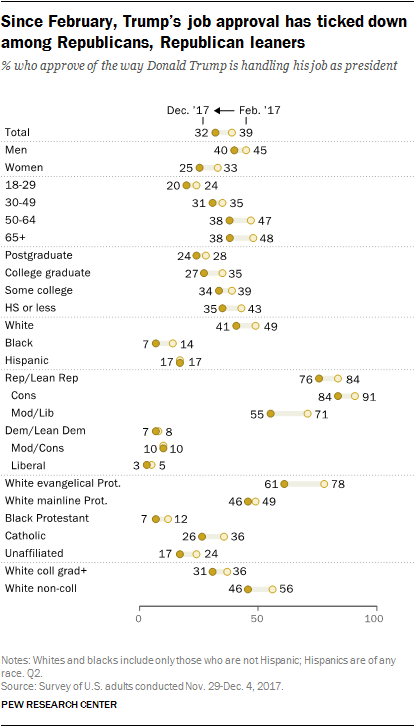
This week, I’m catching up with old news about another conservative religious group that has similarly fond feelings for Trump, but none of the same unique history in this country. Orthodox Judaism has not had the same sense of proprietary ownership over public space in these United States, but apparently the Orthodox community is even fonder of Trumpism than white evangelicals are.pew chart trump support

At Forward, Elad Nehorai explores the curious fondness for white nationalism and Trumpism among the American Orthodox community. As he points out, Trump’s support seem to be falling among white evangelicals. At least as of December, Pew found white evangelical Trump fans had dropped to 61%. Among the Orthodox, though, support for Trump jumped to 71%, as of last September.

What gives?

Nehorai argues that some of his co-religionists have been so utterly disgusted by liberal politics they are willing to embrace any alternative. As one Orthodox writer offered, if he had to choose between Antifa and the Klan he’d take the latter. Nehorai concluded, for some Orthodox thinkers,

Ultimately, even the KKK may not be as bad as the liberal world.

If You Don’t Teach about It, Will It Go Away?

Nothing is touchier than teaching young kids about sex. A new bill in South Dakota’s state senate illustrates the painfully deep culture-war divide we face on this topic. Progressives like me think teaching young kids about sexual identity and gender identity can save lives and create a more equitable society. Some conservatives think it warps minds and turns children into homosexuals or transgender people. But just like evolution and US history, the real divide isn’t over what to teach, it’s over how to teach it. The real issue, as always, is not sex or evolution or history, but TRUST.

Here’s what we know: A bill in the South Dakota senate would simply prohibit schools from teaching elementary students about transgender identity. It’s brief:

No instruction in gender identity or gender expression may be provided to any student in kindergarten through grade seven in any public school in the state.

This is the first bill of this sort, but it joins a group of similar bills about teaching sexual identity. As the Minneapolis Star-Tribune reports, those laws, sometimes called the “no-promo-homo” laws, are in effect in Alabama, Arizona, Louisiana, Mississippi, Oklahoma, South Carolina and Texas. They prohibit teaching positive messages about homosexuality to young students.

And, as SAGLRROILYBYGTH are well aware, it’s the “positive” part of the subject that is the trickiest. As we’ve seen in these pages time and again, conservatives mobilize to block certain books and ideas that hope to teach children that homosexuality is perfectly natural and wholesome.

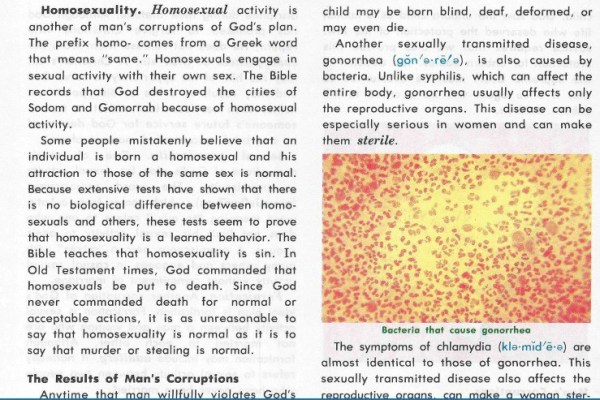
PACE 1107

Image from PACE 1107.

But it’s not the case that conservatives don’t want their children to learn about homosexuality. In fact, even the most ardent fundamentalists teach their children about sexual identity and gender identity. The staunchly conservative Accelerated Christian Education curriculum, for example, includes a lot of information about homosexuality. For example, children will read the following:

Some people mistakenly believe that an individual is born a homosexual and his attraction to those of the same sex is normal. Because extensive tests have shown that there is no biological difference between homosexuals and others, these tests seem to prove that homosexuality is a learned behavior. The Bible teaches that homosexuality is sin. In Old Testament times, God commanded that homosexuals be put to death. Since God never commanded death for normal or acceptable actions, it is as unreasonable to say that homosexuality is normal as it is to say that murder or stealing is normal.

Now, this is a fairly extreme attitude toward homosexuality; most conservatives wouldn’t want their children learning this sort of idea either. Accelerated Christian Education is only popular among a certain subset of religious conservatives. However, when even those most anti-gay-rights conservatives teach their children explicitly about homosexuality, we see that the problem isn’t the topic, but the approach.

The problem, I think, for many conservative activists is a deep and abiding mistrust of how schools will teach young children about these issues. Conservatives (not all, but it gets repetitive to keep writing “some,” so I’ll shorten it from here on out to “conservatives”) worry that schools will indoctrinate young children with pro-gay, pro-trans messages.

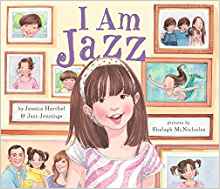
To be fair, those fears are well-founded. Most educational programs that I’ve seen really do hope to foster a sense that homosexuality and transgender are healthy ways to be a person. To cite just one example from my adopted home state of Wisconsin, activists staged a reading of the controversial book I Am Jazz in order to help trans students feel “safe and accepted.”

Indeed, the intention of such books and curricula is precisely to help young people see sexual identity and gender identity in a non-traditional light; the goal is to help everyone accept non-traditional gender identities and sexual identities as healthy and normal. The kind of gender-identity education I support doesn’t just teach students neutral facts about gender. It really does hope to help young children see sexuality and gender identities as variable.

i am jazz

What should children learn about gender identity?

And, to be double fair, if the shoe were on the other foot, I would protest as well. That is, if children in public schools were learning ACE’s message about homosexuality, I would do everything I could to block it.

In South Dakota, and likely in other states soon as well, conservatives are hoping to ban a topic they can’t control. They worry that any instruction about transgender issues will turn into an attempt to indoctrinate young minds. They fret with good reason that progressives hope to get young children to accept non-traditional gender identities and sexual identities. In the end, conservatives don’t trust the public schools to teach their values, so they simply block certain topics altogether.

Where’s the Beef?

I didn’t think it was all that complicated, but at least two smart people have misunderstood my complaint, so I’ll try to clarify. If SAGLRROILYBYGTH think I’m splitting hairs or being overly persnickety, I’ll shut my yap. But I don’t think I am and I don’t think the point is all that abstruse.duty_calls

Here’s what we’re talking about this morning: Last week, I wondered if evolution maven Jerry Coyne had a glitch in his code. He didn’t think protesters against Steve Bannon had a legitimate right to block Bannon’s appearance at UChicago. Coyne pooh-poohed protesters’ claims that the issue wasn’t really about free speech.

But I assumed—correctly it appears—that Prof. Coyne does reject some claims to free-speech protections. Prof. Coyne and I agree: Just because someone claims free-speech protection doesn’t mean they should get it. Some claims are bogus. Some are even harmful, at least potentially. The most obvious case is the perennial free-speech claim of America’s creationists. In state legislatures, bill after bill purports to protect the free-speech rights of creationist students and teachers.

Especially since we agree on everything, Prof. Coyne wondered what my beef was. As he put it,

Laats’s beef seems to be this: if I, Professor Ceiling Cat Emeritus, favor free speech on college campuses, why don’t I favor free speech in the classroom?

Coyne goes on to explain—and I agree with him as far as he goes—that creationist teaching in classrooms is not the same as controversial invited speakers on university campuses. However, he didn’t identify my beef correctly. Here it is: If Prof. Coyne doesn’t recognize the legitimacy of creationists’ claims to free-speech protections, why doesn’t he grant other people similar rights to un-recognize free-speech claims?

After all, Professor Coyne makes it clear. He says,

I do not recognize creationists’ desire to teach goddy stuff in the classroom as a “free speech” claim. [His emphasis.]

Coyne means, I think, that creationists can’t claim protection for their speech if it establishes a government religion unfairly, contra the First Amendment. By doing so, creationists give up any right to free-speech protection for their creationist teaching. The important point, IMHO, is that Prof. Coyne recognizes that some free-speech claims are faulty. Those claims are not legitimate and they do not deserve the protection they demand. Creationists insist on their right to free speech; they insist that their rights to be heard are often dismissed unfairly. In general, I think Prof. Coyne and I agree—we don’t lose any sleep over such creationist complaints, because we do not recognize them as legitimate claims to the protection of free-speech rights.

Which leads us to the main question again: If Prof. Coyne is willing to dismiss some claims to free-speech protection as illegitimate, why doesn’t he at least respect the anti-Bannon argument, even if he disagrees with it?

In other words, though I agree with Professor Coyne both that Bannon should be allowed to speak and that creationists should not be allowed to teach creationism in public-school science classes, I disagree with his glib dismissal of the arguments of the anti-Bannon protesters.

I think we need to acknowledge that there are real and important reasons why some intelligent, informed, well-meaning people refuse to recognize Bannon’s claims to free-speech protections. Further, there are good arguments to be made that a private (or public) institution has a responsibility to consider the implications of its speaking invitations. By inviting Bannon to speak, an elite university like Chicago is conferring on Bannon and Bannon’s ideas more than a touch of mainstream legitimacy. Blocking someone from speaking at the University of Chicago is not the same as blocking his or her right to holler on a street corner. I don’t think the Chicago protesters are hoping to shut down Breitbart; they are merely hoping to deny Bannon the enormous prestige of a Chicago speaking appearance.

Now, in this particular case I think the decision should swing in Bannon’s favor. But that does not mean that the anti-Bannon protesters don’t have a decent case to make. It does not mean that the UChicago protesters are “discarding one of the fundamental principles of American democracy because they don’t like its results,” as Prof. Coyne accused.

Some free-speech claims are bogus and don’t deserve to be recognized. The Chicago protesters and I merely disagree about the proper decision in this one particular case. They are not necessarily against free speech; they are disputing Bannon’s claim to free-speech protections; they are against their university recognizing Bannon’s legitimate status.

Does Jerry Coyne Support Creationism?

Okay, maybe I’m just mad because he poked fun at “humanities” types like me. But I can’t help wondering if Jerry Coyne’s love for free speech is really as consistent as he implies. Does Professor Coyne support creationist “free speech” laws for K-12 schools? Colleges?

Here’s what we know: Right-wing eminence gross Steve Bannon is planning to speak at the University of Chicago. Students and some faculty are protesting. Professor Coyne criticizes the protesters, calling their “tiresome” ideas “reprehensible.”
UChicago sit in

Protesting against unfettered free speech at Chicago…

I tend to agree with Prof. Coyne that almost all speakers should be allowed to speak on university campuses. We need a high bar to prohibit speech, especially for guest lectures at universities. There are exceptions. If someone is likely to directly incite violence, they shouldn’t be allowed to speak. Universities, moreover, are under no obligation to financially support disruptive tactics—the kind of intentional provocation used by the likes of Richard Spencer. That is, when speakers plan to cause riots in order to draw attention to themselves, universities are not obligated to pay for the show. That’s not about free speech, but simple administrative common sense.

White supremacists and Trumpy trolls aren’t the only ones pleading for their right to free speech. As SAGLRROILYBYGTH know, creationists these days demand free speech in schools. Many current school bills insist that they will give teachers “academic freedom” to teach ideas critical of mainstream evolutionary theory. Missouri’s 2015 bill, for example, promises the following:

Neither the state board of education, nor any public elementary or secondary school governing authority, superintendent of schools, school system administrator, or public elementary or secondary school principal or administrator shall prohibit any teacher in a public school system of this state from helping students understand, analyze, critique, and review in an objective manner the scientific strengths and scientific weaknesses of biological or chemical evolution whenever these subjects are taught within the course curriculum schedule.

I’ll say it: I don’t think this kind of “freedom” is good policy. Sponsors of bills like these, IMHO, are mainly trying to cram a wedge into public-school science classes. I’m suspicious of the “scientific weaknesses” that such bills hope to teach about. If they really wanted to teach the various disagreements about the details of evolutionary science, fine. Great, even. But in fact, teaching those “scientific weaknesses” usually means teaching creationist critiques of mainstream evolutionary science as a whole. Teachers in public schools should not consider themselves free to tell students that worse creationist science is just as good as better mainstream academic science.

“Academic freedom” creationist gambits are not limited to K-12 schools. A few years back, for example, Professor Eric Hedin won tenure at Ball State despite accusations that he taught creationism-friendly ideas.

Does Professor Coyne support free speech in cases like these? In the case of Eric Hedin, we don’t have to wonder. Coyne outed Hedin early and often. Coyne protested that no professor at a publicly funded university had the freedom to teach creationism-friendly ideas as if they were science.

In creationist cases, then, Professor Coyne agrees to strict limits on free speech. How does he choose which free speech to prohibit?

A few possibilities:

  • Professor Coyne might say that he only objects to tax-funded religious preaching, as when a public university pays Hedin’s salary.

But tax money supports lots of religious talk on public college campuses. At many schools, religious groups use tax-funded facilities as meeting rooms. They use tax-funded student lists to recruit possible converts and members. Moreover, nearly every decent public university teaches lots of classes about all sorts of religious ideas. Why single out this particular instance?

  • Professor Coyne might object that Hedin taught religious ideas as science.

Surely Prof. Coyne knows better than me how difficult it is to articulate a simple definition of “science.” Shouldn’t scholars have the freedom to explore those boundaries?

  • Professor Coyne might say that he is against schools paying salaries for the promulgation of bad ideas; he doesn’t want intelligent design afforded the prestige of appearing in a college class.

If so, he would be repeating the ideas of the anti-Bannon UChicago protesters and their ilk. They do not want to legitimize hateful trolls such as Steve Bannon by paying him to speak at Chicago. They do not want to afford Bannon the prestige of such an affiliation.

  • Professor Coyne might say that teachers should stick with the curriculum.

But I don’t think he would. The heart and soul of academic free speech is the freedom to explore ideas not dictated from above.

Or, even if Professor Coyne could convince people that Professor Hedin was a special case, a case in which a teacher falsely claimed the freedom to preach religion on the public dime, what would he say about other free-speech schemes out there, like the one in Wisconsin?

Lawmakers in Madison have proposed a law to protect free speech on campus. If a creationist student were told that his “speech” about a 6000-year-old earth was incorrect on an exam, he could complain to an ominously named Council on Free Expression.

I just can’t imagine that Professor Coyne would protect creationists’ freedom to equal status for their ideas. In fact, I’m hopeful he would join me in strident opposition to this sort of thing.

The point, in the end, is not that students, faculty, and outside speakers are all engaging in the same sorts of speech. When a professor teaches a class or a student writes an exam, they are obviously engaged in different sorts of speech than when an outsider comes for a one-off lecture. They’re not all the same, but that’s not the point. Rather, the central point is that some assertions of free speech are strategic manipulations. In the case of most creationist “free speech” bills, the true goal is to make creationism seem legitimate.

When I (and maybe Prof. Coyne would join me) argue against such creationist free speech laws, our motives and goals are not “reprehensible.” We are trying to protect a vital idea—that mainstream science and creationist alternatives are not merely equally valuable scientific understandings. Academic freedom for instructors and free speech for students doesn’t include the right to teach and preach worse science as if it were equal science. People are certainly free to speak their minds about creationism, but schools do not have to pay people to engage in that kind of speech.

Given all that, I don’t understand why Coyne is so quick to bash his Chicago colleagues. Sure, he may disagree with them, but he should recognize his own objections to some purported “free speech” claims. If he did, he would likely have a different take on the “reprehensible” actions of his Bannon-busting colleagues.

News Again: The Oldest Scandal in Public Schools

Don’t act surprised. The depressingly predictable scandal in DC schools serves as yet another reminder of a centuries-old truth about public education. When people tell you they have figured out how to fix urban schools on the cheap, they’re either lying or fooling themselves. When they show you proof, they’re faking it.

ballou HS DC

Where magic didn’t happen….

Here’s what we know: NPR investigated Ballou High School in Washington DC. The school showed remarkable sudden improvements. Graduation rates suddenly jumped to 100% and all the grads were accepted to college.

A triumph, right? Not really. Turns out about a third of the students hadn’t been to school enough to meet minimum requirements. Many of them couldn’t read or write well. Teachers felt enormous pressure to move kids along, whether or not they had met any of their educational goals. Some teachers reported a “culture of fear;” they felt forced to do things they knew weren’t right.

Now wunderkind chancellor Antwan Wilson is in the spotlight. What did he know and when did he know it? Not only Wilson, but informed school folks are all keenly aware of the sobering truth: We all knew this would happen and we’ve known it for centuries. Even for those few folks who don’t read ILYBYGTH to find out the centuries-old story of urban school reform, there are so many recent examples that no one can claim ignorance.

Consider Rod Paige and the overstuffed “Houston Miracle.” Or the ugly cheating scandal in Atlanta. Time and time again, when reformers and administrators build sparkling careers on their sudden, dramatic improvements, they have simply cut corners, cheated, and fudged numbers.

For SAGLRROILYBYGTH in the know, these sorts of educational con jobs are the oldest story in urban public education. As I’m researching these days, in the early 1800s Joseph Lancaster set the pattern that Paige, Wilson, and many others would follow. Lancaster was an earnest young Quaker who opened a school for urban urchins in London. He copied a system that allowed him to educate hundreds of students with only one adult teacher.

Soon, a group of wealthy philanthropists hyped Lancaster’s “Borough Road Miracle.” Lancaster thought he had figured out something radically new. He promised he could establish similar schools for America’s cities. He promised he could turn illiterate “Street Arabs” into upstanding literate Christian citizens.

lancaster schools

The promise: Everyone learns, no one pays…

He couldn’t.

In a few years, Lancaster’s over-hyped schools had flopped and failed. Parents and students complained that they were abused and under-educated. Teachers warned that Lancaster’s methods didn’t work. Lancaster himself was in debt up to his ears and fled to Caracas.

The lesson? It’s not that school reform isn’t possible or desirable. Rather, we need to remember that charismatic, ambitious reformers will always promise more than they can deliver. Politicians will tend to glom on to silver-bullet solutions that don’t cost any extra. School reports that sound too good to be true usually are.

School reform IS possible, but it isn’t easy and it isn’t cheap. If we really want to fix our public schools, we need to stop looking for magic solutions and rather do the difficult and expensive job of improving every school.

From the Archives: I Know Who Will Win the Super Bowl

[Editor’s Note: It’s that time of year again, so I dusted off this oldie from the ILYBYGTH vaults. The survey data is a couple of years old, but I bet it’s still fresh.]

Call Vegas.  Bet the farm.  We know for sure who will win the Super Bowl.

First a note for readers outside the United States or for those ensconced in thick protective layers of nerd: The “Super Bowl” is a contest between football teams.  It is typically a hugely popular TV and social event.

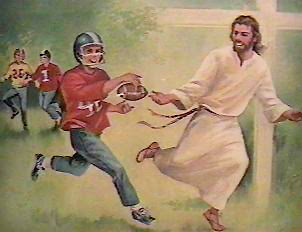
The winner this year has been proclaimed in advance.  No matter what happens on the  field, the winner will be… Jesus!

jesus_football

Did Tommy Brady grow a beard?

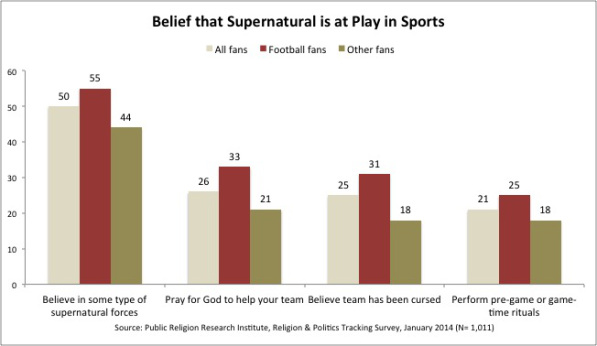
That’s right: no matter how the game goes, Americans tell pollsters they believe that Jesus will determine the outcome.  At least according to a recent report from the Public Religion Research Institute, a majority of Americans think that “some type of supernatural forces” will decide who wins the big game on Sunday.  More than a quarter of fans say they pray to God to help their team win.  And roughly a quarter of fans think their team has been cursed at one time or another. Weirdly, this tendency seems to be stronger among football fans than fans of other sports. No matter what the sport, though, plenty of Americans live in a world of magic and supernatural forces.

Shocking?  Not really.  It seems to be just another piece of evidence that Americans are enormously religious.  And another warning to out-of-touch academics that their understanding of a liberal, secular society is woefully out of step with social realities. supernaturalforces_in_sports