The Amazing Historio!

That’s right, folks, the Amazing Historio can tell the future. I can predict with shocking accuracy the path any new school-reform panacea will take. Actually, it’s not very amazing. Any teacher can do it. Anyone who has been paying attention can do it. The pattern is so depressingly predictable that the only real challenge is figuring out why journalists keep buying tickets for the same show. This time around, the story comes from San Antonio.

SAGLRROILYBYGTH know I’m working on a new book about America’s first urban school reformer, Joseph Lancaster. It’s not to Lancaster’s credit that his loud-mouthed ego-trip school-reform plan established this depressing pattern in the 1810s.

Here’s how it goes: A well-meaning, energetic young person pours his or her heart into building a great school. It works. Soon, the students are doing far better than anyone believed possible.

Buoyed by success, the reformer will build his or her ideas into a marketable plan, something that he or she promises will be able to fix urban schools without costing any more tax money.

It doesn’t work. Turns out, the thing that was really fueling the improvement was not any specific method of teaching or of organizing schools, but rather the energy and dedication that the community poured into its original reform effort. As soon as the “reform” becomes standard, it loses its pep and becomes merely business as usual.

Soon, jealous hacks notice that the reformers’ big promises didn’t pan out, and after explaining away the failure for a while, the reformer goes into some sort of awkward retirement.

For Joseph Lancaster in the early 1800s, his big reform was the “Lancastrian” system, which set up hundreds of kids from low-income urban families in big school warehouses, goaded by older student monitors. It worked great at first, at the Borough Road School in London. Lancaster ate lunch with kings and presidents and promised his system could save every city from hordes of illiterate urchins.

borough road school 1805

The solution, c. 1805. Never again would urban students from low-income families suffer from lower-quality education.

But guess what: Lancaster’s schools didn’t save every city. Students hated them. Parents hated them. Soon, Lancaster was in monstrous debt and his many detractors accused him of venality and obfuscation.

You’d think we’d learn the lesson, but we haven’t. The pattern has repeated itself with every new promise of a silver-bullet reform that will “save” urban education. Ask Colonel Parker. Ask Rod Paige.

And now we can ask Julian Castro in San Antonio. As a recent profile in Politico reports, the former mayor has built his meteoric career on a school-reform plan for the Texas city. The heart and soul of the plan is to enroll every San Antonian four-year-old in high-quality pre-kindergarten with a progressive pedagogy.

SA pre k

The solution, c. 2017. Never again will students from low-income families suffer from lower-quality education.

So far, so good. Getting every student into great schools really IS a great way to reform urban education. The problem is not in the idea itself. Rather, the problem comes when ambitious reformers think they have found a simple, transferable method for fixing schools. The problems begin to pile up when those same reformers hope to build their political careers by wildly overpromising.

In this case, the CEO of San Antonio’s program read her lines directly from Joseph Lancaster’s disastrous centuries-old script. As Politico reports,

Pre-K 4 SA has posted impressive results. Its kids start below the national average in cognition, math and literacy, and finish the year above average. Its founders have become evangelists for the idea that early-childhood education is key to giving poor kids an equal chance to succeed in school and life. The goal, says Sarah Baray, Pre-K 4 SA’s CEO, is nothing less than “to change the trajectory of San Antonio in one generation.”

Again, I’m all for progressive pre-K programs. I’m all for giving all students a great early education. Those are great things.

The problem comes when ambitious reformers suggest that changing the methods or structure of school will solve the problems of low-income families. The problems come when politicians promise that their plan will level the playing field and solve the challenges of poverty in a single generation.

They won’t, and it seems nearly criminal to build a career by making these obviously extravagant promises. When the politicians and CEOs have moved on to Washington DC and cushy corporate sinecures, local schools are always left tackling the same problems as ever.

The recipe for real reform is obvious, but it is never easy. Every kid should attend a school in which the entire community is engaged and enthusiastic. That’s not easy and it’s not cheap. But as we all know, it is the only school reform that really works.

Anything else is just hot air.

What Is the REAL Deal with Fundamentalists and the Big Eclipse?

As Bart Simpson put it best, “The ironing is delicious.” Secular folks like me blast kooky fundamentalists for their wacky ignorance of science, while we ourselves show a curiously stubborn ignorance about what fundamentalists really believe. Tomorrow’s big eclipse gives us another example of the way most outsiders don’t understand conservative evangelical culture.

What are fundamentalists thinking about tomorrow’s eclipse? It might be tempting to agree with the right-wing watchers at Americans United for Separation of Church and State. The AU folks stumbled across a blog post from Billy Graham’s daughter Anne Graham Lotz. Lotz worried that the eclipse is meant as a warning of God’s impending judgment on the USA. Foolish Americans, Lotz warned, are blithely

preparing to mark this significant event with viewing parties at exclusive prime sites. The celebratory nature regarding the eclipse brings to my mind the Babylonian King Belshazzar who threw a drunken feast the night the Medes and Persians crept under the city gate.  While Belshazzar and his friends partied, they were oblivious to the impending danger.  Belshazzar wound up dead the next day, and the Babylonian empire was destroyed.

At Americans United, Rob Boston warned that this sort of blather proved the sad truth about “fundamentalist Christians these days.” Folks like Lotz, Boston wrote, wallow in their

utter repudiation of science. It’s not that they can’t understand it – they choose not to try. Furthermore, they often heap disdain upon it.

Now, I’m no fundamentalist and I’m not worried that the eclipse is a fulfillment of Joel 2:31 or Ezekiel 33:1-6. In fact, I don’t really care what the Bible says about eclipses or anything else. But as I work on my new book about American creationism and my soon-to-be-released book about the history of evangelical higher ed, I can’t help but protest that Boston’s viewpoint is astoundingly ironic. Secular anti-fundamentalists like Boston (and me) need to do more to understand the real relationship between conservative evangelical religion and mainstream science. Too often, it’s not that we can’t understand it, it’s that we choose not to try. And then we often heap disdain upon it.

…oh, the ironing!

In fact, even the most conservative radical creationist institutions in these United States are acting remarkably similar to mainstream institutions in their embrace of tomorrow’s eclipse as a way to bring science to the masses. To be sure, it’s a very different sort of science, what ILYBYGTH calls “zombie science,” but it is nearly the opposite of an “utter repudiation” of science. Radical creationists LOVE science; they engage in endless missionary outreach to bring their vision of real Biblical science to the benighted secular and moderate-evangelical multitudes.

At Answers In Genesis, for example, radical creationist missionaries are falling all over themselves to help curious people view the eclipse and draw the correct scientific lessons from it.

At fundamentalist Bob Jones University in Greenville, South Carolina, administrators are pulling out all the stops to use the eclipse to spread the word. Located right in the path of totality, BJU is hosting a huge party, with speakers explaining the proper way to understand the relationship between the Bible and science.

bju eclipse

Belshazzar at BJU?

Bryan College, too, another creationist stalwart, is throwing a viewing party on campus, with faculty experts offering lectures on the proper fundamentalist way to understand eclipses.

Are these radical-creationist institutions saying the same thing as secular institutions about the eclipse? Of course not. No secular scientific experts care much about the Bible’s explanation of eclipses. But just as secular scientific organizations are using eclipse mania to attract attention to their programs, so too are these creationist groups crowing about their scientific expertise and their many scientific resources.

So, even though some conservative evangelicals are warning people away from viewing parties and eclipse-related hubbubbery, many more are using the eclipse as a way to explain their vision of the proper relationship between God and science.

I Love You but You Didn’t Do the Reading: Charlottesville Edition

We’re still reeling from the events in Charlottesville. Here are some related stories that caught our eye:

“Should We Be Freaking Out?”

All of a sudden, those videos from Charlottesville were everywhere: military-looking right-wing goons lunging at counterprotesters; hairspray flamethrowers squaring off against Confederate-flag spears. When we heard that a terrorist had plowed his car into a group of protesters, it seemed half shocking and half depressingly predictable. When I starting hearing the news this past weekend, I was relaxing in a late-summer reunion with some old friends, sitting around a fire, when one of them asked the question: “Should we be freaking out?”

Here’s the ILYBYGTH answer: Yes. But not because Americans will fight each other.

If you’ve been paying attention, it shouldn’t shock you that right-wing terrorists are willing to kill in the name of conservatism. It should astound all of us, though, that a leader of a mainstream political party is so blasé about it.

As I argued in my book about twentieth-century American conservatism, culture-war battles regularly and repeatedly heated up into physical conflict. In the 1930s, school board members in my new hometown promised to ignite bonfires of progressive textbooks and throttle any progressive protesters. In Kanawha County, West Virginia, a 1970s textbook battle degenerated into a slurry of Klan marches, dynamite bombs, and shootings.

It’s sadly predictable; shocking only to people who are too comfortable in their self-delusion. What really is outrageous, though, is the notion that President Trump has ignored and pooh-poohed the display of white terrorism. In his diffidence, Trump has given succor and encouragement to the radical reactionaries of the white nationalist movement. And THAT should freak us all out.

Let me be clear: I’m not saying this merely because I find Trump’s policies and presidency terrifyingly out of control, even though I do. I’m saying this rather as an historian of American conservatism. As I also argued in my recent book, since the 1970s the mainstream American right has gone to great lengths to distance itself from its white-supremacist past. Just as Democratic leaders such as President Obama and Secretary Clinton made a public display of their religiosity, hoping to prove to conservative critics that they weren’t left-wing Godhaters, so too have mainstream Republicans used the strongest language possible to distance themselves from the racist right-wing of their own party.

Trump’s pandering goes against all that. So here’s what should freak us out: Trump is making a bald play against mainstream conservatism and in favor of right-wing reaction.

Why?

We Have Failed You

Nostra culpa. I don’t know if I’ll ever really understand how it happened, but every once in a while we see new evidence of a depressing truth: We have failed you and failed America in two huge ways.

MASTERY-superJumbo

Mastery-based learning today…

Today’s reminder comes from the pages of the New York Times and the Hechinger Report. It sounds cheerful enough: some schools in New York and elsewhere are switching to a shiny new “mastery” system that abolishes grades and focuses on individual student learning goals.

The problem is that even well-informed journalists and educators talk about this as if it were something new, something novel, an exciting innovation made possible by twenty-first century technology. It’s not. Not even a little bit. The push for this sort of child-centered, goal-focused approach to education is as old as modernity itself.

And that’s how we’ve failed you.

Both educational historians and progressive educators have failed to convey the huge potential contributions of their work. Ed historians are all aware of the long history of goal-focused education. Progressive educators have fought for such things for centuries. Centuries!

And yet smart, informed people keep talking about these sorts of reform as “new,” as innovations, as solutions that ambitious reformers have finally figured out. It’s a big problem, since it robs reformers of any sense of the lessons of history. It sets up each new generation of progressive reformers to repeat the mistakes and the unnecessary conflicts of their parents, their grand-parents, and their great-great-great-great-etc.-grand-parents.

Why, oh why have we failed so miserably? I’m really stumped.

Every new teacher, for instance, has to take some sort of “foundations” class in which they are exposed to the historical outline of formal education. They all hear about the experiments and theories of Rousseau, Froebel, Pestalozzi, Montessori, Dewey, and Col. Parker. With some tweaks over time, those ideas are basically the same as the ones today’s reformers are embracing as a “new” solution.

progressive ed in pasadena

…and how it looked when it was “new” in 1929.

Why do educated educators, then, fall into the trap of overpromising and under-researching these tried-and-failed education reforms?

To be fair, the article notes the genealogy of this idea, but the author traces it back only to the work of Benjamin Bloom at Chicago in the 1960s. Neither the author nor anyone else apparently is aware of the much longer history of these reform plans. The article suggests that new computer technology will solve the problems of earlier efforts, but that’s exactly the sort of promise every new reform generation has made.

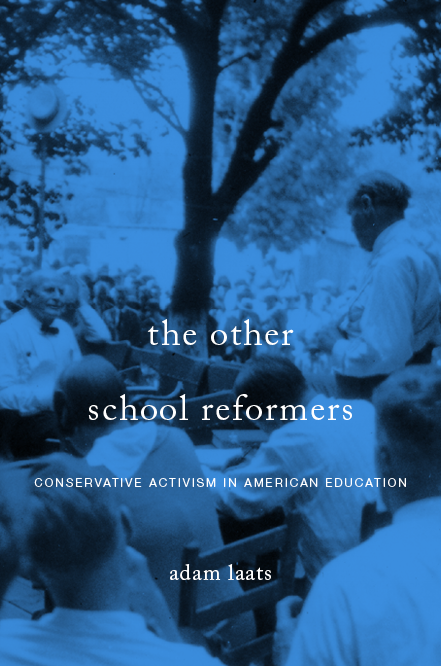
In my book The Other School Reformers, to cite just one example, I examine a similar case from Pasadena. In 1950, the new superintendent tried something almost identical. He promised that new communication technology allowed him to abolish deadly old report cards and Procrustean letter grades.

It didn’t work, and today’s reformers would surely benefit from understanding this historical context. It seems more than naïve for today’s reformers to stumble along unaware of the predictable reactions to their plans. Back then, for example, one critic excoriated the new superintendent in an open letter to the local newspaper. The idea of abolishing grades, this outraged parent noted, means

there is no incentive for the average student or the exceptionally bright student to do any better than the slower ones.  During the first six years there are no grades given out so there is no competitive spirit.  The report cards are marked only Satisfactory and Unsatisfactory, and the parent is unable to find out what the child is really capable of doing.  They acquire indolent habits, and when they arrive at Junior High School they are supposed to get down to work, but they don’t because they have been allowed to coast along for six years, doing as much or as little as they wished to.  They have not been made to feel that it is important to do the best they are capable of doing.  There were some who formerly flunked out of class and had to take the classes over, but at least they eventually learned what was given in that grade before they went on, and today they are passed, many of them without having learned it, to flounder in the next grade, when they are not ready.

Pasadena parents tended to agree with this curmudgeon. In the end, the superintendent was hounded out of town with his progressive plans thrown out after him.

There is no good reason—no good reason I can see—that school reformers like the ones described in the New York Times article shouldn’t be aware of their own checkered history. In every generation, from Rousseau’s day to our own, earnest progressive teachers have assumed that their powerful new child-centered approach would surely carry the day, sweeping outdated crusty methods before it.

It never has.

As progressive educators, we have failed to convince America as a whole how much better it will be to focus on individual learning instead of letter grades.

As educational historians, we have failed to share the story of America’s never-ending cycle of educational reform and reaction.

As a result, even the smartest and most well-meaning reformers go into every old experience as if it were new. School boards and parents are promised the world every time, only to react with predictable and preventable resentment when those laudable goals prove out of reach.

I don’t blame reformers and journalists for not doing their research. They shouldn’t have to. By this point, the long and gripping story of child-centered educational reform should be common knowledge.

So why isn’t it?

Do YOU Hate Science?

We all know the stereotypes: Conservatives love God and hate science, vice versa for progressives. But it’s utterly untrue, and every once in a while we see new evidence to prove it. These days, the frouforale over James Damore’s gender/diversity manifesto at Google has us asking the question again: Who hates science?

We’ll get to Damore’s story in a minute, but first, a necessary reminder. SAGLRROILYBYGTH are sick of hearing this, but I’m not interested in attacking or defending Damore. If I have to pick a side, I’ll generally stick with my progressive roots. Luckily, I don’t have to pick a side, so today I’ll bring up more interesting questions. I’m working these days on a new book about American creationism. One of the vital points to understanding creationism, especially the radical young-earth variant, is that creationists are not anti-science. Creationists LOVE science.

As anthropologist Chris Toumey puts it in his terrific and under-appreciated book God’s Own Scientists, radical creationists are just like the rest of America. They don’t dispute the authority of capital-s Science. In Toumey’s words, radical creationists have deep faith in the

plenary authority of science; that is, the idea that something is more valuable and more credible when it is believed that science endorses it.

For radical creationists, the problem isn’t science. The problem, rather, is that benighted false scientists have hijacked science and replaced it with ideologically driven materialism.

Of course, to the rest of us, creationists’ preference for their own bizarre “zombie science” makes their claims to love science hardly credible. To the rest of us, radical creationists seem to insist on their own outlandish scientific beliefs in the face of overwhelming evidence from real science.

Are Damore’s opponents guilty of the same thing?

If you haven’t followed the story, Damore was a Google engineer who was fired for a leaked ten-page memo. In the memo, Damore opined that Google’s diversity policy was deeply flawed. The goal of hiring equal numbers of male and female engineers, Damore wrote, didn’t match reality. In fact, Damore wrote, there are biological differences between men and women that make men—as a statistical group—more interested in engineering.

Like Larry Summers before him, Damore was fired and vilified for his words. And like ex-president Summers, Damore insisted he was only citing scientific data.

At least one scientist agrees with Damore. Writing in the Globe and Mail, Debra Soh argues that

the memo was fair and factually accurate. Scientific studies have confirmed sex differences in the brain that lead to differences in our interests and behaviour.

I’m no scientist, of gender or anything else. But conservative pundits have latched onto Soh’s comments to howl that progressives are just as blind to real science as are radical religious folks. As Benedictine pundit Rod Dreher frothed wordily,

Gender non-essentialists are the young earth creationists of the Left.

Maybe, maybe not. But in one thing, at least, Dreher is exactly right. Just like young-earth creationists, the anti-Damorists insist they have real science on their side. When it comes to culture-war issues—whether it’s the nature of gender or the origin of our species—everyone insists they are the side of true science.

…still Think “Evangelical” Is Not a Political Label?

Albert Mohler can say what he wants. To this reporter, there is a much more obvious conclusion. For those of us who struggle to understand evangelical identity, another recent poll seems like more evidence that we can’t rely on religious ideas alone.

SAGLRROILYBYGTH are sick of hearing about it, but I can’t stop mulling it over. In my upcoming book about evangelical higher education, for example, I argue that a merely theological definition of American evangelicalism will not suffice. The reason it is so important to study evangelical colleges, universities, seminaries, and institutes—at least one of the reasons—is because these institutions make it startlingly obvious that religion and theology are only one element defining evangelical identity, sometimes a remarkably small one.

Smart people disagree. Recently, for example, Neil J. Young took Frances FitzGerald to task for over-emphasizing the political element of evangelical identity. And a few months back, John Fea called me on the carpet for over-emphasizing the culturally and politically conservative element of evangelical higher education.

And smart people will surely disagree about the implications of recent poll results from the Washington Post and Kaiser Family Foundation. To me, they seem like more proof that American evangelicals are more “American” than “evangelical,” at least when it comes to their knee-jerk responses to poll questions.

The poll asked people whether poverty was more the result of personal failings or of circumstances beyond people’s control. As WaPo sums it up,

Christians, especially white evangelical Christians, are much more likely than non-Christians to view poverty as the result of individual failings.

Now, I’m not much of a Christian, and I’m not at all evangelical, but I can’t help but think that blaming the poor’s lack of effort for their poverty is not a very Christian attitude. And plenty of Christians agree with me. According to Julie Zauzmer in WaPo, African-American Christians tend to blame circumstances by large margins. The divide stretches beyond race. Democrats tend to blame circumstances. Republicans tend to blame individual failings.

Zauzmer reached out to experts to try to explain why white evangelical Christians might feel this way. She gave Albert Mohler of the Southern Baptist Theological Seminar a chance to explain it away. And Mohler did his level best. The reason white evangelicals blame the poor for their poverty, Mohler told her, was because

The Christian worldview is saying that all poverty is due to sin, though that doesn’t necessarily mean the sin of the person in poverty. In the Garden of Eden, there would have been no poverty. In a fallen world, there is poverty.

I just don’t buy it. If we really want to understand why white evangelical Americans tend to blame the poor for their poverty, we are better off looking at Reagan than at Revelation, at Goldwater than at Genesis. Blaming the poor has deep political and cultural roots. American conservatives—at least since the early twentieth century—have insisted that poverty in the Land of Opportunity must be due to individual failings rather than to structural problems in society. When American evangelicals mouth such notions, they are allowing those political and cultural beliefs to speak louder than their strictly religious or theological beliefs.

If we want to understand American evangelicalism—especially among white evangelicals—we need to understand that the “conservative” half of “conservative evangelicalism” is just as vital as the “evangelical” half. We need to understand that white evangelicals are complicated people, motivated by a slew of notions, beliefs, and knee-jerk impulses.

Why did so many white evangelicals vote for Trump? Why do so many white evangelicals blame the poor for their poverty? If we really want to make sense of it, we can’t focus on the merely religious beliefs of evangelicals. We have to look at the big picture.

What Kind of School Abuses Its Students?

Depressing news: No matter how hard you try to insulate and protect your kids, you can’t rely on schools to help. From the fanciest prep schools to the firmest fundamentalist redoubts, no school is safe.

You may have seen the news. Recent self-investigations at elite prep schools have turned up sordid but depressingly unsurprising news. Institutions such as Andover and Choate looked the other way at sexual abuse of students by faculty members, even writing strong letters of recommendation so that abusers could move on to fertile new fields.

frederic lyman

Preying on the elite…

The New York Times reported recently, for example, that Frederic Lyman serially abused students at a string of fancy prep schools. When he was found out, he was asked to leave and given a glowing letter of recommendation.

As SAGLRROILYBYGTH are sadly aware, evangelical schools have similar ugly histories. Institutions such as Bob Jones University have engaged in their own processes of self-examination and come up with some alarming results. Time after time, victims were blamed, abusers were enabled.

It forces us to ask the tough question: Why can’t schools protect students? After all, institutions such as Bob Jones University and Choate rely on their reputations as peculiarly protective places. BJU promises to keep students safe from any hint of liberalism. Choate promises to insulate students from any hint of the hoi polloi. Yet neither of them protect their students in this most basic way.

I’ve argued earlier in these pages that this is more than just a weird irony. Rather, it is precisely because of their peculiar status that these sorts of unusual schools cover up sexual abuse. After all, the pattern holds for other types of schools as well. It was not in spite of, but because of, their unique status as football powerhouses such as Penn State and Florida State covered up shocking sex-abuse revelations.

Perhaps it is due to the fact that niche schools have the most to lose—in terms of their all-important reputations—that they have such terrible records when it comes to sexual abuse.

A Texas-Sized Dilemma for Conservatives

How can you befuddle Texas conservatives? Make them choose between banning transgender bathrooms and the NFL. That’s the strategy taken recently by the Texas Association of Business.

Here’s what we know: Texas is mulling over its own version of a transgender bathroom bill. The bill would require students in public schools to use the bathroom corresponding to the gender they were assigned at birth. So, in other words, if I were identified as a male when I was born, but when I was fifteen I identified as female, I would legally be compelled to use the boys’ bathroom at my public high school.

According to the Dallas Morning News, business groups in Texas are alarmed. They look at the fallout in states such as North Carolina, where a similar bathroom bill led to billions of dollars in lost business. The Texas Association of Business ran an ad in the Dallas area, warning that the National Football League would pull its draft ceremony out of Texas if the bill passes.

It’s not an idle threat. The NFL has officially opposed “discriminatory” legislation. As an NFL spokesman put it,

If a proposal that is discriminatory or inconsistent with our values were to become law there, that would certainly be a factor considered when thinking about awarding future events.

For conservative Texans, the choice might be a tough one. They might want to affirm their devotion to traditional notions about gender. But they also want to host the NFL draft.

Now, as SAGLRROILYBYGTH know, I’m firmly in favor of transgender rights. But if I weren’t—if I were a conservative type wondering if the Benedict Option was right for me—I would take this sort of announcement from the NFL as stark evidence that I had lost the fight over the meaning of gender.

If the NFL, home to scantily clad cheerleaders, ass-kickin’ macho men, Blue-Angels flyovers, and Hank Williams Jr….if the NFL considers gender traditionalism to be “discriminatory,” then it does indeed seem that conservatives have lost the fight on this one.

Created in Nothing Flat

Okay, I’ll bite: What is the difference? News from Denver brings us back to an old chestnut: What is the difference between young-earth creationists and other dissident-scientists such as flat earthers? Certainly, there are differences in political power—we have a young-earther in the White House these days—but is there anything more than that? Or is it all just an accident of history?

The story from Denver’s flat-earth community points out some of the obvious superficial differences. At least in Denver, flat-earthers tend to be far more about government conspiracies than biblical hermeneutics.

And prominent creationists have always insisted that their beliefs have nothing to do with a flat earth. Back in the 1920s, for example, fundamentalist leader William Bell Riley fumed and fussed that his anti-evolution activism had nothing to do with “‘a flat earth’ . . . ‘an immovable world’ . . . [or] ‘a canopy of roof overhead.’” Those outdated scientific ideas, Riley insisted, were only used to poke fun at people who rejected the false science of evolution.

These days, too, young-earth creationists at Answers In Genesis insist that their scientific ideas have nothing to do with a flat earth. AIG’s Danny Faulkner admits that there are some similarities between the two views, since both have been ridiculed by people who don’t understand them. In the end, though, Faulkner concludes that most flat-earthers are either kooks or insincere.

Officially, AIG contends that since the spherical nature of the earth can be observed directly, the question of the earth’s shape belongs in the realm of “observational science.” That is, we can trust the mainstream facts in this case, even if we can’t trust scientists who speak ignorantly about “historical science.”

For those who know the history, though, the idea of a flat earth has had a remarkably similar history to the notions of a literal worldwide flood and a six-day creation.

As creationist-history guru Glenn Branch has described, in the 1920s the two movements had enormous similarities. Back then, most anti-evolution activists did not believe in a literal six-day creation. They did not insist that the earth was only about 6,004 years old. But a vocal minority did. Spearheaded by the indefatigable activism of George McCready Price, the ideas of a young earth and “flood geology” grew until they became in the 1960s key litmus tests for fundamentalist faith. (For more on that story, check out Ron Numbers’s masterpiece, The Creationists.)

As Branch describes, back in the 1920s flat-earthers also represented a small minority of the anti-evolution crowd. Like the young-earthers, flat-earthers could claim an energetic and charismatic spokesperson, Glenn Voliva. Voliva crusaded against the notion of a spherical earth. Like George McCready Price, Voliva insisted that he had the Truth, a truth evolutionists and round-earthers were too prejudiced to admit.

At the time of the Scopes Trial, Voliva hustled to Dayton, Tennessee to help prosecute John Scopes. Voliva’s hope, according to author Christine Garwood, was to “eliminate the twin heresies of evolution and a spherical earth.”flat earth garwood

But that’s where the two ideas went their separate ways. Whereas the outlandish notion of a literally young earth came to be accepted as true by large minorities of Americans, the outlandish notion of a flat earth became an internet quirk adopted by basement-dwelling conspiracy theorists.

So I ask again: What is the difference? I have a few ideas that I’m including in my current book about American creationism. In short, I think the answer lies not in dissident science, but in the mainstream world. By the 1960s, fundamentalist Protestants faced a new choice: Embrace mainstream evolutionary thinking and find a way to reconcile it with evangelical belief, or reject mainstream evolutionary science utterly and create a new creationist science.

When it came to evolution, the choice seemed simple, to many fundamentalists at least. Either kowtow to secular science or remain steadfast to young-earth beliefs.

Flat-earthers, though, never offered such a stark and simple choice. Belief in a flat earth (or a geo-centric solar system, for that matter) had always been embraced by some Biblical conservatives, but it never became a litmus test of orthodoxy.

At least, that’s the argument I’m trying to make in my new book.

What do you think?