Protecting Kids from Knowledge: Transvestite Edition

P-ding!  There it is again—our ILYBYGTH alert when schools insist on blocking knowledge.

If you’re just joining us, you might be under the impression that the point of school is to teach kids stuff.   That’s partly true, but it’s not the only thing schools do.  As SAGLRROILYBYGTH are painfully aware, schools have also always worked just as hard to keep kids from knowing stuff.

Don’t believe me?  Check out the news from the Charlotte-Mecklenburg school district.  According to a report in the New York Times, conservatives grumbled about a new book offered for first graders, Jacob’s New Dress.  Their beef: No youngster should know that some boys like to wear dresses.  Before you assume, though, that those pesky conservatives are the only ones who want to stop kids from acquiring knowledge, read on.  In these sorts of culture-war confrontations, everyone agrees that kids should remain ignorant.  They only disagree on the details.
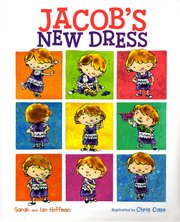
jacobs new dress

Knowledge-spreader? Or knowledge-blocker?

In this incarnation, the story follows the same culture-war script I described in my recent book about educational conservatism.  A teacher called a conservative group to warn them about the book selection.  The conservative activists issued press releases.  The district instantly caved at the merest whiff of controversy.

If we were feeling persnickety, we could point out a few details that individualize this case.  The conservative group in this case, the North Carolina Values Coalition, doesn’t really seem to have a clear understanding of the issues involved.  According to the NYT report, at least, the group’s spokesperson doesn’t recognize the differences between cross-dressing and transgender.  “The book,” she warned, “is meant as a tool of indoctrination to normalize transgender behavior. I think a lot of parents would object to that.”

Even if we don’t agree with her, we should note—except for the goof about equating cross-dressing with transgender—the conservative activist was correct.  The school and the book really DID want to normalize the idea that a boy might like to dress up in traditionally feminine clothing.  According to the NYT, the authors hoped to help people see that there’s nothing weird about a boy choosing to wear a dress.

For new readers, let me be clear: If anyone were to ask me my personal opinion, I wouldn’t hesitate.  I strongly agree with the goals and approach of the progressive authors.  I think kids should read their book.  But that’s not the main point here.  Instead, we want to look at the ways the progressive activists agreed with their conservative foes without even realizing it.

Just as the conservative activists read from their traditional script, so too did the progressive authors.  In the future, the authors assumed, no one would find their book objectionable or even remarkable.  As one author put it, “Our hope, when we wrote this book, was that some day it would be considered quaint. We imagined future generations saying, ‘What was the fuss about?’ Clearly, there’s more work to do.”  Just as conservatives have always hoped to lock out any hint of progressive ideas, so too have progressive activists always assumed without much evidence that their ideas would win in the end.

It might seem as if the two sides are miles apart.  When it comes to blocking knowledge, though, both sides agree.  The book’s authors share the conservative activists’ desire to block kids from certain forms of knowledge.  They disagree, of course, about what to block.  Conservatives in this case—and in (almost) every case—hope that kids won’t find out yet that some people like to dress up in non-traditional clothes.  And progressives don’t want their young people to know that some people find non-traditional gender dressing weird or objectionable.

Both sides want to keep kids safe from certain forms of knowledge.  Both sides assume that they have common sense on their side.  But neither side would admit to blocking knowledge.

Yet that sort of knowledge-blocking has always been at the heart of our educational system.  It has also always been at the heart of our educational culture wars.  People disagree about what ideas should be kept from kids.  They also disagree about how old kids should be before they are introduced to certain forms of knowledge.

But everyone agrees—without even talking about it—that schools MUST block some information from kids.  At least as important as delivering knowledge to children, our schools exist to keep knowledge away from them.

The Future of Liberty’s Love Affair with Trump

With university commencement season approaching, it’s time for a new round of culture-war outrage.  Schools scramble to secure the most famous names as markers of their higher-ed cachet.  And, predictably, some invited speakers will be shouted down, provoking a new round of hand-wringing over the parlous state of campus free speech.

The news from the world of evangelical colleges tells us that the traditions of Fundamentalist U are alive and well.  Here’s the nail-biter: Can we assume that the twentieth century will repeat itself?  Read on.  Your humble editor will make some predictions that he can be held to.

Trump at liberty

I Love You, Man

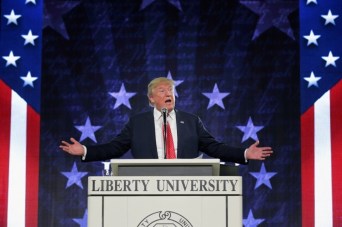
But first, the news.  It won’t come as any surprise to SAGLRROILYBYGTH.  According to the Washington Post, Trump is heading back to Lynchburg, Virginia to speak at Liberty University.

As your humble editor has argued elsewhere, Liberty has come up the big winner in this presidential election.  Its second-generation Falwell, Jerry Jr., has bragged about his appointment to a top-level super-secret Presidential commission on higher ed.  And at least one Liberty student is starry-eyed with the news of Trump’s upcoming visit.  What does Trump’s speech mean?  To one gun-toting Flame, at least, it means “That’s how you know my school is better than yours.”

But Trump’s appearance at Liberty’s commencement is more than just payback to one of his loyal evangelical supporters.  By acting chummy with Liberty, Trump scores big.  As I argue in my upcoming book about the history of evangelical higher ed, in the 1970s Liberty and other fundamentalist schools came to represent one-stop shops for politicians seeking evangelical approval.

If nothing else has been clear or predictable about Trump’s presidency, his courtship of the conservative evangelical vote has been steady and unimaginative.  It’s not just Jerry Falwell Jr.  By surrounding himself with folks such as Ben Carson and Betsy DeVos, Trump has sent unmistakable signals about his support for America’s fundamentalist traditions.

How will it end for him?  If history is any guide—and we all know it usually isn’t—President Trump is in for a rough ride.  Back in 1980, President Ronald Reagan pioneered a cynical courtship of conservative evangelicals.  He palled around with Jerry Falwell Sr. and other fundamentalist school leaders such as Bob Jones III.

Once in office, though, Reagan disappointed them and their wrath was Biblical in its proportions.  The most pressing issues back then were racism and tax policy.  Reagan and the GOP had promised to throw out Jimmy Carter’s persecution of racist fundamentalist schools.  Once in office, however, Reagan realized that the segregatory policy of schools such as Bob Jones University was politically impossible.  So Reagan punted.  He reversed himself.  The reaction of Bob Jones III was immediate and ferocious.

Reagan, Jones III ranted, had proved himself a “traitor to God’s people.”  It was time, Jones threatened, for fundamentalists to “stay away from the polls and let their ship sink.”

The full story of Jones III’s relationship with the Reagan White House had some complications, and you can read the full story in my upcoming book.  However, the general drift was clear: Politicians could court the fundamentalist vote by appearing at evangelical and fundamentalist colleges, but the demands of those fundamentalists might not be politically palatable.

And no one is quicker to resent political compromise than fundamentalists.

So what do I predict for the Trump/Falwell love affair?  First, let me offer a few nerdy qualifications.  YES, I understand that Liberty today has worked hard to shed some of its fundamentalist trappings.  And YES, I understand that Falwell Jr. is not Falwell Sr., and neither of them shared the shoot-first-ask-questions-later fundamentalist style of the Bob Joneses.

However, with all that said, I will go on record as predicting a blow-up between the Trumpists and the Flames.  The existing anti-Trump vibe on Liberty’s campus will grow into an irresistible force.  Falwell will eventually come out against his current BFF, when the conservatives and (relative) liberals in the extended Liberty community unite against Trumpism.

Hold me to it!

Is Zinn the Darwin of the History World?

There are few things more troubling than a book ban.  Yet conservative activists keep trying to ban Howard Zinn’s People’s History of the United States.  The latest effort takes place in Arkansas.  To us, this raises a tricky question: Is Zinn the Darwin of the history world?

Of course, that’s not the only question that might keep us up at night.  We might ask why this particular book is so offensive to conservatives.  We might even ask how banning books and ideas unites the left and the right these days.

Maybe we’ll get to those questions some fine day.  Today, though, we want to ask about the Zinn/evolution connection.

Who’s afraid of the big bad Zinn?

First, some catch up: If you don’t know Howard Zinn, you might get a tax break for your energy-saving under-a-rock lifestyle.  His People’s History has long been touted as a welcome correction to the flag-waving, Bible-thumping, chest-beating stories that so often get taught in US History classes.  In Zinn’s history, European explorers aren’t heroes, but exploiters and rapists.  In Zinn’s telling, “Manifest Destiny” was nothing but a shill for robbery and genocide.  In a word, Zinn offered a leftist counter-history to the standard textbook tale.

And opposition to Zinn has been ferocious.  A few years back, Indiana Governor Mitch Daniels tried to ban the book from Indiana.  And now, Representative Kim Hendren has introduced a bill in Arkansas to ban everything written by Zinn since 1959.

As I argued in my book The Other School Reformers, conservative educational activists have always been a fractious bunch.  On one thing, though, they agreed without even having to talk about it: Schools must be “safe spaces” for students.  They must not introduce ideas that shake students’ religious faith, patriotic pride, or traditional notions of family.

The most obvious intellectual threat to the conservative vision of proper education has been evolution.  Since the 1920s, conservatives worked hard—often with great success—to have evolutionary theory banned or watered down in American public schools.

But history books have often come under fire, too.  Long before Zinn freaked out the squares with his People’s History, Harold Rugg’s textbooks were purged from millions of American schools.  Rugg’s books were yanked from shelves, and one hapless school board member in my sunny hometown of Binghamton, New York suggested they should be piled up and burned.

The parallels seem striking.  Like evolution, leftist history is seen as a deadly threat, a spiritual and intellectual contaminant.  Many conservative activists think they must eliminate it entirely in order to protect students.  Consider former Governor Mitch Daniels’ comments from Indiana.  “How do we get rid of [A People’s History],” Daniels asked, “before more young people are force-fed a totally false version of our history?”

Like Darwin’s theory of natural selection, or its neo-Darwinian progeny, many conservatives see Zinn’s historical ideas as a terrible threat to their children’s well-being.  They might well want their children to consider a broad range of diverse ideas, but Zinn’s telling of US history, like Darwin’s telling of the origins of humanity, seems to veer far out of bounds of acceptable thinking.  Like evolutionary theory, Zinn’s history sparks an immediate fear among conservatives.  Some activists worry that mere exposure to such ideas will harm their children.

Look out, children!

For reasons like these, it seems fair to conclude that Zinn does indeed serve as a sort of Darwin of the historical world.  Zinn’s vision of US history seems to match Darwin’s vision of speciation, in the perceived intellectual threat it poses to the helpless children of conservative America.

But we can’t stop there.  There are also important differences between Zinn and Darwin.  When it comes to evolutionary theory, academic biologists agree: the modern evolutionary synthesis is our best current understanding of speciation.  Banning evolution, or even watering it down by suggesting that it is only one idea out of many equals, means giving schoolkids worse science.

Fans of Zinn’s People’s History can’t say the same thing.  True, the American Historical Association condemned Governor Daniels’ ban.  But historians as a whole don’t love Zinn’s book.  Sam Wineburg, for example, has famously pointed out the problems with Zinn’s work.  Michael Kazin, too, agreed that Zinn’s book was “stronger on polemical passion than historical insight.”  Neither Kazin nor Wineburg liked Indiana’s attempted ban, but neither of them loved Zinn’s book, either.

So as Arkansas gears up to debate (again) the notion of banning leftist history, we can agree that banning Zinn is a bad idea.  Straight-up dumb.  But we don’t want to fall into the obvious trap.  Zinn is no Darwin.  Banning evolution means banning science.  Banning Zinn doesn’t necessarily mean eliminating good history.

Let’s say it again: Banning Zinn is a terrible idea.  It is good for students to consider different ideas about history.  His book, though, should be understood for what it is: a political book about history, not a history book about politics.

One Big Unhappy Family

Normal people might be forgiven for saying ‘Enough already.’ The Larycia Hawkins case at Wheaton College has been poked and prodded by commentators and armchair pundits from every conceivable angle, including my own humble contribution at History News Network about Wheaton’s relevant history. But just one more word from me before I let the subject drop: Does this purge help heal the rift between fundamentalist universities?

In case you’ve been living life and not keeping with the latest, here’s a quick refresher: Professor Hawkins was fired for her statements that Muslims and Christians worship the same God.

Commentators have offered a full spectrum of analysis. One Wheaton professor defended his school. Crunchy conservative Rod Dreher also spoke up for Wheaton’s right to police its theological borders. A former student said Wheaton’s decision was in line with evangelical tradition. And perhaps most intriguing, historian extraordinaire Michael S. Hamilton told the Chronicle of Higher Education that Wheaton doesn’t like it when people don’t fit into its white, Northern, fundamentalist tradition.

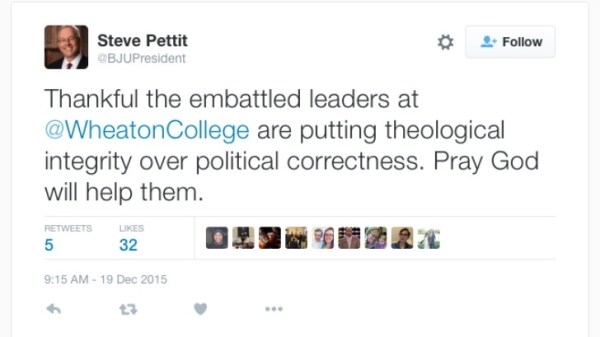
In all the hullaballoo, I missed an important piece in this evangelical jigsaw puzzle. Just as Wheaton decided to suspend Professor Hawkins, they got some support from an unlikely source. President Steve Pettit of Bob Jones University tweeted his support for the beleaguered administration.

pettit tweet BJU supports Wheaton firing dec 2015

Are they all on the same page again?

As I noted recently, my current research into the history of evangelical colleges has revealed continuing tensions between the two schools. I won’t rehash the whole story here, but in brief, a stormy rivalry in the 1930s developed into an outright breach in the 1970s. By that point, BJU had become the flagship university of steadfast separatist fundamentalism, while Wheaton represented the best of a broader conservative evangelicalism.

Maybe things have changed. President Steve Pettit of BJU recently visited Wheaton’s campus, a remarkable thaw in the deep freeze between the two schools. Now President Pettit is extending his support to Wheaton’s “embattled” leaders in this difficult time.

What does that mean?

Might it mean that President Pettit hopes Wheaton will move closer to its fundamentalist roots? At Bob Jones University, fundamentalism had often meant ruthless purges of dissenting faculty and administration. Since its founding in the 1920s, Bob Jones University has maintained a steady record of firing anyone who does not agree with the administration. As founder Bob Jones Sr. memorably expressed it in a chapel talk,

We are not going to pay anybody to ‘cuss’ us. We can get ‘cussin’ free from the outside. . . . We have never been a divided college. . . . We are of one mind in this school. We have not always had smooth sailing, but we have thrown the Jonah overboard. If we get a Jonah on this ship, and the ship doesn’t take him, we let the fish eat him! We throw him overboard. . . ‘United we stand, divided we fall.’ That is the reason that in this school we have no ‘griping.’ Gripers are not welcome here. If you are a dirty griper, you are not one of us. . . . God helping us, we are going to keep Bob Jones College a kingdom that isn’t divided and a house that stands together.

I’ve got no inside scoop here, but I can’t help but wonder: Does Wheaton’s recent faculty purge put it back on the “fundamentalist” side of this long-lived divide?

Teacher Fired for Heroic Incompetence

I’m no cynic. But anyone who’s paying attention knows that schools serve a range of purposes. We see depressing evidence today that one of their primary functions is to contain and control young people. How do we know? Because a teacher in New York City was fired, according to her, for talking about structural racism in a way that would “rile up” her African American students. Yikes.

Lee Walker Fired

Fired for heroic incompetence…

The story is grim. Jeena Lee-Walker has sued New York schools for her termination. Beginning in 2012, school administrators asked her to tone down her teaching about the Central Park Five case. As all New Yorkers remember, a group of young men were falsely convicted of raping a woman. They were eventually freed, but only after spending long years in prison.

Lee-Walker taught her students about the case. Many of them, she thought, “should be riled up” about the deep injustice done, as well as about continuing injustices in American society.

Her administrators thought differently. They gave her several bad evaluations and eventually fired her for “insubordination.”

Let me be crystal clear here: I think all teachers should be like Ms. Lee-Walker. All teachers should “rile up” their students about injustices in our society.

But we need to recognize two complicating factors. Though I’m a big fan of his, I think Curmudgucrat Peter Greene misses the boat here when he says Lee-Walker was “fired for competence.”

She was fired for two other reasons, reasons central to the successful functioning of any school. Even as we praise Ms. Lee-Walker’s bravery and integrity, we need to be a little more clearheaded about what was really going on. In short, Ms. Lee-Walker’s unwillingness to go along with the school system really DID make her incompetent as a teacher. Heroic, yes, but not willing to do the job.

That might sound odd, so let me offer two long-winded explanations.

First, teachers are not simply private citizens. Ms. Lee-Walker will not have luck protesting that her First Amendment rights have been breached. And, by and large, none of us want to cede to teachers such rights. Consider, for example, what we might think if she had been accused of promoting political or religious agendas with which we don’t agree. What if she “riled up” students by denouncing abortion? Or by denouncing evolution?

In principle, then, we need to acknowledge that teachers are bound to stick within curricular guidelines established by the school and community. I’ll repeat: in this case I think those guidelines are utterly bogus. I think we should encourage all New York City high schools to emulate Ms. Lee-Walker’s decision to teach the Central Park Five case. It is the truth and young people deserve to learn about it.

But if and when a heroic teacher decides to go against her superiors, she should be prepared to be kicked out. That is equally true whether we agree or disagree with the teacher’s ideas. I’m going to say this again, just because I think it could be misinterpreted: In this case, I side wholly with Ms. Lee-Walker. Her protest, however, should not be taken as a simple case of good teaching vs. evil administrating. Rather, this is a heroic attempt to push the curriculum in New York City schools toward this sort of teaching. Ms. Lee-Walker should have expected to get fired—even WANTED to get fired—because that was her only chance to take her appeal to a wider stage.

We don’t have to like it, but I think we need to be clear about our terms. In this sort of case, the closest analogy is that of Kim Davis, the Kentucky county clerk who refused to issue marriage licenses. To some, she was a hero, to others a poorly coiffed villain. In the end, however, she was a government bureaucrat who refused to do her job. Whatever we think of her politics or religion, no institution can function if it doesn’t purge such folks.

Rowan County Clerk Kim Davis celebrates her release from the Carter County Detention center in Grayson Kentucky

Fired for heroic incompetence…

That brings us to our second point. This story drives home the depressing custodial role schools and teachers play in our society. We tend to think of schools as educational institutions—and they are—but they are also holding pens of varying levels of pleasantness.

As a result, a big part of the job of school administrators is to keep the students relatively calm. With a dizzyingly high student-to-teacher ratio, most schools rely on passive and compliant students. When and if students choose to throw off schools’ restraints, there is not much administrators can physically do to coerce them into submission.

In some schools, this results at worst in hijinx such as food fights. In other schools, we get a prison-like atmosphere in which students are continually monitored and physically controlled.

Is that a good thing? Not at all. But if we want to make sense of this case and the many other cases like this, we need to understand the many things that schools do in our society. Teachers are not merely Socratic wisdom-peddlers in the agora. They are street-level bureaucrats who help process large numbers of young people in educational containment systems.

The point of Ms. Lee-Walker’s actions—if she was acting intentionally—was not merely to teach children something true. The point was to make a public spectacle of the fact that New York City schools do not regularly include that sort of teaching. She was not “fired for competence,” but for her stubborn insistence on principled incompetence, her brave unwillingness to go along with a system that fails students so miserably.

…so very angry…

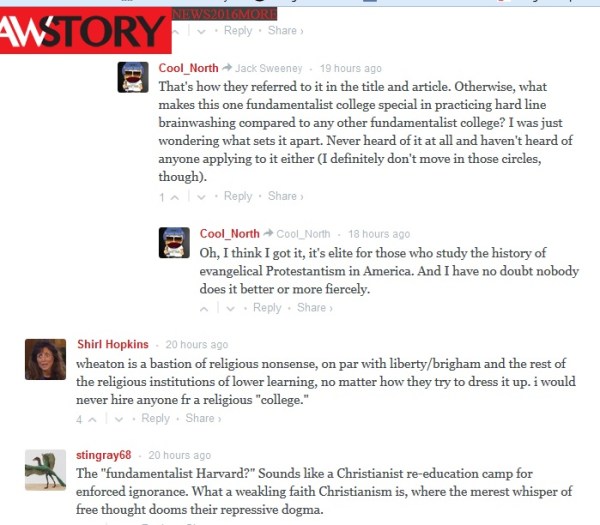
I don’t get out much. I’ve been happily ensconced in my nerd cocoon for the past couple years, working on my new book about the history of conservative higher ed. So I know I’m out of touch with what normal people think and know about these things. But I’m still surprised by the venom of some recent comments about Wheaton College. Is the average person-in-the-street really so very angry about evangelical colleges?

raw story wheaton comments

…so very angry…

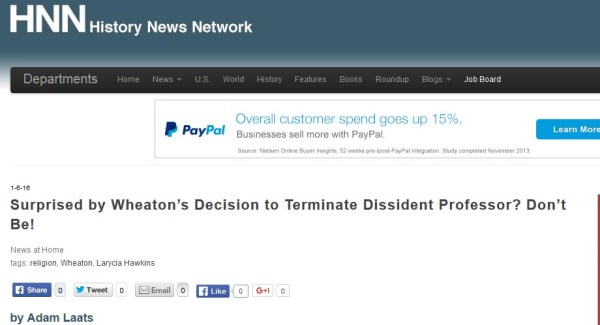
Here’s the background: I recently published in History News Network a few thoughts about the history behind Wheaton’s decision to terminate tenured Professor Larycia Hawkins. In short, Professor Hawkins is being fired for saying that Muslims and Christians “worship the same god.” RawStory picked up the essay.

I am floored by the level of venom in the RawStory comments thread. Of course, I know that internet comments are the abode of trolls. Still, I’m surprised by the hostility people seem to have toward Wheaton College.

Here are a couple of examples of the comments people saw fit to make:

  • I have a very special file for job applicants who graduated from religious “schools.” It is round, and lined with a plastic bag.

  • So people willingly and enthusiastically jump into sewers and then act shocked when they’re shit upon? I just don’t get it.

  • How wonderful it is receiving a degree from a Troglodyte University!

  • Hopefully Prof. Hawkins can find another position at a real school and put the memory of Holy Roller Hogwarts’ behind her.

  • I don’t get how a strict, fundamentalist college can also be an elite learning institution. In what exactly? The made up field of theology? Perhaps (heavily censured) literature and definitely rewritten history to fit the Christian angst? Home economics? Does creationism even qualify as serious subject of study? Really, what?

And there’s more!

Again, I know I live and work in an intellectual bubble. But are people in general really so very angry towards evangelical colleges? I thought people in general respected Wheaton as a top-tier evangelical school. In fact, I KNOW people do. But are they the exceptions?

Why Did Wheaton Fire Larycia Hawkins?

Did you hear the news yet?  According to Christianity Today, Wheaton College in Illinois has begun termination proceedings against tenured political science Professor Larycia Hawkins.

HNN article Larycia Hawkins

All the news that about the old…

Why?  For explanations from Professor Hawkins and Wheaton College, take a look at the Christianity Today piece.

But for historical context, check out my essay at History News Network.  In short, I argue that this kind of faculty uber-supervision is par for the course at evangelical colleges, even elite ones such as Wheaton.

A False “Idol?”

I admit it. I’ve never watched it. But bajillions of Americans have loved American Idol for the past fourteen years. It has been one of the most influential TV programs in our recent past. And it has proven particularly friendly to conservative evangelical Protestant singers. To this reporter, the life and death of American Idol seems to typify the paradox at the heart of American religious culture. Is America sexier and more secular now than it has ever been? Yes. And is America dominated now by fiercely traditional evangelical Protestantism? Also yes!

adam lambert

Would Adam Lambert have made it on the Ed Sullivan Show?

The face of conservative Christianity has changed a lot in the past century, but one thing has remained constant: Christian thinkers and pundits have consistently lamented the supposed fact that America has just kicked God out of its public life. As I’ve argued in academic publications here and there, evangelical Protestants, especially, have continually lamented the fact that their generation—whether that was the 1920s generation or the 1960s one—has witnessed the final prophesized turn of America away from its Christian roots.

There is no doubt that mainstream American culture has changed over time. Mainstream America was ferociously, even murderously hostile to homosexuals as recently as the 1950s. Public norms of dress and behavior have certainly loosened up in the past century. And public pronouncements have shed over time much of their explicitly Christian language. Some of them, at least.

Even granting all those major changes, it still seems remarkable to me that smart conservatives still lament the “loss” of America. Crunchy thinkers such as Rod Dreher call for conservative retreat, for a “Benedict Option.” And conservatives of all sorts recently howled over a perceived “War on Christmas.”

In each case, conservative Christians have insisted that the last straw had finally been laid, that American culture had finally transformed from a city on a hill to Babylon.

Now, it’s not my place to tell conservative Christians or anyone what to think. Anyone who reads their history, though, can’t help but be struck by the complicated truth. There has never been a single event or Supreme Court decision that finally kicked God out of the public square, but there has always been an outcry among conservatives that they were witnessing precisely such an event.

Today’s news about American Idol serves as a good illustration of this weird legacy. On one hand, we can see in the blockbuster show just how much America has changed. The stars wear intoxicatingly low-cut dresses. There is no defense of old-fashioned gender or racial hierarchies. Famous contestants such as Adam Lambert have been proudly gay. None of this would have happened on a TV show from the 1950s.

On the other hand, as the Christian Post reported recently, the show has also launched the careers of some of today’s top evangelical Christian performers. Singers such as Mandisa, Colton Dixon, Jeremy Rosado, and Danny Gokey all got their starts on the show.

Now, I admit it proudly: I have no idea who any of those people are. According to the Christian Post, however, they seem to have made a splash in the world of Christian pop music.

We might say, then, that as American Idol goes, so go America’s idols. The show is certainly not explicitly Christian or even religious. Its norms for dress, language, and behavior would certainly shock mainstream Americans from the 1920s or 1950s. Yet among all the hedonism, anything-goes morality, and sexiness, conservative Christianity still claims an enormous place.

Hijab & Halloween

Well, that just proves it, you might be tempted to say. When Wheaton College can suspend a tenured professor for saying that Muslims and Christians worship the “same God,” it just goes to show that the “Fundamentalist Harvard” is (still) more “Fundamentalist” than “Harvard.”

Hawkins Wheaton

Whose God?

But wait just one minute. If we look at this episode another way, we see that Wheaton’s recent strange action puts it smack dab in the mainstream of elite higher education these days.

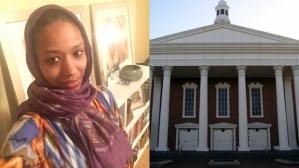
You’ve probably seen the story by now. As Christianity Today reports, political science professor Larycia Hawkins was suspended recently. Professor Hawkins planned to wear a traditional Islamic headcovering—the hijab—during Advent this year to express her Christian solidarity with Muslims.

That’s not why she was suspended, at least not officially. The college suspended her, officially, for her statements about God. In a Facebook post on December 10, Professor Hawkins explained the reasons for her act of sartorial solidarity: “as Pope Francis stated last week, we worship the same God.”

Non-evangelicals like me might not see the problem. But as Christianity Today pointed out, the question of Muslims and Christians worshipping the same God is intensely controversial among some Christians.

It is tempting to see this episode as proof of Wheaton’s continuing status as a school outside of the higher educational mainstream. As I’m arguing in my new book about the history of conservative evangelical higher education, however, the truth has always been more complicated. Wheaton is NOT outside the mainstream here. Rather, this is exactly the sort of action that is taking place at elite colleges across the nation.

Of course, the details are different; the specific issues are different. In Wheaton’s case, the administration acted to suspend Professor Hawkins because, in their words,

As a Christian liberal arts institution, Wheaton College embodies a distinctive Protestant evangelical identity, represented in our Statement of Faith, which guides the leadership, faculty and students of Wheaton at the core of our institution’s identity. Upon entering into a contractual employment agreement, each of our faculty and staff members voluntarily commits to accept and model the Statement of Faith with integrity, compassion and theological clarity.

This final problem of “theological clarity” seems to be the rub. Wheaton’s administration said they sympathized with Prof. Hawkins’s sympathy for Muslims. But, they repeated, “our compassion must be infused with theological clarity.” Professor Hawkins, in short, was suspended for “theological statements that seemed inconsistent with Wheaton College’s doctrinal convictions.”

Obviously, no pluralist, liberal, or secular school would suspend a professor for an act of theological un-clarity. As we’ve seen over the past few months, however, elite colleges everywhere are suspending professors and administrators for actions and statements that seem inconsistent with their non-theological convictions.

Like Professor Hawkins, for example, Erika Christakis at Yale has left her teaching duties. Why? Because she wrote an email that many students found unsettling. We might say that Christakis’s suspension was due to her lack of sufficient “clarity” about her racial ideology.

Or, we might consider the case of Mary Spellman at Claremont McKenna College. Did Dean Spellman make racist comments? No, but her attempt to care for one non-white student seemed to lack clarity to many students and activists.

SAGLRROILYBYGTH are sick of hearing it. But I think it is true, and I think this episode is further proof: Mainstream colleges today are moving more toward the “impulse to orthodoxy” that has been the hallmark of conservative evangelical colleges like Wheaton.

It’s easy enough to point out differences, of course. At Wheaton, pressure came from conservative alumni and administrators. At the other schools, pressure came—at first—from students. At Wheaton, the statement of faith is explicit and official, whereas the other orthodoxies are implicit and tentative.

In the end, though, I think the parallels are striking. At elite colleges these days, instructors, students, and administrators are expected to do more than agree generally and in principle with their schools’ current orthodoxy. They are expected, rather, to agree with forceful clarity. They are expected to avoid any statement or action that “seem[s] inconsistent” with dominant moral ideas.

To this reporter, it looks as if Wheaton College continues to be more similar than different from other elite schools these days.

HT: EH

Christian Colleges Find LGBT Loophole

What are conservative Christians to do? Since the US Supreme Court has ruled that same-sex marriage must be recognized nationwide, some conservatives have called for retreat, for the “Benedict Option.” Christian colleges, some fret, are in a particularly difficult position, since they could be forced to violate their own religious principles in order to include same-sex couples, transgender students and faculty, and unmarried homosexual students and faculty. Some schools, however, have taken advantage of a loophole in federal law that seems to alleviate some of these fears. This loophole, however, only sidesteps the real problem; it leaves the most important questions unaddressed.

First, a little background: As we noted in the run-up to the Obergefell decision, conservative religious colleges worried that the SCOTUS ruling could force them into an impossible position. It would not be theologically possible for many schools to introduce housing for same-sex couples, for instance. Yet if they did not, they would be in violation of non-discrimination rules.

As I predicted based on my current research into the history of conservative evangelical higher education, this kind of thing would likely lead to another fracture among the network of conservative colleges and universities.

Once the decision was passed, it did indeed prompt a split among conservative Christian schools. Some schools immediately changed their policies about homosexuality to accommodate the ruling. Others doubled down on their existing policies banning homosexuality.

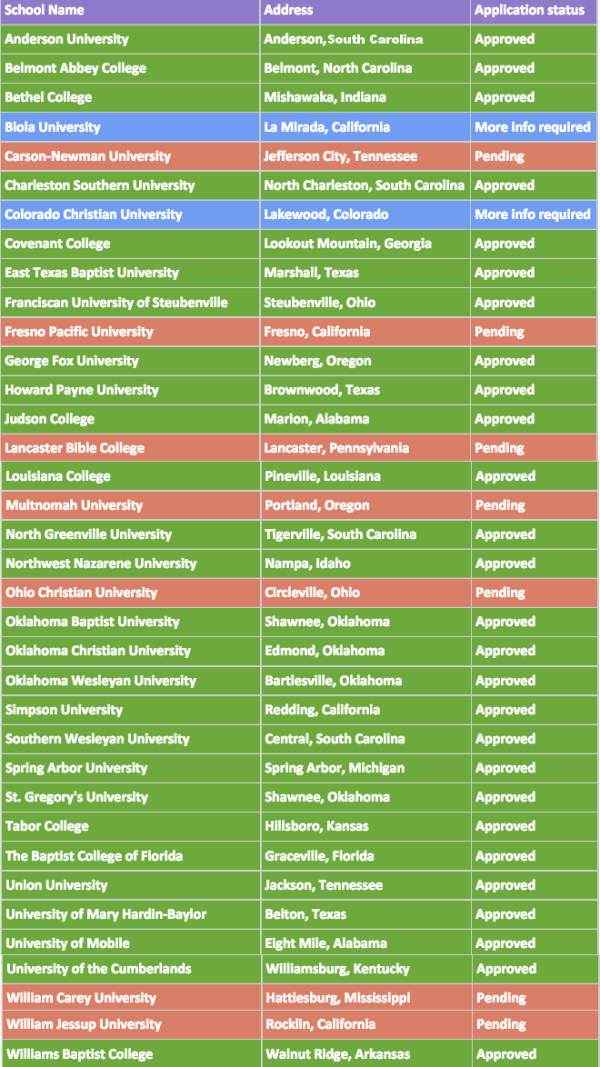
We read with interest this week that some three dozen religious schools have applied for a waiver from Title IX. Via the New York Times, we see news from The Column that handfuls of Christian college have successfully applied for waivers.

Column list of schools

Waivers for all?

As The Column reports, the original language of Title IX banned sex- and gender-based discrimination at institutions of higher education. But it included a vital loophole. Such rules, the law stated, could be waived in some cases. As Andy Birkey of The Column puts it,

When Title IX was passed in 1972 to combat discrimination based on sex, Congress added a small but powerful provision that states that an educational institution that is “controlled by a religious organization” does not have to comply if Title IX “would not be consistent with the religious tenets of such organization.”

Apparently, thirty-six schools have applied for these waivers, and twenty-seven have been approved. For many of the schools, the Christian Legal Society has provided a how-to guide to apply for such waivers.

For conservative colleges, this waiver might seem to solve their legal and religious pickle. But it will not heal the rift between such schools. Schools such as Goshen College and Eastern Mennonite University, have already left the Council for Christian Colleges and Universities. They changed their policies to welcome homosexual faculty, and presumably transgender faculty as well.

This loophole might provide wiggle room for some conservative religious schools. It leaves the most important questions on the table, however. What is the proper religious attitude toward non-heterosexual sex? Toward non-traditional marriages? Toward gender identity and sexuality as a whole?