Americans Love ‘Nazi Propaganda’ Film; Conservatives Celebrate

Conservative pundits are gloating this morning. The new film American Sniper attracted huge audiences this past weekend. Americans love it, even though liberal pundits condemned it.

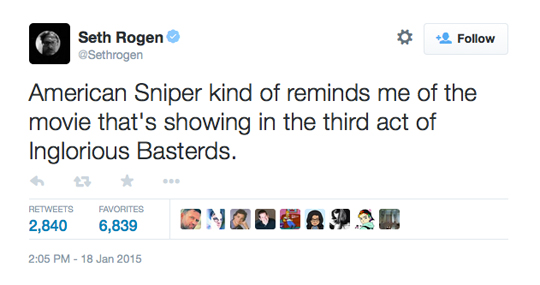
Most famously, actor Seth Rogen tweeted smarmily that the movie reminded him of a fictional Nazi propaganda film from the movie Inglorious Basterds. Apparently, in that fake film a German sniper is lionized.

Nazi propaganda from Hollywood...

Nazi propaganda from Hollywood…

American audiences, on the other hand, turned out in droves to see American Sniper. As conservative pundit Rich Lowry crowed in the pages of National Review, the movie marks the “return of the American war hero.” For liberals like Rogen, Lowry wrote, the story of real-life sniper Chris Kyle “smacks of backwardness and jingoism.”

At the Weekly Standard, Michael Graham argues that Hollywood liberals can’t seem to get it through their thick skulls that Americans want to see movies that are not aggressively “anti-American.” Mark Hemingway agreed. “Everyone in Hollywood,” Hemingway noted,

skews heavily left. . . . all these people line up to write checks for Hillary Clinton. . . . That might change now that they’ve seen that this film’s gonna make $90 million in one weekend in January. Maybe we’ll start to see more honest attempts at portraying soldiers.

Whose Values Rule the Schools?

What are the dominant values in American public schools? Progressive activists tend to think schools are dominated by conservatism. But conservatives say that progressives are in charge. New poll data suggest that conservatives are wrong. When it comes to general attitudes toward children and education, conservative values seem enormously powerful.

Progressives have always hoped that schooling would soon be transformed into a progressive paradise. But they have also always acknowledged widespread public resistance. As far back as 1925, scholars Otis Caldwell and Stuart Courtis—from the progressive bulwark of Teachers College, Columbia University—argued that the “new philosophy” of progressive education could transform schools into a “childish utopia.” Unfortunately, they wrote, most Americans weren’t interested. Instead, most people “blamed teachers and schoolmen generally for ‘new-fangled methods.’”

These days, leading progressives agree. Pundits such as Alfie Kohn insist that progressive ideas are the best. As Kohn once put it, progressive education is “hard to beat, but also hard to find.” In spite of the clear superiority of progressive methods, Kohn writes, most schools only use them in dribs and drabs. Conservative, traditional schoolrooms, Kohn notes glumly, tend to be the norm.

We might think that conservative activists would celebrate their domination of American public education. But in fact we see just the opposite. Historically, conservative activists have taken progressive dominance for granted. Many conservatives have assumed without question that the progressive nostrums of philosopher John Dewey had long ago triumphed.

Writing in the wake of a tumultuous school battle in 1950s Pasadena, California, for instance, conservative activist Mary Allen explained that “traditional education” had been abandoned in the 1930s. Why? Because at that time “some of Dewey’s followers prepared to use the schools to introduce a new social order.” To Allen as to generations of conservatives, conservative values had long since been kicked out of public education.

Today’s educational conservatives voice similar frustration. For example, Peter Collier has lamented the dominance in public education of the progressive tentacles of Columbia University’s Teachers College. A pernicious leftist stew of “critical pedagogy,” Collier noted, “slowly infiltrated leftist ideas into every aspect of classroom teaching.”

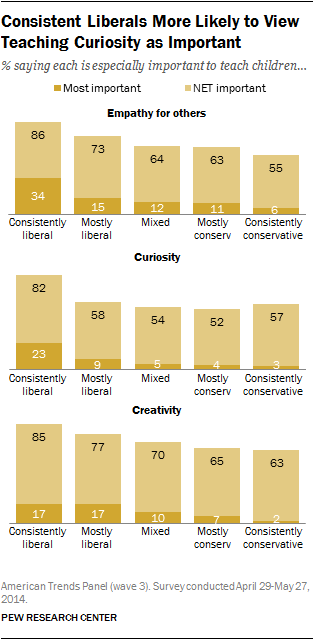
How important is "curiosity" as an educational goal?

How important is “curiosity” as an educational goal?

New poll data from the Pew Research Center for the People and the Press suggest that conservatives have this one wrong. When it comes to basic attitudes about children and proper education, conservative ideas tend to dominate. Those who call themselves “consistently liberal” find themselves on the outside looking in.

Who's the outlier here?

Who’s the outlier here?

To be fair, the poll also suggests that Americans of all ideologies share broad agreement about the proper way to raise children. Huge majorities of the “consistently liberal,” the “mostly liberal,” the “mixed,” the “mostly conservative,” and the “consistently conservative” agree that children must be taught responsibility.

But in a couple of other categories, those who call themselves “consistently liberal” stand out. And those differences tell us something about the values that dominate our schools and society.

For example, the “consistently liberal” place a much higher value on teaching curiosity than do any other groups, by a huge margin. Nearly a quarter of the consistently liberal place this among the three most important factors for children, and over three quarters think it is important. In contrast, none of the other groups, including the “mostly liberal,” thought that teaching curiosity was nearly as important. Only nine percent of the “mostly liberal” called curiosity one of the most important values, and only fifty-eight percent considered it important. And though fifty-seven percent of the “consistently conservative” agreed that curiosity was important, only a paltry three percent of consistent conservatives placed it at the top of their lists.

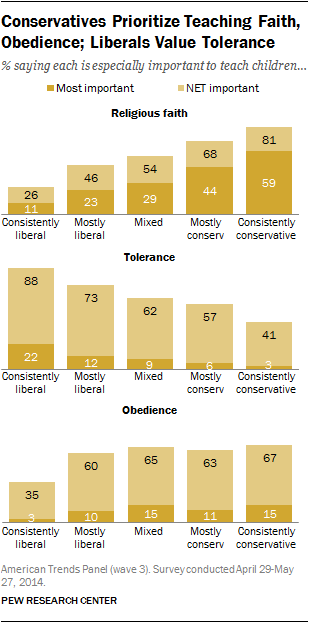
In addition, large majorities of every group except the “consistently liberal” placed a high value on teaching obedience. Even among the “mostly liberal,” sixty percent found this important. At the high end, two-thirds of the “consistently conservative” thought obedience was an important idea for children, compared to just over one-third of the “consistently liberal.”

Of course, it’s notoriously difficult to define “progressive” and “conservative” ideas about education. But in general, it’s fair to say that progressives tend to value curiosity above obedience, exploration above authoritarianism. Yet those values are only shared by a small sliver of the respondents in this survey.

The good news for conservatives? They are wrong about the values that guide American public education.   Progressive notions of child-centered learning, of students freed from the dictation of authoritarian teachers and exploring the creative curiosity of youth, have not sunk the deep roots that conservatives have often assumed.

Instead, when it comes to central ideas about obedience and curiosity, this poll suggests that conservative attitudes are the norm.

Are Colleges REALLY Charlie Hebdo?

David Brooks raises a tough question about college culture. In the aftermath of the killings in Paris, shocked observers have voiced their solidarity with the slain writers and editors at Charlie Hebdo. But Brooks challenges college students and deans.

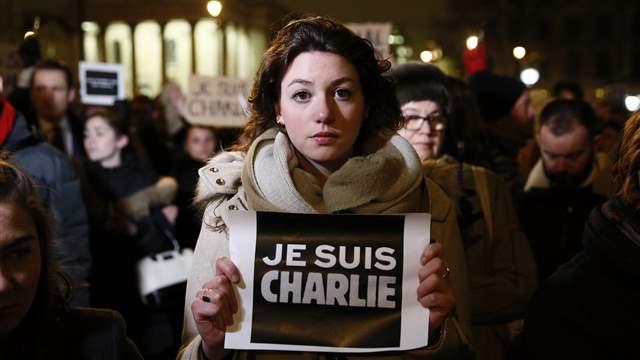
Are today's college students REALLY Charlie?

Are today’s college students REALLY Charlie?

“Let’s face it,” Brooks writes,

If [Charlie Hebdo] had tried to publish their satirical newspaper on any American university campus over the last two decades it wouldn’t have lasted 30 seconds. Student and faculty groups would have accused them of hate speech. The administration would have cut financing and shut them down.

As Brooks points out, critics of Islam such as Ayaan Hirsi Ali have been snubbed by schools such as Brandeis University. And anti-Islam comedian Bill Maher was the subject of a protest by students at Berkeley.

In neither case did students articulate the same sort of Islamic fundamentalism seen in the Charlie Hebdo murders. Rather, students protest that anti-Islam speakers were “racist” and must not be allowed to spew their “hate speech” on an enlightened campus.

Brandeis said it could no longer offer Hirsi Ali an honorary degree due to “certain of her past statements.” Hirsi Ali had apparently condemned all of Islam, not only “radical” Islam. She had called for Islam as a whole to be “defeated.”

In Berkeley, students protested the choice of Bill Maher as commencement speaker. In a much-ballyhooed argument with actor Ben Affleck, Maher denounced Islam as “the only religion that acts like the mafia.” Maher’s anti-Islam comments, students argued, constituted “racist and bigoted remarks.”

Maher himself insisted he still wanted to come to Berkeley. He pointed out the irony of celebrating the fiftieth anniversary of Berkeley’s famous Free Speech Movement by banning a speaker.

Obviously, these “attacks” on anti-Islam speakers are not the same as the murders in Paris, and Brooks does not equate them. But he does raise a question we need to consider: Are campus activists who ban speakers hypocritical when they now claim, “Je Suis Charlie Hebdo?”

Historians Rule the School

Why do educational historians have so much influence, relative to other kinds of educational scholars? This year’s Edu-Scholar influence rankings are in, and historians seem to be represented far beyond their numbers.

Like any ranking system, this one is imperfect. (It must be, since it didn’t include your humble editor.) Overall, the Edu-Scholar scale tries to couple academic influence with policy influence. As Rick Hess explains in the pages of EdWeek,

The rubric reflects both a scholar’s body of academic work—encompassing the breadth and influence of their scholarship—and their footprint on the public discourse last year. . . . I’m not sure that I’ve got the measures right or even how much these results can or should tell us. That said, I think the same can be said about U.S. News college rankings, NFL quarterback ratings, or international scorecards of human rights. For all their imperfections, I think such efforts convey real information—and help spark useful discussion.

Fair enough. Given those caveats, by this scale, at least, historians seem to punch far above their weight. Why?

Just in the top ten, for example, are historians Diane Ravitch (#1) and Larry Cuban (#8). At number four we find Gary Orfield, a sociologist whose work on desegregation is heavily historical.

We don’t have to go very far down the list (#26) to find Jon Zimmerman, ILYBYGTH’s house favorite. Penn’s Marybeth Gasman shows up at 18. Also included are David Labaree, Charles Payne (another sociologist who writes a lot about civil-rights history), and Sherman Dorn. Sam Wineburg is also on the list, and though he’s not officially an historian he writes about history and historical thinking.

That might not seem like a lot of historians, out of a total of 200 scholars. But when it comes to public policy, the surprise is that there are any academic historians at all. And doubly surprising to find more than one in the top ten! In general, academic historians get nervous when it comes to making pronouncements about current-day policy.

Many of the scholars here are full-time policy wonks. It would seem their work would do more to influence thinking about education than would the work of so many historians.

So why do all these wonderful historians exert so much influence on public discourse?

Colleges Call for Cop Killings

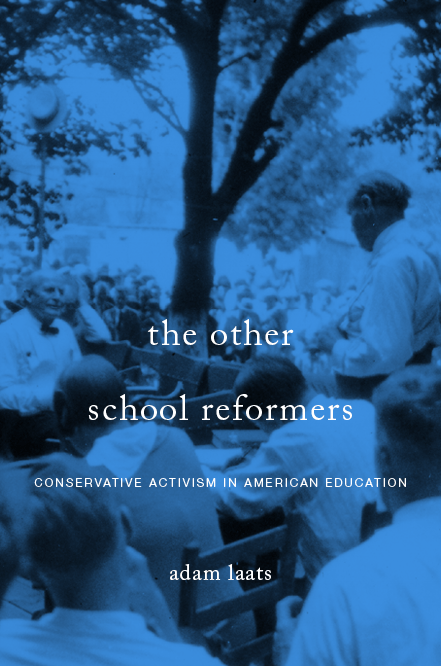
Do radical professors encourage violence? That’s the question some conservative commentators are asking in the wake of the vicious assassinations of two New York City police officers. As I argue in my upcoming book about educational conservatism, this sort of conservative worry has a long history. It goes much farther back than the campus radicalism of the 1960s.

Available soon: the more things change...

Available soon: the more things change…

At National Review Online, for instance, Katherine Timpf shares a story from Brandeis University. At that prestigious school just outside of Boston, student Daniel Mael has published violent tweets from fellow student Khadijah Lynch.

Mael blasted Lynch for advocating violence against the government, and Brandeis for supporting her. According to Mael, Lynch had tweeted that she had “no sympathy for the nypd officers who were murdered today.” Earlier, according to Mael, Lynch had written, “I am in riot mode. F*** this f****** country.”

Instead of being punished for such incendiary language, Mael noted, Brandeis had made Lynch an official campus student officer, responsible for advising younger students. She had been a featured speaker at university events and, according to Mael, remained an undergraduate student representative of her academic department.

Is the university to blame for encouraging racial violence?

Timpf is not the only conservative pundit to ask the question. At Minding the Campus, Peter Wood blasts college culture for nurturing violent extremism. Today’s leftist-riddled faculties and administrations, Wood charges, encourage and condone wild-eyed radicalism among students.

Students and faculty, Wood writes, have been implicated in recent anti-police violence in New York City. But that’s not all. On the bitterly divided campus of the University of Virginia, the administration has turned a blind eye to student violence against innocent fraternity members.

Wood gives several examples of graduate students and faculty who have encouraged racial violence. Does this implicate universities? As he concluded,

the links don’t have to be guessed at. They are there to be seen.  Some of the connections are in the form of forceful declarations. . . . Some of the connections are in the form of heedless enthusiasm from individuals who have no sense of where this goes.

Wood’s indictment goes beyond the murders of New York policemen. At the University of Virginia, Wood writes, violence against innocent fraternity members has been winked at by the administration.

After the debacle of the Rolling Stone article falsely accusing fraternity members of a horrific sexual assault, a group of UVA students attacked the fraternity house. They were not punished, even though their identities were well known, according to Wood. Wood writes,

faced with the real crime of serious vandalism against a fraternity that had been falsely accused, and having the opportunity at hand to charge the culprits, President Sullivan [of UVA] decided to take no action.

Virginia is not alone, Wood argues. At other schools, a certain sort of student violence is condoned or even encouraged by faculty and administration who sympathize with student attitudes. The radical likes of Ward Churchill and Bill Ayers, Wood implies, are only the most famous cases of red professors guiding student malfeasance.

Wood argues that this campus radicalism has been a problem “Since the 1960s.” But in reality both campus radicalism and conservative denunciations have a much longer history. In some cases, conservative denunciations can seem eerily eternal.

For example, Wood calls out a doctoral student by name at Teachers College Columbia. Aaron Samuel Breslow, Wood writes, has been an active supporter of violent resistance. In 1938, it was Teachers College doctoral student William Gellerman who attracted conservative ire. Back then, Gellerman published a denunciation of American Legion activism. The Legion, Gellerman accused, represented nothing more than

an expression of entrenched business and military interests which attempt to hide their true purposes under democratic guise.

Legion leader Daniel Doherty accused Teachers College of coddling this sort of inflammatory leftist claptrap. Doherty asked an audience at Columbia University,

Why not rid this institution of such baleful influences? The name of Columbia is besmirched from time to time when preachments containing un-American doctrines emanate from those who identify themselves with this institution. . . . Do you like having it called ‘the big red university?’

As I argue in my upcoming book, this sort of anti-higher-ed accusation was a standard part of conservative activism long before the 1960s. Indeed, its roots can be clearly seen in the 1920s.

In the 1930s, the question was clear: Should universities purge their leftist faculty? The same question echoes throughout conservative punditry today, with an inflammatory twist:

Are universities morally culpable in the assassination of police officers?

What Unbroken Leaves Out

**SPOILER ALERT: If you haven’t yet read Unbroken or seen the recent movie, you might want to skip this. But it’s so interesting, you’ll be sorry.**

Unbroken?...or Un-Finished?

Unbroken?…or Un-Finished?

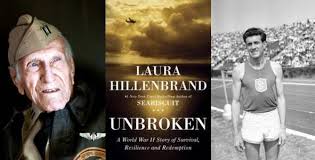
What is the takeaway message from the life of Louis Zamperini, subject of the new film Unbroken? The power of resilience? The unplumbed depths of human courage?

…or is it the healing power of Protestant fundamentalism?

In the pages of World Magazine, Cal Thomas asks an intriguing question: Why did the recent film leave out the central role played in Zamperini’s life by the fundamentalist revival of Billy Graham?

When protagonist Louis Zamperini returned home from his hellish ordeals at sea and in Japanese prison camps, he struggled with alcoholism and depression. As the original book by Laura Hillenbrand makes very clear, Zamperini overcame these demons through fundamentalist faith. After attending a 1949 revival by fundamentalist preacher Billy Graham, Zamperini turned his life around.

This conversion was not an incidental part of Zamperini’s story. Zamperini, we could say, gave America a powerful demonstration of the healing power of a particular brand of fundamentalist Protestantism. But that is not the way celebrity director Angelina Jolie saw it. Thomas wants to know why Jolie left that part out. As Thomas puts it,

it is puzzling why Jolie, who directed the film, and the Coen brothers, who wrote it, left out the most important part of Zamperini’s story.

Not only is Zamperini’s conversion a central part of his life story, it reflects the power of a specifically fundamentalist religion. Some readers may be more familiar with Billy Graham’s later work, when Graham had begun to articulate a kinder, gentler evangelical faith. In the 1940s, however, at the time of Zamperini’s conversion, Graham’s crusades packed a firmly fundamentalist punch. Not just theologically, either, but politically.

In his 1940s campaigns, for instance, the message of conversion was wrapped in a conservative anti-communist package. At the blockbuster Rose Bowl campaign of 1950, for example, theologian Harold Ockenga introduced Graham’s sermon as “The Answer to Communist Aggression.”

And just as Billy Graham was helping Zamperini defeat his demons, Graham insisted on his loyalty to the fundamentalist message. Though later a split developed between the most conservative fundamentalists and Graham’s famous crusades, that split had not yet developed by 1949. At that time, Graham loudly proclaimed his loyalty to the fundamentalist message. In a 1949 letter to staunch fundamentalist leader Bob Jones Sr., for example, Graham called Jones the

model toward which we are patterning our lives. Your counsel means more to me than that of any individual in the nation.

During the late 1940s, Billy Graham remained a staunch fundamentalist partisan. The message that saved Zamperini was not just one of generic Christian healing, but one of specifically fundamentalist rigor. In this one famous case, at least, we can see the ways fundamentalism’s unyielding moral stance pulled a suffering soul out of a personal hell.

We can’t help but echo Cal Thomas’s question: Why didn’t Angelina Jolie include this part? Jolie no longer returns my calls, but I can’t help but think that she might have some aversion toward fundamentalism.

I’m no fundamentalist myself. American fundamentalism has its share of skeletons in its closets, as we’ve explored here at ILYBYGTH. It may be fair to accuse the latter-day followers of Bob Jones Sr., for example, of terrible misconduct. But if we really want to be fair, shouldn’t we also acknowledge the ways that fundamentalism has saved lives?

Conservative Warriors and Homosexuality

Where is the line? What can conservatives say about homosexuality that won’t be considered bigotry? The case of Professor John McAdams has lit up the conservative intellectual world with its implications for the eroding respectability of conservative opposition to gay rights and the utterly transformed intellectual environment on US college campuses.

Let’s start with a few caveats. First, full disclosure: I taught one semester at Marquette University, Professor McAdams’s school. I also taught for several years down the street at Marquette High School, which is no longer directly connected to the university. I feel an abiding love for both institutions. More important, I am unapologetically biased in this case. I believe it is legitimate and important to regulate speech in public (and some private) forums, including college classrooms. Hard as it is to hear, some ideas do not deserve to be granted equal status with others. Ideas that dehumanize classes of people are not just as good as other ideas. For instance, if a student in a seminar wants to insist that no white people can possibly understand US history because they are by definition part of an exploitative class, such talk should be ruled out of bounds. It would tend to exclude an entire class of people simply because of their cultural identity. Similarly, if a student wanted to rule that homosexuals were incapable of being moral in their relationships, or that women cannot understand certain concepts, or that non-citizens have no right to be heard in political discussions, such talk should be out of bounds.

Of course, many conservative intellectuals share that basic framework, but they disagree bitterly that traditionalist notions about homosexuality constitute that same sort of exclusionary mentality. In other words, many conservative thinkers agree that public speech shouldn’t be racist or chauvinist, but they disagree that conservative ideas about homosexuality fall into that same category.

The steamroller drive of homosexual rights in recent months and years has put some traditionalist conservatives on edge. A few recent cases have raised hackles among many conservative thinkers. At Mozilla and Gordon College, to cite just two examples, conservative intellectuals attracted instant and furious retribution for statements that have been perceived as anti-gay. In each case, ideas that would have been unremarkable just a few years ago are now taken as beyond the pale of respectable public speech.

In the case of Professor McAdams, college politics and bureaucracy have added new wrinkles into the question of acceptable conservative opinion about homosexuality. In brief, McAdams has been suspended with pay and asked to stay away from campus. Why? He blogged about the statements of a teaching assistant. That TA had told a student that opposition to homosexual marriage would not be considered in a class on ethics. The student complained to Professor McAdams, and McAdams outed the TA on his blog.

As McAdams noted, his support for the student prompted furious condemnation by “leftist academics,” who “demanded our head on a pike.” A group of prominent faculty at Marquette published an open letter on the issue. McAdams’s actions, they write, constituted “harassment and intimidation” of the TA. Other members of the Marquette community, they write, altered their behavior to avoid similar attacks from McAdams.

In the end, McAdams has been suspended with pay. The Fox-News commentariat has had its chance to recoil in horror at the anti-conservative “inquisition.”

There is, of course, more at stake here than intellectual positions about homosexuality and gay rights. We also must consider faculty politics and the unfortunate ways academics learn to teach. How do teaching assistants learn to handle disagreement among students? When does a tenured professor have a duty not to attack publicly a non-degreed teaching assistant? How should faculty respond when a colleague behaves in ways they dislike?

At the center of all these questions, however, is the question of conservatism and homosexuality. Not too long ago, opposition to gay marriage was a common part of our mainstream political discussion. These days, in college seminars, newspapers, technology companies, and public policy, any conservative notion that homosexuals do not have the right to marry one another is often considered rank bigotry.

Is it possible for conservative intellectuals to oppose gay marriage without being branded bigots? Has that culture-war train left the station?

Investigative Report: Sex Abuse at Fundamentalist U

HT: DW

Are fundamentalist universities guilty of encouraging sex abuse? Does “purity culture” encourage predators? Does the environment at fundamentalist universities force victims, at best, to suffer in silence and shame?

We don’t have all the answers, but the GRACE report of sex abuse at Bob Jones University offers a few clues. Short answer: BJU is guilty of establishing an idiosyncratic administration and campus culture that punished victims and rewarded loyalty over caring and competence.

I’ve taken some heat in the past for wondering if fundamentalist universities had been targeted unfairly on this subject. Certainly, fundamentalist schools have done a terrible job in handling sexual assault and abuse. But so have secular and liberal schools. Wasn’t it possible, I asked, that the no-drinking, no-partying culture at fundamentalist colleges helped deter some cases of assault? Given the large number of alcohol-fueled assault cases recently, I still think these are fair questions.

In spite of such questions, however, the recent GRACE report paints a damning picture of Bob Jones University. I’ll repeat: I do not think it is fair to assume that conservative schools will somehow automatically do a worse job of handling abuse and assault cases than other schools. However, the GRACE report points to systemic problems at BJU that are likely shared by smaller, less prestigious fundamentalist colleges and schools.

As I see it, BJU has failed in two significant ways. First, it has insisted on a climate in which student complaints of any kind were viewed as a moral failing for the complainer. Second, since the 1930s BJU has maintained a policy of rewarding staff loyalty over any other concern. As a result, leading administrators were woefully—perhaps even criminally—incompetent to deal with student victims of sexual abuse and assault.

I do not make these charges lightly. Nor do I have any personal animus toward BJU or other fundamentalist colleges. But the record is clear.

First, some brief facts of the case. Two years ago, administrators at BJU commissioned an outside study of their response to abuse claims. In itself, this sort of outside examination made a clear break with BJU tradition. The assembled commission, Godly Response to Abuse in the Christian Environment, or GRACE, recently published its findings. BJU’s current leader, Steven Pettit, has apologized for any suffering the university has caused or ignored.

That is a start. The university, in my opinion, has two main faults for which it needs to apologize.

First, the leaders of the school have insisted for decades on one cardinal rule: No “griping.” Students who complain have been consistently treated as disloyal, or at least suspicious. For example, in one statement made by the founder, Bob Jones Sr., on June 19, 1953, Jones advised the BJU community of the first rule: “Griping not tolerated, but constructive suggestions appreciated.”

In practice, the culture at BJU has promoted a suffer-in-silence mentality.

Second, and perhaps more problematic, hiring and promotion practices at BJU have encouraged loyalty above all other factors, including competence. In cases of abuse and assault, this has led to terrible consequences. As the GRACE report documents, administrator Jim Berg handled many abuse reports since 1981. Time after time, Berg demonstrated his lack of preparation. For a while, Berg was unaware of South Carolina’s mandatory-reporting law.

The blame here belongs to more than Berg alone. Berg’s leadership role was the product of an institutional culture that valued loyalty first. Berg’s decisions and professional intuitions were the product of a culture that saw itself as removed from all obligations to the outside world.

The evidence for this loyalty-first culture is abundant. In the same 1953 statement referred to above, Bob Jones Sr. warned faculty that he had an obligation to fire anyone “who is not loyal.” This statement came in the wake of mass resignations at the school in 1952 and 1953.

That was not the only time the school’s leaders made their emphasis on loyalty clear. In 1936, just before another group firing, Bob Jones Sr. warned one faculty member,

First: There must be absolute loyalty to the administration. If something happens in the administration which you do not like, your protest is your resignation. If you stay here you must not under any circumstances criticise [sic] the administration.

The results of such a sustained policy are clear. Those who remained in leadership positions at BJU were rewarded for loyalty first, competence second. In the case of student abuse and assault, such an emphasis left students in the hands of utterly unprepared administrators.

All schools—all institutions—can suffer from incompetence, of course, but the BJU policy of loyalty-first intentionally undervalued professional competence.

It bears repeating that BJU’s current leader has apologized for these faults. As he put it,

I would like to sincerely and humbly apologize to those who felt they did not receive from us genuine love, compassion, understanding and support after suffering sexual abuse or assault …To them I would say—we have carefully listened to your voice. We take your testimony in this report to our hearts. We intend to thoroughly review every aspect and concern outlined in the investigation and respond appropriately.

And, sadly, we must remember that fundamentalist institutions are by no means alone in establishing and protecting cultures of abuse. Other religious groups, such as the Catholic Church, and other colleges, such as Penn State University, have similarly criminal histories.

As it might at those institutions, perhaps the future at BJU and other fundamentalist universities will be brighter than the past.

A Story We Should Care More About

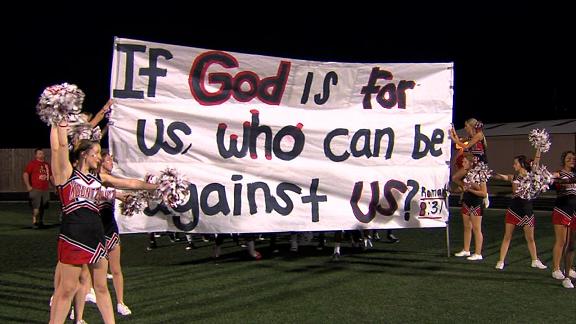
Every new story about creationist teachers or praying cheerleaders gets lots of attention, but the news we should really care about involves the humdrum topics of taxes and school funding. As creationist hero William Jennings Bryan put it in the 1920s, “The hand that writes the paycheck rules the school.” In Alabama, conservatives passed a law allowing taxpayers to write their paychecks in a different way. Yesterday, the state Supreme Court started hearing arguments about this new conservative strategy. This story is one we should all follow as if it were interesting. After all, it promises to give an answer that no praying cheerleader ever could: Will conservative taxpayers be able to rule the school?

Don’t look at us: Study school-funding laws!

Don’t look at us: Study school-funding laws!

The Alabama Accountability Act allows taxpayers to divert their tax money away from public schools and toward private ones. Alabama is not alone. More than a dozen states have similar laws on the books. What the justices decide in Alabama might direct debate about these laws nationwide.

Of course, not all the laws are the same. As the National Council of State Legislatures reported, as of April 2014, 14 states had some sort of tax-direction law. In general, these laws allow people to shift some of their taxes to scholarship funding organizations (SFOs). Instead of the tax money going to the government, it goes to these organizations. In turn, the SFOs defray the cost of private school for selected students.

Why should we care? Some critics of these laws insist that the laws are intended to break down the wall of separation between church and state. By allowing students to attend private religious schools, some say, these laws use tax dollars to pay for religious indoctrination.

In Georgia, for example, enemies of that state’s law have worried that students will be sent to conservative schools.  At some schools, foes announce, students are forced to pray and banned from supporting homosexual rights.

Conservative supporters of the laws, such as the Virginia-based Institute for Justice, insist that these laws are the last best chance for low-income students. With tax-funded scholarships, low-income students will be able to escape failing public schools. The real issue, according to the Institute for Justice, is the “right of all . . . parents to send their children to the school of their choice.”

Historically, since the 1930s conservatives have agreed that public schools have been taken over by a grasping, out-of-touch academic elite. Any effort to weaken public schools and strengthen private ones has been seen by many conservatives as a win. As I argue in my upcoming book about twentieth-century educational conservatism, this notion has been both enormously influential and widely shared among very different sorts of conservatives.

Religious conservatives have insisted that secularizing “humanists” like John Dewey have taken over public education. Free-market conservatives have worried that the same power-drunk Keynesian economics that dominated public policy between 1930 and 1980 had turned public schools into intellectual cesspools. Patriotic conservatives fretted that sneaky subversion had become the public-school norm. And we can’t forget, of course, that white racial conservatives considered desegregated public schools to be worse than no schools at all.

This sort of tax-direction law is the most recent strategy conservatives have used to move students out of public schools. Will it work? We should all be riveted to the noises coming out the Alabama Supreme Court. Their decision could set a precedent other states will have to notice.

Here’s How We Get a Creationist in the White House

It will take more than six twenty-four hour days. Months ahead of time, the team to put Ben Carson in the White House has been assembled and is feverishly working to get a solid creationist in the White House in 2016.

As Eliana Johnson reports in National Review Online, Carson hasn’t announced his candidacy, but his team is now interviewing thirty-five potential staffers for a possible White-House run. When Johnson asked Carson if he were serious, Carson dodged. “We believe in being prepared,” Carson said,

And that requires a sophisticated and complex infrastructure if I decide to run. . . . It’s like the Boy Scouts: Be Prepared.”

Does Carson think he can win? He told Johnson that the recent mid-term elections pushed him closer. “People are starting to wake up,” Carson told her.

Conservatives love Carson. His rags-to-riches tale and unapologetic religious conservatism, along with his stop-complaining messages to his fellow African Americans, have endeared him to the conservative wing of the party.

That doesn’t mean he has a chance. In the past, conservative hard-liners have entered the primaries even if they don’t think they’ll win. Their goal, in some cases, has been to move the party in a more conservative direction. By running as an unyielding social conservative, Carson will force other GOP hopefuls to tack toward the right.

And whether he wins or not, Carson will bring a dose of good old-fashioned Seventh-day Adventist creationism to the race. Seventh-day Adventism, as historian Ron Numbers argued so convincingly, played a leading role in converting American religious conservatives to a young-earth creationism.

Have you read it yet?

Have you read it yet?

Of course, just because Carson is a member of that staunchly young-earth creationist denomination, it doesn’t mean that he would emphasize those beliefs from the White House. After all, similar fears were raised by conservatives when Catholics such as Al Smith (1928) and John F. Kennedy ran for President. Each candidate had to assure voters that policy would not be dictated from the Vatican.

But Carson has taken a different approach. Instead of distancing himself from the rather extreme form of creationism that is official dogma in his church, Carson has publicly embraced it. In an interview last year, Carson doubled down on his SDA creationism. “I’ve seen a lot of articles,” Carson explained,

that say, ‘Carson is a Seventh-day Adventist, and that means he believes in the six-day creation. Ha ha ha.’ You know, I’m proud of the fact that I believe what God has said, and I’ve said many times that I’ll defend it before anyone. If they want to criticize the fact that I believe in a literal, six-day creation, let’s have at it because I will poke all kinds of holes in what they believe. In the end it depends on where you want to place your faith – do you want to place your faith in what God’s word says, or do you want to place your faith in an invention of man. You’re perfectly welcome to choose. I’ve chosen the one I want.

Maybe I’m viewing the world through evolution-tinted glasses, but I can’t help but think that such a firm statement of YEC belief will be off-putting for many voters. But even if Carson can’t win the race, he can pull his fellow Republican prospects into more firmly creationist positions. By standing firm on a six-day recent creation, Carson can make the entire GOP field friendlier to creationism.