Bill Gates Pushes a Rope

Must be tough. All that money and doodly-squat to show for it.

Bill Gates gave a speech yesterday about his plans to fix American education. He has found the secret, he explained. It took him seven years and ba-jillions of dollars, but he has found it. Seems like he could have just spent a few hours and thirty bucks to discover why his big plans are still doomed to failure.

Gates isn’t alone. Other new-rich tech types have also crashed on the reefs of education reform. Most recently, Facebook’s Mark Zuckerberg frittered away $100 million in a good-hearted but wrong-headed attempt to help Newark’s public schools.

To be fair, Bill Gates has spent more time and effort (and moolah) than Zuckerberg in his attempts to improve America’s public schools. His foundation has funded a host of reform efforts.

What has he learned? As he put it yesterday,

We set out on this path seven years ago. If I had to place our foundation somewhere on our own learning line today—where the starting point is absolute ignorance and the end point is knowing everything about great teaching and how to spread it—I would say we’re not even halfway to our goal.

But I believe we are on the right track. For today, and for the coming years, this is our vision: Every student deserves high standards. Every student deserves an effective teacher. Every teacher deserves the tools and support to be phenomenal. And all students deserve the opportunity to learn in a way that is tailored to their needs, skills, and interests.

Gates’s current plan focuses on improving teachers. In his words:

Building effective teacher feedback and improvement systems everywhere is the most important movement in American education today.

Good teachers make a huge difference, he argues correctly. And good school districts do what it takes to make their teachers better.

So what is wrong with Gates’s strategy? It’s not a secret and it’s not a surprise. Mr. Gates could have spent a few hours with David Tyack’s and Larry Cuban’s book Tinkering Toward Utopia to figure out something that every veteran teacher knows already. And it would only have cost him thirty bucks.

Read these works, ye mighty, and despair...

Read these works, ye mighty, and despair…

To wit: Good teachers are hungry for help. They want reform that will help them do a better job at what they are already doing well. But ALL teachers are good at dodging fads and gimmicks. They have to be. Every experienced teacher has survived wave after wave of “the latest thing.” We have tall bookshelves stacked with chart-packed three-ring binders about how to implement each new reform.

Teachers know what to do. When someone offers them something that helps them do it, they jump on board. Smartboards, for example, or teaching teams, are one-time “reforms” that have now become standard operating practice in many public schools. Why? Because they work. They help teachers do a better job at their jobs.

As Tyack and Cuban document, however, history is littered with the Ozymandian dreams of earlier generations of Gateses and Zuckerbergs. At the advent of television in the 1950s, for example, the US government and the Ford Foundation plunked down tens of millions of dollars to have a plane always circling the Great Plains states, broadcasting the latest educational TV programming for schools. No kidding. The plan was to have the country’s smartest experts teaching kids directly. No more vagaries of teacher quality or school efficiency. This multi-million-dollar reform was going to use the latest technology to fix American public schools in one fell swoop.

Did it transform schools? No. Why not? Because good teachers struggled to find a way to incorporate that expensive “reform” into their teaching. For some reason too mysterious for the experts to divine, students in Kansas did not want to sit quietly while fuzzy black-and-white professors laboriously explained sentence structuring or osmosis.

Bill Gates is pushing a rope. Trying to fix America’s teachers from the outside is a losing proposition. The language itself generates its own defeat. Instead of fixing America’s teachers, Gates and other well-heeled know-it-alls should focus on HELPING America’s teachers.

…He’s Sitting over There

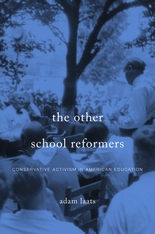
The reviews keep coming in! My German is more than a little rusty, but your humble editor noted this morning a new review of The Other School Reformers on the H-Soz-u-Cult page. Thanks to Lukas Boser Hofmann and the H-Soz-u-Cult list.

Does he like it? If my translation can be trusted, then yes indeed. He raises central questions and offers some helpful ideas.

With his Continental perspective, Boser points out a fair criticism. My book really does focus on the experience of American activists and traditions. As he suggests, we would all profit from comparative cross-national studies. As he asks, how have conservative ideas formed European educational policies? How have different nations struggled to determine the content of their curricula? Such comparisons would indeed offer a more comprehensive definition of what it has meant to be “conservative,” about education or any other issue.

I’m grateful for Boser’s claim that my book succeeds in giving conservatism and conservative activists a more accurate place in educational history. (At least, that’s my understanding of this section:

dem es den Konservativen einen Platz im grand narrative der US-amerikanischen Schulgeschichte einräumt. Dieses grand narrative wird von Laats durch die Verknüpfung der vier zeitlich und örtlich unabhängigen Einzelfallstudien und durch den Einbezug der Konservativen als wichtige Akteure ausgebaut und gestärkt und nicht etwa in Frage gestellt.

Maybe the SAGLRROILYBYGTH can offer a clearer translation. As I read it, though, Boser generously says that I’ve succeeded in incorporating conservatism into the “grand narrative” of American educational history. For me, after all, the primary motivation for the book was to find out why conservatives show up in so many educational histories as merely pesky gadflies, roadblocks in the inevitable progress of progressive education.  In my experience, at least, conservatives have played a much stronger leading role in shaping the course of American education.

At the end, Boser notes my sloppy style and predilection for puns (“seinen Hang zu Wortspielereien und Alliterationen – beispielsweise in den Kapitelüberschriften – und den manchmal etwas saloppen Stil.”) Ouch. In spite of such flaws, though, Boser concludes that my book is overall entertaining (“unterhaltsame”).

As SAGLRROILYBYGTH are aware, if I can’t be punny, I won’t bother. I wouldn’t like to be thought of as a sloppy writer, though.

In the end, I’m extremely gratified to hear that I managed to make a potentially dry and jargon-y book more pleasant to read, at least in Dr. Boser’s opinion.

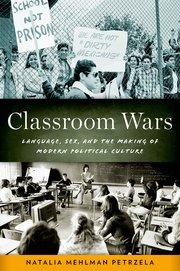
Required Reading: Classroom Wars

What should schools teach?  How should they teach it?  Who gets to decide?  These are the questions that keep SAGLRROILYBYGTH up at night, and now we have a great new book to shed light on the infinitely complicated ways they play out in real life.

Natalia Mehlman Petrzela’s new book, Classroom Wars: Language, Sex, and the Making of Modern Political Culture examines battles in California over bilingual ed and sex ed during the 1960s and 1970s.  As Petrzela explains,

This book focuses on bilingual (Spanish-language) and sex education in California in order to understand how grass-roots citizens came to define the schoolhouse and the family as politicized sites during the late 1960s and 1970s.

Full disclosure: Petrzela and I are friends and colleagues.  We’ve worked together for several years now, and we’ll be doing some presentations together in upcoming months at academic conferences about history, education, and culture wars.  Even if we weren’t friends, though, I would love this book.   petrzela classroom wars

For one thing, Petrzela’s careful examination of California’s educational politics shows us the ways culture-war politics are not somehow “natural,” but rather develop over time due to specific historical circumstances and activism.

For example, as she describes, in the early 1960s bilingual ed had lots of support among conservatives.  Arch-conservative Max Rafferty pushed for it, and even as late as 1968, many California legislators touted bilingual ed as the “American thing to do.”  Soon, however, bilingual education was tied together with leftist radicalism.  Students in 1968 staged huge “blow-out” protests in LA, carrying “Viva la Revolucion!” signs and demanding that all Anglo teachers be fired.  As Petrzela puts it,

In the two years following the BEA’s [Bilingual Education Act] passage and the blowouts [student walkouts], bilingual-bicultural education evolved from a relatively uncontroversial issue that garnered significant bipartisan support to a lightning rod dividing and defining conservatives and liberals.

Among activists, too, we need to be careful before we assume too much.  In the education bureaucracy of California, for instance, Petrzela introduces us to the complicated positions of folks such as Eugene Gonzalez, associate superintendent and chief of the division of instruction.  Gonzalez was close with conservative leader Max Rafferty, and like Rafferty he spoke out against the methods used by radical student protesters.  But he also continued to push for better and fairer education for latino/as in California schools.  Other Mexican-American activists, such as Alfred Ramirez, refused to go along with the protesting students at all.  He pushed Gonzalez to crack down on the Latino protesters and to get rid of bilingual programs entirely.

Nor were California’s educational culture wars a simple, stereotypical battle between progressive teachers and students on one side against conservative activists on the other.  That may often be the case, but as Petrzela recounts, in 1970 conservative teachers in LA founded their own union, the Professional Educators of Los Angeles.  And, though one conservative teacher lamented her position as a “minority among educators,” Petrzela also reveals that students, too, were split.  In at least one case, a group of conservative students gathered to denounce the “leftist-liberal bias” of their teachers.

We also see in these pages a clearer-than-usual vision of what conservative activists wanted.  At root, Petrzela shows us, conservatives felt as if they had too often been frozen out of discussions of sex ed and bilingual ed.  They felt they had not been included, not been consulted.  Many times, conservative activists and parents worried that a blundering school administration was trying to insert itself between parents and children.

When this wasn’t the case, many conservatives did not protest against sex education.  In conservative San Diego County, for example, sex ed was not at all controversial.  Part of the reason was because the teachers had a strong reputation in the whole community as family women with “high moral standards.”  By the end of the 1970s, Petrzela tells us, policy-makers had figured it out.  By then, most sex ed curricula were no longer so ferociously controversial, largely because parents and conservative organizations had been consulted beforehand.

Petrzela also tackles one of the toughest questions of these educational culture wars: Who won?  She argues that over all, over time, progressives tended to score victories.  In about half the cases of controversy over sex ed, Petrzela found, California districts actually expanded their sex ed programs after the blow-ups.

In every case, Petrzela makes her case well that schools matter.  As she puts it,

In the 1960s and 1970s, militant Chicanos in East Los Angeles, suburban housewives in Anaheim, and political aspirants as varied as Max Rafferty and Julian Nava all pinned their hopes on the public schools as the primary institution for cultivating an ethical, informed, moral next generation.

For all of us who want to look beyond the headlines of America’s continuing educational culture wars, this book is a good place to start.

…Almost Makes You Want to Read It

Thanks to Mike Wakeford and the Society for US Intellectual History for offering a thoughtful review of my new book.   I was tickled pink to see it. Intellectual historians can be a tough crowd, so I was a little nervous when I starting reading it. But Dr. Wakeford captured my goals well and offered some kind words as well.

Get yr copy today!  The book one person is talking about!!

Get yr copy today! The book one person is talking about!!

SAGLRROILYBYGTH are sick of hearing about the book. But new readers might not know that I looked closely at four of the most famous school controversies of the twentieth century. I wanted to figure out what had gone into making someone “conservative” when it came to education.

It would not have been kosher, I thought, simply to pick some of the best-known conservative groups and chronicle their activism. To do so, I would have had to impose a definition of what it meant to be a true “conservative.” By looking at school battles and examining instead what the conservative side wanted in each case, I was able to extract a definition of conservatism without imposing one from the outside.

That was the goal, anyway. Did it work? Dr. Wakeford thinks so:

Laats’ case-study approach is sound, effectively accomplishing his stated purpose of avoiding falling into easy stereotypes and generalizations (5).

Whew! My second goal in this book was to avoid imposing twenty-first-century connotations of “conservatism” onto earlier generations. I worked hard to get into a broad array of archives in order to get a handle on what conservatives themselves really cared about in the decades from 1920 to 1980. I was enormously gratified to read that Wakeford appreciated my labors. As he put it, my approach

also required that he dip into a remarkably eclectic source base, which ends up as one of the book’s strengths. Given the public nature of educational debates, national and local newspapers from Tennessee to Pasadena to West Virginia provide the core. But the study is enriched by Laats’ use of state legislative records and evangelical publications from the 1920s, the archival and published record of the American Legion and other conservative groups, local school board records, and, in the case of Kanawha County, author interviews with key figures.

In the book—and in my work here on ILYBYGTH—I worked hard not to impose my own progressive assumptions or stereotypes on conservative activists. I did not want to write a book simply damning the work of conservatives. Rather, I wanted to try to understand their goals and evaluate their strategies. Wakeford evaluated those attempts kindly as well:

To his credit, Laats rarely questions his subjects’ sincerity or the authenticity of their curricular visions, crediting them as meaningful participants in an important civic conversation about the purpose of schooling. But he is no sympathizer, and asks difficult questions about what has really made the movement tick.

Almost makes you want to read the book! Many thanks to Dr. Wakeford and the US Intellectual History blog.

Pro-Life: From Liberal Catholics to Conservative Protestants

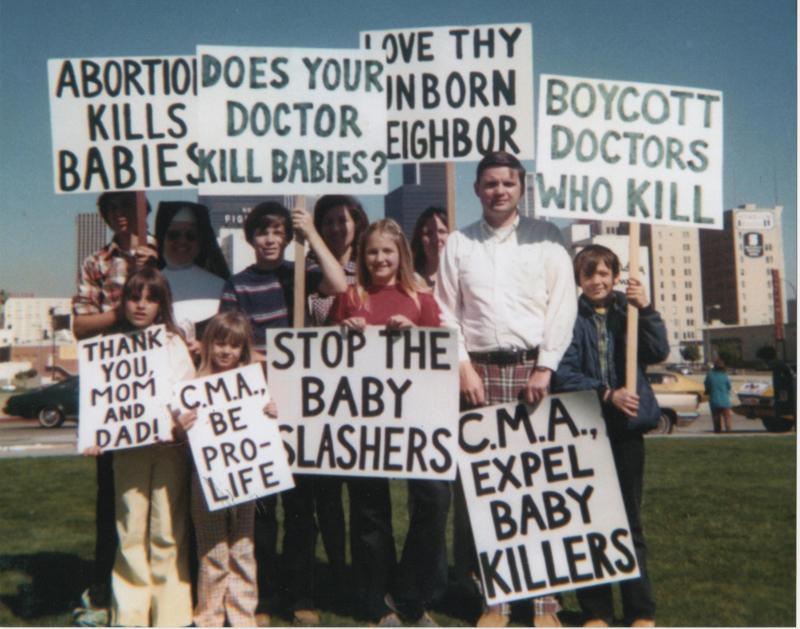
Who are the folks who stand outside of family-planning clinics these days, warning young women that some planning services are nothing but the cruelest form of murder? As historian Daniel Williams argues in a recent article in the journal Religions, the “pro-life” movement shifted from its early roots as a socially liberal Catholic cause to a politically conservative Protestant one.

Is this kind of thing inherently "conservative?"

Is this kind of thing inherently “conservative?”

For those of us interested in the historical development of America’s culture wars, Williams’s article is a must-read. As he explains, in 1972 the first generation of pro-lifers pulled from the civil-rights and anti-war wing of liberalism. At the time, Williams argues, “it seemed unthinkable that anyone would equate the pro-life cause with political conservatism.”

What happened?

As anyone with a pulse is well aware, these days the pro-life movement is firmly in the hands of culturally and politically conservative evangelicals.

Williams argues that pro-life Catholicism had its roots in the 1930s. Back then, Catholic intellectuals and activists often tied their theological arguments against abortion to the dominant New Deal liberalism of Franklin Delano Roosevelt.

After Vatican II’s liberalizing reforms in the early 1960s, liberal Catholics forged even tighter bonds between liberal Catholicism and secular Great-Society anti-poverty programs. As Williams recounts, anti-racist liberals tied new abortion laws to genocide against African Americans.

Around the time of the landmark Roe v. Wade decision in 1973, liberals began shifting their thinking. Instead of an issue of the rights of an oppressed and voiceless minority, abortion became a question of women’s rights.

On the conservative side, anti-abortion activism lost its connection to anti-war and anti-poverty campaigns. It lost its overwhelming connection to liberal Catholicism. Instead, it became wrapped in the Protestant-dominated language of “family values,” Williams writes.

For many of us who follow culture-war politics, it can come as a shock to read Williams’s re-creation of recent evangelical history. Even up to and during the early 1970s, many conservative evangelical organizations and intellectuals did not take a recognizably pro-life position.

Everyone interested in the full story should check out Williams’s article as well as his other work. It serves as a reminder that the seemingly hard-and-fast positions of our culture-war trenches have actually shifted dramatically over the years.

And for many of us, it prompts important questions:

  • Does pro-life seem inherently “conservative?”
    • Why?
  • Do some SAGLRROILYBYGTH who consider themselves “liberal” also consider themselves “pro-life?”
    • Why?
  • If you are “pro-life” and conservative, do you think the two go together?
  • Would it be possible these days to be a real pro-life liberal?
  • Is there something different about Catholic pro-lifers vs. Protestant ones?

Creationism Then & Now

Do you read Ted Davis? For folks interested in the creation/evolution debates, Professor Davis has long produced essential historical analyses of the various voices of creationism in all their befuddling complexity. I was reading one of Professor Davis’ essays on the Biologos Forum recently and it raised some perennial questions: Can we compare the dissenting science of today’s creationists to the scientific ideas of long ago? Can today’s creationists claim a long legacy of prestigious scientific antecedents?

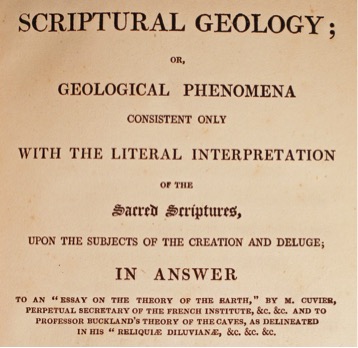
Cutting-edge creation science, c. 1827

Cutting-edge creation science, c. 1827

Davis is writing these days about science and creationism in antebellum America. In this post, he explains the school of “Scriptural Geology” that attracted religious scientists in the early 1800s. Scholars such as Princeton Seminary’s Samuel Miller and Anglican minister George Bugg rebutted new(ish) ideas of an ancient earth.

Professor Davis pointed out the remarkable similarities of their 19th-century arguments with the 21st-century arguments of today’s young-earth creationists. As Davis put it,

Readers familiar with Henry Morris or Ken Ham will find many of their ideas, expressed in substantially the same ways and for the same reasons, in the pages of Bugg’s book.

Now, Professor Davis would be the last person to ignore historical context or to misunderstand the historical changes that have wracked the world of creationist scientists. Yet his comparison to the Scriptural Geologists to Answers in Genesis or the Institute for Creation Research points out the radical changes that have taken place in the realms of creationism and science.

In the 1820s, discussions of the age of the earth still had some fading legitimacy among mainstream scientists. Even as late as the 1920s, when American politicians such as William Jennings Bryan insisted that “Darwinism” was losing scientific prestige, their claims made some sense. In the 1920s, for example, mainstream scientists had not yet cobbled together the modern evolutionary synthesis. They had not yet figured out how to reconcile the mechanism of natural selection with the maintenance of beneficial mutations.

As I describe in my upcoming book, mainstream science has changed enormously over the course of the twentieth century. Positions that made some scientific sense in 1827, or 1927, lost those claims as the 20th century progressed.

As an obvious result, there yawns an enormous gulf between the work of George Bugg and that of Ken Ham or Henry Morris. Today’s young-earth creationists are forced to take the role of utter scientific outsiders. They are forced to dismiss the entirety of mainstream evolutionary science as deluded.

Of course, as Professor Davis explains, earlier “creationists” such as Miller and Bugg also felt like scientific outsiders. But their position was radically different. Saying nearly the exact same thing, as always, can mean very different things, depending on when one says them.

Mixing It Up with Pope Francis

Confused by the incessant culture-war back and forth on the issue of climate change? Usually, it’s pretty easy to pick a side. Since, as Yale Law School’s Dan Kahan argues, what we “believe” about issues such as evolution, vaccinations, and climate change tells us more about who we are than what we know. Usually, those of us who consider ourselves progressives push for more and faster action on climate change. Those who consider themselves conservatives pooh-pooh the urgency of the issue. Yesterday, Pope Francis threw a St.-Peter’s-size monkey wrench into the works with his encyclical about the environment. In this searing statement, the pope challenged all of us to take a stronger stand about the changing climate.

Is THIS what conservatives should drive? . . .

Is THIS what conservatives should drive? . . .

Now, I admit, I have not read the full document. It weighs in at 184 pages and I’ll be sure to put it at the top of my reading list. Analysis by the New York Times paints a picture of a fairly radical stand by the Argentinian pope. In short, Pope Francis went further than tut-tutting the bromides of climate science. The pope blamed affluent throwaway culture for the dangerous changes that have already begun. What are we to do? Not just consume smarter, but change our feelings of entitlement and our endless apotheosis of appetite.

Climate change, the pope wrote, is nothing less than “one of the principal challenges facing humanity in our day.” It is not enough for us to merely cap-and-trade carbon emissions. It is not enough for us to merely “grow” our way out of the dilemma. The pope’s message is clear, and rather startling in its Greenpeace-scented tones. Those of us who follow culture-war-related developments are more accustomed to the Vatican as a world headquarters for staunchly conservative thinking on issues such as abortion and gay rights.

The new Popemobile?

The new Popemobile?

What does this mean for our climate-change culture wars? It will certainly mess up any bright lines between “conservative” and “progressive” orthodoxies. Of course, we’ve seen conservative intellectuals at places such as Front Porch Republic and The American Conservative who have long promoted this sort of less-is-more conservatism. But by and large, American conservatives might be more likely to agree with Richard Viguerie, who called Pope Francis’ statement a “confusing distraction.”

As Josh Rosenau of the National Center for Science Education has pointed out, American Catholics have been divided on the issue of climate change. “Traditional” Catholics in the USA have tended to be split on the issue and generally have been more interested in preserving traditional religious practices than in environmental activism. Could Pope Francis’ statement push them to action?

More broadly, might the pope’s statement encourage American conservatives to consider tackling climate change as a conservative mission? What about conservative Christians who are not Catholic? Some American evangelicals have openly attacked environmentalism as a “green dragon.” Others have talked about an evangelical environmentalism, calling it “creation care” or respect for the “doctrine of dominion.” Still others have voiced more complicated positions. American creationists, for example, have wondered about their theology of climate change. At the young-earth creationist ministry Answers In Genesis, for instance, readers are told that climate change is certainly a real phenomenon. But should we worry? Here is AIG’s advice:

should we be alarmed about climate change? Not at all. Yes, climate change is real, but according to the true history book of the universe, we should expect it as a consequence of the cataclysmic Flood. Also, Earth—and Earth’s climate—was designed by the all-knowing, all-wise Creator God. He built an incredible amount of variety into the DNA of His creatures so that they could survive and thrive as Earth’s environments change. Surely the God who equipped life to survive on a changing Earth also designed Earth with the necessary features to deal with environmental changes.

No one doubts the pope’s credentials as a smart, earnest, conservative Christian thinker. Might his encyclical spark a dialogue between conservative Catholics and other conservative Christians about the issue of climate change? Could an inter-Christian, inter-conservative dialogue move conservative Christians towards the pope’s position?

Dissenters, Not Ignoramuses

[Editor’s Note: As SAGLRROILYBYGTH are well aware, I’ve just completed work on a new book about creationism and evolution education in the United States.  Based on that effort, the education editor of Anthropology Now invited me to contribute some thoughts about the implications of the creation/evolution controversy.  Below I’m reprinting that essay in its entirety, with the permission of Anthropology Now.  You can also find the essay in its original form in the April 2015 edition of that magazine. Thanks to Zoe Burkholder and Maria Vesperi of AN.]

Physical anthropologists have long been on the front lines of debates over evolution. In the Texas textbook tumult over the past decade, for example, Ronald Wetherington of Southern Methodist University has gone head-to-head with creationists over the content of science textbooks. There is no debate over the science, Wetherington has argued. There is simply no way humanity’s origins can be traced to two bashful ancestors in an idyllic garden, 6,000 years ago.[1]

Image courtesy of Scott Thurman, The Revisionaries

Wetherington thinking it over. Image courtesy of Scott Thurman, The Revisionaries

Yet the fight goes on. Creationists insist on including their religious beliefs in public-school science classes. Mainstream scientists protest. All too often, the debate has forced folks such as Wetherington to attack the scientific pretensions of creationism. How would it be possible, mainstream scientists insist, for the earth to only have a short history? For humanity to trace its lineage from the Garden of Eden? The genetics just don’t line up. The fossils don’t line up. Nothing fits.

This sort of back-and-forth about the possibilities of science goes nowhere. More false debates pitting mainstream scientists against creationist scientists in a choreographed and predictable non-dialogue about the proper nature of science are not needed. One side calls the other a bunch of ignoramuses. Creationists retort that they are the only real scientists in the room.

Creationists may or may not be ignorant about evolutionary theory, but there is a better way to understand creationism, as primarily a form of religious dissent. Of course, notions of religion and religious dissent have always played a part in creation/evolution debates. Court decisions, especially, have tended to reject creationists’ claims on the basis that they represent a religious viewpoint, not a scientific one. Even those decisions, however, have pushed creationists to insist on their status as scientific dissenters above all. For everyone’s sake, including that of creationists themselves, creationism should be viewed first and foremost within the tradition of religious dissent in the United States.

This approach offers hope for moving the long debates over creation and evolution in a more productive direction. In the end, centering the debate on religious dissent rather than on scientific truth could offer two promising new policy goals. First, it would require both sides to agree on different goals for evolution education. Public schools would be tasked with clarifying their expectations and demands. While students from every background must be helped to understand evolution, their beliefs about that knowledge are their own business. As religious dissenters, creationists have the right to preserve their religious beliefs. Second, for public-school teachers to teach dissenting students, teachers themselves must be taught some basic principles about cultural difference and inclusion. Here is where anthropologists can get involved. Teachers should study not only biology and geology, but also ethnography and principles of cultural anthropology. Science teachers must understand the cultural beliefs of religious dissenters in order to welcome those dissenters into science classes. And teachers should be trained to understand their own cultural perspectives, to see the dissent of their students as a cultural strength, not a deficit to be corrected or an ignorance to be attacked.

Anthropologists can be helped by historians. As every historian is well aware, the US educational system has a long, spotty record of handling religious dissent. All too often, public schools have crammed hegemonic notions of proper culture and theology down the throats of minority students and families. In the 19th century, as historian Carl Kaestle has argued, Protestant school leaders often pooh-poohed the objections of Catholic dissenters. In the 1830s, Protestant school leaders in cities such as Boston, New York, and Philadelphia dismissed Catholic complaints about textbooks that ridiculed the Pope and described Catholics as inquisitors and anti-Christians.[2] Even into the 20th century, as David Wallace Adams has shown, minority groups felt the heavy hand of the dominant culture. At Native American Indian boarding schools, Adams found, non-native teachers made it their mission to squash the religion of their native charges. School founder Richard Henry Pratt wanted to “kill the Indian and save the man.”[3]

As the 20th century progressed, religious dissenters scored some successes in major court cases. Perhaps most influential, the US Supreme Court ruled in Abington School District v. Schempp (1963) that students had the right to dissent from religious practices in public-school classrooms. Even if families were allowed to opt out of prayers and Bible readings, the Court decided, such religious practices involved the government too closely in private religious beliefs.[4] Other federal courts have underlined the rights of religious dissenters in public schools. One Tennessee district court ruling in 1979 spelled it out: “if that which is taught seeks either to disparage or to encourage a commitment to a set of religious beliefs, it is constitutionally impermissible in a public school setting.”[5] It is not enough anymore for public schools to allow minorities to attend. It is not enough to permit dissenters to share in parts of the public-school culture. Public schools, rather, must welcome dissenters and minorities as equal members.

That new consensus can be applied to the status of creationist dissenters. Their beliefs should not be mocked or dismissed out of hand. But while dissenting religious beliefs must be respected, religion should never inform the public-school curriculum. Students of all backgrounds, dissenting or not, must be exposed to the very best knowledge on offer. They should be helped to understand that knowledge, even if it contradicts their home religions. At the same time, they must not be forced to believe anything that they find theologically repugnant.

Although creationists and mainstream scientists have disagreed bitterly for generations, they have often agreed on one fundamental—but mistaken—notion. Both sides have repeatedly defined the struggle as a scientific one, rather than a religious one. Many creationists insist that their religiously motivated understanding of the origins of humanity represents a scientific vision. And many mainstream scientists engage on just this issue: Which model represents the better scientific explanation? These debates—fascinating but ultimately pointless and unproductive—roiled in the 20th century and continue into the 21st.

Monkeys and Modernity

The first generation of evolution/creation debates in the 1920s set the tone for those that followed. One of the leading anti-evolution voices of that generation, William Jennings Bryan, insisted that evolution was first and foremost bad science. Bryan proudly and pointedly maintained his membership in the American Association for the Advancement of Science. In the pages of the New York Times in 1922, Bryan insisted that his anti-evolution position represented a deep love of true science. “We do not ask,” Bryan told readers, “for the exclusion of any scientific truth, but we do protest against an atheist teacher being allowed to blow his guesses in the face of the student.”[6] Those who insisted on forcing such false ideas on America’s students, Bryan mocked, were nothing but irresponsible “pseudo-scientists.”[7]
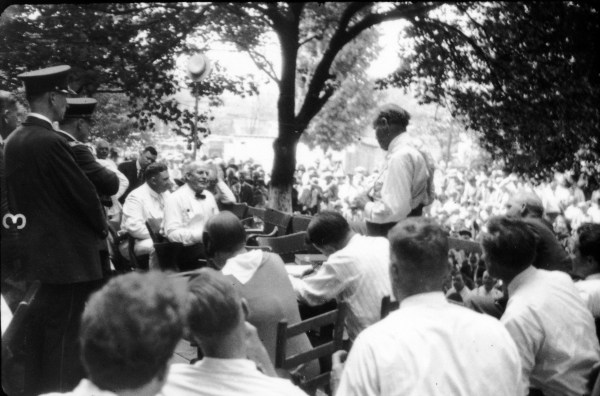
"Are you know or have you ever been...an ignoramus?"

“Are you know or have you ever been…an ignoramus?”

Mainstream scientists met Bryan on the field of science. They often insisted that his was not real science, yet allowed the discussion to focus too often on such definitions. One of Bryan’s primary public antagonists in the 1920s was Princeton biologist Edwin Conklin. Conklin called Bryan a “non-scientific person,” someone utterly unqualified to assert the boundaries of scientific knowledge.[8] Conklin poured out a good deal of time, sweat and ink in his attempt to prove that creationism did not count as real science. Real science, he wrote, was the “freedom to seek and to find truth. . . . confident that even unwelcome truth is better than cherished error.”[9] Real scientists never shied away from uncomfortable conclusions, while Bryan’s sort—scientific usurpers—began with false conclusion and worked backwards.

Perhaps the defining moment of these battles over evolution and creationism came in the summer of 1925. The Scopes Trial in July of that year focused the world’s attention on the question of evolution and creationism, religion and science. Bryan battled famous atheist Clarence Darrow in the sweltering heat of Dayton, Tennessee. The trial brought public attention to the question, but did not do much to resolve the issues. Too often, debates still focused on questions of science.

For example, in the months following the trial, the first celebrity creation scientist from the United States debated the issue with journalist Joseph McCabe. In this debate, held in London in September 1925, leading creationist George McCready Price pilloried evolution as a scientific travesty. The theory made sense, Price told the assembled crowd, “for the times of comparative ignorance of the real facts of heredity and variation and of the facts of geology which prevailed during the latter part of the nineteenth century.” To real scientists, though, Price insisted that evolution could not hold water. Any believer in evolution, Price concluded, would “wake up some fine morning and find that he needs an introduction to the modern scientific world.”[10]

Price never mentioned the need to protect the rights of religious minorities. He did not argue in 1925 that evolutionary theory might outrage the religious sensibilities of dissenters such as himself. Yet it is without doubt that Price’s scientific vision emerged from his religious faith. Price was a member of the Seventh-day Adventist church, a denomination founded in the aftermath of William Miller’s failed 1844 apocalyptic visions. The prophetess of the denomination, Ellen G. White, founded the group largely on her visions of the beginning and end of time. In the beginning, White attested, God created the universe in six literal days. For orthodox Seventh-day Adventists such as Price, faith demanded a young Earth, a worldwide flood and a six-day special creation by God.[11]

Such debates at the start of the modern culture-war controversies over the teaching of evolution defined the issue mainly as one of science and science education. Not that activists did not also discuss the religious aspect of these debates—Conklin, for example, accused Bryan of pushing for “medieval theology” in place of real science—but too often the debates implied that the central questions were scientific ones.[12]

The More Things Change…

Contemporary debates feature similar definitions and boundaries. In February, 2014, for instance, today’s leading young-Earth creationist Ken Ham debated the prominent science-educator Bill Nye, “The Science Guy.” In that debate, Ham insisted that mainstream science had lost its way. Creationists such as himself, Ham told the crowd, had a better grasp of the impossibility of “historic” science. Real science, Ham informed Nye and the world, did not make leaps of illogic about past events. Mainstream scientists made a fundamental error when they limited themselves to the echo-chamber of flawed evolutionary reasoning.

Bill Nye played along. The simplest facts of real science, Nye insisted, proved the utter baselessness of young-Earth creationism. Nye referred to the local Kentucky limestone as just one example of the many that made the case. “We are standing,” Nye said, “on millions of layers of ancient life. How could those animals have lived their entire lives in just four thousand years?” The briefest introduction to the principles of geology or biology proved the power of evolutionary theory beyond any reasonable doubt.[13]

Even in the 21st century, creationists insist that their religious beliefs are better science  and mainstream scientists (and “Science Guys”) agree to define the fight as one about the proper boundaries of science. For their part, creationists these days are in a strategic pickle. Courts have ruled against teaching religious views in science classes. Most significantly, the US Supreme Court’s 1987 decision in the case of Edwards v. Aguillard specified that creationism could not be taught in public schools. Such beliefs, the court ruled in a 7-2 decision, represented religion, not science. However, the majority decision stipulated that dissenting visions of science could be taught if they represented better science instead of simply better religion.[14] Thus creationists can hope to include creationism in public-school science classes only if they can demonstrate that their science is better than mainstream teachings. Mainstream scientists, too, still hesitate to dispute creationism on religious grounds. After all, it is easier to attack the scientific pretensions of what philosopher Philip Kitcher has called “dead science” than it is to critique an opponent’s religious beliefs.[15]

While courts have repeatedly concluded that creationism is primarily a religious belief, both creationists and mainstream scientists have continued their endless rounds of debate. But embracing the definition of creationism as a form of religious dissent instead can reveal new approaches to the controversies. Dissenters in public schools have a contentious but clearly defined tradition of rights and responsibilities. They must be treated respectfully and knowledgeably, but their beliefs do not grant them the right to dictate curriculum for the entire school. Dissenters must be allowed to specify why they find curricular material offensive, but simply calling something offensive does not automatically guarantee that it should be excluded from public education.

Two general rules of thumb will help public schools walk this fine line, teaching evolution to everyone, yet respecting the beliefs of those who dissent for religious reasons. First, teachers should make their goals clear. When it comes to evolution education—or any other form of public education, for that matter—the goal should be for students to understand the material, not to adopt any sort of belief about it. In the case of evolution, all students from all backgrounds would be expected to learn the outlines of evolutionary theory. But teachers would be required to avoid implying that students should believe anything in particular about human origins or the age of the universe. And again, teachers would need to know more about the home cultures of dissenting students. Educating teachers about creationism in its cultural context would help smooth away unnecessary conflict between evolution educators and dissenting creationist students.

Creationists Get On the Bus

Along with their arguments about the superiority of their science, some creationists have long argued for their rights as religious dissenters. Most famously, in 1978, creationist scholar Wendell Bird argued for the rights of creationists as a minority in the pages of the Yale Law Review. “Exclusive public school instruction in the general theory of evolution,” Bird insisted, “abridges free exercise of religion.”[16] Other creationist activists and writers have similarly insisted on their rights as beleaguered minorities. In the mid-1980s, for instance, creationist Jerry Bergman complained that he had been denied tenure at Bowling Green State University due to his creationist beliefs. “A similar case might be,” Bergman claimed, “if a black were fired on the suspicion that he had ‘talked to students about being black,’ or a woman being fired for having ‘talked to students about women’s issues.’”[17] Speaking in the mid-1990s, creationist activist Duane Gish took a similar stance. When he learned he was one of only two creationists invited to a scientific dialogue, Gish erupted, “I will proceed to take one of the two seats on the back of the bus reserved for the creationists in this meeting.”[18] No one believed more strongly in the definition of creationists as put-upon minorities than these creationists themselves. If the benefits of that position can be made clear, perhaps other creationists would embrace a definition as religious dissenters.

Even if they do, however, it remains a question whether it be possible for creationist students to learn about evolution without embracing it as a belief. Can students be asked to understand something if they are not asked to believe it? Some scattered evidence suggests this is already happening. Anthropologist David Long, for example, studied a small group of about 30 undergraduate biology students at a large public university. Many of them came from creationist backgrounds. Those students reported no trouble in learning and understanding evolution without changing their religious beliefs. One student told Long:

I take those really big classes, because it’s really easy to excel in those huge classes. I mean, I got like a hundred on every test. You have to be an idiot pretty much not to. If you just sit, and you listen to what they’re saying, and you know how to take tests, it’s very easy to do well in those classes.[19]

Of the students from creationist backgrounds in Long’s sample, only one abandoned her creationist beliefs while studying biology at a public university. And that student had already begun to abandon her faith before she left high school.[20] Learning evolutionary science, Long found, did not lead to religious conversions.

Similar results occur in high schools. One study of roughly one hundred public-school biology students found that a three-week unit on evolution did not force creationist students to abandon their beliefs. Indeed, though students in this study learned a good deal about evolution, many of them became more firmly convinced of their creationism by learning about evolution. After the unit on evolution, for instance, students improved their performance on a test about basic evolutionary principles. More of these same students, however, agreed or agreed strongly—after studying evolution—with the statement, “Genesis is the best account of how the Earth was created and populated with life.”[21]

Americans in general already seem to separate knowledge from belief when it comes to evolution. In 2012, the National Science Board (NSB), which is part of the National Science Foundation, experimented with the wording of its questions about general science knowledge. Only 48 percent of respondents agreed with the statement, “human beings, as we know them today, developed from earlier species of animals.” But when the NSB prefaced that statement with the phrase, “According to scientists,” 72 percent of respondents agreed.[22] In short, significant numbers of Americans know what the science says about evolution. They simply choose not to agree that it is true.

Finally, students learn better when they feel some connection to their teachers. Teachers who can connect culturally with their students will have an easier time teaching anything, from evolution to arithmetic. As education scholar Gloria Ladson-Billings has argued, “Teachers who practice culturally relevant methods. . . . see themselves as part of the community and they see teaching as giving back to the community. They help students make connections between their local, national, racial, cultural, and global identities.”[23]

For teachers who come from non-creationist backgrounds, the effect of a short course in cultural anthropology could be profound. For one thing, it would introduce teachers to the idea that the world of creationism includes a vast kaleidoscopic array of beliefs and cultures. It would be useful to know how a Baptist creationist student might differ from a Seventh-day Adventist or from a Gulenist. More important, an introduction to the foundational principles of cultural anthropology can help science teachers understand that difference is not deficit. Simply because creationist students do not accept evolution, they are not necessarily naively ignorant about evolution. Indeed, as David Long has noted, many students from creationist backgrounds perceive any discussion of evolution as “troublesome or even dangerous.”[24] Good teachers want to help students, not terrify them. A primer on the principles of cultural anthropology can help teachers connect with creationist students more productively.

None of this will make creation/evolution controversies go away. There is no magic wand here. But by placing the educational discussion more squarely on the rights and responsibilities of religious dissent, we may drain some of the venom from our achingly repetitive school battles.  

Notes

[1] See Scott Thurman’s documentary, The Revisionaries (2012).

[2] Carl F. Kaestle, Pillars of the Republic: Common Schools and American Society, 1780-1860 (New York: Macmillan, 1983).

[3] David Wallace Adams, Education for Extinction: American Indians and the Boarding School Experience, 1875-1928 (Lawrence: University Press of Kansas, 1995), 52.

[4] Abington School District v. Schempp, 374 U.S. 203 (1963).  (accessed January 11, 2015).

[5] Wiley v. Franklin 474 F. Supp. 525 [E.D. Tenn. 1979] at 531.(accessed January 11, 2015).

[6] William Jennings Bryan, “God and Evolution,” New York Times, February 26, 1922, 11.

[7] William Jennings Bryan, In His Image (New York: Fleming Revell, 1922), 69.

[8] Edwin Grant Conklin, “Bryan and Evolution,” New York Times, March 5, 1922, 1.

[9] Edwin Grant Conklin, The Direction of Human Evolution (New York: Scribner’s, 1921), v–vi.

[10] George McCready Price, “Is Evolution True?” in Ronald L. Numbers, ed., Creation-Evolution Debates (New York: Garland Publishing, 1995), 160.

[11] See Ronald L. Numbers, The Creationists: From Scientific Creationism to Intelligent Design, expanded edition (Cambridge, MA: Harvard University Press, 2006), 91-93.

[12] Conklin, “Bryan and Evolution,” 1.

[13] Video of the debate from February 4, 2014 is still available at http://debatelive.org/ . See the author’s commentary and discussion at “Time for Ham on Nye!” I Love You but You’re Going to Hell, February 4, 2014,  (accessed June 2, 2014).

[14] Edwards v. Aguillard, 482 US 578 (1987)  (accessed April 14, 2014).

[15] Philip Kitcher, Living with Darwin: Evolution, Design, and the Future of Faith (New York: Oxford University Press, 2007), 8.

[16] Wendell R. Bird, “Freedom of Religion and Science Instruction in Public Schools,” The Yale Law Journal 87 (January, 1978): 518.

[17] Jerry Bergman, The Criterion: Religious Discrimination in America (Richfield, MN: Onesimus Press, 1984), 43.

[18] Duane T. Gish, “The Scientific Case for Creation,” in Frank Awbrey and William Thwaites, eds., Evolutionists Confront Creationists: Proceedings of the 63rd Annual Meeting of the Pacific Division, American Association for the Advancement of Science, Vol. I, Part 3 (San Francisco: Pacific Division, American Association for the Advancement of Science, 1984), 26.

[19] David E. Long, Evolution and Religion in American Education: An Ethnography (New York: Springer, 2011), 36.

[20] Ibid., 75.

[21] Anton E. Lawson and William A. Worsnop, “Learning about Evolution and Rejecting a Belief in Special Creation: Effects of Reflective Reasoning Skill, Prior Knowledge, Prior Belief and Religious Commitment,” Journal of Research in Science Teaching 29:2 (February 1992): 143-166.

[22] National Science Board, Science and Engineering Indicators 2014, “Chapter 7: Science and Technology: Public Attitudes and Understanding,” National Science Foundation, February 2014  (accessed January 11, 2015). See also “Evolution in Science and Engineering Indicators 2014,” National Center for Science Education Blog, February 18, 2014  (accessed January 11, 2015).

[23] Gloria Ladson-Billings, The Dreamkeepers: Successful Teachers of African American Children (New York: Wiley, 1997), 25.

[24] Long, Evolution and Religion in American Education, 15.

Loving your Homosexual Neighbor: Hell or Rapture?

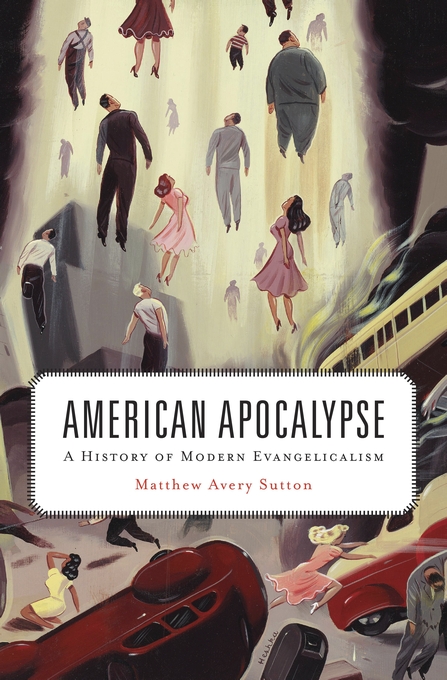
Why are our culture wars so durable? In his new book American Apocalypse, historian Matthew A. Sutton argues that the answer lies in the end of the world. But more evidence keeps piling up that there is a different answer, a better explanation. For some conservative religious people, the culture wars are about more than just winning elections or improving schools. The fight for America’s soul is nothing less than a battle to save people from eternal torment.

I Love You but It's the End of the World...?

I Love You but It’s the End of the World…?

Professor Sutton’s book is really terrific. He examines the history of what he calls “radical evangelical” belief as it emerged in the twentieth century. Unlike most historians, he doesn’t ignore important aspects of the radical evangelical family, such as Pentecostals and African Americans. The part that I’m struggling with is Prof. Sutton’s definition of radical evangelicalism. At its heart, Sutton says, American fundamentalism can be understood as

radical apocalyptic evangelicalism. . . . fundamentalists’ anticipation of the soon-coming apocalypse made them who they were.

In other words, Professor Sutton thinks that the heart and soul of fundamentalist belief comes from beliefs about the imminent and cataclysmic apocalypse. Our American culture wars are so virulent, he explains in chapter four, because fundamentalists and other radical evangelicals believe that they will be judged soon by a righteous God. They must fight against immoral movies, immoral booze, and other immoral trends because such things are part of the seductive Satanic lure of the end days.

Certainly, ideas of Bible prophecy and apocalypse are central to fundamentalist belief. But are they really as central as Professor Sutton contends? Are there other ideas that are even more important?

We stumbled across an evangelical warning this morning that raises the question again. In the pages of World Magazine, conservative evangelical Andree Seu Peterson explains why fundamentalists can’t relax. She does not mention the coming apocalypse. To Peterson’s way of thinking, there is a different reason why fundamentalists must continue fighting culture wars.

Peterson warns that things have changed fast in the last ten years. For conservatives, the question of homosexuality used to be cut-and-dried. Ten years ago, she says,

homosexuality was fringy and dangerous and you were dead set against it. Today homosexuality is the guy grilling steaks next door, waving to you over the picket fence, calling, “How about those Phillies!”

Conservatives might be tempted to accept homosexuals as part of God’s family. Christians might be tempted to love their neighbors, as Christ commanded. In secular terms, we might say, conservatives might feel pressure to adapt their beliefs to changing cultural norms.

Such thinking is dangerous, Peterson warns. Not because the world will be ending soon, but for a more basic reason, a reason more fundamental to fundamentalists. If you really care about your neighbor, Peterson explains,

If you want to talk about “love your neighbor,” need we mention that neighbors don’t let neighbors go to hell? … What good is all the good will you reap now when in the future Mr. Steak Griller next door curses you from across the chasm for your quiet complicity in his damnation?

When it comes to culture wars, this I-Love-You-but-You’re-Going-to-Hell logic is the equivalent of a perpetual motion machine. Whenever religious conservatives might be tempted to relax, to get along, to go with the flow, they can remind themselves of the eternal dangers of compromise. Even when it seems as if the kind thing to do, the loving thing to do, is to meet our neighbors in the middle, such apparent kindness, to some religious conservative, is a terrible mistake.

For some conservative religious people, culture-war issues are not just about accepting our neighbors’ “alternate lifestyles.” If they were, then we could all just get along. As Peterson tells the tale, we could all just smile and wave at one another, then go our separate ways. But for some conservatives, the culture wars have eternal stakes. If they don’t win, they will be guilty of sending people straight to hell.

Is that related to the apocalypse? Sure. Sorta. If Jesus will be returning sometime soon, suddenly and without warning, then these questions of damnation become even more urgent. But it is the damnation itself that is the crucial idea.

For those of us outside the circle of conservative evangelical belief, it can be difficult to understand the vital importance of the idea of damnation to evangelicals. For those of us who don’t believe in a real and terrifying hell, it can be easy to miss the enormous implications of such an idea. The apocalypse is only scary because of the threat of eternal damnation. The culture wars are only worth fighting if we can save some souls from such torment. Missionary work is only crucial because we need to spread the light as far as we can. Indeed, rather than defining fundamentalism as the radical evangelical belief in the apocalypse, we might better define fundamentalism as the radical evangelical belief in a real, eternal, and difficult-to-avoid Hell.

Certainly everyone interested in the nature of fundamentalism and culture wars should read Professor Sutton’s book. And maybe someone can explain to me what I’m missing. It seems to me, though, that the central idea to understanding what makes fundamentalists unique is hell, not just the coming apocalypse.

Required Listening: Us & Them

Can we talk across the culture-war divide?  That’s the question journalist Trey Kay is asking in his new podcast series, Us & Them.  Is it worth talking to someone with whom we have fundamental disagreements?

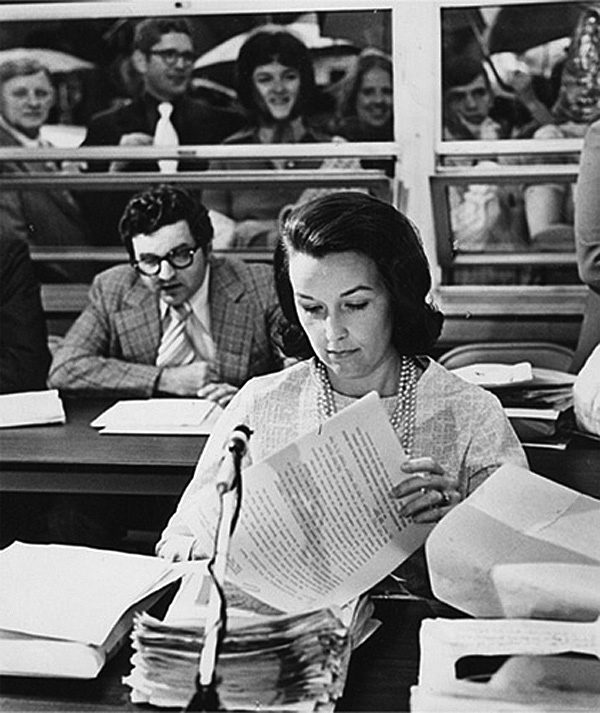
In his first episode, Trey Kay describes his culture-war-defying friendship with conservative activist Alice Moore.  Kay first got to know Alice Moore when he was working on an earlier documentary about the 1974-75 textbook controversy in Kanawha County, West Virginia.

As the sophisticated and good-looking regular readers of I Love You but You’re Going to Hell (SAGLRROILYBYGTH) are well aware, this Kanawha County story also plays a prominent role in my recent book about educational conservatism.  Alice Moore played a leading role as a conservative leader in that tumultuous school boycott.

Ms. Moore makes her case in a crowded 1974 school-board hearing...

Ms. Moore makes her case in a crowded 1974 school-board hearing…

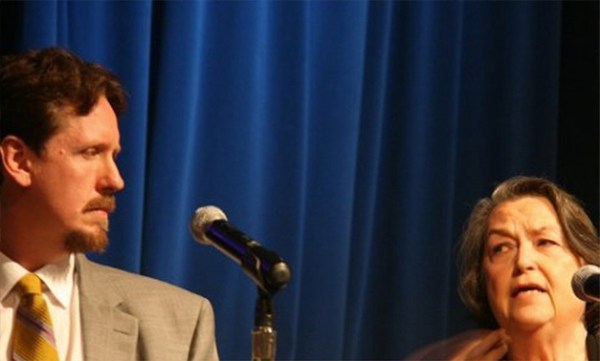
In his first podcast, Kay describes his continuing friendship with her.  The two of them inhabit different culture-war realms; Kay is a self-identified “blue-state liberal,” while Moore is a “red-state conservative.”  More than that, Ms. Moore believes in a conservative evangelical Protestantism that liberals often find intellectually outrageous.

Can the two of them be friends?

At the very least, it would take careful diplomacy on both sides. As Kay asked himself, “I have core beliefs.  What if I truly felt that they were under attack?”

Check out the whole episode when you’ve got a few spare minutes.  Kay and Moore manage to do the things friends do: Get a meal together, talk about politics and religion.  Yet neither of them budges an inch on his or her core beliefs.

Are such conversations worth having?  As Kay includes in this episode, his editor wasn’t sure.  She told Kay, “I don’t know how you can stand to have this conversation.”  It seemed to Kay’s editor that he was listening to Moore, but Moore wasn’t listening back.

Frenemies?

Frenemies?

Yet Kay remained convinced there was some value to such outreach programs.  He asked historian Jonathan Zimmerman’s opinion.  Zimmerman insisted that Americans need to speak with each other; we need a common language to discuss “American problems . . . shared by all of us.”  The most dangerous culture-war idea going around, Zimmerman said, is that those who disagree with us are either morally warped or ignorant.

Trey Kay hopes his new series will help figure out “what might happen if we take the time to listen to each other.”  Can it work?