Required Reading: The Big Tent of Creationism

Creationism ruffles feathers.  As the belligerent atheist Richard Dawkins memorably quipped, those who do not believe in evolution must be “ignorant, stupid or insane (or wicked, but I’d rather not consider that).”  There is comfort in Dawkins’ dismissal.  An insightful article in the most recent Christianity Today, however, probes deeper into the complexities of creationism.

I still remember my first introduction to the world of creation science.  I was a staunch outsider, having had little interaction with creationism until my mid-30s.  In graduate school, reading Ron Numbers’ The Creationists, I was astounded to learn that nearly 50% of American adults agree with a young-earth creationism, according to Gallup polls.  And one-quarter of those creationists have college degrees.
Much of my academic research has been devoted to puzzling out how such a thing is possible.  Since the 1920s (my Scopes book now available in paperback!), creationism has entrenched itself in schools, colleges, and alternative scientific organizations.  It has become a viable way for millions of Americans to understand the origins of life on Earth.

Glib dismissals like those of Richard Dawkins do not help us understand this cultural phenomenon.  What will help are thoughtful, sympathetic explorations like that of Tim Stafford in July’s Christianity Today.  In “A Tale of Two Scientists,” Stafford explores the lives and careers of two evangelical scientists, Darrell Falk and Todd Wood.  Falk is an evolutionary creationist, Wood a young-earth creationist.

Falk describes his falling away from his upbringing in the Nazarene Church.  As a graduate student, he had fallen in love with the beauty of genetics, and soon found himself estranged from the church.  When he watched his two daughters growing up, he knew he wanted to find them a church home like the one he had known.  He was worried about a cold reception from church members, but as a tenure-track scientist at Syracuse University, he looked for a church he could join.  At first, he was nervous.  As Stafford tells the story,

“Falk went alone, like a spy, into the church for a worship service.

“After the service, he found himself surrounded by friendly faces. They seemed delighted that he was a professor at Syracuse. Falk went home and told his wife, ‘We might have a church after all.’

“So it proved to be. Though the church certainly didn’t believe in evolution, and came to know that Falk did, they never bothered about it. ‘That church, God’s gift to us, built a bridge to us and welcomed us just as we were, gradual creation perspective and all.’ The pastor helped Falk as he found his way to a fuller, more robust faith, eventually asking him to teach a Sunday school class for young adults.”

Wood had a very different upbringing and career.  As he explains in the article, he never moved away from the assumption that the Bible’s description of a six-day creation tells the real story of the origins of life.  But that did not mean that he was somehow ignorant of evolution.  As Stafford writes,

“The first human genome sequence was published the year that Wood began graduate school, providing strong evidence for evolution. The DNA for chimps and humans was virtually the same. Traces of common origins were everywhere: Humans even possessed a broken version of the gene that lizards and birds use to produce eggs. Wood remained fully committed to a six-day creation—he says he never doubted it for a minute—because he saw no other way to read the Bible. But that didn’t keep him from recognizing that evolution had powerful attestation.”

The two men have very different ideas about the origins of life.  Yet they can both describe themselves as “creationists.”  And, unlike the harsh denunciations of critics like Dawkins, neither scientist is stupid, insane, or ignorant.  Rather, their relationships to mainstream science have been profoundly shaped by their religious beliefs.  This does not mean they have been brainwashed or indoctrinated.  Nor does it mean they are anti-science.  Rather, they came to very different conclusions about the need to reconcile science and religion, all within the big tent of creationism.

We do not have to agree with their conclusions in order to recognize the intellectual complexities of their positions.  If we hope to understand Fundamentalist America, it will help to dig deeper than Dawkins’ brand of simplistic denunciation.

Required Reading: Fifty Shades of Fundamentalism

When is a Fundamentalist not a fundamentalist?  When he or she comes from one of the many other conservative traditions in American religion.

One of the foremost dangers for outsiders like me who hope to understand Fundamentalist America is our tendency to oversimplify the nature of conservative religious folks.  Some commentators talk too blithely about the “Christian Right,” as if there was some secretive star chamber featuring the Pope, David Barton, Tim LaHaye, and a handful of other Jesus moguls, drinking soda pop and planning to take over secular society.

A new book by James C. Burkee helps to explain one of the other groups that has long contributed to the kaleidoscope of Fundamentalist America.  At Religion in American LifeJon Pahl offers a substantial review of Burkee’s Power, Politics, and the Missouri Synod: A Conflict That Changed American Christianity.

Why should those of us who hope to understand Fundamentalist America care about Burkee’s book?  Two main reasons.  First, the LCMS has long been an important element in conservative Protestant cultural activism.  Many of the leading creationists, for instance, come from within the LCMS tradition.  And this is a very different group than the sort of tent-revival, Billy Sunday, wave-your-hands-in-the-air kind of evangelical Christianity that many people associate with conservative theology in America.  In the 1920s, for instance, as I note in my Scopes book (now in paperback!), Missouri Synod Lutheran leader John Theodore Mueller pointed out that “after all has been said, there remains a sharp difference between Calvinistic Fundamentalism and confessional Lutheranism—a difference not in degree, but in kind.”  In addition to theological differences, the cultural differences of LCMS as a group of German immigrants–fiercely devoted to preserving both their religious and their cultural traditions–differs markedly from the sort of “take our country back” conservatism of many from the evangelical tradition.

If we outsiders hope to understand the real complexity of conservative religion in America, we need to spend some time with books like Burkee’s.  In addition, Pahl makes some points that are illuminating about the nature of conservative American religion in general.  One of the storylines in Burkee’s book is the desire among a core of the LCMS leadership to purge their institutions of what they saw as dangerous tendencies.  However, Pahl comments,

“By trying to “purify” an institution (and especially its Seminary—they are, after all, notorious places of rampant impurity), conservatives harmed, if not destroyed, it.  Purity, one might put it, is God’s prerogative.  Humans are too dangerous to be trusted with it—as the crucifixion of Jesus supposedly makes manifestly evident.”  

This example of the dangers of the impulse to purify could offer larger lessons about the career of conservative religion.  Since the start of small-f fundamentalism in the 1920s, conservative Protestants have sought to purify their institutions.  It has often led them away from the kind of cultural influence they originally hoped to achieve.  Even Pope Benedict has been said (perhaps unfairly) to desire a smaller, purer Catholic Church.  Burkee’s description of LCMS efforts in this direction could shed helpful light on this broader conservative impulse.

Burkee’s book also discusses the ways LCMS leaders connected a bundle of politically and culturally conservative ideas to their conservative theology.  As Pahl explains,

“A 20th century method of biblical interpretation (usually exercised in English, no less) became a political weapon, which in Otten’s discourse was wielded not only against historically-critical seminary professors, but also against advocates of civil rights, ecumenists, big government, the social gospel, feminists, and communists—'”liberals” all.'(59)” 

This, too, has been a common experience across the universe of conservative religion.  The big-F Fundamentalist tradition, after all, has been to combine religion, politics, and culture into a potent American identity.  Some of elements make very little theological sense, but a wealth of cultural sense.  For instance, what does short hair on men have to do with belief in an inerrant Bible?  Jesus wore it long, after all.  But in the American context, long hair on men means “hippie.”

For those of us trying to make sense of all these seeming contradictions, books like Burkee’s will be a big help.

Now in Paperback!

At long last, we have an affordable paperback edition of my 1920s book.  Buy it!!!!  My kid really does need a new pair of shoes.

Palgrave Macmillan is offering a 25% discount on its website.  Enter promo code “Conf2012” to get this edition for the low low price of $24.00.  Of course, you can also get a copy on Amazon for $26.40.

A warning, though: this book was a revision of my PhD dissertation at the University of Wisconsin.  It is targeted at a thoroughly nerdy audience.  I’m proud of it, but it represents academic writing with all of its hazards.  Even members of my immediate family have told me they enjoyed the first sentence very much.  After that it got a little dry.

But if you are interested in the long history of battles over religion, culture, and education in America’s public square, I can recommend the book without blushing.  There is not another book out there that explores all of the meanings of “fundamentalism” in the public school battles of the 1920s as well as this one.

Quantum Physics and the Need for God

Here’s one we missed until Anna Williams of First Things brought it to our attention: Stephen M. Barr, physicist at the University of Delaware, examines the argument that quantum mechanics suggests a reality beyond the material world.

Barr walks readers through the argument that quantum mechanics makes more sense if we include a notion of transcendent mind.  Here is his conclusion:

“The upshot is this: If the mathematics of quantum mechanics is right (as most fundamental physicists believe), and if materialism is right, one is forced to accept the Many Worlds Interpretation of quantum mechanics. And that is awfully heavy baggage for materialism to carry.

“If, on the other hand, we accept the more traditional understanding of quantum mechanics that goes back to von Neumann, one is led by its logic (as Wigner and Peierls were) to the conclusion that not everything is just matter in motion, and that in particular there is something about the human mind that transcends matter and its laws.  It then becomes possible to take seriously certain questions that materialism had ruled out of court: If the human mind transcends matter to some extent, could there not exist minds that transcend the physical universe altogether? And might there not even exist an ultimate Mind?”

One of the favorite scientific arguments of many intellectuals in Fundamentalist America is that their faith does not contradict the discoveries of true science.  From evolution to abortion, many conservatives will insist from time to time that science will eventually catch up with their religiously motivated beliefs.  Many, like Robert George recently, note that false science, like that of eugenics, has historically captured the fidelity of mainstream scientists for a time.  George insisted that the arrogance of mainstream science often mistakes its own fashions for abiding truths.  In the 1920s and 1930s, George argued,

“Affluent, sophisticated, “right-minded” people were all on board with the eugenics program. It, too, seemed like a juggernaut. Only those retrograde Catholics, joined by some other backward religious folk, resisted; and the thought was that the back of their resistance would soon be broken by the sheer rationality of the eugenics idea. The eugenicists were certain that their adversaries were on “the wrong side of history.” The full acceptance of eugenics was “inevitable.” But, of course, things didn’t quite turn out that way.”

The false science of eugenics and its temporary dominance among mainstream scientists has also long been a favorite theme of creationists.  For example, as David Dewitt argued on the Answers in Genesis blog, eugenics was simply the “dark side of evolution.”

The long-standing hope of many conservatives is that science will eventually come around.  Outsiders often accuse conservatives, especially creationists, of being anti-science.  But a better term might be “anti-professoriate.”  Many conservatives cling–sometimes with increasing desperation–to the hope that mainstram science will someday recover from the long night of materialism.  Arguments such as Professor Barr’s provide fuel for this long siege.

Required Reading: The “Gospel Homosexual”

Just like all people, many Fundamentalist Americans can be a lot of things at the same time.  At Religion Dispatches, Douglas Harrison interviews Anthony Heilbut about people who live with seemingly irreconcilable contradictions: African American, conservative Christian, and homosexual, all at once.  And often without feeling the conflict.  How do they do it?

Heilbut describes his recent book, The Fan Who Knew Too Much: Aretha Franklin, the Rise of the Soap Opera, Children of the Gospel Church, and Other Meditations.  One of his themes is the persistent tradition of “gospel homosexuals.”  Heilbut says in this tradition, homosexuals have long had an influential role.  Often called “the children,” they experienced an intensely ambiguous role as singers, musicians, and fans.

On the one hand, “the children” endured or even participated in an increasingly rabid anti-homosexual theology and culture in the black church.  On the other, they pushed for acceptance–albeit in a very different way than many other post-Stonewall gay-rights activists.

Heilbut wants to crack the anti-gay code, both to prevent more ruined lives and to promote better music.  As he told Harrison,

“What I want to say to all of these people from all denominations—and we know that homophobia is allowed in all the churches—is: where would religious art be without gay men? You wouldn’t have the Sistine Chapel. You wouldn’t have The Last Supper. You wouldn’t have “Ave Maria.” Most likely you wouldn’t have the “Hallelujah Chorus,” because we seem to think Handel was gay.”   

The story, as Heilbut tells it, is not a happy one.  His gospel homosexuals lived tortured, even persecuted lives.  “You must remember,” he concludes,

 “that I’m really very angry. I really want to be literate and literary, but I’m really furious. Probably the most daring thing I say in the book is when I compare [the gospel church to] the Taliban, and then I say, thinking of all the ruined gay lives, this really is the number that no man can number.”

It would be hard to imagine a group of people more exposed to the destructions of America’s culture wars than this.  Forced to negotiate between seemingly irreconcilable cultural identities, some members of this contested group made some of the greatest contributions to gospel music.  More than that, Heilbut implies that other gay African Americans, such as James Baldwin and George Washington Carver, found themselves propelled by these ambiguities to excel in literature or science, too.

Required Reading: A Summer List from Matthew Lee Anderson

If we want to understand most people, we just need to look at the car they choose to drive and the clothes they choose to wear.  But if we want to understand smart people, we should look at the books they choose to read.

For this Fourth of July holiday, Mere Orthodoxy‘s Matthew Lee Anderson has offered a terrific list of his summer reading picks.

From Unpacking My Library, Steven Pinker’s bookshelf

As Leah Price noted recently in Unpacking My Library: Writers and Their Books (Yale University Press, 2011), book collections say a lot about an intellectual life.

Of course, not every book lover is necessarily a brainiac (See figure 2).  But Anderson’s list demonstrates some of the intellectual richness of today’s conservative evangelical Protestantism.  His picks include some new releases that will likely be of interest mainly to evangelicals themselves, such as Fred Bahnson’s and

Figure 2: Ol’ Blue Eyes sounding it out.

Norman Wirtzba’s Making Peace with the Land or Richard J. Mouw’s Talking with Mormons.  But it also includes titles that promise to help outsiders understand the intellectual culture of Fundamentalist America, such  as Roger Scruton’s The Face of God and Amy Black’s Honoring God in Red or Blue.  And it  features new books of interest to all, such as Andrew Delbanco’s College and a new translation of the Bhagavad Gita.

We here at ILYBYGTH are going out to celebrate our nation’s birth by blowing up a small piece of it.  But after that, we’ll hunker down with Anderson’s list and do some summer reading.

Required Reading: Kicking God Out of Public Schools

We have looked recently at the effects on Fundamentalist America of the US Supreme Court’s rulings in 1962 and 1963.  These decisions ruled against the use of state-sponsored prayer and school-led religious devotions and Bible reading in public schools.  As any observer of Fundamentalist America is aware, many conservatives pinpoint these events as the date when God was “kicked out” of American public schoolsAs we’ve noted, the historical reality was much more complex.

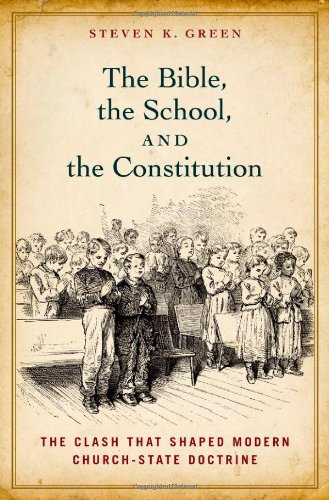
Happily, those interested in these questions now have a promising new book to help them muddle through the mishmash of Constitutional, cultural, educational, and devotional questions raised by this thorny issue.  At Religion & Politics, Michael Waggoner has offered a thoughtful review of Steven Green’s newish The Bible, the School, and the Constitution: The Clash That Shaped Modern Church-State Doctrine (New York: Oxford University Press, 2012).

Waggoner, a scholar of higher education at the University of Northern Iowa and editor of the academic journal Religion and Education, concludes that the most significant contribution of Green’s book is that it moves the discussion away from the 1960s and back to their proper arena: the 1860s.  As Waggoner notes,

“while many Americans believed in 1962—and continue to believe today—that the crisis over the proper relationship between religion and public education arose full blown in the chambers of the Supreme Court, in fact these changes were a century in the making.”

In Green’s telling, the significant struggle over the role of religion and public education took place in the second half of the 19th century.  The linchpin, Green argues in his third chapter, was not only the US Supreme Court’s 1962’s Engel and 1963’s Schempp rulings, but the Ohio Supreme Court’s 1870 Board of Education of Cincinnati v. Minor.*  In that case, the culmination of Cincinnati’s angry “Bible Wars,” the school board successfully defended its decision to remove the reading of the King James Bible from public schools.  The first plaintiffs, John D. Minor and a group of concerned citizens, complained that such a removal was illegal, impractical, and immoral.  One of their reasons was that “large numbers [of city school children] receive no religious instruction or knowledge of the Holy Bible, except that communicated as aforesaid in said schools.”

As Green argues, this case and the cultural controversies that accompanied it nationwide laid the groundwork for the Court decisions of the 1960s.  The “culture wars” of the 1860s and 70s demonstrated the nation’s growing unease with traditional Protestant domination of public life.  Minor’s argument that children would not learn about the Bible if not in public schools did not win over the justices of the Ohio Supreme Court.  Not only that, as Green details, activists who sought to marshal the forces of traditionalism soon realized they faced a fundamentally different political and cultural environment.  A coalition of Protestant ministers first proposed a “Christian Amendment.”  They hoped to answer Cincinnati’s anti-Bible ordinance with a change to the US Constitution clarifying the government’s role in promoting religion.  More successful was the Blaine Amendment.  Largely a move to isolate Catholic schools, Congressman James Blaine proposed an amendment that would clarify: public funds must never support religious schools.

Green’s book will not likely satisfy the critics who insist that God was kicked out of public schools in the 1960s.  But for those of us hoping to understand the long cultural conversation about the changing role of religion in the public square, Green’s book is a great new resource.

* A nerdy detail: as with “Schempp” and “Engel,” this case is usually incorrectly described as Minor v. Board of Education.  That was indeed the name of the original 1869 Cincinnati case that sought to get the Bible back into Cincinatti schools.  However, the Ohio Supreme Court case in 1870 was actually an appeal by the Board of Education against John Minor, thus Board of Education of Cincinnati v. Minor.

Required Reading: Growing Up Un-Absurd with The Sword of the Lord

How can we get along with fundamentalists if we don’t embrace fundamentalism?  More specifically, how can we tolerate religious people who will not tolerate others?

Many voluble ex-fundamentalists out there (see a few examples here and here) wrestle with this question.  Some are angry, some bemused, some both.

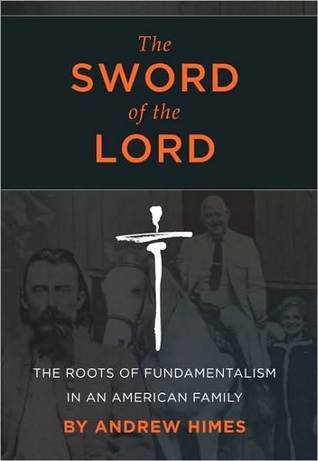
Andrew Himes’ Sword of the Lord: The Roots of Fundamentalism in an American Family (Seattle: Chiara Press, 2011),  offers a unique vision into the world of both fundamentalism and ex-fundamentalism.

Himes is the grandson of John R. Rice.  He was born in 1950 into one of the leading families of post-World War II fundamentalism.  The Reverend Rice led the branch of separatist, revival-based conservative Protestant evangelicalism, the branch that clung resolutely to the label ‘fundamentalist.’  In this sense, Himes’ meaning of ‘fundamentalism’ differs from the broader, cultural traditionalist definition we use at ILYBYGTH.

Himes broke bitterly with his family tradition in high school, but over the years, he came to embrace a more complicated relationship with his family’s vision of fundamentalism.  As Himes puts it, his grandfather remained “one of the kindest, funniest, and most honorable people I knew.”  But Rice also embraced “downright silly” notions of cultural separatism—no card playing, no movies, no short hair for women.  Even worse, Himes argues, his grandfather supported racial injustice in America and imperialist injustices in Southeast Asia. (5) The central dilemma for Himes is the same as it is for ILYBYGTH: How can we love someone whose ideas and policies seem so radically different from our own?

In his attempt to understand fundamentalism and his family, Himes tells the long story of evangelicalism in American history.  Indeed, those familiar with American religious history can safely skip the second and third parts of Himes’ tale.  Himes writes with an engaging style, weaving his own experiences into this long history.  However, his reliance on secondary sources leads him to make a few minor errors.  For instance, he repeats the story that John Scopes of the 1925 “monkey” trial had been teaching evolution for years, (179) when in fact Scopes had a very tenuous record of classroom teaching at all.  Also, Himes overstates the novelty of the Scopes trial in 1925. (180)  By that time, the notion of a media-grabbing “Trial of the Century” had been pioneered by the experiences of dramatic stories like Leopold and Loeb.  These are minor missteps in a tale that sweeps centuries of American history.  However, Himes’ book is also marred somewhat by a number of distracting typos and unclear footnotes.

These quibbles aside, Sword of the Lord is a great introduction to the world of separatist “Big-F” fundamentalism in the later twentieth century.  ILYBYGTH readers will likely appreciate several contributions of Himes’ work.

First of all, the intimate world of John R. Rice offers an eye-opening perspective into life in fundamentalist America.  To cite just one example, Himes tells the story of his childhood spent with colorful evangelists such as C.B. “Red” Smith and Apostle the Premillennial Horse.  This passage is so revealing I’ll quote it at length:

The summer after I turned 12 [c. 1962], C. B. “Red” Smith came to the Bill Rice Ranch and brought along Apostle the Premillennialist Horse.  On the first night of the camp meeting in the open-air tabernacle at the Ranch, Brother Smith himself stepped up to the pulpit and led the singing for the first gospel song.  He was a tall man with curly brown hair, a pink, whiskerless face, and laugh wrinkles around his eyes.  He tilted back his head on the high notes and pointed his chin down at the floor on the low notes, and held back nothing.

            “When we ALLLL get to heaven,” sang Brother Smith, “what a DAY of rejoicing that will BE!  When we ALLLLL see Jesus, we’ll SING and SHOUT the victorEEEEE!”. . .

            “We’ve got a guest speaker in the house tonight,” said Brother Smith with a big grin that showed off a gold-capped tooth.  “He’s a good friend of mine, and he’s come all the way from Jonesboro, Arkansas.” . . .

“Please allow me to introduce Apostle the Premillennialist Horse,” said Brother Smith with a twinkle in his eye.  “Apostle, say hello to all the folks out here.” . . .

            “All right now, Apostle,” said Brother Smith, “what’s our chapter and verse for tonight?”

            Apostle tossed his head, then picked up his right forefoot and stomped deliberately, four times in a row. . . . Apostle shook his head, cocked his ears as if considering, then began stomping his foot again, with Brother Smith counting right along with him: “One, two, three . . . fourteen, fifteen sixteen! Amen!  So that’s Thessalonians chapter four, verse sixteen, is it Apostle?” . . .

            My great-uncle Bill Rice stepped up to the pulpit, waved to the woman seated at the piano, and launched into a spirited rendition of an old revival favorite: “Give me that old-time religion, give me that old-time religion, give me that old-time religion, it’s good enough for me!”

In addition to this kind of illuminating vignette of life growing up in a fundamentalist family, Himes also illustrates the difficulties of changing cultural identities.  For Himes, rejecting fundamentalism meant more than an intellectual decision.  It was more than a theological awakening.  He remembers spending teenaged hours “staring at the animals in the Racine [Wisconsin] Zoo behind rusting iron bars in their drab concrete cages.  I woke in the early morning hours crying piteously, half-remembering the fragments of a dream in which lost souls were dying and God was among the missing.”  (141)

In his youth, Himes swung to the opposite cultural pole, embracing Maoism and leftist radicalism.  In the end, he concluded that he had only “traded in one form of fundamentalism for another, equally rigid, dogmatic, and wrongheaded.” (294)  As a teenager, though, Himes’ transformation pushed him into a “deep pit of self-righteousness and suicidal despair.” (266)

Finally, Himes’ book offers a sympathetic yet critical biography of Himes’ grandfather John R. Rice.  Himes implies that Rice’s doctrinal rigidity may have been a result of his hardscrabble origins.  After all, a childhood spent motherless, left alone to tend for stock animals every year at Christmas, might have led to what Himes calls Rice’s childhood “fear of death and hell—an unsaved boy confronting the terrors of solitude and unknown dangers in a little house under the arc of the great Texas skies.” (105)  That kind of analysis may make sense in Rice’s case, but it doesn’t help us understand the strength and durability of separatist fundamentalism in America.  After all, many ardent fundamentalists had no such childhood, yet they embrace a strict doctrinal orthodoxy.

Childhood trauma aside, Himes offers a fascinating glimpse into his grandfather’s intellectual world.  For instance, Rice was a relative moderate on issues such as race.  In Rice’s time and place, that meant an eventual disavowal of the vigilantism of the Ku Klux Klan.  It meant an insistence that God created all people equally.  But it did not include an embrace of social equality or of the Civil Rights Movement.  As Himes describes, Rice condemned the grisly murder of Emmett Till as a result of interfering activist African Americans. (258)

Rice was also a firm cultural traditionalist, insisting consistently on traditional family life, aggressive anti-communist foreign policies, and anti-abortion activism.  Finally, Himes chronicles the many splits and dissensions among conservative evangelical Protestants.  Rice eventually broke with Billy Graham over Graham’s ecumenism.  Later, Bob Jones Jr. broke with Rice for Rice’s willingness to be yoked with non-fundamentalists.

Those hoping to get the flavor of life in this fundamentalist subculture would do well to read Himes’ book.  By the time of his writing, Himes had overcome much of his bitterness against his grandfather’s faith.  Himes succeeds in his effort to paint a loving portrait without endorsing his grandfather’s ideas.

Required Reading: Shields and the Civility of the New Right

Another reason to spend time at Mere Orthodoxy: Matthew Lee Anderson today shares his interview with Jon Shields.  Shields is the author of The Democratic Virtues of the Christian Right.  Even if you don’t have time to spend with the whole book, it is worth taking a few minutes to read this interview. 

Shields elaborates on the thesis of his book, viz., that the incivility of the Christian Right has been overplayed by journalists looking for a good story.  Using interviews and a participant-observer method, Shields found that such headline-grabbing fury did not fairly represent the movement.  As Shields notes in this interview,

If one looks at Christian radio personalities or at direct mailings or at fringe organizations, belligerency is quite common. The media picks up on these latter examples partly because they are somewhat more visible, partly because they make for more interesting stories, and partly because of the sociology of the newsroom itself. So the media has identified real incivility in the Christian Right.

Of course, such distortion takes place all over the political and theological spectrum.  In my research into the history of conservative educational activism, I find that conservative writers and pundits also relied on the tactic of the hyperbolic example.  For example, the early Soviet-friendly statements of John Dewey or George Counts are often used by conservatives to demonstrate that all of progressive education is nothing but a communist plot. 

It seems to return us to the central dilemma of America’s ballyhooed culture wars.  Even though most people–even people politically, culturally, and theologically committed on issues such as abortion or gay rights–prefer to act in civil, “small-d” democratic ways, the fevered punditry of voices on each side dominate the headlines.  One religion-bashing quip by Richard Dawkins, or one minority-bashing pronouncement by Glenn Beck, does more to define the two sides than thousands of people working quietly and politely to promote their vision of America.


It’s Hard to Get the Right Right!

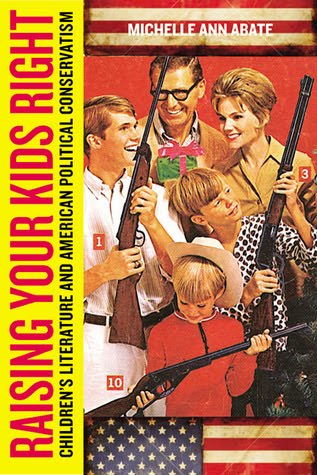
Fellow nerds: Have you ever had this kind of deflating experience?  You see a new book title that promises to answer a bunch of questions that have been rattling around in your head unorganized and unarticulated.  You finally get your hands on the book and eagerly start reading, only to find that the author does not seem very interested in the very interesting questions that you wanted her to answer.  That was my experience with Michelle Abate’s Raising Your Kids Right.

Now Cam Scribner has published a review on the US Intellectual History Blog of Abate’s book that manages to put my geekmotional response into coherent prose.  Scribner is working on an important study of conservative educational activism.  He is someone who works hard to understand what it meant to be “conservative” in America.  And, as Scribner notes, Abate fails to get the Right right.  In Scribner’s words:

First, despite providing a pretty cogent history of right-wing politics since the 1960s, Abate uses the word “conservative” far too broadly. For her, in fact, it seems interchangeable with the words “histrionic,” “retrograde,” and “racist” (pgs. 35, 37, 180-181).

I know it’s not fair to criticize someone for the book they didn’t write.  But in this case, I agree with Scribner.  If one is to dig into the rich field of conservative children’s literature, there are a few things that one must consider.  Quoth Scribner:

Rather than capturing conservative writing at its smallest, Abate could have written a much more meaningful book about what conservatives actually think will interest or ennoble their children. Prefacing her discussion of The Book of Virtues, for example, with selections from C.S. Lewis, Pilgrim’s Progress, McGuffey’s Readers, or other conservative favorites would accrue more historical weight to her argument and preclude the sort of caricature and dismissal that seems to underlie much of her analysis.

The good news for historians, I suppose, is that there is still plenty of room for studies of conservatism and children’s issues, including children’s books.