Science and “The Question”

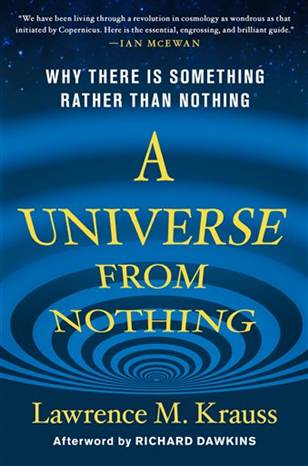
In a recent scathing review of Lawrence Krauss’ A Universe from Nothing, science writer John Horgan argues that science will never answer “The Question.”  That is, Horgan thinks that science–the way we usually understand science–will not be able to explain why there is something rather than nothing.

For those following the creation/evolution debates, “the Question” has long been a central bone of contention between creationists and evolutionists.  Creationists have always rested their arguments on the notion that science could not explain the fundamental creation of life ex nihilo.

As Horgan insists, one does not have to be a fundamentalist anti-evolutionist to doubt the ability of science to answer such fundamental questions.  In fact, Horgan concludes his review by warning scientists that they must not overextend.  If mainstream scientists claim to be able to answer “The Question,” Horgan warns, “they become the mirror images of the religious fundamentalists they despise.”

I imagine many of those fundamentalists will take solace from the fact that prominent scientists dispute Krauss’ ex nihilo argument.  There is a vibrant tradition among anti-evolutionists of following evolution debates among scientists.  Anti-evolution writers and activists have always used such debates to demonstrate to their audiences that scientists do not agree on the science of evolution.  As Ronald L. Numbers demonstrated in Darwin Comes to America and The Creationists, anti-evolutionists have long celebrated disagreements among mainstream scientists.  My hunch is that some pundits from Fundamentalist America will cite anti-Krauss arguments as evidence that science will never be able to answer “The Question.”

The Bible in America: How the Bible Works

A lot of people don’t get it.  Why does it matter so much in Fundamentalist America what the Bible says?  After all, the Bible, for a lot of people, is just one collection of ancient writings.  Richard Dawkins concluded his Blind Watchmaker, for example, by calling “the Genesis story . . . just the one that happened to have been adopted by one particular tribe of Middle Eastern herders.”  Dawkins has not been the first to make such accusations.  In the 1920s, sociologist Harry E. Barnes derided the Bible as merely “the product of the folkways and mores of the primitive Hebrews. . . and the personal views of religious reformers of all grades from Jesus to Paul.”  It doesn’t make sense to non-fundamentalists to base social policy or even personal ethics on this collection of cranky commandments from ancient sheep-herders.  Deuteronomy just doesn’t fit with today’s lifestyle, some think.
Those hoping to make some sense of the ways Fundamentalist America understands the Bible should take some time with a newish book, Brian Malley’s How the Bible Works.   It is not an attack or expose of fundamentalist foibles.  Rather, it is an ethnographic study of one evangelical community, “Creekside Baptist.”  It is a thoughtful and deeply sympathetic attempt to understand what one group of conservative evangelical Protestants mean when they say “Bible.”  Malley himself is the product of a conservative evangelical Protestant upbringing.  ILYBYGTH readers will likely appreciate his perspective.  He is not out to demonize or lionize the folks he studies.  Rather, he conducted a series of interviews and probed the complicated questions lying at the heart of many conservative Protestants about the Bible and their faith.

In the first section of the book, Malley asks his informants to help him understand labels.  Perhaps most interesting for ILYBYGTH readers, he asks then to explain how they felt about “fundamentalist.”  Here is a taste of some responses:

“the word has gotten such a bad rap, but yes [I consider myself fundamentalist.]  Not in the sense that you hear in the news.  Basically I view those words as being interchangeable—evangelical and fundamentalist.”

Several interviewees said they felt fundamentalist, but that the term had a negative connotation.  For example, in the words of one “middle-aged man”:

“That [‘fundamentalist’] has a more negative connotation to me.  I think of it as a person.  ‘Fundamentalist’ to me today means more of a judging person that has a whole series of rules that they follow and I don’t think that’s right.  I’m not on the other end of the spectrum either, a wild liberal person either.  I guess I don’t live primarily by rules but by principles.  The principles come from the Bible.  But I don’t see myself as what I hear people describing fundamentalist as today.”

Another interviewee, “Stan,” said,

“I don’t like the term because of the connotations that it has.”

            Brian: “Which ones specifically?”

            Stan: “Connotations being I think that if you said that in this country, a fundamentalist would be considered kind of a far-right-wing wacko, and is a way extreme almost to the point of being non-Christian, something other than Christian.  Probably in its true identity, the definition of the word is you believe the fundamentals of Christianity, the basics of Christianity, that term would apply.  But that definition doesn’t apply anymore in this country.”

One young man, “Todd,” offered this explanation:

“Again, ‘fundamentalist’ is another term which I fear has been misunderstood and caricatured and stereotyped widely across modern American culture.  I’m not really familiar with what I consider properly called ‘fundamentalist culture.’  I know a bit of fundamentalist theology, but . . . I think properly understood, especially if you look at historical roots of fundamentalism, it gets down to what are fundamentals of the faith, and I think most fundamentalists and I agree what the fundamentals of the faith are, if you boil it down.”

For these conservative evangelical Protestants, “fundamentalism” had attracted a cluster of unfair meanings.  They generally agreed with what they understood to be fundamentalist theology, but they felt that fundamentalism as a whole had come to include all sorts of other meanings.

But Malley’s main interest in in the ways his respondents felt about the Bible.  Evangelicals, Malley argues, create a many-layered meaning around “Bible.”  One important part of this is what Malley calls “artifactual knowledge.”  Evangelicals know the Bible as a physical thing, a certain kind of book.  As he describes, this kind of knowledge is encouraged among evangelicals.  In the very youngest of children’s groups at Creekside Baptist, two-year-olds are taught to hold a Bible while they sing song such as “Pat the Bible” (to the tune of Did You Ever See a Lassie, or Wheels on the Bus, or Here We Go Round the Mulberry Bush, etc.).  In the words of one teacher of this two-year-old class, the youngsters should learn that the Bible is a special kind of book.  It is something to be cherished and valued.  It is not something to be treated like other books.

Another fascinating point Malley makes is that his respondents don’t think of the Bible as a certain translation of the original documents.  He held up two versions in some of his interviews, one in Greek and one in English.  He asked his interviewees which one they thought was “the” Bible.  Not only did the folks he talked with say they were both equally “Bible,” they thought the very question was nonsensical.  In other words, for this community at least, “The Bible” does not refer only to one specific translation.  Rather, it is understood to be a collection of texts that has been and will continue to be understood in a variety of languages, in a variety of translations.  Not only that, but folks at Creekside Baptist all agreed that the Bible did not actually have to be a printed book at all.  It could be put onto a website or CD.  It could be printed on enormous sheets or in a tiny pocket edition.  But it could NOT be made into a movie.  Movies could be made ABOUT the Bible, but they would not be the Bible itself.  The Bible was print, but it could be print in a variety of formats, languages, and translations.  As long as the text stayed true to the original meanings, any sort of text could be used to create an authentic Bible.

Malley also argues that his respondents have an interpretive Bible tradition, but not a hermeneutic one.  That is, evangelicals define their intellectual and theological world in large part as an interpretation of Biblical texts.  Scholarship and intellectualism mean, in large part, engaging in interpretation and citation of Biblical texts.  This results in the Bible-centered talk that non-evangelicals often find so baffling.  For example, evangelicals will explain their political opinions on topics such as gay marriage by offering Bible citations.  To evangelicals, those citations act as strong intellectual arguments.  If one can back up opinions on any topic with proper citations, one can carry the argument.  But evangelicals are not trained—outside of academic theologians—to engage in hermeneutic acts with and about their Bibles.  That is, Malley’s respondents did not feel a need to apply special interpretive skills to reading their Bibles.  Respondents consistently referred to reading their Bibles not as an act that required intellectual training, but as an act that required devotion.  The challenge was not to learn a set of keys to make sense of the Bible, but rather to learn an attitude toward reading.

Another topic Malley tangles with is the complex meanings of “literalism.”  Some folks outside of conservative Protestant circles misunderstand the notion of a literal interpretation of the Bible.  For Malley’s informants, as for most conservative Protestants, “literalism” does not mean that every word of the Bible must be taken as the literal truth.  In some places, the Bible clearly speaks figuratively, as when Jesus tells his audience they are the salt of the earth.  For Malley’s informants, the important aspect of literalism is a reading of the Bible that gives authority to the Bible itself.  Instead of taking freedom to interpret passages in ways that make the most sense to readers, the Bible must be read in ways that make the most sense in the context of the Bible itself.  Literalism, in this understanding, is more about authority than anything else.  If a passage was intended to be literal, it must be taken that way, even if that seems to contradict with the reader’s experience or desire.  Generally, when the Bible does not mean for itself to be taken literally, as in Jesus’ parables, it makes that abundantly clear.  Readers do not have the right to assume it is speaking symbolically when it does not clearly say that itself.

Malley points out that there are several layers of Biblical interpretation active at the same time in the evangelical world, broadly considered.  Among evangelical scholars, questions of authority and interpretation receive intense scrutiny.  But among the folks he talked to, there was much wider latitude for traditional, passed-along understandings of “Bible” and its meanings.  As Malley argues, “The evangelical tradition solves this problem by maintaining fairly rigorous standards of exegesis in its scholarship and quietly ignoring those standards in the churches.”

So, for example, Malley’s informants at Creekside Baptist could confidently assure Malley that the Bible was authoritative, even if they could not clearly explain what they meant by that when Malley pressed them.  As one way of testing this principle, Malley pressed people to explain why they regarded only some parts of the Bible as authoritative.  He asked, for example, what respondents thought about passages such as Romans 16:116, repeated in 1 Corinthians 16:20, 2 Corinthians 13:12, and 1 Thessalonians 5:26, in which Christians are instructed to “greet one another with a holy kiss.”  Malley interviewees acknowledged that the instruction was in the Bible.  They agreed that the Bible was authoritative.  And they acknowledged that they did not follow that particular instruction.  When pressed to explain the contradiction, respondents argued that such passages were “cultural” commands, meant to apply to people at the time, but not to them.  Or respondents shrugged.  The important point is that Biblical Christians did not feel this kind of apparent contradiction challenged the authority of the Bible, or their justification in considering the Bible authoritative in their lives.

For those living outside of the tradition of evangelical Protestantism, such apparent paradoxes can seem like proof that a Biblical worldview is non-sensical.  Malley doesn’t try to make that leap.  Rather, he is more interested in understanding and explaining how his respondents themselves understand this seeming contradiction.  He is more interested in exploring the fact that it does not appear to be much of a contradiction at all to them.

If outsiders hope to understand Fundamentalist America, this kind of intellectual stretching will help.  Malley’s study of one evangelical community can’t be taken to speak for all conservative Protestants, much less for the broad conservative coalition that makes up Fundamentalist America.  But his book is a good place for outsiders to start.  It will help people from outside the tradition make sense of the many meanings of “Bible” in Fundamentalist America.

FURTHER READING: Harry Elmer Barnes, “Sociology and Ethics: A Genetic View of the Theory of Conduct,” The Journal of Social Forces, III (January, 1925): 214; Brian Malley, How the Bible Works: An Anthropological Study of Evangelical Biblicism (Walnut Creek, CA: Altamira Press, 2004).

Bible in America: RAH interview with Robert Alter

Fundamentalists don’t always make the best historians.  American fundamentalists tend to insist on an American past that is far too rosy.  When she was still an up-and-coming Presidential nomination contender, for example, Michele Bachmann insisted that the Founding Fathers had “worked tirelessly” to end slavery.   Though she later tacked away from her statement, noting that she meant John Quincy Adams, it doesn’t take a slanted leftist historical perspective to notice that her claim is just not true.  The Founding Fathers may have accomplished a good deal.  Some of them may even have tried to improve the conditions of slaves, or to hurry the day when human chattel slavery would be abolished.  But overall, the issue of slavery was one that the Founders explicitly pushed off on a later generation.

However, as we’ve noted here in the past, one of the historical claims of fundamentalists in America lines up more neatly with the findings of non-fundamentalist academics.  On the Religion in American History blog, Randall Stephens recently interviewed scholar Robert Alter about his newish book, Pen of Iron: American Prose and the King James Bible.

Alter’s book is focused on the ways Biblical themes and language infuse American literature and culture.  In the RAH interview, he makes the point that American culture in the past was thoroughly Biblicized:

“In nineteenth-century Protestant America, the Bible, almost always in the King James Version, was a constant companion for most people. They not only heard it in church, but very often it was regularly read out loud in the family circle at home.”

Fundamentalists often make the case that America is and should remain a Christian, Biblical society.  They insist on a vision of American history in which early European settlers and Founding Fathers planned to create a Christian Nation.  (For the leading example of these kinds of arguments, check out David Barton’s Wallbuilders articles.)

Academic historians have noted that these historical claims must be treated carefully.  John Fea, for instance, has argued that there was indeed a good deal of Christian intent among the founding generation, but this is often used by activists in unfair and ahistoric ways.

However, it is only fair to notice that in some cases, the vision of the past promoted by fundamentalist activists lines up neatly with that of non-fundamentalist scholars.  According to Robert Alter, at least, American culture in the past really was thoroughly infused with the KJV Bible.


Required Reading: Are we all bigots now? Haidt’s Righteous Mind

Fundamentalists get called bigots a lot.  They don’t like it.  Since the 1920s, they have spent a lot of mental time and energy proving that they are, in fact, the side of openminded scientific inquiry.  For example, in the early 1920s fundamentalist intellectual Alfred Fairhurst complained that the teaching of evolution served mainly to close student minds.  “I am sure,” Fairhurst complained,

“that the teachers who would teach the subject are not fully prepared to present both sides as should be done when taught.  I believe that the teaching of evolution is mostly dogmatic, and that the result of teaching it is a new crop of dogmatists.  I am aware that there are those who hold that the subject of evolution greatly expands the mind.  I think that, as taught, it warps the mind and closes it against much truth.”

Generations later, in 1995, Duane Gish agreed that excluding creation science from public schools was nothing but “bigotry.”

Like the creationist activist Duane Gish, fundamentalists like to call their secular and liberal foes the true bigots.  As we have explored here at ILYBYGTH, fundamentalist activists such Bradley Johnson press the limits of fundamentalist free speech.  They provoke repression of their public religiosity in order to highlight the masked bigotry of hypocritical liberals.  Traditionalists point to foundational lefty intellectuals such as Herbert Marcuse as creeping totalitarians.  Marcuse and his minions, fundamentalists assert, are the ones who will not tolerate any disagreement.

I’m no fundamentalist, but I’ve seen this kind of anti-fundamentalist bigotry in action.  My academic research focuses on the history of fundamentalism.  While giving talks or discussing my research, I’ve often been surprised by both the viciousness and the ingenuousness of anti-fundamentalist bigotry.  I once had a very intelligent, well educated college student ask me how long it would take before religious people realized that religion was only for weak, ignorant people.  A colleague asked me once, regarding fundamentalists, “What’s wrong with these people?”  Another academic acquaintance suggested that the cure to the creation/evolution debate would be to “round up all the crazy white people” and force them to go through a rigorous de-theization education.  I like to think this last person was joking, but her comment elicited raucous cheers in the conference room.  All of these comments, fundamentalists would say with some justification, would never be tolerated about any other cultural group in our society.  Perhaps most egregious, the people making these comments tend to be almost entirely ignorant about fundamentalism.  They form their opinions based on vague stereotypes and in-group thinking, the very definition of bigotry.

So I sympathize with fundamentalist claims.  But I do agree there are limits.  I agree that fundamentalists often make these claims of victimization in order to promote a false moral equivalence between cultural sides.  For example, if we acknowledge the cultural legitimacy of creation science, do we give in to a strategic desire to muddle the issues in mainstream science and evolution?  (For an example of this debate, see the discussion at the US Intellectual History blog about the legitimacy of ILBYGTH’s fundamentalist-friendly forum.)

A new book casts a pox on all houses.  Psychologist Jonathan Haidt argues that most Americans decide first and come up with reasons later.  In The Righteous Mind: Why Good People Are Divided by Politics and Religion, Haidt describes his conclusions from over 130,000 online morality tests he and his colleagues delivered.  Their website, YourMorals.org, asks people an array of moral questions, from the mundane (Should teenagers listen to their parents’ advice?) to the bizarre (Is it morally acceptable to have sex with a dead chicken?).  For most people, Haidt argues, the moral answer is intuitive, not rational.  We do not start with principles and deduce the proper response.  Rather, we answer first and come up with justifications later.

If the nature of bigotry is to cling to irrational ideas demanded by ingroups and cultural cliques, then, according to Haidt, we’re all bigots now.  The moral answers we insist upon derive more from “groupishness” than from reason.

Not that both sides of America’s “culture wars” do everything the same way.  Haidt and his colleagues parsed morality into six fundamental notions: care, fairness, liberty, loyalty, authority, and sanctity.  Most Americans are deeply moved by the first three of these.  Liberals, however, tend to “care” more.  Conservatives tend to be more concerned with “fairness.”  According to Haidt—who self-identifies as a recovering partisan liberal—American conservatives do a better job with loyalty, authority, and sanctity.  Haidt disputes the notion that conservatives somehow trick voters into voting against their economic interests.  Rather, Haidt thinks conservatives simply do better at speaking to all six of the fundamental moral notions people really care about.

The most compelling part of Haidt’s book, for ILYBYGTH readers, is his conclusion about the closedmindedness of liberal America.  Haidt conducted a survey of 2,000 Americans, asking them to predict the moral choices of those with whom they disagree.  Self-identified “liberals” fared the worst at this game.  That is, respondents who called themselves “very liberal” ended up being the worst able to guess what fundamentalists cared about.  For outsiders—non-fundamentalists—who are trying to understand Fundamentalist America, this must serve as a sobering warning.  Simply because the worldview of liberal America treasures such notions as inclusiveness, tolerance, openmindedness, and rationality, doesn’t mean that we naturally apply such notions to fundamentalist ideas.  Rather, liberals—at least in Haidt’s research—tend to be the least able to understand where their cultural rivals are coming from.

Haidt hopes that true humility about the bigotry of our own moral impulses might lead to a softening of America’s culture wars.  He argues that one way to overcome our “groupishness” is to spend time engaged with the moral understandings of those with whom we disagree.  He has established one web forum to do just that.  At civilpolitics.org, he and his colleagues have listed ways to help Americans of different moral backgrounds to work together more calmly and productively.

Such anti-bigotry is the goal of ILYBTGTH as well.  Acknowledging the pre-rational roots of our strong moral feelings does not mean simply throwing up our hands and embracing moral relativity.  But making an honest effort to understand someone else’s moral universe can’t help but move us along the spectrum to a moral society we can all live with.


Required Reading: Louis Menand and the Left-Leaning Ivory Tower

Louis Menand,  The Marketplace of Ideas: Reform and Resistance in the
American University.
  New York:  W.W. Norton, 2010.

Fundamentalists have long argued that America’s colleges and universities had been captured by a sinister left wing.  Now they have some evidence to back up their complaints.

Most often, those accusations branded mainstream American univeristies as hopelessly lost to pernicious non-fundamentalist ideas.  For example, Texas fundamentalist minister J. Frank Norris insisted in 1921 that the problem with America all started when some influential young Americans studied “in Chicago University where they got the forty-second echo of some beer-guzzling German Professor of Rationalism.”

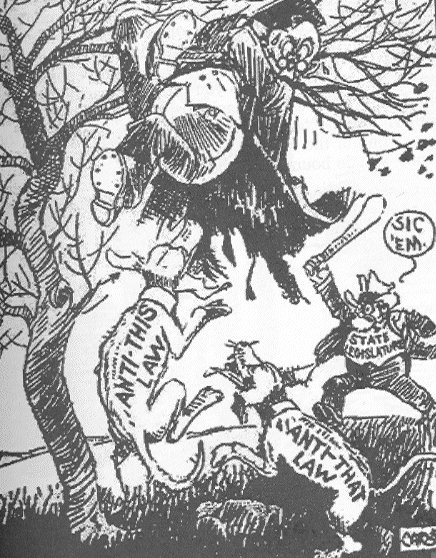
This hostility among fundamentalists toward the professoriate was noted by one cartoonist in the Wall Street Journal around the time of the Scopes Trial in 1925.  In this cartoon, hillbilly fundamentalists sic their legislative dogs on a hapless professor.

In the run-up to that Scopes Trial, the greatest fundamentalist scientist of the 1920s, George McCready Price, informed William Jennings Bryan confidentially that evolutionists had fallen prey to a debilitating group-think.  Because they only listened to one another, Price insisted, such evolutionists had become “out of date,–behind the times,–and don’t know it.”

This outright hostility toward the academic classes continued throughout the twentieth century.  For instance, one pamphlet from the American Legion in 1930 warned that too many college professors saw their jobs as indoctrinating each new generation of young, impressionable minds.  In this author’s opinion, college professors did not try to authentically educate their students, but only saw their jobs as a chance to make new “teachers of communism and atheism out of them.”

In the early 1960s, conservative California State Superintendent of Education Max Rafferty found the main culprit of America’s decline in the progressive, leftist orthodoxy promulgated in America’s institutions of higher education.  Rafferty insisted that colleges had created a new landscape of “temples . . . great universities which marble the land.”  These temples no longer pursued true intellectual endeavor, Rafferty claimed, but only passed along a deadened orthodoxy, “turning out swarms of neophytes each year to preach the gospel of Group Adaptation.  Their secret crypts and inner sanctums are the graduate schools.”

More recently, fundamentalist blockbuster author Tim LaHaye agreed.  In the twenty-first century, LaHaye believed, university faculties had placed themselves hopelessly in thrall to the false idols of the cultural Left.  After his huge publishing success with the Left Behind series, LaHaye set out to create a new biblical hero.  In Babylon Rising (2003), LaHaye described the adventures of biblical archeologist Michael Murphy.  In Murphy, LaHaye hoped to create a “true hero for our times,” one who united unwavering biblical faith with scholarly acumen and a dose of two-fisted machismo.  In one telling scene, Murphy is confronted by his smarmy secular dean.  This little episode tells us a lot about continuing fundamentalist attitudes toward the professoriate.

“Hold it, Murphy!”

A bony hand grabbed Murphy by his backpack as he left the hall. “Dean Fallworth.  What a fine example you set for the students by monitoring my lecture.”

“Can it, Professor Murphy.”  Fallworth was as tall as Murphy but cursed with a library-stack pallor that would make some mummies look healthy by comparison.  “You call that a lecture?  I call it a disgrace.  Why, the only thing separating you from a Sunday tent preacher is the fact that you didn’t pass the plate for a collection.”
“I will gratefully accept any donation you wish to make, Dean.  Did you need a syllabus, by the way?”

“No, Mr. Murphy, I have everything I need to get the university board to begin accreditation hearings for this evangelical clambake you’re calling a class.”

“Temper,” Murphy mumbled to himself.  “Dean, if you feel my work is unprofessional in any way, then please help me to improve my teaching skills, but if you want to bash Christians, I don’t have to stand here for that.”

“Do you know what they’re already calling this silly circus around the campus?  Bible for Bubbleheads, Jesus for Jocks, and the Gut from Galilee.”

Murphy couldn’t help but laugh.  “I like that last one.  I’m intending this to be a quite intellectually stimulating course, Dean, but I confess I did not post an I.Q. requirement for taking it.  The knowledge will be there, I promise you, but I will likely fall short of your apparent requirement that the only acceptable instructional method is to bore your students to an early ossuary.”

“Mark my words, Murphy.  Your hopes of this course surviving and your hopes of tenure at this university are as dead as whatever was in that bone box of yours.”

“Ossuary, Dean.  Ossuary.  We’re at a university, let’s try to use multisyllabic words.  If it doesn’t turn out to be legitimate, maybe I can get it for you cheap and you can keep your buttons in it.  Now, if you’ll excuse me, I have a new artifact to begin work on.”

In this vision of the world of higher education, only fundamentalists have remained true to the original mission.  Fundamentalist intellectuals, this line of reasoning goes, have retained their sense of inquiry and intellectual honesty.  They have not been seduced by the showy appeals of false science, such as evolution.  They have not been lulled by a peaceful-sounding pluralism that in practice degrades human dignity.  And they have not been willing to accept the hidebound leftist, secularist, evolutionist orthodoxy required of the mainstream academic.

This trope has remained so ubiquitous among fundamentalist activists that is tempting to dismiss it as sour grapes.  In this sour-grapes line of thinking, fundamentalists attack the intellectual pretensions of college professors since those professors show universal disdain for the Biblical belief of fundamentalists.  Fundamentalist attacks, this argument goes, actually prove the intelligence and perspicacity of college professors.

Louis Menand’s new book suggests otherwise.  Menand, best known for his Pulitzer-Prize-winning Metaphysical Club, now takes aim at the sclerotic intellectual culture of American higher education.  Menand is no fundamentalist.  Nor does he have an axe to grind against the left-leaning cultural politics of today’s universities.  However, he does agree with fundamentalist critics that the professoriate encourages group thinking and intellectual conformity rather than innovative ideas and iconoclasm.

Unlike fundamentalist critics of higher education, Menand does not blame evolution, socialism, or secularism for this state of affairs.  Rather, Menand’s critique is more prosaic.  In order to become a tenure-track professor in the humanities, Menand points out, aspiring professors must endure years, even decades, of powerless apprenticeship.  Those who survive this ordeal do so not by bucking the intellectual party line but rather by honing their ability to locate and placate the institutionally powerful.

In Menand’s view, this leads to a dangerous state of affairs in which “The academic profession is not reproducing itself so much as cloning itself” (153).  Until and unless research universities find a new way to train the next generations of faculty, Menand frets, the trend toward intellectual conformity will accelerate.  [UPDATE: For a full review of Menand’s book, be sure to check out the H-Education list review commissioned by Jon Anuik:  https://www.h-net.org/reviews/showrev.php?id=33892 Thanks, Jon, for this notice.  –Editor]

Fundamentalists won’t be surprised.  For generations they have dismissed the protestations of the kept intellectuals at America’s universities.  Menand’s book should serve to give them support from outside their own ranks for their deeply held distrust of pointy-headed professors.

IN THE NEWS: Fea, Worthen, Santorum, and Civil Discourse

Three cheers for John Fea!  Fea is an American historian and blogger.  I’m a big of both his academic writing and his history-themed blog.

Fea recently criticized a piece in the New York Times about Rick Santorum’s mix of religion and politics.  The author, Molly Worthen, marred an otherwise insightful article about Santorum with some unnecessary derogatory comments about Santorum’s religious tradition.

Instead of summarizing any more, I’ll just include a slice of Fea’s conclusion here:

Let me be clear.  This post is not meant as an endorsement or rejection of Santorum’s beliefs or his candidacy. (I voted for Bob Casey Jr. in the 2006 Pennsylvania senatorial race).  It is rather written out of frustration over the way Santorum’s views are so easily dismissed, as if they are not worthy of being engaged in civil discourse or the public square. I wish Worthen would have done one of two things in this piece:
1.  Simply describe, without the gratuitous swipes, the Catholic natural law tradition that informs Santorum’s conservatism.  She is a good historian and a perceptive political reporter.
OR
2.  Directly engage with Santorum’s ideas rather than just assume that he a crazy, prejudiced bigot because his understanding of moral life comes from Thomas Aquinas.

Hear hear!

REQUIRED READING: The Long March against Evolution

Michael Lienesch, In the Beginning: Fundamentalism, the Scopes Trial, and the Making of the Antievolution Movement (University of North Carolina Press, 2007).

Want to make a mainstream scientist apoplectic?  Remind him or her that about half of American adults agree with the notion that the earth was created in six literal days, at some point in the past 10,000 years or so.  This idea is so utterly at odds with mainstream scientific understanding that it remains beyond the understanding of most of the other half of American adults.

Readers of ILYBYGTH will likely agree that these notions go beyond any narrow definition of scientific thinking.  In order to understand the durable cultural divide between evolutionists and creationists, we need to understand both evolution and creation as much more than mere scientific ideas.

I recently had the pleasure to review a book that furthers this understanding.  The review described its merits for an audience of educational historians, but Michael Lienesch’s In the Beginning should be required reading for anyone interested in the nature of the creation/evolution struggle.  A political scientist, Lienesch uses social-movement theory to make sense of the ways creationism has thrived in an intellectually hostile environment.

Fundamentalists might hope that creationism’s success is due to its God-given truth.  Evolutionists might insist, on the contrary, that creationism has thrived in the same way as have meth labs and Twinkies—Americans love dumb things that are bad for them.

Lienesch’s analysis presents a calmer and more sensible answer.  Creationism is more than just a scientific idea, more than just a theology.  It is a social movement, with all the attendant complexity.  As such, the social-science literature on social movements can go a long way toward making sense of the twentieth-century career of creationism.

Lienesch remains agnostic on the question of ultimate truth.  He is not much interested in the truth claims of either evolution or creation.  Rather, he explores the ways creationism—and I’m afraid it is the best word here—has evolved across the course of the twentieth century.

Required Reading: Plantinga, Where the Conflict Really Lies

Required Reading: Alvin Plantinga, Where the Conflict Really Lies: Science, Religion, and Naturalism (New York: Oxford University Press, 2011).

For a quick preview of the book, see John Wilson’s interview with Plantinga in Christianity Today.

In this interview, Plantinga’s quiet insistence on the compatibility of Biblical Christianity with human evolution raises once more the old question: Do the LOUDEST people insist on the fact that evolution and biblical religion are incompatible, while the SMARTEST people find  lots of room for the two to agree?

As Plantinga puts it:

There’s no real conflict, [between religion and evolution] even though conflict has been alleged by people on the Right as well as on the Left. Richard Dawkins, Daniel Dennett, and a host of others claim that there is outright conflict between evolutionary theory and belief in such a person as God, who has created and designed the living world. At the other end, there are Christian thinkers, too—like Phillip Johnson—who think there is irreconcilable conflict between the scientific theory of evolution and Christian belief.

There’s no doubt in my mind that Richard Dawkins and Phillip Johnson are both smart people and terrific polemicists.  But in his other works, Plantinga’s brand of careful consideration and his thorough, quiet, deliberative method have resonated with me in a much more profound way. When in doubt, it seems to be a fairly reliable guide that the person with the greatest certainty is usually not the most careful, most dispassionate seeker of truth.

As Plantinga says in this interview, “to argue for it [the relationship between evolution and naturalism] properly is quite complicated; it’s hard to do in a brief compass.”  So maybe the best thing for all of us to do is to quit talking so much about it, and start with a more careful reading of books like Plantinga’s new one.