
You might have trended before. I don’t think I have. I’m a little dizzy…
Does this mean I’ll need new outfits?
You might have trended before. I don’t think I have. I’m a little dizzy…
Does this mean I’ll need new outfits?
Posted by Adam Laats on March 13, 2018
https://iloveyoubutyouregoingtohell.org/2018/03/13/were-trending/
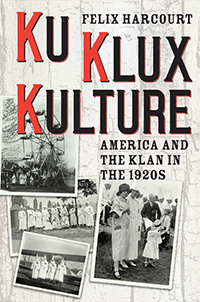
Is America a racist place? Like, fundamentally and deeply racist? When historians look around, they tend to say yes. But as a terrific new book about the 1920s Ku Klux Klan makes clear, saying that white racism has always been a central part of American culture is only the beginning. If we really want to understand white racism in America, we need to be prepared to wrestle with some complicated and uncomfortable facts.
Required reading…
We can see the dilemma everywhere we look these days. White nationalism seems to be thriving, as we saw in the 2016 presidential elections. We also see it all over today’s college campuses. And—as I argued recently in Religion Dispatches—we find it in places we might not expect, such as evangelical colleges and universities.
But white nationalism is only part of the story. These days, every triumph of Trumpishness is also a catalyst for anti-Trump activism.
This paradox at the heart of American identity is made disturbingly clear in a wonderful new book by Felix Harcourt. Harcourt examines the impact of the 1920s Ku Klux Klan on the wider American culture of the 1920s. I’ve spent my share of time studying the 1920s Klan—it was a big part of my book about the history of educational conservatism.
Harcourt’s book raises new and intriguing ways to understand the everyday bigotry associated with the Klan of the 1920s. When most of us imagine the Ku Klux Klan, we think of the much smaller, much different Civil-Rights-era group. In the 1950s and 1960s, the Klan had been reduced to small clusters of southern hillbillies lashing together dynamite bombs and informing for the FBI.
The 1920s Klan wasn’t like that. Some of the symbols were the same, such as the fiery cross, the infamous hood, and the night-rider imagery. In the 1920s, though, membership in the Klan boomed into the millions. Instead of hunkering down in barns and basements, the 1920s Klan seized Main Street with lavish parades and open celebrations of “100% Americanism.” The organizations briefly ran the government of states such as Indiana and Oregon. Its main bugbear was not voting rights for African Americans, but rather infiltration by Catholics and other sorts of immigrants.
Not that the 1920s Klan wasn’t fiercely controversial. It was. Even as it attracted endless criticism, however, it also attracted millions of members, each coughing up ten dollars for required accoutrements and registration forms.
Professor Harcourt does the best job any historian has done yet of capturing this American paradox. He examines the way the Klan presented itself in newspapers, books, and other media. He also looks at the ways outsiders unwittingly helped drive membership by attacking the Klan. As Harcourt makes abundantly clear, the real lesson of the 1920s Klan lies in its everyday radicalism, in the way its members thought of the Klan as a muscle-bound Rotary Club, another expression of their Main-Street claim to white Protestant supremacy.
For example, journalists in Columbus, Georgia took great personal and professional risks to confront their local Klan. They went undercover to expose their governor as a Klan stooge. The upshot? Their newspaper won a Pulitzer Prize for brave investigative journalism but the outed governor won a landslide re-election.
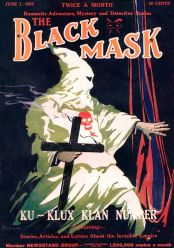
Beyond electoral politics, the 1920s Klan made a huge impact on popular culture. As Harcourt recounts, publishers generally were more interested in exploiting the Klan’s controversial reputation than in supporting or denouncing it. Maybe the best example of this was the June, 1923 special edition of the pulp magazine Black Mask.
“Rip-snorting” racism.
In a masterpiece of blather, the editor told readers of the Klan issue that the hooded empire was
the most picturesque element that has appeared in American life since the war, regardless of whether or not we condemn its aims—whatever they may be—or not.
This same editor told one author to provide a “rip-snorting dramatic tale” about the Klan, but to leave out any sort of controversy. In the story, “Call Out the Klan,” a WWI veteran investigates the Virginia Klan who has kidnaped his love interest. Turns out it was fake news—a non-Klansman put on robes and hood and kidnaped the southern belle in order to discredit the Klan. In the end, the true Klan saved the day, in particularly dramatic fashion. The story includes no mention of racism, anti-Semitism, or anti-Catholicism.
The 1920s Klan was at once frightening and fascinating; lauded as a tough answer for tough times and excoriated for anti-democratic thuggery; hailed as America’s salvation and cursed as its damnation.
In our popular memory, the Klan is usually conveniently dismissed as a nutty group of thugs and crazies. In fact, as Harcourt reminds us, “the men and women of the Klan were far from aberrant and far from marginal.”
Those of us who were shocked by President Trump’s surprise electoral victory in 2016 should heed these historical lessons. White nationalism has always been able to mobilize Americans. Many of us get off the couch to fight against it, but equally large numbers will fight in favor.
And though no one says President Trump is a latter-day Clifford Walker, it’s difficult not to get spooked by some of the parallels. As one Klansman told reporters, the Klan’s strategy was always to attract attention, no matter what. As he put it, “the Klan organization dealt very deliberately in provocative statements, knowing they would garner front-page headlines.”
Posted by Adam Laats on March 12, 2018
https://iloveyoubutyouregoingtohell.org/2018/03/12/required-reading-our-american-dilemma/
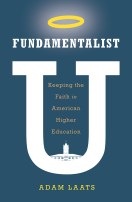
Good news. Oxford has donated ten copies of Fundamentalist U to Goodreads for a giveaway. If you’d like to save your ten bucks, you can put your name in the hat for a free copy.
 Good luck!
Posted by Adam Laats on March 8, 2018
https://iloveyoubutyouregoingtohell.org/2018/03/08/attention-cheapskates/
Well, friends, March 1st is just around the corner. And that means the official release of my new book, Fundamentalist U: Keeping the Faith in American Higher Education. 
I’ve heard from none of you that you plan to “Harry-Potter” this release. That is, that you plan to camp out all night at the bookstore on Wednesday, February 28th, dressed as your favorite personage from Fundamentalist U. For those of you who will be doing so, I’ll share here a few images of the people you might choose to dress up as.
I’m not sure how many of them were in Hufflepuff…


All of these people play important roles in the history of conservative evangelical higher education. For bonus points, can you match the pix to the names? Or the names to the relevant institutions?
Here they are, in no particular order:
Have fun, and see you at the bookstore!
Posted by Adam Laats on February 27, 2018
https://iloveyoubutyouregoingtohell.org/2018/02/27/dress-for-success/
In a sense, it’s as old as Galileo. In another, though, our question today shows the uniquely modern state of our current culture-war climate. Can someone stand up for science by opposing heresy? If we really want to understand culture-war thinking, we need to make sense of the ways they can, even if we don’t agree with them.
MUST science denial be heresy?
A conservative lament about gender-bending school policy brings this question to our attention. Ideas about gender fluidity, Margot Cleveland argues, turn otherwise intelligent people into thugs and morons. In her view, insisting that young people can and should be able to identify their own genders is both “science denial and heresy.”
I don’t agree, but that’s not the main point here. More important, I want to know how any idea can do those do things at once. How can an idea—any idea—claim to be both religiously and scientifically orthodox?
For secular people like me, it seems like a contradiction, a paradox. Yet for conservative religious intellectuals, this notion has long been both obvious and vitally true.
After all, in the street-level, Bill-Nye sense of the word, “Science” can’t really care about heresy or orthodoxy. As Neil deGrasse Tyson defines it, “Science” means the opposite of such things. In his words,
Science discovers objective truths. These are not established by any seated authority, nor by any single research paper. . . . Meanwhile, personal truths are what you may hold dear, but have no real way of convincing others who disagree, except by heated argument, coercion or by force. . . . in science, conformity is anathema to success.
Before we talk about Cleveland’s claims about heresy and science, let’s acknowledge a few things to start.
Those things make sense to me, but they don’t get to the heart of our dilemma. The interesting question, the difficult question is whether or not heresy and science denial can really go together as a general rule.
When it comes to the questions of evolution, climate change, sexuality, and now gender identity, conservative religious thinkers have long argued that they can. Indeed, that they must. To my mind, it is this point that is most important. If secular people like me want to really understand conservative religious thinking, we need to try harder to understand this logic. To me, it seems obviously false. To many people, though, it is compelling.
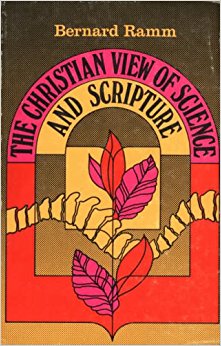
It is not only fundamentalist young-earthers who have made this case. Consider the most famous creationist dissenter from young-earth thinking, Bernard Ramm. In the 1950s, Ramm shattered the complacency of fundamentalist science with his blockbuster book, The Christian View of Science and Scripture.
In some ways, Ramm’s anti-young-earth work can be said to have sparked the modern young-earth renaissance. After all, it was in furious response to Ramm that John Whitcomb Jr. penned the young-earth counter-blockbuster The Genesis Flood in 1961.
Ramm denounced young-earth fundamentalist thinking in no uncertain terms. Young-earthers, whom Ramm called the “hyperorthodox,” missed the point of both science and scripture. Ramm explained,
If the theologian teaches that the earth is the center of the solar system, or that man first appeared on the earth at 4004 BC, or that all the world was submerged under water at 4004 BC and had been for unknown millennia, he is misinterpreting Scripture and bringing Scripture into needless conflict with science.
Instead, Ramm argued religious thinkers needed to reclaim their roles as scientific leaders. Real science, decent science, productive science, Ramm insisted, needed to be guided by the “light of revelation.” Without it, science could only be either “cheap or ironical.”
What does any of this have to do with gender-identity curriculum in California or Indiana? The way I see it, we have two ways to interpret arguments like the one made by Margot Cleveland. Either she is saying that religious truth and scientific inquiry happen to agree about gender identity, or she is making the much stronger case that religious truth and scientific truth must always agree about everything.
For those of us outside the world of conservative religious thinking, this second argument is very difficult to comprehend or even to recognize. Many of us default to Neil deGrasse Tyson’s heresy-promoting vision of true science. If we want to understand our religious friends and neighbors, though, we need to understand a world in which heresy is the very heart of science denialism.
Posted by Adam Laats on February 22, 2018
https://iloveyoubutyouregoingtohell.org/2018/02/22/can-science-oppose-heresy/
I’ve said it before and now I’m saying it again: Trumpism speaks to long traditions among white evangelicals. And time and again, evangelical colleges have been the institutional homes of Trump-like yearnings to “make America great again.” As I argue this afternoon over at Religion Dispatches, however, evangelical colleges have also played another key role.
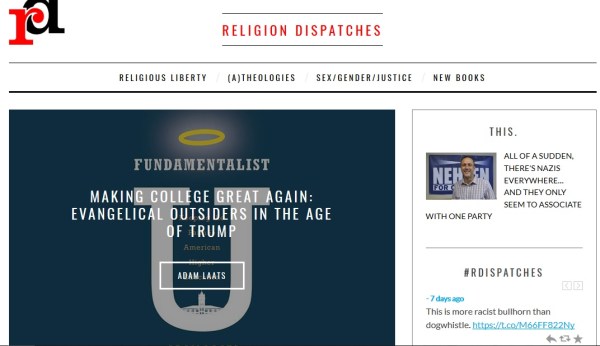
Are evangelical colleges bastions of Trumpism? Or are they the only places evangelicals can turn to find out what’s wrong with loving The Donald?
I won’t give away the entire argument. SAGLRROILYBYGTH might be bored to tears with the topic and you can read the whole thing if you’re interested. But I will say that it’s no surprise that President Trump loves Liberty University. It’s also no surprise, however, that the Liberty community isn’t sure if they love him back.
Posted by Adam Laats on February 19, 2018
https://iloveyoubutyouregoingtohell.org/2018/02/19/trumpist-towers-or-critical-colleges/
[Editor’s Note: We are happy to include an interview with Robert Gross about his new book Public vs. Private. In his book, Dr. Gross explores questions near and dear to the hearts of SAGLRROILYBYGTH: Private schools, public schools, religion, government, and the politics of education. His new book examines the early history of these questions and we’re delighted Dr. Gross has agreed to share some of his thoughts with us.]
1.) In the introduction to Public vs Private, you write,
American conceptions of public and private . . . are impossible to fully understand without placing education at the center of the regulatory state.
Could you please expand on that idea a little? Why is it so important to understand educational history in this area if we want to understand American concepts of “public” and “private?”
There are three main reasons that I think education needs to be placed at the center of our understanding of the history of the regulatory state. The first is simply that, by the early twentieth century, there was perhaps no other sphere of American life that was more heavily regulated. When focusing exclusively on private schools you see the scope of American market regulation in a way that is more hidden in other areas. States regulated almost the entirety of the private school sector: what classes they could teach, what credentials their teachers needed, what language they could speak in the classroom, and so forth. Private schools had to open their doors to inspectors and turn over their attendance rosters. And of course the state reached into the homes of private school parents—paying visits to them if their child was truant or not assigned to a schools.
Get your copy today.
The second way that education matters to understanding American government power is that court cases about public regulation of private schools have served as major precedents to define the broader scope of market regulation over business. I discuss a range of major supreme court cases in the book—from Dartmouth College v. Woodward to Berea College v. Kentucky to Pierce v. Society of Sisters—that centered on state regulation of private schools, but that also had a tremendous impact on how state governments could regulate to private enterprise more generally. Private schools have thus frequently been the sites over our most important legal contestations over the role of state power.
Finally, I was struck when researching and writing the book how much state officials relied on private schools to accomplish a crucial public goal: of providing mass education at no cost to taxpayers. I don’t think we can understand American government without seeing how it often uses private corporations to achieve public ends—we see that in health care, of course, but it was very much there in the 19th century with schooling.
2.) In the era you focus on in Public vs. Private, religion and religious arguments played a huge role in debates about funding for schools. How were those earlier debates different from today’s fights about religion in public schools? How were they similar?
Religious arguments were indeed used to prevent the vast majority of (religious) private schools from receiving direct state funding. But we have to remember that Catholic school systems, in particular, benefited immensely from a range of financial subsidies, especially property tax exemptions. While this is not something I explicitly write about in the book, my sense is that religious arguments historically have been less successful in obtaining funds than broader, more secular claims from religious schools about the “quasi-public” nature of their work. For example, in the 19th century legislatures and courts allowed Catholic parochial schools to have property-tax exemptions not solely (or even chiefly) because they were religious institutions, but rather because they served an important “public” purpose of educating masses of children. You see a somewhat similar dynamic in the middle of the 20th century over whether private schools that engage in various forms of discrimination can maintain their tax-exempt status. Courts ruled that private schools excluding African Americans, for example, were violating an important area of public policy, and so had no constitutional protections, nor claims to a tax deduction, in doing so. In the Hobby Lobby era we may see a shift in this general trend, of course.
3.) At the heart of the story you tell is an idea that seems foreign to a lot of people today. Can you explain the ways some leading 19th-century school reformers considered all private education to be a threat? Why did they think private schools were dangerous to American liberty?
Horace Mann and other public school reformers wrote extensively in the middle of the nineteenth century about how public school systems not only would eliminate private schooling but should do so. Public schools, they argued, were created precisely to destroy the balkanized provision of education that had existed beforehand—where Americans attended schools on the basis of their religious denomination, their class, or their ethnic heritage. Private schools thus represented an inherent challenge to the public school’s ability to be the assimilationist institution their founders envisioned. And because the vast majority of private schools by the late nineteenth century were run by Catholic organizations and, often, immigrant Catholics, they became enmeshed in deeper American traditions of anti-Catholicism and nativism.
There were a variety of other arguments for why private schools were seen as threatening that I think are worth mentioning as well. Many state public school leaders used economic arguments to suggest that private schools were inefficient, that schooling itself was a “natural monopoly” best operated by the government, without private competition—similar to how the government was increasingly providing other public utilities like water, gas, rail transportation, and so forth.
4.) What do you wish Betsy Devos knew about the history of the line between public and private schools?
I cannot speak to what Secretary Devos knows or does not know, but there is an important lesson in this book that I would want any public official to understand. The first is that we spend too much time in our debates about educational policy over whether one “supports” charter schools, voucher programs, school choice, or doesn’t support these initiatives. I think we would be better off if we talked about school choice in less Manichean terms, and instead posed the question that the communities in Public vs. Private had to contend with: “If we have school choice, how do we want to regulate it?” To what standards should we hold schools that receive public subsidies but are privately governed? How should we hold them accountable? Public regulation, as I argue in the book, is what allowed us to have robust school choice in the first place a century ago, and yet too often we ignore it in our contemporary debates.
Author bio: Robert N. Gross is a history teacher and assistant academic dean at Sidwell Friends School. He holds a PhD from the University of Wisconsin-Madison and writes about the social and educational history of the United States.
Posted by Adam Laats on February 8, 2018
https://iloveyoubutyouregoingtohell.org/2018/02/08/required-reading-public-vs-private/
It exists! Thanks to the folks at Oxford, I have received the first copy of Fundamentalist U. Looks good!
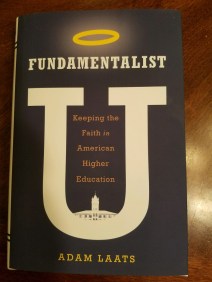
Hot off the presses…
Thanks to everyone who pre-ordered a copy. Those pre-orders will be shipping on Thursday. The kindle version will be available then, too. The hardcover release will be on March 1.
In the meantime, you can read some blurbs to see what leading nerds have had to say about it. You can also read a short Q&A at RACM, here and here.
Posted by Adam Laats on January 30, 2018
https://iloveyoubutyouregoingtohell.org/2018/01/30/confirmed-sighting/
[Editor’s note: To SAGLRROILYBYGTH, Dr. Don McLeroy needs no introduction. As the genial conservative former head of the Texas State Board of Education, Dr. McLeroy is well known especially for his firm creationist beliefs. As I finish up my new book about American creationism, I reached out to Dr. McLeroy to ask him about his ideas. He graciously responded with an explanation and some questions of his own. He asked me, for instance, why I had so much confidence in mainstream evolutionary science. For the past few months, Dr. McLeroy and I have been reading key works together. He has explained to me why he finds some of Kenneth Miller’s work problematic and finds some convincing. I suggested a few of my favorite books, such as Edward Larson’s Evolution and Kostas Kampourakis’s Understanding Evolution. Dr. McLeroy read both and offered his explanation of why he found Dr. Kampourakis’s book ultimately unconvincing. I thought Dr. McLeroy’s critique of Understanding Evolution would be interesting to others, so I asked Dr. McLeroy for permission to publish it here. It appears below, unedited and unmodified by me.]
A critique of Kostas Kampourakis’ Understanding Evolution, Cambridge University Press, 2014
By Don McLeroy, donmcleroy@gmail.com
Kostas Kampourakis believes if you truly understand evolution—the idea that all life is descended from a common ancestor as a result of unguided natural processes—you will accept it and to this end he wrote his book. He does offer a unique contribution to the literature; besides an original discussion of “the core concepts of evolutionary theory and the features of evolutionary explanations,” (p. xi) he specifically concentrates on explaining why he believes evolution is hard to understand and why it has not won widespread acceptance. He emphasizes the conceptual obstacles to understanding evolution, how it is counter-intuitive and why there is so much religious resistance.
As for explaining the core concepts of evolution, his book succeeds; I do have a better understanding of evolution. However, I do not find his discussion of the conceptual difficulties of understanding evolution very compelling. The main obstacle for the evolution skeptic is the evidence doesn’t support it. And, if evolution is false, rejection of evolution is not counter-intuitive. However, he may be right; conceptual obstacles could play a major role in the evolution controversies. Only I think he has it totally backwards and the conceptual difficulties lie with the evolutionist inability to reject evolution.
He devotes two chapters of his book to the core concepts of evolutionary theory: “Common ancestry” and “Evolutionary change.” They are unlike any other evolutionary explanations I have ever read. They are challenging, interesting and I enjoyed studying them. One reason is because Kampourakis has an excellent imagination and he uses it to create “imaginary” examples to help illustrate evolutionary ideas. He has imaginary beetles, imaginary families, an imaginary Gogonasus man, imaginary slides with rolling balls, imaginary “Jons and Nathans,” and an imaginary pizza shop evolving into an imaginary cookie shop. These examples do help in understanding evolutionary concepts, but I am left wondering, why not use actual examples to illustrate these ideas? Are simple real life examples unavailable to explain evolution?
Kampourakis’ book, like every other evolutionary apologetic book I have read, leaves me a stronger skeptic. The first thing I do when I read a new book on evolution is to look for any actual evidence cited that supports evolution. These books all claim they have lots of evidence, but when I read the books I do not find it. Kampourakis agrees the first requirement of a good scientific theory is the “empirical fit or support by data.” (p. 209) He claims “The fact that we do not know some details yet, as well as that we may never know all the details, does not undermine how strongly evolutionary theory is supported by empirical data.” (p. 209) Therefore, how many actual facts do we see included in this book? He presents some biology but not much evolutionary evidence. Interestingly, I find more imaginary examples than actual examples. His strongest example is Neil Shubin’s Tiktaalik.
The unique purpose of Kampourakis’ book is to focus “on conceptual difficulties and obstacles to understanding evolution.” (p. 62) I find it interesting his goal is not for everyone to “accept” evolution but simply to “understand” it. Again, he seems to believe if only we could understand it, then of course, we would accept it. I believe I do understand evolution. And, the more I understand it the more skeptical I have become. What amazes me is how many intelligent, educated people understand evolution and then accept it. Therefore, let’s examine the conceptual problem in reverse. The question would now be: What are the conceptual difficulties facing the evolutionist in ultimately rejecting evolution. I believe they are easily identifiable.
This brings us back to the key issue—the evidence. I believe the first and most significant conceptual obstacle in preventing the evolutionist from rejecting evolution is in not realizing how much evidence is needed to show evolution to be true. To illustrate, how much evidence has evolution presented to demonstrate how the myriads of biochemical pathways have supposedly developed naturally? Kampourakis’ book is completely silent on this issue. But, Kampourakis provides for more evidence for evolution by referencing a “Further reading” section at the end of his first chapter. Here he begins “There exist numerous books which present the evidence for evolution as well as the main processes. A nice book to start with is Jerry Coyne’s Why Evolution Is True, which provides an authoritative overview of evidence and processes. Another book with several examples and useful information is The Greatest Show on Earth: the Evidence for Evolution, by Richard Dawkins.” (p. 29) Therefore, based on Kampourakis suggestion, let us examine how well these two books explain the evolution of biochemical pathways.
In Dr. Coyne’s book, the only specific evidence he provides to demonstrate biochemical complexity is to hypothesize an imaginary common ancestor of sea cucumbers and vertebrates had a gene that was later co-opted in vertebrates as fibrinogen. (Coyne, ps. 131-3) Richard Dawkins presents even less evidence than Jerry Coyne. He describes the cell as “breathtakingly complicated;” stating “the key to understand how such complexity is put together is that it is all done locally, by small entities obeying local rules.” (Dawkins, p. 438) He also states some of the features of the cell descended from different bacteria, that built up their “chemical wizardries billions of years before.” (Dawkins, p. 377) These statements are not evidence. Click on the links associated with each picture to see what evolution must explain and decide for yourself how strong the evidence is for what Kampourakis’ experts present.


In conclusion, Kampourakis, Coyne and Dawkins do not seem to be concerned about the lack of evidence supporting the evolution of biochemical pathways. And, this is only one small area evolution encompasses that needs explaining.
The second conceptual block the evolutionist faces in rejecting evolution is they don’t seem to realize or be bothered by how much they depend upon just-so stories in their explanations for how evolution actually happened. Kampourakis, to his credit, doesn’t spin too many just-so stories; he simply presents them as facts. Examine this table Kampourakis includes in his book (p. 172). These transitions are presented as facts, as the truth. Here, the conceptual block the evolutionist faces is the failure to ask the key question “HOW did this happen?” For example, can evolution answer these questions for the first four transitions?
 Not knowing the definition of science
Finally, the most foundational conceptual obstacle preventing the evolutionist from rejecting evolution is they have defined themselves into a box. Kampourakis, after a lengthy and excellent discussion of religion and how it relates to science concludes “Science is a practice of methodological naturalism: Whether a realm of the supernatural exists or not, it cannot be studied by the rational tools of science. Science does not deny the supernatural, but accepts that it has nothing to say about it. Science is a method of studying nature, hence methodological naturalism.” (p. 59) But, what if God really did create life? This would mean Kampourakis’ science would not be able to discover it. I find this an untenable situation for science.
The solution, as I see it, is to reject “methodological naturalism” and endorse “The National Academy of Sciences” definition of science. In its book Science, Evolution, and Creationism, 2008, the National Academy defines science as: “The use of evidence to construct testable explanations and predictions of natural phenomena, as well as the knowledge generated through this process.” (p. 10) This wording is excellent: it supports both a naturalist and a supernaturalist view of science. With it, science must only limit itself to “testable explanations” not methodological naturalism’s “natural explanations.” Now, the supernaturalist will be as free as the naturalist to make testable explanations of natural phenomena. Let the view with the best empirical evidence prevail. Unfortunately, with Kampourakis’ purely naturalistic view, he and his fellow evolutionists are trapped in a box with only naturalistic explanations; they then must accept naturalistic evolution. As a Christian, I am free to accept or reject evolution. Kampourakis even documents leading Christian scientists who accept evolution by quoting Francisco Ayala and Kenneth Miller. (p. 46)
Kostas Kampourakis’ Understanding Evolution argues if you truly understand evolution you would come to accept it. For this to happen, he believes you just need to overcome conceptual obstacles standing in your way. I argue just the opposite; I believe if you truly understand evolution you will come to reject it. We agree though, for this to happen, you just need to overcome conceptual obstacles standing in your way.
Posted by Adam Laats on January 24, 2018
https://iloveyoubutyouregoingtohell.org/2018/01/24/creationists-understanding-evolution/
[Editor’s Note: I’m happy to be able to share my review of Charles Eagles’s recent book, Civil Rights: Culture Wars. It will appear in the March, 2018 edition of the Journal of American History. The editors gave us permission to reprint it here verbatim.]
What history should schools teach? Who should decide? And how? These questions have always been central to the United States’ tumultuous culture wars. With Civil Rights, Culture Wars: The Fight over a Mississippi Textbook, Charles W. Eagles offers a valuable new exploration of one twentieth-century battle over these questions.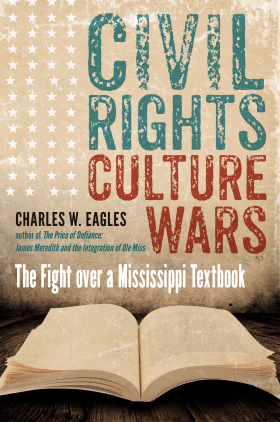
Eagles’ book examines the career of a controversial new state-history textbook in 1970s Mississippi. Sociologist James Loewen and historian Charles Sallis hoped their book, Mississippi: Conflict and Change, would introduce Mississippi’s ninth-graders to the kinds of history that had been widely accepted by academic historians. Instead of preaching a bland, saccharine history of slavery, the Civil War, Reconstruction, and the Civil-Rights Movement, Loewen and Sallis hoped to tell the full story of Mississippi’s conflicted history.
Perhaps not surprisingly, Mississippi’s educational establishment balked. The new textbook was rejected by the state textbook commission as “‘unsuitable’ for classroom use” (156). Critics worried that Loewen’s and Sallis’ text harped on racial animosity. Images of a lynching, especially, caused consternation among commission members. Even one African American member of the commission believed the new textbook would remind African American students of a violent history “they want to forget” (183).
In the end, the authors had to force a federal lawsuit to have their book adopted for state use. Even with their victory in court, they found to their disappointment that not many school districts selected their book.
Eagles tells the story of the origins of the new textbook and its long struggle for adoption in admirable detail. He includes a fascinating examination of earlier history textbooks in Mississippi. By and large, those books told the story of heroic white Mississippians working tirelessly for freedom, assisted by loyal slaves and plagued by corrupt carpetbaggers.
One widely used textbook from 1930, for example, informed Mississippi schoolchildren that “the life of a slave [was] pleasant” (46) and that Reconstruction-era terrorism by the Ku Klux Klan was “a grim necessity” (47).
Eagles’ book also offers a valuable insight into the banality of culture-war bureaucracy. He details the process by which textbooks were adopted in Mississippi. More often than not, texts were not chosen for their intellectual rigor or methodological innovation, but rather for their low cost and ease of use. Members of the textbook committee recoiled at any whiff of controversy, preferring instead to select textbooks that celebrated Mississippi’s history, even the ugliest parts.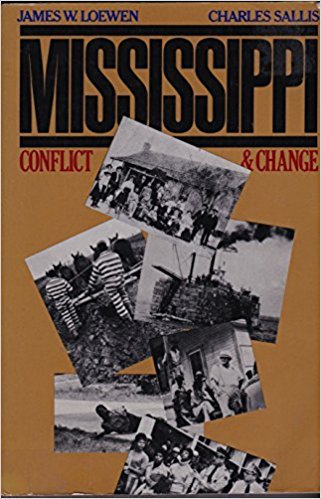
At times, Eagles’ perspective seems too close to that of Loewen and Sallis. For example, Eagles praises the authors’ surprising ignorance about the field of secondary history education. As Eagles argued, that ignorance “actually benefitted the MHP [Mississippi History Project] by fueling their effort with an independent, even innocent, evangelical air” (99). It’s hard to believe that ignorance of the field would ever be an asset and Eagles is too willing to explain away Loewen’s and Sallis’ faults.
Despite this minor flaw, Civil Rights, Culture Wars offers a thorough, valuable description of the ways the convoluted politics of history and memory played out in 1970s Mississippi.
Posted by Adam Laats on December 2, 2017
https://iloveyoubutyouregoingtohell.org/2017/12/02/required-reading-textbook-culture-wars/


Available now from Harvard University Press.

Available now from University of Chicago Press!
 I Love You but You're Going to Hell